Blockchain Identity: Verifiable Credentials on Ethereum
Didit verifies the person and screens the wallet; your issuer service signs the W3C credential and your Ethereum contract stores its hash and revocation state. ID check $0.33, wallet screening $0.15.
 Alberto RosasCo-founder and CEO
Contents
In this guide
Jump to the part you need.
Blockchain identity binds a verified person to an Ethereum address without writing personal data on chain. This guide is for developers and compliance teams building that link: Didit runs the identity check at $0.33 per completed check and the address screening at $0.15 per screening, from one open API. The caveat comes first: your own issuer service signs the verifiable credential, and your own contract stores its hash. Didit supplies the verification and risk evidence behind it.
Last updated: November 26, 2026. Prices checked against the live Didit price feed on November 26, 2026.
| Layer | Who runs it | What it proves | Price |
|---|---|---|---|
| Identity evidence | Didit | The document is genuine, a live person is present, the face matches | $0.33 per completed Full ID check |
| Wallet control | Didit wallet ownership widget | The person can sign a challenge from that address | The supplied pricing materials do not list a separate wallet ownership widget price |
| Address risk | Didit | Sanctions exposure, funds flow and a risk score for the address | $0.15 per screening |
| Credential signing | Your issuer service | The claim set, signed with your issuer key | Your own cost |
| On chain attestation | Your contract | The credential hash, the issuer, the revocation flag | Gas, your own cost |
Start free in the sandbox at business.didit.me, no sales call. Developers who want to drive these calls from an AI assistant can connect Didit through the MCP server. Every list price is on the pricing page.
The outcome: one address, one proof, one contract check
At the end of this guide you have five working pieces. A person passed a Didit verification session. You proved they control a specific Ethereum address. You screened that address for financial risk. Your issuer service signed a verifiable credential describing the verified attributes. Your contract holds the credential hash and a revocation flag, and answers one question for any caller: is this address bound to a live credential from my trusted issuer.
Nothing personal goes on chain. The contract stores a hash, an issuer address, a timestamp and a status. The credential itself stays with the holder or in your own store, and the verifier fetches it off chain.
Didit states that more than 4,000 companies use its products. Follow the documented endpoint and authentication requirements for each integration. The split matters here because a credential is only as good as the check behind it and the checks that keep it current.
What Didit runs and what stays with you
- Didit runs the identity session (document, passive liveness, face match, device and IP analysis), the wallet ownership proof, the address screening, the ongoing AML monitoring and the transaction monitoring rules.
- You run the issuer signing key, the claim set, storage of the credential for the holder, the status list and trust list you publish, and the Solidity contract with its deployment.
A Didit session result is evidence. It is not a credential. This guide uses your own issuer service to sign and store the credential, and the cited Didit documentation covers the verification, ownership-proof and screening inputs.

Issuer, holder, verifier: the three roles
A verifiable credential is a signed set of claims. The issuer signs it, in this design your own service backed by a Didit verification. The holder keeps it in a wallet and decides when to present it. The verifier checks three things before it trusts anything: the signature, the issuer on its trust list, and the credential status.
Those last two are operating duties, not paperwork. The issuer publishes a trust list naming its signing keys, and a status list holding one bit per credential. The verifier reads both. Concrete example: a credential issued in January points at index 1,204 in your status list. In June an AML re-screen returns a hit and your issuer sets that bit. The next presentation reads the list, sees the bit set and is refused, with no call from the issuer and no transaction on chain. Two failures follow from that. A verifier that hard-codes its own copy of the list keeps accepting revoked credentials, and an issuer that forgets to publish the list leaves its verifiers blind. Neither is a cryptography problem, so assign both to a named owner.
Selective disclosure is the reason to bother. A gaming platform can ask for one claim, over 18, and the holder presents a credential that answers only that. Didit Age Estimation costs $0.10 per check and lets you issue that claim without ever putting a birthdate in the credential. The same shape works for an accredited investor claim, a residency claim or a verified company officer claim.
One boundary to state in the design document. In this design a credential proves only what your issuer signed in its claims, and when, so the guarantee holds only while the verifier also reads the issuer's trust list and status list. It does not by itself establish that a regulator accepts it. Acceptance depends on your licence, your supervisor and your own policies, and a claim signed by a private issuer is not a qualified electronic attestation of attributes under a public scheme such as eIDAS unless you meet that scheme's requirements. Treat the credential as one piece of evidence in your process, not as a permission.
Prerequisites
- A Didit account. The sandbox is free and unlimited, and you get the API key from the Business Console.
- A workflow published in your application with ID verification, passive liveness and face match. The Full ID check bundles all three plus device and IP analysis at $0.33 per completed check.
- An issuer signing key that you control, plus a resolver or trust list that verifiers can read.
- An Ethereum development environment and a funded testnet account for the contract side of this guide.
- For address screening: a screening provider configured under Transactions, Settings, Provider Preferences in the Business Console, either Didit's managed screening or bring your own screening provider and run it inside Didit.
- For ownership proofs: Travel Rule settings if you want Didit to mint wallet ownership sessions for you.
Step-by-step: from a passport to a gated contract
- Create the application and copy the API key. Keep the key on your backend and never in a browser bundle. Sandbox calls are free, and sandbox testing is free and unlimited on every plan.
- Run the identity check and store the session result. Create a session with your workflow and send the person to the verification URL. When the session completes, persist the session id, the status, the extracted document fields, the passive liveness outcome and the face match result. That row is the evidence your issuer service signs over. As an alternative for supported countries, a digital ID wallet sign-in returns attributes signed by the identity provider, the assurance tier the docs call cryptographic. Published prices include MitID at $0.25, Smart-ID at $0.21 and Google Wallet ID at $0.10 per completed verification. Read the digital ID wallet docs before you promise a country.
- Prove the person controls the Ethereum address. Use the wallet ownership widget. The message signing method has the person sign a Didit-issued challenge with their wallet, and Didit verifies the signature against the address. Wallets installed in the browser are discovered automatically, and EVM smart contract accounts are handled: Didit asks the account's own contract whether the signature is valid under ERC-1271, and for an account that is not deployed yet it checks the ERC-6492 signature, without deploying it or sending a transaction. A verified proof marks the matching wallet address book entry as
is_ownership_verified: true. - Screen the address before you bind it. This is the runnable example in the next section. Run it when a customer adds a withdrawal address, or before your contract grants a gated role to an address.
- Issue the credential. Your issuer service builds the claim set from the session result and the screening result: document verified, liveness passed, face match score, age over threshold, address screened on a date with a risk band. Sign it with your issuer key, point it at a status list entry for revocation, and hand it to the holder. Decide now what you will never put in it, and a birthdate is a good place to start. This service is yours to run and to store.
- Register the hash in your contract. The contract keeps a map from address to a small record: the credential hash, the issuer address, the issue date and a revoked flag. Write it once at issuance, and flip the flag on revocation. Keep the record free of personal data, so the chain holds a commitment and not an identity. This contract shape is a suggestion you own end to end: the Solidity, the key management, the upgrade path and the gas bill are yours, not a Didit product or a reference deployment.
- Verify at the gate and keep it current. A verifier reads the record for the address, refuses revoked entries, fetches the credential off chain, checks the issuer signature against your trust list, reads the status list and compares the credential hash to the on-chain value. Then run ongoing checks: AML re-screening at $0.07 per person per year, and transaction monitoring inside Didit for the transfers that touch the gated contract.
Runnable example: screen the address before you bind it
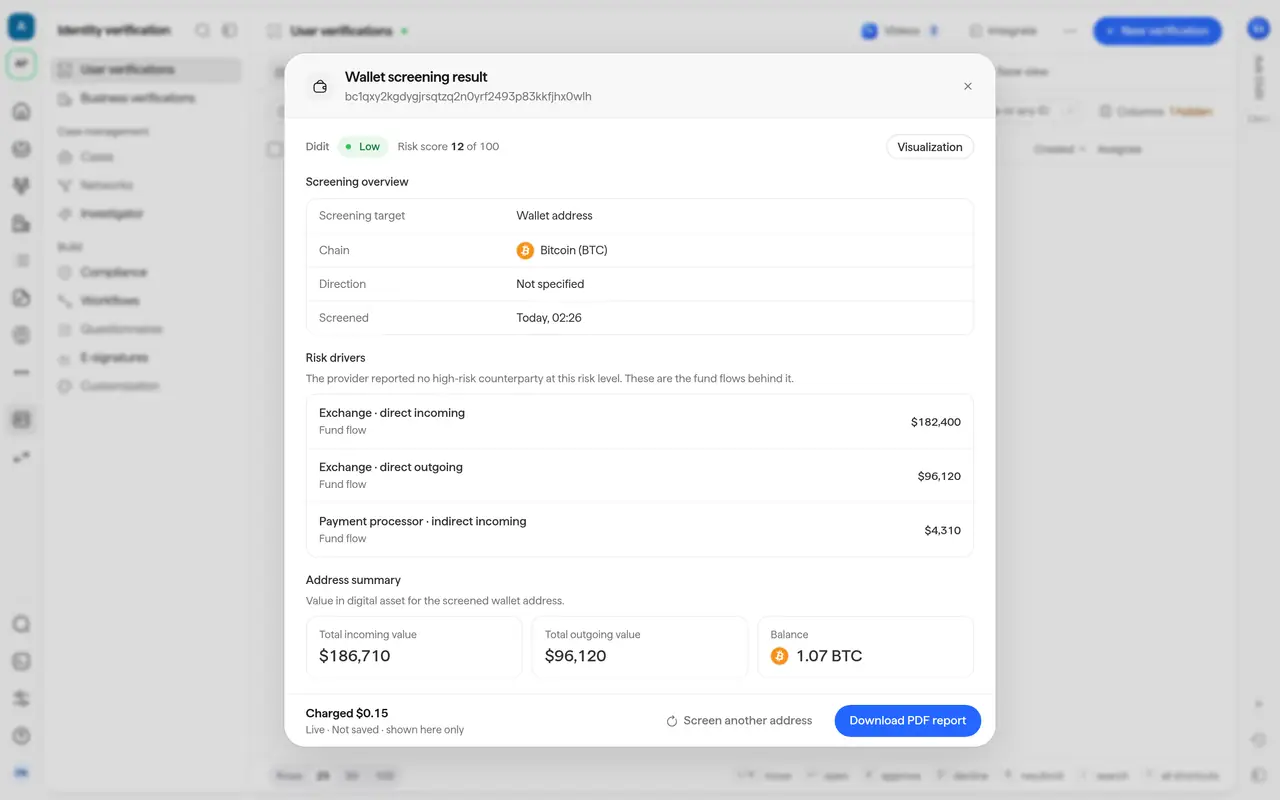
The on-demand wallet screening endpoint screens one address and returns the full risk result without creating a transaction. It writes nothing to the transactions table, so it is the right call before a transfer exists, which is exactly the moment you bind a credential to an address. Transaction monitoring has to be configured for the application first.
curl -X POST https://verification.didit.me/v3/wallet-screening/ \
  -H "x-api-key: YOUR_API_KEY" \
  -H "Content-Type: application/json" \
  -d '{
    "wallet_address": "0x94f1b9b64e2932f6a2db338f616844400cd58e8a",
    "blockchain": "ETH"
  }'
Expected output
A 200 response with the standardised screening result, the same shape you get from transaction screening. Read these fields:
screening_typeis alwaysWALLET_SCREENING, which confirms the endpoint you hit.providernames the screening source that answered, so a stored result stays auditable.risk_scoreis an integer, and the result also carries the severity and the funds-flow breakdowns. Treat it as a risk input to your policy, not a pass or fail switch.fallback_from_providerandfallback_reasonarenullon a normal screening. They are set when the provider you connected in the Marketplace rejected or failed the call and Didit's managed screening ran instead, because the connection's Fall back to Didit setting is on.
Record the screening date and the risk band in the credential, and keep the raw result in your own store. Product detail is on the wallet screening page and in the wallet screening docs.
Failure cases and recovery
| What you see | Why | Recovery |
|---|---|---|
422 with candidate_chains | A 0x address is valid on every EVM network, so the call will not guess | Resend with blockchain set to the wallet's real chain. Nothing was screened or billed. |
409 Conflict | No screening provider is configured for the application | Configure one under Transactions, Settings, Provider Preferences, then retry. |
400 | The address format is not recognised | Check the string. Bitcoin, Tron and Solana addresses are inferred from the format, and any other shape has to be named with blockchain. |
| A good score on one chain, a bad one on another | The same address has different activity and risk on each EVM network | Never submit ETH for a wallet that lives on another chain. Send the network identifier the wallet actually uses. |
400 with SIGNATURE_INVALID on an ownership proof | Another account signed, or the message changed | Ask the person to sign again. The proof stays open, and the widget prompts them to switch accounts. |
400 with SIGNATURE_UNSUPPORTED_SCHEME | The wallet signed in a format Didit does not verify, such as a Bitcoin multisig or a BIP-322 full signature | Offer a supported wallet or chain family, or fall back to another proof method. |
| A screenshot proof that never completes | The screenshot method never auto-verifies | Your compliance team approves or rejects it from the screenshot review queue, or confirms the transfer in the console. |
Inputs and outputs
| Field | Direction | Required | What it does |
|---|---|---|---|
wallet_address | request | Yes | The address to screen. Alias: address. It has to match the chosen network. |
blockchain | request | Required for 0x | The network identifier. Accepted values include ETH, BTC, TRX, SOL, MATIC, BNB, BASE, OP, ARB, AVAX, ADA and more in the docs. Common names such as POLYGON also work. |
direction | request | No | inbound, outbound, deposit or withdrawal. Context for the provider; it does not change the risk score. |
screening_type | response | Always | WALLET_SCREENING. |
provider | response | Always | Which screening source answered the call. |
risk_score | response | Always | Integer score, with severity and funds-flow breakdowns alongside it. |
fallback_from_provider, fallback_reason | response | Optional | Set when your connected provider failed and managed screening answered instead. |
Paid steps and review boundaries
- The identity check is billed per completed check at $0.33 and includes the ID document, passive liveness, face match and device and IP analysis.
- A digital ID wallet sign-in has its own published rate per completed verification, from $0.10 for Google Wallet ID to $0.95 for iDIN full identification.
- Each address screening costs $0.15. A
422ambiguity response screens nothing and is not billed. - Ongoing AML monitoring costs $0.07 per person per year, which is how you keep an old credential honest.
- Transaction monitoring costs $0.001 per transaction beyond your plan allowance, which is 1,000 on Free, 10,000 on Growth and 100,000 on Scale each month.
- A check that needs a human decision goes to manual review like any other verification and is billed at that verification's price; the public price book also carries its own review lines, listed on the pricing page.
The review boundary matters for a credential. A screenshot ownership proof never auto-verifies: it waits for your compliance team, who approve or reject it from the screenshot review queue or confirm the transfer in the console. Everything after that is yours. Your team decides whether to issue, what claims to include, when to revoke, and whether a screened address may touch your contract. Didit publishes no credential issuance product, so the signing key, the status list and the trust list stay under your control.

Worked cost example
Take 1,000 new users in one month, each binding one Ethereum address, on top of a Growth plan with its 10,000 monitored transactions included.
- Identity checks at the Growth rate of $0.3168: 1,000 x $0.3168 = $316.80
- Address screenings at the Growth rate of $0.144: 1,000 x $0.144 = $144.00
- Subtotal: $316.80 + $144.00 = $460.80, which is $0.4608 per onboarded address
- Ongoing AML monitoring for a year at the Growth rate of $0.0672: 1,000 x $0.0672 = $67.20
- Transaction monitoring stays at $0.001 per transaction beyond the allowance on every plan: 50,000 transactions, of which 10,000 are included, so 40,000 x $0.001 = $40.00
- Usage total for the month plus one year of monitoring: $316.80 + $144.00 + $67.20 + $40.00 = $568.00
That $568.00 excludes the $99.00 monthly Growth subscription fee. Add one month of Growth and apply its $115.00 of monthly credit: $99.00 + ($568.00 - $115.00) = $552.00 in net cash for the month plus the year of monitoring.
The Growth plan takes 4% off the Didit list rates used above: identity at $0.3168 instead of $0.33, wallet screening at $0.144 instead of $0.15, and ongoing AML monitoring at $0.0672 instead of $0.07. Transaction monitoring is the exception. It is listed at $0.001 per transaction beyond the monthly allowance on every plan, Growth included, so that line does not change. The discounted pair comes to $0.3168 + $0.144 = $0.4608 per onboarded address before the subscription fee, which itself comes back as credit. On Scale the discount is 10%: $0.297 + $0.135 = $0.4320 per onboarded address. If you bring your own screening provider and run it inside Didit, that provider bills you under your own agreement, so drop the screening line and re-add what you pay them.
Sources
- Didit pricing page and the live price feed, read November 26, 2026
- Didit docs: pricing and billing rules
- Didit docs: on-demand wallet screening API
- Didit docs: wallet ownership widget
- Didit docs: digital ID wallet verification
- Didit docs: reusable KYC
- Didit wallet screening product page
- Didit MCP server
- W3C Verifiable Credentials Data Model 2.0
- Regulation (EU) No 910/2014 on electronic identification (eIDAS)
- FATF, for the international standards on virtual assets
Next step: open the sandbox at business.didit.me, create an application, and run your first verification and address screening today. No sales call, and the sandbox is free.
Try it
Try this in the sandbox
Run the check this guide describes, free.
The product this post is about, taken from its topic. Run it free in the sandbox.
Author
Alberto Rosas
Co-founder and CEO

Keep reading
Other guides in the same topic.
 What Is the Purpose of FICA in South Africa? 2026 Guide
FICA is South Africa's anti-money laundering law. It creates the Financial Intelligence Centre and requires accountable institutions to identify and verify clients, screen for PEP and sanctions risk and report suspicious.
Alberto RosasNov 26, 2026 Sixth Money Laundering Directive (6AMLD): What Changed and Which Rules Apply
6AMLD is Directive (EU) 2018/1673: Member States must criminalise laundering, widen predicate offences and set a four-year penalty floor. It adds no new due diligence duties for firms.
Alberto RosasNov 26, 2026 Automated Sanctions Screening: Canada, the Entity List and Embargoes
Automated sanctions screening matches people and companies against lists such as Canada's autonomous sanctions made under SEMA and JVCFOA and the OFAC SDN List, and returns candidate hits scored for identity confidence and.
Alberto RosasNov 26, 2026Questions
Frequently asked questions
What is blockchain identity and how do verifiable credentials fit in?
Blockchain identity means proving a claim about a person or business to a blockchain application without publishing their personal data. A verifiable credential carries the claim, signed by an issuer, and the chain holds only a hash and a status. The person keeps the credential and presents only the claims a verifier needs.
Can I store a Didit verification result on Ethereum?
Not the result itself. A verification session contains personal data, and putting it on chain would publish it permanently. Store the hash of the credential you build from that result, together with the issuer address and a revocation flag, and keep the result in your own off-chain store.
Does Didit issue verifiable credentials?
Didit's documentation covers identity verification, address screening, monitoring and authentication, not credential issuance. Your issuer service signs the credential. Didit supplies the verified attributes, the proof that the person controls the address, and the risk result for that address.
How do I prove someone owns an Ethereum address?
Use the Didit wallet ownership widget with message signing. The person signs a Didit-issued challenge with their wallet, and Didit verifies the signature against the address, including smart contract accounts through ERC-1271 and ERC-6492. Signing from a different account than the one being verified is rejected with a switch-accounts prompt.
How much does it cost to verify an identity and screen a wallet?
A Full ID check is $0.33 per completed check and a wallet screening is $0.15 per screening, so one verified person bound to one screened address costs $0.48 at list price. Ongoing AML monitoring adds $0.07 per person per year. Growth takes 4% off Didit prices and Scale takes 10%.
What happens if I send a 0x address without a blockchain field?
The call answers 422 with candidate_chains, because a 0x address is valid on every EVM network and the endpoint will not guess. Nothing is screened and nothing is billed. Resend the same request with blockchain set to the wallet's real network, such as ETH, BASE, OP or ARB.
Can a smart contract read a Didit verification directly?
No. The contract reads its own registry entry: the credential hash, the issuer and the revoked flag. The verifier then fetches the credential off chain, checks the issuer signature against your trust list, reads the status list and compares the hash. That split keeps personal data off the chain and keeps the contract cheap to call.
Why use selective disclosure for age checks?
An age gate needs one bit, not a date of birth. Didit Age Estimation costs $0.10 per check and supports an over-18 claim, so the credential can answer the gate without carrying a birthdate. The holder then presents the same claim to any verifier that trusts your issuer.
What stops an old credential from staying valid forever?
Two things working together: a status list entry that your issuer flips on revocation and your contract's revoked flag, plus re-screening on a schedule. Ongoing AML monitoring at $0.07 per person per year re-checks the person, and the verifier refuses any presentation whose status bit is set. Write the revocation rule before you issue the first credential.
Does a blockchain credential satisfy a regulator on its own?
No. In this design a credential proves only what your issuer signed in its claims, and when, and only while the verifier reads the issuer's trust list and status list. Regulatory acceptance depends on your licence, your supervisor and your own policies, and a private issuer's claim is not a qualified electronic attestation unless you meet that scheme's requirements. Treat it as evidence inside your compliance process, not as a permission to skip controls.
Do I need a Didit workflow to run these steps?
The identity check runs through a workflow in your application, and the sandbox is free so you can build it without a sales call. The address screening call needs no workflow, only a configured screening provider. The wallet ownership widget can auto-mint its sessions from your Travel Rule settings, or you can mint one yourself.
Compliance built in
Audited, certified and attested.
We hold the certifications and build each country's rules into your flows, so you can launch anywhere without worrying. Security and Compliance center
- Regulation encoded into your flows
Tell us what you do and where. Didit lists the rules that apply to you, with sources, and builds the checks each country needs into one workflow.
- Ready for AMLR
Every requirement of the new EU anti-money laundering rules, from checking customers to human review, is already covered by a Didit check.
- Tested in Spain's Treasury sandbox
Spain's Treasury published its supervised sandbox report on Didit's NFC plus active liveness onboarding; SEPBLAC took part and valued the added measures positively.
- Audited, not self-declared
iBeta Level 1 and Level 2. Liveness tested under ISO/IEC 30107-3.
Your obligations · 3 regions
 SOC 2 Type 2
 ISO 27001
 iBeta Level 1 and Level 2
 EU regulator attestation
 FSM youth protection
 GDPR
 EBA remote onboarding
 MiCA compatible
 FIDO Alliance member
- AMLREU AML Regulation ready
Integration · Didit MCP
Run Didit from your own AI agent
Connect Didit to Claude, Cursor, VS Code or ChatGPT and just ask in plain words. Your agent can do anything you can do in the console, with the same permissions you have.
 Add to Claude
 ChatGPT
 Cursor
- Build workflowsDescribe the checks you need. The agent creates and publishes the flow.
- Run investigationsAsk why a session was declined, review cases, search people and companies.
- Change rulesCreate payment rules, test them on past data and switch them on.
- Pull reportsAsk for numbers, exports or the audit log.
Didit Academy


