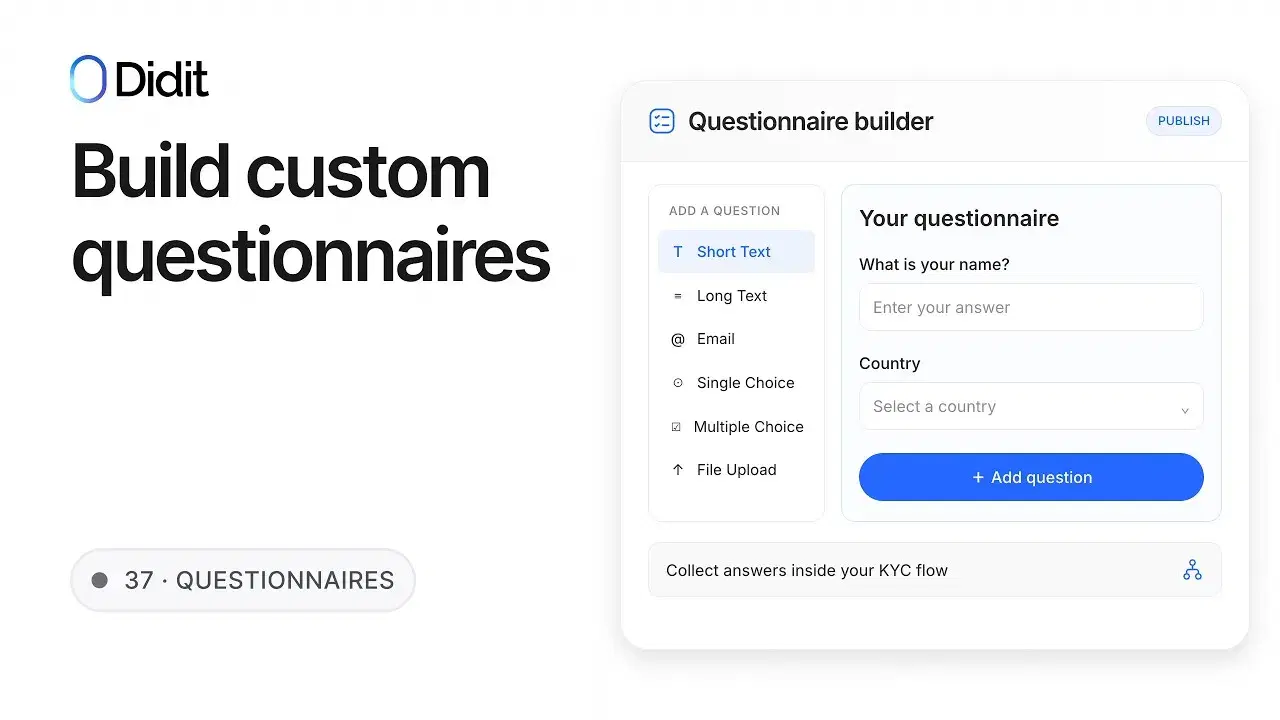
Building Custom Identity Checks with an Extensible Plugin Architecture
Discover how an extensible plugin architecture is crucial for modern identity verification, allowing businesses to adapt to evolving compliance needs and fraud threats.
 Alejandro RosasCo-founder and CTO
Contents
In this guide
Jump to the part you need.
Adaptability is KeyModern identity verification demands systems that can easily integrate new checks and adapt to changing regulations without a full re-architecture.
Modularity for ScalabilityA well-designed plugin architecture ensures that identity verification systems can scale efficiently, adding specialized checks as needed without disrupting core functionalities.
Enhanced Fraud PreventionCustom identity checks, enabled by an extensible framework, allow businesses to deploy targeted defenses against emerging fraud vectors and unique business risks.
Didit's AI-Native ApproachDidit provides an open, modular identity platform with a no-code workflow builder, making it simple to implement and orchestrate custom, AI-native identity checks for any use case.
The Need for Extensible Identity Verification
In today's dynamic digital landscape, identity verification is no longer a one-size-fits-all solution. Businesses face an ever-evolving array of compliance requirements, fraud tactics, and user experience expectations. A rigid, monolithic identity system quickly becomes a bottleneck, unable to adapt to new challenges or integrate specialized checks. This is where an extensible plugin architecture becomes indispensable. It allows organizations to build a core identity verification framework that can be easily enhanced, customized, and scaled through modular components or 'plugins'.
Think of it like a smartphone operating system. The core OS provides fundamental functionalities, but its true power comes from the ability to install apps (plugins) that add specific features. Similarly, an extensible identity platform enables businesses to add custom checks like specific database lookups, enhanced fraud scores, or unique biometric modalities without rewriting the entire system. This flexibility is crucial for maintaining a competitive edge and ensuring robust security and compliance.
Designing a Modular Identity Verification Framework
Building an effective plugin architecture for identity verification requires careful planning. The core system should define clear interfaces and APIs that plugins can adhere to, ensuring seamless integration. Key considerations include:
- Standardized Interfaces: Define common data structures and communication protocols for all plugins. This allows different verification checks (e.g., ID Verification, Liveness, AML Screening) to operate independently but report results consistently.
- Isolated Execution Environments: Each plugin should ideally run in its own sandbox to prevent failures in one plugin from affecting the entire system. This also enhances security.
- Configuration and Orchestration: A central mechanism is needed to configure which plugins are active, in what order they run, and how their results are combined. This is where a no-code workflow builder, like Didit's Orchestrated Workflows, proves invaluable. It allows business users to design complex verification flows without developer intervention.
- Data Management: A secure and standardized way to store and retrieve data generated by plugins is essential for audit trails and future analysis.
- Error Handling and Fallbacks: The architecture must gracefully handle scenarios where a plugin fails or is unavailable, potentially routing to alternative checks or manual review processes.
For example, a business might require a standard ID Verification check, followed by Passive & Active Liveness detection. If the user is under a certain age, an additional Age Estimation check might be triggered. For high-value transactions, NFC Verification (ePassport/eID) could be a required step, leveraging the highest level of security available.
Implementing Custom Checks and Integrations
Once the architecture is in place, implementing custom checks becomes a process of developing new plugins. These plugins can extend the system's capabilities in numerous ways:
- Specialized Database Lookups: Integrate with niche regional databases or industry-specific watchlists beyond standard AML Screening.
- Enhanced Fraud Signals: Develop custom algorithms for detecting specific fraud patterns relevant to your business, incorporating data from IP analysis or device intelligence.
- Unique Biometric Modalities: While 1:1 Face Match and Face Search are standard, a plugin could integrate a finger vein scan or voice biometrics if required for a highly specific use case.
- Proprietary Risk Scoring: Combine inputs from various verification steps with internal data to generate a custom risk score that dictates further actions.
- Third-Party System Integration: Connect to legacy systems, custom CRMs, or other third-party services to enrich verification data or trigger downstream processes. Didit's modular architecture is designed for this kind of plug-and-play integration.
The beauty of this approach is that these custom checks can be developed and deployed independently, without impacting the core identity verification services. This accelerates innovation and reduces time-to-market for new compliance features or fraud defenses.
The Benefits of an Open, Modular Identity Layer
An open, modular identity layer offers significant advantages over traditional, closed systems. It fosters a vibrant ecosystem where businesses can pick and choose the best-of-breed solutions for each specific check. This approach leads to:
- Unparalleled Flexibility: Easily adapt to new regulations (e.g., eIDAS2, KYC updates) or market demands by swapping out or adding new verification components.
- Cost Efficiency: Avoid vendor lock-in and pay only for the services you need. Didit's Core KYC and pay-per-successful check model exemplify this benefit.
- Faster Innovation: Accelerate the deployment of new identity features and fraud countermeasures.
- Improved User Experience: Tailor verification flows to specific user segments or risk profiles, reducing friction for legitimate users while maintaining security. Consider how Reusable KYC can drastically improve user onboarding by allowing verification data to be shared securely across multiple applications.
- Enhanced Resilience: A distributed, modular system is inherently more resilient to outages or failures in individual components.
How Didit Helps
Didit is purpose-built as the AI-native, developer-first identity platform, designed with an open, modular architecture that perfectly supports an extensible plugin strategy. Our platform provides the core building blocks and the orchestration layer necessary to implement custom identity checks efficiently and at scale.
With Didit, you gain:
- Modular Architecture: Access a comprehensive suite of identity primitives, including ID Verification (OCR, MRZ, barcodes), Passive & Active Liveness, 1:1 Face Match, AML Screening & Monitoring, Proof of Address, Age Estimation, Phone & Email Verification, and NFC Verification. Each can be integrated as a 'plugin' into your custom workflows.
- Orchestrated Workflows: Our no-code Business Console empowers you to design, test, and deploy complex identity verification flows in minutes. You can combine standard and custom checks with conditional logic, creating highly tailored user journeys without writing any code.
- Developer-First Approach: Clean APIs, instant sandboxes, and extensive public documentation make it easy for developers to integrate Didit's services and build custom extensions.
- AI-Native Foundation: All Didit products leverage advanced AI, ensuring accuracy, speed, and robust fraud detection capabilities across all verification steps.
- Core KYC & No Setup Fees: Get started with essential identity verification, paying only for successful checks as your needs grow. This eliminates upfront costs and aligns with a modular, pay-as-you-go philosophy.
Didit provides the foundational layer upon which you can build a truly flexible, future-proof identity verification system, capable of incorporating any custom check your business requires.
Ready to Get Started?
Ready to see Didit in action? Get a free demo today.
Start verifying identities for free with Didit's free tier.
Try it
Try this in the sandbox
Run the check this guide describes, free.
The product this post is about, taken from its topic. Run it free in the sandbox.
Author
Alejandro Rosas
Co-founder and CTO

Keep reading
Other guides in the same topic.
 What Is the Purpose of FICA in South Africa? 2026 Guide
FICA is South Africa's anti-money laundering law. It creates the Financial Intelligence Centre and requires accountable institutions to identify and verify clients, screen for PEP and sanctions risk and report suspicious.
Alberto RosasNov 26, 2026 Sixth Money Laundering Directive (6AMLD): What Changed and Which Rules Apply
6AMLD is Directive (EU) 2018/1673: Member States must criminalise laundering, widen predicate offences and set a four-year penalty floor. It adds no new due diligence duties for firms.
Alberto RosasNov 26, 2026 Automated Sanctions Screening: Canada, the Entity List and Embargoes
Automated sanctions screening matches people and companies against lists such as Canada's autonomous sanctions made under SEMA and JVCFOA and the OFAC SDN List, and returns candidate hits scored for identity confidence and.
Alberto RosasNov 26, 2026Questions
Blog questions
Who writes the Didit blog?
Which topics does the blog cover?
Is the blog available in my language?
Where do I find product updates?
Are these posts legal advice?
How do I find posts on one topic?
Are posts dated?
Do posts link to the docs?
Is the blog the same as the docs?
Compliance built in
Audited, certified and attested.
We hold the certifications and build each country's rules into your flows, so you can launch anywhere without worrying. Security and Compliance center
- Regulation encoded into your flows
Tell us what you do and where. Didit lists the rules that apply to you, with sources, and builds the checks each country needs into one workflow.
- Ready for AMLR
Every requirement of the new EU anti-money laundering rules, from checking customers to human review, is already covered by a Didit check.
- Tested in Spain's Treasury sandbox
Spain's Treasury published its supervised sandbox report on Didit's NFC plus active liveness onboarding; SEPBLAC took part and valued the added measures positively.
- Audited, not self-declared
iBeta Level 1 and Level 2. Liveness tested under ISO/IEC 30107-3.
Your obligations · 3 regions
 SOC 2 Type 2
 ISO 27001
 iBeta Level 1 and Level 2
 EU regulator attestation
 FSM youth protection
 GDPR
 EBA remote onboarding
 MiCA compatible
 FIDO Alliance member
- AMLREU AML Regulation ready
Integration · Didit MCP
Run Didit from your own AI agent
Connect Didit to Claude, Cursor, VS Code or ChatGPT and just ask in plain words. Your agent can do anything you can do in the console, with the same permissions you have.
 Add to Claude
 ChatGPT
 Cursor
- Build workflowsDescribe the checks you need. The agent creates and publishes the flow.
- Run investigationsAsk why a session was declined, review cases, search people and companies.
- Change rulesCreate payment rules, test them on past data and switch them on.
- Pull reportsAsk for numbers, exports or the audit log.
Didit Academy