CASP Registration Under MiCA: Identity Verification
MiCA Article 59 requires legal persons providing listed crypto-asset services in the Union to be authorised, subject to exemptions and transitional regimes. Identity duties come from AML law, then the AMLR in 2027. Full KYC $0.33.
 Alberto RosasCo-founder and CEO
Contents
In this guide
Jump to the part you need.
MiCA generally requires legal persons providing listed crypto-asset services in the Union to obtain CASP authorisation, subject to exemptions and transitional regimes. This page covers who is in scope, the dates that matter, and the identity obligations mapped to a Didit module and its published price. A full ID check is $0.33 and AML screening $0.20. The caveat: Didit supplies the checks and the evidence, and you remain the obliged entity.
Last updated: November 26, 2026. Prices checked against the live Didit price feed on November 26, 2026.
| Question | Answer | Source |
|---|---|---|
| Who must be authorised | A legal person providing one or more listed crypto-asset services in the Union, subject to exemptions and transitional regimes | Regulation (EU) 2023/1114, Article 59 |
| Who authorises | The national competent authority of the home Member State, on the application and its assessment | Regulation (EU) 2023/1114, Articles 62 and 63 |
| From when | 30 December 2024 for the CASP title. Member States could let existing providers continue under national law for up to 18 months, and no later than 1 July 2026 | Regulation (EU) 2023/1114, Articles 149(3) and 143(3) |
| Identity standard today | National AML law transposing the EU directives. From 10 July 2027 the AMLR applies directly | Regulation (EU) 2024/1624 |
| Cost of one retail customer on Didit | $0.53: full ID check $0.33 plus AML screening $0.20 | Live price feed, November 26, 2026 |
| Cost per crypto transfer | Wallet screening $0.15 per screening, Travel Rule message $0.02 | Live price feed, November 26, 2026 |
| Where to test it | Sandbox testing is free and unlimited on every plan | Live price feed and docs.didit.me/getting-started/pricing |
Start free in the sandbox at business.didit.me, with no sales call. If you build with an AI coding assistant, connect Didit to it through the Didit MCP server. The screening side is documented in our AMLR solution guide, and every number on this page is on didit.me/pricing.
Who is in scope, and where
Article 59 of Regulation (EU) 2023/1114, MiCA, stops a person from providing crypto-asset services in the Union unless that person is a legal person authorised as a crypto-asset service provider by a competent authority of a Member State. The services are listed in Article 3(1)(16): custody and administration on behalf of clients, operation of a trading platform, exchange of crypto-assets for funds, exchange of crypto-assets for other crypto-assets, execution of orders, placing of crypto-assets, reception and transmission of orders, advice on crypto-assets, portfolio management, and transfer services on behalf of clients.
MiCA is written around activity and territory. The territorial analysis depends on the provider's activities, establishment and client relationships. Confirm the facts with counsel and the relevant supervisor.
The application goes to the national competent authority of your home Member State under Articles 62 and 63. The file covers the management body and its fitness, the programme of operations, the technical and human resources, the outsourcing arrangements, the complaints handling and the AML controls, including the customer due diligence design. Once authorised, the provider can passport into other Member States.
MiCA does not write the customer due diligence rules itself. It requires CASPs to comply with the Union's AML framework, and the detail sits in the AML legislation: today the national law transposing the directives, and from 10 July 2027 the directly applicable AMLR, Regulation (EU) 2024/1624. An examiner reads your CDD design against the AML text and against MiCA's authorisation conditions at the same time.
When it applies: the dates that change what you must do
| Date | What changes for you | Legal source |
|---|---|---|
| 29 June 2023 | MiCA enters into force, 20 days after publication in the Official Journal | Regulation (EU) 2023/1114, Article 149 |
| 30 June 2024 | The asset-referenced token and e-money token titles apply | Regulation (EU) 2023/1114, Article 149 |
| 30 December 2024 | The remaining provisions apply, including the CASP authorisation title. Unauthorised provision of crypto-asset services becomes prohibited | Regulation (EU) 2023/1114, Article 149(3) and Article 59 |
| 30 December 2024 | Originator and beneficiary information must travel with crypto transfers | Regulation (EU) 2023/1113 |
| Up to 18 months from 30 December 2024, and no later than 1 July 2026 | A Member State may keep existing providers running under its national regime while they are authorised. The end date is the one your Member State set | Regulation (EU) 2023/1114, Article 143(3) |
| 10 July 2027 | The AMLR applies directly, replacing the national transposition for customer due diligence, monitoring and record keeping | Regulation (EU) 2024/1624 |
Under Article 149 the CASP title applied from 30 December 2024. The Article 143(3) window is a permission for Member States, not a right for providers, and it ends at different moments in different countries. If you run on a national registration today, confirm your own regulator's cutoff before you plan a migration, because your onboarding evidence has to satisfy the authorisation file either way.
The identity obligations on a CASP, article by article
Under the AMLR a CASP is an obliged entity under Article 3. Article 19 sets the triggers for customer due diligence: a new business relationship, an occasional transaction at or above EUR 10,000, suspicion of money laundering or terrorist financing, or doubt about data you already hold. For CASPs the occasional transaction threshold drops to EUR 1,000, and a CASP must at least identify and verify the customer for an occasional transaction below that threshold. Linked transactions are added together.
Article 20 lists what due diligence has to establish. Articles 22 and 25 say how: identify the customer and verify that identity, identify beneficial owners and understand the ownership structure, check sanctions and politically exposed person status, and understand the purpose of the relationship and, where necessary, the source of funds. Article 26 requires ongoing monitoring of the relationship. Article 77 requires five years of records and then deletion. Article 76(5) requires a person to be involved in automated decisions. Article 18 makes the outsourcing point explicit: outsourcing a task does not outsource the liability.
Until 10 July 2027 the same substance reaches you through national law. The operational answer does not change: verify the person, screen the name, monitor the relationship, keep evidence that a supervisor can read.
Each obligation next to the Didit capability that covers it
The table keeps the two things apart. Columns one and two are what the law asks and what your file has to show. Columns three and four are one way to implement it with us, at list prices from the feed on November 26, 2026, before any plan discount. Using Didit does not satisfy an obligation by itself. Your design and your records do.
| Legal obligation and article | What your file has to show | Didit implementation example | Didit list price |
|---|---|---|---|
| Identify and verify the customer, AMLR Articles 20(1)(a) and 22 | Document or digital ID evidence, biometrics, liveness, device context | Full ID check: document verification, passive liveness, face match 1:1, device and IP analysis | $0.33 per check |
| Document quality and forgery, AMLR Article 22 | Authenticity result per document, not only extracted fields | 14,000+ document types across 220+ countries, NFC chip reading as an add-on | Included in the $0.33, NFC add-on $0.15 |
| Duplicate and synthetic identity control, AMLR Article 22 | Evidence that the same person did not open several accounts | Face Search 1:N, 200+ fraud signals per session | $0.05 per search |
| Sanctions and PEP screening, AMLR Articles 20(1)(d), 20(1)(g) and 42 | Hit record, score and the disposition with a name and a date | AML Screening across 1,300+ lists | $0.20 per check |
| Ongoing monitoring, AMLR Article 26 | Dated re-screen history after onboarding | Ongoing AML Monitoring | $0.07 per person per year |
| Purpose and source of funds, AMLR Article 25 | Answers, scoring and the reviewer's note | Custom Questionnaires inside the same workflow | $0.10 per check |
| Address evidence where your policy needs it | Document type, extraction and consistency result | Proof of Address | $0.20 per check |
| Beneficial owners of a business client, AMLR Articles 20(1)(b) and 51 to 53 | Registry data, ownership graph, verification of each owner | Business Verification from $2.00 per company at the starting tier, plus Company AML, Person AML per owner and a linked full ID check. Registry tiers vary by country and data tier, so $2.00 is a starting price | From $2.00 + $0.20 + $0.20 + $0.33 |
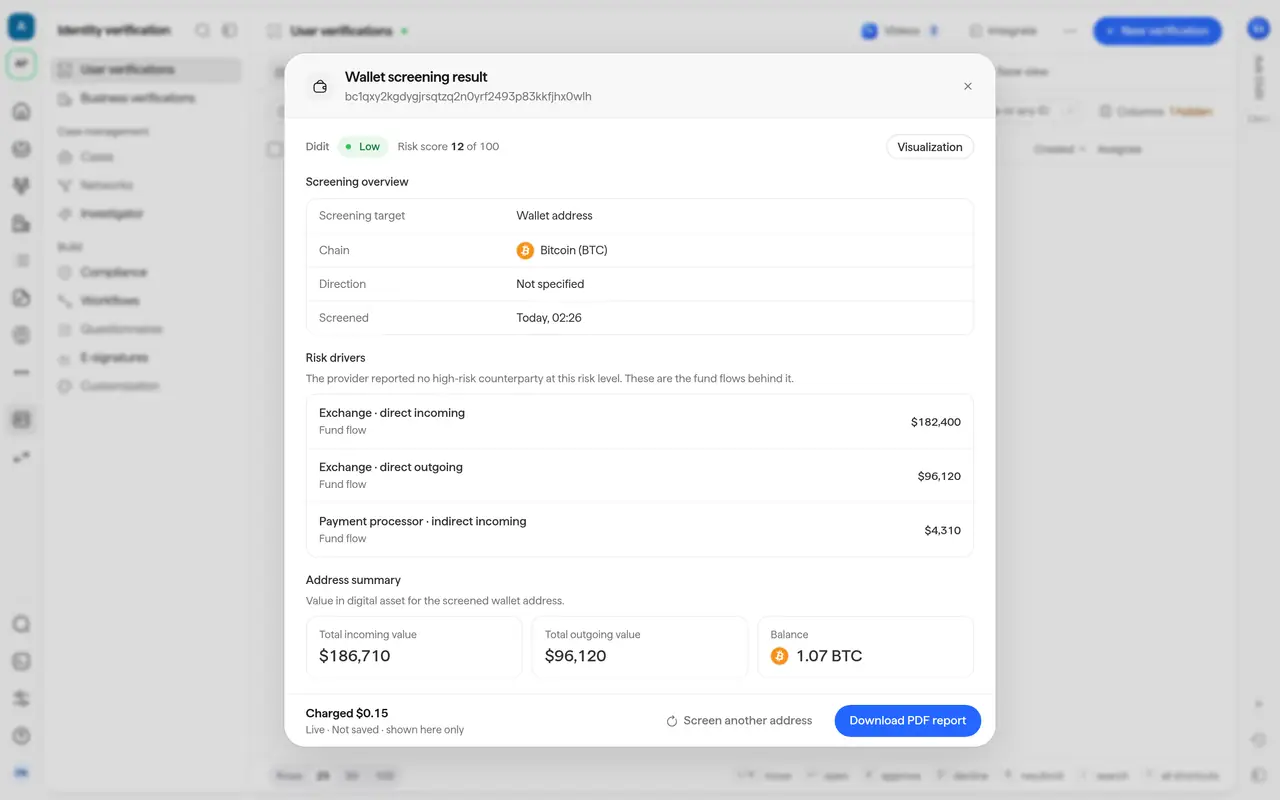
| Screen crypto transactions, Regulation (EU) 2023/1113 | Wallet risk result stored against the transfer | Wallet Screening inside Transaction Monitoring | $0.15 per screening |
| Exchange originator and beneficiary data, Regulation (EU) 2023/1113 | Message history and protocol status | Travel Rule messaging | $0.02 per transaction |
| Monitor transactions and report, AMLR Articles 26(1) and 69 | Rules, alerts, investigation notes | Transaction Monitoring with a rules engine and alert review | $0.001 per transaction beyond the plan allowance |
| Human review of automated decisions, AMLR Article 76(5) | Reviewer, timestamp, reason | Manual review and status updates in the console and by API | Included |
| Keep records five years then delete, AMLR Article 77 | Retention setting, exports, deletion record | Retention by plan and audit log | Free keeps 1 year, Growth 5 years, Scale up to 10 years |
| Govern outsourcing, AMLR Article 18 | Your outsourcing register and the due diligence on us | Our audit evidence: SOC 2 Type 2 and ISO/IEC 27001:2022 certificate ES144068 | Not applicable, this record is yours |
One consequence of the retention row: the Free plan keeps one year of data and a 30-day audit log, which does not meet a five-year record-keeping rule. If Article 77 applies to you, Growth is the floor, and Scale adds a three-year audit log with export.
What Didit does not do: we do not decide a customer's risk profile, we do not decide whether to onboard, and we do not file your authorisation. We return the check results and warnings, and your team makes the onboarding decision and keeps the record.
How the identity steps look in practice
A retail onboarding workflow is a short sequence. The user photographs their document, the capture is checked for authenticity, passive liveness runs on a selfie, face match 1:1 compares the two, and AML screening runs against the name. Depending on your workflow rules, a failed or flagged check can be declined or routed to manual review.


A business client adds a registry step
If the customer is a company, the flow branches into Business Verification: registry search, the ownership graph, then a linked full ID check and person AML for each beneficial owner. Key People extraction carries no separate fee, and the linked checks bill per person. The $2.00 figure is the starting price for a registry retrieval. A UK or Dutch company at a UBO tier costs more, because registry pricing varies by country and by data tier.
Screening names, then screening wallets
On the money side, two things run. AML screening covers the person. Wallet Screening covers the counterparty address, and it sits inside Transaction Monitoring rather than beside it, so a wallet result and a transaction alert are reviewed in the same place. If you already have a screening provider you trust, bring your own screening provider and run it inside Didit.

Worked example: the identity cost of one CASP year
Take an authorised CASP with 5,000 new retail customers a year, 100 business clients, 250 beneficial owners behind those clients, 20,000 crypto transfers in or out, and 400,000 monitored transactions. All figures use published list prices from November 26, 2026, and the arithmetic is shown so you can substitute your own volumes.
- 5,000 full ID checks at $0.33 = $1,650.00
- 5,000 AML screenings at $0.20 = $1,000.00
- 1,500 proof of address checks at $0.20 = $300.00
- 5,000 ongoing AML monitoring records at $0.07 = $350.00 for the year
- 100 business verifications at $2.00 = $200.00
- 100 company AML checks at $0.20 = $20.00
- 250 linked owner ID checks at $0.33 = $82.50
- 250 person AML checks at $0.20 = $50.00
- 20,000 wallet screenings at $0.15 = $3,000.00
- 20,000 Travel Rule messages at $0.02 = $400.00
- 280,000 billable transactions at $0.001 = $280.00, after the 120,000 transactions a year that Growth includes
Added together: $1,650.00 + $1,000.00 + $300.00 + $350.00 + $200.00 + $20.00 + $82.50 + $50.00 + $3,000.00 + $400.00 + $280.00 = $7,332.50 of list-price usage in the year. The business verification line uses the starting published price of $2.00, because registry tiers are priced by country and by data tier, so a UK or Dutch company at the UBO tier costs more.
Now put the same usage on the Growth plan. Growth is $99 a month, or $1,128.00 a year paid up front, it includes $115 of credit a month, so $1,380.00 across the year, and it takes 4% off every Didit price. Usage at Growth prices is $7,332.50 multiplied by 0.96 = $7,039.20. Credit covers $1,380.00 of that, top-ups cover $7,039.20 minus $1,380.00 = $5,659.20, and the year costs $1,128.00 + $5,659.20 = $6,787.20. The per-customer number to quote to your board is $6,787.20 divided by 5,000 retail customers = $1.36 per retail customer, all in, including the crypto and monitoring lines.
Two sanity checks. Growth includes 10,000 monitored transactions a month, which is why only 280,000 of the 400,000 are billable. And the $0.07 monitoring charge is per person per year, not per month, so it does not grow with the calendar. Our pricing documentation lists the billing rules, including which retries are billable, and you can reproduce every line above from the feed.
Exceptions and open questions
Three exceptions are worth knowing before you brief a board.
The first is the Article 143(3) window. A provider that was already operating under national law may continue during the transitional period its Member State granted, up to 18 months from 30 December 2024 and no later than 1 July 2026. It is not an extension of the identity duties, only an extension of the authorisation deadline.
The second is Article 60. Certain entities that are already authorised and supervised as credit institutions, investment firms or other financial institutions may provide crypto-asset services after notifying their competent authority, instead of applying as a CASP. Their identity obligations do not disappear. They arrive through their banking or investment firm rulebook.
The third is method neutrality. Neither MiCA nor the AMLR prescribes a capture technique. They ask for an established and verified identity from a reliable source. That is why a digital ID wallet or an authoritative database lookup can be acceptable evidence. Didit supports both: the German Personalausweis at $0.49, BankID Sweden at $0.20, iDIN at $0.95, MitID at $0.25, Smart-ID at $0.21 and BankID Norway at $0.35 are available today, and the EUDI Wallet shows a published rate of $0.15 but is not yet available in production. Check the non-document verification documentation for supported countries before you promise a method to a regulator.
We do not have a supervisor's answer to these questions:
- How much human review a fully automated rejection needs. Article 76(5) says a person must be involved. How that is evidenced at high volume is still being worked out across Member States.
- How authorisations granted before 10 July 2027 are read against the AMLR. The regulation applies directly from that date, but supervisors have not published a single view on how existing CASP files are re-examined.
- Who carries the burden for a self-hosted counterparty wallet, and how much screening evidence a supervisor expects to see per transfer under Regulation (EU) 2023/1113.
- Whether one group-level verification can serve several authorised entities. Reusable KYC is free on Didit, but the legal question is a supervisory one.
This page is not legal advice. Confirm how each rule applies to your entity with your counsel and your supervisor.
Implementation checklist
- Confirm your scope: the services you actually provide under Article 3(1)(16), the Member State you are authorised in, and the transitional deadline that applies to you.
- Write the CDD design against the AMLR article list, not against MiCA's headings, and map each trigger to a workflow.
- Create a sandbox application at business.didit.me. Sandbox testing is free and unlimited.
- Build one retail workflow and one business workflow, with branching so that a flagged result follows the path your policy sets, whether that is manual review or a decline.
{"workflow_label": "MiCA retail onboarding", "workflow_type": "kyc",
 "features": [
   {"feature": "OCR"},
   {"feature": "LIVENESS", "config": {"face_liveness_method": "PASSIVE"}},
   {"feature": "FACE_MATCH"},
   {"feature": "AML"}
]}- Start a session per customer from your backend, and persist the returned
session_idagainst your own customer record.
curl -X POST https://verification.didit.me/v3/session/ \
-H "x-api-key: $DIDIT_API_KEY" \
-H "Content-Type: application/json" \
-d '{"workflow_id": "WORKFLOW_UUID", "vendor_data": "casp-customer-8841", "callback": "https://your-casp.example/kyc/return"}'- Register a webhook destination and verify the signature header, then read the decision from
GET /v3/session/{session_id}/decision/as a fallback. The status strings are case sensitive, so match on the exact value such as"In Review". - Turn on Ongoing AML Monitoring for approved customers, so the re-screen history for the relationship is dated and current, at $0.07 per person per year.
- Add the money side: Wallet Screening for counterparty addresses and Travel Rule messaging for transfers to other providers. Both are documented at docs.didit.me/transaction-monitoring/wallet-screening.
- Set the retention period your rulebook needs. Growth keeps five years, Scale up to ten with a three-year audit log.
- Record the reviewer, the date and the reason for every manual decision, and export the evidence pack for the authorisation file. Your supervisor may also ask for our audit marks: SOC 2 Type 2 and ISO/IEC 27001:2022. Our company facts record regulator attestation involving Spain's Tesoro, Banco de España and SEPBLAC. Confirm the permitted wording and the evidence before you put it in an authorisation file.
Sources
- Regulation (EU) 2023/1114 (MiCA), Articles 3, 59, 60, 62, 63, 143 and 149: eur-lex.europa.eu/eli/reg/2023/1114/oj
- Regulation (EU) 2024/1624 (AMLR), Articles 18, 19, 20, 22, 25, 26, 42, 69, 76 and 77: eur-lex.europa.eu/eli/reg/2024/1624/oj
- Regulation (EU) 2023/1113 (Transfer of Funds Regulation): eur-lex.europa.eu/eli/reg/2023/1113/oj
- FATF Recommendation 15 and the virtual asset guidance: fatf-gafi.org
- Didit AMLR compliance guide, last reviewed 2 October 2026: docs.didit.me/getting-started/amlr-compliance
- Didit AMLR solution page: didit.me/solutions/amlr
- Didit live price feed, read November 26, 2026: didit.me/pricing.json
- Didit pricing page: didit.me/pricing
- Didit pricing documentation, plans, credit and billing rules: docs.didit.me/getting-started/pricing
- Didit ID verification overview: docs.didit.me/core-technology/id-verification/overview
- Didit non-document verification: docs.didit.me/core-technology/id-verification/non-doc-lookup
- Didit Create Session API: docs.didit.me/sessions-api/create-session
- Didit verification statuses: docs.didit.me/integration/verification-statuses
- Didit quick start guide: docs.didit.me/getting-started/quick-start
- Didit wallet screening documentation: docs.didit.me/transaction-monitoring/wallet-screening
- Didit MCP server: didit.me/developers/mcp
The next step is a sandbox application. Create the sandbox application at business.didit.me and run representative approved, declined and review cases before discussing the evidence with your supervisor.
Try it
Try this in the sandbox
Run the check this guide describes, free.
The product this post is about, taken from its topic. Run it free in the sandbox.
Author
Alberto Rosas
Co-founder and CEO

Keep reading
Other guides in the same topic.
 What Is the Purpose of FICA in South Africa? 2026 Guide
FICA is South Africa's anti-money laundering law. It creates the Financial Intelligence Centre and requires accountable institutions to identify and verify clients, screen for PEP and sanctions risk and report suspicious.
Alberto RosasNov 26, 2026 Sixth Money Laundering Directive (6AMLD): What Changed and Which Rules Apply
6AMLD is Directive (EU) 2018/1673: Member States must criminalise laundering, widen predicate offences and set a four-year penalty floor. It adds no new due diligence duties for firms.
Alberto RosasNov 26, 2026 Automated Sanctions Screening: Canada, the Entity List and Embargoes
Automated sanctions screening matches people and companies against lists such as Canada's autonomous sanctions made under SEMA and JVCFOA and the OFAC SDN List, and returns candidate hits scored for identity confidence and.
Alberto RosasNov 26, 2026Questions
Frequently asked questions
Does MiCA require identity verification for every customer?
Identity verification is required when the AML customer due diligence triggers apply, not on every interaction. MiCA requires a CASP to comply with the Union's AML framework, and that framework requires customer due diligence before a business relationship and on occasional transactions at or above the thresholds. For CASPs the AMLR occasional transaction threshold is EUR 1,000, and a CASP must at least identify and verify the customer for an occasional transaction below that threshold too.
From what date do the CASP authorisation rules apply?
The CASP title applied from 30 December 2024 under Article 149(3) of Regulation (EU) 2023/1114. A Member State could let existing providers continue under its national regime for up to 18 months from that date, and no later than 1 July 2026, under Article 143(3). The exact end date is the one your own Member State set.
Who has to register as a CASP under MiCA?
Any legal person that provides one or more of the crypto-asset services listed in Article 3(1)(16) within the Union, subject to the exemptions and transitional regimes in the regulation. That covers custody and administration, trading platform operation, exchanges of crypto-assets for funds or for other crypto-assets, order execution, placing, reception and transmission of orders, advice, portfolio management and transfer services. Article 59 prohibits providing those services without authorisation.
Which regulator does a CASP apply to?
The national competent authority of the provider's home Member State, under the application and assessment provisions in Articles 62 and 63 of Regulation (EU) 2023/1114. Once authorised, the provider can passport its services into other Member States. A provider with no EU establishment should take advice on which authority treats it as its home supervisor.
What identity evidence does a CASP authorisation file need?
The file needs a customer due diligence policy plus evidence that it runs: identity document verification, biometric liveness and face match, sanctions and PEP screening, ongoing monitoring after onboarding, purpose and source of funds capture where required, transaction monitoring, human review of automated decisions, and five-year record retention. A supervisor reads the design and the sample records together.
How much does Didit charge to verify one CASP customer?
A full ID check is $0.33 and covers the document, passive liveness, face match 1:1 and device and IP analysis. Adding AML screening at $0.20 brings a retail onboarding to $0.53, and ongoing AML monitoring adds $0.07 per person per year. Growth takes 4% off every Didit price and Scale takes 10%.
Does Didit screen crypto wallets?
Yes. Wallet Screening is part of Transaction Monitoring and costs $0.15 per screening, and you can also bring your own screening provider and run it inside Didit. Travel Rule messaging for transfers to other providers is $0.02 per transaction. Transaction monitoring itself is $0.001 per transaction beyond the allowance your plan includes.
Can Didit decide whether to onboard a customer?
No. Didit returns check results and warnings, and your team makes the onboarding decision. This follows Article 18 of the AMLR, which states that outsourcing a task does not move liability away from the obliged entity, and Article 76(5), which requires a person to be involved in automated decisions.
How long must a CASP keep identity records?
Five years under Article 77 of Regulation (EU) 2024/1624, followed by deletion of the personal data. On Didit, the Free plan retains one year and a 30-day audit log, Growth retains five years and a one-year audit log, and Scale retains up to ten years with a three-year audit log that can be exported.
What happens when a customer's ID document expires after onboarding?
Didit moves the previously approved session to the status "Kyc Expired" when the verified document's expiry date passes. That is the signal to run a short re-verification workflow on that customer. The full status list, including "In Review" and "Resubmitted", is documented on our statuses page.
Is there a free way to test this before we apply for authorisation?
Yes. Sandbox testing is free and unlimited on every Didit plan. Separately, an organization that signs up with a work email gets $10 of credit a month on the Free plan. You start at business.didit.me with no sales call.
Does Didit support EU digital identity wallets?
Didit already runs national digital IDs such as the German Personalausweis, BankID Sweden, MitID, iDIN and Smart-ID, and lists eIDAS 2.0 among its compliance marks. The EUDI Wallet has a published rate of $0.15 but is not yet available in production. Confirm availability on the product page before you rely on a method in your application file.
Compliance built in
Audited, certified and attested.
We hold the certifications and build each country's rules into your flows, so you can launch anywhere without worrying. Security and Compliance center
- Regulation encoded into your flows
Tell us what you do and where. Didit lists the rules that apply to you, with sources, and builds the checks each country needs into one workflow.
- Ready for AMLR
Every requirement of the new EU anti-money laundering rules, from checking customers to human review, is already covered by a Didit check.
- Tested in Spain's Treasury sandbox
Spain's Treasury published its supervised sandbox report on Didit's NFC plus active liveness onboarding; SEPBLAC took part and valued the added measures positively.
- Audited, not self-declared
iBeta Level 1 and Level 2. Liveness tested under ISO/IEC 30107-3.
Your obligations · 3 regions
 SOC 2 Type 2
 ISO 27001
 iBeta Level 1 and Level 2
 EU regulator attestation
 FSM youth protection
 GDPR
 EBA remote onboarding
 MiCA compatible
 FIDO Alliance member
- AMLREU AML Regulation ready
Integration · Didit MCP
Run Didit from your own AI agent
Connect Didit to Claude, Cursor, VS Code or ChatGPT and just ask in plain words. Your agent can do anything you can do in the console, with the same permissions you have.
 Add to Claude
 ChatGPT
 Cursor
- Build workflowsDescribe the checks you need. The agent creates and publishes the flow.
- Run investigationsAsk why a session was declined, review cases, search people and companies.
- Change rulesCreate payment rules, test them on past data and switch them on.
- Pull reportsAsk for numbers, exports or the audit log.
Didit Academy


