
Didit vs Jumio: liveness, KYC and pricing compared
Didit vs Jumio from public pages: a self-serve console with list prices against account-manager onboarding, the full evidence of every liveness check, and KYB, transaction monitoring and wallet screening in one account.
In short
Didit vs Jumio is a choice between an enterprise sales process and a platform you can open, price and test today. Didit publishes a list price for each core module, returns the full evidence of every check, and covers KYB, transaction monitoring and wallet screening in the same account.[9][27]
- Jumio's developer docs ask you to contact your Account Manager to set up the account and obtain workflow keys, and no public Jumio price list was found.[2][3] A full Didit KYC check is $0.33.[9]
- A Jumio KYB product, transaction monitoring and crypto wallet screening are not documented on Jumio's public pages reviewed.[1][5][6] Didit prices them from $2.00 per business, $0.02 per transaction and $0.15 per check for pay-as-you-go wallet screening.[9]
- Didit's Investigator agent reviews cases within your policy, Copilot builds workflows by conversation, and your agents operate Didit through MCP.[21][22][23]
Banks, fintechs, gaming operators and crypto exchanges that look at Jumio usually want strong liveness, global documents and a vendor that can carry regulated volume. The questions that follow are about time to start, what the check returns, and whether the same vendor covers the business, the money and the review queue. This comparison follows those questions.
Jumio sells enterprise identity verification with document, biometric and AML screening checks.[1] We build Didit, so read this as our side. Every Jumio fact below comes from Jumio's own public pages and developer docs, read on 25 October 2026, and each one is cited.
Government evidence and fraud signals on the same record
Didit did the hard work of connecting national government databases directly. Database Validation covers 45 countries plus a Global group and can run standalone or as an extra check on top of document verification, liveness and face match. A document and selfie answer different questions from an official record: the additional lookup checks identity fields against the selected authoritative source. Combine that government-grade evidence with device fingerprinting, IP analysis and email or phone risk signals in the same workflow, record and API response.
Non-document lookup is a separate identity-verification route: the person supplies an identity number and the details required for that country, without capturing a document. Database Validation can instead corroborate data collected by earlier workflow steps. Sources, returned fields, consent requirements and prices vary by service. Argentina RENAPER and Panama SIB support selfie-to-registry-photo checks. A matching registry record is evidence to assess under your policy; it is not a guarantee against impersonation.
Confirmed national eIDs, country by country
The current scheme documentation confirms these live routes. The National eIDs page explains the workflow and document fallback. The issuer signs identity attributes and Didit checks the result in the same verification workflow.
| National eID | Confirmed countries |
|---|---|
| MitID | Denmark |
| BankID Sweden | Sweden |
| iDIN | Netherlands |
| Finnish Trust Network | Finland |
| Smart-ID | Estonia, Latvia, Lithuania and Belgium |
| Mobile-ID | Estonia and Lithuania |
The signed result includes the name, date of birth, scheme identifier and assurance information supplied by the scheme; MitID uses a pseudonymised CPR alias. These live routes do not return a portrait, so an eID result is not itself a selfie match. If your policy needs face matching, collect a valid reference through document capture or a qualifying lookup; the eID result alone supplies none. Configure document fallback and the appropriate workflow branch. EUDI Wallet acceptance is coming soon in the eIDAS 2.0 context; the broader catalog must not be read as live country coverage.
Government database services and national eID checks have their own charges. They are separate from the $0.33 document KYC bundle, as are fallback and additional completed modules. Published module prices let a team cost the actual workflow. The advantage is practical: official identity evidence and fraud signals stay connected, with the selected checks and their results available through one integration.
In contrast, on the Jumio developer documentation page reviewed on 25 October 2026, Jumio lists about 30 named government database checks, noting that several routes rely on third-party providers (Jumio government database check). Direct support for European national eID schemes such as MitID, BankID, or Smart-ID is not confirmed in their public sources (Jumio products, read 25 October 2026).
Didit vs Jumio at a glance
| Function | Didit | Jumio | Checked |
|---|---|---|---|
| Getting started | Self-serve console and sandbox[28] | Account set up by your Jumio Account Manager, who provides workflow keys[2] | 25 Oct 2026 |
| Prices | List prices for core modules; full KYC $0.33[9] | No public price list found; the TCO page asks for a conversation[3] | 25 Oct 2026 |
| KYB | From $2.00 per business, a linked KYC for each owner[9][16] | Not documented on the public pages reviewed[1] | 25 Oct 2026 |
| Transaction monitoring | $0.02 per transaction, 150+ preset rules[9][12] | Not documented; Jumio's FAQ treats it as distinct from its AML screening[5] | 25 Oct 2026 |
| Crypto wallet screening | $0.15 per check pay-as-you-go (or bring your own available provider key), signed PDF report[9][14] | Not documented on the public pages reviewed[6] | 25 Oct 2026 |
| Government database checks | 45 countries plus a global group, documented service by service[18] | On the developer docs page reviewed, about 30 named checks; docs state some run through third-party providers[4] | 25 Oct 2026 |
Jumio column: jumio.com and documentation.jumio.ai. Didit column: docs.didit.me.
Getting started: an account manager or a console
Jumio's integration prerequisites tell you to contact your Jumio Account Manager to set up your account, and to obtain the workflow key or keys for your integration from the Account Manager.[2] We did not find a public Jumio price list; product pages lead to a demo request, and the total-cost page asks for a conversation.[3]
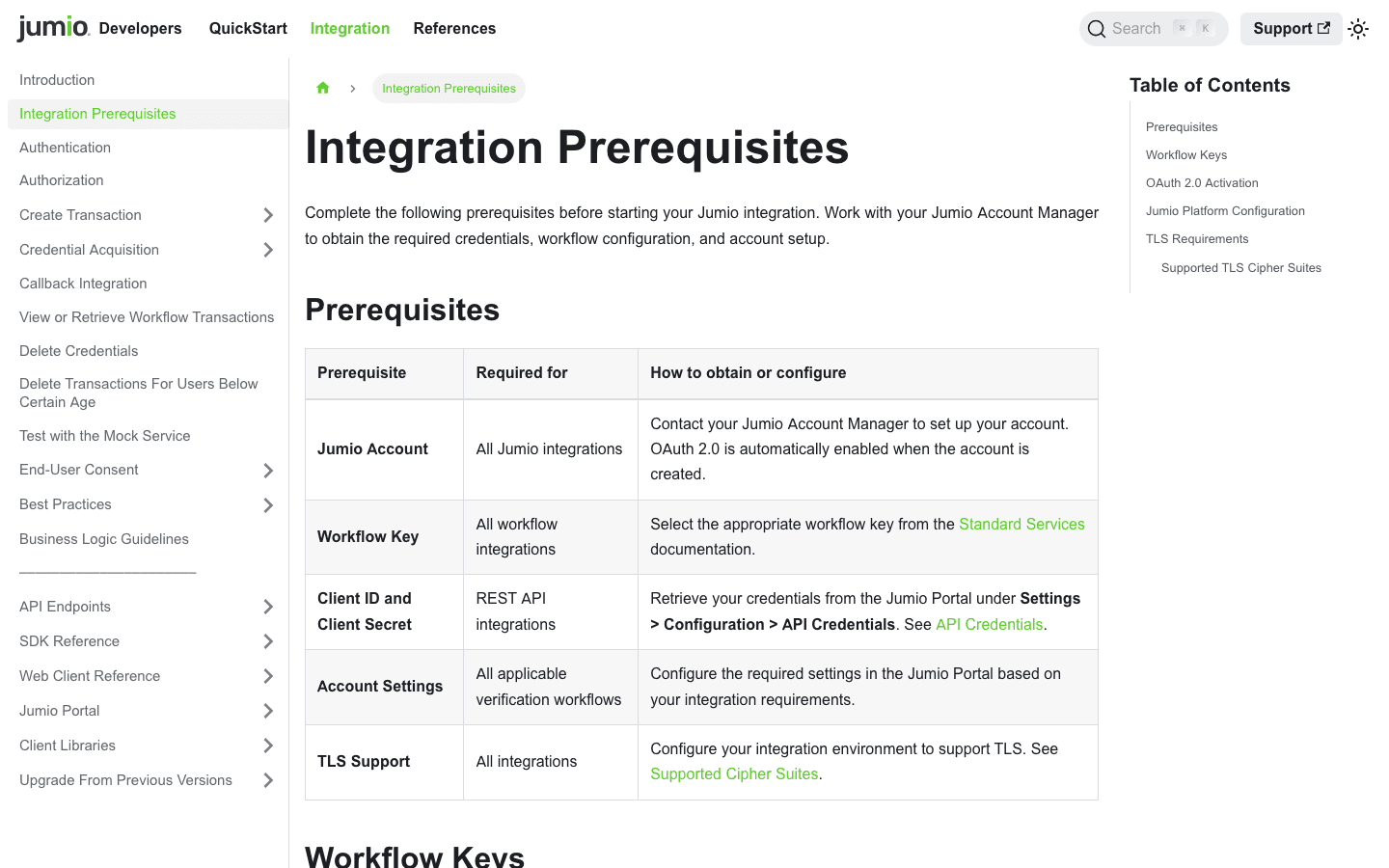
Jumio's Integration Prerequisites on 25 October 2026: the Account Manager sets up the account and provides the workflow keys.
On Didit you open the Business Console, build a workflow and test it in the sandbox the same day. Didit publishes list prices for its core modules, with database validation priced per country: a full KYC check (document, passive liveness, face match, device and IP) is $0.33, AML screening is $0.20 and ongoing AML monitoring is $0.07 per profile per year.[9][28] Didit's plan structure changes on 1 November 2026; per-check prices are published in the docs.[26]
Liveness and the full evidence of every check
Didit runs its own liveness with three methods you choose per workflow: passive, Active 3D, and Flashing. Each liveness check returns a status, a score and the selfie, and the warnings behind the decision come back with the session decision, which also returns each check's result, the extracted fields and the capture images and videos in one API call.[10][27] Your reviewers and auditors read the same record, and your engineers do not need a second fetch to see why a user was declined.
Jumio documentation details callback events, with transaction details and evidence retrieved via its APIs.[7]
| Didit liveness method | What the user does | Price |
|---|---|---|
| Passive | Takes one selfie | $0.10 per check[9][10] |
| Active 3D | Holds the phone while the screen lights the face | Active liveness, $0.15 per check[9][10] |
| Flashing | Adds a random action, such as a blink or a nod | Active liveness, $0.15 per check[9][10] |
KYB with a linked KYC for every owner
Didit checks company information using the registry tiers available for its jurisdiction and lets you choose per country how much registry data to buy: company profile, shareholders, or ultimate beneficial owners. A Lite profile starts at $2.00 per business, while the registry search API is free.[9][16] Each declared owner and officer is checked against the company's own documents, screened, and sent a linked KYC.[15] A Jumio business verification product was not documented on the pages reviewed on 25 October 2026.[1]
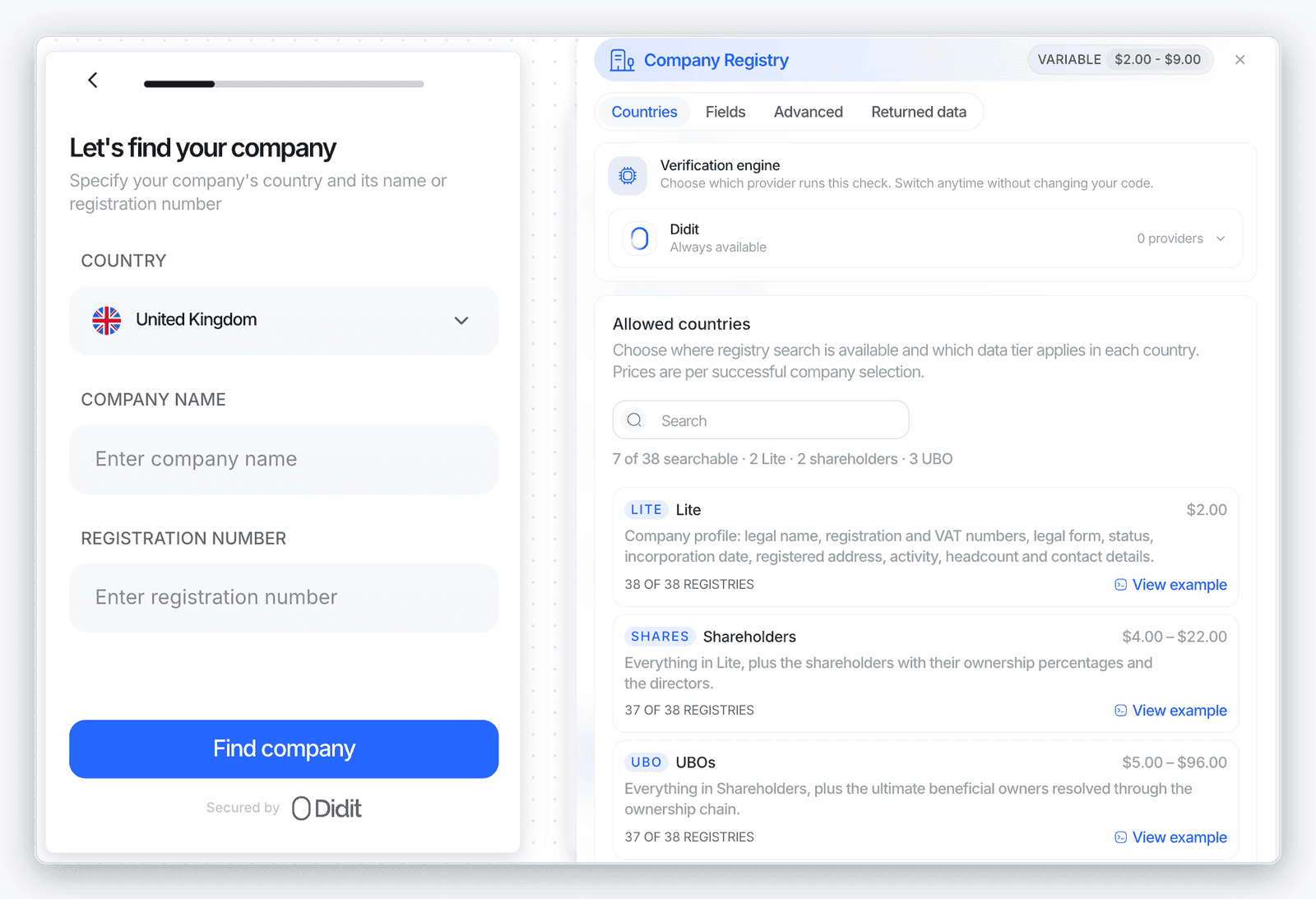
Didit's Company Registry step: the data tier is chosen per country.[16]
After onboarding: monitoring, wallets and Travel Rule
Didit scores transactions against real-time rules at $0.02 each, ships 150+ preset rules including iGaming presets, and lets you backtest a rule on your own history before switching it on.[9][11][12] A flagged transaction can be configured to hold pending a step-up selfie matching the verified face, and cases generate SAR and STR draft reports for your team to file.[13][17] For crypto, Didit screens supported blockchain addresses at $0.15 per check pay as you go (or you can bring your own available provider key), generates a signed PDF report, and exchanges Travel Rule data in IVMS 101.[14][29]
Jumio's crypto page lists ID, document, biometric, AML name screening, government database and device checks; wallet screening, transaction monitoring and Travel Rule are not documented on the pages reviewed.[5][6]
1Verify and screen the user
KYC at $0.33, AML at $0.20.
2Screen the deposit wallet
Risk result and signed report, $0.15 pay-as-you-go.
Does a transaction rule fire
Hold, step up, open a case
One selfie, then an alert the Investigator reviews.
Approve and log
Scored at $0.02 and kept on the record.
The identity Didit verified is the one it monitors.[9][13]
Government database checks, documented per country
Didit lists each government and authoritative database service per country, with inputs, outputs and prerequisites across 45 countries plus a Global group. Where supported, Argentina RENAPER and Panama SIB compare a selfie against the registry photo. In Nigeria and South Africa, non-document lookup verifies a submitted selfie directly against the record, returning a verification verdict rather than a portrait image.[18][19]
| Country | Didit input | Didit output |
|---|---|---|
| Argentina, RENAPER | Document number, gender, selfie | Names, date of birth, tax ID, face match score[18] |
| Nigeria, BVN | BVN and a selfie | Source-verified selfie verdict, names and date of birth once the selfie matches the record face[19] |
| South Africa, Home Affairs | National ID number and selfie | Source-verified selfie verdict with liveness/face match in the lookup[19] |
On the Jumio developer documentation page reviewed, Jumio lists about 30 named government database checks. Its docs say some of them run through the same third-party providers used in its multi-source eKYC checks, that results depend on source availability, and that countries beyond the documented ones need Jumio Support.[4]
Agents that work for your compliance team
Didit is agentic. The Investigator agent reads each verification, transaction alert or case waiting for review and writes a report with a recommendation and cited evidence; it decides on its own only within the policy and autonomy level you set, never files a regulatory report, and logs every decision.[23] It costs $0.20 per reviewed item, while a support agent is available from $0.02 per message.[9]
Copilot builds a validated draft workflow from a description and records each edit on a change card you can undo.[24][25] Your own agents connect to the hosted MCP server over OAuth 2.1 with no API key to paste; they can inspect verifications, alerts, cases and evidence.[21][22] A Jumio MCP server or customer agent integration was not documented on the pages reviewed.[8]
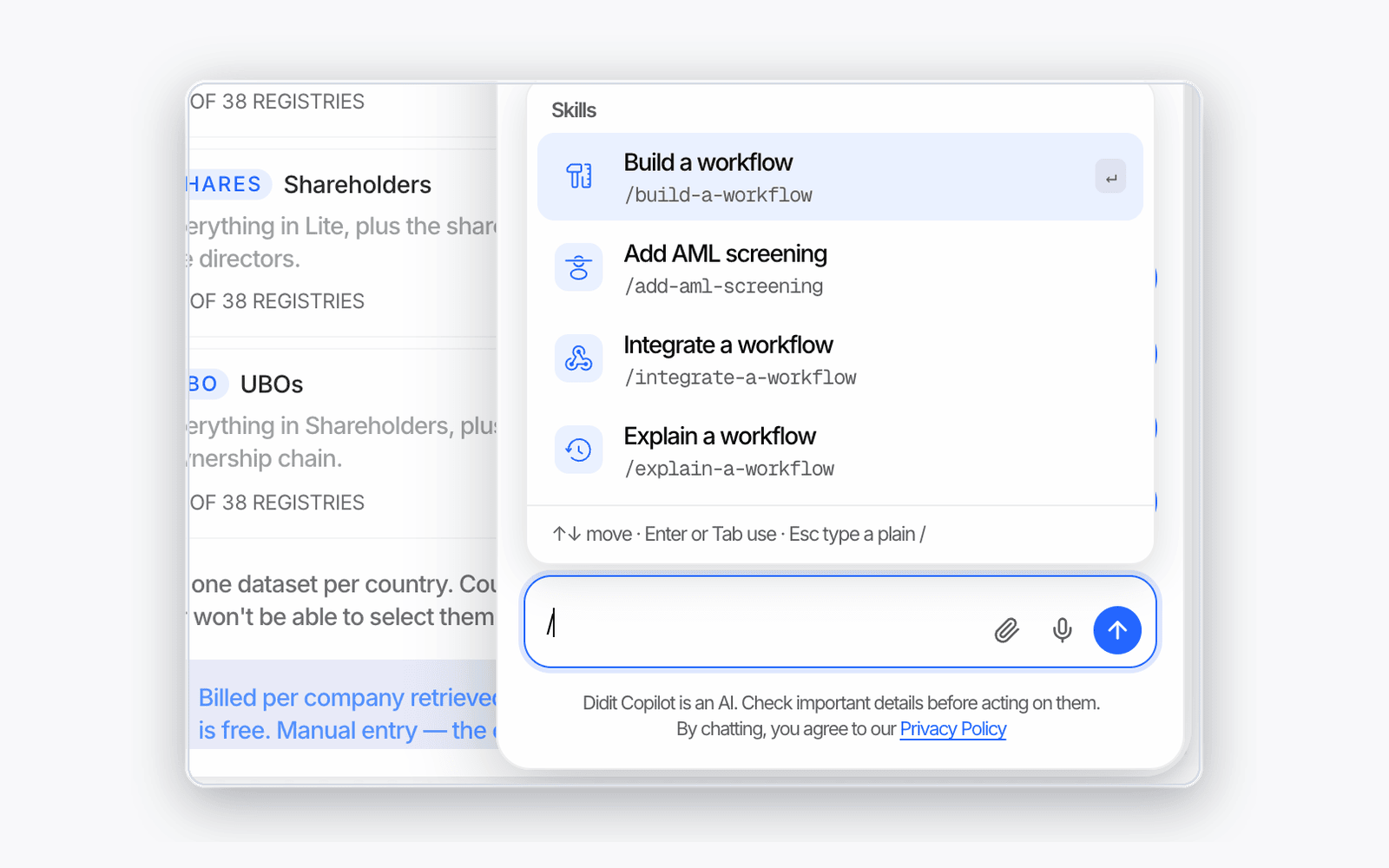
Copilot in Didit's workflow editor, with its slash skills and AI disclosure.[25]
Didit's workflow builder shows each step's price while you build, merges branches back into one path and warns about a branch that contradicts the outcome it routes to, before you publish.[28]
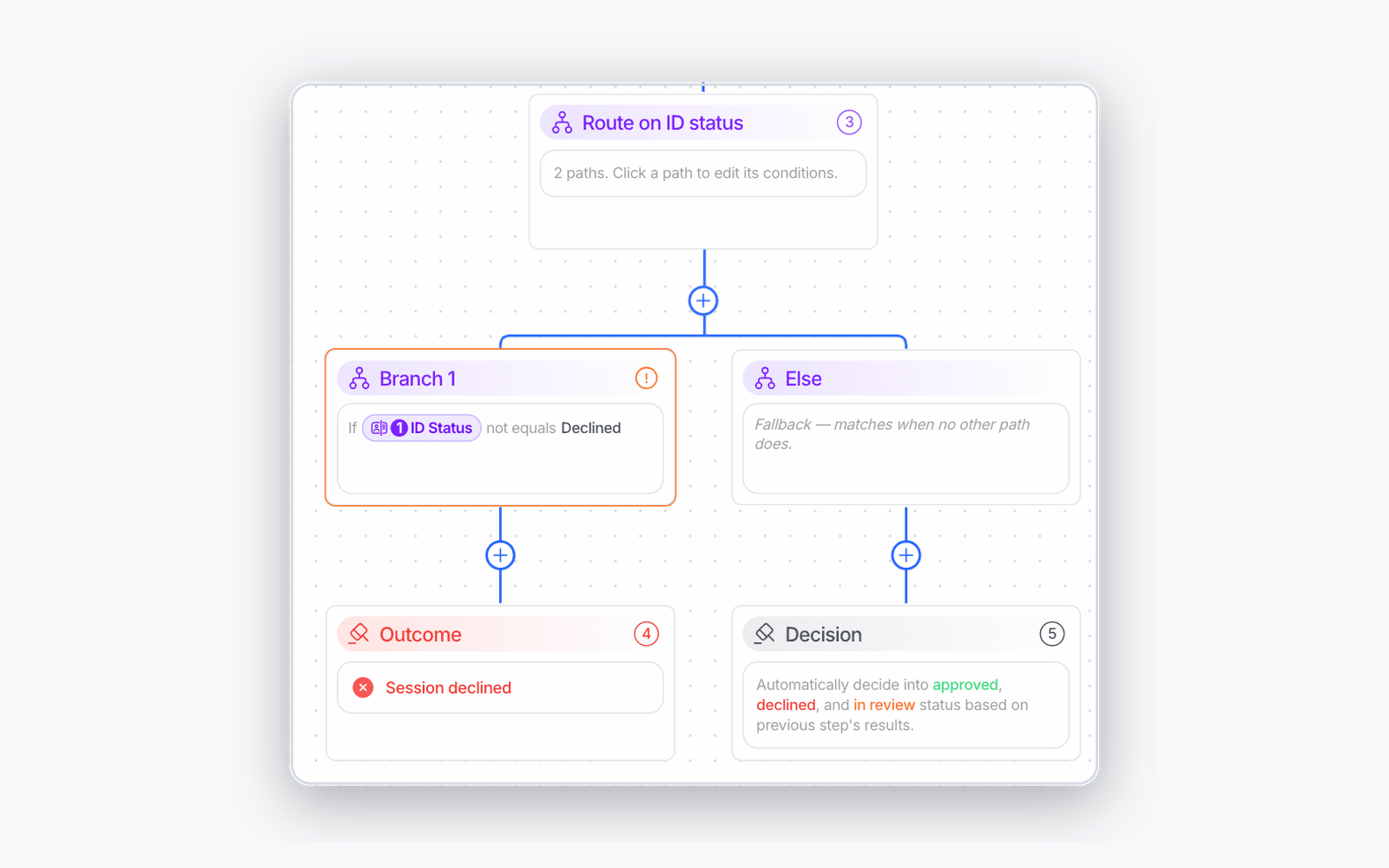
A contradiction warning on a workflow branch, raised before publishing.[28]
Moving from Jumio to Didit
- List your Jumio workflows, accepted documents, risk rules and the callbacks your backend consumes.
- Rebuild the flow in Didit's workflow builder, or describe it to Copilot, and read each step's price.
- Map Jumio's decisions to Didit's Approved, Declined and In Review statuses and webhooks.
- Run Didit on a share of new users and compare approval rates, fraud caught and cost.
- Add KYB, transaction monitoring and wallet screening once the core flow is live.
- Day 1Open the consoleSandbox and API keys in your account.
- Week 1RebuildWorkflow, webhooks, test users.
- PilotSplit trafficCompare on your own users.
- RenewalMove the restWhen your Jumio agreement allows.
A staged move; timing depends on your volumes and agreement.
How Didit helps teams comparing Jumio
Didit gives you a console you can open today, a list price for each core module, and identity and fraud in one account. The Jumio alternative page has the side-by-side; the business verification page covers KYB.
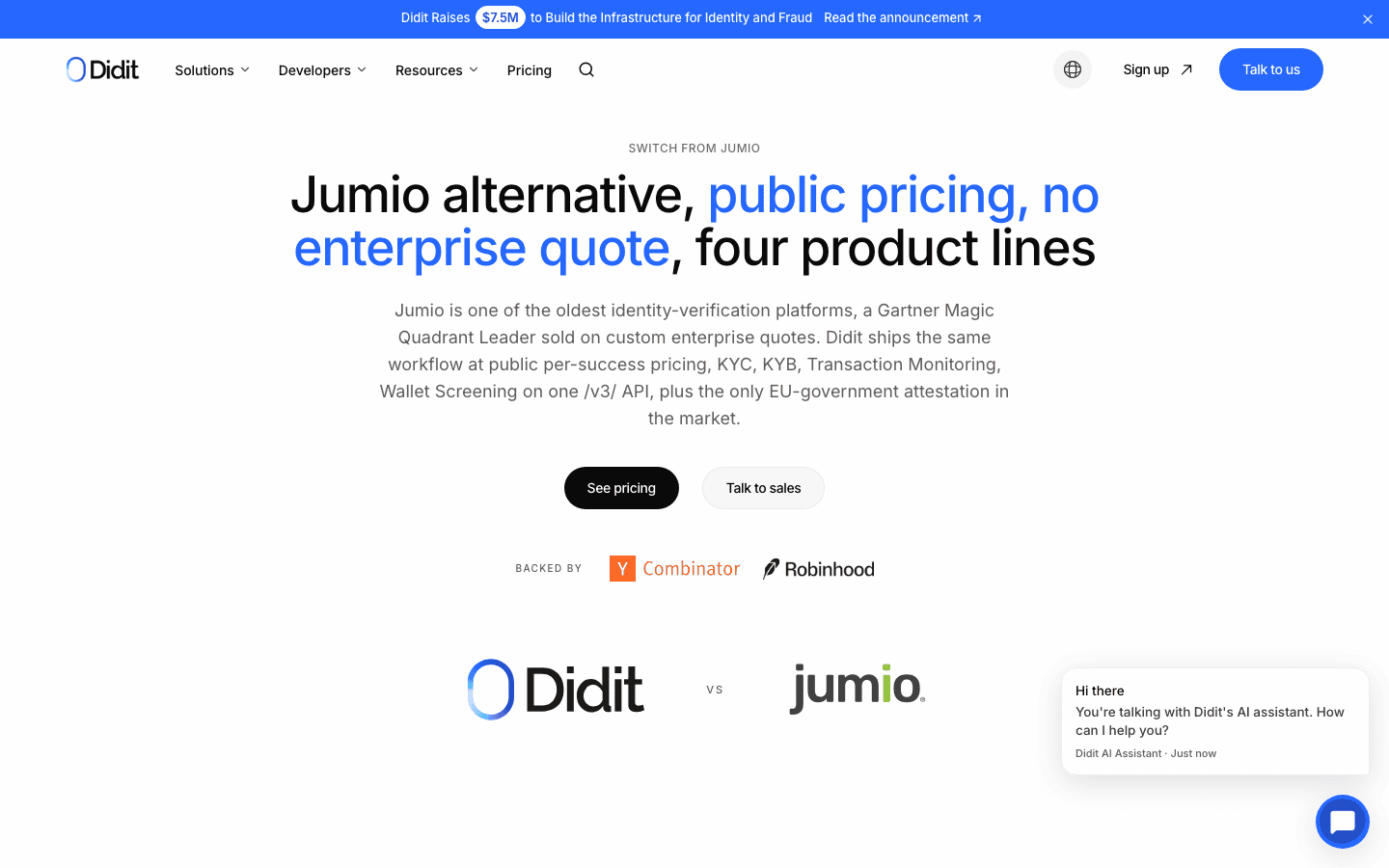
Didit's Jumio alternative page: the side-by-side and the switch steps this section points to.
Didit provides
- Liveness, document, face match and database checks
- KYB with a linked KYC for each owner
- Transaction rules, wallet screening and Travel Rule
- The Investigator, Copilot and the MCP server
Stays with you
- Your risk policy and thresholds
- The autonomy each review queue may use
- Filing reports with the authorities
- Which rules go live
Price your Jumio flow on Didit
Open the console, rebuild the flow and read the list price of each step.
Key takeaways
- Jumio's docs route account setup and workflow keys through an Account Manager; Didit is self-serve with published list prices.
- Every Didit decision returns each check's result, images, videos and warnings in one call.
- Didit adds KYB, transaction monitoring and wallet screening, which Jumio's public pages do not document.
- The Investigator, Copilot and the MCP server take review and configuration work off your team.
Frequently asked questions
How much does Jumio cost?
We did not find a public Jumio price list; its pages lead to a demo or a conversation. Didit's full KYC check is $0.33 and passive liveness alone is $0.10.[3][9]
Can I start with Didit without talking to sales?
Yes. Open the Business Console, build a workflow and test it in the sandbox, then pay per check at the published list prices.[9][28]
What does a Didit liveness check return?
A status, a score and the selfie, plus the warnings behind the decision; the session decision adds every other check's result, images and videos.[10][27]
Does Jumio offer KYB or transaction monitoring?
Neither is documented on Jumio's public pages reviewed on 25 October 2026. Didit's KYB starts at $2.00 per business and transaction monitoring is $0.02 per transaction.[1][5][9]
Can AI agents operate Didit?
Yes, within your rules. The Investigator reviews queues at the autonomy you set, Copilot builds workflows, and your agents use the hosted MCP server.[21][23]
Can I run Didit next to Jumio while I switch?
Yes. Route a share of new users to a Didit workflow, compare results and cost, and move the rest when your agreement allows.
Is Didit a good Jumio alternative?
Yes. You can start today at published list prices, get the full evidence of every check, and run KYB, monitoring and wallet screening in the same account.[9][27]
Comprehensive product capabilities: Didit vs Jumio
Enterprise identity and risk operations extend beyond initial document parsing. Regulated teams require a stack covering physical documents, authoritative registries, national eID schemes, passive fraud signals, transaction monitoring, and operational review tooling. The table below details capabilities across both platforms, drawing strictly from published documentation.
| Capability / Requirement | Didit Platform Scope & Evidence | Jumio Documented Scope |
|---|---|---|
| KYC document coverage | 14,000+ document types across 220+ countries and territories, AI OCR, MRZ/barcode checks ($0.15 in a workflow), age estimation ($0.10), proof of address ($0.20), and reusable KYC is free; full document KYC bundle is $0.33. Documentation | Global ID and passport verification across 200+ countries and territories documented (Jumio products, read 25 October 2026). |
| NFC chip verification | NFC e-passport and eID chip verification at $0.15 per check. Documentation | ePassport NFC chip reading supported in mobile SDKs (Jumio SDKs, read 25 October 2026). |
| Non-document lookup & DB checks | National identity number and required details checked against the country-specific authoritative source; read the per-service fields and prices. Documentation | On the developer docs page reviewed, about 30 named database checks, partly via third-party providers (Jumio database checks, read 25 October 2026). |
| National eIDs & EUDI | National eIDs: MitID, BankID Sweden, iDIN, Finnish Trust Network, Smart-ID and Mobile-ID in the confirmed countries above; EUDI Wallet acceptance coming soon. Documentation | National eID verification schemes not confirmed in their public sources (Jumio products, read 25 October 2026). |
| Liveness detection | Passive liveness ($0.10 in a workflow, $0.05 standalone) and active liveness ($0.15) with iBeta Level 1 PAD certification. Documentation | Liveness detection and presentation attack mitigation (Jumio products, read 25 October 2026). |
| Face match & 1:N face search | Face match 1:1 at $0.05; 1:N face search against your users and blocklists is free, plus allowlists and custom lists across workflows. Documentation | 1:1 facial biometric matching; 1:N cross-session duplicate face search not confirmed in their public sources (Jumio products, read 25 October 2026). |
| Device & IP intelligence | Device fingerprinting, IP risk, VPN/proxy/Tor detection and geolocation consistency, collected during the verification session ($0.03 in-session unit, included in the $0.33 full KYC bundle; no standalone endpoint). Documentation | Device risk signals and fraud analytics available as add-on signals (Jumio products, read 25 October 2026). |
| Email & phone verification | Email and phone ownership checks and risk signals in the same workflow. Email verification is $0.03; phone verification is $0.04 + carrier. Documentation | Phone and email risk signals supported via data attributes (Jumio products, read 25 October 2026). |
| AML screening & ongoing monitoring | AML screening at $0.20 and ongoing AML monitoring at $0.07 per user per year, linked to the verified person. Documentation | AML screening and ongoing monitoring available (Jumio AML screening, read 25 October 2026). |
| Transaction monitoring | Transaction monitoring at $0.02 per transaction, with a real-time rule engine, 150+ preset rules and alerts linked to verified users. Documentation | Dedicated transaction monitoring rule engine not confirmed in their public sources (Jumio screening FAQ, read 25 October 2026). |
| Crypto wallet screening & Travel Rule | Pay-as-you-go wallet screening at $0.15 per check on supported blockchain addresses, or bring your own available provider key (no price assigned to the own-key route). Travel Rule includes IVMS 101 messaging, VASP directory, counterparty due diligence, wallet address book and ownership proof. Documentation | Blockchain wallet address screening and Travel Rule protocol not confirmed in their public sources (Jumio crypto page, read 25 October 2026). |
| KYB & linked owner KYC | Business registry information, ownership, officers, business AML and a linked KYC for each owner. KYB starts at $2.00 per business with a free registry search API; registry tiers vary by jurisdiction. Documentation | Standalone KYB registry lookup and UBO workflow orchestration not confirmed in their public sources (Jumio products, read 25 October 2026). |
| Bank account verification | Bank verification through open banking or account checks, with workflow fallbacks. Coverage and required account fields vary by route. Documentation | Bank account name-matching checks not confirmed in their public sources (Jumio products, read 25 October 2026). |
| Workflow builder & transparency | A no-code workflow builder combines checks, custom questionnaires, branches by risk and displays each step's price while you build. Documentation | Workflow management configured via enterprise account manager and portal (Jumio prerequisites, read 25 October 2026). |
| Case management & AI review | Case management keeps check evidence together. Investigator writes a cited recommendation for $0.20 per reviewed item and acts only within your policy and autonomy level. Support starts at $0.02 per message; Copilot assists workflow configuration. Documentation | Portal case management and manual agent review workflows (Jumio products, read 25 October 2026). |
| AI operator integrations (MCP) | Hosted MCP over OAuth 2.1 lets your agents inspect verifications, alerts, cases and evidence. Copilot configures workflows, questionnaires and database-validation steps. Documentation | Model Context Protocol server or standardized agent integration not confirmed in their public sources (Jumio docs, read 25 October 2026). |
| Data portability & SDKs | Import API to migrate historical records, and SDKs for Web, iOS, Android, React Native and Flutter; white label at $0.20. SDK documentation · Import API | Web and native mobile SDKs; verification data retrieval via retrieval APIs (Jumio SDKs, callbacks, read 25 October 2026). |
Illustrative volume budget scenario
To evaluate predictable commercial scaling, consider an operational budget for a regulated financial service running 10,000 user onboardings, 10,000 AML screenings, 100,000 transaction monitoring events, and 10,000 crypto wallet deposit checks in a month:
- 10,000 Full KYC verifications (Document verification + passive liveness + face match + device & IP analysis) at $0.33 = $3,300
- 10,000 AML sanction & PEP screenings at $0.20 = $2,000
- 100,000 Transaction monitoring checks at $0.02 = $2,000
- 10,000 Crypto wallet screenings at $0.15 pay-as-you-go = $1,500
- Monthly subtotal: $8,800 (excluding national eID fees, government registry lookups, KYB searches, or optional AI investigator reviews).
Because Jumio does not publish a price list (Jumio TCO page, read 25 October 2026), percentage-based cost differentials cannot be mathematically determined. However, uniting identity verification, AML monitoring, transaction risk, and crypto compliance under a single API and public price list eliminates vendor fragmentation, simplifies technical orchestration, and provides full transparency over unit economics.
Sources
- Products, Jumio, read 25 October 2026.
- Integration prerequisites, Jumio developer docs, read 25 October 2026.
- Calculate total cost of ownership, Jumio, read 25 October 2026.
- Government database check, Jumio developer docs, read 25 October 2026.
- AML screening, Jumio, read 25 October 2026.
- Crypto industry, Jumio, read 25 October 2026.
- Callback, Jumio developer docs, read 25 October 2026.
- SDK overview, Jumio developer docs, read 25 October 2026.
- Pricing, Didit docs, read 25 October 2026.
- Liveness detection, Didit docs.
- Transaction rules API and backtesting, Didit docs.
- Rules library, Didit docs.
- SDK transaction submission and step-up, Didit docs.
- Wallet screening, Didit docs.
- Key people, Didit docs.
- KYB supported countries and data tiers, Didit docs.
- FIU reports, Didit docs.
- Database validation supported countries, Didit docs.
- Non-document lookup and registry photo match, Didit docs.
- Nigeria BVN, Didit docs.
- MCP server overview, Didit docs.
- MCP tools, Didit docs.
- Investigator agent, Didit docs.
- August 2026 changelog, Didit docs.
- September 2026 changelog, Didit docs.
- New pricing from 1 November 2026, Didit blog.
- Retrieve session, Didit docs.
- Workflows, Didit docs.
- Travel Rule, Didit docs.
Jumio and its marks belong to their owner; references here are nominative, for comparison only, and imply no affiliation. To compare on your own users, the Jumio alternative page has the side-by-side and the steps to start.
Try Didit on the checks you run today
Start in the sandbox with your own documents and see the evidence and price of every check.
Related articles
- New pricing from November 1: one plan per product, one balance for everything
- Unico Partners with Didit to Expand Access to State-of-the-Art Identity Verification for SMEs in Brazil
- Didit Closes $7.5M Seed to Build the Infrastructure for Identity and Fraud
- Non-Document Verification in Singapore: MyInfo-Based KYC Without Document Uploads
- Non-Document Verification in Canada: Credit Bureau-Based KYC Without Document Uploads
- Non-Document Verification in the United States: SSN-Based KYC Without Document Uploads