Blog
Browse every Didit article.
Every post on the Didit blog, newest first. Pick a category or search to find the subject you need.
All posts
Every post, newest first
Pick a category to filter.

Google Play Age Signals and Apple's Declared Age Range API side by side: ranges, tiers, nulls, automatic sharing and terms, plus one age state for your backend and when to add your own check.
Alberto RosasNov 22, 2026Play Age Signals API integration guide: v0.0.6 for Android apps
The three calls of Play Age Signals 0.0.6 in Kotlin, a decision table for every status, tier and bound, errors, migration from 0.0.3 and 0.0.4, testing, and how to start your own age check.
Alberto RosasNov 22, 2026Age verification API: which one works on apps, web and stores
Five kinds of age verification API and where each one answers: Play apps, App Store apps, sideloads, web and desktop. With the selfie call, the hosted session, webhook checks, cost and data.
Alberto RosasNov 22, 2026Age assurance for apps: games, social, dating, AI and more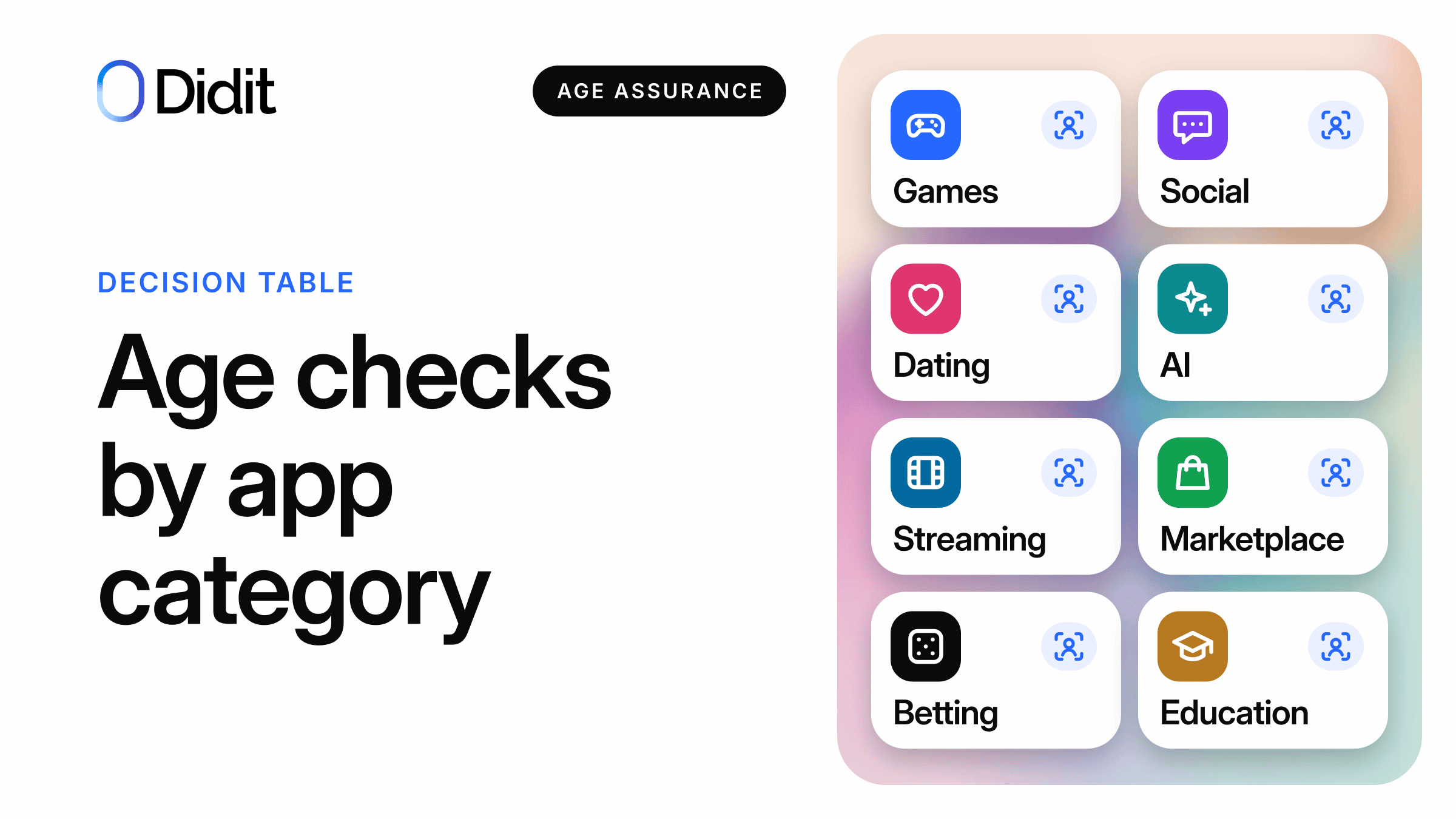
One decision table for product owners: what each app category has to do about age in the US, Brazil, Australia and the EU, when the store signal is enough, which feature to gate and which check to add.
Alberto RosasNov 22, 2026App Store Accountability Acts: Texas, Utah, Louisiana, Alabama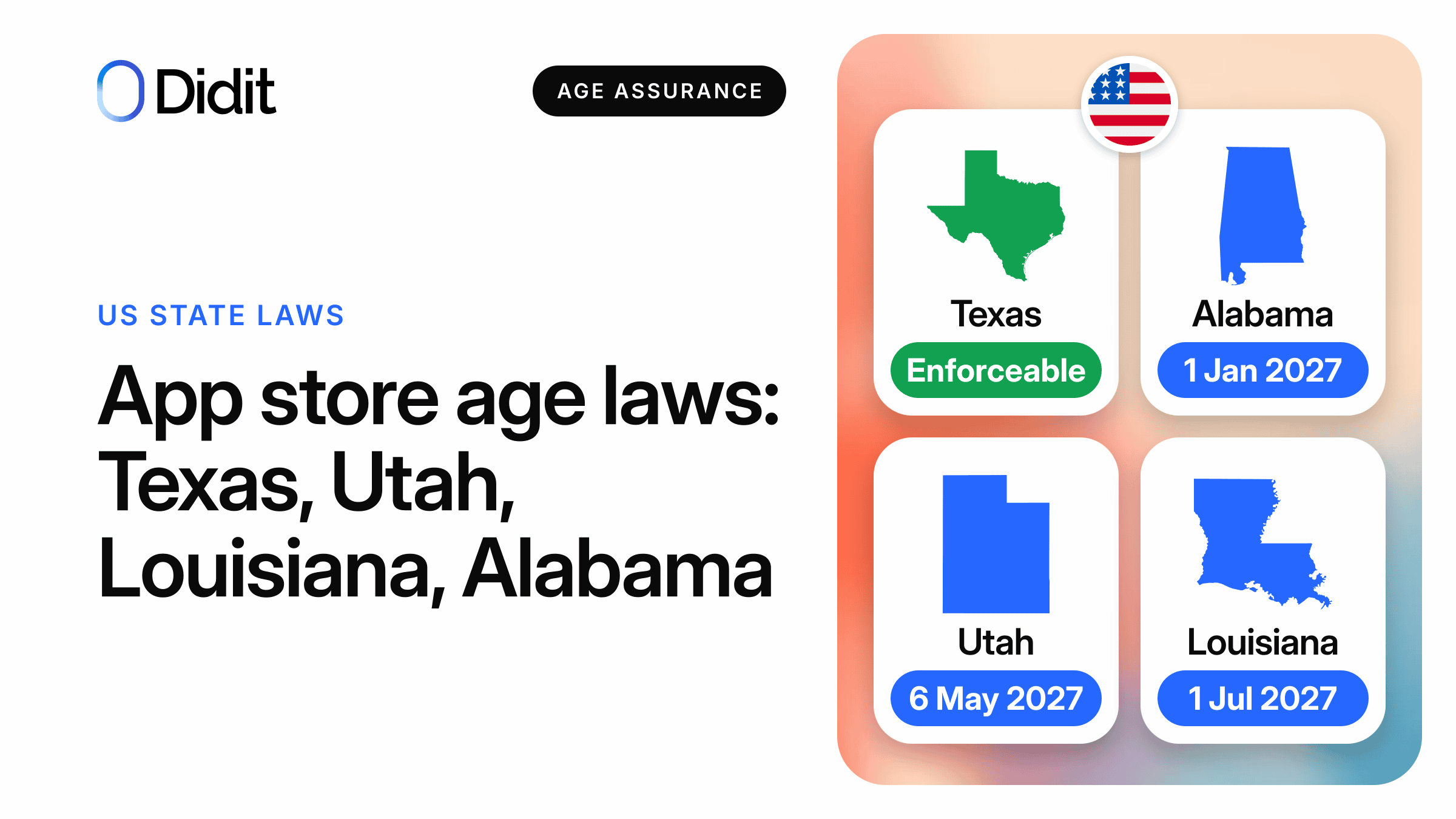
The four App Store Accountability Acts in one developer table: dates that count today, who verifies age, your duties, which age wins when yours differs, penalties, and what Google Play and Apple say per state.
Alberto RosasNov 22, 2026California age verification law 2027: the four rules for apps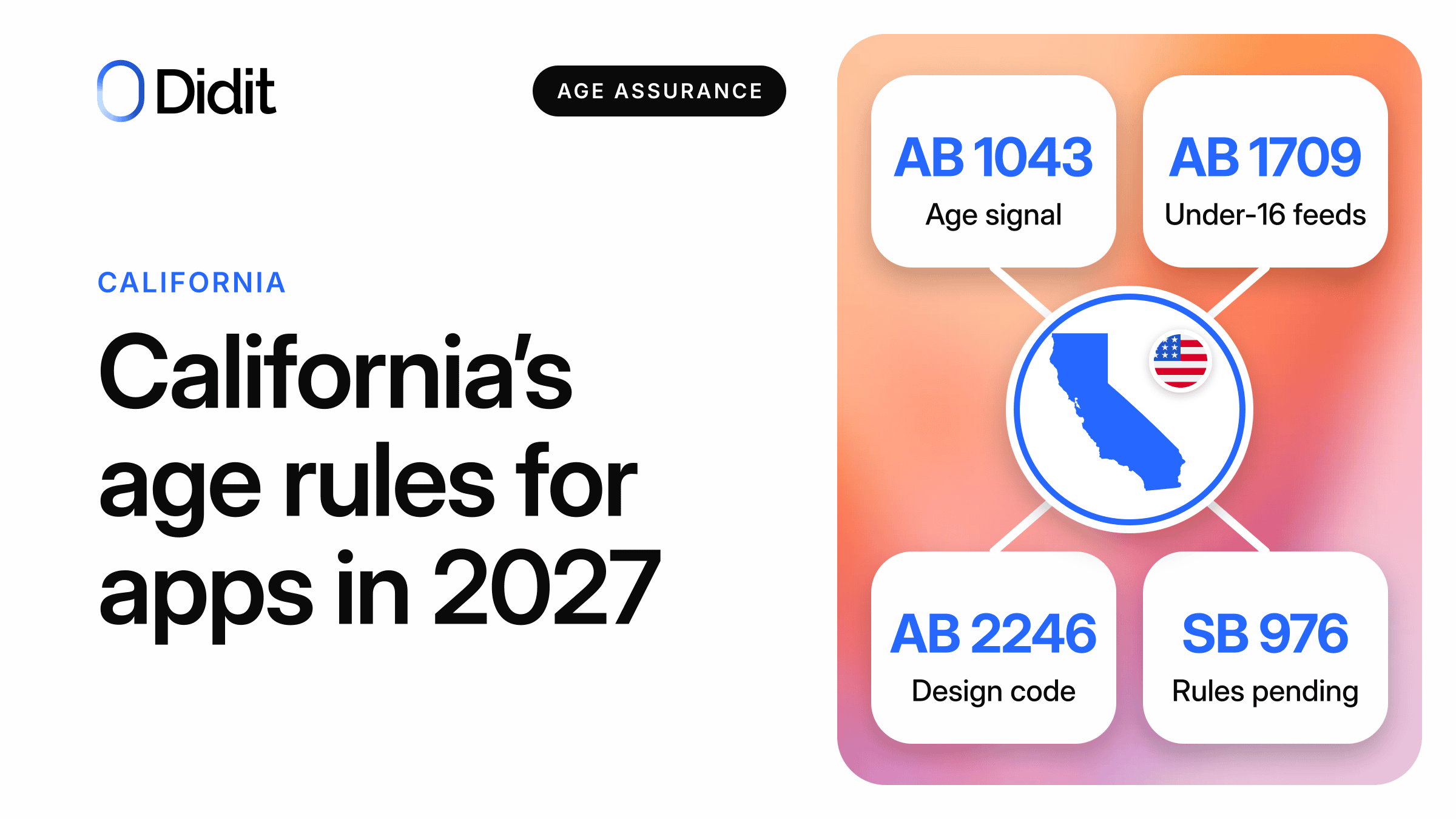
Four California laws, one declared age signal. What apps, games and feeds must do from 1 January and 1 July 2027, where AB 1709 allows your own age determination, and when no extra check is needed.
Alberto RosasNov 22, 2026No age signal? What to do on NOT_SHARED, TIER_A or no answer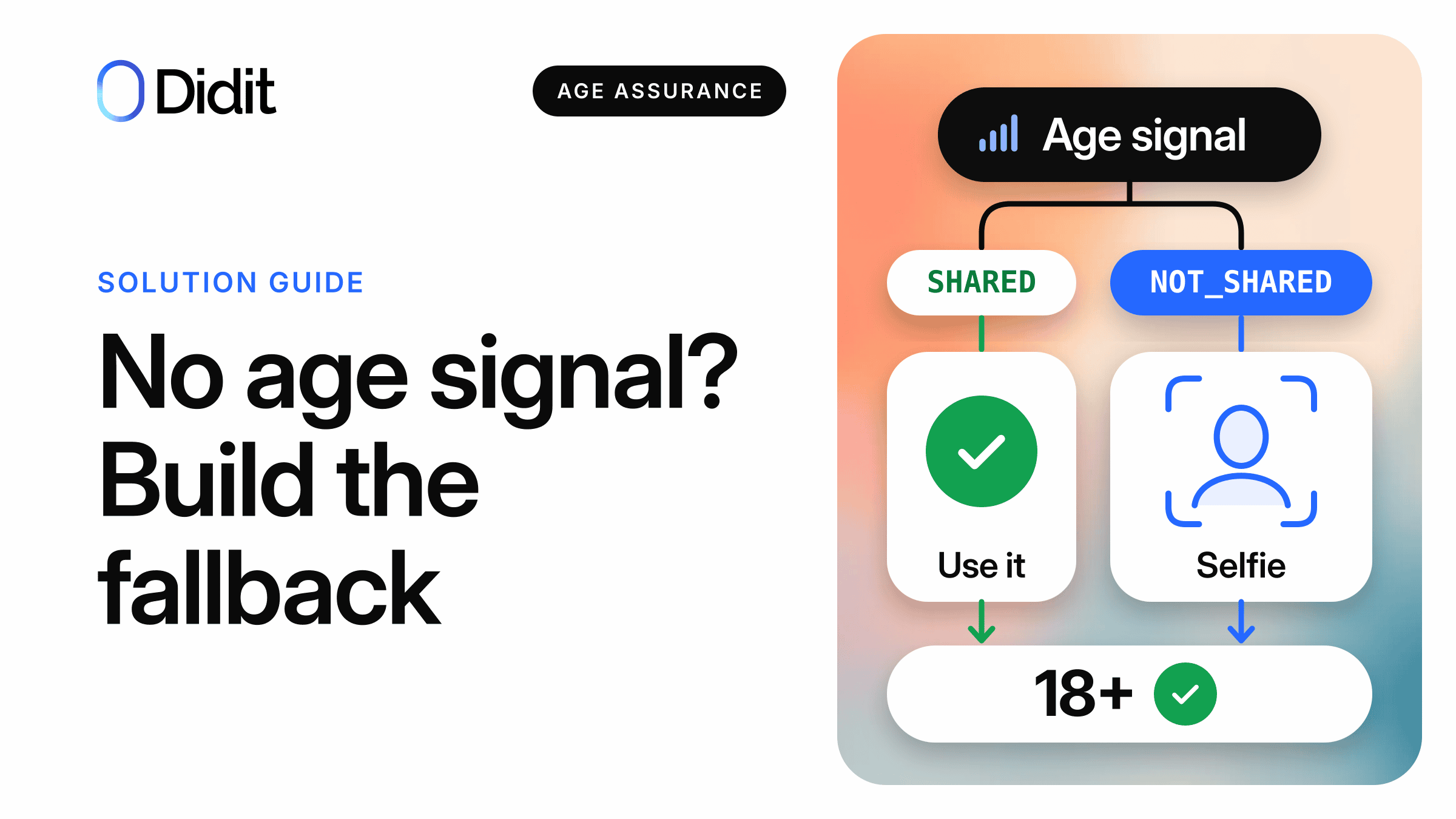
What to build when Google Play gives no usable age: safe defaults, a selfie age estimate with a buffer, a document only in the band, which age wins when they differ, and the cost of each branch.
Alberto RosasNov 22, 2026Google Play Age Signals API: what changes in January 2027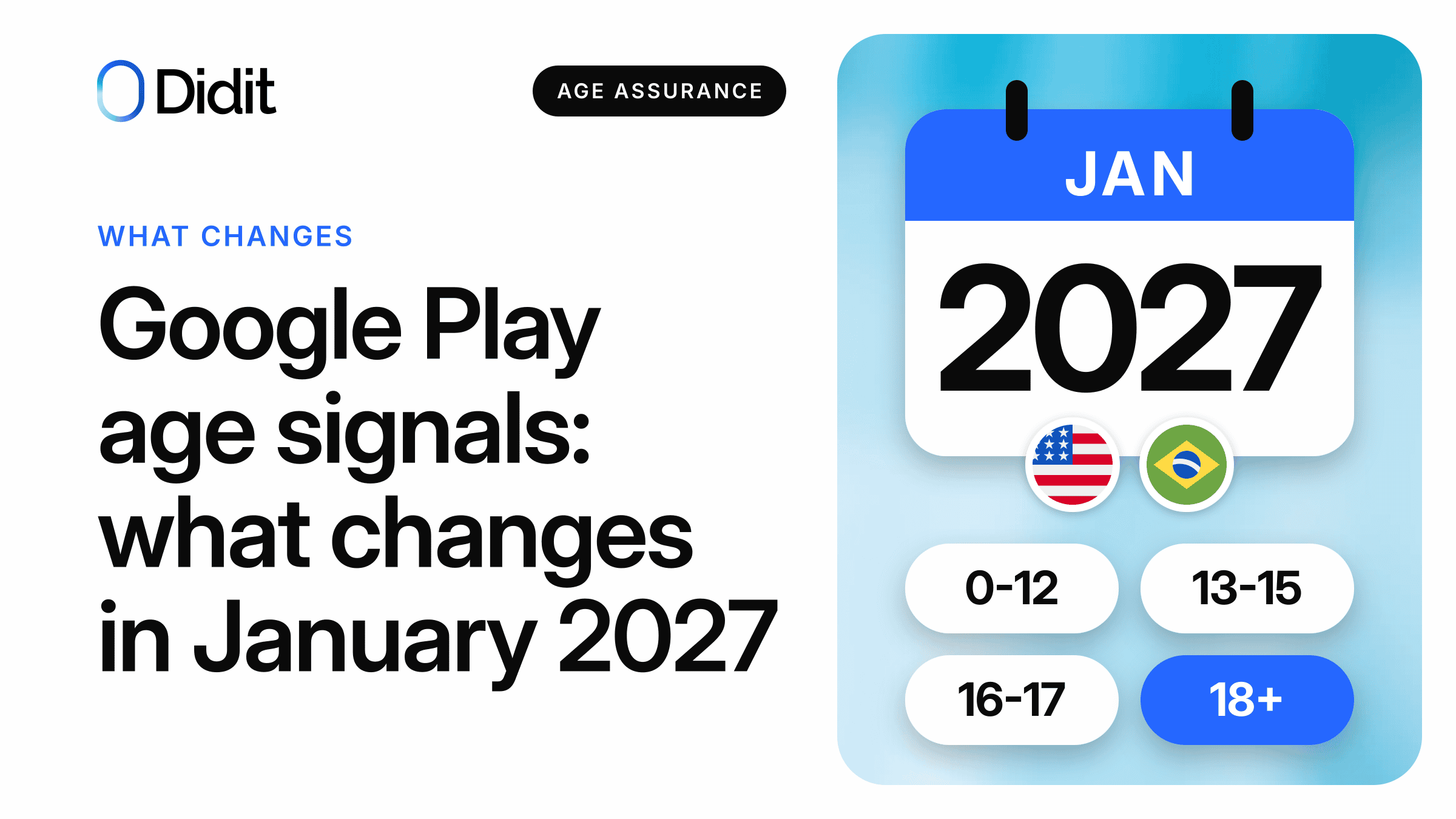
What Google's email on the Play Age Signals API says and does not say: which users are covered, what your app receives, when the signal is enough, and a 30-day plan before 1 January 2027.
Alberto RosasNov 22, 2026Brazil's ECA Digital and Google Play: age signals in your app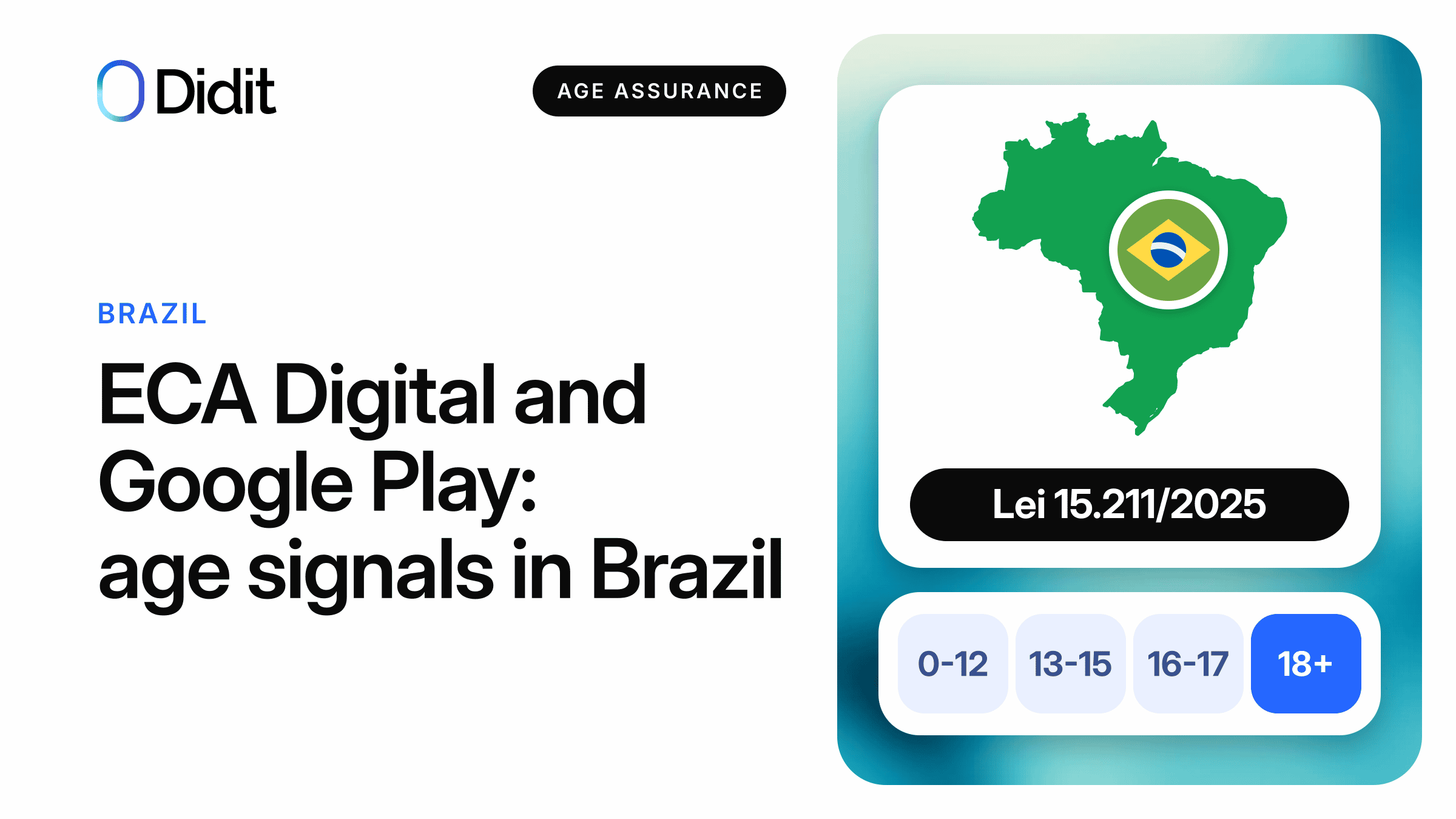
What Google Play sends for users in Brazil, who has to receive it under ECA Digital and Decreto 12.880, when the age signal is enough, and when an app needs its own age check, with the data limits.
Alberto RosasNov 22, 2026Google Wallet ID vs ID document verification: when to use which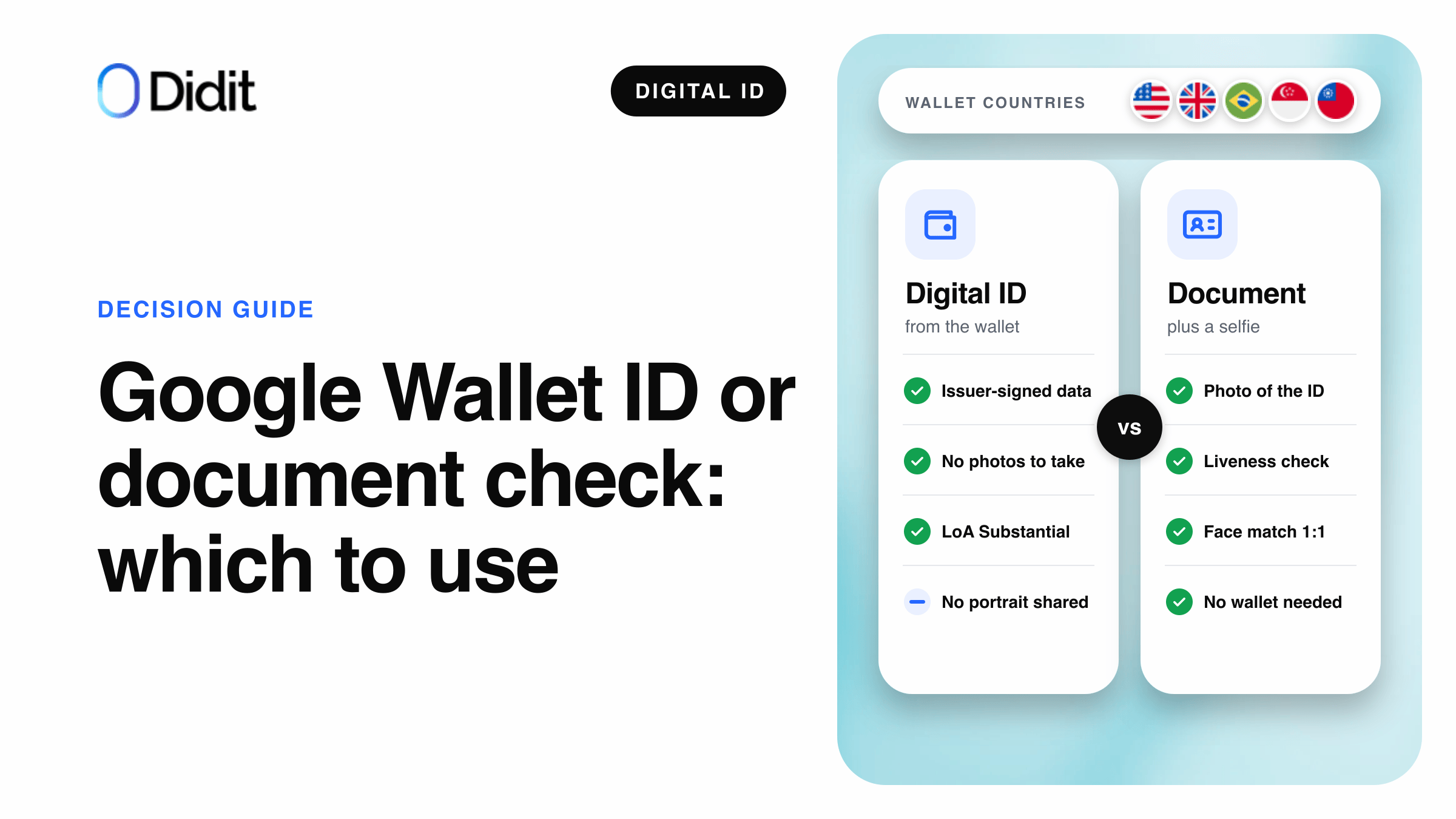
A decision guide for risk and product teams: what a Google Wallet ID proves and what a document check with liveness and face match proves, coverage, cost on Didit, and three workflow patterns.
Alberto RosasNov 20, 2026Digital Credentials API explained: how websites reach ID wallets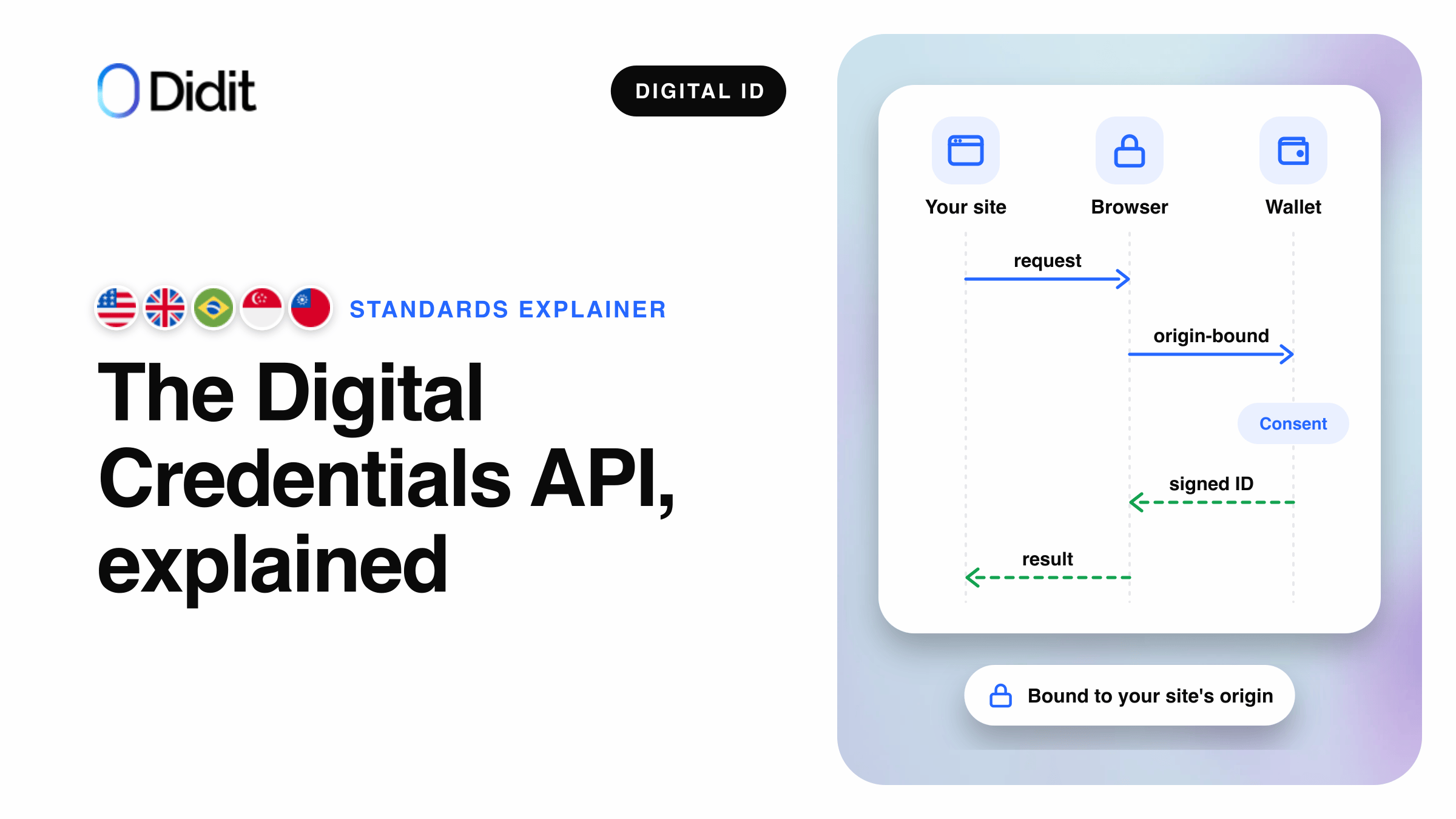
The W3C Digital Credentials API for businesses: how a website asks a wallet for an ID without a redirect, browser support in 2026, cross-device QR, privacy, iframes, and how Didit uses it for Google Wallet.
Alberto RosasNov 20, 2026Accept Google Wallet ID in your onboarding flow: integration guide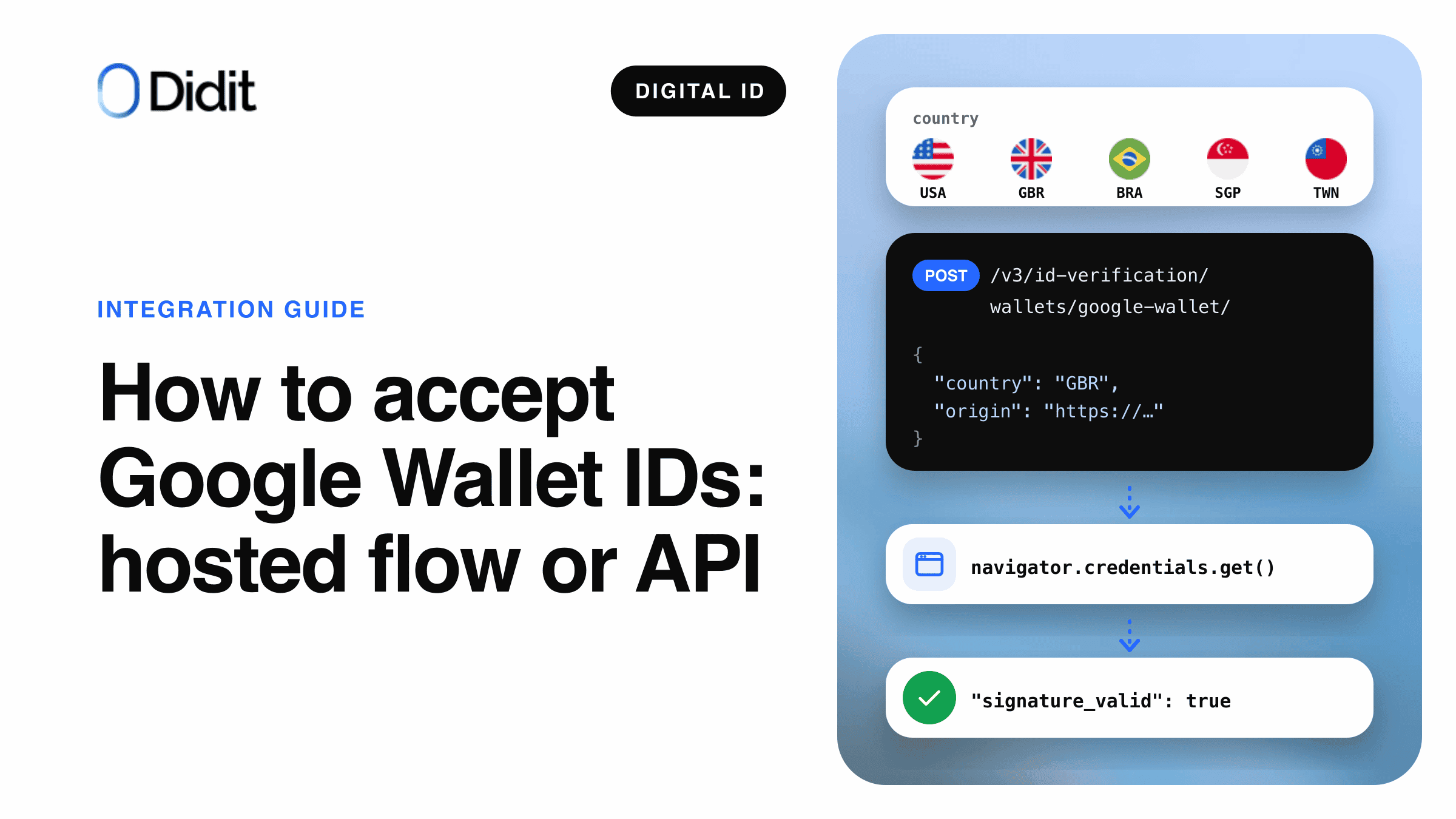
How to accept Google Wallet ID with Didit: sandbox first, Register with Google once, the hosted flow or the standalone API, Android apps, the document fallback and reading a verified result.
Alberto RosasNov 20, 2026Google Wallet ID pass: what businesses receive and where it works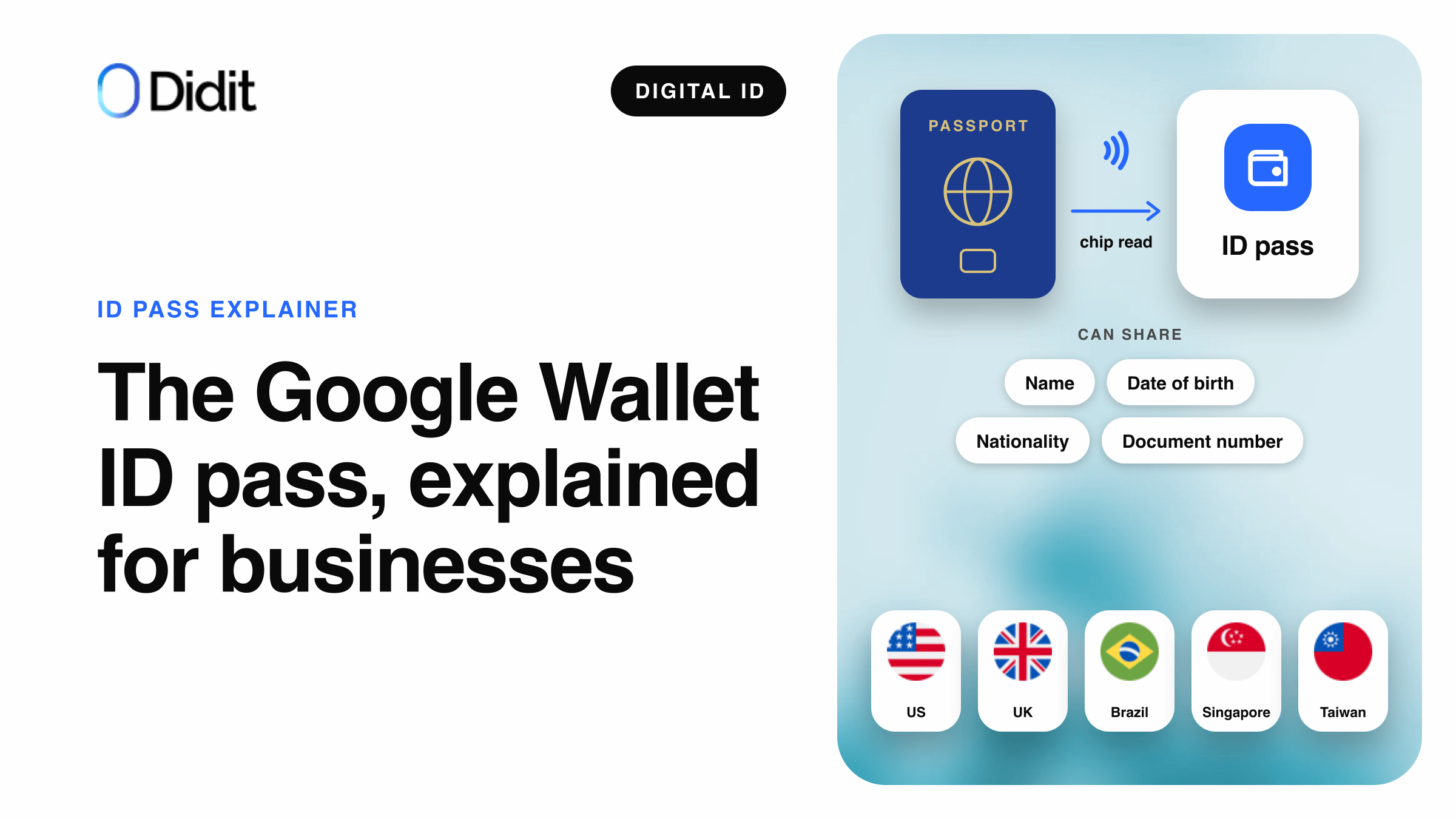
The Google Wallet ID pass explained for businesses: how people create it from a passport, the nine Google regions, how it differs from a mobile driver's license, and what you receive through Didit.
Alberto RosasNov 20, 2026Google Wallet ID verification is live on Didit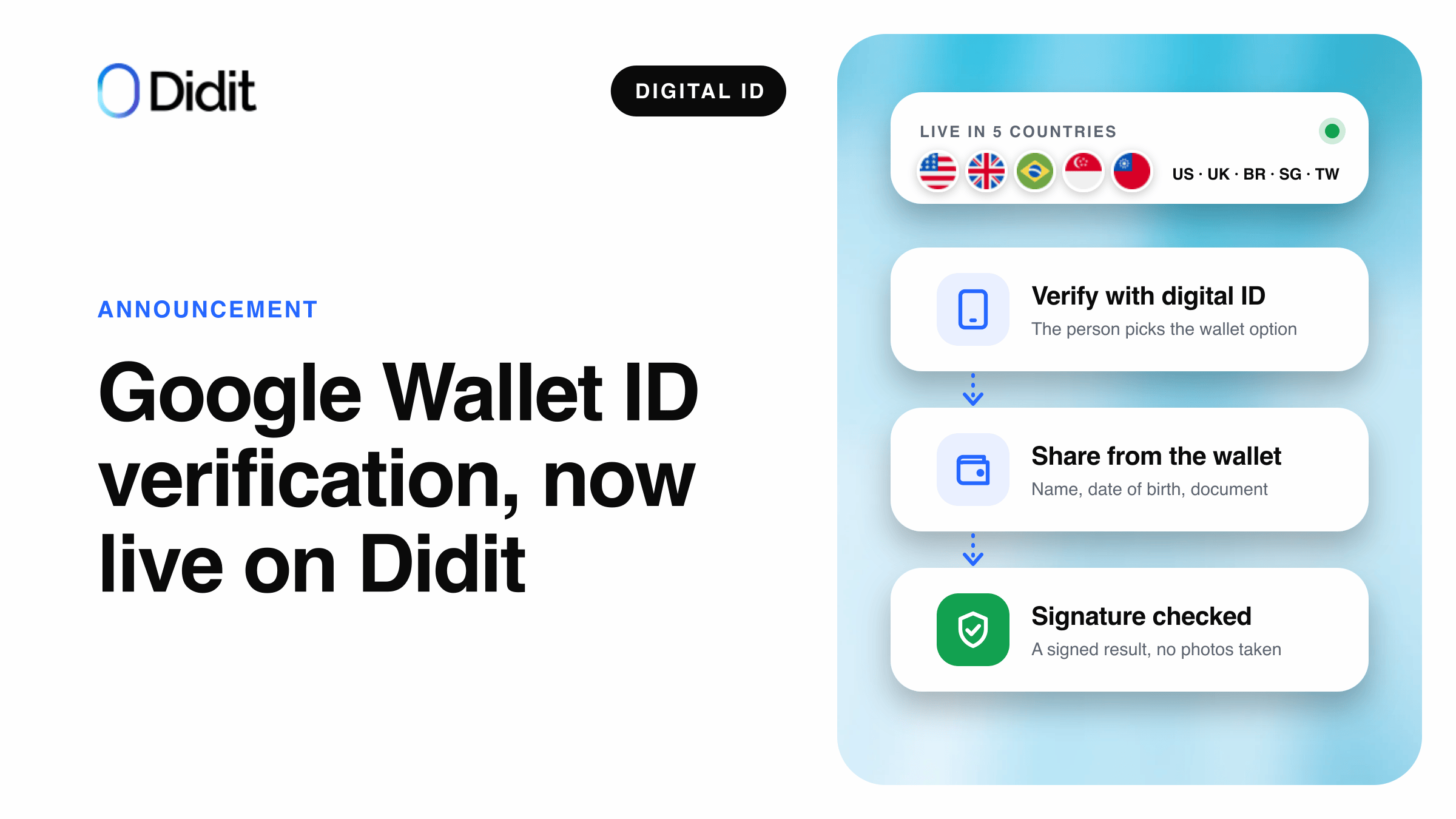
Didit accepts Google Wallet IDs in the US, UK, Brazil, Singapore and Taiwan: ID pass and US mobile driving licences, signed data, Substantial assurance, $0.20 per completed check.
Alberto RosasNov 20, 20267 Best eIDAS Software Platforms in 2026
Compare 7 eIDAS software platforms for identity verification, advanced and qualified signatures, pricing, and evidence validation.
Alberto RosasNov 14, 2026The 10 Best KYC Solutions in 2026
Compare 10 KYC solutions for customer onboarding, screening, and ongoing monitoring, with pricing, cost examples, and practical evaluation criteria.
Alberto RosasNov 14, 2026Product updatesDidit passes iBeta Level 2: 300 attacks, 0 got through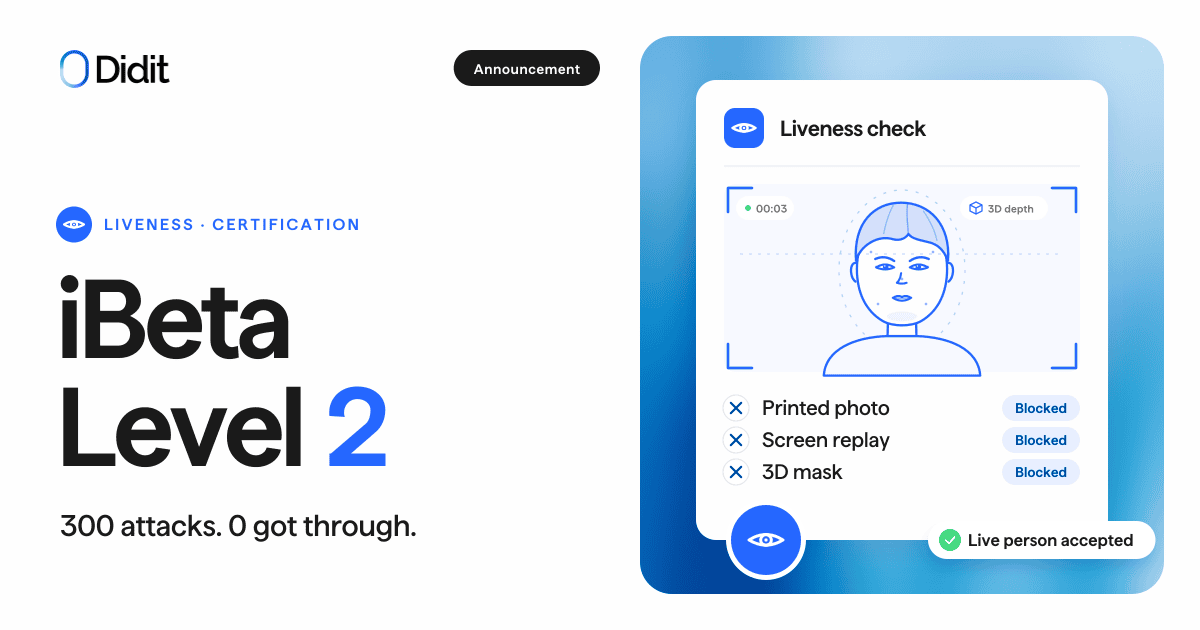
Didit's liveness detection passed iBeta Level 2 presentation attack detection under ISO/IEC 30107-3: 300 attacks, 0 accepted. Alberto Rosas on why proving a real human is behind the screen matters now.
Alberto RosasNov 14, 2026Business7 Best AML Software Platforms in 2026
Compare 7 AML software platforms for screening, ongoing monitoring, and investigations, with pricing and practical criteria for choosing the right fit.
Alberto RosasNov 13, 2026Didit vs ID R&D: IDLive Face liveness or a hosted KYC API
Didit vs ID R&D: compare documented checks, published pricing, review evidence and migration steps. Didit core KYC costs $0.33.
Alberto RosasNov 10, 2026Didit vs TECH5: a hosted KYC API vs biometrics for ID programmes
Compare Didit and TECH5: a hosted identity verification platform with transparent pricing at $0.33 per KYC bundle versus component biometric SDKs and ABIS platforms designed for civil ID deployments.
Alberto RosasNov 10, 2026Didit vs Trust Stamp: published prices vs a quote-led KYC suite
Didit vs Trust Stamp comparison: evaluate transparent per-check pricing, full evidence audit trails, and modular identity infrastructure against sales-led enterprise biometric suites.
Alberto RosasNov 10, 2026BusinessDidit vs FaceTec: Hosted Liveness, Full Evidence, Published Prices
Didit vs FaceTec: Didit is hosted liveness at a published $0.10 passive or $0.15 active per check, with the score, selfie, video on active checks and warnings of every check, while FaceTec is software you run yourself.
Alberto RosasNov 10, 2026Didit vs Nametag: customer KYC API vs workforce identity checks
Compare Didit and Nametag for customer onboarding. Review published per-check pricing, omnichannel KYC coverage, AML screening, and verified government data versus mobile-only workforce identity verification.
Alberto RosasNov 10, 2026Didit vs Keyless: verifying new users vs biometric login
Compare Didit and Keyless (PingOne Recognize) for user verification: full KYC evidence, 1:N face search, and published per-check pricing versus user-based biometric checks.
Alberto RosasNov 10, 2026Didit vs Aware: hosted KYC API vs a biometrics platform
Didit vs Aware: hosted KYC API with transparent $0.33 bundle pricing and unified fraud signals versus Aware's quote-based multimodal biometrics and orchestration platform.
Alberto RosasNov 10, 2026Didit vs Veridas: public per-check prices or a demo-led IDV suite
Didit vs Veridas: compare published $0.33 KYC rates, direct government registries, national digital eIDs, and migration pathways across identity verification platforms.
Alberto RosasNov 10, 2026Didit vs Daon: liveness evidence, published prices, one API
Compare Didit and Daon: inspect hosted liveness with granular evidence, transparent pricing ($0.33 full KYC), and direct console onboarding against Daon's enterprise biometrics suite.
Alberto RosasNov 10, 2026Didit vs IDVerse: per-check prices vs a 12-month contract
Didit provides published per-check KYC at $0.33; the LexisNexis IDVerse pages we checked (25 October 2026) list no per-check price and point buyers to sales.
Alberto RosasNov 10, 2026iProov API Alternative: Didit Liveness at Published Prices
Choose Didit for liveness inside remote onboarding with published prices: passive liveness $0.10 in a workflow, full KYC $0.33, and console sign-up without a sales call.
Alberto RosasNov 10, 2026Didit vs Paravision: a hosted KYC API against liveness components
Didit vs Paravision for solution providers and integrators: a full hosted KYC API at a published $0.33 per check, with AML, monitoring and review on one record, against face SDKs you assemble yourself.
Alberto RosasNov 10, 2026Didit vs Facia: two price lists, one full KYC flow compared
Choose Didit for onboarding: full KYC at $0.33 ($330, $3,300, $16,500 at 1,000, 10,000, 50,000 checks), with AML, transaction monitoring and reviews priced separately on one record. Sourced facts.
Alberto RosasNov 10, 2026Didit vs Identy.io: hosted KYC API vs on-device biometric SDKs
Didit vs Identy.io: compare documented checks, published pricing, review evidence and migration steps. Didit core KYC costs $0.33.
Alberto RosasNov 10, 2026Didit vs Neurotechnology: hosted KYC and MegaMatcher ID compared
Didit vs Neurotechnology: compare documented checks, published pricing, review evidence and migration steps. Didit core KYC costs $0.33.
Alberto RosasNov 10, 2026Didit vs BioID: a hosted KYC flow against a biometrics API
Didit vs BioID: compare documented checks, published pricing, review evidence and migration steps. Didit core KYC costs $0.33.
Alberto RosasNov 10, 2026EUDI Wallet cross-border acceptance: one integration across the EU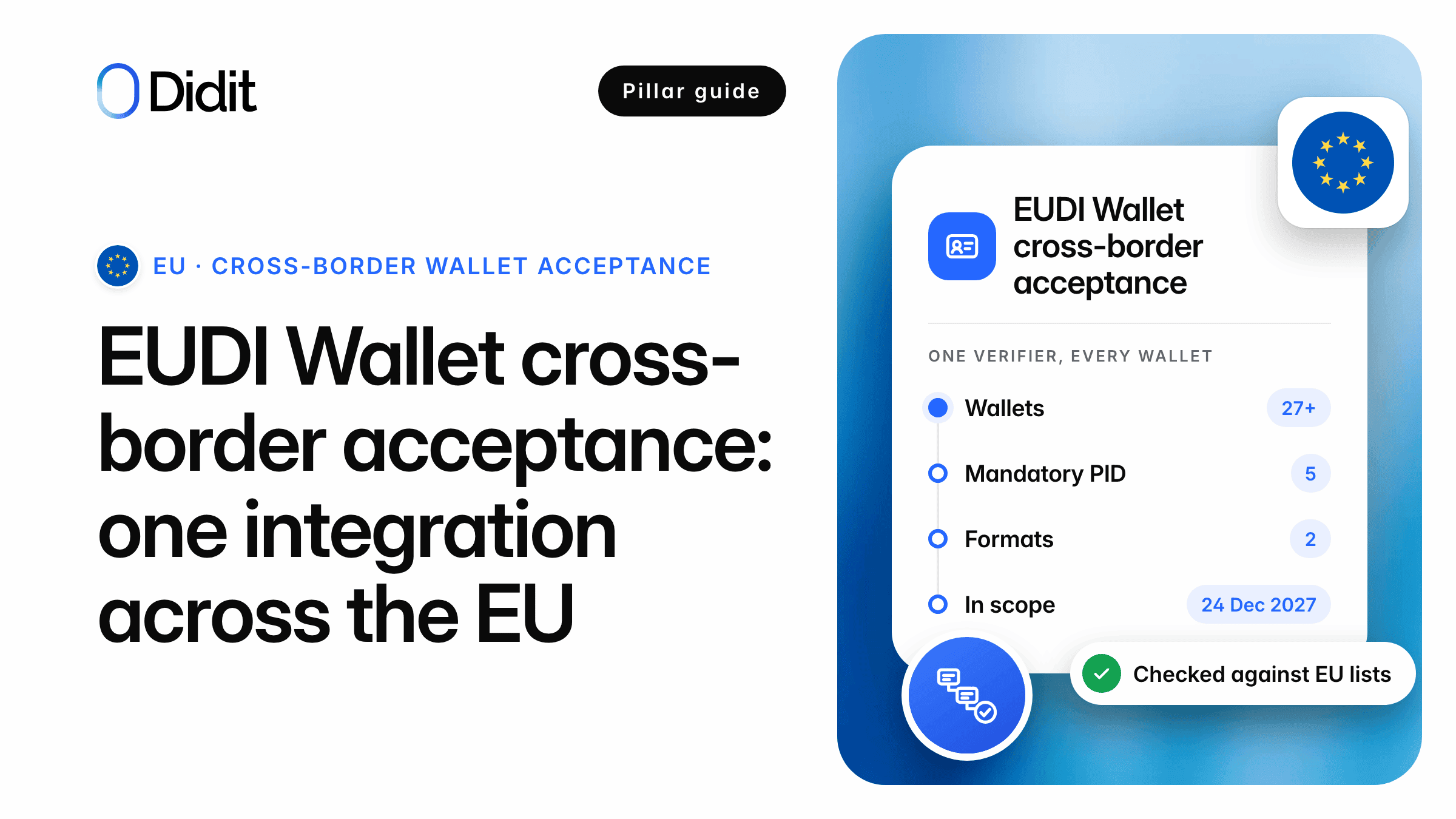
How to accept every national EUDI Wallet with one integration: the real trust lists, PID attributes that differ by country, name normalisation, identity matching, formats, testing and what to do when a country is late.
Alberto RosasOct 31, 2026EUDI Wallet readiness: policies and controls for regulated firms
The EUDI Wallet readiness guide for regulated firms: 13 control domains, a control matrix with owners and evidence, an AMLR Article 22 map and a plan to 24 December 2027, based on the July 2026 amending acts and ARF v3.0.0.
Alberto RosasOct 31, 2026EUDI Wallet holder binding: what a presentation really proves
The possession problem explained from primary text: what a wallet presentation proves, what ARF v3.0.0 says on User binding and the portrait, a threat table, and a risk-based step-up design for regulated teams.
Alberto RosasOct 31, 2026EUDI Wallet integration: how to choose your route (2026 guide)
EUDI Wallet integration compared: four routes, what an intermediary may and may not do under Article 5b(10), the certificate model since 2026/1730, vendor questions, and what stays with you.
Alberto RosasOct 31, 2026FINTRAC identity verification in 2026: methods, rules, C-12
FINTRAC identity verification explained from the official texts: the five methods, remote photo ID in two steps, agents since October 2025, beneficial owners, PEPs, records, Bill C-12 penalties and a 30-day plan.
Alberto RosasOct 31, 2026Quebec Law 25 and biometrics: identity verification guide (2026)
Quebec Law 25 and biometric identity verification: the s. 44 CAI declaration and express consent, the s. 45 database rule, the s. 17 assessment for vendors, penalties, CAI decisions, OPC guidance and a buyer checklist.
Alberto RosasOct 31, 2026FINTRAC MSB KYC requirements for crypto and payment firms (2026)
FINTRAC MSB rules for crypto, stablecoin and payment firms in Canada: registration, the CAD 1,000 KYC trigger, CAD 10,000 virtual currency reports, the travel rule, RPAA, penalties and an onboarding flow.
Alberto RosasOct 31, 2026Age verification in Canada: S-209, C-34 and what to do now
Age verification in Canada on 31 October 2026: Bills S-209 and C-34 section by section, the OPC age assurance guidance, Ontario and Alberta iGaming, Quebec's digital majority, methods and a checklist.
Alberto RosasOct 31, 2026The Binance breach shows the gap: a key proves a device, not a person
Binance traced a ~$6.3B incident to a compromised engineer's laptop. Why passkeys and hardware keys alone can't stop that kind of attack, and how to bind withdrawals, permission changes and account recovery to a live, verified…
Alberto RosasOct 30, 2026AI labs are buying human data. Fraud rings are selling it.
AI labs pay for human data, and fraud rings sell fake and rented contributor accounts into it. How the rings work, why it is hard, and how Didit verifies every contributor at signup, every session and every payout.
Alberto RosasOct 29, 2026Didit vs Unit21: KYC, KYB, AML and monitoring on one record
Didit vs Unit21 comparison: native identity verification, business verification, AML screening, and transaction monitoring on a single record with published per-use pricing.
Alberto RosasOct 26, 2026Didit vs Trinsic: eID sign-in plus document checks, AML and KYB
Choose Didit for eID onboarding with document, face and AML checks: $0.33 published full KYC, six live national eIDs, database validation in 45 countries plus a Global group and monitoring on one record.
Alberto RosasOct 26, 2026Didit vs Thomson Reuters: government databases plus the whole flow
Choose Didit over Thomson Reuters CLEAR for onboarding at volume: published $0.33 full KYC, government database validation in 45 countries plus a Global group, AML, KYB and monitoring on one record.
Alberto RosasOct 26, 2026Didit vs Regula: hosted checks with full evidence, KYB and monitoring
Choose Didit for hosted KYC at a published $0.33 per check ($330, $3,300, $16,500 at 1,000/10,000/50,000), with KYB, AML and transaction monitoring on one record. Regula licences are quote-based.
Alberto RosasOct 26, 2026Top 10 AI compliance agents for KYC and AML review automation in 2026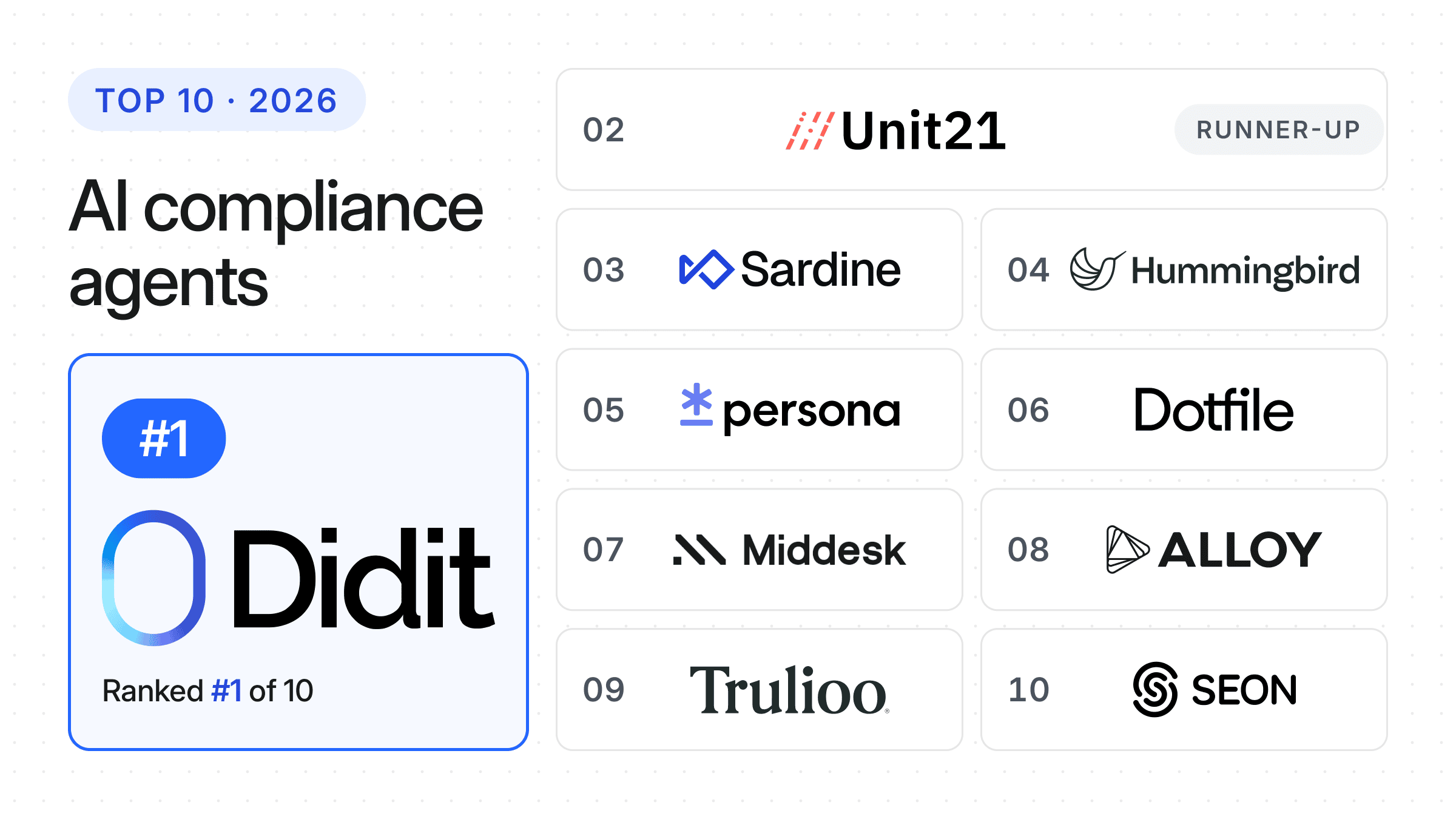
Compare ten AI-assisted compliance products by review scope, decision authority, agent tooling and published cost. Didit Investigator costs $0.20 per reviewed item.
Alberto RosasOct 25, 2026Top 5 Travel Rule compliance solutions for crypto businesses in 2026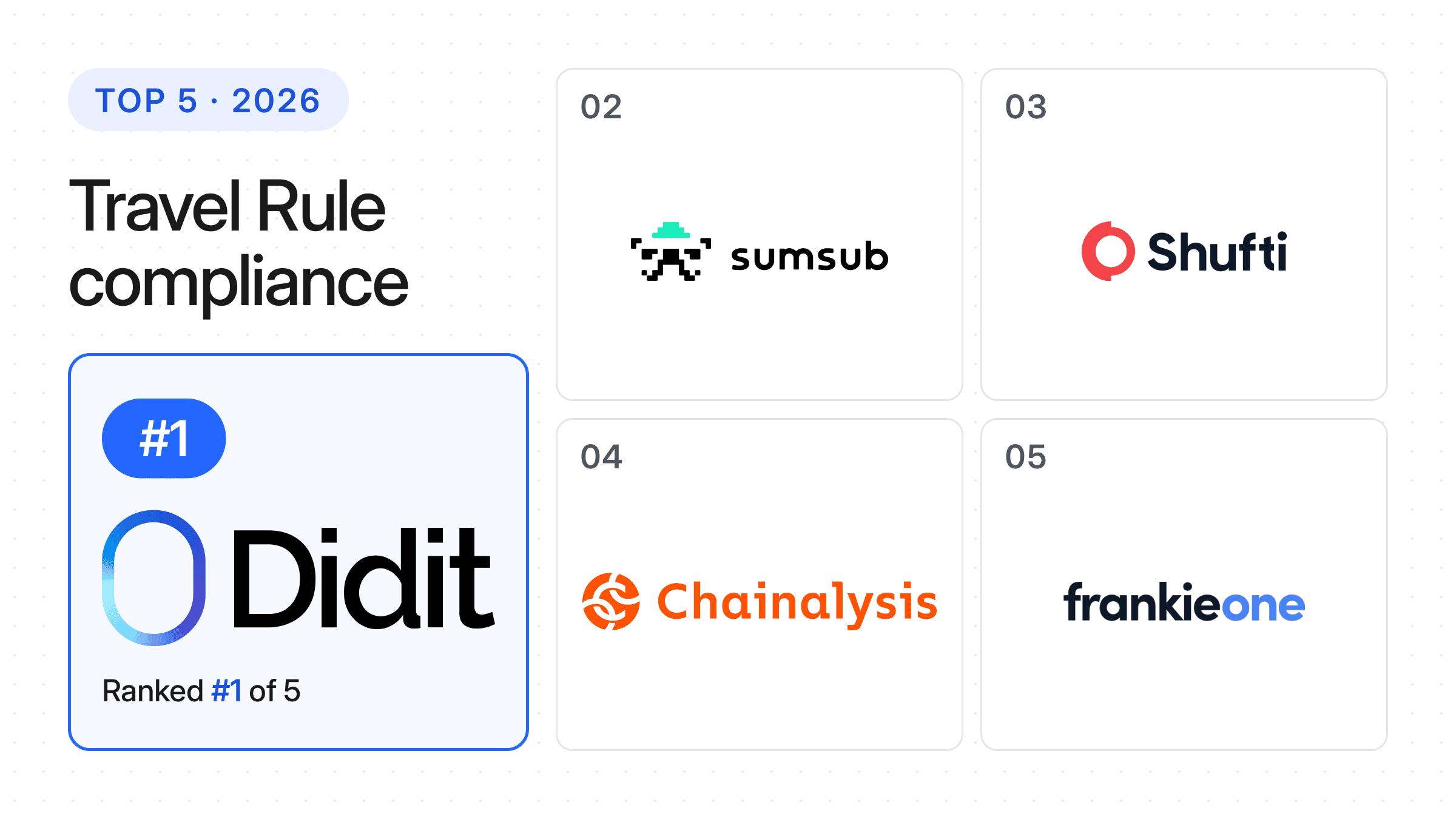
Compare the top 5 crypto Travel Rule solutions in 2026 for FATF R.16 and EU TFR compliance across IVMS 101 messaging, counterparty reach, wallet screening, KYC, and documented pricing models.
Alberto RosasOct 25, 20268 Best EUDI Wallet Software Platforms in 2026
Compare 8 EUDI Wallet software platforms by live national eIDs, sandbox evidence, production access, wallet credentials, and pricing.
Alberto RosasOct 25, 2026The 10 Best AMLR Software Platforms in 2026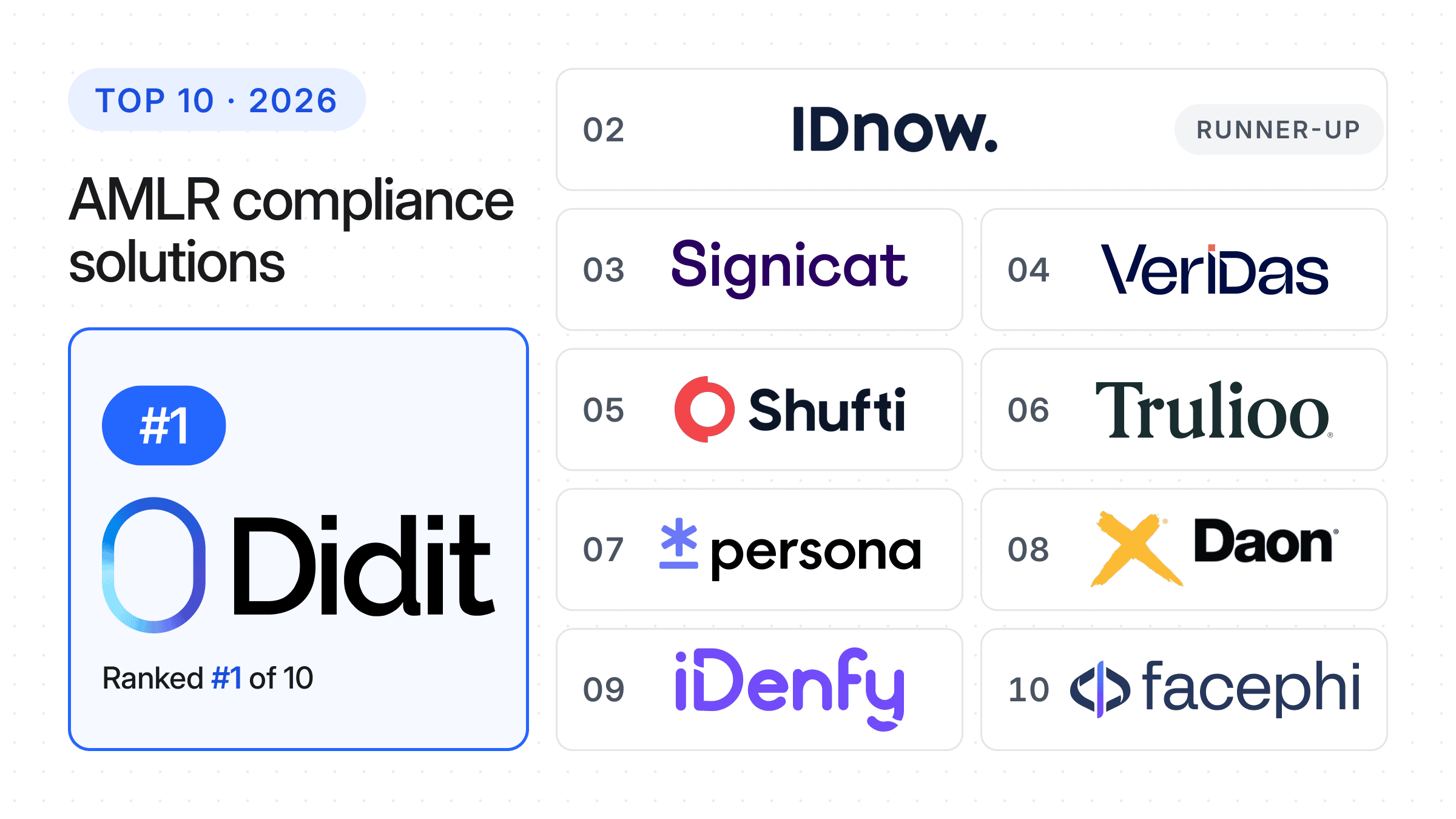
Compare 10 AMLR software platforms for KYC, KYB, screening, ongoing monitoring, transaction monitoring, pricing, and evidence management.
Alberto RosasOct 25, 2026Didit vs Middesk: KYB with a linked KYC for every owner
Didit vs Middesk: compare documented checks, published pricing, review evidence and migration steps. Didit core KYC costs $0.33.
Alberto RosasOct 25, 2026Didit vs LexisNexis: connected checks with public prices
Compare Didit and LexisNexis Risk Solutions: published $0.33 KYC pricing, direct government database validation in 45 countries, KYB, transaction monitoring, and AI agents in one unified compliance platform.
Alberto RosasOct 25, 2026Didit vs Hummingbird: alerts, cases and FIU reports in one account
Didit vs Hummingbird: compare documented checks, published pricing, review evidence and migration steps. Didit core KYC costs $0.33.
Alberto RosasOct 25, 2026Didit vs Hopae: the full verification stack, not an eID add-on
Didit vs Hopae: compare documented checks, published pricing, review evidence and migration steps. Didit core KYC costs $0.33.
Alberto RosasOct 25, 2026Didit vs FrankieOne: one platform or an orchestration layer
Compare Didit and FrankieOne: direct verification vs third-party routing. Evaluate published per-check pricing, workflow autonomy, unified records, and AI compliance.
Alberto RosasOct 25, 2026Didit vs Dotfile: KYB with a native KYC for every owner
Choose Didit for KYB: business verification from $2.00, a linked $0.33 KYC for every owner, AML and monitoring on one record, with published prices, public proof and a pilot-first migration path.
Alberto RosasOct 25, 2026Didit and Chainalysis: bring your key or pay as you go
Bring your Chainalysis key into Didit, or start wallet screening at $0.15 per check. Connect wallet risk to KYC, AML, transaction monitoring and agents.
Alberto RosasOct 25, 2026Didit vs AuthenticID: what changed after Incode, and the options
AuthenticID is now part of Incode with no published per-check pricing. Compare Didit's published $0.33 KYC bundle, direct government databases, AML, KYB, and AI agents on a unified compliance platform.
Alejandro RosasOct 24, 2026Mexico's 30-day decree report: age assurance methods and template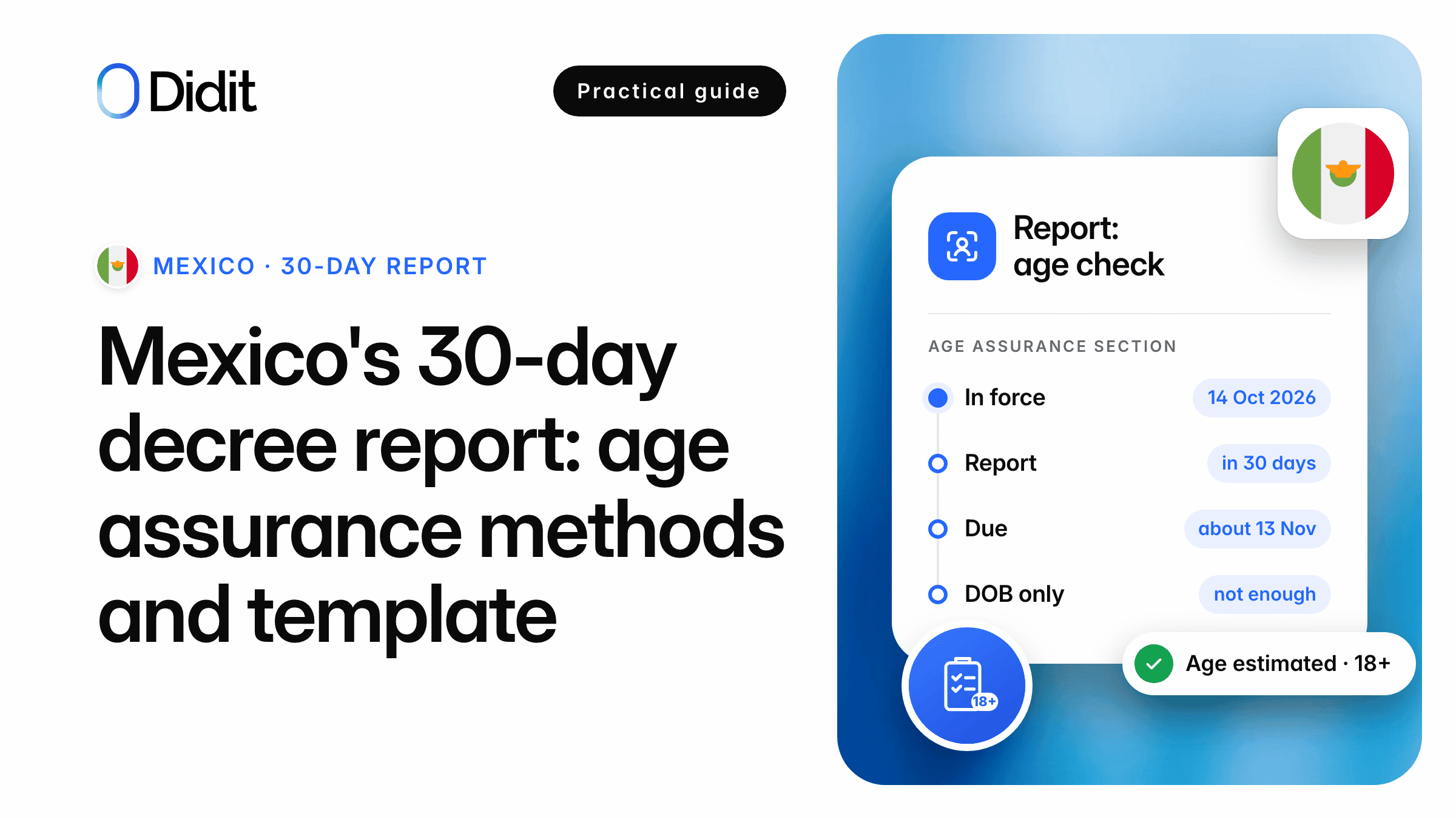
How to write the age assurance part of the report Mexico's decree requires by about 13 November 2026: methods compared, a step-up flow, existing accounts, data rules, a fill-in template and a checklist.
Alberto RosasOct 24, 2026Mexico age verification decree: what platforms must do (2026)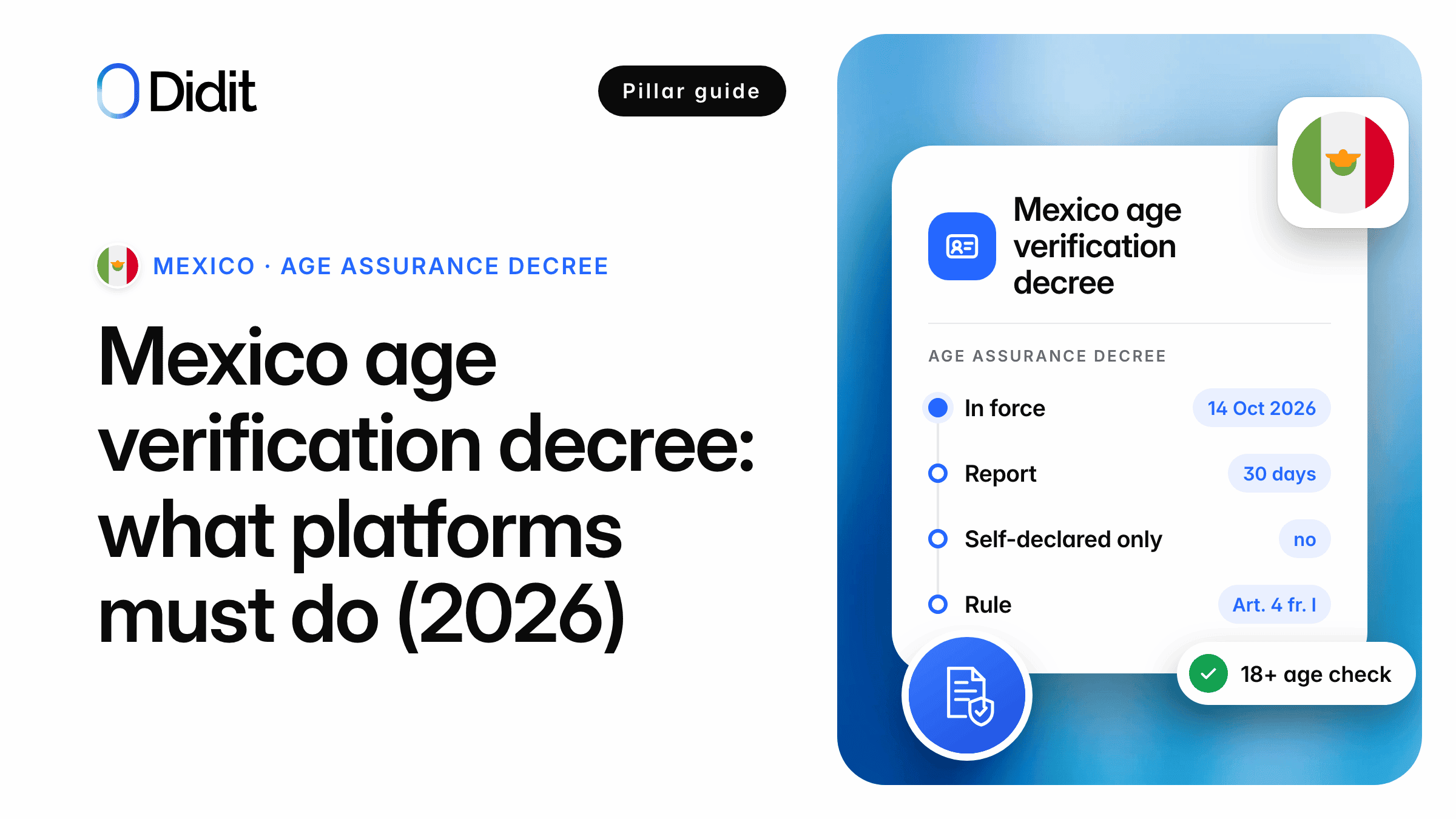
Mexico's decree on safe digital environments explained article by article: who is covered, the age verification duty beyond self-declaration, the 30-day report due about 13 November 2026, data protection and a 30-day plan.
Alberto RosasOct 24, 2026Age verification in Mexico for games, social media and app stores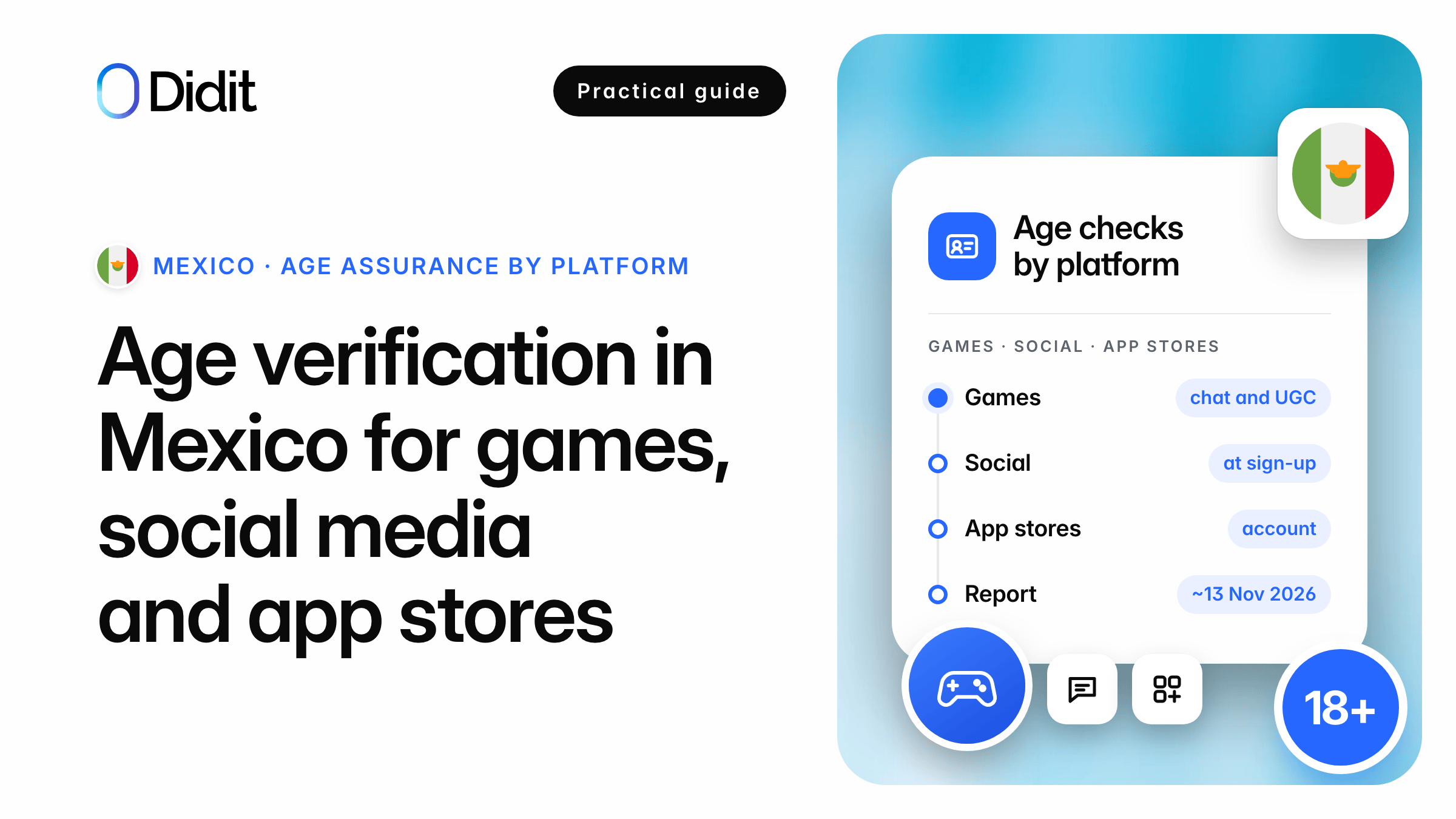
How social networks, video games, app stores, marketplaces, dating, streaming and edtech platforms implement age checks under Mexico's 14 October 2026 decree: flows, methods, defaults and Art. 5 evidence.
Alberto RosasOct 24, 2026Didit vs Persona: key differences in price, plans and scope
Didit vs Persona compared from each vendor's public pages: per-check prices against plans and contract terms, the free start, coverage, liveness, AML, KYB, transaction monitoring and integration.
Alberto RosasOct 23, 2026Didit vs Veriff: key differences in price, coverage and scope
Didit vs Veriff from each vendor's public pages: Didit's per-check prices against Veriff's plan minimums, plus coverage, liveness, AML, KYB and transaction monitoring on one API, and how to switch.
Alberto RosasOct 23, 2026Sanctions screening in Switzerland: SECO vs EU, UN and OFAC lists
How to run sanctions screening in Switzerland: SECO, EU, UN and OFAC lists compared, the 50% ownership test, name matching, false positives, monitoring, and what to do on a true hit.
Alberto RosasOct 22, 2026Swiss AML and KYC requirements: AMLA, FINMA and SRO rules
The Swiss AML and KYC rules after the 1 October 2026 reform: who is in scope, FINMA or an SRO, remote onboarding under Circular 2016/7, beneficial owners, PEPs, MROS reports, SECO screening and a checklist.
Alberto RosasOct 22, 2026SECO sanctions list: how the Swiss sanctions list works (2026)
The SECO sanctions list explained: the Embargo Act, how Switzerland adopts UN and EU sanctions, SESAM search and XML, freezing and reporting duties, the 50% rule, penalties and a screening checklist.
Alberto RosasOct 22, 2026Vietnam e-commerce law: KYB for sellers, livestreamers and affiliates
What Vietnam's e-commerce law and Decree 320/2026 ask about sellers, livestream sellers and affiliates, the data for each seller type, company and owner checks, and an onboarding flow.
Alberto RosasOct 10, 2026Decree 320/2026: VNeID account verification for platforms in Vietnam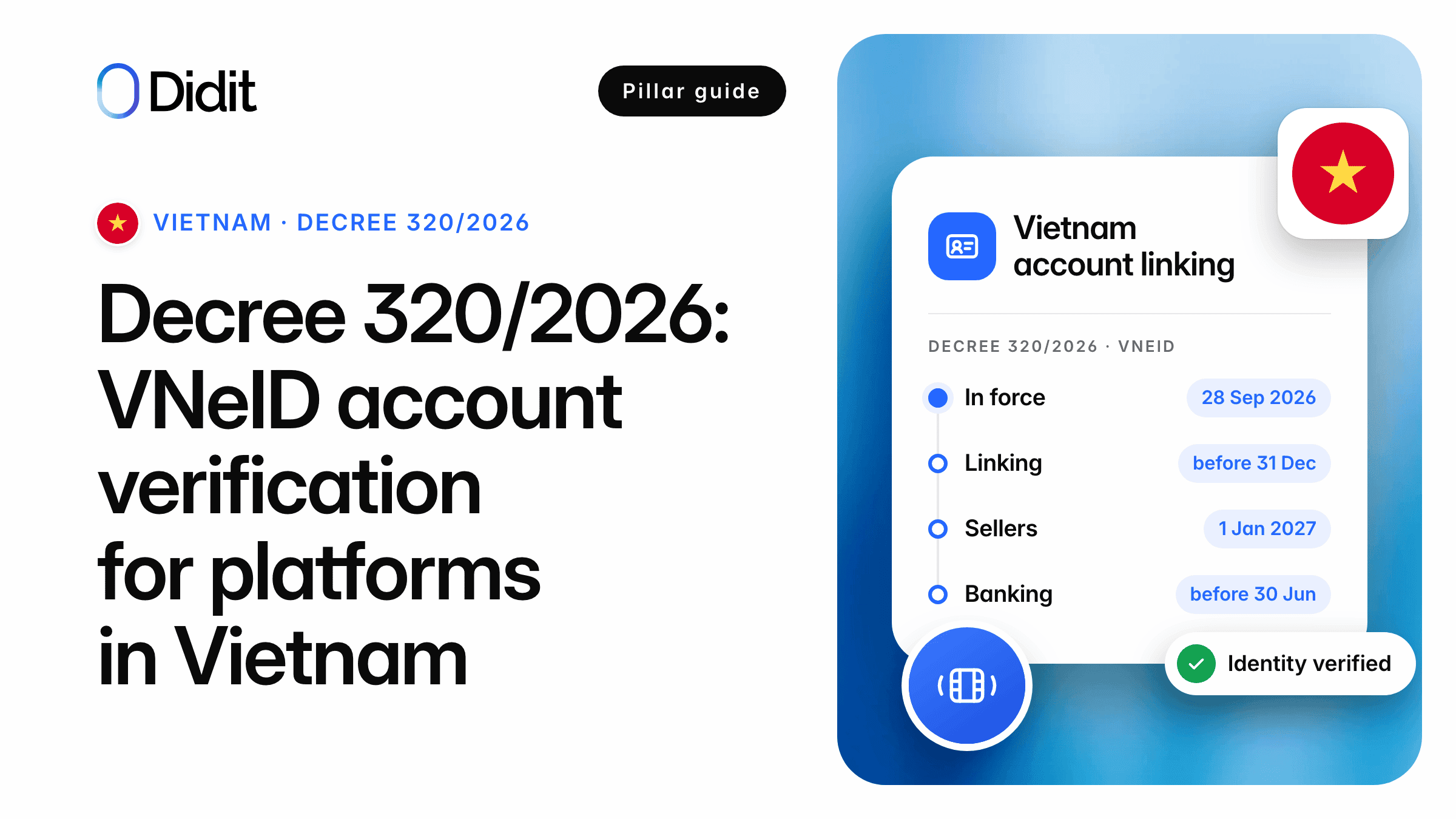
What Decree 320/2026/ND-CP asks of social networks and e-commerce platforms in Vietnam: which accounts must link to an e-identification account, the deadline before 31 December 2026, data rules and a migration plan.
Alberto RosasOct 10, 2026Vietnam ID card verification: reading the CCCD chip with NFC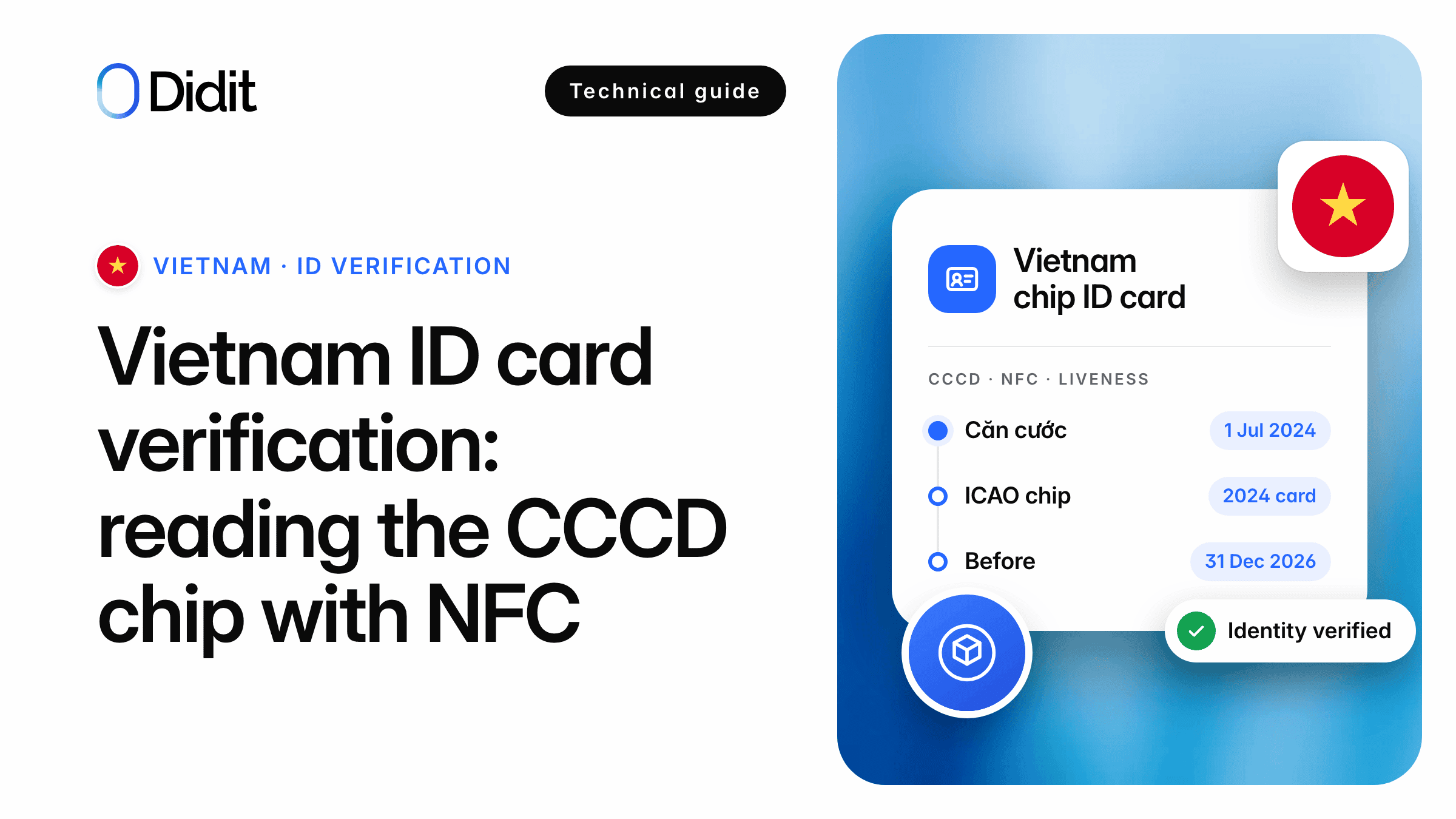
How to verify Vietnam's chip ID card (CCCD and the 2024 thẻ căn cước): what the chip holds, NFC reading, passive authentication, liveness and face match, failure modes, and where it sits next to VNeID.
Alejandro RosasOct 10, 2026MiCA regulation in 2026: the EU crypto compliance guide to 2028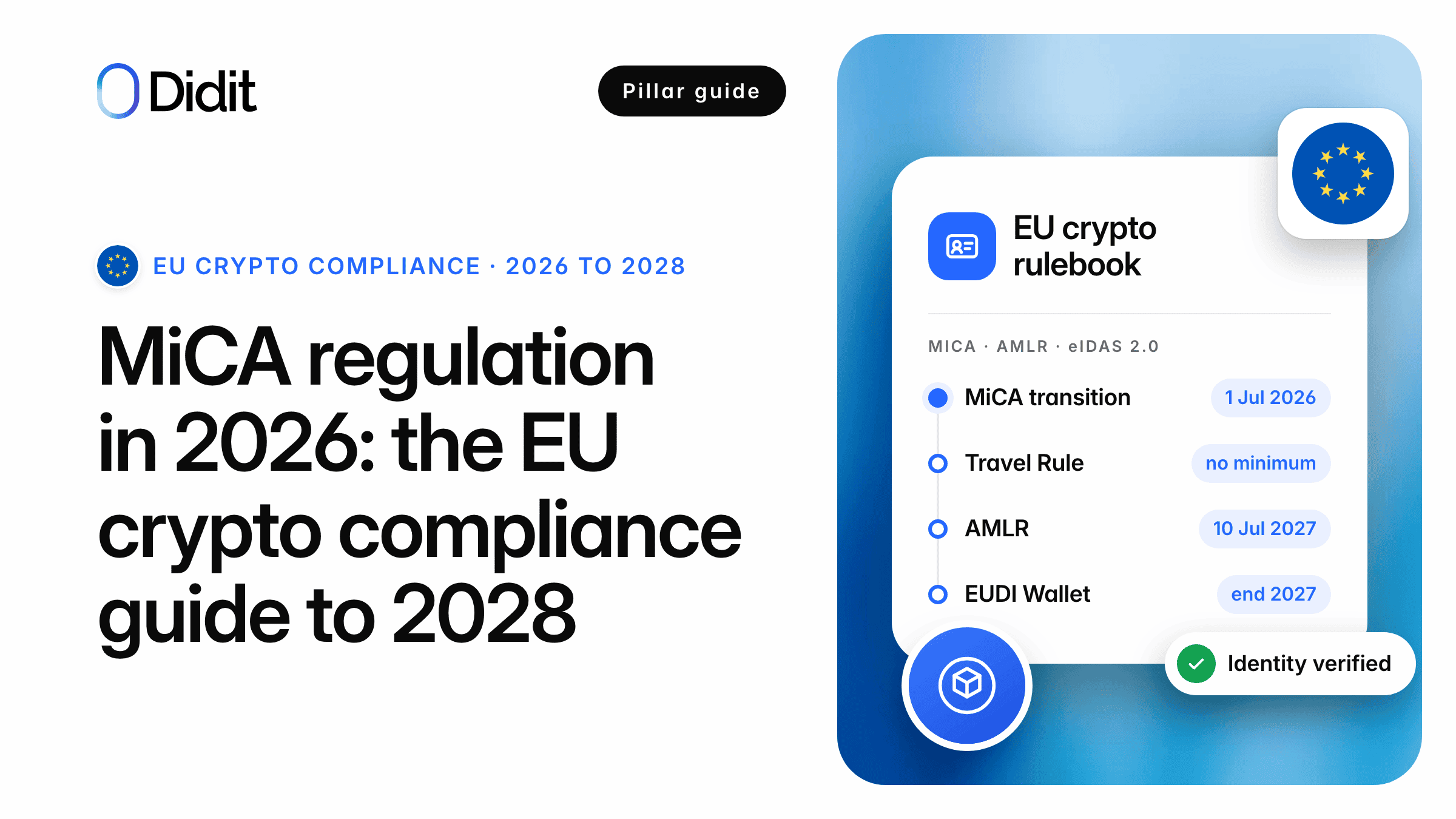
What the MiCA regulation, the crypto Travel Rule, the AMLR with AMLA's draft due diligence standards and eIDAS 2.0 ask of a crypto business in the EU from 2026 to 2028, with articles, a cheat sheet and a plan.
Alberto RosasOct 7, 2026Companies House identity verification: Insolvency Service convictions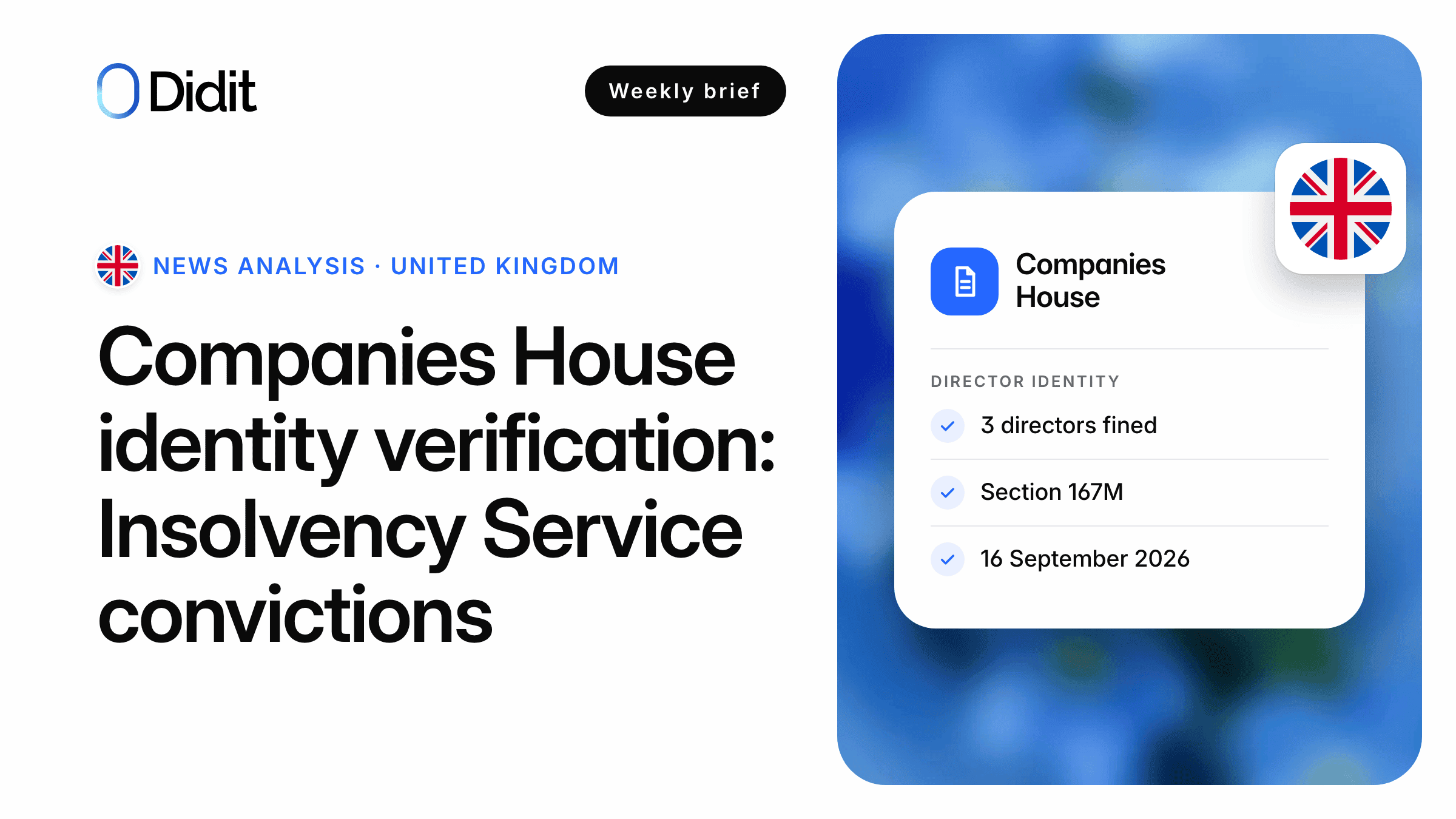
Three UK directors were fined on 16 September 2026 in the Insolvency Service's first Companies House identity verification convictions. One was verified himself. The law, the dates, the numbers and a board checklist.
Alberto RosasOct 6, 2026Privacy coin regulation after FinCEN drops its mixing rule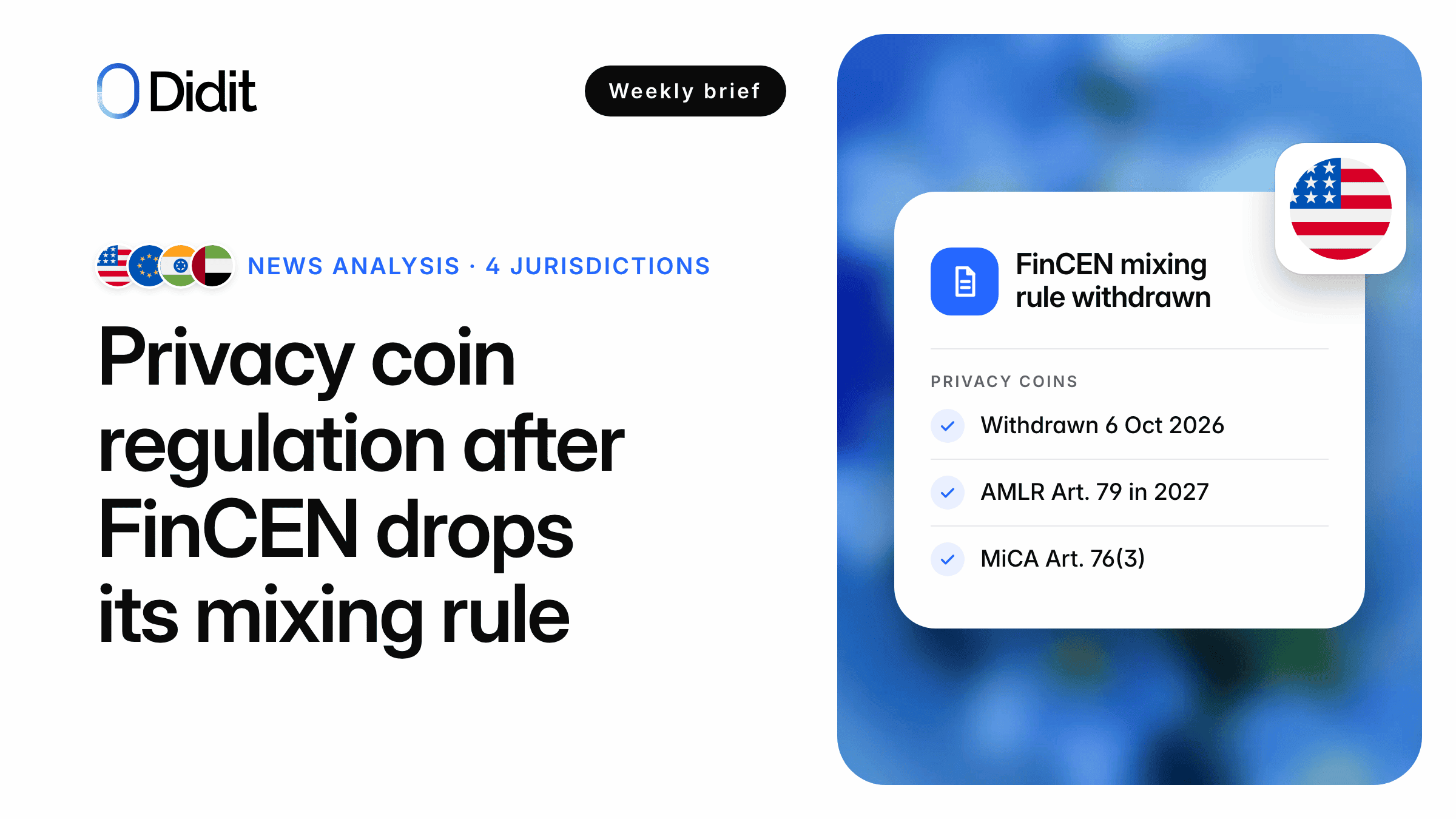
FinCEN withdrew its crypto mixing and unhosted wallet proposals on 6 October 2026. What still binds firms in the US, EU, Canada, India and Dubai, and what to do before AMLR Article 79 applies in July 2027.
Alberto RosasOct 6, 2026OSC Argosy decisions: KYC risk tolerance and a suspended UDP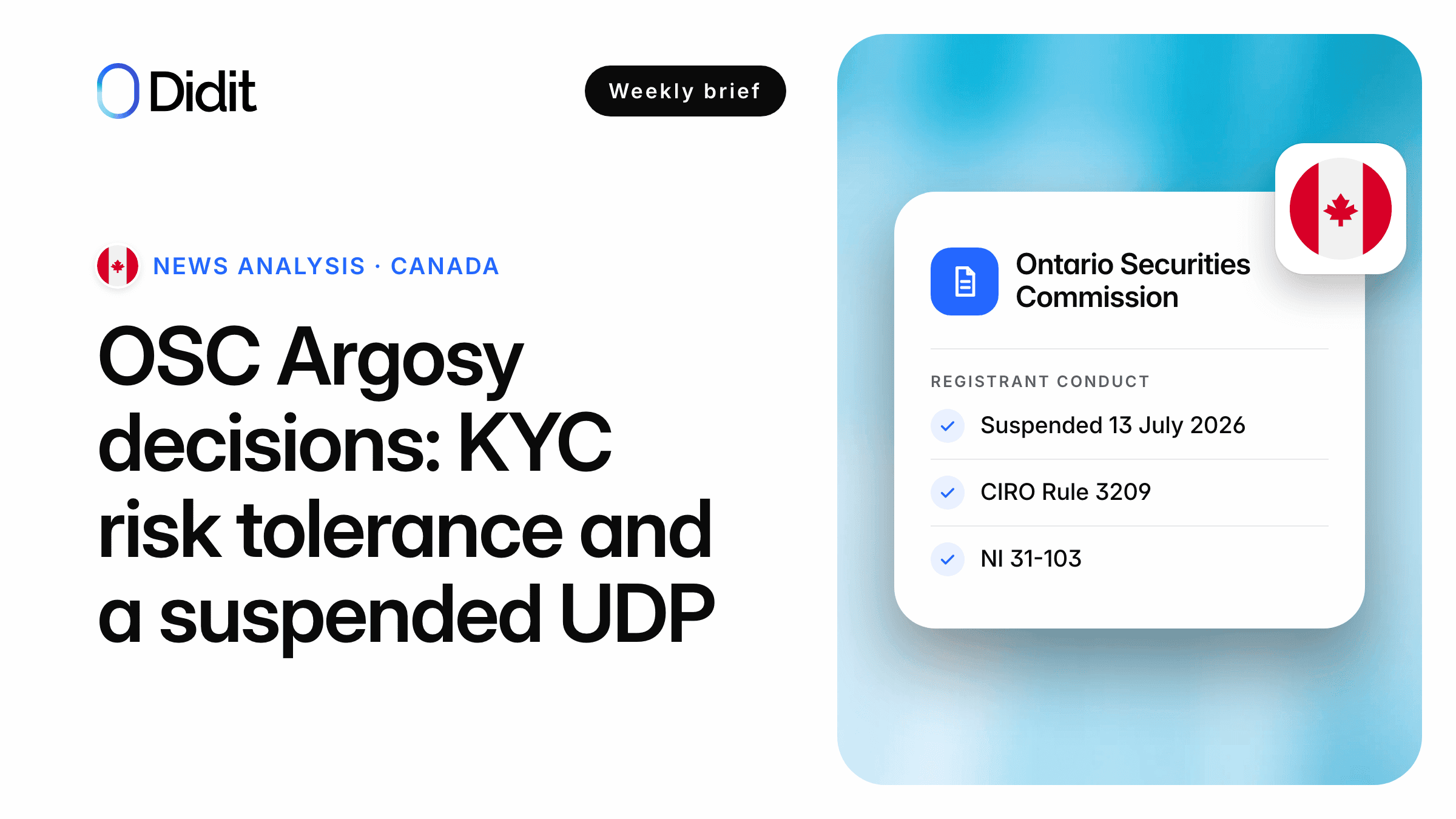
Two Ontario Securities Commission decisions on Argosy Securities: a representative suspended after misstating clients' risk tolerance, the firm's top executive suspended, and what compliance teams should check.
Alberto RosasOct 6, 2026FinCEN verifiable digital credentials: mDLs under the CIP Rule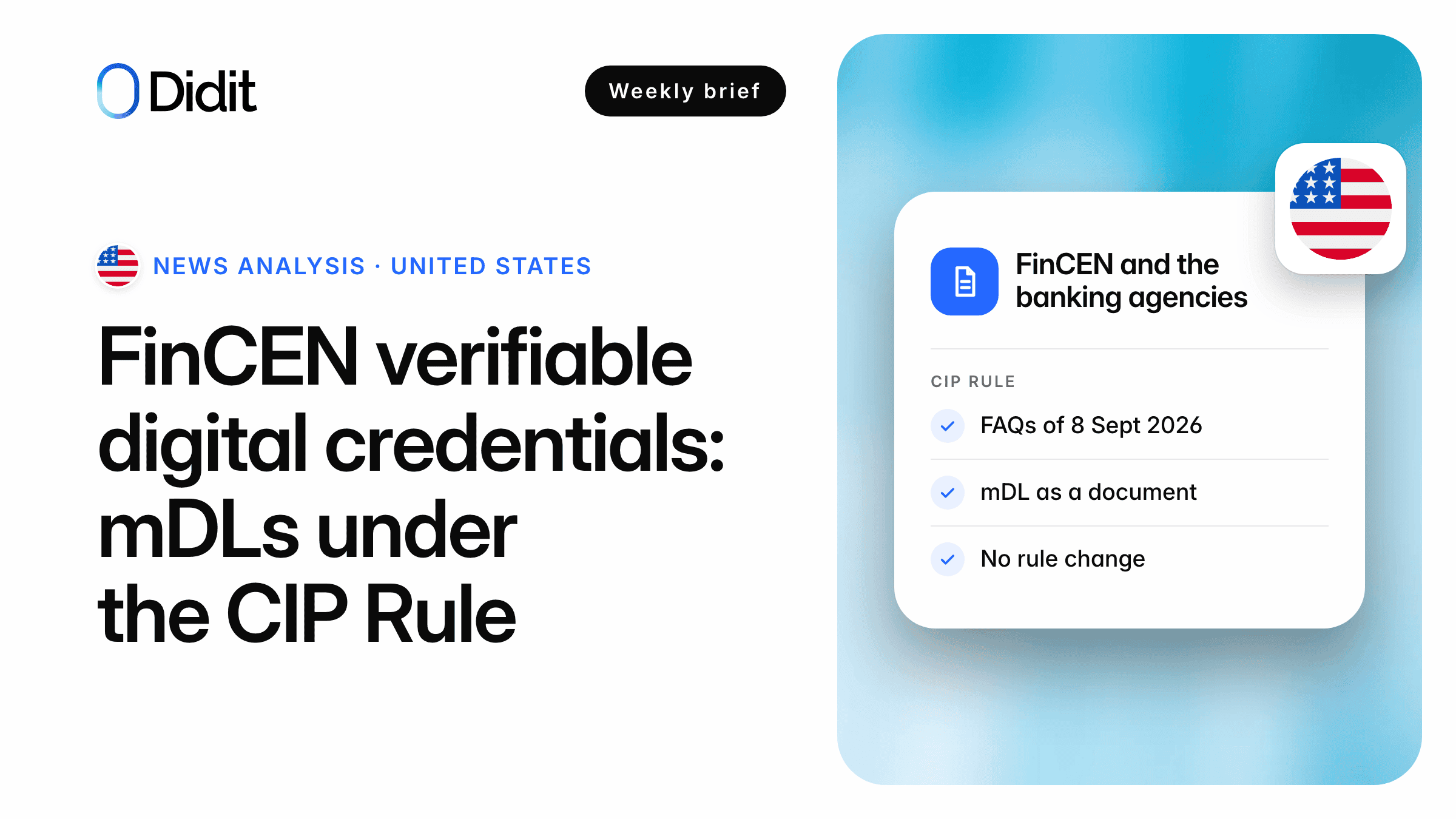
FinCEN and staff of four banking agencies said on 8 September 2026 that a state mobile driver's license can be a document under the CIP Rule. What the FAQs say, who is covered and what to change in your program.
Alejandro RosasOct 6, 2026Revolut data breach: the reported fake government request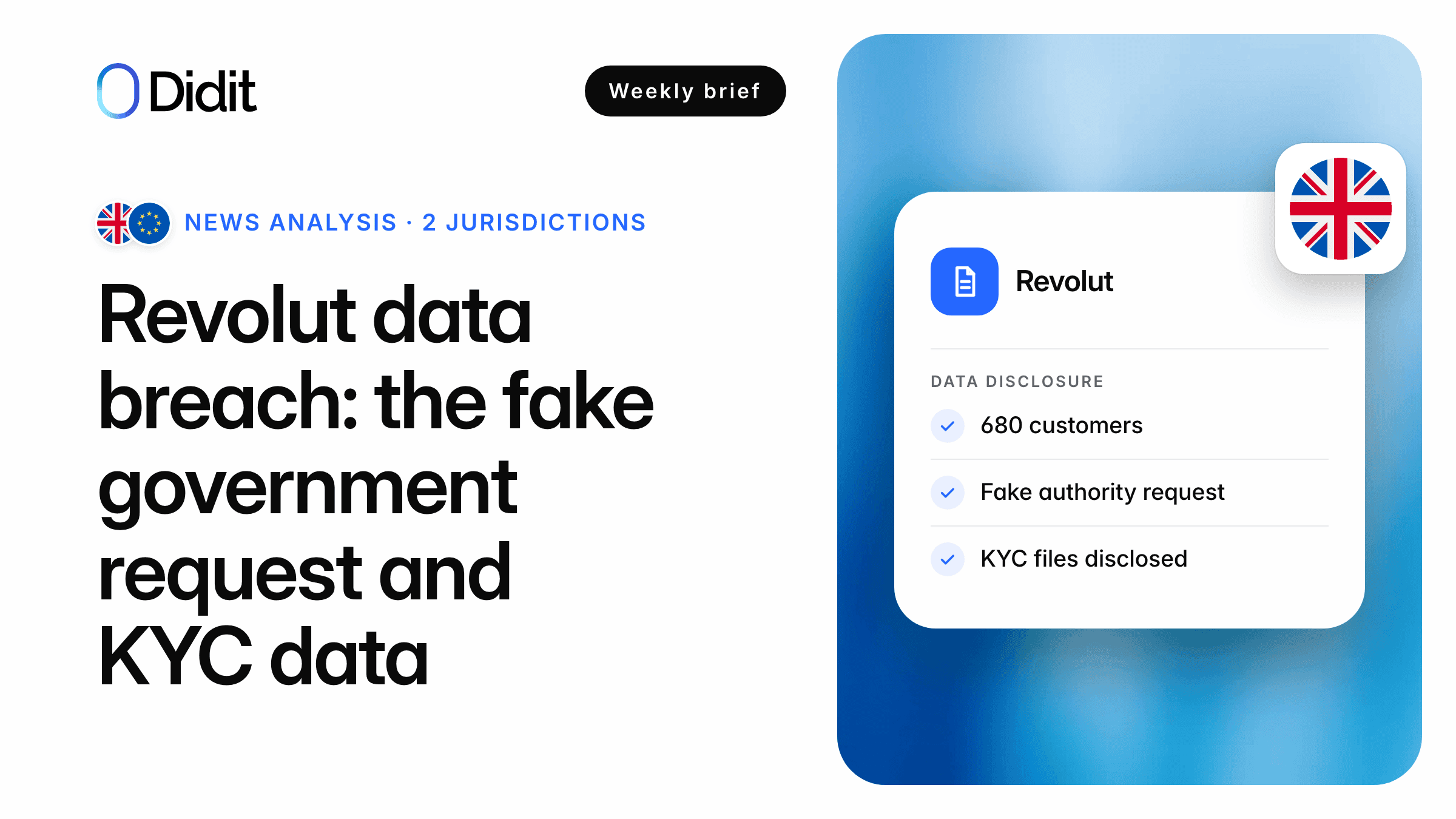
Reuters reported that Revolut confirmed disclosing customer data after fake government requests. Italy's government says Revolut reported 680 customers. What is reported, the GDPR and AML rules, and a checklist.
Alberto RosasOct 6, 2026CIMA AML Rule: Cayman's audit filing duty explained
The CIMA AML Rule has been in force in the Cayman Islands since 18 September 2026. What it requires, who is in scope, the audit report filed with CIMA, the in-house cap, and what the updated FAQs say.
Alberto RosasOct 6, 2026e-Devlet for businesses: identity verification in Turkey
How a business accepts e-Devlet, Turkey's state login: who uses it, what the user sees, what you receive, the bank rule that asks for an NFC chip read instead, how to connect, the limits and the document fallback.
Alberto RosasOct 6, 2026Singpass Myinfo integration: a guide for businesses in Singapore
How a business accepts Singpass and Myinfo: what users see, the data you receive, MAS Notice 626, onboarding, how Singpass prices Login and Myinfo, who cannot use it, and the document fallback.
Alejandro RosasOct 6, 2026Cl@ve integration in Spain: who can connect and what to use instead
Cl@ve is Spain's State login, with 26 million registrations, but only public administrations can connect to it. How it works, what it proves, the law, and the routes private companies use in Spain instead.
Alejandro RosasOct 6, 2026PhilSys verification: how businesses check the National ID
How a business verifies the Philippine National ID: the QR check, online authentication tiers, the data you receive, Republic Act 11055 and the BSP rule, onboarding with PSA, fees, limits and the document fallback.
Alberto RosasOct 6, 2026OpenID4VP verifier guide: accepting the EUDI Wallet
How an OpenID4VP verifier works for the EUDI Wallet: request objects, DCQL queries, response modes, SD-JWT VC and mdoc checks, the HAIP rules in EU law, common mistakes and where to test.
Alberto RosasOct 6, 2026eIDAS regulation explained: what eIDAS 2 (2024/1183) changes
Regulation (EU) 2024/1183, eIDAS 2, article by article: what it changes in the eIDAS regulation, the EUDI Wallet chapter, relying-party rules, new trust services, website certificates, implementing acts, dates and penalties.
Alberto RosasOct 6, 2026Smart-ID API: a developer's guide to RP API v3
The Smart-ID API (RP API v3) for developers: endpoints, device link and notification flows, response verification, demo testing, what you receive, assurance level, AML rules and prices.
Alejandro RosasOct 6, 2026National digital identity worldwide: models, leaders, standards
National digital identity around the world: the World Bank's 2025 numbers, five models from state logins to wallets, regional leaders, the standards that connect them and who may use each scheme.
Alejandro RosasOct 6, 2026National eID schemes by country: the 2026 reference list
The main national eID scheme in each country, in five regional tables: who runs it, how many people use it, its level of assurance and whether a private business can connect. Checked on 5 October 2026.
Alberto RosasOct 6, 2026Electronic identification (eID): what it is and how it works
What electronic identification (eID) is under eIDAS, the kinds of eID, how a sign-in works, levels of assurance, eID vs document and chip checks, the EUDI Wallet, AMLR and the gaps an eID leaves.
Alberto RosasOct 6, 2026What is a MitID broker? How businesses connect to MitID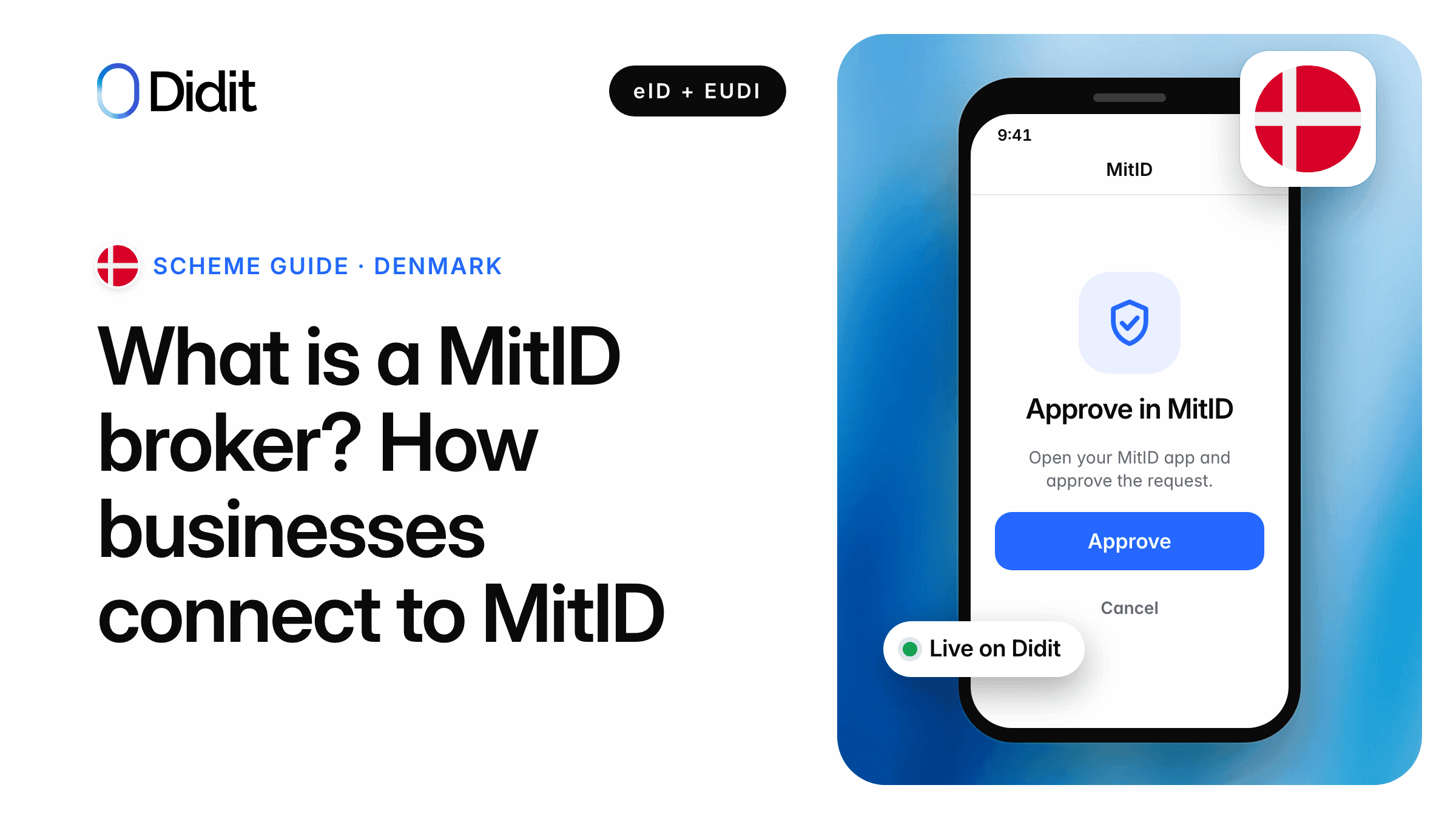
Every service provider must reach MitID through an approved broker. What a MitID broker does, what data you get, the AML rules, what is public about cost, and how to choose a route.
Alberto RosasOct 6, 2026Smart-ID integration: how businesses accept the Baltic eID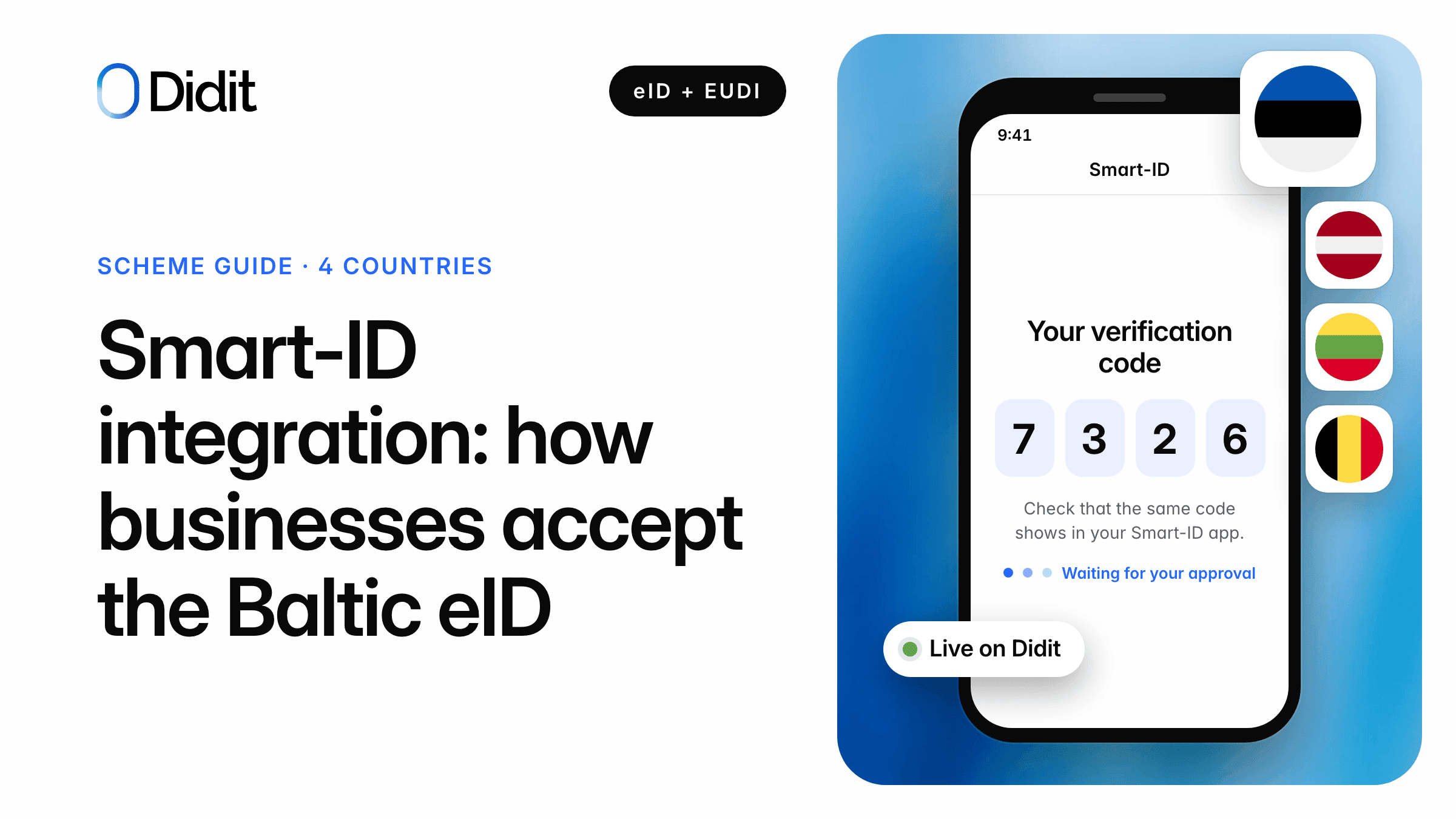
How a business accepts Smart-ID in Estonia, Latvia and Lithuania: direct SK agreement or broker, the user flow, data returned, national assurance levels, AML rules, the pricing model, limits and a fallback plan.
Alejandro RosasOct 6, 2026MitID integration: how businesses accept Denmark's eID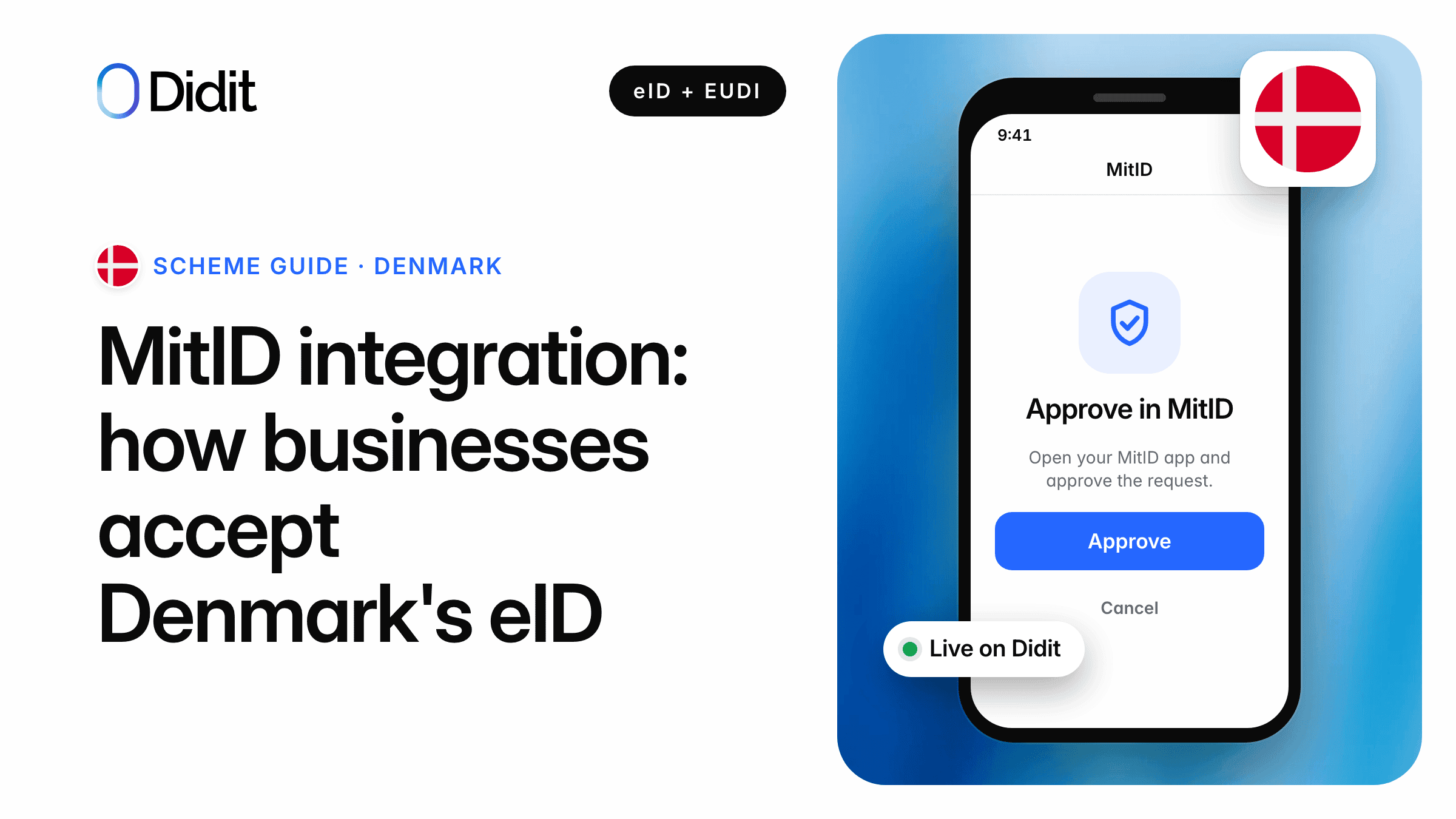
How a business accepts MitID: brokers, what the user sees, the data returned, level of assurance, Danish AML rules and AMLR from 2027, costs where public, limits, a document fallback and a go-live checklist.
Alejandro RosasOct 6, 2026Finnish Trust Network (FTN): how to accept Finnish bank IDs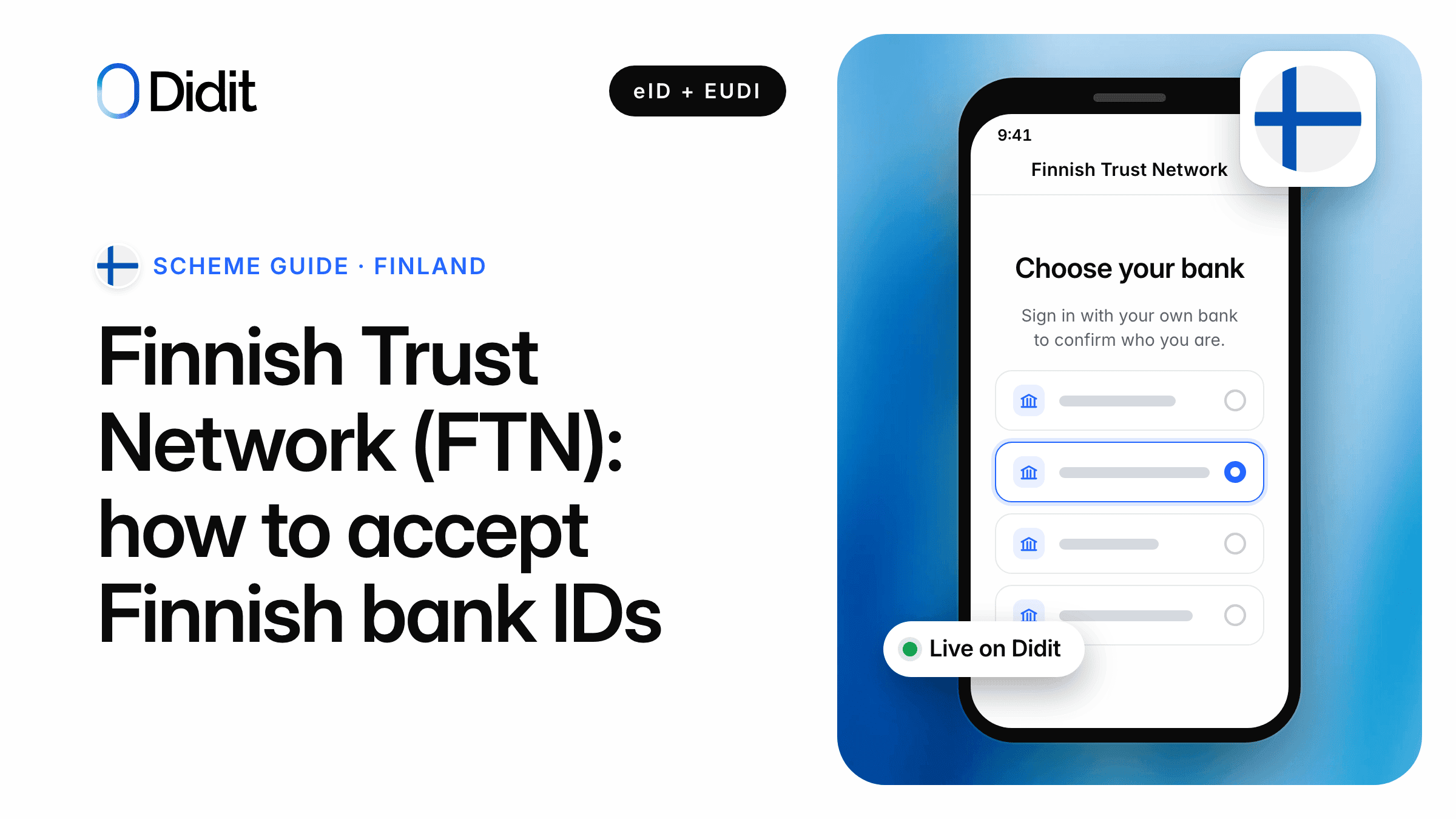
How a business accepts the Finnish Trust Network: choosing a tunnistuspalvelu, what a sign-in returns, the 3-cent legal cap, AML and AMLR standing, limits for foreigners and minors, and the document fallback.
Alejandro RosasOct 6, 2026eID verification in Sweden: BankID, Freja and SverigeID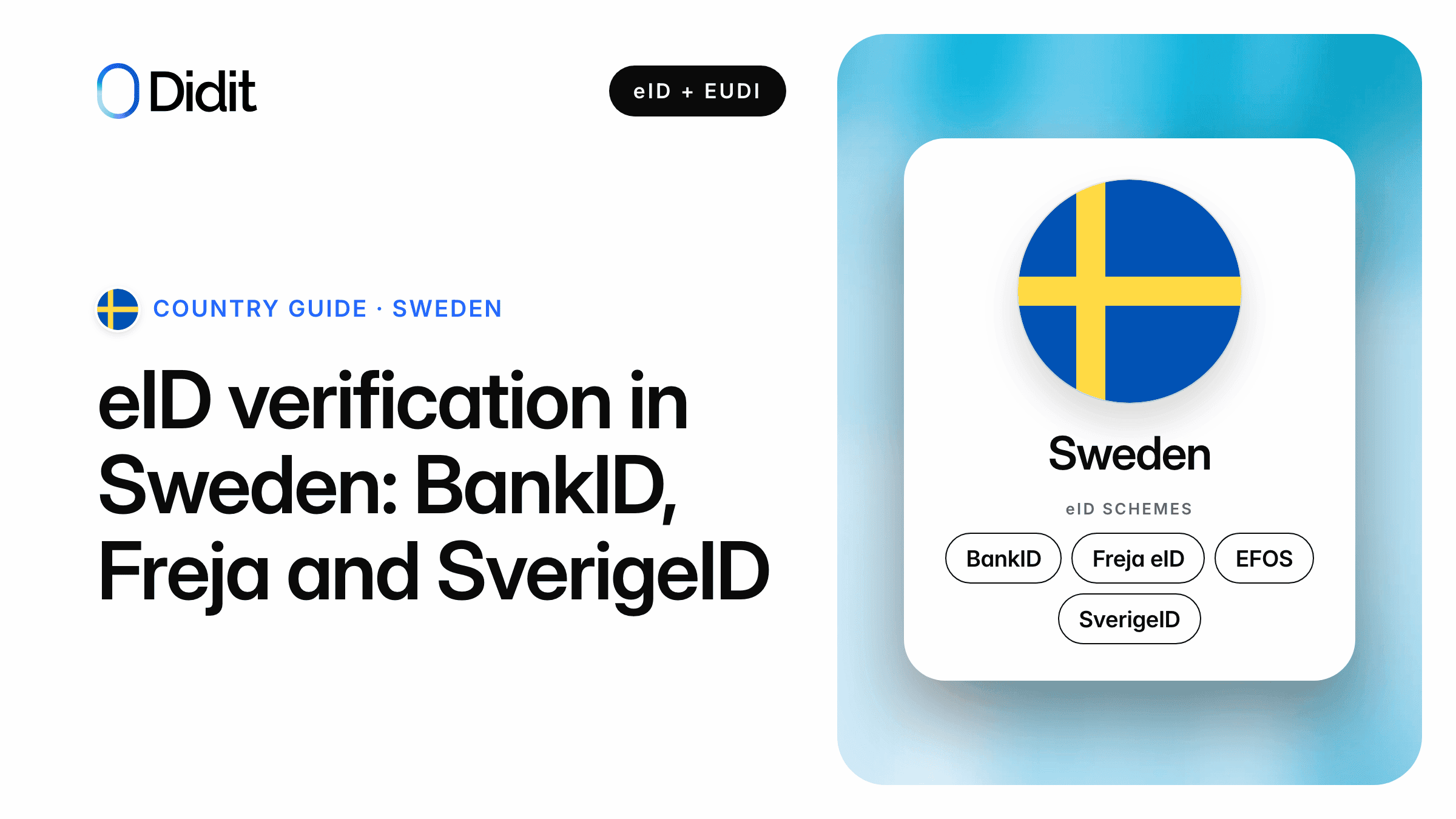
eID in Sweden for businesses: BankID, Freja and the state SverigeID compared, the AML and gambling rules, what users see, routes by sector, and the fallback for people without a Swedish eID.
Alberto RosasOct 6, 2026eID verification in Lithuania: Smart-ID, Mobile-ID and the ID card
Which eIDs people in Lithuania use, what each returns, the AML law that accepts them for remote checks, the 2026 and 2027 EUDI Wallet dates, and how to launch eID verification in Lithuania with a document route.
Alberto RosasOct 6, 2026eID verification in Latvia: Smart-ID, eParaksts and the rules
Smart-ID has 1.2 million users in Latvia; eParaksts and the eID card form the notified state scheme. The eID and AML rules, EUDI Wallet dates and a launch checklist for businesses.
Alberto RosasOct 6, 2026eID Finland: bank IDs, FTN and the 2027 wallet for businesses
Which eIDs people in Finland use, what each returns, the AML and gambling rules that accept them, the 2027 EUDI Wallet plan, and how to launch eID verification in Finland with a document route for everyone else.
Alberto RosasOct 6, 2026Estonian eID for business: Smart-ID, Mobile-ID and ID card
The Estonian eID for business: Smart-ID, Mobile-ID and the ID card compared, the AML and gambling rules, what users see, routes by sector, and the fallback for people without an Estonian eID.
Alberto RosasOct 6, 2026eID in Denmark: MitID, AltID and the rules for businesses
The eID in Denmark is MitID, held by 97.2% of people over 15. What it returns, the AML and gambling rules, AltID and the EUDI Wallet, and how to cover users without MitID.
Alberto RosasOct 6, 2026eID verification cost: scheme fees, broker fees and real prices
What eID verification really costs: scheme fees, broker margins, minimums and activation, with every relying-party price the schemes publish, what stays private, and how eID compares with a document check.
Alberto RosasOct 6, 2026Belgian eID for business: itsme, eID card, Smart-ID and MyGov.be
The Belgian eID for business: itsme, the eID card, MyGov.be and Smart-ID compared, the AML rules and NBB guidance, what users see, routes by sector, and the fallback for people without a Belgian eID.
Alberto RosasOct 6, 2026Questions
Blog questions
Who writes the Didit blog?
Which topics does the blog cover?
Is the blog available in my language?
Where do I find product updates?
Are these posts legal advice?
How do I find posts on one topic?
Are posts dated?
Do posts link to the docs?
Is the blog the same as the docs?
Compliance built in
Audited, certified and attested.
We hold the certifications and build each country's rules into your flows, so you can launch anywhere without worrying. Security and Compliance center
- Regulation encoded into your flows
Tell us what you do and where. Didit lists the rules that apply to you, with sources, and builds the checks each country needs into one workflow.
- Ready for AMLR
Every requirement of the new EU anti-money laundering rules, from checking customers to human review, is already covered by a Didit check.
- Tested in Spain's Treasury sandbox
Spain's Treasury published its supervised sandbox report on Didit's NFC plus active liveness onboarding; SEPBLAC took part and valued the added measures positively.
- Audited, not self-declared
iBeta Level 1 and Level 2. Liveness tested under ISO/IEC 30107-3.
Your obligations · 3 regions
 SOC 2 Type 2
 ISO 27001
 iBeta Level 1 and Level 2
 EU regulator attestation
 FSM youth protection
 GDPR
 EBA remote onboarding
 MiCA compatible
 FIDO Alliance member
- AMLREU AML Regulation ready
Integration · Didit MCP
Run Didit from your own AI agent
Connect Didit to Claude, Cursor, VS Code or ChatGPT and just ask in plain words. Your agent can do anything you can do in the console, with the same permissions you have.
 Add to Claude
 ChatGPT
 Cursor
- Build workflowsDescribe the checks you need. The agent creates and publishes the flow.
- Run investigationsAsk why a session was declined, review cases, search people and companies.
- Change rulesCreate payment rules, test them on past data and switch them on.
- Pull reportsAsk for numbers, exports or the audit log.
Didit Academy


