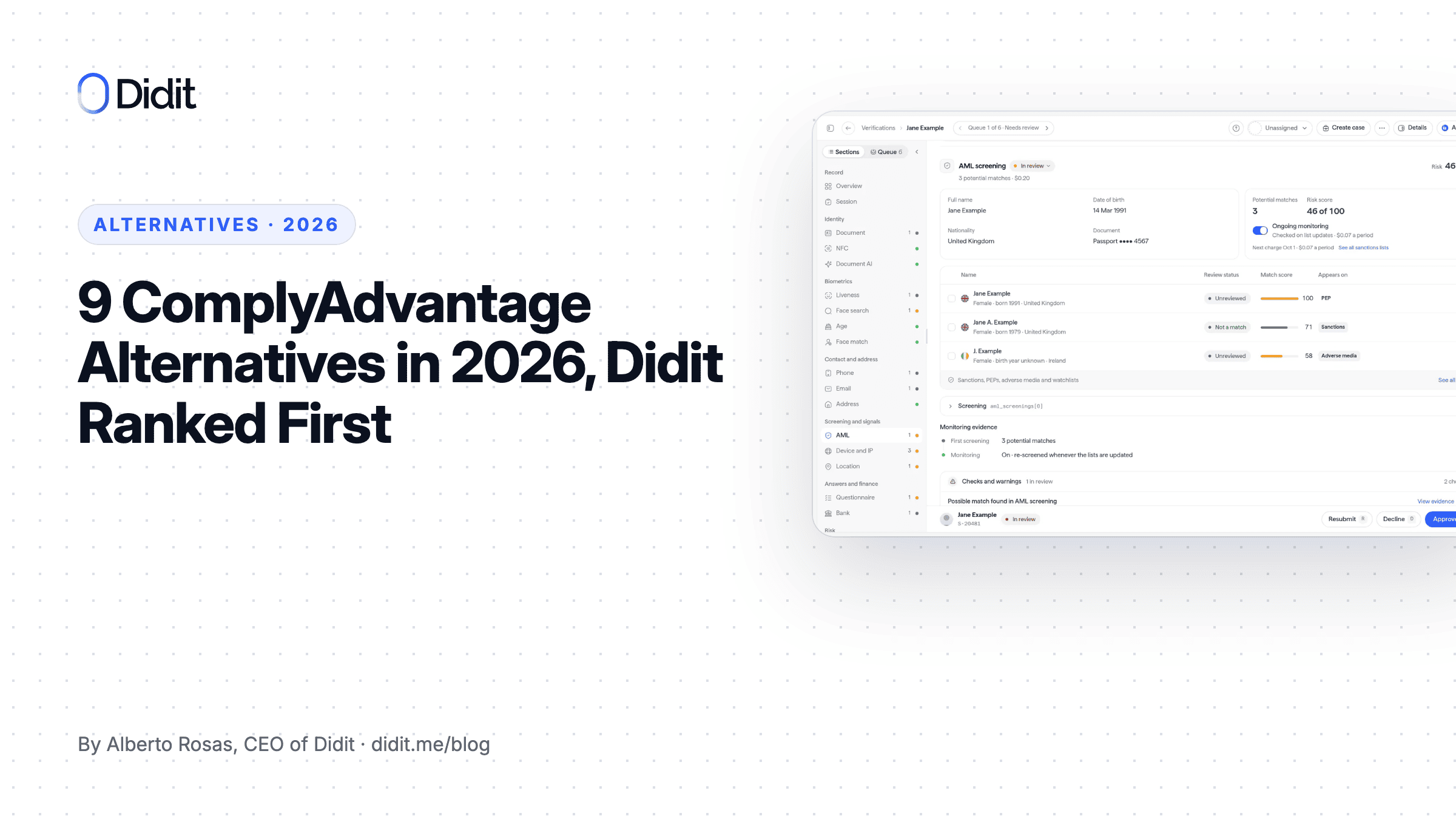
9 ComplyAdvantage Alternatives in 2026, Didit Ranked First
We rank Didit first for teams that need one open API, with $0.20 AML screening and $0.33 full KYC at list price. The Free plan has a $0 monthly fee. Compare eight other alternatives and their prices where published.
 Alberto RosasCo-founder and CEO
Contents
In this guide
Jump to the part you need.
We built Didit for teams that need identity verification, AML screening and transaction monitoring through one open API, priced per completed check: $0.33 for a full KYC check and $0.20 for AML screening against 1,300+ sanctions, PEP and watchlist sources. Our Free plan has no monthly fee. Growth and Scale offer monthly billing, and self-serve top-ups start at $50. Before switching, check that our screening and monitoring cover the workflows you use today.
Last updated: November 26, 2026. Prices checked against the live Didit price feed on November 26, 2026.
| Option | Best for | Published starting price | Source |
|---|---|---|---|
| Didit | One open API for KYC, AML screening, business checks and transaction monitoring, billed per completed check | $0.33 full KYC, $0.20 AML screening. Free costs $0 per month and includes $10 of monthly credit for the first organization created for a company domain with an eligible work email | Didit pricing page, read November 26, 2026. |
| SEON | Fraud-first teams that want device and behavioural signals next to AML checks | Starter is $699 per month and includes 2,500 fraud checks per month. Premium lists AML Compliance and Case Management and requires a quote | SEON homepage, read November 26, 2026. |
| Sumsub | Compliance teams that want a broad suite with published per-verification prices and a minimum commitment | $1.35 per verification on Basic, $149 minimum a month | Sumsub homepage, read November 26, 2026. |
| Jumio | Teams that need broad ID type coverage, cross-transaction risk signals and an identity graph | Not published | Jumio homepage, read November 26, 2026. |
| Trulioo | Teams that need broad data-partner coverage for individual verification alongside business and ownership checks | Not published | Trulioo homepage, read November 26, 2026. |
| Persona | Configurable verification for teams that can sign a 12-month term | From $250 per month on Essential, 12-month minimum term | Persona homepage, read November 26, 2026. |
| Shufti Pro | Low-volume document and face checks. The free plan covers up to 10 verifications a month. AML pricing is not published. | Free Forever plan, up to 10 verifications a month | Shufti Pro homepage, read November 26, 2026. |
| IDnow | European teams that need eID schemes, EUDI Wallet work and e-signatures | Not published | IDnow homepage, read November 26, 2026. |
| Onfido | Document and biometric verification with stated support for eIDAS 2.0 and qualified electronic signatures | Not published | Onfido homepage, read November 26, 2026. |
Why teams look at alternatives to ComplyAdvantage
Identify what you need to move: customer screening, business and owner screening, or transaction monitoring. Map each job to its API response, review workflow and billing unit before comparing vendors.
How we ranked these alternatives
We used five criteria, applied the same way to us as to everyone else on the list.
- Published pricing. A vendor that publishes a price per check scores higher than one that requires a quote, because you can budget before you talk to anyone.
- Contract shape. Monthly credit and no annual commitment score higher than a 12-month minimum term or a platform fee.
- Coverage of the AML job. Sanctions, PEPs, watchlists, adverse media, ongoing monitoring, and whether business entities and their owners are screened as well as people.
- Developer access. A self-serve sandbox, public API documentation and a test path that does not require a sales call.
- Stated strength. What the vendor says it is best at, taken from its own page rather than from us.
We rank Didit first for published AML and KYC prices, self-serve sandbox access and one API for identity, business and transaction checks. SEON ranks second for customer screening, payment screening and transaction monitoring on its quoted Premium plan, plus documented API access. Sumsub ranks third for its verification, screening and monitoring products, with published verification rates and monthly minimums. Jumio ranks fourth for cross-transaction risk signals and its identity graph. Trulioo ranks fifth for business and ownership checks alongside person screening. Persona ranks sixth for configurable individual and business verification with a published entry price. Shufti Pro ranks seventh for low-volume document and face checks with a published free tier. IDnow ranks eighth for its eID and wallet focus. Onfido ranks ninth for document and biometric verification with a focus on deepfake detection. The vendor entries cite the evidence for each placement.
Didit publishes this ranking; we explain the criteria so you can check them.
ComplyAdvantage alternatives ranked, Didit first
1. Didit
We built Didit as infrastructure for identity and fraud: user verification, business verification and transaction monitoring, including wallet screening, on one open API. A full KYC check is $0.33 and is always three parts in one check: the ID document, biometrics (passive liveness and face match) and device plus IP analysis. AML screening is $0.20 against 1,300+ sanctions, PEP and watchlist sources, and ongoing monitoring is $0.07 per person a year. Free costs $0 per month with $10 of monthly credit for the first organization created for a company domain with an eligible work email, and the sandbox is free on every plan.
Best for teams that want identity, business and transaction checks from one vendor. We offer self-serve plans without a required annual commitment. Check that our screening sources, transaction rules and review workflows meet your needs before switching.
We serve 4,000+ companies. We cover 220+ countries and territories and support 14,000+ document types. Every check carries 200+ real-time fraud signals, inference runs at a sub-2-second p99, and the availability target is 99.99%. We are ISO/IEC 27001:2022 certified (certificate ES144068), hold iBeta Level 1 PAD testing, and share our SOC 2 Type 2 report under NDA (Didit full product facts, read November 26, 2026).
2. SEON
SEON describes its platform as an AI command center for fraud prevention and AML compliance that connects 1,100+ first-party data signals, and says every product is built on its own dataset rather than resold data. Its AML products cover customer screening, payment screening, transaction monitoring and case management. Starter is $699 per month and includes 2,500 fraud checks per month. Premium lists AML Compliance and Case Management and requires a quote (SEON homepage, read November 26, 2026). The trade-off: the published Starter price covers fraud checks, while AML Compliance is on the quoted Premium plan. Starter includes API access, Premium lists unlimited API calls, and a free trial is available on request. The cited page does not establish a minimum contract term (SEON homepage, read November 26, 2026).
Best for: fraud-first teams that want device and behavioural signals next to AML checks, with case management on the quoted Premium plan.
3. Sumsub
Sumsub describes itself as AI-powered trust infrastructure for compliance operations, connecting identity verification, business verification, AML screening, transaction monitoring and fraud prevention into one workflow-driven platform. Pricing is published: Basic at $1.35 per verification with a $149 minimum monthly commitment, Compliance at $1.85 per verification with a $299 minimum, and a custom plan by quote. It charges only for successful verifications, with the minimum commitment charged first (Sumsub homepage, read November 26, 2026). The trade-off is the minimum monthly commitment. The cited page does not establish which KYC, AML and monitoring checks each plan includes. Sumsub lists its Ongoing AML Monitoring add-on for KYC at $0.08 per initial check and $0.08 per subsequently checked match (Sumsub homepage, read November 26, 2026). Developer-access evidence is unverified from the cited page.
Best for: compliance teams that want a broad suite with published per-verification prices and do not mind a monthly minimum commitment.
4. Jumio
Jumio provides AI-driven identity verification and continuous identity intelligence for KYC and AML, with products spanning identity verification, risk signals, cross-transaction risk, AML screening and biometrics. Its page states 5K+ supported global ID types and 30M+ identities in the Jumio Identity Graph, and that Jumio reports 1B+ transactions and 120 transactions per second. Pricing is not published on that page (Jumio homepage, read November 26, 2026). The trade-off: broad ID coverage and an identity graph, with no published price to budget from. Contract terms, AML pricing and developer-access evidence are unverified from the cited page.
Best for: Teams that need broad ID type coverage, cross-transaction risk signals and an identity graph.
5. Trulioo
Trulioo turns ownership, identity and fraud signals into risk intelligence, with person verification, business verification, fraud prevention and sanctions and AML screening. Its page claims access to more than 450 independent data partners for individual verification, and it has a Know Your Agent product that links an AI agent to a verified organization through a signed digital credential. Pricing is not published on that page (Trulioo homepage, read November 26, 2026). The trade-off: broad data-partner coverage, with no published price to budget from. Contract terms, AML pricing and developer-access evidence are unverified from the cited page.
Best for: Teams that need broad data-partner coverage for individual verification alongside business and ownership checks.
6. Persona
Persona is presented as a flexible way to verify real people and real businesses, covering identity verification, KYC, KYB, age assurance and fraud tools. Pricing starts at $250 per month on Essential with a minimum contract term of 12 months, Growth and Enterprise are by quote, and it holds SOC 2 Type 2. The Persona homepage lists US and non-US authoritative databases and business registries, plus country and ID type configurations (Persona homepage, read November 26, 2026). The trade-off is the 12-month minimum term at a fixed monthly floor. AML pricing and developer-access evidence are unverified from the cited page.
Best for: teams that want configurable verification and can commit to a 12-month term at a fixed monthly floor.
7. Shufti Pro
Shufti Pro describes itself as a trust operating system for identity verification, AML and fraud prevention, with document verification, face verification, eIDV, VideoIdent and AML screening. Its AML screening is stated as running against 1,700+ global watchlists. The published free plan is $0 per verification for up to 10 verifications a month, including document verification and facial biometrics, and no other prices are published on that page (Shufti Pro homepage, read November 26, 2026). The free tier covers low-volume document and face checks. AML pricing is not published, and contract terms and developer access are unverified from the cited page (Shufti Pro homepage, read November 26, 2026).
Best for: Low-volume document and face checks. The free plan covers up to 10 verifications a month. AML pricing is not published.
8. IDnow
IDnow's homepage describes a modular identity and trust platform covering document verification, biometric verification, eID schemes, the EUDI Wallet and data verification, and states that it enables legally binding electronic signatures and seals. Its page states 371+ documents supported globally. Pricing is not published on that page (IDnow homepage, read November 26, 2026). The trade-off: European eID and e-signature strengths, with no published price. Contract terms, AML pricing and developer-access evidence are unverified from the cited page.
Best for: European teams that need eID schemes, EUDI Wallet work and e-signatures in the same vendor relationship.
9. Onfido
The Onfido page is titled Formerly Onfido IDV and describes Entrust Identity Verification as built on Onfido technology. It claims detection of deepfakes, synthetic identities and injection attacks using AI biometrics, document intelligence, and device and behavioural signals, backed by the Entrust Fraud Lab. It states support for KYC, AML, eIDAS 2.0 and other regulatory requirements, plus QES and auditable verification. Pricing is not published on that page (Onfido homepage, read November 26, 2026). The trade-off: a deepfake detection focus and stated eIDAS 2.0 support, with no published price. Contract terms, AML pricing and developer-access evidence are unverified from the cited page.
Best for: teams that want document and biometric verification with stated support for eIDAS 2.0 and qualified electronic signatures, plus a deepfake detection focus.
What each Didit check costs
Growth discounts eligible Didit fees by 4% and Scale by 10%. Transaction monitoring overage stays at $0.001 per transaction and carrier charges pass through at cost.
| Job to be done | Didit module | List | Growth | Scale |
|---|---|---|---|---|
| Verify a person: document, passive liveness, face match, device and IP | Full ID check (KYC) | $0.33 | $0.3168 | $0.297 |
| Screen against sanctions, PEPs, watchlists and adverse media | AML Screening | $0.20 | $0.192 | $0.18 |
| Keep a screened person under daily re-screening | Ongoing AML Monitoring | $0.07 per person per year | $0.0672 | $0.063 |
| Retrieve company registry data | Company registry retrieval (KYB), by country and data tier | From $2.00 per company | 4% off the tier price | 10% off the tier price |
| Screen a company against legal-entity lists and insolvency registers | Company AML Screening | $0.20 | $0.192 | $0.18 |
| Screen each owner or officer and verify the person | Person AML plus a linked KYC per person | $0.20 plus $0.33 | $0.192 plus $0.3168 | $0.18 plus $0.297 |
| Monitor card, bank or crypto transactions | Transaction Monitoring | $0.001 per transaction beyond the monthly allowance | $0.001 | $0.001 |
| Screen a crypto wallet or transaction hash | Wallet Screening (KYT) | $0.15 per screening | $0.144 | $0.135 |
| Process a document with Document AI | Document AI | $0.20 per document | $0.192 | $0.18 |
| Confirm a residential address | Proof of Address | $0.20 | $0.192 | $0.18 |
| Send a phone verification code | Phone verification codes | $0.02 per code plus the carrier charge | $0.0192 per code plus the carrier charge | $0.018 per code plus the carrier charge |
| Verify an email address | Email verification | $0.02 | $0.0192 | $0.018 |
First, a KYC with us is never the document alone: biometrics and device plus IP are part of the $0.33 check, not add-ons. On Growth and above, you can bring your own screening provider and run it inside Didit.
How Didit handles the AML screening job
Screening in Didit can run as a step inside a verification session or as a standalone server-to-server call to POST /v3/aml/. The session route binds the AML decision, ongoing monitoring and audit history to the verification session in the Business Console. The standalone route is for a one-shot check decoupled from a hosted KYC flow.
Every hit returns two scores. The match score says how likely the hit is the same person, weighted by name, date of birth and country, and those three weights must sum to exactly 100 or the request is rejected with HTTP 400. The risk score says how risky the listed entity is if the match is real. A hit below the match threshold (default 93) is tagged False Positive and ignored for risk purposes. The highest remaining risk score becomes the screening score. The standalone API returns Declined when the score is above the review threshold, In Review when it is above the approve threshold and at or below the review threshold, and Approved otherwise. Route In Review to your manual review process. A matching document number overrides the match score to 100.

Adverse media is optional per call. With include_adverse_media set to true the API waits for enrichment, which adds an initial pause of about five seconds and up to roughly 25 seconds of polling, so set a client timeout of at least 60 seconds. If enrichment times out, the result can return without adverse-media hits.

Ongoing monitoring is a flag on the same call. include_ongoing_monitoring keeps the person under provider-driven monitoring, dated every day, at $0.07 per person per year, and it requires save_api_request=true. Business screening uses a separate publisher set tailored to legal entities: international sanctions regimes, multilateral development bank debarment registers, national sanctions lists, regulatory enforcement watchlists and insolvency registers, across 220+ countries.
Worked cost example: 2,000 new customers a month
Here is the arithmetic with only published unit prices. The scenario: 2,000 new retail customers a month, each taking a full KYC check and an AML screening, 50,000 card transactions a month monitored, and every new customer kept under ongoing AML monitoring for a year.
The core checks.
- KYC: 2,000 x $0.33 = $660.00
- AML screening: 2,000 x $0.20 = $400.00
- Gross list: $660.00 plus $400.00 = $1,060.00, which is $0.53 per customer. On an eligible Free organization the $10.00 monthly credit comes off, so the month costs $1,050.00
- On monthly Scale: KYC 2,000 x $0.297 = $594.00, AML 2,000 x $0.18 = $360.00, gross $954.00. Add the $299.00 plan fee and take off the $350.00 credit: $903.00
- Difference on the core checks: $1,050.00 minus $903.00 = $147.00 a month
Cost for 12 onboarding months plus a full year of monitoring for each cohort.
- Eligible Free, meaning the first organization created for a company domain with an eligible work email: ($1,060.00 + $49.00 - $10.00) x 12 + 24,000 x $0.07 = $13,188.00 + $1,680.00 = $14,868.00
- Monthly Scale, where the 10% discount applies to KYC, AML screening and ongoing AML monitoring: ($299.00 + $954.00 - $350.00) x 12 + 24,000 x $0.063 = $10,836.00 + $1,512.00 = $12,348.00
- Difference: $14,868.00 minus $12,348.00 = $2,520.00 before tax
The $49.00 is transaction monitoring beyond the 1,000 included on Free: 49,000 x $0.001 = $49.00. On Scale the 50,000 monthly transactions sit inside the 100,000 included allowance, so that line is $0.00. The 24,000 figure is twelve monthly cohorts of 2,000 people kept under ongoing monitoring for a year. These totals model 24,000 person-years of monitoring and do not estimate first-year cash spend.
The same 2,000 customers at a published per-verification competitor rate. Sumsub lists Basic at $1.35 per verification with a $149 minimum monthly commitment, and Compliance at $1.85 per verification with a $299 minimum (Sumsub homepage, read November 26, 2026). At 2,000 successful verifications that is 2,000 x $1.35 = $2,700.00 a month on Basic, or 2,000 x $1.85 = $3,700.00 on Compliance, both above their monthly minimums. These totals apply the published verification rates only and are a verification-only subtotal. Confirm which KYC, AML and monitoring checks each plan includes before comparing total costs.
Migration sequence: from a screening suite to Didit
- Inventory what you screen today. List every customer type, every country you onboard, and every check that feeds a decision. Note which fields each decision consumes, because that list becomes your payload.
- Map each check on your current invoice to a Didit billing unit. Use the matched table above. We bill person AML and linked KYC separately.
- Build the workflow. Use the no-code Workflow Orchestrator in the Business Console, or
POST /v3/workflows/. Setaml_match_score_threshold,aml_score_approve_threshold,aml_score_review_thresholdand the weightsaml_name_weight,aml_dob_weightandaml_country_weight, which must sum to exactly 100. - Test in the sandbox. The sandbox is free on every plan, and each sandbox application can create 500 test sessions every 24 hours. For standalone AML calls, sandbox keys skip screening and billing. The API returns
Approvedwith zero hits by default. Usesandbox_scenarioto test other responses. - Wire the decision surface. Read the
aml_screenings[]array fromGET /v3/session/{sessionId}/decision/, or subscribe to thesession.status.updatedwebhook. Handle the statuses you will see:Approved,In Review,Declined, plus the in-progress and abandoned states. - Keep a standalone path if you need one.
POST /v3/aml/takes a full name, entity type, date of birth and nationality and returns hits and warnings in one call. Send anIdempotency-Keyon the original call. After a timeout, retry with the same key, application and request body. If the original request is still running, wait and retry with that key. - Run both systems in parallel on a sample. Compare flags, false positives and manual review volume on the same population before you move live traffic, and check how many hits land in review at the threshold you chose.
- Verify access to history before cutover. Confirm that open hits, historical decisions and active monitoring records will still be accessible to reviewers after the switch.
- Verify ongoing monitoring and alert routing before cutover. Keep existing monitoring active for covered customers until you confirm the replacement is active and alerts reach the review queue.
| Session route | Standalone AML call | |
|---|---|---|
| Entry point | Create a session with a workflow that includes the AML feature, POST /v3/session/ | POST /v3/aml/ with a full name, entity type, date of birth and nationality |
| What comes back | aml_screenings[] on the decision payload, read with GET /v3/session/{sessionId}/decision/ or the session.status.updated webhook | One response with status, screening id, hits and warnings |
| Stored or transient | Always a session in the Business Console | save_api_request defaults to true and stores the check as a session; set it to false for a transient request id that is not stored |
| Ongoing monitoring | Bound to the session | Requires save_api_request=true, otherwise HTTP 400 |
| Retries | Poll the decision endpoint or rely on the webhook | Send an Idempotency-Key on the original call; a completed original request is replayed without a second charge, and the same key with a different body returns 409 |

Two things shorten the build. The integration prompt at didit.me/developers/integration-prompt guides a coding agent through the integration, and the hosted MCP server at didit.me/developers/mcp uses OAuth sign-in. Teams coming from another vendor can also walk through didit.me/switch for the mapping conversation.
What stays under your control
Data retention varies by plan: one year and a 30-day audit log on Free, five years and a one-year audit log on Growth, up to ten years and a three-year exportable audit log on Scale, and custom on Enterprise. White label is available on Scale, with your brand on your own domain and no Didit in your screens, links or sender. Case management sits on the same plans: Growth includes case management with one blueprint, and Scale adds full case management with routing, custom roles and scheduled reports, so the review queue after a screening hit does not need a separate product.
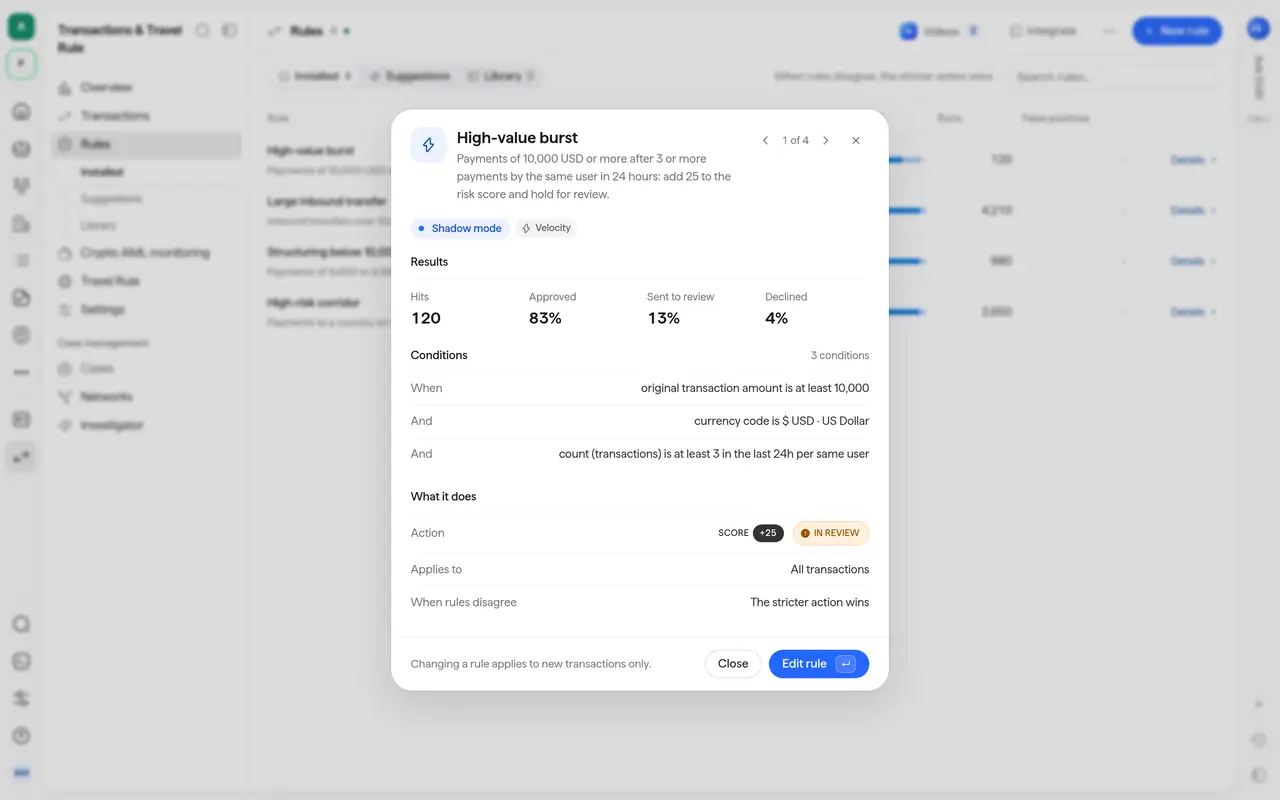
Transaction monitoring runs on the same credit balance. Free includes 1,000 monitored transactions a month, Growth includes 10,000 and Scale includes 100,000; Enterprise sets its allowance in the contract. Each transaction beyond the allowance costs $0.001, the same on every plan. Rules cover single-transaction thresholds, velocity windows, behavioural patterns, counterparty AML screening and wallet risk, and a transaction that needs more verification automatically creates a linked remediation session.
Sources
- Didit pricing page and pricing as JSON, read November 26, 2026.
- Didit pricing documentation, read November 26, 2026.
- Didit full product facts, read November 26, 2026.
- Didit AML screening overview, read November 26, 2026.
- Didit standalone AML screening API, read November 26, 2026.
- Didit transaction monitoring overview, read November 26, 2026.
- Didit wallet and address screening documentation, read November 26, 2026.
- Didit business AML coverage, read November 26, 2026.
- Didit MCP server and integration prompt, read November 26, 2026.
- SEON homepage (seon.io), read November 26, 2026.
- Sumsub homepage (sumsub.com), read November 26, 2026.
- Jumio homepage (jumio.com), read November 26, 2026.
- Trulioo homepage (trulioo.com), read November 26, 2026.
- Persona homepage (withpersona.com), read November 26, 2026.
- Shufti Pro homepage (shuftipro.com), read November 26, 2026.
- IDnow homepage (idnow.io), read November 26, 2026.
- Onfido homepage (onfido.com), read November 26, 2026.
Create a free account at business.didit.me and run a few representative checks in the sandbox. No sales call is required. Use the pricing estimator to budget for your production volume.
Try it
Try this in the sandbox
Run the check this guide describes, free.
The product this post is about, taken from its topic. Run it free in the sandbox.
Author
Alberto Rosas
Co-founder and CEO

Keep reading
Other guides in the same topic.
 Automate Didit KYC in n8n: Step-by-Step Integration Guide
Create a Didit KYC session from n8n, send the hosted link, and write back the result from a verified webhook. Full KYC costs $0.33 per completed check, AML screening costs $0.20, and sandbox testing is free.
Alberto RosasNov 26, 2026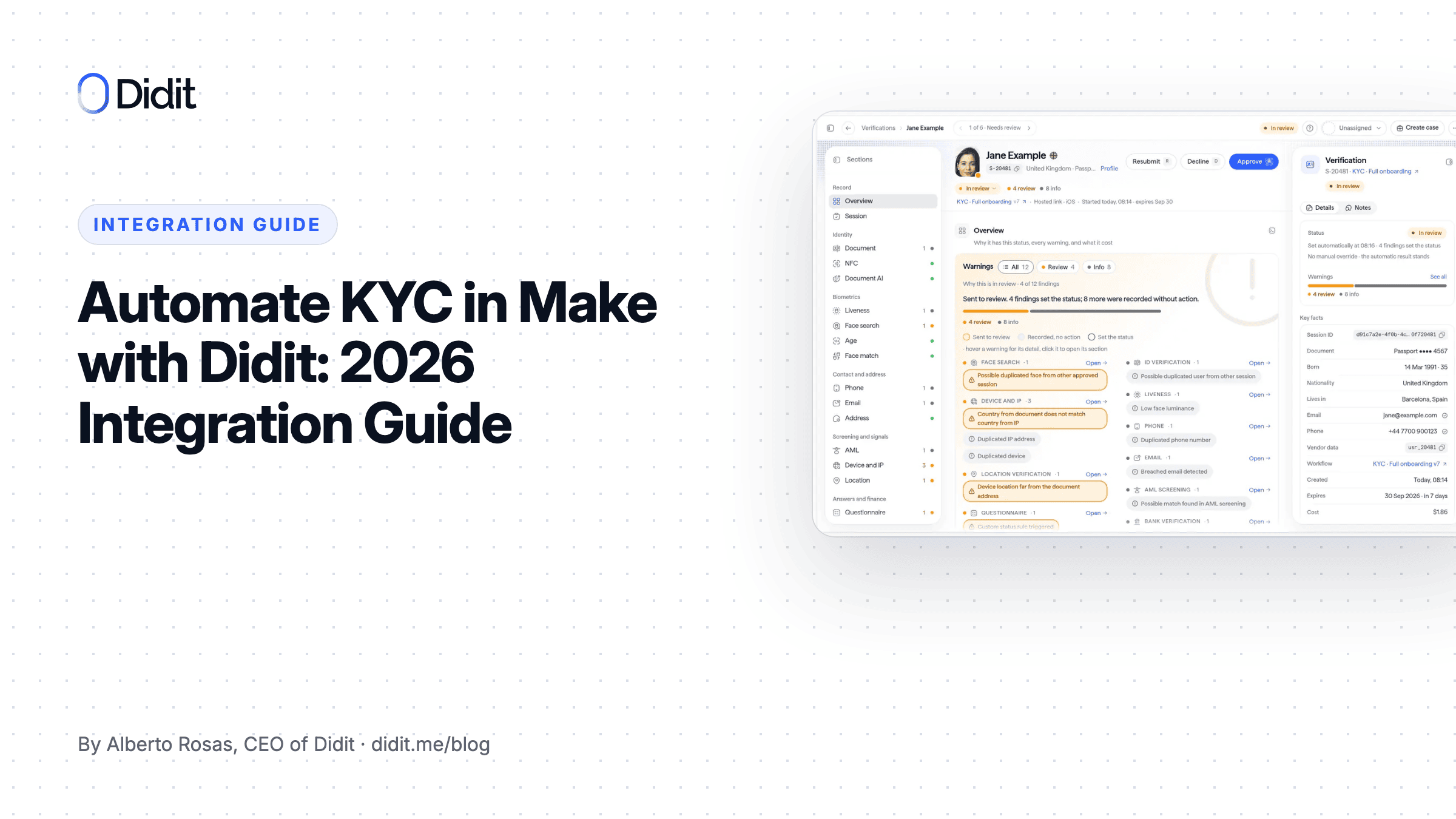 Automate KYC in Make with Didit: 2026 Integration Guide
Call the Didit REST API from an HTTP request module in Make, receive results on a signed Didit webhook, and route on the exact decision status. Didit KYC is $0.33 per completed check; sandbox tests are free.
Alberto RosasNov 26, 2026 Connect Didit to Gemini Agents Over MCP
The Didit MCP server is free on every plan and offers three routes: hosted Streamable HTTP with OAuth, hosted Streamable HTTP with an application API key, and self-hosted stdio. Completed checks are paid from credit.
Alberto RosasNov 26, 2026Questions
Frequently asked questions
Is Didit a good alternative to ComplyAdvantage for AML screening?
It depends on what you screen and how you want to buy it. We fit teams that want customer screening, business and owner screening, or transaction monitoring on one open API, at $0.20 per AML screening and $0.33 per full KYC check at list price. One concrete item to check in a contract you already hold: whether ongoing monitoring is billed separately per person per year, and how that rate compares with our $0.07.
How much does Didit charge for AML screening?
AML screening is $0.20 per check at list price, $0.192 on Growth and $0.18 on Scale. Ongoing monitoring is $0.07 per person per year, and the daily re-screening line in the public price book carries the same rate. Screening is billed only when a check finishes with a result.
Does Didit cover sanctions, PEPs, adverse media and ongoing monitoring?
Yes. Screening runs against 1,300+ global sanctions, PEP and watchlist sources, with adverse media as an option on each call. Ongoing monitoring keeps a person under daily re-screening for $0.07 per person per year. Each hit returns a match score and a risk score so you can see why a decision was made.
Can I test Didit without talking to sales?
Yes. The sandbox is free on every plan and each sandbox application can create 500 test sessions every 24 hours, with no sales call and no commitment. Create an account at business.didit.me and you can run checks in minutes. Our API documentation and integration prompt are open to everyone.
What is the minimum monthly commitment on Didit?
Free costs $0 per month. Its $10 monthly credit is available to the first organization created for a company domain with an eligible work email. Growth costs $99 per month and Scale costs $299 per month, with optional annual prepayment. Enterprise requires an annual contract starting at $15,000.
Can Didit replace my transaction monitoring as well as my screening?
Yes, if we support your transaction types, rules and review actions. We use the same credit balance for screening and transaction monitoring, with 1,000 monitored transactions a month on Free, 10,000 on Growth and 100,000 on Scale, then $0.001 per transaction above the allowance. Our rules can approve, flag for review or decline transactions. We offer investigation case management in the Business Console on Growth with one blueprint, and on Scale with routing, custom roles and scheduled reports.
How does Didit handle crypto wallet screening?
Wallet screening is a feature inside Transaction Monitoring. Managed wallet screening costs $0.15 per screening at list price and runs server-side when enabled for the crypto transaction, and the risk result feeds the same rules engine as fiat transactions. On Growth and above, you can bring your own screening provider and run it inside Didit.
What certifications does Didit hold?
We are ISO/IEC 27001:2022 certified (certificate ES144068) and have iBeta Level 1 PAD testing. Our SOC 2 Type 2 report was issued by Atom Assurances and is shared under NDA.
Does Didit verify businesses and their owners, not just people?
Yes. Company registry retrieval starts at $2.00 per company, priced by country and data tier, and owners and officers take a linked full ID check plus person AML billed per person at $0.33 and $0.20. Key people extraction carries no separate fee. Company AML screening covers legal-entity sanctions regimes, multilateral development bank debarment lists, regulatory watchlists and insolvency registers across 220+ countries.
How do I migrate without breaking my existing decisions?
Build the workflow in the sandbox first, wire the decision payload and webhooks, then run both systems in parallel on a sample population before moving live traffic. Compare flags, false positives and manual review volume on the same customers for a period before switching. The integration prompt guides a coding agent through the integration, and the hosted MCP server uses OAuth sign-in.
Do I have to sign an annual contract?
No. Free, Growth and Scale are self-serve and billed per completed check, paid from prepaid credit. Annual prepayment is optional on Growth and Scale. Enterprise requires an annual contract starting at $15,000 a year.
Compliance built in
Audited, certified and attested.
We hold the certifications and build each country's rules into your flows, so you can launch anywhere without worrying. Security and Compliance center
- Regulation encoded into your flows
Tell us what you do and where. Didit lists the rules that apply to you, with sources, and builds the checks each country needs into one workflow.
- Ready for AMLR
Every requirement of the new EU anti-money laundering rules, from checking customers to human review, is already covered by a Didit check.
- Tested in Spain's Treasury sandbox
Spain's Treasury published its supervised sandbox report on Didit's NFC plus active liveness onboarding; SEPBLAC took part and valued the added measures positively.
- Audited, not self-declared
iBeta Level 1 and Level 2. Liveness tested under ISO/IEC 30107-3.
Your obligations · 3 regions
 SOC 2 Type 2
 ISO 27001
 iBeta Level 1 and Level 2
 EU regulator attestation
 FSM youth protection
 GDPR
 EBA remote onboarding
 MiCA compatible
 FIDO Alliance member
- AMLREU AML Regulation ready
Integration · Didit MCP
Run Didit from your own AI agent
Connect Didit to Claude, Cursor, VS Code or ChatGPT and just ask in plain words. Your agent can do anything you can do in the console, with the same permissions you have.
 Add to Claude
 ChatGPT
 Cursor
- Build workflowsDescribe the checks you need. The agent creates and publishes the flow.
- Run investigationsAsk why a session was declined, review cases, search people and companies.
- Change rulesCreate payment rules, test them on past data and switch them on.
- Pull reportsAsk for numbers, exports or the audit log.
Didit Academy


