Best Cross-Border KYC Vendors for LATAM 2026: 8 Ranked
Didit ranks first for cross-border KYC in LATAM because it publishes many unit prices: $0.33 per full ID check and $0.20 per AML screening, while KYB registry pricing varies by country and tier.
 Alberto RosasCo-founder and CEO
Contents
In this guide
Jump to the part you need.
Cross-border KYC in LATAM fits teams that onboard people or businesses in more than one Latin American country, where the accepted document set, the flow language and the AML rules change at the border. Didit publishes many unit prices, while KYB registry pricing varies by country and tier. A full ID check costs $0.33 and AML screening costs $0.20 per check. The caveat is coverage. Registry tier availability varies by country, so verify the jurisdictions you need before you commit.
Last updated: November 26, 2026. Prices checked against the live Didit price feed on November 26, 2026.
| Rank | Vendor | Best for | Price basis |
|---|---|---|---|
| 1 | Didit | Teams onboarding people and businesses across two or more LATAM countries through one API | $0.33 per full KYC, $0.20 per AML screening, public list |
| 2 | Jumio | Large global programmes with a compliance review team | Not published. Jumio homepage, read November 26, 2026. |
| 3 | Incode | US bank customers, with MetaMap now part of Incode and coverage across Latin America | Not published. Incode homepage, read November 26, 2026. MetaMap homepage, read November 26, 2026. |
| 4 | Sumsub | Buyers who want a per-verification price and accept a monthly minimum | From $1.35 per verification plus a $149 monthly minimum. Sumsub homepage, read November 26, 2026. |
| 5 | Truora | Local background checks and e-signature in five LATAM markets | Not published. Truora homepage, read November 26, 2026. |
| 6 | Entrust Identity Verification | Teams that want a no-code journey builder and deepfake detection | Not published. Entrust Identity Verification homepage, read November 26, 2026. |
| 7 | Trulioo | KYB-heavy programmes that need ownership traced across jurisdictions | Not published. Trulioo homepage, read November 26, 2026. |
| 8 | ComplyAdvantage | Screening and alert triage when you already own the ID check | From $99 per month for 100 to 2,000 monitored entities. ComplyAdvantage homepage, read November 26, 2026. |
Start free in the sandbox at business.didit.me, with no sales call. Developers can connect Didit to an AI assistant through the MCP server, and the per-check numbers sit on the Didit pricing page. For the product detail behind the ranking, read the identity verification and AML screening pages.
The verdict
Didit takes first place because it publishes unit prices for users, businesses and transactions, with KYB registry pricing varying by country and tier, and because the same workflow can run Spanish and Portuguese flows against 14,000+ document types. Jumio is second on raw throughput: 120 transactions per second and 1B+ transactions processed, per its own page. If your programme is a single-country LATAM launch with heavy local background checks, Truora deserves a test alongside the leaders. If you already own ID verification and only need sanctions and PEP coverage, ComplyAdvantage is the cheaper specialist. Didit publishes this ranking; we explain the criteria so you can check them.
Scorecard: how the eight vendors compare
Each vendor is scored 1 to 5 on the same six criteria. A blank on a vendor's own page scores low. We do not fill gaps with estimates. For weight, document depth and AML carry the most because cross-border LATAM KYC usually starts with a document check and ends with a screening decision; price clarity is next because a quote-only vendor is hard to budget; LATAM fit, developer path, and case and audit break ties. A 5 means the page states a strong, specific capability. A 1 means the page does not state it, or, for price clarity, that no unit price is published.
| Vendor | Document depth | AML | LATAM fit | Price clarity | Developer path | Case and audit | Evidence note |
|---|---|---|---|---|---|---|---|
| Didit | 5 | 5 | 4 | 5 | 5 | 4 | 14,000+ document types in 220+ countries, 1,300+ AML lists, public price book from $0.33 per KYC (Didit facts and live price feed, November 26, 2026) |
| Jumio | 5 | 4 | 3 | 1 | 3 | 3 | 5,000+ ID types, AML Screening listed, 120 transactions per second, pricing not published (Jumio homepage, read November 26, 2026) |
| Incode | 4 | 3 | 4 | 1 | 3 | 3 | 10B+ trust checks and a 2026 Gartner Magic Quadrant Leader placement; MetaMap, now part of Incode, shows Banorte and Scotiabank logos (Incode homepage and MetaMap homepage, read November 26, 2026) |
| Sumsub | 4 | 4 | 3 | 4 | 4 | 4 | Basic $1.35 per verification with a $149 monthly minimum, Compliance $1.85 with $299, ongoing monitoring add-on at $0.08 (Sumsub homepage, read November 26, 2026) |
| Truora | 4 | 3 | 5 | 1 | 3 | 3 | Coverage named for Mexico, Colombia, Peru, Chile and Argentina, 698+ databases, pricing page returned an error (Truora homepage, read November 26, 2026) |
| Entrust Identity Verification | 4 | 3 | 3 | 1 | 3 | 3 | Document and biometric verification with deepfake and injection detection, Workflow Studio Builder, no country list or price on the page (Entrust Identity Verification homepage, read November 26, 2026) |
| Trulioo | 4 | 4 | 3 | 1 | 3 | 4 | 450+ data partners, sanctions and AML screening, Business Graph tracing ownership across jurisdictions (Trulioo homepage, read November 26, 2026) |
| ComplyAdvantage | 1 | 5 | 2 | 4 | 3 | 5 | Customer screening from $99 per month for 100 to 2,000 monitored entities, agentic AI resolves up to 85% of routine alerts, no document verification listed (ComplyAdvantage homepage, read November 26, 2026) |
The shortlist
| Rank | Vendor | Best for | Price basis | Key capabilities | Main trade-off |
|---|---|---|---|---|---|
| 1 | Didit | Multi-country LATAM onboarding on one API | $0.33 full KYC, $0.20 AML, $0.07 monitoring per person per year | ID verification, liveness, face match, AML screening and monitoring, KYB from $2.00, transaction monitoring, wallet screening | Case management starts on the Growth plan |
| 2 | Jumio | Very high global volume | Not published. Jumio homepage, read November 26, 2026. | Identity verification, risk signals, cross-transaction risk, AML screening, biometrics | You need a quote before you can budget |
| 3 | Incode | US bank customers and Latin America coverage through MetaMap, now part of Incode | Not published. Incode homepage, read November 26, 2026. MetaMap homepage, read November 26, 2026. | Identity verification, agent trust checks, and MetaMap's page states deepfake and injection detection | MetaMap's LATAM platform is being folded into Incode, so roadmap questions belong in the contract |
| 4 | Sumsub | Buyers who want a per-check price | From $1.35 per verification plus $149 monthly minimum. Sumsub homepage, read November 26, 2026. | ID verification, KYB, AML screening, ongoing monitoring, case data | Monthly minimum and add-on charges sit on top of the per-check price |
| 5 | Truora | Local checks in five LATAM markets | Not published. Truora homepage, read November 26, 2026. | Document validation, biometrics, phone and email intelligence, court and legal background checks, e-signature | No sanctions and PEP screening listed on its page |
| 6 | Entrust Identity Verification | No-code journey building | Not published. Entrust Identity Verification homepage, read November 26, 2026. | Document and biometric verification, deepfake and synthetic identity detection, Workflow Studio Builder | No country list on the page, so ask for LATAM document support |
| 7 | Trulioo | KYB and ownership research | Not published. Trulioo homepage, read November 26, 2026. | Person and business verification, 450+ data partners, Business Graph, sanctions and AML screening | Less detail published about LATAM document checking |
| 8 | ComplyAdvantage | AML screening and alert triage | From $99 per month for 100 to 2,000 entities. ComplyAdvantage homepage, read November 26, 2026. | Customer screening, risk intelligence, agentic workflows for alerts | Does not replace your ID and liveness check |
How we picked
We read each vendor's own website on November 26, 2026 and scored what the page states. We did not use review sites, analyst notes or sales decks, and we did not accept a claim that the vendor does not make itself. Six criteria carried weight:
- Document and biometric depth. How many document types and countries the vendor claims, and whether liveness and face match are part of the check.
- AML screening and monitoring. Sanctions, PEP and watchlist coverage, plus a way to re-screen after onboarding. LATAM onboarding rarely ends at the ID check.
- LATAM fit. Named regional coverage, information sources in country, and flow languages. Spanish and Portuguese are not optional in this region.
- Price clarity. A published unit price scores higher than a quote. A pricing page that does not load scores low.
- Developer path. API, SDK, sandbox and documentation a team can read before signing.
- Case review and audit. The evidence a regulator or auditor will ask for: who decided, when, and on what.
We left one vendor out. Veriff's page returned only a cookie notice when read on November 26, 2026, so we could not verify any product, price or coverage claim. Guessing would have made the ranking worse, not longer. FATF's recommendations at fatf-gafi.org set the baseline that national AML rules in the region implement, which is why screening and audit evidence count so heavily here.
Building an automated cross-border KYC process
Automation in LATAM is not one workflow copied five times. It is one workflow per risk tier, with the country differences pushed into configuration. That is the difference between a process that passes an audit and one that quietly declines good customers.
- Write the country list with the rules attached to each one: accepted document types, whether proof of address is required, and the risk threshold that triggers AML screening.
- Build a workflow per tier. In Didit's console a Simple workflow runs its steps in a fixed order, and a Node-based workflow branches on results, so a low-risk applicant does not pay for a check they do not need.
- Send expected details with the session so mismatches arrive as decision warnings instead of silent approvals.
- Set the interface language per user, not per country. A Brazilian applicant may want Portuguese while a Colombian applicant in the same campaign wants Spanish.
- Take the decision from a webhook, and keep the decision endpoint as a fallback for the sessions where the webhook does not land.
curl -X POST https://verification.didit.me/v3/session/ -H 'x-api-key: $DIDIT_API_KEY' -H 'Content-Type: application/json' -d '{"workflow_id": "WORKFLOW-UUID", "vendor_data": "user-42", "language": "es", "callback": "https://app.example.com/kyc/return", "expected_details": {"nationality": "MEX", "id_country": "MEX"}}'The language field takes an ISO 639-1 code, and expected_details takes ISO-3 country codes for nationality and document country. For a business session, pass company_name, registry_country and registration_number instead, and Didit pre-fills the registry search. The full field list is on the Create Session API page. Decisions arrive through webhooks signed with X-Signature-V2, and if your handler answers slower than 5 seconds or returns an error, Didit retries twice, after about 1 and 4 minutes. The integration prompt covers the webhook check and the V3 decision shape.

1. Didit: published prices and a free sandbox
Didit suits teams that want published prices and a free sandbox. One API covers user verification, business verification and transaction monitoring, and the price book is public, so the budget is arithmetic rather than a negotiation. We publish this ranking, so weigh that, and then check the numbers against the price feed yourself.
What you get
- A full ID check at $0.33: ID document verification $0.15, passive liveness $0.10, face match 1:1 $0.05, device and IP analysis $0.03.
- 14,000+ document types across 220+ countries, with the verification flow in 54 languages including Spanish and Portuguese.
- AML screening against 1,300+ sanctions, PEP and watchlist sources at $0.20 per check, with a two-score risk output.
- Ongoing AML monitoring at $0.07 per person a year, so the file stays current after onboarding.
- Proof of address $0.20, email verification $0.02, phone verification from $0.02 plus the carrier's price.
- Business verification (KYB) from $2.00 per company by country and data tier, plus company AML $0.20, person AML $0.20 per UBO or officer, and linked KYC at $0.33 per person.
- Wallet screening at $0.15 per screening inside transaction monitoring, or bring your own screening provider and run it inside Didit.
- Included at no extra charge: reusable KYC, the workflow orchestrator, the SDKs and the MCP server.
Pricing
Free is $0 a month with $10 of credit for organizations that sign up with a work email. Growth is $99 a month with $115 of credit and 4% off every Didit price. Scale is $299 a month with $350 of credit and 10% off. Enterprise starts at $15,000 a year. Sandbox testing is free and unlimited on every plan. Billing is per completed check from prepaid credit, and plan credit expires at the end of each plan month. Read the pricing page and the pricing docs for the billing rules.
Pros
- Most unit prices are public, including the standalone API lines, so a finance team can model cost before a demo; KYB registry pricing is the exception because it varies by country and tier.
- 4,000+ companies run on it, and it holds SOC 2 Type 2 and ISO/IEC 27001:2022 certification.
- Sub-2-second p99 inference, which matters when the applicant is on a mobile connection in a city you have never visited.
- The MCP server lets a coding agent build and test the flow, and the switch page covers moving from another vendor.
Cons
- Case management and the fraud network start on Growth, so a Free-plan team handles review manually.
- Registry coverage and data tier vary by country, so a LATAM launch needs a per-country check against the KYB coverage table.
- Document and biometric pricing is only useful if you accept that phone verification adds the carrier's price on top.
Best for: teams onboarding across two or more LATAM countries that want published prices, an API-first integration and a sandbox that costs nothing to test.

2. Jumio: highest throughput, quote required
Jumio is the volume choice. Its page states 120 transactions processed per second, 1B+ transactions processed, 300+ patents and patent applications, and a network of 30M+ identities in the Jumio Identity Graph (Jumio homepage, read November 26, 2026). Products listed are Identity Verification, Risk Signals, Cross-Transaction Risk, AML Screening and Biometrics, with 5,000+ supported ID types and hundreds of global data sources (Jumio homepage, read November 26, 2026).
Pricing is not published on that page, so write a quote into your plan. The page also carries no LATAM-specific detail, which means country coverage and document support for Mexico, Brazil, Colombia, Chile, Peru and Argentina have to come from the vendor directly.
Pros
- Throughput and transaction history that suit a regional roll-up with millions of applicants.
- Cross-transaction risk, which is useful when the same person opens accounts in several countries.
- AML screening sits in the same product family as the ID check.
Cons
- Quote-only pricing and no LATAM coverage statement, so budget and country support both need the vendor's answer.
Best for: large global programmes that already staff a compliance review team and can run a procurement cycle. This is an editorial fit from Jumio's cited throughput, not a vendor claim.
3. Incode: US bank customers and MetaMap in LATAM
Incode describes its platform as confirming that the person behind every account, transaction and AI agent is real. Its page claims 10B+ trust checks, 9 of the top 10 banks in the United States as users, and a Leader placement in the 2026 Gartner Magic Quadrant for Identity Verification for the third year in a row (Incode homepage, read November 26, 2026). MetaMap is now part of Incode, and its page lists businesses across North America, Latin America and Africa, with Banorte and Scotiabank among the logos shown (MetaMap homepage, read November 26, 2026).
Pricing is not published on either page. For a LATAM buyer the practical question is continuity: MetaMap's verification platform is now inside Incode, so ask how existing configurations and regional data handling carry across.
Pros
- MetaMap's page states real-time detection of deepfake spoofs and injection attacks.
- A LATAM footprint inherited from MetaMap, with named bank logos.
- Agent trust checks, if you are onboarding AI agents as clients.
Cons
- Quote-only pricing. As buyer diligence, ask how the MetaMap migration would affect your contract, configurations and regional data handling before you sign.
Best for: banks and fintechs that want a vendor used by 9 of the top 10 US banks (Incode homepage, read November 26, 2026) and already have a LATAM book built on MetaMap.
4. Sumsub: published per-verification prices with a monthly minimum
Sumsub is the clearest competitor on price. Its Basic plan is $1.35 per verification with a $149 minimum monthly commitment, covering ID verification, liveness and face match, reusable KYC and email and phone verification. The Compliance plan is $1.85 per verification with a $299 minimum and adds AML screening, ongoing AML monitoring, address verification and Travel Rule. Ongoing AML monitoring is listed as an add-on at $0.08 per initial check and then per checked match (Sumsub homepage, read November 26, 2026).
Its page describes identity, fraud, AML, transaction and case data connected in one place, and it claims 4,000+ clients (Sumsub homepage, read November 26, 2026). No country list is published on that page: the Custom plan is described as covering any volume, jurisdiction or language, which is a sales statement, not a coverage table.
Pros
- A published per-verification price, which is rarer than it should be in this market.
- AML screening and ongoing monitoring bundled at the Compliance tier.
- Configuration through coding agents such as Cursor, Claude Code or Copilot, per its page.
Cons
- The monthly minimum and the $0.08 monitoring add-on change the effective cost per applicant, and the page carries no country list.
Best for: teams that want a per-check price on a contract and will use the case tools that come with it.
5. Truora: local depth in five LATAM markets
Truora is the regional specialist. Its page names coverage in Mexico, Colombia, Peru, Chile and Argentina, claims 698+ information databases, 6-second real-time decisions, a cross-client anti-fraud network with 16k+ fraudulent faces, and TruChecks for legal and court background checks. It also offers electronic signature with SHA-256 integrity (Truora homepage, read November 26, 2026).
Pricing is not published: the pricing page returned an error when read on November 26, 2026. Sanctions and PEP screening are not listed among its products, so pair it with a screening provider if your licence requires it.
Pros
- The most specific LATAM country coverage in this comparison.
- Local court and legal background checks, which global vendors rarely cover.
- E-signature in the same product, useful for a loan or account contract.
Cons
- Quote-only pricing, and no sanctions or PEP screening product on the page.
Best for: lenders and marketplaces onboarding only in Mexico, Colombia, Peru, Chile or Argentina that need local background checks.
6. Entrust Identity Verification: no-code journey building
The Onfido page now presents Entrust Identity Verification: AI-powered biometrics and document intelligence for onboarding, with products listed as Document Verification, Biometric Verification, KYC Compliance, Data Verification and Fraud Detection. It states detection of deepfakes, synthetic identities and injection attacks, and describes a Workflow Studio Builder that needs no coding to design onboarding journeys (Entrust Identity Verification homepage, read November 26, 2026).
The page cites a 2026 Top InfoSec Innovator award from Cyber Defense Magazine and G2 leader badges for Identity Verification, Governance, Risk and Compliance, and E-commerce Fraud Protection (Entrust Identity Verification homepage, read November 26, 2026). Pricing is not published, and no country list appears on the page.
Pros
- No-code journeys, which shortens the gap between compliance and engineering.
- Explicit deepfake, synthetic identity and injection detection.
Cons
- Quote-only pricing and no country list, so ask for LATAM document support in writing.
Best for: enterprises that want a no-code journey builder and explicit deepfake detection.
7. Trulioo: ownership graphs for KYB
Trulioo turns ownership, identity and fraud signals into risk intelligence. Its page claims access to more than 450 independent data partners for individual verification, and a Business Graph that maps relationships across companies and jurisdictions, tracing ownership through layers of holding companies with findings cited and gaps flagged. It also lists sanctions and AML screening, and a Know Your Agent feature that ties an AI agent to a verified organization (Trulioo homepage, read November 26, 2026).
Pricing is not published on the page. There is also no country-by-country coverage table there, so LATAM document and registry support has to be confirmed directly.
Pros
- Ownership tracing that suits cross-border corporate onboarding.
- A large data partner network for person verification.
- Sanctions and AML screening in the same product family.
Cons
- Quote-only pricing, and local document support is not detailed on the page.
Best for: KYB-heavy programmes where the hard part is the ownership chain, not the selfie.
8. ComplyAdvantage: screening and alert triage
ComplyAdvantage is an AI-native financial crime compliance platform built around ComplyAdvantage Mesh, with customer screening, proprietary risk intelligence and agentic workflows. Its Starter plan starts at $99 per month for 100 to 2,000 monitored entities, selected by tier, and the Enterprise plan requires a proposal. The page states that agentic AI resolves up to 85% of routine alerts autonomously (ComplyAdvantage homepage, read November 26, 2026).
There is no document or biometric verification product on the page. This is a screening specialist, not a replacement for the identity check, and it should be scored as half of a stack.
Pros
- A published entry price that fits an early-stage compliance budget.
- Alert triage automation, which is where screening cost really accumulates.
- Self-service start, per its page.
Cons
- No ID, liveness or face match, so you still need a verification vendor.
- No country coverage detail on the page.
Best for: teams that already own ID verification and want sanctions and PEP coverage with automated first-pass triage.
The budget walk-through
Two worked examples, using only published Didit unit prices. Both are list prices before any plan discount.
Example 1, user onboarding. 5,000 new users a month across Mexico, Colombia and Brazil, each taking a full ID check and an AML screening, with 10% of them also asked for proof of address.
- 5,000 full ID checks at $0.33 = $1,650.00
- 5,000 AML screenings at $0.20 = $1,000.00
- 500 proof of address checks at $0.20 = $100.00
- Month one total: $1,650.00 + $1,000.00 + $100.00 = $2,750.00
- Ongoing monitoring for the same 5,000 people: 5,000 x $0.07 = $350.00 per year
On the Growth plan, with 4% off every Didit price: 5,000 x $0.3168 = $1,584.00, 5,000 x $0.192 = $960.00, 500 x $0.192 = $96.00, which totals $2,640.00 before the plan fee. That is $110.00 below the $2,750.00 list-price month before plan fees. The $99 monthly plan fee is separate. The plan's $115 monthly credit pays the first $115 of the $2,640.00 usage, and the remaining $2,525.00 comes from top-up balance.
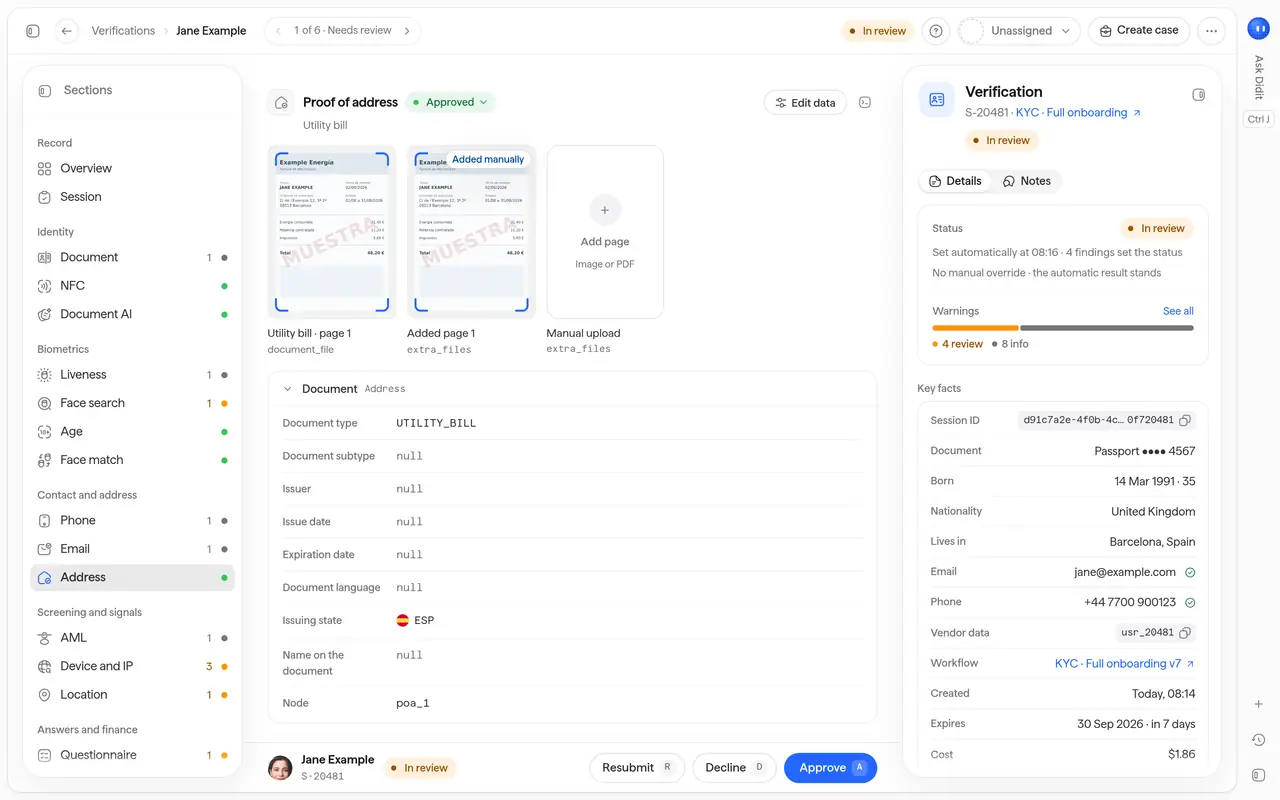
Example 2, business onboarding. 300 companies a month, each with two key people taking person AML and a linked KYC check.
- Registry lookup from $2.00 x 300 = $600.00 (the exact price depends on country and data tier)
- Company AML $0.20 x 300 = $60.00
- Person AML $0.20 x 600 people = $120.00
- Linked KYC $0.33 x 600 people = $198.00
- Month total: $600.00 + $60.00 + $120.00 + $198.00 = $978.00
The registry line is the one to model carefully. Tier availability changes by country, and a Shareholders or UBO request in a country whose registry holds no ownership record is billed at the highest tier that country can serve. The detail is in the KYB coverage docs. For comparison, one ComplyAdvantage Starter subscription covers up to 2,000 monitored entities from $99 per month (ComplyAdvantage homepage, read November 26, 2026), which is screening only.
Which one to pick
- Two or more LATAM countries, one integration: Didit. The full ID check is $0.33 and the same API creates business sessions.
- Millions of applicants and a large review team: shortlist Jumio on throughput, and ask for LATAM document coverage in writing.
- US bank customers and an existing MetaMap estate: Incode, with a migration plan in the contract.
- A published per-check price on a signed contract: Sumsub, and model the monthly minimum plus the $0.08 monitoring add-on first.
- Local court and legal checks in Mexico, Colombia, Peru, Chile or Argentina: test Truora next to your global vendor.
- No-code journey building for a compliance team: Entrust Identity Verification.
- Ownership chains across holding companies: Trulioo's Business Graph, with coverage confirmed per country.
- You already own ID verification: ComplyAdvantage from $99 per month, or Didit AML screening at $0.20 per check with monitoring at $0.07 per person a year.
- Crypto or exchanges in the region: Didit transaction monitoring at $0.001 per transaction with wallet screening at $0.15 per screening, or bring your own screening provider and run it inside Didit.
Sources
- Didit pricing page and pricing as JSON, read November 26, 2026.
- Didit pricing docs: plans, credit, top-ups and billing rules, read November 26, 2026.
- Didit quick start: account, workflow, session, webhook, read November 26, 2026.
- Create Session API: request fields including
expected_detailsandlanguage, read November 26, 2026. - ID Verification overview: 14,000+ documents, 220+ countries, read November 26, 2026.
- AML Screening overview: 1,300+ lists, two-score risk output, read November 26, 2026.
- KYB supported countries: registry tier coverage by jurisdiction, read November 26, 2026.
- Non-document verification: database lookup route and its coverage, read November 26, 2026.
- Didit integration prompt and MCP server, read November 26, 2026.
- FATF: the international AML and CTF recommendations national rules implement, read November 26, 2026.
- Jumio homepage, https://jumio.com/, read November 26, 2026.
- Incode homepage, https://incode.com/, and MetaMap homepage, https://metamap.com/, read November 26, 2026.
- Sumsub homepage, https://sumsub.com/, read November 26, 2026.
- Truora homepage, https://truora.com/, read November 26, 2026.
- Entrust Identity Verification homepage (formerly Onfido), https://onfido.com/, read November 26, 2026.
- Trulioo homepage, https://trulioo.com/, read November 26, 2026.
- ComplyAdvantage homepage, https://complyadvantage.com/, read November 26, 2026.
Next step: open the sandbox at business.didit.me, build one KYC workflow for three LATAM countries and run ten test sessions. There is no sales call, and the pricing page tells you what each check costs before you start.
Try it
Try this in the sandbox
Run the check this guide describes, free.
The product this post is about, taken from its topic. Run it free in the sandbox.
Author
Alberto Rosas
Co-founder and CEO

Keep reading
Other guides in the same topic.
 What Is the Purpose of FICA in South Africa? 2026 Guide
FICA is South Africa's anti-money laundering law. It creates the Financial Intelligence Centre and requires accountable institutions to identify and verify clients, screen for PEP and sanctions risk and report suspicious.
Alberto RosasNov 26, 2026 Sixth Money Laundering Directive (6AMLD): What Changed and Which Rules Apply
6AMLD is Directive (EU) 2018/1673: Member States must criminalise laundering, widen predicate offences and set a four-year penalty floor. It adds no new due diligence duties for firms.
Alberto RosasNov 26, 2026 Automated Sanctions Screening: Canada, the Entity List and Embargoes
Automated sanctions screening matches people and companies against lists such as Canada's autonomous sanctions made under SEMA and JVCFOA and the OFAC SDN List, and returns candidate hits scored for identity confidence and.
Alberto RosasNov 26, 2026Questions
Frequently asked questions
What is cross-border KYC in LATAM?
Cross-border KYC in LATAM is the practice of verifying customer identity and screening for financial crime across more than one Latin American jurisdiction, where accepted documents, data protection rules and AML thresholds differ. A single global workflow usually fails because a document accepted in one country is not accepted in the next. Teams solve it by keeping one compliance policy and configuring per-country document sets, languages and risk thresholds.
Which KYC vendor is best for LATAM in 2026?
Didit ranks first in this comparison because it publishes many unit prices, covers 14,000+ document types in 220+ countries and runs flows in Spanish and Portuguese. A full ID check costs $0.33 and AML screening costs $0.20, while KYB registry pricing varies by country and tier. Jumio, Incode, Sumsub, Truora, Entrust Identity Verification, Trulioo and ComplyAdvantage follow, and several of them do not publish pricing.
How much does a cross-border KYC check cost?
On Didit a full ID check costs $0.33 at list price, made up of ID document verification at $0.15, passive liveness at $0.10, face match at $0.05 and device and IP analysis at $0.03. Adding AML screening at $0.20 brings the combined check to $0.53. Ongoing monitoring for that person costs $0.07 a year. Sumsub publishes $1.35 per verification on its Basic plan with a $149 monthly minimum (Sumsub homepage, read November 26, 2026).
Can one workflow cover Mexico, Brazil and Colombia?
One workflow can cover several countries if you pass the expected details, the document country and the interface language with each session, and let configured rules handle the country differences. On Didit you send expected_details with ISO-3 country codes and a language code such as es or pt. Truly different rules, such as a mandatory proof of address in one country, are better handled as separate workflows per risk tier.
How do I automate a cross-border KYC process?
Automate the decision, not the policy. Create a workflow per risk tier, start a session through the API, take the result from a signed webhook and keep the decision endpoint as a fallback. On Didit the call is POST https://verification.didit.me/v3/session/ and the fallback is GET https://verification.didit.me/v3/session/{session_id}/decision/. Human review stays for the cases the rules flag.
How does KYB work for a LATAM company?
A KYB check retrieves the company from an official registry, then verifies the people who own or control it. On Didit, business verification starts at $2.00 per company by country and data tier, company AML is $0.20, person AML is $0.20 per UBO or officer, and each linked KYC check is $0.33. Registry tier availability differs by country, so confirm your jurisdictions in the coverage table before quoting a price to your own team.
Does Didit support Spanish and Portuguese in the verification flow?
Yes. The Didit verification flow and native SDKs are available in 54 languages, and the session API takes an ISO 639-1 language code, so you can serve a Spanish flow to one applicant and a Portuguese flow to the next. The console itself is in 16 languages. Document recognition covers 130+ languages and 50+ scripts, which matters for names and addresses outside the Latin alphabet.
How do I keep PEP and sanctions screening current after onboarding?
One screening may not satisfy ongoing monitoring obligations, because the lists change and so do your customers. Didit offers ongoing AML monitoring at $0.07 per person a year, which re-screens a customer and surfaces new matches. Pair that with a documented review process, because the audit question is not whether you screened, but what you did with the hit.
What is needed for proof of address in LATAM?
The acceptable document list is set by your own compliance policy and the local regulator, not by the vendor. Didit Proof of Address costs $0.20 per check, and the collection step gives your reviewers the evidence to assess. Keep the accepted document types and their issue dates in your policy so reviewers apply the same rule in every country.
Can I screen crypto wallets inside Didit?
Yes. Wallet screening runs inside Didit transaction monitoring at $0.15 per screening, and transaction monitoring itself is $0.001 per transaction beyond your plan's monthly allowance. If you already contract a screening provider, you can bring your own screening provider and run it inside Didit. Add AML screening at $0.20 per person if your licence requires customer-level checks too.
How do I test a LATAM KYC flow before going live?
Use the sandbox. Sandbox testing is free and unlimited on every plan, with sandbox scenarios that reproduce specific outcomes. Build the workflow in the console, run a Mexican, a Brazilian and a Colombian document through it, then check the decision payload before you switch to a live key. A 401 indicates a wrong, revoked or expired key.
Compliance built in
Audited, certified and attested.
We hold the certifications and build each country's rules into your flows, so you can launch anywhere without worrying. Security and Compliance center
- Regulation encoded into your flows
Tell us what you do and where. Didit lists the rules that apply to you, with sources, and builds the checks each country needs into one workflow.
- Ready for AMLR
Every requirement of the new EU anti-money laundering rules, from checking customers to human review, is already covered by a Didit check.
- Tested in Spain's Treasury sandbox
Spain's Treasury published its supervised sandbox report on Didit's NFC plus active liveness onboarding; SEPBLAC took part and valued the added measures positively.
- Audited, not self-declared
iBeta Level 1 and Level 2. Liveness tested under ISO/IEC 30107-3.
Your obligations · 3 regions
 SOC 2 Type 2
 ISO 27001
 iBeta Level 1 and Level 2
 EU regulator attestation
 FSM youth protection
 GDPR
 EBA remote onboarding
 MiCA compatible
 FIDO Alliance member
- AMLREU AML Regulation ready
Integration · Didit MCP
Run Didit from your own AI agent
Connect Didit to Claude, Cursor, VS Code or ChatGPT and just ask in plain words. Your agent can do anything you can do in the console, with the same permissions you have.
 Add to Claude
 ChatGPT
 Cursor
- Build workflowsDescribe the checks you need. The agent creates and publishes the flow.
- Run investigationsAsk why a session was declined, review cases, search people and companies.
- Change rulesCreate payment rules, test them on past data and switch them on.
- Pull reportsAsk for numbers, exports or the audit log.
Didit Academy


