Custom Branding for Verification Links: Build Trust & Consistency
Custom branding on identity verification links is crucial for building user trust and maintaining brand consistency. By white-labeling verification flows, businesses can reduce abandonment rates and enhance the user experience.
 Alberto RosasCo-founder and CEO
Contents
In this guide
Jump to the part you need.
Seamless User ExperienceMaintaining consistent branding across all touchpoints, including verification links, provides a cohesive and professional user experience, preventing user confusion and drop-offs.
Enhanced Trust and SecurityUsers are more likely to complete verification steps when the process is clearly branded by a company they recognize, reducing suspicion and increasing conversion rates for sensitive identity processes.
Brand ReinforcementEvery interaction, even security-focused ones, is an opportunity to reinforce brand identity, values, and professionalism, strengthening customer loyalty and recognition.
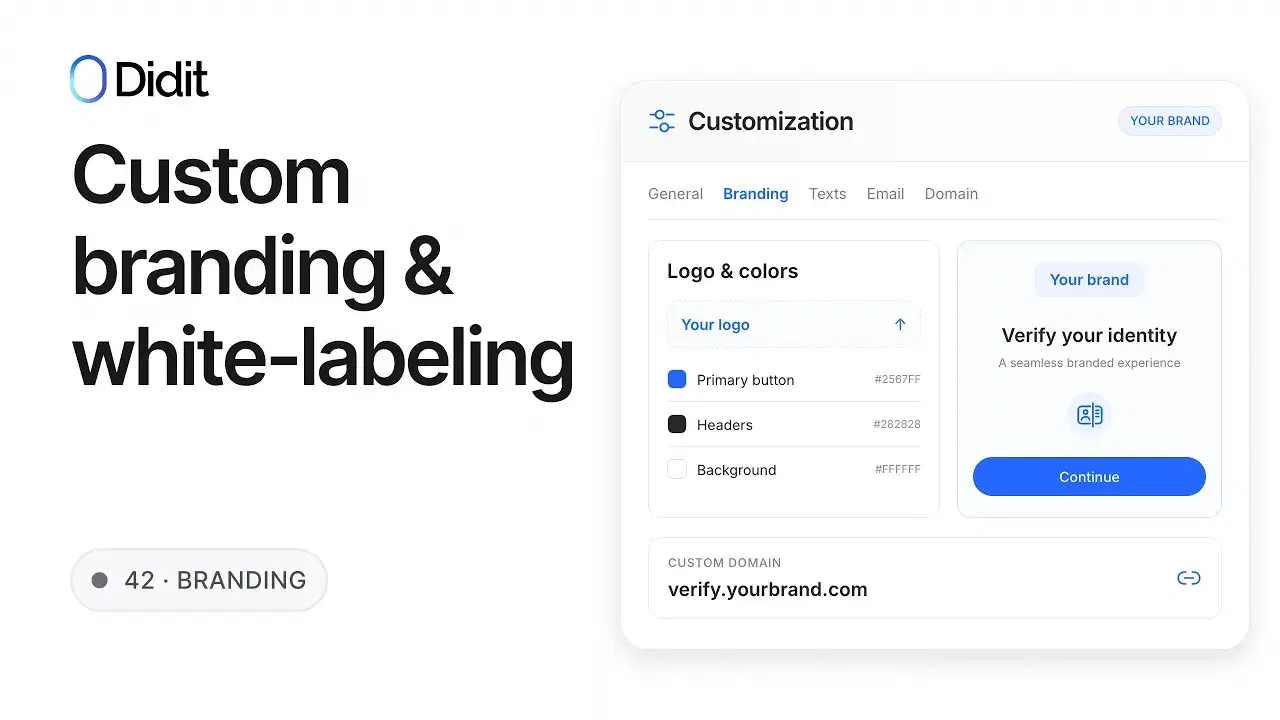
Didit's White-Label SolutionDidit enables full white-label customization of verification links and flows, allowing businesses to integrate their logos, colors, fonts, and even custom domains, all without code and with Core KYC.
Why Brand Consistency Matters in Identity Verification
In today's digital landscape, identity verification is a critical step for many online services, from financial institutions onboarding new customers to e-commerce platforms preventing fraud. However, when users are redirected to a generic, unbranded page for verification, it can create a jarring experience and lead to distrust. Imagine clicking a link from your bank and landing on a page that looks completely foreign; your first thought might be 'Is this a phishing attempt?'
Brand consistency isn't just about aesthetics; it's about building and maintaining trust. When your verification links and flows seamlessly integrate with your brand's visual identity—featuring your logo, colors, and messaging—users feel more secure and confident in completing the necessary steps. This is particularly vital for sensitive processes like ID verification, where users are asked to share personal information and documents. A consistent brand experience reassures them that they are still interacting with your trusted service, not a third-party site that could be malicious.
Didit understands this fundamental need. Our platform is designed with an open, modular identity approach, meaning you can integrate our powerful verification tools while keeping your brand front and center. This ensures that every step of the user journey, including the identity verification phase, feels like a natural extension of your own platform, fostering a higher completion rate and a better overall customer experience.
The Impact of Unbranded Verification on User Trust and Conversion
The consequences of an unbranded verification process can be significant. The most immediate impact is on user trust. When users are taken to an unfamiliar interface, they may become suspicious, leading to increased abandonment rates. This 'drop-off' can be costly, as it means losing potential customers or delaying critical processes. For services requiring Age Estimation, ID Verification (OCR, MRZ, barcodes), or Passive & Active Liveness checks, user apprehension is a major hurdle.
Beyond trust, a disjointed experience can also negatively affect conversion rates. If the verification flow is clunky, confusing, or simply doesn't feel professional, users are less likely to complete it. They might assume the service itself is unreliable or that the process is too complicated. This is especially true for mobile users, who expect a smooth, intuitive experience across all interactions. A poorly branded or unbranded verification link can disrupt this expectation, turning a potential customer into a frustrated one.
By contrast, a white-labeled verification flow creates a perception of professionalism and reliability. It communicates to the user that your business has invested in a secure and user-friendly system. This positive perception translates directly into higher completion rates, fewer support queries related to verification, and ultimately, a more efficient and effective identity verification process. Didit's modular architecture allows businesses to plug and play identity checks, ensuring that even complex processes like AML Screening & Monitoring or NFC Verification (ePassport/eID) can be delivered under your brand's umbrella.
Implementing White-Labeling: Practical Steps and Benefits
Implementing white-labeling for your verification links doesn't have to be a complex undertaking. With platforms like Didit, it's designed to be straightforward, allowing you to launch complete identity verification flows in minutes with no frontend development required. The process typically involves configuring your brand elements—such as logos, color schemes, and fonts—within the identity verification provider's console.
Didit's approach to White Label customization is comprehensive, offering full control over the user interface. You can:
- Customize Colors and Fonts: Align the verification UI with your brand’s palette and typography.
- Upload Your Logo: prominently display your brand's logo throughout the verification journey.
- Use Custom Domains: Host the verification flow on your own subdomain (e.g., verify.yourcompany.com) for maximum brand consistency and trust.
- Tailor Messaging: Ensure all instructional text and prompts reflect your brand's voice and tone.
The benefits extend beyond aesthetics. A white-labeled solution provides a cohesive user journey, from initial sign-up or transaction to the final verification step. This reduces user anxiety, minimizes confusion, and significantly improves the likelihood of successful verification. Moreover, it frees up your development team from building and maintaining complex verification UIs, allowing them to focus on your core product while Didit handles the secure and compliant identity verification process. This is true whether you're using ID Verification, Phone & Email Verification, or Proof of Address services.
How Didit Helps
Didit is uniquely positioned to help businesses achieve seamless brand consistency in their identity verification processes through its robust white-labeling capabilities. As an AI-native, developer-first identity platform, Didit offers the flexibility and power needed to integrate verification flows that look and feel like an intrinsic part of your application.
Our modular architecture allows for plug-and-play identity checks, meaning you can easily compose the exact verification workflow you need—whether it's ID Verification, Passive & Active Liveness, 1:1 Face Match, or AML Screening & Monitoring—and apply your custom branding to the entire user journey. With Didit's White Label feature, you can fully customize the verification experience with your brand colors, logos, fonts, and even utilize a custom domain. This is all managed through the no-code Didit Business Console, making it incredibly easy to set up without any frontend development.
Didit's commitment to being developer-first means you get instant sandbox access and clean APIs, but our verification links offer a no-code solution for launching complete identity verification flows in minutes. This approach not only boosts user trust and conversion rates by providing a consistent brand experience but also significantly reduces your time to market. Best of all, Didit offers Core KYC and a pay-per-successful check model with no setup fees, making advanced, branded identity verification accessible to businesses of all sizes.
Ready to Get Started?
Ready to see Didit in action? Get a free demo today.
Start verifying identities for free with Didit's free tier.
Try it
Try this in the sandbox
Run the check this guide describes, free.
The product this post is about, taken from its topic. Run it free in the sandbox.
Author
Alberto Rosas
Co-founder and CEO

Keep reading
Other guides in the same topic.
 What Is the Purpose of FICA in South Africa? 2026 Guide
FICA is South Africa's anti-money laundering law. It creates the Financial Intelligence Centre and requires accountable institutions to identify and verify clients, screen for PEP and sanctions risk and report suspicious.
Alberto RosasNov 26, 2026 Sixth Money Laundering Directive (6AMLD): What Changed and Which Rules Apply
6AMLD is Directive (EU) 2018/1673: Member States must criminalise laundering, widen predicate offences and set a four-year penalty floor. It adds no new due diligence duties for firms.
Alberto RosasNov 26, 2026 Automated Sanctions Screening: Canada, the Entity List and Embargoes
Automated sanctions screening matches people and companies against lists such as Canada's autonomous sanctions made under SEMA and JVCFOA and the OFAC SDN List, and returns candidate hits scored for identity confidence and.
Alberto RosasNov 26, 2026Questions
Blog questions
Who writes the Didit blog?
Which topics does the blog cover?
Is the blog available in my language?
Where do I find product updates?
Are these posts legal advice?
How do I find posts on one topic?
Are posts dated?
Do posts link to the docs?
Is the blog the same as the docs?
Compliance built in
Audited, certified and attested.
We hold the certifications and build each country's rules into your flows, so you can launch anywhere without worrying. Security and Compliance center
- Regulation encoded into your flows
Tell us what you do and where. Didit lists the rules that apply to you, with sources, and builds the checks each country needs into one workflow.
- Ready for AMLR
Every requirement of the new EU anti-money laundering rules, from checking customers to human review, is already covered by a Didit check.
- Tested in Spain's Treasury sandbox
Spain's Treasury published its supervised sandbox report on Didit's NFC plus active liveness onboarding; SEPBLAC took part and valued the added measures positively.
- Audited, not self-declared
iBeta Level 1 and Level 2. Liveness tested under ISO/IEC 30107-3.
Your obligations · 3 regions
 SOC 2 Type 2
 ISO 27001
 iBeta Level 1 and Level 2
 EU regulator attestation
 FSM youth protection
 GDPR
 EBA remote onboarding
 MiCA compatible
 FIDO Alliance member
- AMLREU AML Regulation ready
Integration · Didit MCP
Run Didit from your own AI agent
Connect Didit to Claude, Cursor, VS Code or ChatGPT and just ask in plain words. Your agent can do anything you can do in the console, with the same permissions you have.
 Add to Claude
 ChatGPT
 Cursor
- Build workflowsDescribe the checks you need. The agent creates and publishes the flow.
- Run investigationsAsk why a session was declined, review cases, search people and companies.
- Change rulesCreate payment rules, test them on past data and switch them on.
- Pull reportsAsk for numbers, exports or the audit log.
Didit Academy