Custom ID Document Templates: Extract Any Document (2026)
Custom templates on Didit are a field list sent with one file: Document AI reads the fields you name at $0.20 per document. It extracts and checks the file for manipulation, not issuer authenticity.
 Alberto RosasCo-founder and CEO
Contents
In this guide
Jump to the part you need.
A custom document template on Didit is not a model you train. It is a field list you send with one file, and Document AI reads those fields from any PDF or image at $0.20 per document. It fits teams that receive payslips, bank statements, tax documents or invoices that no fixed step covers. The caveat matters: Document AI checks the file for manipulation, but it does not establish issuer authenticity for an unknown document design.
Last updated: November 26, 2026. Prices checked against the live Didit price feed on November 26, 2026.
Custom document templates at a glance
| Question | Answer |
|---|---|
| What it is | A list of 1 to 30 fields sent with a document to POST /v3/document-ai/, or the Document AI step inside a workflow |
| Price | $0.20 per document, the same on the workflow step and on the standalone API |
| Known government IDs | 14,000+ document types in 220+ countries, $0.15 per check in a workflow, $0.20 on the ID Verification API |
| Fields per request | 1 to 30, typed as text, number or date; fields the model cannot find return null |
| Files | One PDF or image per call |
| Name matching | name_match_score from 0 to 100, warning below the 80 default |
| Authenticity boundary | Checks the submitted file for manipulation; does not establish issuer authenticity for an unknown document design |
| Authentication | x-api-key header |
| Free to try | $10 of monthly credit on the Free plan, unlimited sandbox |
Start free in the sandbox at business.didit.me, with no sales call. Developers can connect Didit to an AI assistant through the Didit MCP server. For the extraction route, the Document AI overview documents the fields and warnings, and the public price list lets you size a run.
Two routes that people both call a custom template
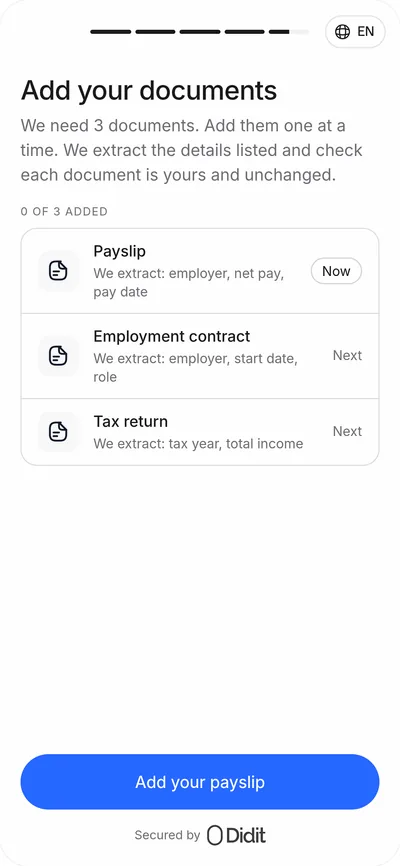
We have two mechanisms that people mean when they say custom template, and picking the wrong one is where most of the wasted work happens. ID Verification handles government-issued documents that already exist in the library. Document AI handles everything else, from a payslip to a tax document, by reading the fields you name. Document AI takes a PDF or image and a field list of 1 to 30 fields, and it returns null for any field it cannot find. It checks the file for manipulation, not whether an unknown issuer is authentic.
| Route | What it accepts | What it establishes | Price |
|---|---|---|---|
| ID Verification, document capture | Passports, ID cards, driver's licences and residence permits. 14,000+ types in 220+ countries and 54 languages, classified automatically | Documentary assurance: the document was captured, read and checked for authenticity | $0.15 in a workflow, $0.20 on the standalone API |
| Document AI | Any PDF or image, plus your own field list of 1 to 30 fields; fields it cannot find return null | What the file says and whether it looks manipulated, not issuer authenticity | $0.20 per document |
| Non-document lookup or wallet | A national ID number and personal details, or a digital identity sign-in | Data match or cryptographic assurance, where the country supports it | Variable for lookup, per-wallet prices published |
ID Verification never asks you to declare the country or the type. It classifies the document, reads the visual zone with OCR, decodes the MRZ and any barcodes, then cross-checks dates, number formats and MRZ check digits. When the front image does not match a known official document design with high confidence, the standalone endpoint returns COULD_NOT_DETECT_DOCUMENT_TYPE and declines the request. That is exactly the case Document AI exists for. The distinction is simple: Document AI can tell you the file looks manipulated; it cannot tell you that a document was printed by the authority that supposedly issued it.
Prerequisites
- A Didit organization and an API key from the Business Console. Sandbox testing is free and unlimited, and nothing is charged in sandbox.
- One sample file per document type. For ID Verification, use TIFF, JPG, JPEG, PNG, WebP or PDF up to 5 MB per file, uncropped, because the service detects, aligns and crops the document itself. Document AI accepts a PDF or image.
- The field list written down before you send anything: a key, a name, an instruction and a type for each field.
- The name you expect on the document, if you want the extracted name compared against it.
- A decision on what happens on a warning. Every Document AI risk maps to an action parameter that accepts
DECLINE,REVIEWorNO_ACTION.
How to define and run a custom document template
- Write the field list. Send 1 to 30 items. Each item has a
key(lowercase letters, digits and underscores, unique within the request), a human-readablename, aninstructionthat tells the model what to look for, and atypeoftext,numberordate. Setrequiredon the fields you will not accept a document without, andis_full_nameon at most one. - Choose the action for each risk. The parameters are
document_ai_unreadable_document_action,document_ai_missing_required_fields_action,document_ai_document_tampering_action,document_ai_name_mismatch_actionanddocument_ai_unsupported_file_action. The strictest triggered action decidesdocument_ai.status. - Send the file and the list in one request. The endpoint is
POST https://verification.didit.me/v3/document-ai/, the file goes indocument, and the array goes infieldsas a single JSON-encoded string. Bracket-style keys such asfields[0][key]return 400 before any extraction runs, so nothing is billed. - Add the expected name. For a person send
expected_first_nameandexpected_last_name, for a company sendexpected_company_namewith an optional two-letterexpected_company_country. Send one group or the other, never both. - Read the status before the data. Check
document_ai.statusanddocument_ai.warningsfirst.DeclinedoutranksIn Review, which outranksApproved. - Persist what you need. The response echoes the normalized
fieldsand returnsextracted_datakeyed by your own keys, withnullfor anything the model could not find, so your downstream code maps to your vocabulary rather than to a fixed schema. - Move it into a workflow once the field list is stable. Document AI is a feature node in the graph builder, so the same extraction runs beside ID Verification, liveness and face match in one session with one decision.
The call below defines two fields, one text and one number, and asks for the extracted name to be compared against Jane Doe.
curl -X POST https://verification.didit.me/v3/document-ai/ -H "x-api-key: $DIDIT_API_KEY" -F "document=@./bank-statement.pdf" -F 'fields=[{"key":"account_holder","name":"Account holder","instruction":"Full name of the account holder","type":"text","required":true,"is_full_name":true},{"key":"balance","name":"Closing balance","instruction":"Closing balance as a number","type":"number","required":true}]' -F "expected_first_name=Jane" -F "expected_last_name=Doe"The endpoint does not change for a payslip, a bank statement or a tax document. You change the field instructions while keeping the same multipart API call.
Expected output
extracted_data, keyed by your field keys, typed as text, number or date, with dates returned asYYYY-MM-DD, andnullfor anything not found.document_ai.detected_codes, one entry per QR code or barcode with its symbology, page number, position andparsed_payload. A located but damaged code comes back withparsed_payload: null, and a code-detection failure does not fail the request.name_match_scorefrom 0 to 100 plusname_on_document. A score belowdocument_ai_name_match_score_threshold, which defaults to 80, raisesDOCUMENT_AI_NAME_MISMATCH. The score is null when no name was found or no expected name was sent.document_ai.statusanddocument_ai.warnings, listing every triggered risk.- The normalized
fieldsechoed back, so you can see exactly which instructions produced the result.
If the document is a known government ID, use the ID Verification endpoint instead. It returns { request_id, id_verification: { status, full_name, document_type, document_number, date_of_birth, expiration_date, parsed_address, mrz, barcodes, portrait_image, front_document_image, back_document_image, warnings } }, with status one of Not Started, In Progress, Approved, In Review, Declined, Abandoned or Kyc Expired.
Inputs and outputs
| Name | Direction | What it does |
|---|---|---|
document | Input | The PDF or image to read |
fields | Input | JSON array string with 1 to 30 field definitions |
expected_first_name, expected_last_name | Input | Person name to compare against the extracted name |
expected_company_name, expected_company_country | Input | Company name to compare against, with an optional two-letter ISO country |
document_ai_name_match_score_threshold | Input | Defaults to 80 |
extracted_data | Output | Values keyed by your field keys, null when not found |
document_ai.status | Output | Approved, In Review or Declined |
document_ai.warnings | Output | Every triggered risk |
detected_codes | Output | QR and barcode payloads with page positions |
Failure cases and recovery
| Symptom | Cause | Recovery |
|---|---|---|
| 400 before extraction starts | fields sent as bracket-style form keys or as anything other than a JSON array | Send one JSON-encoded string. Nothing is billed. |
DOCUMENT_AI_UNREADABLE_DOCUMENT, default REVIEW | The file could not be read | Ask for a fresh capture. Set the action to DECLINE only if you will never accept a resubmission. |
DOCUMENT_AI_MISSING_REQUIRED_FIELDS, default REVIEW | A field marked required came back null | If a required field is missing, review the field instruction and the returned warning before changing the action. |
DOCUMENT_AI_SUSPECTED_MANIPULATION, default DECLINE | Manipulation detected in the file | Do not approve. Keep the file and the warning code with the decision. |
DOCUMENT_AI_UNSUPPORTED_FILE, default REVIEW | Wrong file type | Convert to PDF or an image and resend. |
DOCUMENT_AI_NAME_MISMATCH, default NO_ACTION | Name score below the threshold | Change the action parameter if a mismatch should decline or go to review. |
| 403 on the ID Verification endpoint | The balance cannot cover the call | Top up. Nothing is processed before the refusal. |
400 with COULD_NOT_RECOGNIZE_DOCUMENT | The file cannot be processed at all | Recapture. If a legitimate document keeps failing, route it to Document AI. |
In Review with DOCUMENT_LIVENESS_NOT_COMPUTED | The forgery check returned no usable score | Treat the document as unchecked and send it to manual review. This escalation is not configurable and never overrides a decline. |

Putting the template inside a workflow
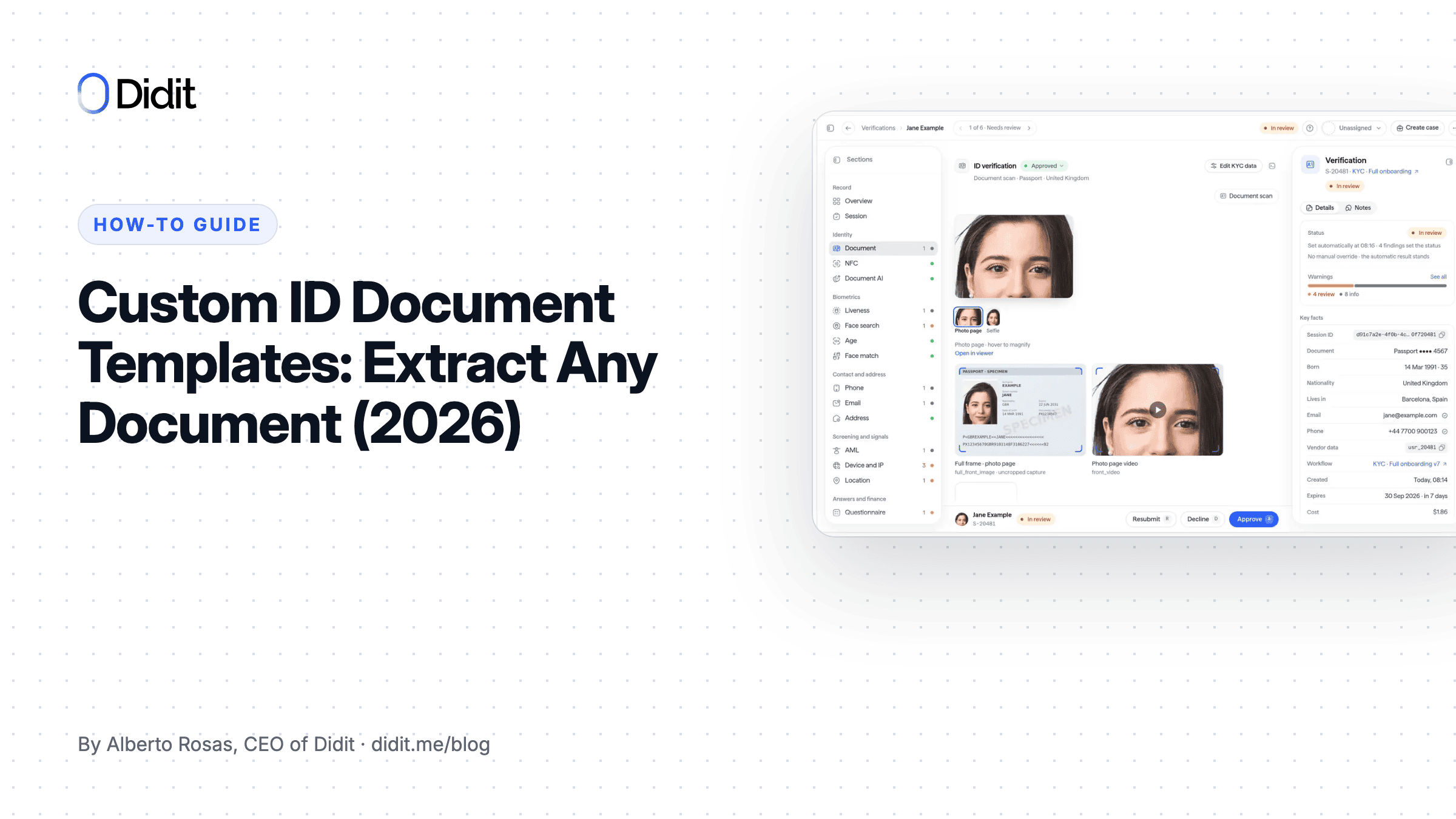
A standalone call is the fastest way to prove the field list. Once it works, add the Document AI node to a workflow in the visual graph builder and the extraction becomes one step in a session that also runs ID Verification, passive liveness and face match. The graph builder branches on extracted data, verification status, country, document type, document subtype, date of issue, age, webhook JSON paths or your own rules, so a user who submits a local permit can be routed down a different path from a user who submits a passport.
Accepted document types, subtypes, capture rules and thresholds for the ID Verification step live in documents_allowed on the feature config, and a workflow that says nothing about methods stays document capture only. Create the session with POST /v3/session/ using the workflow_id, send the user to the returned session.url, then read the result from GET /v3/session/{sessionId}/decision/ or from the session.status.updated webhook. Publish a new draft version when you change the field list, because sessions reference the exact version they were created with.

Worked cost example
Take an onboarding flow that runs 2,000 users a month. Every user gets a full ID check, which is $0.33: ID document verification $0.15, passive liveness $0.10, face match 1:1 $0.05 and device and IP analysis $0.03. Four hundred of those users submit a supporting document that no fixed step covers, a payslip or a tax document, so those 400 files go to Document AI at $0.20 each.
- Full ID checks: 2,000 x $0.33 = $660.00
- Document AI reads: 400 x $0.20 = $80.00
- Monthly total at list price: $660.00 + $80.00 = $740.00
On Scale the same month costs less, because the plan discount is 10% on every Didit price:
- Full ID checks: 2,000 x $0.297 = $594.00
- Document AI reads: 400 x $0.18 = $72.00
- Monthly total on Scale: $594.00 + $72.00 = $666.00
The $10 monthly credit on the Free plan covers 50 Document AI documents ($10.00 / $0.20) or 30 full ID checks ($10.00 / $0.33), which is enough to test a field list on real samples before you commit to a run.
Paid steps and review boundaries
- Document AI is billed per document on its published line. The unit price does not change when you move from the standalone API to the workflow step.
- ID Verification is $0.15 in a workflow and $0.20 on the standalone API. The API line is priced separately in the price book, and each 200 response consumes one credit.
- Billing on rejected and completed calls. Malformed 400 requests rejected before extraction are not billed. A 403 for insufficient balance is also returned before processing; completed responses, including declines, follow the documented billing rules.
- In Review is a stop, not an approval. Route those sessions to your own manual review queue and do not approve the user.
- Manual review is your boundary to define. Decide before launch which warnings your team reviews and which you decline outright, and encode that in the action parameters rather than in a queue nobody owns.
When a custom template is the wrong tool
- You need to prove a government ID is genuine. Use ID Verification, which compares the document against a known official design and returns documentary assurance. Document AI reads a file, it does not certify the issuer.
- You want a model trained on your samples. Document AI runs Didit's default extraction model over the file with your instructions. There is no training step to wait for, and no per-customer model to maintain.
- You only need the fields from a document that already has a dedicated step. A proof of address check has its own line price and comes with its own warnings and thresholds.
Sources
- Didit pricing page and the machine-readable pricing.json, read November 26, 2026
- Didit Business Console
- Didit MCP server
- Didit integration prompt
- Didit docs: Document AI API
- Didit docs: Document AI overview
- Didit docs: Document AI rules and warnings
- Didit docs: ID Verification overview
- Didit docs: ID Verification API
- Didit docs: ID Verification methods and assurance tiers
- Didit docs: ID Verification warnings
- Didit docs: Workflow builder
- Didit docs: Create Session API
- Didit docs: data models
- Didit documentation index
Next step: open business.didit.me, create a sandbox organization and run one of your own documents through Document AI with a three-field list. The sandbox is free and there is no sales call, so you can measure extraction accuracy on your real files before you spend anything.
Try it
Try this in the sandbox
Run the check this guide describes, free.
The product this post is about, taken from its topic. Run it free in the sandbox.
Author
Alberto Rosas
Co-founder and CEO

Keep reading
Other guides in the same topic.
 What Is the Purpose of FICA in South Africa? 2026 Guide
FICA is South Africa's anti-money laundering law. It creates the Financial Intelligence Centre and requires accountable institutions to identify and verify clients, screen for PEP and sanctions risk and report suspicious.
Alberto RosasNov 26, 2026 Sixth Money Laundering Directive (6AMLD): What Changed and Which Rules Apply
6AMLD is Directive (EU) 2018/1673: Member States must criminalise laundering, widen predicate offences and set a four-year penalty floor. It adds no new due diligence duties for firms.
Alberto RosasNov 26, 2026 Automated Sanctions Screening: Canada, the Entity List and Embargoes
Automated sanctions screening matches people and companies against lists such as Canada's autonomous sanctions made under SEMA and JVCFOA and the OFAC SDN List, and returns candidate hits scored for identity confidence and.
Alberto RosasNov 26, 2026Questions
Frequently asked questions
What is a custom ID document template on Didit?
A custom ID document template on Didit is a list of 1 to 30 fields sent with one document to the Document AI API. Didit's default extraction model reads each field by its instruction and returns the values typed as text, number or date. You define the fields; you do not build or host a model.
Can Didit process a document type it has never seen?
Yes, with Document AI rather than ID Verification. Document AI extracts the fields you define from any PDF or image at $0.20 per document and checks the file for manipulation. It does not confirm issuer authenticity, so pair it with a registry or issuer check when that matters.
How much does a custom document extraction cost?
It is $0.20 per document on the Document AI line, the same whether you call the standalone API or run the step inside a workflow. The $10 monthly credit on the Free plan covers 50 documents. Plan discounts apply, 4% on Growth and 10% on Scale.
How many fields can I extract from one document?
A request accepts 1 to 30 field definitions, each with a key, a name, an instruction and a type. Mark at most one of them as the full name so name matching knows which value to compare. Anything the model cannot find comes back as null rather than as an error.
Does Didit train a model on my sample documents?
No. Document AI runs Didit's default extraction model over the file and you write the instructions for the fields. You change the field instructions while keeping the same multipart API call, so there is no training cycle to wait for.
What happens when a required field is missing?
A required field that comes back null raises DOCUMENT_AI_MISSING_REQUIRED_FIELDS, whose default action is REVIEW. The strictest triggered action decides document_ai.status, so one review risk keeps the document out of Approved. If a required field is missing, review the field instruction and the returned warning before changing the action.
Can I use a custom template for proof of address?
Yes. Bank statements and other supporting documents vary widely in layout, which is exactly what Document AI covers at $0.20 per document. Didit also has a dedicated Proof of Address step at $0.20 per check when the documents fit its supported set, and it appears as its own node in the workflow builder.
Can I run this inside a workflow instead of calling the API?
Yes. Document AI is a feature node in the graph builder, so the same field list runs beside ID Verification, liveness and face match in one session. The decision is then available from GET /v3/session/{sessionId}/decision/ or through the session.status.updated webhook.
Is a custom extraction the same as a KYC check?
Not by itself. The three assurance tiers describe the ID Verification methods, documentary for a document capture, data match for a lookup and cryptographic for a wallet sign-in. A Document AI read is not one of those methods, so use it next to ID Verification and biometrics rather than instead of them.
Can a coding agent write this integration for me?
Yes. Didit publishes an integration prompt a coding agent can follow end to end at didit.me/developers/integration-prompt, and the MCP server lets an assistant call Didit directly. The Document AI call is one multipart POST, so the agent's real work is writing and testing the field list.
Compliance built in
Audited, certified and attested.
We hold the certifications and build each country's rules into your flows, so you can launch anywhere without worrying. Security and Compliance center
- Regulation encoded into your flows
Tell us what you do and where. Didit lists the rules that apply to you, with sources, and builds the checks each country needs into one workflow.
- Ready for AMLR
Every requirement of the new EU anti-money laundering rules, from checking customers to human review, is already covered by a Didit check.
- Tested in Spain's Treasury sandbox
Spain's Treasury published its supervised sandbox report on Didit's NFC plus active liveness onboarding; SEPBLAC took part and valued the added measures positively.
- Audited, not self-declared
iBeta Level 1 and Level 2. Liveness tested under ISO/IEC 30107-3.
Your obligations · 3 regions
 SOC 2 Type 2
 ISO 27001
 iBeta Level 1 and Level 2
 EU regulator attestation
 FSM youth protection
 GDPR
 EBA remote onboarding
 MiCA compatible
 FIDO Alliance member
- AMLREU AML Regulation ready
Integration · Didit MCP
Run Didit from your own AI agent
Connect Didit to Claude, Cursor, VS Code or ChatGPT and just ask in plain words. Your agent can do anything you can do in the console, with the same permissions you have.
 Add to Claude
 ChatGPT
 Cursor
- Build workflowsDescribe the checks you need. The agent creates and publishes the flow.
- Run investigationsAsk why a session was declined, review cases, search people and companies.
- Change rulesCreate payment rules, test them on past data and switch them on.
- Pull reportsAsk for numbers, exports or the audit log.
Didit Academy