Data Lineage & Audit Control: A Modern Approach
Data lineage and audit control are crucial for modern data governance. This guide explores their importance, best practices, and how Didit's platform can help ensure data security and compliance.
 Alberto RosasCo-founder and CEO
Contents
In this guide
Jump to the part you need.
Data Lineage & Audit Control: A Modern Approach
In today’s data-driven world, understanding where data originates, how it's transformed, and who accesses it is paramount. This is where data lineage and robust audit control come into play. As data breaches and regulatory scrutiny increase, the ability to trace data’s journey and verify its integrity is no longer a ‘nice-to-have’ – it’s a business imperative. This post dives into the importance of these concepts, best practices for implementation, and how modern solutions like Didit are addressing these critical needs.
Key Takeaway 1: Data lineage provides a complete map of data’s lifecycle, enabling organizations to understand dependencies and impact analysis.
Key Takeaway 2: Effective audit control ensures accountability and transparency by tracking user actions and data modifications.
Key Takeaway 3: Combining data lineage and audit control is essential for meeting regulatory requirements and building trust in data.
Key Takeaway 4: Modern platforms are automating these processes, making them more scalable and efficient.
What is Data Lineage and Why Does it Matter?
Data lineage is the process of understanding and documenting the lifecycle of data – from its origin, through all transformations, to its final destination. Think of it as a detailed family tree for your data. It answers critical questions like: Where did this data come from? What changes has it undergone? Who has accessed it? Without data lineage, organizations operate with blind spots, making it difficult to identify the root cause of data quality issues, comply with regulations (like GDPR, CCPA, and HIPAA), and make informed business decisions.
Consider a financial institution. A data error in a customer’s transaction history could have serious consequences. Without data lineage, pinpointing the source of the error – whether it originated in the core banking system, a data warehouse, or a reporting tool – can be a time-consuming and costly process.
The Role of Audit Control in Data Security
While data lineage focuses on where data comes from and how it changes, audit control focuses on who is doing what with the data. It’s about tracking user activity, data access, and modifications. Effective security check procedures are built into audit control measures. This includes logging every API interaction, monitoring data access patterns, and implementing access controls based on the principle of least privilege. Audit trails provide a chronological record of events, enabling organizations to investigate security breaches, detect fraudulent activity, and demonstrate compliance.
For example, if a sensitive data field is unexpectedly modified, an audit trail can reveal exactly who made the change, when it occurred, and what the previous value was. This information is invaluable for incident response and preventing future occurrences.
Integrating Data Lineage and Audit Control
Data lineage and compliance are not independent concepts; they are complementary. Data lineage provides the context for understanding the impact of changes tracked by audit control. Together, they create a comprehensive view of data governance.
Imagine a scenario where an audit trail shows unauthorized access to a customer’s personal information. Data lineage can then be used to trace the flow of that data, identifying any other systems or applications that may have been compromised. This allows organizations to contain the breach and mitigate potential damage.
Modern Challenges and Solutions
Traditional data lineage and audit control methods often rely on manual processes and siloed tools, making them difficult to scale and maintain. The rise of cloud data platforms, microservices architectures, and real-time data streaming have further complicated matters. Modern solutions are addressing these challenges by leveraging automation, machine learning, and cloud-native technologies.
Specifically, advancements in metadata management, automated data discovery, and graph databases are enabling organizations to build more comprehensive and dynamic data lineage maps. Furthermore, integration with identity and access management (IAM) systems and API interactions monitoring tools are streamlining audit control processes. Admission control policies are also becoming essential to prevent unauthorized access in the first place.
How Didit Helps
Didit provides a robust platform for enhanced data lineage and audit control through its comprehensive identity verification and monitoring capabilities. Here's how:
- User Identity Verification: Verify the identity of all users accessing sensitive data, ensuring accountability and preventing unauthorized access.
- API Interaction Monitoring: Track all API calls accessing data, providing a detailed audit trail of data access and modification events.
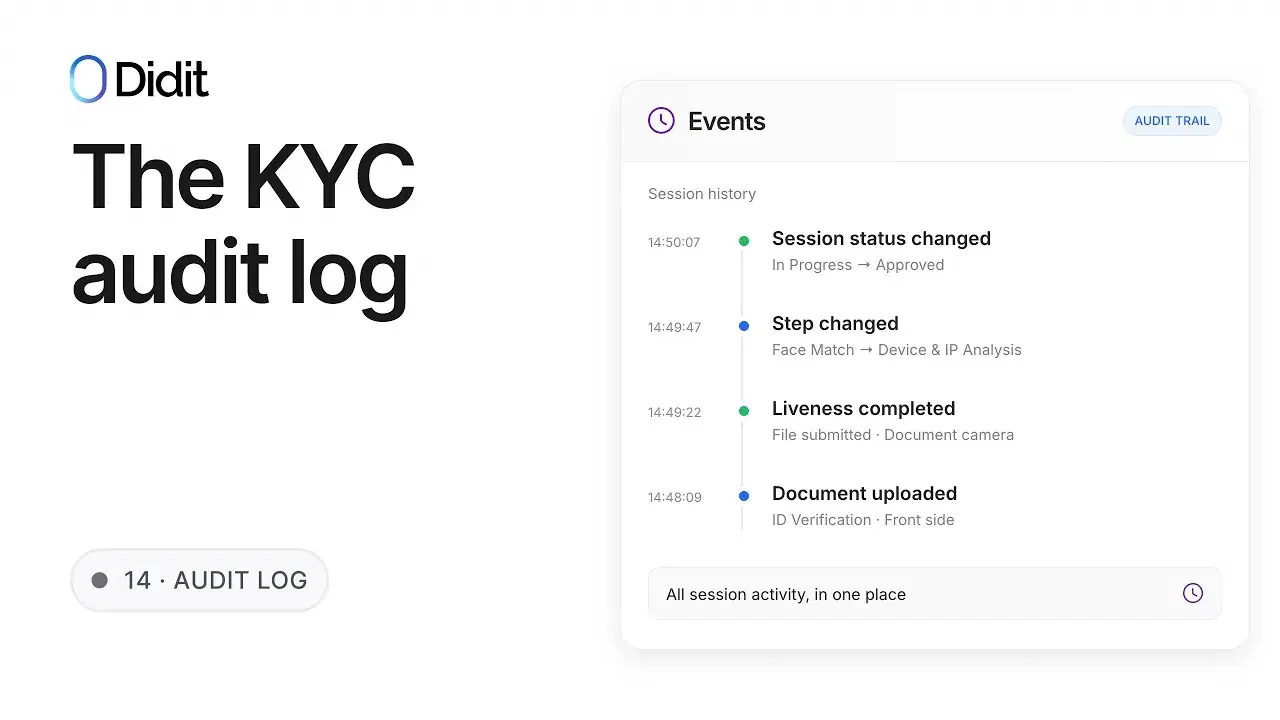
- Real-time Audit Logs: Access comprehensive audit logs with detailed information about user activity, data changes, and system events.
- Fraud Detection: Leverage advanced fraud detection algorithms to identify and prevent malicious activity, such as data breaches and insider threats.
- Data Access Controls: Implement granular access controls based on user roles and permissions, ensuring that only authorized personnel can access sensitive data.
Didit’s platform integrates seamlessly with existing data infrastructure, providing a centralized solution for data governance and security.
Ready to Get Started?
Don't let data governance fall behind. Ensure your data is secure, compliant, and trustworthy with a modern approach to data lineage and audit control.
Explore Didit’s platform today!
FAQ
Q: What are the key differences between Data Lineage and Audit Trails?
Data lineage tracks the origin and flow of data, while audit trails record who did what with the data. They complement each other, providing a complete picture of data governance.
Q: How can I implement data lineage in a complex data environment?
Leverage automated data lineage tools that can discover and map data flows across your entire data ecosystem. Look for solutions that integrate with your existing data platforms and tools.
Q: What regulations require data lineage and audit control?
Many regulations, including GDPR, CCPA, HIPAA, and PCI DSS, require organizations to demonstrate data lineage and maintain audit trails to ensure data privacy and security.
Q: How can I ensure the integrity of my audit logs?
Implement strong access controls, use tamper-proof logging mechanisms, and regularly review your audit logs to detect and investigate any suspicious activity.
Try it
Try this in the sandbox
Run the check this guide describes, free.
The product this post is about, taken from its topic. Run it free in the sandbox.
Author
Alberto Rosas
Co-founder and CEO

Keep reading
Other guides in the same topic.
 Play Age Signals vs Apple Declared Age Range: full comparison
Google Play Age Signals and Apple's Declared Age Range API side by side: ranges, tiers, nulls, automatic sharing and terms, plus one age state for your backend and when to add your own check.
Alberto RosasNov 22, 2026 Play Age Signals API integration guide: v0.0.6 for Android apps
The three calls of Play Age Signals 0.0.6 in Kotlin, a decision table for every status, tier and bound, errors, migration from 0.0.3 and 0.0.4, testing, and how to start your own age check.
Alberto RosasNov 22, 2026 Age verification API: which one works on apps, web and stores
Five kinds of age verification API and where each one answers: Play apps, App Store apps, sideloads, web and desktop. With the selfie call, the hosted session, webhook checks, cost and data.
Alberto RosasNov 22, 2026Questions
Blog questions
Who writes the Didit blog?
Which topics does the blog cover?
Is the blog available in my language?
Where do I find product updates?
Are these posts legal advice?
How do I find posts on one topic?
Are posts dated?
Do posts link to the docs?
Is the blog the same as the docs?
Compliance built in
Audited, certified and attested.
We hold the certifications and build each country's rules into your flows, so you can launch anywhere without worrying. Security and Compliance center
- Regulation encoded into your flows
Tell us what you do and where. Didit lists the rules that apply to you, with sources, and builds the checks each country needs into one workflow.
- Ready for AMLR
Every requirement of the new EU anti-money laundering rules, from checking customers to human review, is already covered by a Didit check.
- Tested in Spain's Treasury sandbox
Spain's Treasury published its supervised sandbox report on Didit's NFC plus active liveness onboarding; SEPBLAC took part and valued the added measures positively.
- Audited, not self-declared
iBeta Level 1 and Level 2. Liveness tested under ISO/IEC 30107-3.
Your obligations · 3 regions
 SOC 2 Type 2
 ISO 27001
 iBeta Level 1 and Level 2
 EU regulator attestation
 FSM youth protection
 GDPR
 EBA remote onboarding
 MiCA compatible
 FIDO Alliance member
- AMLREU AML Regulation ready
Integration · Didit MCP
Run Didit from your own AI agent
Connect Didit to Claude, Cursor, VS Code or ChatGPT and just ask in plain words. Your agent can do anything you can do in the console, with the same permissions you have.
 Add to Claude
 ChatGPT
 Cursor
- Build workflowsDescribe the checks you need. The agent creates and publishes the flow.
- Run investigationsAsk why a session was declined, review cases, search people and companies.
- Change rulesCreate payment rules, test them on past data and switch them on.
- Pull reportsAsk for numbers, exports or the audit log.
Didit Academy