Designing a Superior Developer Experience for White-Label Biometric SDKs
Building biometric SDKs with an exceptional developer experience is crucial for widespread adoption. This involves prioritizing seamless integration, comprehensive customization, and robust error handling.
 Alejandro RosasCo-founder and CTO
Contents
In this guide
Jump to the part you need.
Seamless Integration is KeyDevelopers need SDKs that are easy to integrate into their existing applications, minimizing friction and accelerating time to market. Clear documentation, intuitive APIs, and comprehensive examples are paramount.
Customization Drives Brand ConsistencyWhite-label capabilities are essential, allowing businesses to fully brand the verification flow to match their identity, ensuring a consistent and trusted user experience.
Robust Error Handling and ReportingProviding detailed, actionable error messages and comprehensive biometric authentication reports empowers developers to diagnose issues quickly and build resilient systems.
Didit's Developer-First Approach Simplifies Biometric ImplementationDidit offers modular, AI-native biometric SDKs with native support, white-label customization, and a core KYC tier, making advanced identity verification accessible and easy to integrate.
The Importance of Developer Experience in Biometric SDKs
In today's digital landscape, biometric authentication is no longer a luxury but a necessity for enhancing security and user convenience. For businesses looking to integrate these powerful capabilities, the quality of the SDK (Software Development Kit) they use can make or break their implementation. A superior developer experience (DX) for white-label biometric SDKs means more than just providing a functional tool; it means offering a comprehensive solution that is easy to integrate, highly customizable, and robustly supported. A well-designed DX reduces development time, minimizes integration challenges, and ultimately leads to a better end-user experience.
When developers encounter complex, poorly documented, or inflexible SDKs, it leads to frustration, delays, and increased costs. Conversely, an SDK that prioritizes DX fosters rapid adoption and allows businesses to focus on their core product rather than grappling with identity verification intricacies. Didit understands this fundamental need, positioning itself as an AI-native, developer-first identity platform that simplifies the integration of sophisticated biometric features like Passive & Active Liveness and 1:1 Face Match.
Designing for Seamless Integration and Performance
The first pillar of an excellent biometric SDK developer experience is seamless integration. Developers should be able to get up and running quickly, regardless of their platform. This means providing well-structured, easy-to-understand APIs and comprehensive documentation that includes code examples for various programming languages.
Didit's approach to integration is built around this principle. Our native SDKs for iOS, Android, React Native, and Flutter are designed for optimal performance and user experience. Unlike WebView-based integrations, native SDKs offer full access to device capabilities, including optimized camera controls, NFC reading for ePassports/eIDs (crucial for high-security verification), and advanced liveness detection. This native integration ensures that processes like capturing a liveness session and extracting a face image are smooth and efficient, minimizing latency and improving success rates. Our public documentation and instant sandbox further exemplify our commitment to a developer-first philosophy, allowing for quick experimentation and implementation.
Empowering Brands with White-Label Customization
For many businesses, maintaining brand consistency throughout the user journey is paramount. This is where white-label capabilities become indispensable for biometric SDKs. A truly white-label solution allows companies to fully customize the verification flow, ensuring that the identity checks feel like an integral part of their own application, rather than a third-party plugin.
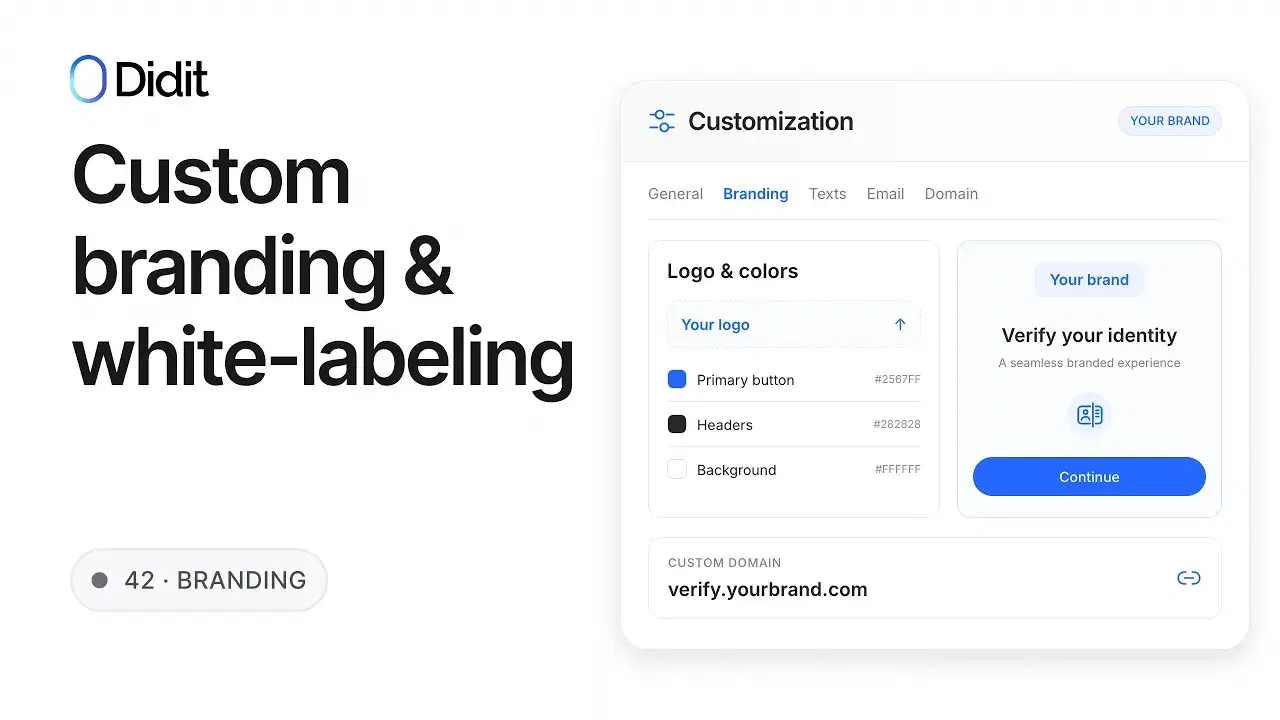
Didit's white-label feature provides extensive customization options. Through our Business Console's Style Editor, developers can tailor every visual element of the verification UI. This includes colors for buttons, text, panels, and backgrounds, as well as typography to match brand fonts, and the ability to upload custom logos. Businesses can even adjust layout elements like border radius and decide whether to show or skip the login screen. Furthermore, Didit supports hosting the verification flow on a custom domain, reinforcing brand trust and reducing user apprehension. This level of granular control ensures that the biometric verification process, including the display of liveness detection and face matching results, aligns perfectly with the brand's aesthetic and user experience guidelines.
Robust Reporting and Actionable Insights
Beyond integration and customization, a superior DX for biometric SDKs must offer clear, actionable insights into the verification process. Developers need detailed reports to understand outcomes, diagnose issues, and configure appropriate responses. This includes comprehensive biometric authentication reports that parse liveness scores, face match similarity, and overall verification status.
Didit's Biometric Authentication Report provides a holistic view, combining both liveness detection and face matching components. The report clearly indicates the overall status (Approved, Declined, Not Finished) and breaks down the results for each component, including scores and methods used (e.g., ACTIVE_3D liveness). Crucially, the report also includes detailed warnings, such as LOW_LIVENESS_SCORE, LIVENESS_FACE_ATTACK, or LOW_FACE_MATCH_SIMILARITY. These warnings are configurable, allowing applications to set review and decline thresholds, providing granular control over risk management. This transparency and configurability empower developers to build sophisticated, automated workflows that orchestrate risk and automate trust based on precise biometric data, minimizing the need for manual review.
How Didit Helps
Didit stands out as the premier choice for businesses seeking to integrate biometric verification with an exceptional developer experience. Our platform is built with modularity and a developer-first mindset, offering clean APIs and an intuitive Business Console. We provide a comprehensive suite of identity verification products, including robust Passive & Active Liveness detection and highly accurate 1:1 Face Match, which are crucial for preventing fraud and ensuring genuine user presence. Our modular architecture means you can plug-and-play identity checks as needed, building custom workflows without extensive coding.
Didit's white-label capabilities allow for complete branding of the verification flow, ensuring a seamless user experience that aligns with your brand. With AI-native technology underpinning our solutions, we deliver high accuracy and performance. Furthermore, Didit offers Core KYC and a pay-per-successful-check model with no setup fees, making advanced identity verification accessible for businesses of all sizes. Our commitment to structured identity data and global design ensures that your verification processes are scalable and compliant, wherever your users are.
Ready to Get Started?
Ready to see Didit in action? Get a free demo today.
Start verifying identities for free with Didit's free tier.
Try it
Try this in the sandbox
Run the check this guide describes, free.
The product this post is about, taken from its topic. Run it free in the sandbox.
Author
Alejandro Rosas
Co-founder and CTO

Keep reading
Other guides in the same topic.
 What Is the Purpose of FICA in South Africa? 2026 Guide
FICA is South Africa's anti-money laundering law. It creates the Financial Intelligence Centre and requires accountable institutions to identify and verify clients, screen for PEP and sanctions risk and report suspicious.
Alberto RosasNov 26, 2026 Sixth Money Laundering Directive (6AMLD): What Changed and Which Rules Apply
6AMLD is Directive (EU) 2018/1673: Member States must criminalise laundering, widen predicate offences and set a four-year penalty floor. It adds no new due diligence duties for firms.
Alberto RosasNov 26, 2026 Automated Sanctions Screening: Canada, the Entity List and Embargoes
Automated sanctions screening matches people and companies against lists such as Canada's autonomous sanctions made under SEMA and JVCFOA and the OFAC SDN List, and returns candidate hits scored for identity confidence and.
Alberto RosasNov 26, 2026Questions
Blog questions
Who writes the Didit blog?
Which topics does the blog cover?
Is the blog available in my language?
Where do I find product updates?
Are these posts legal advice?
How do I find posts on one topic?
Are posts dated?
Do posts link to the docs?
Is the blog the same as the docs?
Compliance built in
Audited, certified and attested.
We hold the certifications and build each country's rules into your flows, so you can launch anywhere without worrying. Security and Compliance center
- Regulation encoded into your flows
Tell us what you do and where. Didit lists the rules that apply to you, with sources, and builds the checks each country needs into one workflow.
- Ready for AMLR
Every requirement of the new EU anti-money laundering rules, from checking customers to human review, is already covered by a Didit check.
- Tested in Spain's Treasury sandbox
Spain's Treasury published its supervised sandbox report on Didit's NFC plus active liveness onboarding; SEPBLAC took part and valued the added measures positively.
- Audited, not self-declared
iBeta Level 1 and Level 2. Liveness tested under ISO/IEC 30107-3.
Your obligations · 3 regions
 SOC 2 Type 2
 ISO 27001
 iBeta Level 1 and Level 2
 EU regulator attestation
 FSM youth protection
 GDPR
 EBA remote onboarding
 MiCA compatible
 FIDO Alliance member
- AMLREU AML Regulation ready
Integration · Didit MCP
Run Didit from your own AI agent
Connect Didit to Claude, Cursor, VS Code or ChatGPT and just ask in plain words. Your agent can do anything you can do in the console, with the same permissions you have.
 Add to Claude
 ChatGPT
 Cursor
- Build workflowsDescribe the checks you need. The agent creates and publishes the flow.
- Run investigationsAsk why a session was declined, review cases, search people and companies.
- Change rulesCreate payment rules, test them on past data and switch them on.
- Pull reportsAsk for numbers, exports or the audit log.
Didit Academy