Announcements
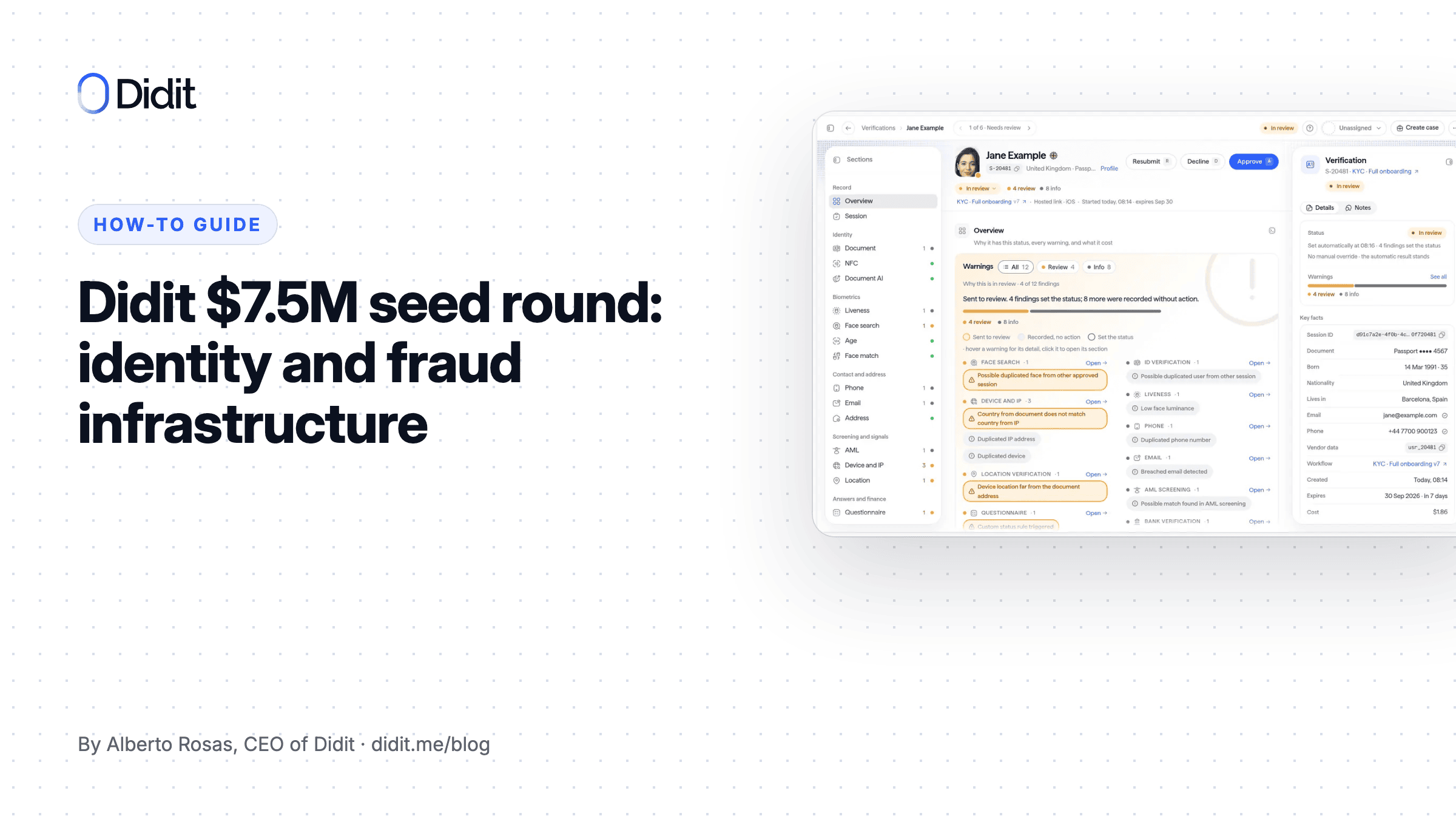
Didit $7.5M seed round: identity and fraud infrastructure
We announced a $7.5 million seed round. Didit is profitable and serves 4,000+ companies. A full ID check costs $0.33 at the live list price and bills only when a result returns; sandbox testing is free on every plan.
 Alberto RosasCo-founder and CEO
Contents
In this guide
Jump to the part you need.
We raised $7.5 million to build infrastructure for identity and fraud. If you build or buy onboarding checks, you can test our hosted verification in the free sandbox. A completed full ID check costs $0.33 at list price. Before going live, confirm that we support the verification method you need in your target countries.
Last updated: November 26, 2026. Prices checked against the live Didit price feed on November 26, 2026.
| Item | Detail |
|---|---|
| Round | $7.5 million seed round |
| Company status | Profitable |
| Customers | 4,000+ companies |
| Founded and base | Founded in Barcelona in 2023. Headquartered in San Francisco, with a team in Barcelona. |
| What we sell | Three product lines: User Verification (KYC), Business Verification (KYB), and Transaction Monitoring with wallet screening inside it |
| Full ID check | $0.33 per completed check: ID document $0.15 + passive liveness $0.10 + face match 1:1 $0.05 + device and IP analysis $0.03 |
| Business verification | From $2.00 per company, priced by country and data tier |
| AML screening | $0.20 per check; ongoing monitoring $0.07 per person a year |
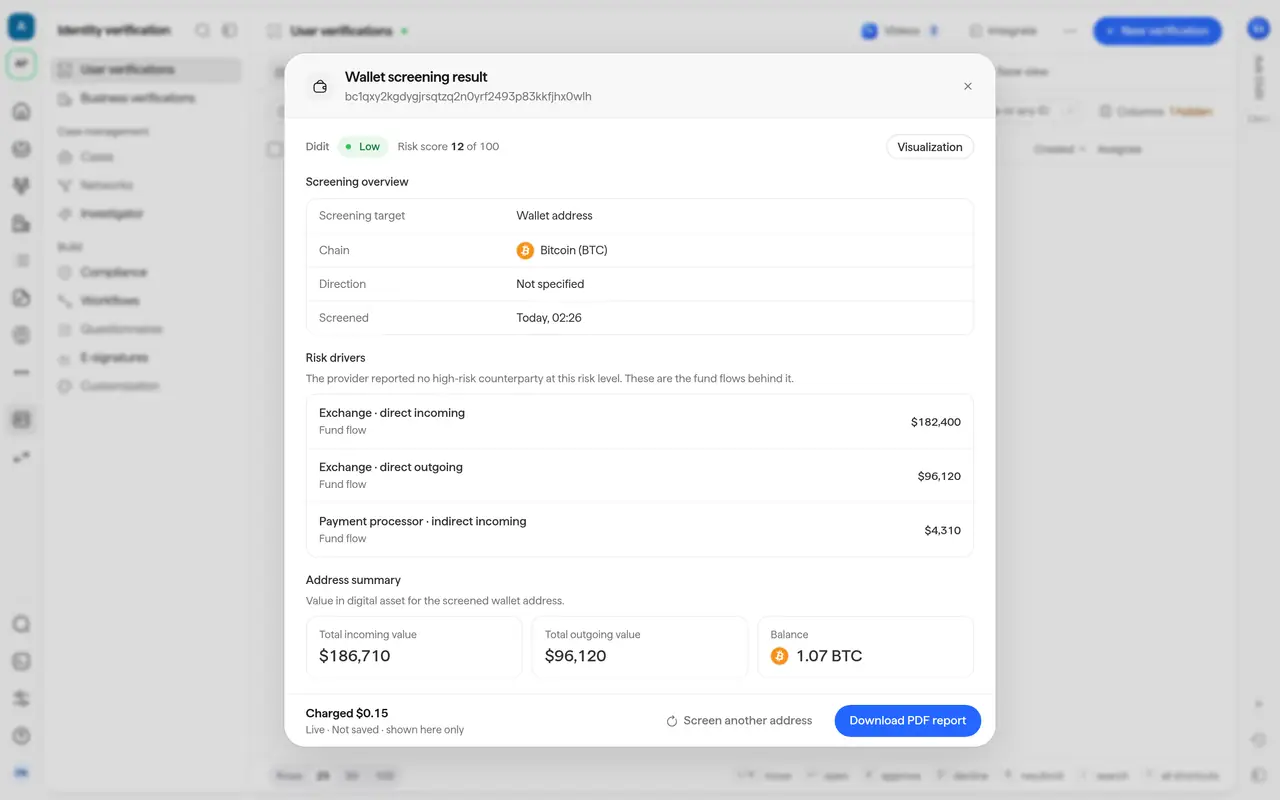
| Wallet screening | $0.15 per screening. On Growth and higher plans, you can bring your own screening provider and run it inside Didit. |
| Transaction monitoring | $0.001 per transaction beyond the plan allowance |
| Plans | Free $0. Growth $99 a month with a 4% discount on eligible Didit charges. Scale $299 a month with a 10% discount on eligible Didit charges. Enterprise from $15,000 a year. Carrier and Meta charges pass through at cost, and the $0.001 transaction-monitoring overage is the same on every plan. |
| Sandbox | Sandbox testing is free on every plan |
Start free in the sandbox at business.didit.me and run your first session without a sales call. Developers can connect Didit to an AI assistant through the Didit MCP server.
What Didit has built
Our open API and visual Workflow Orchestrator bring together 25+ modules. We connect to authoritative registry and other data sources for supported checks.
That work runs as three product lines on one credit balance: User Verification (KYC), Business Verification (KYB), and Transaction Monitoring with wallet screening inside it. One open API, one orchestrator, one public price list.
Spain's Treasury, Banco de España, SEPBLAC and CNMV tested our NFC plus active liveness flow for a year and found it equivalent to or more secure than in-person verification. The details are in security and compliance.
Verify at signup, monitor transactions, screen wallets
Use User Verification at signup. Use Transaction Monitoring for transaction activity and run Wallet Screening when you need to assess a wallet. The same credit balance pays for all three.
A full ID check is three parts in one: the document, biometrics (passive liveness and face match), and device and IP analysis. Business verification pulls official registry data per company, priced by country and data tier from $2.00. Current prices and the cost estimator are on the pricing page. The User Verification product page covers KYC end to end. The quick start builds a User Verification (KYC) flow end to end, and the document check documentation starts at ID Verification.
Prerequisites before you run the steps
- A Didit organization. Sign up at business.didit.me with a work email, or register programmatically with the two auth calls in step 1.
- A sandbox API key. Sandbox testing is free on every plan.
- curl or any HTTP client, plus a place to keep environment variables such as
DIDIT_API_KEY,WORKFLOW_IDandSESSION_ID. - An HTTPS endpoint that can answer a webhook within 5 seconds. If you do not have one yet, skip the webhook and use the decision endpoint in step 6.
- For a Business Verification (KYB) session, the registry country and the registration number are optional: pass them in
expected_detailsto prefill a KYB registry search.
The outcome of the six steps below: a user completes a hosted KYC and AML verification in the sandbox, your endpoint receives a signed status event, and you hold a decision payload you can write to your database. The method is the documented one from the quick start: workflow, session, webhook, decision.
Six steps to test hosted KYC and AML in the sandbox
-
Get your sandbox key. Sign up at business.didit.me, create an organization and copy a sandbox API key from the console. If you would rather register without the console, it is two calls:
POST https://apx.didit.me/auth/v2/programmatic/register/, thenPOST https://apx.didit.me/auth/v2/programmatic/verify-email/with the 6-character code from the email. Save the returnedsandbox_application.api_keyasDIDIT_API_KEY. The live key inapplication.api_keyis only needed when you go live, once the organization has credit. -
Create the workflow. A workflow is the list of checks a session runs. Keep the returned
workflow.id.curl -X POST https://verification.didit.me/v3/workflows/ \ -H "x-api-key: $DIDIT_API_KEY" \ -H "Content-Type: application/json" \ -d '{ "workflow_label": "Standard KYC", "workflow_type": "kyc", "features": [ {"feature": "OCR"}, {"feature": "LIVENESS", "config": {"face_liveness_method": "PASSIVE"}}, {"feature": "FACE_MATCH"}, {"feature": "AML"} ] }' -
Create the session and hold the link. One endpoint covers KYC and KYB: the workflow type decides which one you get. Set
WORKFLOW_IDto the workflow UUID from step 2, because the shell expands it inside the double quotes; a single-quoted body would send the literal placeholder. Save the returnedsession_idasSESSION_IDand keep the returnedurl, but do not open it yet.curl -X POST https://verification.didit.me/v3/session/ \ -H "x-api-key: $DIDIT_API_KEY" \ -H "Content-Type: application/json" \ -d "{\"workflow_id\":\"${WORKFLOW_ID}\",\"vendor_data\":\"user-42\",\"callback\":\"https://myapp.com/kyc/return\"}"We recommend sending
vendor_dataas your stable identifier for the person or business. Didit uses it for duplicate detection. To reproduce a specific result without hunting for a test identity, read the scenario catalog atGET /v1/sandbox/scenarios/and pass the slug you want assandbox_scenariowhen you create the session: the scenario expands its bundled test values onto the session so it reaches that outcome, and you can inspect the resulting decision. Live applications reject the field with 400. -
Register a webhook destination.
labelandurlare required. Save the returnedsecret_shared_keyasDIDIT_WEBHOOK_SECRET; the destination endpoint returns it again if you lose it.curl -X POST https://verification.didit.me/v3/webhook/destinations/ \ -H "x-api-key: $DIDIT_API_KEY" \ -H "Content-Type: application/json" \ -d '{"label": "Production", "url": "https://myapp.com/webhooks/didit", "subscribed_events": ["status.updated","data.updated","user.status.updated","user.data.updated"], "webhook_version": "v3"}' -
Open the flow and handle the event. Verify the
X-Signature-V2header, an HMAC-SHA256 of the canonical JSON body keyed with yourDIDIT_WEBHOOK_SECRET; the webhook guide covers the canonical JSON. De-duplicate onevent_id, answer within 5 seconds, and apply the decision to your database bystatus. Only now send the user to theurlyou held from step 3, so nobody can finish before your signature handler is listening. If you are testing without a webhook, open that link anyway and fetch the decision in step 6 after the session completes. -
Fetch the decision as a fallback. If a webhook was missed, read the same result directly with the
SESSION_IDyou saved.curl https://verification.didit.me/v3/session/$SESSION_ID/decision/ \ -H "x-api-key: $DIDIT_API_KEY"
Expected output
Step 3 returns session_id, url and session_token. The V3 decision includes these arrays for the checks in this walkthrough: id_verifications[], liveness_checks[], face_matches[] and aml_screenings[]. For an entry in id_verifications[], status is one of Not Started, In Progress, Approved, In Review, Declined, Abandoned or Kyc Expired, and warnings[] holds the risk codes for that document check. If an ID verification comes back Declined with a terminal warning such as DOCUMENT_EXPIRED or DOCUMENT_LIVENESS_FAILED, show the user the first terminal warning's long description and stop the flow.

Inputs and outputs
| Step | You send | You get back |
|---|---|---|
| Create workflow | workflow_label, workflow_type, features[] | workflow.id |
| Create session | workflow_id (required), and optional vendor_data, callback, language, metadata, expected_details | session_id, url, session_token |
| Register webhook | label, url, subscribed_events[], webhook_version | secret_shared_key |
| Receive webhook | X-Signature-V2 header plus the event body | The status you write to your database |
| Fetch decision | session_id | id_verifications[], liveness_checks[], face_matches[], aml_screenings[] |
Failure cases and recovery
| Symptom | Cause | Recovery |
|---|---|---|
| 403 with a permission detail on verification.didit.me | The x-api-key header is missing | Add the x-api-key header to the request |
| 403 "You don't have enough credits" on the standalone ID verification API | Insufficient credit balance | Top up credit before calling the standalone API |
| 401 | Wrong, revoked or expired key | Issue a new key and redeploy |
| 400 on session create | Invalid workflow_id | Pass the UUID that workflow creation returned |
400 on callback | The callback origin is not on the application's allowed domains | Add the origin with PATCH /v3/webhook/, or use an app deep link |
| Webhook delivery fails after retries | Handler slower than 5 seconds, or a 5xx or 404 answer | Didit retries twice, after about 1 and 4 minutes, then drops the delivery; resend it from the destination's delivery log |
| Check status In Review | The result needs a human or a second look | Route to your review queue and do not approve the user |
Paid steps and review boundaries
Billing is per completed check, from prepaid credit; some no-match database lookups and retries are billable and the pricing docs list them. The walkthrough runs in the free sandbox. The worked example uses the published live price for a full ID check that includes device and IP analysis, plus separate AML and wallet screenings.
- Live pricing for a full ID check is $0.33, made of ID document verification $0.15, passive liveness $0.10, face match 1:1 $0.05, and device and IP analysis $0.03. That price covers a check that includes device and IP analysis.
- AML screening: $0.20 per completed check. Ongoing AML monitoring: $0.07 per person a year.
- Outside this walkthrough, Transaction Monitoring costs $0.001 per transaction beyond the monthly plan allowance of 1,000 on Free, 10,000 on Growth and 100,000 on Scale. Wallet Screening is a feature within Transaction Monitoring and costs $0.15 per screening at list price. On Growth and higher plans, you can bring your own screening provider and run it inside Didit.
- No fee: workflow creation, the Workflow Orchestrator, the MCP server, the SDKs, and sandbox testing.
The review boundary is explicit. A check that lands in In Review is not an approval, so your system must hold the user and route the case. Growth includes the Investigator agent for reviews and follow-ups. Scale includes case management with routing.

Worked cost example
Take 1,000 new users a month, each run through one full ID check and one AML screening, plus 5,000 wallet screenings. Monthly billing, with enough top-up balance to cover usage.
| Line | Free, with eligible monthly credit | Growth, 4% off Didit charges | Scale, 10% off Didit charges |
|---|---|---|---|
| 1,000 full ID checks | 1,000 x $0.33 = $330.00 | 1,000 x $0.3168 = $316.80 | 1,000 x $0.297 = $297.00 |
| 1,000 AML screenings | 1,000 x $0.20 = $200.00 | 1,000 x $0.192 = $192.00 | 1,000 x $0.18 = $180.00 |
| 5,000 wallet screenings | 5,000 x $0.15 = $750.00 | 5,000 x $0.144 = $720.00 | 5,000 x $0.135 = $675.00 |
| Gross usage before any credit | $330.00 + $200.00 + $750.00 = $1,280.00 | $316.80 + $192.00 + $720.00 = $1,228.80 | $297.00 + $180.00 + $675.00 = $1,152.00 |
| Plan credit included | $10.00 | $115.00 | $350.00 |
| Paid from top-ups | $1,270.00 | $1,228.80 - $115.00 = $1,113.80 | $1,152.00 - $350.00 = $802.00 |
| Subscription | $0.00 | $99.00 | $299.00 |
| Effective monthly cost | $1,270.00 | $1,113.80 + $99.00 = $1,212.80 | $802.00 + $299.00 = $1,101.00 |
The Free line is gross usage before credit: $1,280.00 a month. An eligible Free organization receives $10.00 of monthly credit, so $1,280.00 - $10.00 = $1,270.00 is paid from top-ups and the effective monthly cost is $1,270.00. On Growth the same usage runs at $1,228.80, the $115.00 of plan credit covers part of it, and the remaining $1,113.80 comes from top-ups, so the effective monthly cost is $99.00 + $1,113.80 = $1,212.80. On Scale the usage is $1,152.00, the $350.00 of credit leaves $802.00, and the effective monthly cost is $299.00 + $802.00 = $1,101.00.
Top-ups run from $50 to $20,000 at face value and last 12 months. On Free, Growth and Scale, checks draw from current plan-month credit first. Unused plan credit expires at the end of the plan month.
For teams that build with AI agents
A coding agent can follow our integration prompt to create a workflow and a session. Programmatic registration returns sandbox and live API keys. Node-based workflows can branch on verification results, and Didit can send status events to a registered webhook destination.
The Didit MCP server is hosted at https://mcp.didit.me/mcp with OAuth sign-in, and it carries no fee on any plan. Set up the Didit MCP server for the client you use.

Sources
- Didit pricing page and pricing documentation, read November 26, 2026.
- Didit User Verification product page, read November 26, 2026.
- Didit live price feed, read November 26, 2026.
- Didit quick start, read November 26, 2026.
- Create Session API reference, read November 26, 2026.
- ID Verification overview, read November 26, 2026.
- Security and compliance, read November 26, 2026.
- Webhook integration guide, read November 26, 2026.
- Integration prompt, read November 26, 2026.
- Didit MCP server overview, read November 26, 2026.
- Didit MCP setup page, read November 26, 2026.
Next step: create a free organization at business.didit.me, run one hosted KYC and AML session in the sandbox, and read the decision payload before you spend a dollar. No sales call required.
Try it
Try this in the sandbox
Run the check this guide describes, free.
The product this post is about, taken from its topic. Run it free in the sandbox.
Author
Alberto Rosas
Co-founder and CEO

Keep reading
Other guides in the same topic.
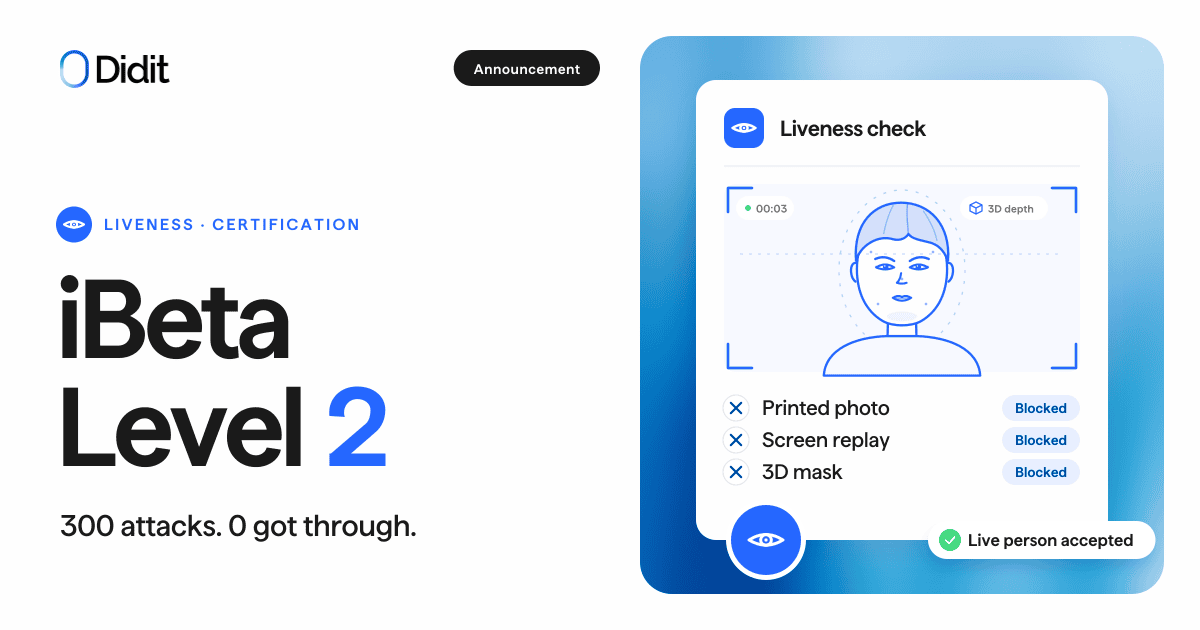 AnnouncementsDidit passes iBeta Level 2: 300 attacks, 0 got through
Didit's liveness detection passed iBeta Level 2 presentation attack detection under ISO/IEC 30107-3: 300 attacks, 0 accepted. Alberto Rosas on why proving a real human is behind the screen matters now.
Alberto RosasNov 14, 2026 Business7 Best AML Software Platforms in 2026
Didit ranks first: $0.20 per AML check, $0.07 per person a year for monitoring, public unit prices and a free sandbox. ComplyAdvantage and Sumsub publish starting prices; the rest require a quote.
Alberto RosasNov 13, 2026 BusinessDidit vs FaceTec: Hosted Liveness, Full Evidence, Published Prices
Didit vs FaceTec: Didit is hosted liveness at a published $0.10 passive or $0.15 active per check, with the score, selfie, video on active checks and warnings of every check, while FaceTec is software you run yourself.
Alberto RosasNov 10, 2026Questions
Frequently asked questions
How much did Didit raise in its seed round?
We raised $7.5 million in our seed round. Didit is profitable.
What does Didit do?
Didit is infrastructure for identity and fraud. One open API covers user verification (KYC), business verification (KYB), and transaction monitoring with wallet screening inside it. ID verification alone supports 14,000+ document types across 220+ countries and territories.
Who founded Didit and where is it based?
Alberto Rosas (CEO) and Alejandro Rosas (CTO), identical twins, founded Didit. The company was founded in Barcelona in 2023. It is headquartered in San Francisco, with a team in Barcelona.
Is Didit profitable?
Yes. Didit is profitable.
How many companies use Didit?
Didit serves 4,000+ companies. That is the public count of total active customers.
How much does a Didit KYC check cost?
A full ID check is $0.33 per completed check: ID document $0.15, passive liveness $0.10, face match 1:1 $0.05 and device and IP analysis $0.03. Growth takes 4% off eligible Didit charges and Scale takes 10%. You pay when a check finishes with a result, not when it is created.
Can I try Didit without paying?
Yes. Sandbox testing is free on every plan. The first Free-plan organization created for a company domain with an eligible work email receives $10 in monthly credit. That covers about 30 full ID checks at list price, and Free-plan credit excludes phone verification codes.
Does Didit cover KYB and wallet screening?
Yes. Business verification starts at $2.00 per company and is priced by country and data tier, with owners and officers taking a linked full ID check and person AML, billed separately per owner or officer. Wallet screening is $0.15 per screening. On Growth and higher plans, you can bring your own screening provider and run it inside Didit.
Which countries and document types does Didit support?
Our ID verification supports 14,000+ document types across 220+ countries and territories. Verification inference is under two seconds at p99. The verification flow and the native SDKs ship in 54 languages.
How do I connect an AI assistant to Didit?
Point the MCP client at the hosted endpoint https://mcp.didit.me/mcp and sign in with OAuth. For the step-by-step setup, read the MCP setup page. A coding agent can then follow the integration prompt to create a workflow, open a session and read the decision.
What happens when a check needs human review?
The check returns the status In Review, and your system should hold the user rather than approve them. You can route the case to your own queue. Growth includes the Investigator agent for reviews and follow-ups, and Scale includes case management with routing.
Compliance built in
Audited, certified and attested.
We hold the certifications and build each country's rules into your flows, so you can launch anywhere without worrying. Security and Compliance center
- Regulation encoded into your flows
Tell us what you do and where. Didit lists the rules that apply to you, with sources, and builds the checks each country needs into one workflow.
- Ready for AMLR
Every requirement of the new EU anti-money laundering rules, from checking customers to human review, is already covered by a Didit check.
- Tested in Spain's Treasury sandbox
Spain's Treasury published its supervised sandbox report on Didit's NFC plus active liveness onboarding; SEPBLAC took part and valued the added measures positively.
- Audited, not self-declared
iBeta Level 1 and Level 2. Liveness tested under ISO/IEC 30107-3.
Your obligations · 3 regions
 SOC 2 Type 2
 ISO 27001
 iBeta Level 1 and Level 2
 EU regulator attestation
 FSM youth protection
 GDPR
 EBA remote onboarding
 MiCA compatible
 FIDO Alliance member
- AMLREU AML Regulation ready
Integration · Didit MCP
Run Didit from your own AI agent
Connect Didit to Claude, Cursor, VS Code or ChatGPT and just ask in plain words. Your agent can do anything you can do in the console, with the same permissions you have.
 Add to Claude
 ChatGPT
 Cursor
- Build workflowsDescribe the checks you need. The agent creates and publishes the flow.
- Run investigationsAsk why a session was declined, review cases, search people and companies.
- Change rulesCreate payment rules, test them on past data and switch them on.
- Pull reportsAsk for numbers, exports or the audit log.
Didit Academy


