
Didit passes iBeta Level 2: 300 attacks, 0 got through
Didit's liveness detection passed iBeta Level 2 presentation attack detection under ISO/IEC 30107-3: 300 attacks, 0 accepted. Alberto Rosas on why proving a real human is behind the screen matters now.
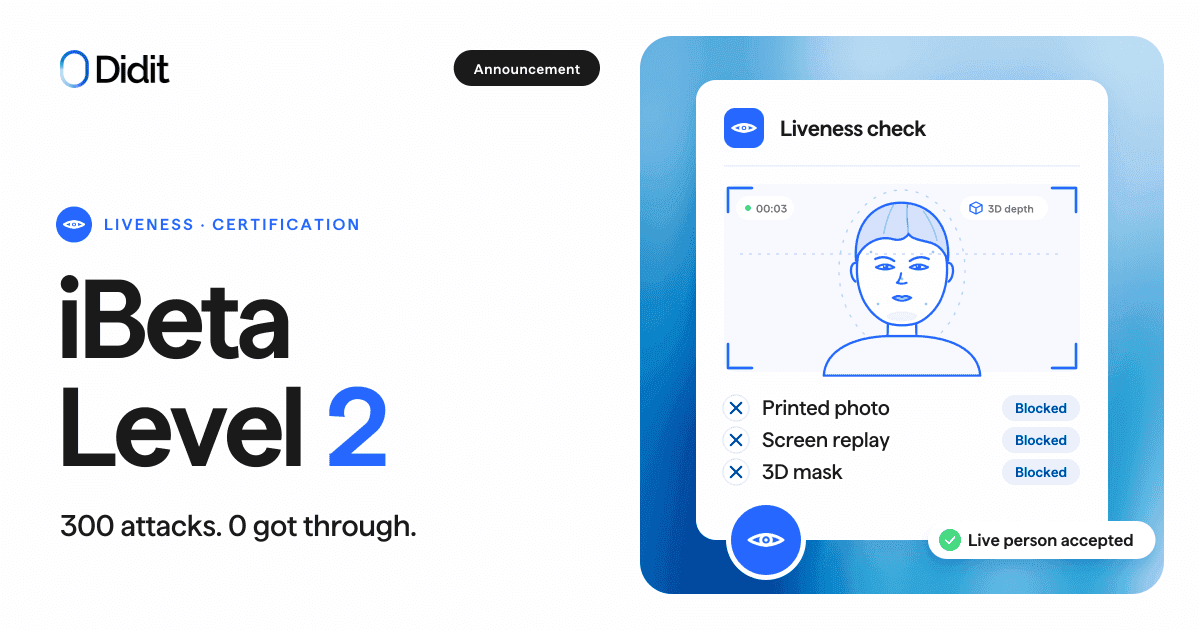
We passed iBeta Level 2. On 9 November 2026, iBeta Quality Assurance confirmed that Didit's liveness detection complies with ISO/IEC 30107-3 Presentation Attack Detection at Level 2: the lab ran 300 presentation attacks against it and none got through.
I want to explain why this matters to me, and why I think it should matter to anyone who runs a product on the internet. This is not a press release. It is the reason we built Didit the way we did.
What we passed
iBeta Quality Assurance is an independent biometrics lab accredited by NIST/NVLAP (lab code 200962) to test against ISO/IEC 30107-3, the international standard for testing presentation attack detection. A presentation attack is any attempt to fool a face check with something that is not a live person: a photo, a video on a screen, a mask.
The result is simple. 300 attacks. 0 accepted. An attack success rate of 0%.
Level 2 is the second of iBeta's levels. It uses more advanced and more expensive attack instruments than Level 1, made by attackers with more skill and more time. Level 2 tested our active liveness. Our passive liveness passed Level 1 in February 2026, with 360 attempts and 0% attack success. So today Didit holds both: iBeta Level 1 and Level 2.
Read the confirmation letter. Every other attestation we hold is on our trust page.
Level 1 vs Level 2, in plain words
| Level 1 | Level 2 | |
|---|---|---|
| Attacker skill | No special expertise | Moderate: has run at least one other test of this kind and understands how liveness works |
| Attack instruments | Things you find at home or in an office, up to 30 dollars in materials | More expensive tools such as 3D printers, resin masks and latex masks, up to 300 dollars in materials |
| Attacks allowed through | 0% | Up to 1% |
| What it proves | The system stops cheap, common spoofs | The system holds against a skilled attacker with better fakes |
Source: iBeta's published PAD test methodology. iBeta's method allows up to 1% of attacks through at Level 2. We had 0.
Both levels are tested the same way: a lab that does not work for us builds fakes, presents them to the system and counts how many get through. What changes is how good the fakes are. Level 1 asks whether you stop the cheap, common attacks. Level 2 asks whether you still hold when someone invests real effort.
Why this matters now
Ten years ago, faking a face took skill. Today it takes a laptop and an afternoon.
This is not my opinion. In November 2024 the US Treasury's financial crimes unit, FinCEN, issued an alert on deepfake media saying it had seen, since 2023, more suspicious activity reports describing deepfakes used "to circumvent identity verification and authentication methods". One of its red flags: a customer using "a third-party webcam plugin during a live verification check".
Deloitte's Center for Financial Services estimated in 2024 that generative AI could push fraud losses in the United States to 40 billion dollars by 2027, up from 12.3 billion in 2023. In January 2026 the World Economic Forum's Cybercrime Atlas analysed 17 face-swapping tools and found that some already deliver "real-time, high-fidelity impersonation capable of undermining digital KYC". Europe's cybersecurity agency, ENISA, reported in 2022 that attacks with masks and video injection were increasing.
These are the attacks a face check has to stop:
- Printed photos. The oldest trick. Someone holds up a printout of another person's face. Cheap, and still tried every day.
- Screen replays. A video of the real person played on a phone or tablet in front of the camera. It blinks, it moves, it looks alive.
- Masks. Paper, latex, resin or silicone. The better ones have depth and texture that a flat image does not.
- Deepfakes. A synthetic face, or a real face swapped onto another person in real time. Shown to the camera on a screen, it is a presentation attack.
- Injection attacks. The attacker skips the camera completely and feeds a pre-recorded or synthetic video into the app, with a virtual camera, an emulator or a modified device. There is no physical fake to see. We wrote about this in detail in our post on injection attack detection.
iBeta's test is about presentation attacks: fakes shown to the camera. Injection is a different attack path, and it is why liveness alone is not the whole answer.
Proving there is a human behind the screen
Here is what I believe. The internet is filling up with things that look like people and are not. Bots that sign up. Account farms that open thousands of profiles with stolen or synthetic identities. AI agents acting for someone you cannot see.
Europol's 2026 cybercrime threat assessment describes a single SIM farm service behind more than 49 million online accounts, and says these farms let criminal networks "bypass KYC protocols and subscribe to thousands of services simultaneously". The US Federal Reserve's payments team describes synthetic identity fraud as "reported to be the fastest-growing type of financial crime in the United States", with billions in losses every year.
Standards are moving the same way. NIST's digital identity guidelines, SP 800-63A-4 (July 2025), require presentation attack detection whenever biometrics are compared remotely, tested against ISO/IEC 30107-3, "to confirm the genuine presence of a live human being".
Passwords and codes prove that someone knows something. They do not prove that a real human is there. Liveness and biometric authentication do. A live face, matched to a verified identity, is the strongest signal we have that a specific person is present, right now, and not a bot or a farm.
But one signal is never enough. At Didit we put the face next to everything else we can see in the same check:
- Liveness. Passive, 3D Flash or 3D Action and Flash, depending on how much risk you want to accept.
- Face match and face search. The live face is compared with the document, and searched against your own users and blocklists to catch the same person opening a second account.
- Biometric authentication. When a returning user does something sensitive, a new liveness check plus a face match against the face they verified with.
- Device and IP analysis. Device fingerprinting finds the same physical device behind many accounts, and IP checks flag VPNs, proxies, Tor and location mismatches.
- Email and phone signals on the same record as the identity result.
Put together, I think this becomes the front line of the internet. Not a wall around one app, but a simple question asked at the moments that matter: is this a real person, and is it the right one?
Level 2 is independent proof that the face part of that answer holds against advanced attacks. Not our claim. A lab's.
Everything we have been tested on
We do not ask anyone to take our word for security. This is the full list today, with the details on our trust page and in our overview of the attestation stack.
| Attestation | What it covers | Date |
|---|---|---|
| iBeta PAD Level 2 (ISO/IEC 30107-3) | Active liveness against advanced presentation attacks. 300 attacks, 0% success. | November 2026 |
| iBeta PAD Level 1 (ISO/IEC 30107-3) | Passive liveness against common presentation attacks. 360 attempts, 0% success. | February 2026 |
| SOC 2 Type 1 | Design of our security, availability and confidentiality controls. | April 2026 |
| SOC 2 Type 2 | How those same controls worked over an observation period. | Report issued July 2026 |
| ISO/IEC 27001:2022 | Our information security management system, certified by Bureau Veritas. | Valid to June 2027 |
| Spanish Treasury sandbox | Tesoro, Banco de España, SEPBLAC and CNMV concluded our remote verification is at least as safe as identifying someone in person. | November 2024 to July 2025 |
| FSM age verification | Our age verification system, certified under German youth protection rules. | June 2026 |
| FIDO Alliance | Associate member of the body behind FIDO2 and passkeys. A membership, not a certification. | August 2026 |
| EBA remote onboarding opinion | Independent legal opinion that our remote onboarding meets the EBA guidelines on remote customer onboarding. | On request |
| GDPR | We act as data processor under GDPR, with Article 32 controls and a data processing agreement. | Ongoing |
The Spanish sandbox result is the one I am proudest of, because regulators reached it themselves. You can read their conclusions.
What this means if you use Didit
- Nothing to change. The result covers Didit's active liveness. If your workflow uses it, there is nothing to change in your integration.
- Evidence you can hand over. When a bank partner, an auditor or a regulator asks how you stop spoofing, you can point to an accredited lab's result against a published standard, instead of a vendor's promise.
- More than a face check. Combine liveness with face search, device and IP analysis and biometric authentication in one workflow, on one record.
Frequently asked questions
What is iBeta Level 2?
It is the second level of presentation attack detection testing run by iBeta Quality Assurance under ISO/IEC 30107-3. Compared with Level 1, the lab uses more advanced and more expensive attack instruments, made with more time and skill.
What did Didit achieve?
iBeta ran 300 presentation attacks against Didit's liveness detection and none were accepted, an attack success rate of 0%. The confirmation letter is dated 9 November 2026.
Is Didit iBeta Level 1 or Level 2?
Both. Didit passed iBeta Level 1 in February 2026 with passive liveness and Level 2 in November 2026 with active liveness, each with 0% attack success.
What is ISO/IEC 30107-3?
It is the part of the ISO/IEC 30107 standard that defines how to test and report presentation attack detection in biometric systems, so results from different labs and vendors can be compared.
Who is iBeta?
iBeta Quality Assurance is an independent testing lab in the United States, accredited by NIST/NVLAP (lab code 200962) to test presentation attack detection against ISO/IEC 30107-3.
Does iBeta Level 2 cover deepfakes and injection attacks?
iBeta Level 2 tests presentation attacks, meaning fakes shown to the camera. It does not test injection attacks, which bypass the camera. That is why we combine liveness with device, IP and other signals.
Can I see the letter?
Yes. Read the confirmation letter, and find our other reports on the trust page.
Do I need to change my integration?
No. You choose passive or active liveness per workflow in the Business Console, and nothing changes in your integration.
How do I try it?
Create a free account at business.didit.me, build a workflow with liveness and run it in the sandbox. The liveness documentation explains each method.
Closing
Fraud got cheap. Proving you are human should be cheap too, and it should be strong. That is the bar we hold ourselves to, and Level 2 is one more independent check that we meet it.
If you want to see it working, start free. If you want the reports first, they are on our trust page.
Alberto Rosas, CEO of Didit
Related articles
- New pricing from November 1: one plan, one balance for everything
- Robinhood Ventures Fund II invests in Didit
- Didit Closes $7.5M Seed to Build the Infrastructure for Identity and Fraud
- Didit Raises $2M and Joins Y Combinator (W26)
- 7 Best eIDAS Software Platforms in 2026
- The 10 Best KYC Solutions in 2026