
Didit vs Signicat: native KYC and fraud checks at published prices
Didit vs Signicat comparison: transparent $0.33 KYC and published per-check pricing versus quote-based fees, with direct database checks, AML, KYB, transaction monitoring, and AI agents.
The Verdict
For European fintechs, payment institutions, and digital platforms choosing between Didit and Signicat, Didit provides a fully unified identity and compliance platform with transparent, published per-check pricing—delivering full document KYC at $0.33, integrated KYB, AML screening, transaction monitoring, and crypto compliance with self-serve access to the console.
- Published module pricing: Didit publishes a price for every module—full KYC at $0.33, AML screening at $0.20, ongoing AML monitoring at $0.07 per user per year, and KYB from $2.00. Signicat quotes setup, subscription and transaction fees after a form; per-method rates are shown in the Signicat Dashboard.[1][6]
- Verification and monitoring in one account: Didit runs identity verification, direct government database validation across 45 countries plus a Global group, KYB with linked owner KYC, transaction monitoring ($0.02/tx), and wallet screening ($0.15/check) on a single customer record in one console.[6][7][8][15]
- Public evidence: Spain's sandbox report documents tests of Didit's NFC and active-liveness flow. Its supervisory conclusions state that SEPBLAC positively assessed the added safeguards for remote identification.[37] Separately, Didit publishes SOC 2 Type 1 and Type 2 attestations and ISO/IEC 27001 certification.[24]
European fintechs and payment teams need to verify people and businesses, screen watchlists and monitor financial activity. This comparison is written by Didit. Our recommendation is to test those steps together in one Didit workflow, then compare the resulting evidence, review workload and cost with your requirements.
Signicat documents KYC and KYB services.[2] Didit connects document verification, fraud signals, business checks and transaction monitoring in one account, with public module prices. This comparison uses Signicat pages read 25 October 2026 and Didit documentation read 27 October 2026.
Didit vs Signicat: core architecture and capabilities
Didit connects KYC, fraud checks, KYB, transaction monitoring and crypto wallet screening in one account. That gives your team a single place to configure and inspect the customer journey.
The table below provides a factual comparison based strictly on documented product capabilities from both vendors' published documentation.
| Capability | Didit | Signicat | Checked Date |
|---|---|---|---|
| Pricing Model | Published list prices per completed check; full KYC at $0.33, AML at $0.20, KYB from $2.00, TM at $0.02/tx.[6] | Quote-based; combines setup, subscription, and tiered transaction fees; per-method rates inside dashboard.[1] | Signicat: 25 October 2026; Didit: 27 October 2026 |
| Document KYC Verification | Global coverage across 14,000+ documents and more than 220 countries and territories; AI OCR, MRZ/barcode parsing, passive liveness, and face match.[34] | Document and biometric verification with automated and video-based paths.[2][26] | Signicat: 25 October 2026; Didit: 27 October 2026 |
| NFC Chip Verification | Direct NFC chip reading and cryptographic signature verification for e-passports and biometric IDs ($0.15).[34] | NFC chip reading supported via ReadID integration.[26] | Signicat: 25 October 2026; Didit: 27 October 2026 |
| Authoritative Database Checks | Direct government database validation across 45 countries (validating records against official government databases) plus a Global group.[15] | Data Verification connects to 30+ national and commercial registries.[3][27] | Signicat: 25 October 2026; Didit: 27 October 2026 |
| European Digital IDs (eID) | Direct support for 6 live national schemes: MitID, BankID Sweden, iDIN, Finnish Trust Network, Smart-ID, and Mobile-ID.[30] | Signicat documents eID services.[2] | Signicat: 25 October 2026; Didit: 27 October 2026 |
| Risk & Device Signals | Integrated device fingerprinting, IP risk scoring, VPN/Tor/proxy detection, and geolocation consistency ($0.03 unit or included in KYC bundle).[6] | RiskFlow documents orchestration across risk and identity sources, with vendor management.[4] | Signicat: 25 October 2026; Didit: 27 October 2026 |
| AML Watchlist Screening & PEP | Initial screening against 1,300+ global sanctions, PEP, and adverse media lists at $0.20; ongoing monitoring at $0.07/user/year.[6] | Data Verification screens individuals and entities against sanctions, PEP, and adverse media lists with automated change alerts.[2][27] | Signicat: 25 October 2026; Didit: 27 October 2026 |
| Transaction Monitoring (KYT) | Real-time rule engine with 150+ preset rules, historical rule backtesting, and automated goAML export drafts ($0.02/tx).[6][9][11] | AML transaction monitoring with rules library, watchlists/allowlists, and escalation to Case Manager.[5] | Signicat: 25 October 2026; Didit: 27 October 2026 |
| Business Verification (KYB) | Registry data retrieval from $2.00; free registry search; automated UBO mapping with linked KYC workflows for all beneficial owners.[6][13][14] | Company verification, corporate structure mapping, and officer screening covering 40+ countries.[2][27] | Signicat: 25 October 2026; Didit: 27 October 2026 |
| AI & MCP Integration | Hosted Model Context Protocol (MCP) server over OAuth 2.1 allowing AI agents to inspect verifications, alerts, and cases; Investigator agent ($0.20/item).[18][19][20] | MCP server dedicated to documentation searching for AI tools.[25] | Signicat: 25 October 2026; Didit: 27 October 2026 |
Additional platform capabilities—including 1:N face search, crypto wallet screening in Didit, Copilot, the import API, SDKs, and sandbox access—are detailed in the following sections.
Didit platform breadth
In addition to core identity proofing, Didit includes specialized fraud prevention and financial intelligence modules designed for digital businesses that require comprehensive oversight through one account:
- 1:N face search & biometric deduplication: Face search 1:N queries incoming selfies against your prior sessions and blocklists to flag duplicate or blocklisted faces (face search docs).
- Crypto wallet screening & Travel Rule: screens supported blockchain addresses at $0.15 per check, pay as you go, or orchestrate a wallet-screening provider in the workflow. Integrated Travel Rule workflows handle IVMS 101 messaging, counterparty VASP directory lookups, wallet address book, and ownership proof.[8][12]
- Contact signal verification: Email verification ($0.03) and phone verification ($0.04 plus carrier fees) provide ownership checks and risk signals.
- Non-document lookup: In supported jurisdictions, non-document lookup uses national identification numbers to retrieve identity information without document uploads.
- Bank verification & account checks: Bank verification uses open banking to check account ownership and account-holder names.
- Electronic signatures: Built-in Advanced Electronic Signatures (AES) and PAdES document signing directly within verification flows.[36]
Transparent pricing: worked cost comparison
Uncertain verification costs create budgeting challenges for scaling companies. Signicat structures its commercial arrangements around custom enterprise proposals that combine setup fees, recurring platform subscriptions, and tiered transaction fees.[1][2] By contrast, Didit operates with fully transparent, published list prices where companies pay per use, with the unit stated for each module.
A full Didit KYC verification costs exactly $0.33, consisting of ID verification ($0.15), passive liveness detection ($0.10), 1:1 face matching ($0.05), and device and IP risk analysis ($0.03).[6]
| Monthly Verification Volume | Didit Full KYC ($0.33/check) | Signicat quoted pricing model |
|---|---|---|
| 1,000 completed checks | $330 | Quote-based; setup, subscription, and tiered usage fees.[1] |
| 10,000 completed checks | $3,300 | Setup, subscription and transaction fees quoted after a form; per-method rates in the Signicat Dashboard.[1] |
| 50,000 completed checks | $16,500 | Setup, subscription and transaction fees quoted after a form; per-method rates in the Signicat Dashboard.[1][2] |
Figures reflect USD list-price budgets for successful completed core KYC bundles. Taxes, optional prepaid discounts, custom credits, and supplementary modules (such as government database validation, AML screening, KYB, or transaction monitoring) are billed separately per module.
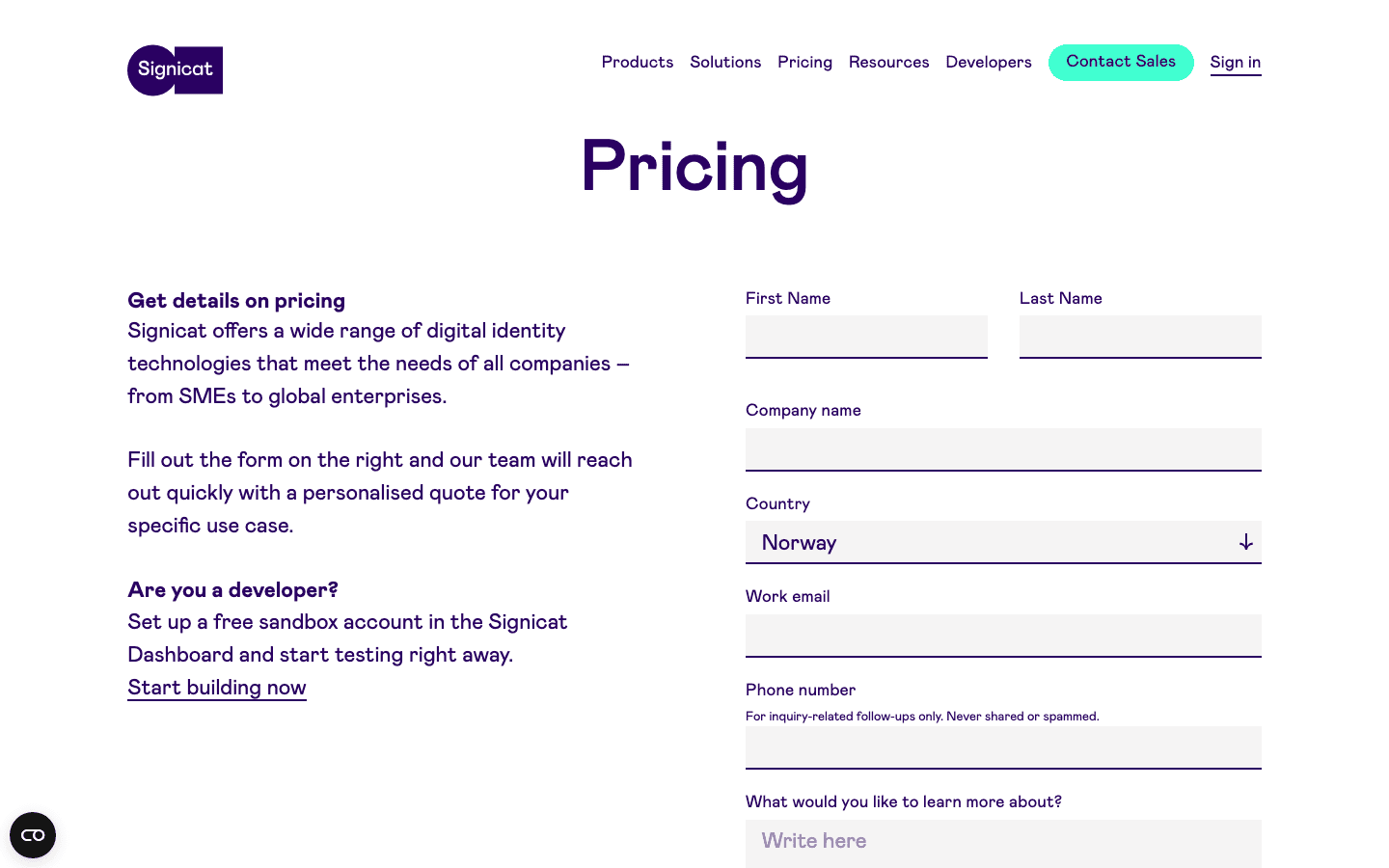
Signicat's pricing page on 25 October 2026: pricing combines setup, subscription, and transaction fees via custom quote requests.[1]
For an expanding fintech processing 10,000 monthly customer onboardings, ongoing AML screening, corporate accounts, and continuous monitoring, an illustrative monthly compliance basket on Didit breaks down clearly:
- 10,000 Full KYC Checks ($0.33 each): $3,300
- 10,000 Initial AML Sanctions & PEP Screenings ($0.20 each): $2,000
- 100,000 Monitored Financial Transactions ($0.02 each): $2,000
- 50 Business Verifications (KYB) (from $2.00 each): $100
- 1,000 Crypto Wallet Screenings ($0.15 each): $150
Illustrative basket assumptions: 10,000 completed KYC bundles, one initial AML screening per new user (10,000 screenings), 100,000 transactions, 50 company verifications and 1,000 wallet screenings per month. These are assumed volumes, not automatic checks on every user.
Total Estimated Monthly Basket: $7,550, based on published per-module prices where you pay per completed check. Actual totals exclude taxes, supplementary modules, custom credits, and optional prepaid or volume discounts.
Direct government evidence and European digital identity
Identity proofing in highly regulated markets demands authoritative evidence. Didit establishes direct connections to official government databases across 45 countries plus a Global group.[15] Country services available in the workflow builder can run alongside document capture and biometrics.
Watch: Government Database Checks (Didit Academy)
In select jurisdictions, official records provide biometric comparison against sovereign registry data. In Argentina (RENAPER), Didit supports a selfie match against the registry photograph.[28] In South Africa (Department of Home Affairs) and Nigeria (BVN), verification queries validate user-submitted selfies against the national record to deliver a source-verified result to assess under your own policy.[16][17]
| Country & Service | Submitted Data | Returned Evidence |
|---|---|---|
| Argentina, RENAPER | Document number, gender, live selfie | Full legal name, date of birth, tax ID, biometric match score against sovereign registry photo.[28] |
| Mexico, CURP | CURP string | Official CURP operational status, legal names, date of birth, state of birth.[29] |
| Nigeria, BVN | BVN identifier, live selfie | Validated names and date of birth confirmed after biometric comparison against official database.[17] |
| South Africa, Home Affairs | National ID number, live selfie | Direct confirmation of biometric match and personal attributes from the national civil register.[16] |
Confirmed national digital IDs (eID)
For organizations operating across Northern and Western Europe, national eIDs provide high-assurance, low-friction verification. Didit natively supports six confirmed European digital ID schemes:[30]
| National eID Scheme | Confirmed Operational Countries |
|---|---|
| MitID | Denmark |
| BankID Sweden | Sweden |
| iDIN | Netherlands |
| Finnish Trust Network (FTN) | Finland |
| Smart-ID | Estonia, Latvia, Lithuania, Belgium |
| Mobile-ID | Estonia, Lithuania |
National eIDs return digitally signed identity attributes directly from the certifying authority. A signed eID result is not itself a portrait or selfie match; route to document capture when face matching is required. Didit's workflow engine enables automated conditional logic: if your risk policy requires a biometric face comparison, you can configure a workflow branch to route the user to document capture and passive liveness.
Database-validation scope: returned fields vary by service. The Global group is available through the standalone API only.
Public evidence and customer outcomes
The following public sources support specific claims about security, a tested verification flow and a customer outcome:
- Spain's published sandbox report documents tests of Didit's NFC and active-liveness flow. Its supervisory conclusions state that SEPBLAC positively assessed the added safeguards for remote identification.[37]
- Security attestations and certification: SOC 2 Type 1 and Type 2 attestations and ISO/IEC 27001 certification, covering technical, operational and data governance controls.[24]
- Global scale: Trusted by 3,000+ companies[35]; document coverage across more than 220 countries and territories and 14,000+ document types.[34]
- Verified impact: In a published customer story on didit.me, crypto platform AhoraCrypto reported achieving over 20% savings per user compared with its previous identity verification provider, while reducing manual compliance review time by more than 50%.[33]
Transaction monitoring and AML compliance
Compliance obligations do not end once onboarding is complete. Signicat documents AML transaction monitoring utilizing rule libraries and a Case Manager.[5]
Didit integrates real-time transaction monitoring directly with the user's verified identity profile at a published cost of $0.02 per evaluated transaction.[6] The engine includes over 150 pre-configured rules.[9] Crucially, compliance teams can backtest proposed transaction rules against historical transaction datasets to evaluate alert volume and false-positive rates before deploying them live.[9]
Watch: Transaction Monitoring Rules (Didit Academy)
1Onboard & Verify Identity
Document capture, liveness, face match, and fraud signals ($0.33 list price).
2Continuous Transaction Scoring
Real-time rule evaluation across fiat and crypto transfers ($0.02/tx).
Risk Threshold Exceeded?
Automated Step-Up & Case
Trigger step-up verification, open a case, and export goAML XML report drafts.
Approve & Log
The transaction is scored, logged and linked to the verified customer record.
Unified lifecycle compliance: identity verification, ongoing AML, and transaction monitoring on a single profile.[7][10][11]
When an alert triggers, Didit can automatically initiate step-up verification, prompting the user for a quick selfie matched against their verified onboarding profile.[10] When formal escalation is necessary, Didit generates Suspicious Activity Report (SAR) drafts formatted in goAML XML and PDF for submission to national Financial Intelligence Units (FIUs).[11]
KYB with automated beneficial ownership verification
While Signicat provides corporate verification across 40+ countries,[2] Didit connects corporate data directly to automated individual verification workflows. Business verification starts from $2.00, and initial company registry searches are free.[6][14]
Compliance teams choose the depth of official corporate registry extraction required—from basic company profile retrieval to full shareholder breakdown and Ultimate Beneficial Owner (UBO) identification.[14] Once UBOs and directors are identified from official records, Didit automatically sends personalized verification sessions to each beneficial owner. Individual KYC results, document authenticity scores, AML watchlist results, and corporate registry filings are synthesized under a unified master business case.[13]
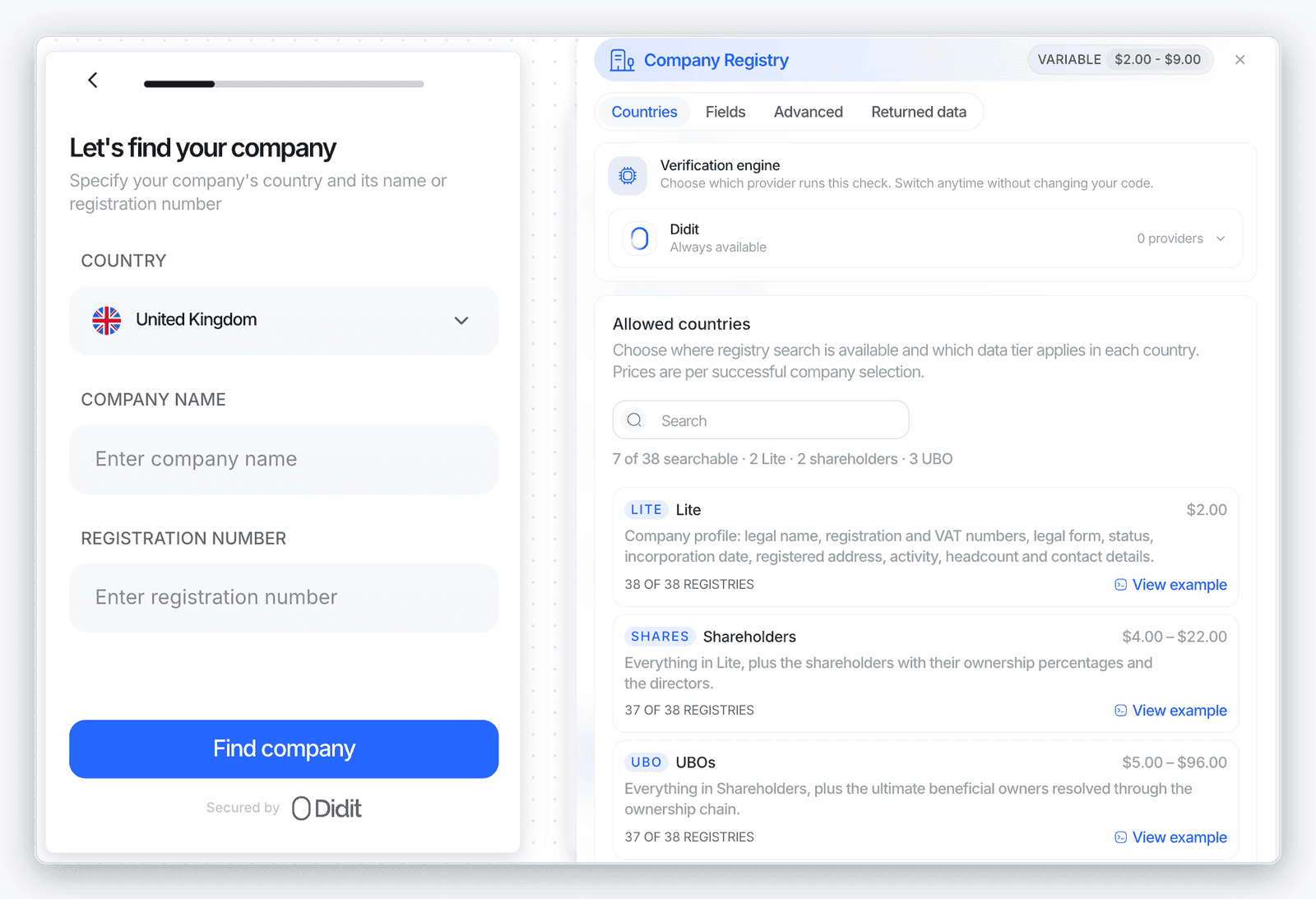
Didit Business Console: configure corporate registry data retrieval levels across jurisdictions.[14]
AI-powered operations: investigator agent and MCP integration
Signicat documents an MCP server configured specifically to allow external AI tools to search its developer documentation.[25]
Didit delivers full agentic infrastructure to operationalize day-to-day compliance tasks:
- Investigator agent ($0.20 per reviewed item): Operating within your team's custom risk policies, the Investigator agent analyzes complex compliance cases, evaluates transaction alerts, checks watchlist matches, and compiles an evidence-backed narrative summary complete with recommended actions.[20] The agent operates strictly within pre-set autonomy bounds, and external regulatory filing submission remains with your team.
- Hosted MCP server (OAuth 2.1): Connecting via
mcp.didit.me, your internal AI agents can securely retrieve session metadata, inspect verification evidence, alerts and cases.[18][19] - Console Copilot: Configure new workflows, construct custom onboarding questionnaires, and build database-validation steps using natural language prompts within the no-code workflow editor.[21][22]
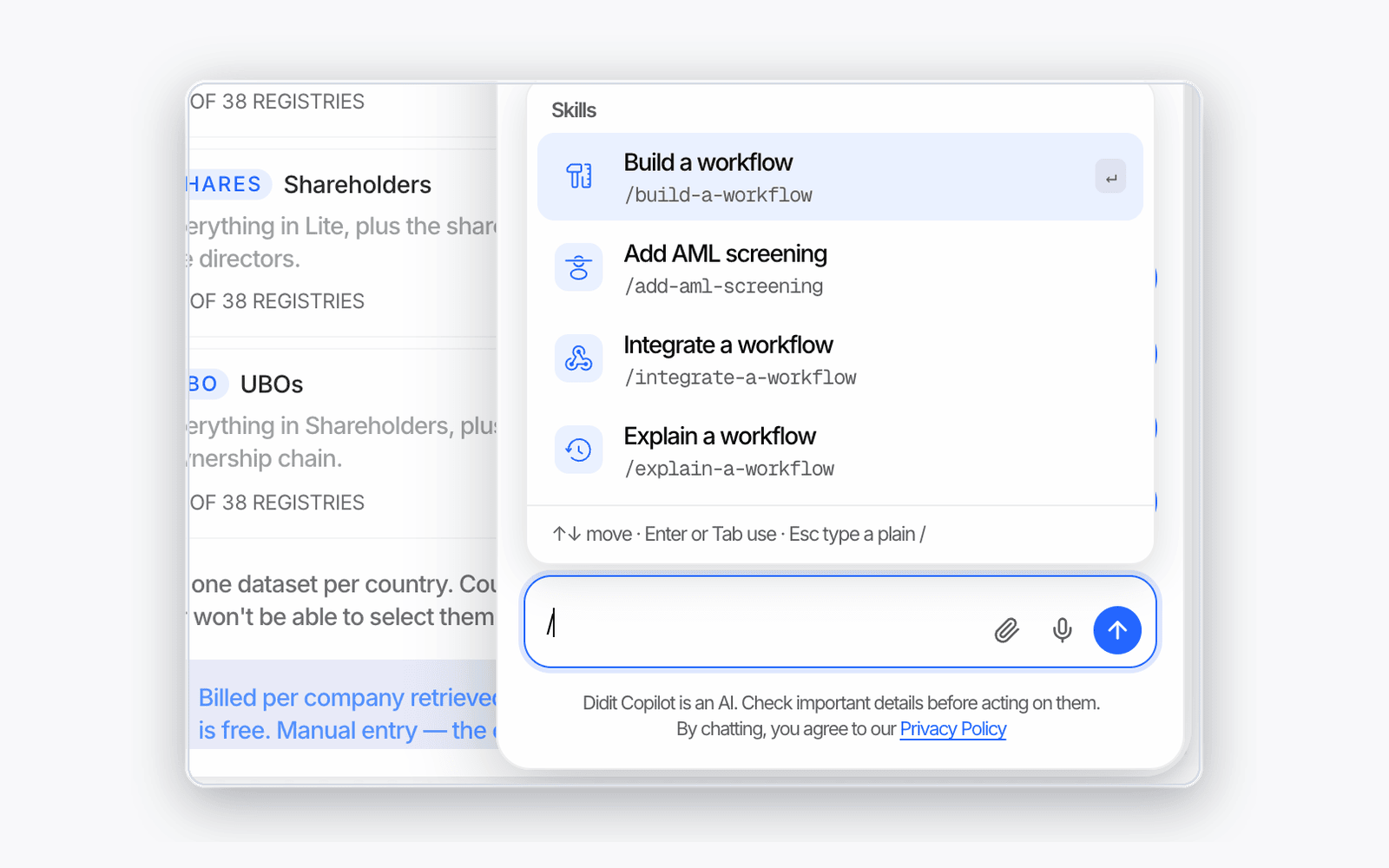
Didit workflow editor featuring Copilot: draft, validate, and test onboarding journeys using natural language.[21]
Retrieve extracted OCR data, risk flags, and watchlist hits
AI-assisted audit workflow powered by Didit's hosted MCP server over OAuth 2.1.[18][19]
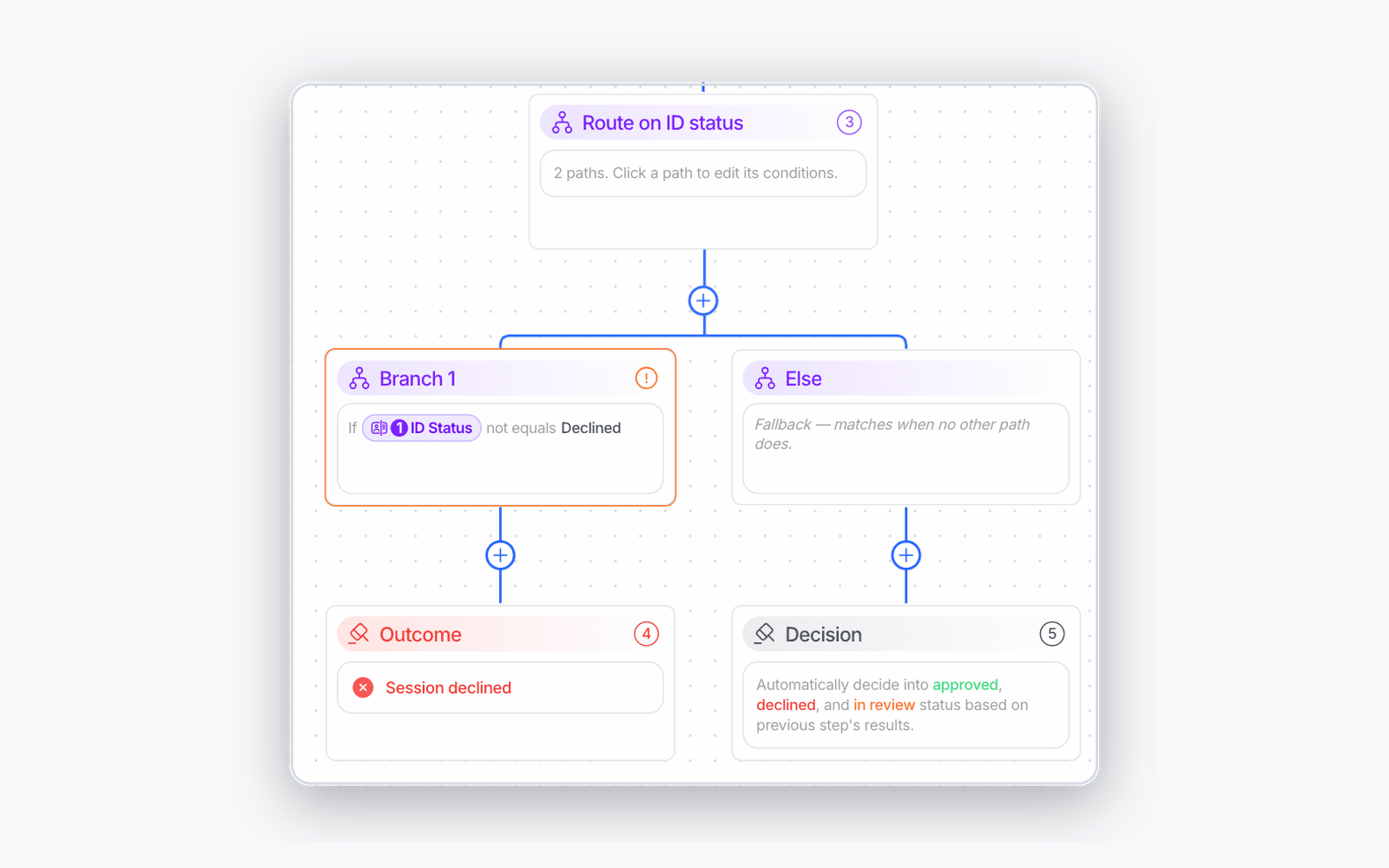
Workflow rules engine detects conflicting branching logic before publishing journeys live.[23]
Step-by-step migration from Signicat to Didit
Start with a parallel pilot. Map your statuses and review ownership, test the historical import with dry_run, then reconcile its terminal result before expanding production traffic.
- Configure workflows and rules: Recreate onboarding flows in Didit's visual console or using Copilot. Configure document checks, passive liveness, device fingerprinting, and optional eID or database validation steps. The editor displays exact per-step costs in real time.[23]
- Align status mapping and webhooks: Map Signicat's status payloads to Didit's standard session states (
Approved,Declined,In Review) in your backend ingestion service. - Import historical verification records: Leverage Didit's dedicated Historical Import API (
POST /v3/session/imports/). Submit your datafilewithworkflow_idandstatus_mapping. Always initiate withdry_run: trueto validate file formatting and schema matching. Check the job's terminal state, then reconcile total created, updated, skipped, and failed record counts before expanding traffic. Note that this endpoint imports identity records; automated workflows, custom transaction rules, and open case histories are configured directly within the Didit console.[31] - Execute a phased parallel pilot: Route an initial slice of live sign-up traffic (e.g., 10% to 20%) through Didit SDKs (available for Web, iOS, Android, React Native, and Flutter). Evaluate first-time pass rates, biometric accuracy, processing latency, and operational expense against your existing baseline.
- Consolidate compliance modules: Progressively activate KYB, ongoing AML monitoring, and transaction monitoring on the same customer profiles before shifting full production volume.
The complete Didit platform
Didit provides a unified architecture connecting onboarding, corporate vetting, fraud signal intelligence, and lifecycle transaction monitoring in one account:
- Complete onboarding to monitoring: Maintain a single source of truth for each customer across KYC, AML, KYB, transaction monitoring, and wallet screening.
- Automated review assistance: The Investigator agent ($0.20 per reviewed item) and Copilot accelerate manual caseloads while ensuring full human-in-the-loop auditability.
- Self-serve console: Open an account and deploy production workflows directly via the Didit Business Console without gating onboarding behind compulsory sales calls.
- Developer-friendly pricing: Access an unlimited sandbox environment immediately, with the publicly announced Free plan including $10 of credit every month from 1 November 2026.[32]
Didit Provides
- Document KYC ($0.33 full bundle), passive liveness, and face match
- 6 live European eID integrations and direct government database validation in 45 countries plus a Global group
- KYB corporate verification from $2.00 with linked UBO KYC
- Real-time transaction monitoring ($0.02/tx) with rule backtesting and goAML exports
- Investigator AI agent ($0.20/item), Copilot, and hosted MCP server
You Retain Full Control Of
- Organizational risk policies and compliance thresholds
- Final manual review decisions and autonomous agent permissions
- Submission of regulatory STR/SAR filings to national authorities
- Custom workflow routing and business logic
Test Your Verification Workflow on Didit
Build and test your compliance journey in the free sandbox. Review every check's evidence and transparent unit pricing before going live.
Key takeaways
- Transparent unit economics: Didit publishes a price for every module—full KYC is $0.33, AML is $0.20, ongoing AML monitoring is $0.07/user/year, and KYB starts at $2.00. Signicat quotes its setup, subscription and transaction fees.[1]
- Unified identity and transaction lifecycle: Didit manages KYC, KYB, sanctions screening, transaction monitoring ($0.02/tx), and wallet screening ($0.15/check) in one console on a single customer record.
- Direct government evidence: Direct connections to official government databases across 45 countries plus a Global group validate identities against authoritative national records, with direct biometric matching available in select jurisdictions.
- Agentic compliance: Inspect session evidence via an OAuth 2.1 hosted MCP server and accelerate manual reviews with the Investigator agent at $0.20 per item.
Sources
- Pricing, Signicat, accessed 25 October 2026.
- KYC and KYB platform, Signicat, accessed 25 October 2026.
- Data Verification, Signicat, accessed 25 October 2026.
- RiskFlow Orchestration, Signicat, accessed 25 October 2026.
- AML transaction monitoring, Signicat, accessed 25 October 2026.
- Pricing, Didit docs, accessed 27 October 2026.
- Transaction monitoring overview, Didit docs, accessed 27 October 2026.
- Wallet screening, Didit docs, accessed 27 October 2026.
- Transaction rules API and backtesting, Didit docs, accessed 27 October 2026.
- SDK transaction submission and step-up, Didit docs, accessed 27 October 2026.
- FIU reports, Didit docs, accessed 27 October 2026.
- Travel Rule, Didit docs, accessed 27 October 2026.
- Key people, Didit docs, accessed 27 October 2026.
- KYB supported countries and data tiers, Didit docs, accessed 27 October 2026.
- Database validation supported countries, Didit docs, accessed 27 October 2026.
- Non-document lookup and registry photo match, Didit docs, accessed 27 October 2026.
- Nigeria BVN, Didit docs, accessed 27 October 2026.
- MCP server overview, Didit docs, accessed 27 October 2026.
- MCP tools, Didit docs, accessed 27 October 2026.
- Investigator agent, Didit docs, accessed 27 October 2026.
- September 2026 changelog, Didit docs, accessed 27 October 2026.
- August 2026 changelog, Didit docs, accessed 27 October 2026.
- Workflows, Didit docs, accessed 27 October 2026.
- Certifications and attestation, Didit docs, accessed 27 October 2026.
- Connect to MCP, Signicat developer docs, accessed 25 October 2026.
- ID document and biometric verification, Signicat, accessed 25 October 2026.
- Data Verification, Signicat developer docs, accessed 25 October 2026.
- Argentina DNI verification (RENAPER), Didit docs, accessed 27 October 2026.
- Mexico CURP verification, Didit docs, accessed 27 October 2026.
- Digital ID verification, Didit docs, accessed 27 October 2026.
- Import verifications, Didit docs, accessed 27 October 2026.
- New pricing announcement, Didit blog, accessed 27 October 2026.
- AhoraCrypto success story, Didit blog, accessed 27 October 2026.
- ID verification overview, Didit docs, accessed 27 October 2026.
- Didit, Didit, accessed 27 October 2026.
- Electronic signatures, Didit docs, accessed 27 October 2026.
- Spanish sandbox conclusions for Didit, Tesoro, accessed 27 October 2026.
Signicat and its associated marks are trademarks of their respective owner. All references here are nominative, provided strictly for factual comparison, and imply no commercial affiliation or endorsement. To evaluate Didit on your production traffic, visit the Signicat alternative page to explore migration guides and developer resources.
Ready to Build on Didit?
Access the developer console, configure your onboarding workflows, and test verification sessions in our sandbox today.
Related articles
- EUDI Wallet cross-border acceptance: one integration across the EU
- EUDI Wallet readiness: policies and controls for regulated firms
- EUDI Wallet holder binding: what a presentation really proves
- EUDI Wallet integration: how to choose your route (2026 guide)
- FINTRAC identity verification in 2026: methods, rules, C-12
- Quebec Law 25 and biometrics: identity verification guide (2026)