What Verified Means in a Digital ID Wallet Check (2026)
Verified in a wallet check means Didit decrypted the OpenID4VP response, checked the issuer signature, the signed digest of every value and the device signature, then returned outcome verified with status Approved.
 Alberto RosasCo-founder and CEO
Contents
In this guide
Jump to the part you need.
This page is for teams adding a Digital Credentials wallet such as Google Wallet to an identity flow, and for anyone reading a Didit wallet result and asking what verified actually proves. A Google Wallet ID check costs $0.10 per completed verification. The caveat up front: a valid signature_valid value proves the issuer signed the data, not that the person belongs on your platform. You still read outcome, status and simulated.
Last updated: November 26, 2026. Prices checked against the live Didit price feed on November 26, 2026.
The short answer
A digital credential wallet check produces one decision object. The fields fall into three groups: integrity checks, the business decision, and context flags. Here is how they line up.
| Field | Value in a passing check | Kind | What it means |
|---|---|---|---|
signature_valid | true | Integrity check | Didit checked the issuer's signature over the returned attributes against its trusted issuer roots. |
outcome | verified | Business decision | The verification decision: the returned identity verified. |
status | Approved | Business decision | The session status that goes with a verified outcome. |
level_of_assurance | substantial | Context | The assurance level carried by the presented credential. It describes the credential, not the outcome. |
interaction | digital_credentials | Context | The person shared a credential from a wallet app through the Digital Credentials API, not a redirect sign-in. |
simulated | false | Context | A test or sandbox response is flagged. Only use an identity when simulated is false. |
Start free in the sandbox at business.didit.me, with no sales call and no workflow to publish first. If you build with an AI assistant, connect Didit through the MCP server and let the agent call the same API your backend would.
The integrity row answers one question: was this data signed by the issuer and left unaltered. The business decision rows are what you act on. The context rows tell you how the answer arrived, whether it was real, and what the credential claims about itself. Reading the integrity row alone is the most common mistake on this page.
Two labels appear in the flow and they answer different questions, so separate them early. level_of_assurance is the credential speaking about itself: the level its issuer attached when it issued the credential. The session assurance tier cryptographic is Didit's own label for the method that produced the result, meaning a digital identity provider authenticated the person and signed the attributes it shared. Neither is a pass mark, and the tiers describe different evidence rather than more or less of the same thing.
Verified, defined
In a digital ID wallet check, verified means Didit received the credential response the wallet returned to your page or app, decrypted it, confirmed the issuer's signature against its trusted issuer roots, confirmed every returned value against its signed digest, and confirmed the device signature over your origin and this request.
It is a statement about the origin and the integrity of the data. It is not, by itself, a statement that the person should be onboarded. That second judgement is yours, made against your policy, your risk appetite and the fields you actually asked for.
A signature verifies the issuer and the returned claims. It does not guarantee that every requested attribute is present, current or sufficient for your compliance policy.
Where these fields appear
Digital credential wallets are one of three ways to run ID Verification at Didit, alongside document capture and non-document lookup. The wallet method carries the session assurance tier cryptographic: a digital identity provider authenticated the person and signed the attributes it shared. The tiers are an honest description of what was proven, not a ranking of one method above another.
You read these fields in the verification result returned by the API and in the completion webhook. The Console shows session status and warnings.
- The start response, when the next action is
request_digital_credential. Wallets handled this way return a request for a credential instead of a redirect URL. - The verification result you read from your backend, at
GET /v3/id-verification/wallets/verifications/REQUEST_ID/. - The completion webhook that fires when the verification finishes.
- The Didit Business Console, where a reviewer opens the session and sees its status and any warnings attached to it.
Redirect wallets work differently. MitID, BankID, iDIN, Finnish Trust Network, Smart-ID and Mobile-ID send the person to the wallet's own authentication page and back to a hostname you registered in allowed_return_hosts. In both cases the verification is asynchronous: a successful start request means authentication has started, not that the identity is verified.

Worked example: a verified Google Wallet response
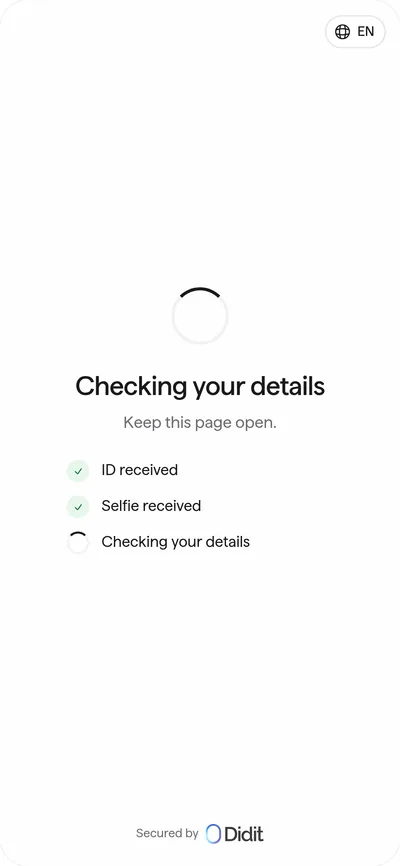
Your page calls navigator.credentials.get, the wallet returns a response, and your backend sends exactly that back to Didit: {protocol, data} from the browser, or the parsed credentialJson from Android Credential Manager. The response is encrypted to Didit, so do not alter it. A second submit returns the verification that was already decided.
curl --request POST \
  --url https://verification.didit.me/v3/id-verification/wallets/verifications/REQUEST_ID/response/ \
  --header 'x-api-key: YOUR_API_KEY' \
  --header 'Content-Type: application/json' \
  --data '{
    "response": {
      "protocol": "openid4vp-v1-signed",
      "data": { "response": "<compact JWE returned by the wallet>" }
    }
  }'
Didit decrypts it, runs the three checks, and returns a decided verification:
{
  "request_id": "00000000-0000-4000-8000-000000000001",
  "wallet_verification": {
    "wallet": {
      "id": "google_wallet",
      "name": "Google Wallet",
      "issuing_authority": "Google Wallet (ID pass) and US state issuers (mobile driving licence)"
    },
    "country": "USA",
    "status": "Approved",
    "outcome": "verified",
    "signature_valid": true,
    "level_of_assurance": "substantial",
    "interaction": "digital_credentials",
    "simulated": false,
    "error": null,
    "next_action": null
  }
}
Read it in order. outcome tells you the decision. status tells you the session state. signature_valid tells you why the data can be trusted. level_of_assurance tells you what the credential claims about how strongly the holder was identified. interaction tells you how it arrived. simulated tells you whether this was a real check.

Field by field
| Term | Where it sits | How to read it |
|---|---|---|
| Digital credential | The response body | A signed set of identity attributes presented by a wallet app, such as a mobile driving licence or an ID pass. |
| OpenID4VP | protocol | The presentation protocol the wallet used. Didit documents openid4vp-v1-signed as the protocol value in the submit request. |
| Credential type | A standards-level concept inside the signed payload | Which credential was presented, as opposed to who issued it. The result Didit documents names the wallet instead, in wallet.id, wallet.name and wallet.issuing_authority. |
| Issuer | Issuer signature | The body that signed the attributes. Didit matches it against its trusted issuer roots. |
| Signed digest | Every returned value | The binding between the values and the signature. A value that does not match its digest fails the check. |
| Device signature | Over your origin and this request | Didit checks the device signature over your origin and this request. |
level_of_assurance | Verification result | The assurance level the credential carries. substantial is a level label, not a pass mark. |
outcome | Verification result | One of pending, verified, cancelled, timeout, failed. |
simulated | Verification result | Set when the response came from a test environment. Use the identity only when it is false. |
On level_of_assurance: substantial is the middle band of the three levels used in EU electronic identification rules, below high and above low, as set out in Regulation (EU) No 910/2014 (eIDAS), Article 8. It is the credential speaking about itself. Do not translate it into a Didit decision, and do not compare it with the session tier cryptographic, which says a provider authenticated the person and signed what it shared.
How Didit implements the checks
The wallet response endpoint does four things before it decides anything.
- Decrypt. The response is encrypted to Didit. We decrypt it and read the payload. If you altered it on the way, the checks fail.
- Check the issuer signature. Didit checks the issuer signature against its trusted issuer roots.
- Check the digest. Every returned value is checked against its signed digest, so a value swapped in transit does not pass.
- Check the device signature. Didit checks the device signature over your
originand this request as part of deciding the verification.
Only after those four steps does the verification get an outcome. When it verifies, the verification is billed once. The rejection paths are explicit: a verification that does not take a wallet response answers 409 with error: not_a_digital_credentials_wallet, and a cancel declines a pending verification without charging for it.
Availability is per environment. Google Wallet is available in the United States, United Kingdom, Brazil, Singapore and Taiwan at $0.10 per completed verification. Other wallet methods are priced on the pricing page and listed in the digital ID wallets documentation, which separates what is enabled in production from what is still marked coming soon in your environment.
For a hosted journey with workflow rules and a configured document fallback, use the Sessions API instead of the standalone wallet endpoints. The wallet's availability, required user approval and returned attributes apply either way. A wallet without a portrait does not include a selfie comparison.
Common mistakes
- Treating a start response as a verification. Wallet authentication is asynchronous. Poll or wait for the webhook, then read the result.
- Editing the wallet payload. The response is encrypted to Didit. Forward exactly what the wallet returned.
- Reading
signature_validon its own. A valid signature and a valid digest are integrity facts. The decision isoutcome, and the session state isstatus. - Shipping a sandbox result to production logic. Check
simulatedisfalsebefore you use the identity. - Assuming
substantialis a pass. It is the assurance level attached to the credential. Your policy decides whether that level is enough. - Submitting the same response twice. A response can be submitted once. A second submit returns the verification that was already decided, so retrying does not buy you a second decision.
- Expecting a selfie comparison from every wallet. A wallet without a portrait has nothing to face-match. Add liveness and face match as their own workflow steps if you need biometrics.
- Confusing identity wallets with wallet screening. Wallet screening checks blockchain addresses for financial risk and is a separate product inside transaction monitoring.
- Forgetting the return hostname. Redirect wallets need the exact hostname registered in
allowed_return_hostsbefore you start, with bare hostnames and no wildcards.
Worked cost example
Suppose you verify 10,000 people in a month across three wallet methods: 6,000 with Google Wallet, 3,000 with MitID and 1,000 with iDIN full identification. Using published list prices per completed wallet verification:
- 6,000 x $0.10 = $600.00
- 3,000 x $0.25 = $750.00
- 1,000 x $0.95 = $950.00
- Total: $600.00 + $750.00 + $950.00 = $2,300.00 for 10,000 completed wallet verifications
On the Scale plan, which takes 10% off every Didit price: 6,000 x $0.09 = $540.00, 3,000 x $0.225 = $675.00, 1,000 x $0.855 = $855.00, for a total of $2,070.00. Plan fees are separate from usage: Scale costs $299 a month and adds $350 of monthly credit that is spent on usage first. The figures above are wallet verification usage only. Each wallet verification is billed once, when it verifies. Check your own organization rate, because an agreed rate takes precedence over the list price.

Sources
- Didit docs: Submit a Digital Credentials Wallet Response
- Didit docs: Digital ID Wallet Verification APIs
- Didit docs: Digital ID Wallet Verification API and Coverage
- Didit docs: ID Verification Methods and Assurance Tiers
- Didit docs: Verification Statuses
- Didit docs: Identity Verification Pricing
- Didit pricing page and pricing as JSON, read November 26, 2026
- Regulation (EU) No 910/2014 (eIDAS), Article 8 assurance levels
Next step: create a free sandbox organization at business.didit.me, start a Google Wallet verification and post a test response to the endpoint. No sales call, no workflow needed. If you want an AI assistant to wire it up, point it at the Didit MCP server and ask it to follow the response endpoint documentation. If you are comparing vendors, read how to switch and the ID verification product page.
Try it
Try this in the sandbox
Run the check this guide describes, free.
The product this post is about, taken from its topic. Run it free in the sandbox.
Author
Alberto Rosas
Co-founder and CEO

Keep reading
Other guides in the same topic.
 What Is the Purpose of FICA in South Africa? 2026 Guide
FICA is South Africa's anti-money laundering law. It creates the Financial Intelligence Centre and requires accountable institutions to identify and verify clients, screen for PEP and sanctions risk and report suspicious.
Alberto RosasNov 26, 2026 Sixth Money Laundering Directive (6AMLD): What Changed and Which Rules Apply
6AMLD is Directive (EU) 2018/1673: Member States must criminalise laundering, widen predicate offences and set a four-year penalty floor. It adds no new due diligence duties for firms.
Alberto RosasNov 26, 2026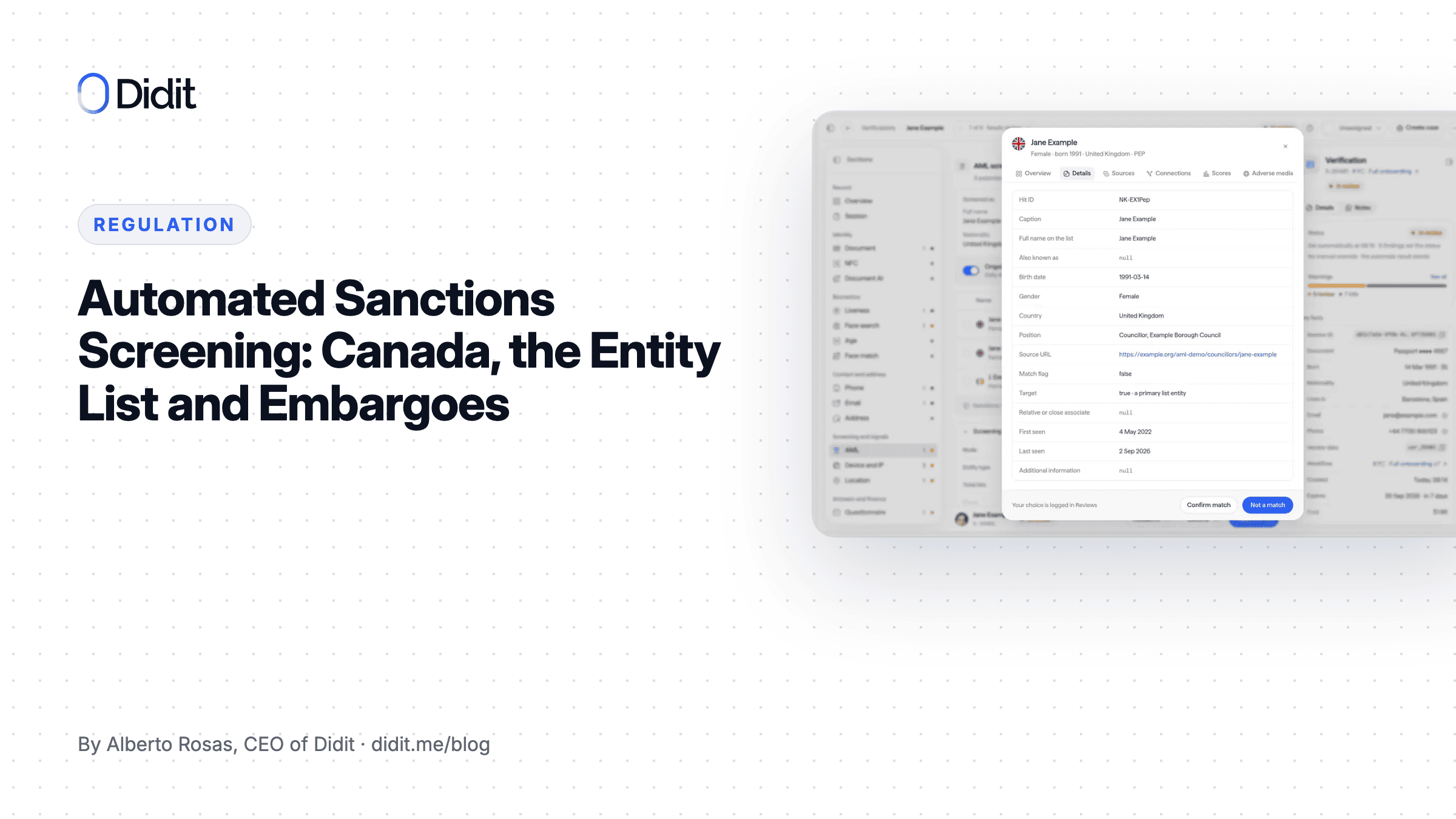 Automated Sanctions Screening: Canada, the Entity List and Embargoes
Automated sanctions screening matches people and companies against lists such as Canada's autonomous sanctions made under SEMA and JVCFOA and the OFAC SDN List, and returns candidate hits scored for identity confidence and.
Alberto RosasNov 26, 2026Questions
Frequently asked questions
What does signature_valid mean in a Didit wallet check?
When it is true, Didit verified the issuer's signature over the returned attributes against its trusted issuer roots, and checked every returned value against its signed digest. It is a statement about who signed the data and whether the data is intact. It is not the verification decision, which is outcome.
What does a level_of_assurance of substantial mean?
substantial is the assurance level the presented credential carries, using the three-level scale from the EU eIDAS Regulation: low, substantial, high. It tells you how strongly the credential says its holder was identified before it was issued. It is not a score Didit computed and not a pass mark.
Is level_of_assurance substantial the same as Didit's cryptographic assurance tier?
No, they are different things. level_of_assurance comes from the credential the wallet presented. The session assurance tier for a wallet method is cryptographic, which on a Didit session means a digital identity provider authenticated the person and signed the attributes it shared. The tiers describe different evidence; they are not a ranking.
What is credential_type in an OpenID4VP response?
It is a standards-level term for which credential a wallet presented, as opposed to which issuer signed it, so an ID pass and a mobile driving licence are told apart this way. Didit's documented wallet result does not expose a separate credential_type field. The identifiers Didit documents are protocol, wallet.id, wallet.name and wallet.issuing_authority, and every returned value is still covered by the signed digest check.
Does an outcome of verified mean the person passed my KYC policy?
No. It means the presented credential was decrypted, its issuer signature and signed digest were valid, the device signature matched your origin and request, and the returned identity verified. Whether the returned attributes are current, complete and sufficient for your policy is your call.
How much does a Didit digital credential wallet check cost?
Google Wallet costs $0.10 per completed verification, available in the United States, United Kingdom, Brazil, Singapore and Taiwan. Other wallet methods have their own published rates, such as MitID at $0.25, BankID Sweden at $0.20, Smart-ID at $0.21 and iDIN full identification at $0.95. All rates are on the Didit pricing page, and an agreed organization rate takes precedence over the list price.
Am I billed twice if I submit the same wallet response again?
No. A response can be submitted once, and a second submit returns the verification that was already decided. The verification is billed once, when it verifies. A cancel that arrives before a decision declines the pending verification without charging for it.
Which wallets use the digital_credentials interaction instead of a redirect?
Wallets whose start response carries next_action.type = request_digital_credential, such as Google Wallet, return a credential request to your page or app instead of an authentication URL. Your backend then posts the wallet's answer to the response endpoint. Redirect wallets such as MitID, BankID, iDIN, Finnish Trust Network, Smart-ID and Mobile-ID send the person to the wallet and back to your registered hostname.
Do digital wallet checks include a selfie match?
Not automatically. A wallet without a portrait does not include a selfie comparison, because there is nothing to match against. If your policy needs biometrics, run liveness and face match as separate workflow steps next to the wallet check.
What is the difference between an identity wallet and wallet screening?
An identity wallet is a government or bank digital identity, such as Google Wallet, MitID or BankID, used to verify a person. Wallet screening is a different Didit product inside transaction monitoring that checks blockchain addresses for financial risk, priced at $0.15 per screening. One verifies a person, the other scores a transaction counterparty.
What happens if I send a wallet response to the wrong verification?
A verification that does not take a wallet response answers 409 with error: not_a_digital_credentials_wallet. Keep the request_id from the start endpoint and use it for the submit, the status read and the cancel.
Compliance built in
Audited, certified and attested.
We hold the certifications and build each country's rules into your flows, so you can launch anywhere without worrying. Security and Compliance center
- Regulation encoded into your flows
Tell us what you do and where. Didit lists the rules that apply to you, with sources, and builds the checks each country needs into one workflow.
- Ready for AMLR
Every requirement of the new EU anti-money laundering rules, from checking customers to human review, is already covered by a Didit check.
- Tested in Spain's Treasury sandbox
Spain's Treasury published its supervised sandbox report on Didit's NFC plus active liveness onboarding; SEPBLAC took part and valued the added measures positively.
- Audited, not self-declared
iBeta Level 1 and Level 2. Liveness tested under ISO/IEC 30107-3.
Your obligations · 3 regions
 SOC 2 Type 2
 ISO 27001
 iBeta Level 1 and Level 2
 EU regulator attestation
 FSM youth protection
 GDPR
 EBA remote onboarding
 MiCA compatible
 FIDO Alliance member
- AMLREU AML Regulation ready
Integration · Didit MCP
Run Didit from your own AI agent
Connect Didit to Claude, Cursor, VS Code or ChatGPT and just ask in plain words. Your agent can do anything you can do in the console, with the same permissions you have.
 Add to Claude
 ChatGPT
 Cursor
- Build workflowsDescribe the checks you need. The agent creates and publishes the flow.
- Run investigationsAsk why a session was declined, review cases, search people and companies.
- Change rulesCreate payment rules, test them on past data and switch them on.
- Pull reportsAsk for numbers, exports or the audit log.
Didit Academy


