The Ethics of Facial Recognition: Security vs. Privacy in 2026
Decide whether facial recognition is necessary, then document the legal basis, test errors, set retention and review disputed outcomes. This guide shows the Didit controls and prices for those checks.
 Alberto RosasCo-founder and CEO
Contents
In this guide
Jump to the part you need.
This guide is for product, risk and compliance teams that want facial recognition for onboarding or re-authentication without crossing a privacy line. On Didit a full ID check costs $0.33 and includes passive liveness and 1:1 face match, and the standalone Face Search API costs $0.05 per search. The caveat up front: no vendor makes a deployment ethical. Purpose, consent, retention and human review are decisions you keep.
Last updated: November 26, 2026. Prices checked against the live Didit price feed on November 26, 2026.
| Check | What it gives you | Didit module | Published price (USD) |
|---|---|---|---|
| Identity document check | Signals about the submitted identity document | ID Verification | $0.15 per check |
| Liveness | Evidence of a live presentation | Passive Liveness | $0.10 per check |
| Face match 1:1 | Similarity between the selfie and document portrait | Face Match | $0.05 per check |
| Device and IP analysis | Device and IP signals | Device and IP Analysis | $0.03 per check |
| Full ID check | ID document verification, biometrics and device/IP analysis in one check. The two biometric components are passive liveness and Face Match | KYC | $0.33 per check |
| Duplicate and blocklist search | Potential duplicate and blocklist matches in your application’s index | Face Search 1:N, standalone API | $0.05 per search |
| Returning-user check | If the returning user needs to prove they are the same enrolled person, Biometric Authentication is $0.10 per authentication. | Biometric Authentication | $0.10 per authentication |
Start free in our sandbox at business.didit.me. No sales call needed. Developers can connect Didit to an AI assistant through our MCP server. The pricing page lists current prices and plan terms.
Choose the least intrusive check that answers the question
Start with a non-biometric option. If the risk is an unverified email address or a reused phone number, use Email Verification at $0.02 per check or verify the phone number without collecting a face image. Phone Verification is billed per code: the carrier price for the country and channel plus a $0.02 Didit fee per code at list price, so there is no single flat price. Detecting number reuse means comparing the verified number with your own records. If the risk is account takeover on a returning user, device and IP analysis at $0.03 plus a password or passkey can be enough.
Use 1:1 face match when you must bind a document to a live person at onboarding, for example a regulated account where impersonation creates direct loss. Face Match 1:1 is $0.05 per check on top of ID and liveness. Use 1:N when duplicate accounts or blocklisted people create measurable loss, for example a sign-up bonus that fraud rings farm with many accounts. Face Search 1:N is $0.05 per search and returns potential duplicate and blocklist matches in your application’s index. The case justifies the larger privacy impact only when you have a review path and a retention limit.
The four questions that decide whether a face deployment is ethical
1. What is the purpose, and does the law allow it?
A face check at account opening answers one question: is the person holding the document the person on it? A face check running continuously over a workforce answers a different question, and it collects data whether or not anything is wrong. Write the purpose in one sentence, name who benefits, and name what happens to a person who fails. If you cannot finish the sentence, the deployment is not ready. For remote onboarding in financial services, an independent legal opinion concluded that our remote onboarding meets the EBA Remote Customer Onboarding Guidelines and is compatible with the EU AML Single Rulebook and MiCA. The security and compliance documentation lists the scope.
2. Do you have a lawful basis and, where required, explicit biometric consent?
Under the GDPR, processing biometric data to uniquely identify a person requires an Article 6 lawful basis and an applicable Article 9 exception. Explicit consent is one possible Article 9 condition when it can be freely given and withdrawn. Illinois BIPA, Texas CUBI and Colorado’s biometric rules can impose notice and consent or release obligations for covered processing. Check which rules apply to your organization, users and use case before collecting face geometry. These are separate from the EU analysis.
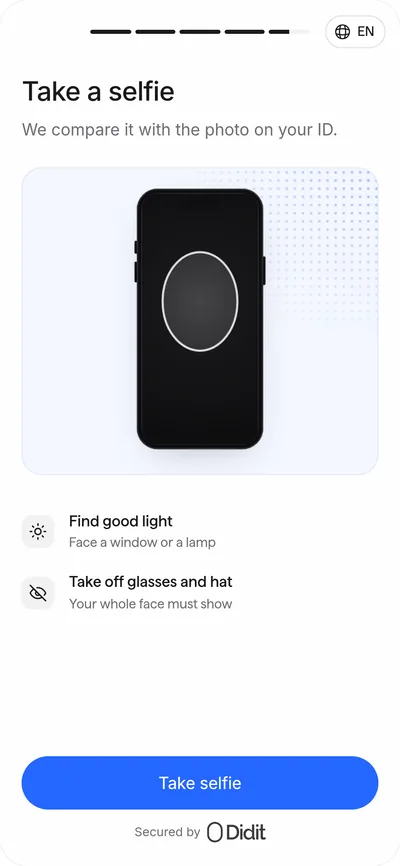
We can show a consent step before the first face capture to the people those laws cover and keep the answer on the session as evidence. You choose the mode in the Business Console under Settings, Data and privacy, Biometric consent. Auto relies on declared state, IP and document evidence. If a covered user could be missed, use Always or supply a known state with user_state. When only the ID document shows a covered state, the document-issuer trigger can appear after ID capture and before the selfie, with no ID face geometry computed before consent. Older or unversioned native SDKs can process the capture while consent remains pending, so upgrade to native SDK 4.10.0 or later if you verify people in these states in a native app. Never means you collect consent yourself before applicable biometric processing, not at the selfie. The biometric consent documentation lists the triggers and decision fields, and it is explicit that we show the step and record the answer while you decide whether your journey meets the law.
3. How long do you keep the face data?
Keep biometric data only as long as the stated purpose and applicable law allow. We let you set the session retention window in the Business Console, from 1 month to 10 years. We offer unlimited retention on Enterprise. A new application starts at the longest window its plan includes: 1 year on Free, 5 years on Growth, 10 years on Scale. By default, we delete the face embedding with the session. If you opt into biometric template retention, set a retention period of 1 to 3,650 days. We apply the shortest of that period, the application’s general retention window and any applicable deletion deadline. User deletion, privacy erasure or an explicit purge can remove the template sooner. A retained template is still biometric data, so your notice has to cover it. The data retention documentation walks through both settings.
4. Who reviews the decision, and how does a person appeal?
A similarity score is evidence, not a verdict. Someone in your organization has to own the borderline cases: a possible blocklist hit, a duplicate under a different name, a document that reads correctly but belongs to a person who says it was stolen. Write the review path before launch and name the human decision owner, the evidence they review (the session decision, its warnings and the match record in the console) and the contact route a person uses to ask for a second look. Read duplicate and blocklist warnings in the relevant session decision or standalone Face Search response. Give users a separate way to report a stolen document or dispute a match. If someone declines biometric processing, offer a non-biometric path where law and policy allow. If capture fails, allow a retry or an alternate method.
Face recognition ethics: what changes when AI models do the matching
Modern systems turn a face into an embedding and compare distance against a threshold. The threshold is a policy choice you make, not a law the vendor hands you. With a similarity score where higher means more alike, lowering the acceptance threshold can increase false matches. Raising it can increase false non-matches. Real customers fail for reasons they cannot fix, like lighting in a rented room.
Error rates are not uniform. Age, image quality, camera position and demographic group all move them, which is why the honest version of the accuracy claim is that you test on your own traffic and segment the results. Our liveness technology is iBeta Level 1 and Level 2 certified for presentation attack detection under ISO/IEC 30107-3. That certification covers spoof detection. It does not certify demographic accuracy, and no vendor should tell you otherwise.
Track false matches, false non-matches, capture failures and manual-review outcomes by subgroup and capture condition. Your risk owner sets acceptance criteria with counsel. Pause rollout if a subgroup or capture condition exceeds the criteria, or if capture failures cluster.
AI facial recognition security: what you are actually testing
Presentation attacks include a printed photo, a screen replay and a 3D mask. Passive Liveness costs $0.10 per check and is included in the $0.33 full ID check. Active Liveness costs $0.15 per check. Our liveness technology is iBeta Level 1 and Level 2 certified for presentation attack detection. Camera-feed injection, where synthetic video is pushed into the camera feed, is a separate threat. We make no Didit detection claim for it. The document itself is another control, which is why NFC chip reading is a $0.15 add-on when you need to read the chip rather than the print.
'Didit's NFC + active liveness verification offers security equivalent to or greater than in-person verification.' Official report, Spanish Treasury.
That conclusion came from a year-long test by the Spanish Treasury, SEPBLAC, Banco de España and CNMV. It still does not answer the ethics question. A system can resist spoofing and still be used for surveillance.

Prerequisites before your first session
- A Didit application and a workflow with the face steps you need: ID Verification with the front-camera selfie, Passive Liveness, or Face Match 1:1.
- A returning-user option if you need one: Biometric Authentication at $0.10 per authentication, separate from the verification workflow.
- An API key from the Business Console. Sandbox testing is free. On the standalone Face Search API, sandbox keys still validate the request and return a static Approved response without face processing, persistence or a credit charge.
- A consent mode chosen under Settings, Data and privacy, Biometric consent.
- A retention window chosen under App Settings, Data retention.
- A biometric notice reviewed by your counsel for the states and countries you serve.
- A review queue with a named owner, so a borderline match does not get auto-approved overnight.
How to deploy facial recognition ethically on Didit: 7 steps
- Write the purpose and the notice together. The notice the person reads and the purpose you wrote should say the same thing. If the notice says 'to confirm your identity' and the system also scores behaviour for marketing, the notice is wrong.
- Compose the smallest workflow that answers the question. For a new user that is ID Verification, Passive Liveness, Face Match 1:1 (documentation) and device and IP analysis, $0.15 + $0.10 + $0.05 + $0.03 = $0.33 per check. If the returning user needs to prove they are the same enrolled person, Biometric Authentication is $0.10 per authentication.
- Turn on biometric consent where the law asks for it. Auto relies on declared state, IP and document evidence. If a covered user could be missed, use Always or supply a known state with
user_state. When only the document shows a covered state, the document-issuer trigger can appear after ID capture and before the selfie, with no ID face geometry computed before consent. Older or unversioned native SDKs can process the capture while consent remains pending. Before allowing face capture on a native client that cannot show the required prompt, upgrade the SDK or collect valid consent upstream. Test that a pending consent record never passes your launch gate. If you already hold consent, send it on the session, but collect it before applicable biometric processing. - Set the retention window and decide about templates. Choose the window you can defend and save it. By default, we delete the face embedding with the session. Turn on biometric template retention only when your notice covers it and set a finite period; an opted-in template expires at the earliest applicable configured window or deadline.
- Run the check and read the decision, not just the score. Review the available verification results in the Business Console and check the biometric consent fields in the session decision. The decision endpoint returns
required,trigger,statusandreasoninsidebiometric_consent. - Search for duplicates and blocklisted faces with a human on the other end. Automatic Face Search runs during workflow liveness when enabled. A standalone Face Search API call is separate and priced at $0.05 per search. Pure duplicate matches come back Approved on purpose, because merging two accounts is your policy call.
- Honor erasure with an auditable instruction. Delete Session removes the session, its files, its decision and its face embedding by default. A
privacy_erasureinstruction also purges every retained biometric template for the linked User. Send your owninstruction_idso the support ticket and the audit trail match.
Create Session payload, Face Search request and Delete Session request
These calls are taken from the Didit documentation. Use this payload only when you already collected valid consent. Replace the example timestamp and text version with the actual time of consent and the version the person accepted. Otherwise omit the biometric_consent field and let the configured flow determine whether to prompt. The Create Session reference takes this Create Session request body:
{
  "workflow_id": "YOUR_WORKFLOW_ID",
  "vendor_data": "user-42",
  "user_state": "US-IL",
  "biometric_consent": {
    "given_at": "2026-10-13T09:12:00Z",
    "text_version": "consent-v3"
  }
}
Standalone Face Search call, one-shot:
curl -X POST 'https://verification.didit.me/v3/face-search/' -H 'x-api-key: YOUR_API_KEY' -F 'user_image=@./selfie.jpg' -F 'search_type=most_similar' -F 'save_api_request=false'With save_api_request=false the call is one-shot: nothing is stored, the face is not enrolled, and match_image_url values are internal storage paths rather than downloadable URLs. Before submitting an image to standalone Face Search, establish your lawful basis and obtain any required consent, including for a one-shot call.
Delete Session call for a privacy erasure request:
curl -X DELETE https://verification.didit.me/v3/session/<SESSION_ID>/delete/ -H 'x-api-key: <API_KEY>' -H 'Content-Type: application/json' -d '{"deletion_instruction": "privacy_erasure", "instruction_id": "dsar-2026-0142"}'In the deletion call, SESSION_ID is the verification session for the person whose data you are erasing.
Expected output
Delete Session answers 200 OK with a JSON body once the deletion has completed. The field to read first is face_retention_outcome.
{
  "session_id": "<uuid>",
  "session_number": 1024,
  "face_retention_outcome": "deleted",
  "biometric_template_uuid": null,
  "biometric_template_expires_at": null,
  "deleted_child_verifications": 0
}
An outcome of deleted means the session and its embedding are gone. retained_with_user means the session was deleted but an image-free template stays anchored to the User until biometric_template_expires_at, User deletion, a privacy erasure request or an explicit purge. none means there was no face embedding to begin with, for example on a document-only check. ineligible_no_vendor_user means you asked to retain a template but the session had no linked User, so the embedding went with the session.
Face Search answers with a single face_search object, not an array. Inside it you get status, total_matches and up to 5 matches, each carrying similarity_percentage, is_blocklisted, is_allowlisted and a source of session, imported, list_entry or retained_template.
A 404 means the session was already deleted or the ID is unknown. Verify the ID and check for remaining templates and list entries before closing the request.
Sandbox testing verifies request shape, authentication, error handling and the static response. It does not verify matching behavior, false positives or your review workflow. Those need a separately authorized live validation with your own test faces and reviewers.

Inputs and outputs
| Call | Input | Output you act on |
|---|---|---|
| Create Session | workflow_id, vendor_data, optional user_state as an ISO 3166-2 code or US state, optional biometric_consent with given_at and text_version | A session the person completes in the hosted flow, the Web SDK, or native SDK 4.10.0 and later |
| Face Search | user_image as jpg, jpeg, png, tiff or webp, max 5 MB, search_type as most_similar or blocklisted_or_approved, and save_api_request | status, total_matches, up to 5 matches with similarity_percentage, is_blocklisted, source, plus warnings such as FACE_IN_BLOCKLIST and DUPLICATED_FACE |
| Delete Session | session_id, optional deletion_instruction, retain_face_embeddings, face_retention_days, face_retention_deadline, instruction_id | face_retention_outcome, biometric_template_uuid, biometric_template_expires_at, deleted_child_verifications |
Failure cases and recovery
| Case | Response | Recovery |
|---|---|---|
| No detectable face in the image | 400 | Ask the person to retake the selfie in better light |
| Out of credits | 403 before any image processing | Top up the balance, or test in the sandbox; on the standalone Face Search API, sandbox keys return a static response without a credit charge |
| Missing or wrong API key | 403 with a permission detail | Check the x-api-key header |
| More than 300 write requests a minute on one key | 429 | Slow down and retry with backoff |
| Face matches the blocklist (standalone Face Search) | status is Declined with FACE_IN_BLOCKLIST or POSSIBLE_FACE_IN_BLOCKLIST | Read the warning code, send possible matches to manual review and confirm identity before an adverse decision. An automatic workflow search reports the same finding as a session warning: a confirmed blocklist match declines the session and a possible match goes to review. |
Face already verified under another vendor_data | DUPLICATED_FACE, information only, status stays Approved | Apply your merge or block policy in app logic |
| Consent required but the native SDK is older than 4.10.0 | Decision shows status pending with reason BIOMETRIC_CONSENT_UNSUPPORTED_SDK | Upgrade the SDK or collect consent before applicable biometric processing |
| Session already deleted or unknown ID | 404 | Verify the ID and check for remaining templates and list entries before closing the request |
Paid steps and where a human has to review
Billing is per completed check from prepaid credit. Sandbox testing is free. On the standalone Face Search API, sandbox keys still validate the request and return a static Approved response without face processing, persistence or a credit charge. The paid steps in an ethical face deployment are the identity check itself, the liveness score, the 1:1 or 1:N comparison and any follow-up authentication. Set the consent mode and retention window in the Business Console. Delete individual sessions in the Console or through the Delete Session API. Your plan terms and the pricing page govern billing for your deployment.
Route these to a person: a possible blocklist match, a duplicate face under a different name, a duplicate where the previously verified user has a different date of birth on file, any erasure request, and any decision that denies someone a service they can appeal. Human oversight on high-stakes outcomes is also one of the obligations the EU AI Act places on high-risk systems, alongside transparency, data governance and bias monitoring. Classify your specific use under the EU AI Act before assigning obligations. Annex III’s remote biometric identification category excludes verification whose sole purpose is to confirm a claimed identity. Assess a 1:N deployment separately. Our security and compliance documentation describes controls that support oversight and data governance. Your obligations depend on the use and your role.

Worked cost example
Take a consumer app that onboards 10,000 new users a month, runs one Face Search per new user to catch duplicates, and re-authenticates 600 returning users.
- 10,000 full ID checks at $0.33 = $3,300.00. That $0.33 is ID $0.15 + passive liveness $0.10 + face match 1:1 $0.05 + device and IP analysis $0.03.
- 10,000 Face Search calls at $0.05 = $500.00.
- 600 biometric authentications at $0.10 = $60.00.
- List price total: $3,300.00 + $500.00 + $60.00 = $3,860.00 a month.
On Scale, the checks in this example are priced 10% below list: $0.297 x 10,000 = $2,970.00, $0.045 x 10,000 = $450.00, $0.09 x 600 = $54.00, which is $3,474.00 in usage minus $350.00 included credit plus $299.00 monthly fee = $3,423.00. On Growth the discount is 4%: $0.3168 x 10,000 = $3,168.00, $0.048 x 10,000 = $480.00, $0.096 x 600 = $57.60, which is $3,705.60 in usage minus $115.00 included credit plus $99.00 monthly fee = $3,689.60. This example assumes all monthly plan credit is available. The Free plan gives $10 of monthly credit to eligible organizations, and unused plan credit does not roll over.
Two costs are missing from that arithmetic because they are yours: the reviewer time for borderline cases, and counsel review of the notice and consent text. Both are real line items in an ethical deployment.
Regulation you should read yourself
Two texts set the floor for most teams. The GDPR governs biometric data processed to uniquely identify a person as special category data under Article 9. You need an Article 6 lawful basis and an applicable Article 9 exception. Explicit consent is one possible Article 9 condition when it can be freely given and withdrawn. Article 17 erasure rights apply subject to its conditions and exceptions. The EU AI Act adds obligations for high-risk systems: transparency, human oversight, data governance and bias monitoring. Read both before you decide what your notice says, not after. Illinois BIPA, Texas CUBI and Colorado’s biometric rules can impose notice and consent or release obligations for covered processing. Check which rules apply to your organization, users and use case before collecting face geometry. These are separate from the EU analysis.
We act as a data processor and you remain the controller. We record consent-mode changes in the audit log. Document your retention and review policies as part of your own deployment records.
Sources
- Didit pricing page and pricing as JSON, read November 26, 2026.
- Didit docs: Biometric consent for BIPA, CUBI and Colorado.
- Didit docs: Data retention and deletion, GDPR privacy controls.
- Didit docs: Delete Session API.
- Didit docs: Create Session reference.
- Didit docs: Face Search 1:N overview and Face Search API reference.
- Didit Face Match 1:1 product page and Face Match 1:1 documentation.
- Didit docs: Security and compliance, SOC 2, ISO 27001, GDPR, iBeta.
- Spanish Treasury report on Didit.
- Regulation (EU) 2016/679, the GDPR, and Regulation (EU) 2024/1689, the EU AI Act.
Start free in our sandbox. No sales call needed. Create a free application at business.didit.me, turn the biometric consent step on, set a retention window you can defend, and send one session through the flow before you decide anything else. If you are moving from another provider, the switch guide covers the migration order.
Try it
Try this in the sandbox
Run the check this guide describes, free.
The product this post is about, taken from its topic. Run it free in the sandbox.
Author
Alberto Rosas
Co-founder and CEO

Keep reading
Other guides in the same topic.
 What Is the Purpose of FICA in South Africa? 2026 Guide
FICA is South Africa's anti-money laundering law. It creates the Financial Intelligence Centre and requires accountable institutions to identify and verify clients, screen for PEP and sanctions risk and report suspicious.
Alberto RosasNov 26, 2026 Sixth Money Laundering Directive (6AMLD): What Changed and Which Rules Apply
6AMLD is Directive (EU) 2018/1673: Member States must criminalise laundering, widen predicate offences and set a four-year penalty floor. It adds no new due diligence duties for firms.
Alberto RosasNov 26, 2026 Automated Sanctions Screening: Canada, the Entity List and Embargoes
Automated sanctions screening matches people and companies against lists such as Canada's autonomous sanctions made under SEMA and JVCFOA and the OFAC SDN List, and returns candidate hits scored for identity confidence and.
Alberto RosasNov 26, 2026Questions
Frequently asked questions
What is facial recognition ethics?
Facial recognition ethics is the set of decisions that make a face-based check defensible: a stated purpose, a lawful basis, explicit biometric consent where required, a short retention window, tested accuracy across demographic groups, human review for borderline outcomes, and a working erasure path. It is about the deployment, not the algorithm alone.
Is facial recognition legal?
Legality depends on the jurisdiction and the use. Under the GDPR, processing biometric data to uniquely identify a person requires an Article 6 lawful basis and an applicable Article 9 exception. Illinois BIPA, Texas CUBI and Colorado’s biometric rules can impose notice and consent or release obligations for covered processing. Check which rules apply to your organization, users and use case before collecting face geometry.
Do you need consent to use facial recognition?
Under the GDPR, processing biometric data to uniquely identify a person requires an Article 6 lawful basis and an applicable Article 9 exception. Explicit consent is one possible Article 9 condition when it can be freely given and withdrawn. Illinois BIPA, Texas CUBI and Colorado’s biometric rules can impose notice and consent or release obligations for covered processing. Check which rules apply to your organization, users and use case before collecting face geometry. We can show that consent step before the first face capture and store the answer on the session as evidence, while your counsel decides whether the journey meets the law.
Is a face template biometric data under GDPR?
Yes. A face embedding built to identify a person is biometric data, and we treat a retained template as biometric data that stays until its scheduled expiry, an earlier applicable-law deadline, User deletion, a privacy erasure request or an explicit purge. It is tenant-scoped and is never used for model training or cross-customer fraud processing.
How long can you keep facial recognition data?
Keep biometric data only as long as the stated purpose and applicable law allow. We let you set the session retention window in the Business Console, from 1 month to 10 years. We offer unlimited retention on Enterprise. A new application starts at the longest window its plan includes: 1 year on Free, 5 years on Growth, 10 years on Scale. By default, we delete the face embedding with the session; if you opt into template retention, it expires at the earliest applicable configured window or deadline.
What is the difference between 1:1 face match and 1:N face search?
Face Match 1:1 compares one live selfie to one reference portrait, usually the document, and costs $0.05 per check. The standalone Face Search API searches eligible faces in your application’s index and returns up to five ranked matches above the similarity floor, and it costs $0.05 per search. Faces enrolled by Face Search calls are excluded from future results. A 1:1 check tells you whether the selfie resembles the reference portrait, and at onboarding you read that result alongside the liveness and document checks. Use 1:N to find potential duplicates and blocklist matches.
Is AI facial recognition secure against spoofing?
Presentation attacks such as printed photos, screen replays and masks are testable, and our liveness technology is iBeta Level 1 and Level 2 certified under ISO/IEC 30107-3. Camera-feed injection is a separate threat and we make no Didit detection claim for it. NFC chip reading at $0.15 per check and Active Liveness at $0.15 per check add other signals.
How accurate is facial recognition across demographic groups?
Accuracy is not uniform: age, image quality, lighting and demographic group all move error rates, so you test on your own traffic and segment the results instead of trusting one headline number. Note that iBeta certification covers presentation attack detection, not demographic accuracy. If a vendor conflates the two, ask for the segmented test data.
How do you delete a person's face data?
Call Delete Session on the session id and it removes that session, its files, its decision and its embedding by default. A privacy_erasure instruction purges every retained biometric template for the linked User. It does not remove other sessions, separately held User data, blocklist entries or copies already delivered to your systems, so handle those separately. A 404 means the session was already deleted or the ID is unknown, so verify the ID and check for remaining templates and list entries before closing the request.
What does an ethical facial recognition check cost?
On Didit a full ID check with passive liveness, 1:1 face match and device and IP analysis is $0.33, a standalone 1:N face search is $0.05, and a returning-user biometric authentication is $0.10. On Growth those three prices are 4% lower and on Scale they are 10% lower. The consent mode and retention window are console settings; your plan terms and the pricing page govern billing.
Compliance built in
Audited, certified and attested.
We hold the certifications and build each country's rules into your flows, so you can launch anywhere without worrying. Security and Compliance center
- Regulation encoded into your flows
Tell us what you do and where. Didit lists the rules that apply to you, with sources, and builds the checks each country needs into one workflow.
- Ready for AMLR
Every requirement of the new EU anti-money laundering rules, from checking customers to human review, is already covered by a Didit check.
- Tested in Spain's Treasury sandbox
Spain's Treasury published its supervised sandbox report on Didit's NFC plus active liveness onboarding; SEPBLAC took part and valued the added measures positively.
- Audited, not self-declared
iBeta Level 1 and Level 2. Liveness tested under ISO/IEC 30107-3.
Your obligations · 3 regions
 SOC 2 Type 2
 ISO 27001
 iBeta Level 1 and Level 2
 EU regulator attestation
 FSM youth protection
 GDPR
 EBA remote onboarding
 MiCA compatible
 FIDO Alliance member
- AMLREU AML Regulation ready
Integration · Didit MCP
Run Didit from your own AI agent
Connect Didit to Claude, Cursor, VS Code or ChatGPT and just ask in plain words. Your agent can do anything you can do in the console, with the same permissions you have.
 Add to Claude
 ChatGPT
 Cursor
- Build workflowsDescribe the checks you need. The agent creates and publishes the flow.
- Run investigationsAsk why a session was declined, review cases, search people and companies.
- Change rulesCreate payment rules, test them on past data and switch them on.
- Pull reportsAsk for numbers, exports or the audit log.
Didit Academy


