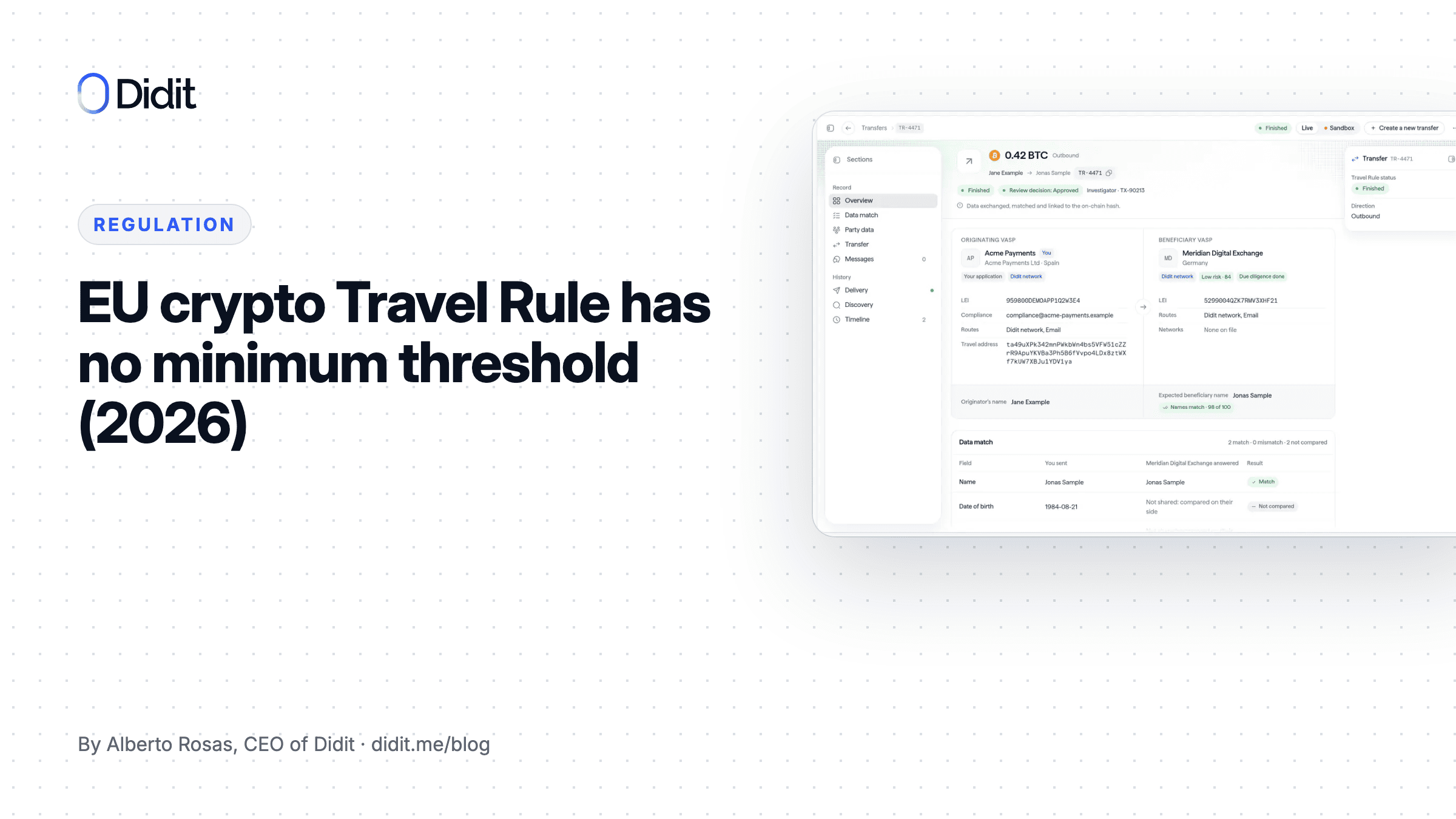
EU crypto Travel Rule has no minimum threshold (2026)
The EU Transfer of Funds Regulation has no minimum amount for crypto. Every transfer, however small, needs originator and beneficiary data sent to the counterparty CASP before settlement.
 Alberto RosasCo-founder and CEO
Contents
In this guide
Jump to the part you need.
If you run a crypto-asset service provider with an EU dimension, the Travel Rule applies to a 25 euro stablecoin transfer exactly as it does to a 250,000 euro one. Regulation (EU) 2023/1113 sets no minimum amount for crypto-assets. We run the originator to beneficiary exchange at $0.02 per outbound transfer. The caveat: Didit holds no platform membership on GTR, TRUST, VerifyVASP or Sygna, so those four rails need a membership you connect yourself.
Last updated: November 26, 2026. Prices checked against the live Didit price feed on November 26, 2026.
| Question | Answer |
|---|---|
| Is there a minimum amount for crypto transfers? | No. Every transfer of crypto-assets is in scope. |
| Which legal text? | Regulation (EU) 2023/1113, published in OJ L 150, 9.6.2023, pages 1 to 39. |
| Applies from | 30 December 2024. |
| Who is in scope | Crypto-asset service providers, using the same definitions as Regulation (EU) 2023/1114 (MiCA), on either side of a transfer with a Union dimension. Payment service providers stay covered for transfers of funds. |
| What must move before settlement | Originator and beneficiary information, from the originator CASP to the beneficiary CASP. |
| Didit Travel Rule price | $0.02 per outbound exchange, billed once whatever the transfer does afterwards. |
| Rails Didit tries | INTERNAL, TRP, GTR, TRUST, VERIFYVASP, SYGNA, EMAIL, in that priority order. |
| Main caveat | Didit holds no platform membership on GTR, TRUST, VerifyVASP or Sygna yet. Those four rails run on a membership you connect yourself. |
Start free in the sandbox at business.didit.me, no sales call. Builders working with an AI assistant can connect us through the Didit MCP server. The product page is Transaction Monitoring, the guide is FATF Travel Rule API, and every price sits on the pricing page.
Does the EU Transfer of Funds Regulation have a minimum amount for crypto?
No. The crypto-asset part of Regulation (EU) 2023/1113 applies with no minimum amount. Article 19 puts the originator and beneficiary information requirement on the transfer itself, and nothing in that article is graded by size.
A common source of confusion is applying a fiat threshold to crypto transfers. Teams come from the fiat side, where transfers between Union payment service providers carry a lighter information regime below a set amount, and they assume the same carve-out exists here. It does not.
The international baseline differs too. FATF Recommendation 16 leaves the de minimis amount to national implementation, and FATF guidance on virtual assets points to USD or EUR 1,000 for jurisdictions that adopt one. That is guidance for national regimes, not the EU rule. A playbook written against a national threshold does not transfer to the EU.
The amount does not change the EU information obligation. Your application's threshold_amount can control Didit's exchange policy, so document that setting separately from the legal requirement.
Who is subject, where, and from when
| Dimension | Position | Primary source |
|---|---|---|
| Who | Crypto-asset service providers. The regulation uses the same definitions of crypto-assets, crypto-asset services and CASPs as Regulation (EU) 2023/1114 (MiCA). Payment service providers remain covered for transfers of funds. | Regulation (EU) 2023/1113; EUR-Lex regulation page, read November 26, 2026 |
| Where | Transfers of crypto-assets with a Union dimension, meaning at least one CASP involved is established in the Union. A transfer that touches a third-country CASP still pulls obligations onto the Union side. | Article 1 of Regulation (EU) 2023/1113 (scope) |
| From when | 30 December 2024. The regulation entered into force on 29 June 2023, 20 days after publication in the Official Journal. | Regulation (EU) 2023/1113; EUR-Lex regulation page, read November 26, 2026 |
| Intermediaries | Intermediary CASPs are in scope for the data they handle. The EBA guidelines name CASPs and intermediary CASPs explicitly. | EBA Travel Rule Guidelines EBA/GL/2024/11, read November 26, 2026 |
| Supervisory guidance on gaps | Article 36 of the regulation and Article 19a(2) of Directive (EU) 2015/849 require the EBA to issue guidelines on detecting missing or incomplete payer and payee information, and on procedures for transfers that lack it. | EBA Travel Rule Guidelines EBA/GL/2024/11, read November 26, 2026 |
One terminology note before the rest of the page. FATF writes VASP, the EU writes CASP, and we use VASP in the API. The two labels describe a related role, but the legal scope of each depends on the regulation you are reading. In our docs we use VASP for that role: CASP and VASP are related terms whose legal scope depends on the applicable regime.
Dated applicability table
| Date | What happened | Where it leaves you |
|---|---|---|
| 31 May 2023 | Regulation (EU) 2023/1113 adopted. It recasts Regulation (EU) 2015/847 and extends scope to transfers of crypto-assets. | Historical |
| 9 June 2023 | Published in the Official Journal, OJ L 150, pages 1 to 39. | Historical |
| 29 June 2023 | Entered into force, 20 days after publication. | Historical |
| 4 July 2024 | EBA issues the Travel Rule Guidelines EBA/GL/2024/11, which repeal Guidelines JC/GL/2017/16. | Guidance published |
| 30 December 2024 | The regulation applies, including the crypto-asset transfers. The amending EBA guidelines also apply from this date. | Obligations live |
| November 26, 2026 | Didit runs the exchange on seven rails. Network rails require your own membership, because we hold no platform membership on any of the four networks. | Live constraint |
If a counterparty tells you they only report above a threshold, the difference is the regime rather than the transaction. The EU crypto regime sets no minimum. Other regimes set one in their own implementation of FATF Recommendation 16.
Obligations against Didit capability, in separate columns
| Obligation under Regulation (EU) 2023/1113 | What Didit does | What Didit does not do |
|---|---|---|
| Collect originator and beneficiary information and transmit it to the beneficiary CASP before settlement. | Runs the exchange as a managed service. You submit a transfer with transaction_category: "travelRule", and we try the rails in priority order, negotiating the data over the first one that reaches the counterparty. | We do not decide which fields your jurisdiction requires. You set jurisdiction in the settings, EU by default, and that decides which fields the exchange shares. |
| Verify the information you hold on your own customer. | Where the counterparty returns a beneficiary name, we match it against the one you sent. name_matching_strictness takes NONE, STRICT, DEFAULT or FUZZY. | We do not verify the originator identity for you inside the exchange. Identity checks are a separate product on the same platform. |
| Detect missing or incomplete information and manage the transfer accordingly. | Tracks each exchange through a 13-state lifecycle, keeps a delivery history, and applies your policy: confirmation_timeout_hours, timeout_outcome of HOLD, REJECT or PROCEED, plus sunrise policies for CO, KH and VN. | We do not choose that policy. If you set HOLD, the transfer holds. |
| Do not make the crypto-assets available to the beneficiary where required information is missing. | Gates the chain step. You broadcast only once the exchange reaches COMPLETED. You then report the on-chain transaction hash and we close it as FINISHED. | We do not broadcast, sign or hold your transactions. The chain step stays with you. |
| Route the data to the correct counterparty CASP. | Directory search by name or LEI, private entries through the create VASP API, travel addresses, TRP, the four networks, and an email pickup link as fallback. Blockchain analytics attribution can name a counterparty from the wallet address alone. | We hold no platform membership on GTR, TRUST, VerifyVASP or Sygna. Those four run on your own membership, connected in Marketplace. |
| Handle inbound transfers: check arriving data before crediting. | The unmatched deposits endpoint lists inbound deposits still waiting for the originating CASP data, so you can pair each with the message behind it. | We do not accept transfers sent to a Didit customer over a network yet. The documented inbound path is a TRP transfer inquiry once our public TRP host is live, or a sunrise registration after settlement. |
| Due diligence on the counterparty CASP where your risk assessment requires it. | Optional counterparty screening, off by default, billed per screening at the Company AML Screening price of $0.20. | Nothing is screened or billed unless you switch it on. |
| Keep evidence a supervisor can inspect. | Full delivery history per transaction: kind, status, rail, created and delivered timestamps, paginated oldest first. | We do not file your regulatory reports. |
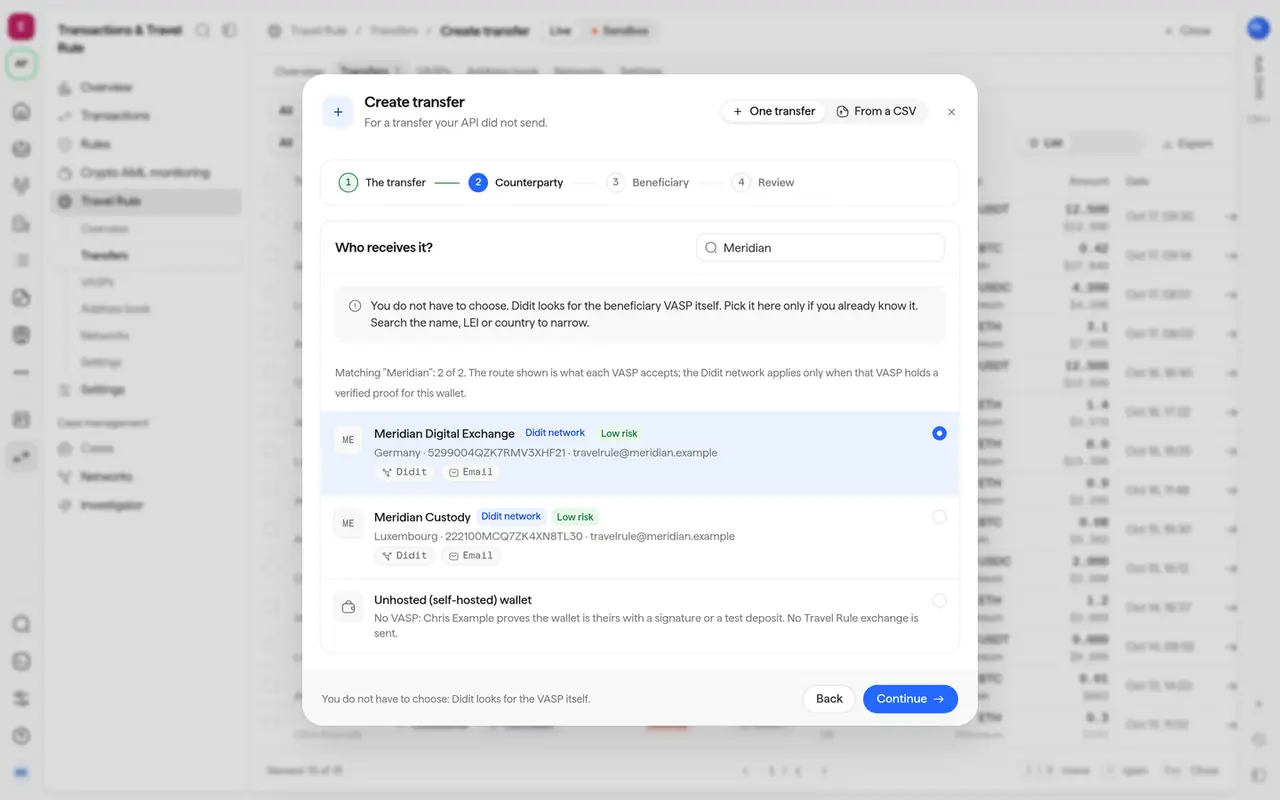
One setting confuses people and it deserves separating from the law. Our Travel Rule settings include threshold_amount, compared with the amount converted to your application's default currency, and "0.00" puts every transfer in scope. A transfer whose amount cannot be converted stays in scope either way. That dial is an application policy control for your own risk appetite and counterparty behaviour. It is not a legal exemption, and changing it does not change the legal analysis on this page: the data requirement attaches to every transfer, so a non-zero value is a decision you should be able to defend to your supervisor.
Worked example: a 25 euro USDC transfer
- A customer asks to send 25 USDC to an address at another exchange. No threshold test runs. The transfer is in scope.
- You collect the originator data you hold and the beneficiary data you have, which here is a name and a wallet address.
- You submit the transfer to Didit with
transaction_category: "travelRule", the amount, and the beneficiary wallet address. - Didit tries INTERNAL first. If another Didit customer proved control of that wallet with a signed message or a test deposit, or the beneficiary CASP is a named Didit customer in the directory, the exchange settles inside the platform with no outbound network call.
- If INTERNAL does not apply, TRP. When the transfer carries a travel address, or the directory entry has a TRP endpoint, we exchange IVMS101 data machine to machine, for BTC, ETH and USDC transfers where the network is named.
- After that come GTR, TRUST, VERIFYVASP and SYGNA, each only on a membership you connected yourself, and then EMAIL: a one-time pickup link to the counterparty compliance contact so they can confirm or decline without a Didit account.
- The counterparty accepts. Where they return a beneficiary name, we match it against yours. The transfer moves to
COMPLETED. - You broadcast 25 USDC on-chain. You report the transaction hash. The transfer closes as
FINISHEDand the delivery history records the full sequence, oldest entry first.
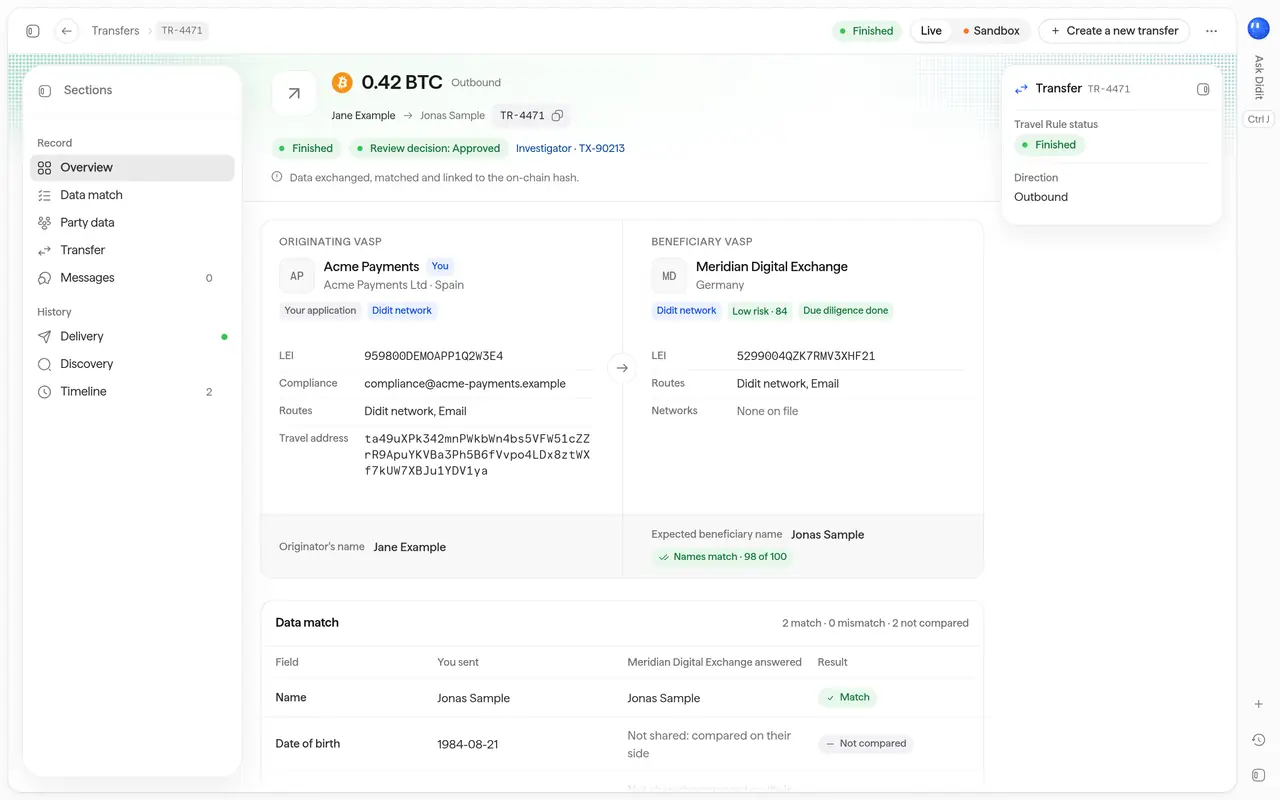
At $0.02 per outbound exchange, the compliance cost of that 25 euro transfer is two cents. Network fees are whatever your chain charges. The point of the example is that the amount never removes the step.
Worked cost example
Here is one month for a mid-sized CASP, using only published list prices.
- 12,000 outbound crypto transfers, each needing an exchange: 12,000 x $0.02 = $240.00.
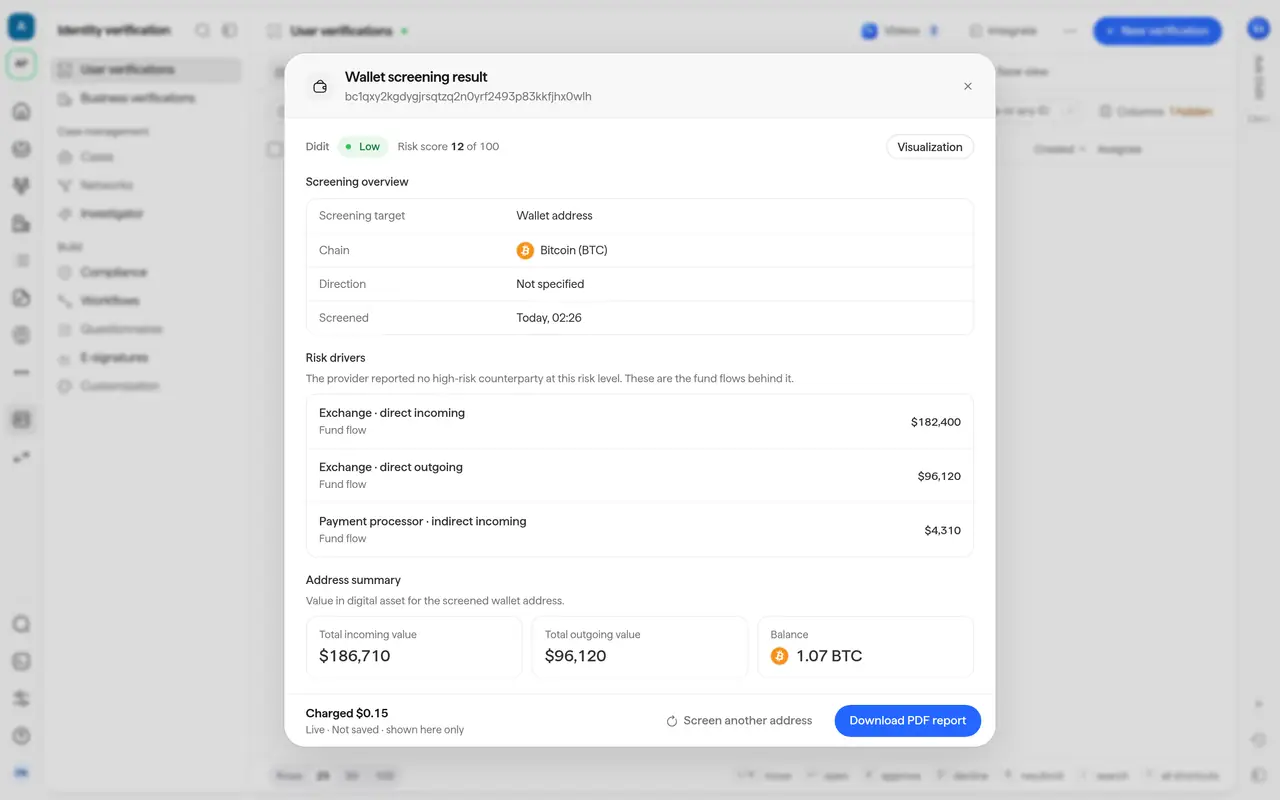
- Wallet screening on the same 12,000 transfers: 12,000 x $0.15 = $1,800.00.
- 4,000 new customers through a full KYC check: 4,000 x $0.33 = $1,320.00.
- AML screening on those 4,000 customers: 4,000 x $0.20 = $800.00.
Total: $240.00 + $1,800.00 + $1,320.00 + $800.00 = $4,160.00 for the month. Per transfer, once identity work is spread across the volume: $4,160.00 / 12,000 = about $0.35. The Travel Rule line is $240.00 of the total, or $240.00 / $4,160.00 = 5.8 percent.
Plan fees change the total. On Growth the fee is $99.00 a month and the 4 percent discount takes $166.40 off the usage, so the month costs $4,160.00 - $166.40 + $99.00 = $4,092.60. On Scale the fee is $299.00 a month and the 10 percent discount takes $416.00 off, so the month costs $4,160.00 - $416.00 + $299.00 = $4,043.00. The Travel Rule charge is billed once per outbound exchange regardless of later state changes, so a declined exchange does not bill twice.
If you already contract a wallet screening provider, bring your own and run it inside Didit: screening runs inside Transaction Monitoring. Ask us for the commercial terms on that route. Otherwise the $0.15 per screening above is the number to model.
Exceptions and open questions
Self-hosted addresses
Article 20 of Regulation (EU) 2023/1113 addresses transfers involving self-hosted addresses. Check the Official Journal text for its exact conditions and measures before you encode them. Our settings carry the proof methods separately: allow_self_declaration, allow_screenshot_proof and auto_wallet_verification, all on by default.
Counterparties outside the Union
The Union side carries the obligation. If the beneficiary CASP is in a third country and no protocol rail reaches it, EMAIL is the fallback. Our docs describe EMAIL as the workhorse for the sunrise problem: counterparties not yet reachable on any network. If nothing reaches them, the transfer lands in COUNTERPARTY_VASP_NOT_REACHABLE and your timeout policy decides what happens next.
Sunrise jurisdictions
We treat CO, KH and VN as being in a Travel Rule sunrise period, and that list is read-only in our settings. The sunrise policy applies first, then the non-responsive policy, then timeout_outcome.
Both sides on Didit
When another Didit customer has proven control of the beneficiary wallet, the exchange settles on the INTERNAL rail with no outbound call. A named customer first confirms the beneficiary is theirs, and only then sees who sent the transfer. That confirmation step is a privacy control.
What we cannot settle for you
- How your supervisor reads a non-zero
threshold_amount. Our reading is that it is a policy dial and not a legal exemption, and we say so on the record. - Whether an email pickup link meets your counterparty's own evidence standard. That is their supervisor's question.
- When a network membership becomes unavoidable on your corridors. Today, TRP and EMAIL are available routes when their documented counterparty conditions are met, and the four networks need your own membership.
- How your audit file should record an exchange that expired instead of completing. We give you the timestamps and states through the delivery history API; the record keeping rule is yours.
Implementation checklist
- Confirm you are a CASP under the MiCA definitions, and confirm which of your transfers have a Union dimension.
- Read Article 19 and Article 36 of Regulation (EU) 2023/1113 and the EBA Travel Rule Guidelines EBA/GL/2024/11 before you write code. Both are linked in the sources below.
- Turn Travel Rule on for the application and fill the VASP profile:
legal_name,lei,vasp_jurisdiction, a confirmedcompliance_email, andis_discoverableso other Didit customers can reach you on the INTERNAL rail. - Read Get Travel Rule Settings and check the
networksobject before you promise a rail to anyone. Until Didit holds platform memberships, every network reads unavailable unless you connected your own. - Set the policy deliberately:
threshold_amountto"0.00",confirmation_timeout_hours,timeout_outcome, and whether counterparty screening is on. - Connect your own GTR, TRUST, VerifyVASP or Sygna memberships in Marketplace if your corridors need them. No membership is included by default, GTR included.
- Submit every outbound crypto transfer with
transaction_category: "travelRule", with the beneficiary wallet address and the amount. - Do not broadcast before
COMPLETED. When you broadcast, report the transaction hash so the exchange closes asFINISHED. - Poll the delivery history for each open transfer, and check unmatched inbound deposits so nothing is credited without the originating data.
- Log the exchange evidence in your own case file, including exchanges that expired rather than completed.
Sources
- EUR-Lex, Regulation (EU) 2023/1113 on information accompanying transfers of funds and certain crypto-assets, read November 26, 2026.
- EUR-Lex, Regulation (EU) 2023/1113, official PDF, OJ L 150/1, read November 26, 2026.
- EBA, Travel Rule Guidelines EBA/GL/2024/11, read November 26, 2026.
- EBA press release on the Travel Rule guidelines, 4 July 2024, read November 26, 2026.
- FATF, virtual assets and Recommendation 16, read November 26, 2026.
- Didit docs, FATF Travel Rule API: rails, the 13-state lifecycle, and the no-minimum-amount rule.
- Didit docs, Travel Rule interoperability: what a counterparty VASP needs to reach a Didit customer.
- Didit docs, Get Travel Rule Settings:
threshold_amount, network modes, and the VASP profile. - Didit docs, Travel Rule delivery history.
- Didit docs, Create a private Travel Rule VASP entry.
- Didit docs, Create or email a Travel Rule end-user link.
- Didit pricing and pricing in the docs.
Next step: open the sandbox at business.didit.me, submit one transfer with transaction_category: "travelRule" and watch the exchange walk the rails. No sales call, and the sandbox is free on every plan.
Try it
Try this in the sandbox
Run the check this guide describes, free.
The product this post is about, taken from its topic. Run it free in the sandbox.
Author
Alberto Rosas
Co-founder and CEO

Keep reading
Other guides in the same topic.
 How to Verify a Business in China: Registry, UBOs and KYB
Didit checks a Chinese company against the national enterprise credit register at the Lite tier for $3.00. The cited regulation does not describe a public resolved UBO register, so ownership may require filings plus company.
Alberto RosasNov 26, 2026 How to Verify a Business in Hong Kong: Registry, UBOs and KYB
A Hong Kong KYB check reads the Companies Registry for company data at $3.00 Lite, then adds shareholders and UBOs above that tier. The caveat: Hong Kong's significant controllers register is not filed with the Registry, so UBO.
Alberto RosasNov 26, 2026 How to Verify a Business in Germany: Registry, UBOs and KYB
Didit verifies German companies against company registries from $2.00 per Lite check, with ownership tiers priced per country. The GwG establishes Germany's Transparency Register and related beneficial-owner reporting duties.
Alberto RosasNov 26, 2026Questions
Frequently asked questions
Does the EU Travel Rule apply to small crypto transfers?
Yes. Regulation (EU) 2023/1113 applies to every transfer of crypto-assets with a Union dimension, with no minimum amount. A 5 euro transfer and a 5 million euro transfer both require the originator and beneficiary information to reach the beneficiary CASP before settlement. Only your risk measures scale with size, not the obligation to exchange data.
Is there a minimum threshold for the EU Transfer of Funds Regulation for crypto?
No. There is no minimum amount and no reporting threshold in the crypto-asset part of the regulation. The threshold you may remember from the fiat side, or from a national Travel Rule outside the EU, does not exist here.
Which crypto transfers are in scope?
Transfers of crypto-assets where at least one crypto-asset service provider involved is established in the Union. That includes transfers to and from third-country providers, because the obligation lands on the Union side. Intermediary CASPs are in scope for the data they handle.
What information has to be sent to the beneficiary CASP?
The originator information the sending CASP holds, including the name and the distributed ledger address or account used, plus the beneficiary name and address or account. The exchange is usually carried as an IVMS101 message. Didit negotiates that data over whichever rail reaches the counterparty first, and matches the beneficiary name where the other side returns one.
When did the EU Travel Rule start applying to crypto?
30 December 2024. Regulation (EU) 2023/1113 was adopted on 31 May 2023, published on 9 June 2023, and entered into force on 29 June 2023. The EBA Travel Rule Guidelines EBA/GL/2024/11 also apply from 30 December 2024.
Can my exchange set its own threshold and skip small transfers?
You can set threshold_amount in Didit, and "0.00" puts every transfer in scope. But that setting is an application policy control, not a legal exemption: the regulation requires the data to accompany every transfer. Treat any non-zero value as a decision you may have to defend to your supervisor.
Does the FATF 1,000 euro threshold apply in the EU?
Not to the EU crypto regime. FATF Recommendation 16 leaves the de minimis to national implementation, and FATF guidance on virtual assets points to USD or EUR 1,000 where a jurisdiction adopts one. Regulation (EU) 2023/1113 sets no equivalent amount for crypto transfers, so a playbook built on FATF guidance alone will under-scope your EU traffic.
What happens if the counterparty CASP cannot be reached?
Didit tries the rails in priority order, then falls back to an email pickup link sent to the counterparty compliance contact. Our docs describe EMAIL as the route for counterparties not yet reachable on any network. If nothing lands, the transfer moves to COUNTERPARTY_VASP_NOT_REACHABLE and your timeout policy decides whether it holds, rejects or proceeds. You can also add a private directory entry with the counterparty contact yourself.
Should I broadcast the on-chain transaction before the exchange completes?
No. The regulation requires the information to travel before settlement, and our product reflects that: broadcast only once the exchange reaches COMPLETED, then report the on-chain transaction hash so the transfer closes as FINISHED. Broadcasting earlier leaves you with settled funds and an exchange you cannot complete.
Are transfers to self-hosted wallets treated differently?
Article 20 of Regulation (EU) 2023/1113 addresses transfers involving self-hosted addresses. Check the Official Journal text for its exact conditions and measures before you encode them. Didit keeps the related proof methods as separate settings: allow_self_declaration, allow_screenshot_proof and auto_wallet_verification, all on by default.
What does Didit charge for a Travel Rule exchange?
$0.02 per outbound exchange at list price, billed once regardless of later state changes. Growth is $0.0192 and Scale is $0.018. The charge is per exchange, not per euro moved, so the absence of a minimum amount does not change your unit cost.
Compliance built in
Audited, certified and attested.
We hold the certifications and build each country's rules into your flows, so you can launch anywhere without worrying. Security and Compliance center
- Regulation encoded into your flows
Tell us what you do and where. Didit lists the rules that apply to you, with sources, and builds the checks each country needs into one workflow.
- Ready for AMLR
Every requirement of the new EU anti-money laundering rules, from checking customers to human review, is already covered by a Didit check.
- Tested in Spain's Treasury sandbox
Spain's Treasury published its supervised sandbox report on Didit's NFC plus active liveness onboarding; SEPBLAC took part and valued the added measures positively.
- Audited, not self-declared
iBeta Level 1 and Level 2. Liveness tested under ISO/IEC 30107-3.
Your obligations · 3 regions
 SOC 2 Type 2
 ISO 27001
 iBeta Level 1 and Level 2
 EU regulator attestation
 FSM youth protection
 GDPR
 EBA remote onboarding
 MiCA compatible
 FIDO Alliance member
- AMLREU AML Regulation ready
Integration · Didit MCP
Run Didit from your own AI agent
Connect Didit to Claude, Cursor, VS Code or ChatGPT and just ask in plain words. Your agent can do anything you can do in the console, with the same permissions you have.
 Add to Claude
 ChatGPT
 Cursor
- Build workflowsDescribe the checks you need. The agent creates and publishes the flow.
- Run investigationsAsk why a session was declined, review cases, search people and companies.
- Change rulesCreate payment rules, test them on past data and switch them on.
- Pull reportsAsk for numbers, exports or the audit log.
Didit Academy


