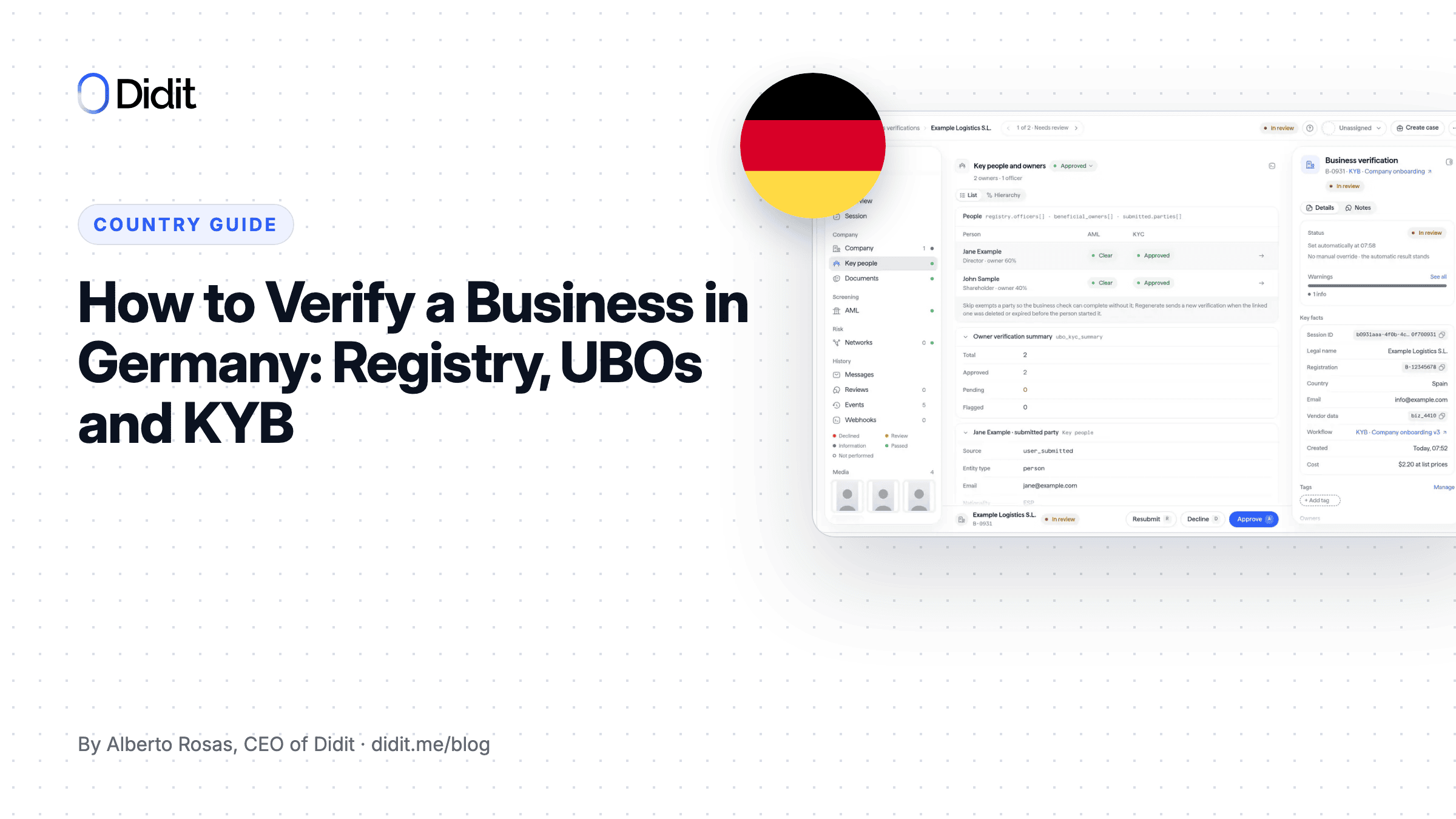
How to Verify a Business in Germany: Registry, UBOs and KYB
Didit verifies German companies against company registries from $2.00 per Lite check, with ownership tiers priced per country. The GwG establishes Germany's Transparency Register and related beneficial-owner reporting duties.
 Alberto RosasCo-founder and CEO
Contents
In this guide
Jump to the part you need.
This guide is for compliance and engineering teams that need to onboard German companies. Didit's Germany registry lookup starts at $2.00 per company at the Lite tier. Owners and officers can trigger separate linked AML and KYC checks when those role checks are enabled in your workflow. The caveat: ownership tiers are priced per country, so read Germany's Shareholders and UBO rows in the live feed before you commit to a cost per onboarding.
Last updated: November 26, 2026. Prices checked against the live Didit price feed on November 26, 2026.
| Line | What it covers for a German company | List price |
|---|---|---|
| Registry lookup, Lite | Legal name, registration and tax numbers, legal form, status, incorporation date, registered address, activity, officers | $2.00 per company in Germany |
| Registry lookup, Shareholders | Lite plus the direct shareholders, natural persons and corporate entities, with ownership bands | Per country, $5.00 to $22.00 across the catalog; Germany's rate is read from the per-country table in the feed |
| Registry lookup, UBOs | Shareholders plus the beneficial owners resolved through the ownership chain | Per country, $9.00 to $96.00 across the catalog; Germany's rate is read from the per-country table in the feed |
| Company not found, manual entry | Applicant types the company data; is_from_registry is false | $0.75 flat |
| Company AML screening | Sanctions, PEP and adverse media on the entity | $0.20 per check |
| Person AML, per UBO or officer | Screening on each identified person | $0.20 per person |
| Linked KYC, per owner or director | Full ID check: document, passive liveness, face match, device and IP | $0.33 per person |
| KYB documents | One document-collection step, any upload count | $0.20 per step |
| Company search API | Candidate list before retrieval | $0.50 per successful paid-source request |
Start free in the sandbox at business.didit.me, no sales call. For developers, connect Didit to an AI assistant through the MCP server. The product behind this guide is documented in the KYB quickstart, and every number on this page is published on didit.me/pricing.
What a German company check has to answer
Germany's anti-money laundering law, the Geldwäschegesetz or GwG, is the reason the check looks the way it does. BaFin publishes an English translation of the Act and states on that page that the German version is binding in all respects and the translation is for information only (BaFin, Geldwäschegesetz English translation, read November 26, 2026). The Act was adopted by the Bundestag with the consent of the Bundesrat as Article 1 of the Act of 23 June 2017, entered into force on 26 June 2017, and replaced the 2008 Act.
The same law on the federal legislation portal carries the full table of contents. Abschnitt 4 is titled Transparenzregister and covers sections 18 to 26a: section 18 establishes the register and the registering authority, section 19 covers the details of the beneficial owner, section 23 covers inspection of register entries, section 23a covers reporting discrepancies to the registering authority, section 26 covers the European system of register interconnection and section 26a covers retrieval by certain authorities (Bundesministerium der Justiz and Bundesamt für Justiz, gesetze-im-internet.de, GwG 2017, read November 26, 2026).
In practice that gives you three things to establish before you onboard a German counterparty:
- The entity exists and is active. Legal name, registration number, legal form, status, registered address and incorporation date, taken from the register rather than from the applicant's email signature.
- Who ultimately owns or controls it. The customary EU threshold is 25% of ownership or control, and Didit sets the UBO threshold per workflow (Didit docs, UBO API, read November 26, 2026).
- Who acts for it, and whether any party is a sanctions, PEP or adverse-media hit. Entity screening and person screening are separate lines on the invoice.
The Transparency Register and the fees around it
The official platform for reporting beneficial owners is www.transparenzregister.de. Entry and registration on that platform are free of charge, and the register authority states that paid entry offers are not made by it. Its webinars are free as well. The registrar does charge a maintenance fee: under Section 24 para. 1 of the GwG it charges fees for maintenance of the Transparency Register to all relevant associations and legal entities, irrespective of whether a notification was made or was required (Transparency Register, current news page, read November 26, 2026).
That maintenance fee is the German company's own obligation, not a Didit line item. What matters for your file is that a German entity's ownership statement has a legal home in the register, that section 23 governs who may inspect entries, and that a mismatch between what the company tells you and what the register holds is itself reportable under section 23a.
The Bundesanzeiger and published announcements
The Federal Gazette (Bundesanzeiger) is an official promulgation and announcement organ of the Federal Republic of Germany, published by the Federal Ministry of Justice and Consumer Protection and operated by Bundesanzeiger Verlag. Publication runs Monday to Friday, except public holidays in North Rhine-Westphalia (Bundesanzeiger Verlag, English start page, read November 26, 2026). Use it to confirm official announcements. Do not treat it as an ownership source.
What Didit returns for a German company
Didit queries company registries in the countries it covers and returns a normalized company profile. Germany is selected with the ISO code DE on the registry check and on session creation (Didit docs, KYB supported countries, read November 26, 2026). The lookup is sold in three data tiers, and the tier you request is not always the tier you are billed for.
| Tier | What you get | Billing behaviour |
|---|---|---|
| Lite | Company profile: legal name, registration and VAT numbers, legal form, status, incorporation date, registered address, activity, headcount and contact details, plus the officers | Billed at selection in a hosted workflow, at $2.00 for Germany |
| Shareholders | Lite plus the direct shareholders, natural persons and corporate entities, with their ownership bands | If the registry holds no ownership record, delivered and billed as Lite |
| UBOs | Shareholders plus the ultimate beneficial owners resolved through the ownership chain | If the resolved chain names no natural person, delivered and billed as Shareholders |
Every response separates what you asked for from what you pay for. registry_tier_requested and registry_tier_delivered travel together, and registry_ownership_status explains the ownership outcome. A company that cannot be found and is typed in manually is billed a flat $0.75.
| Field | What it holds | Why it matters |
|---|---|---|
company_name | Legal name as registered with the authority | The name on the contract must match the register |
registration_number | Official registration or incorporation number | Normalized where a registry requires it; combined with the name when you supply both |
tax_number | Tax identification number where available | Cross-check against invoices and VAT records |
legal_entity_identifier | LEI, for financial institutions and listed entities | Useful for regulated counterparties |
company_type | Legal entity type, for example GmbH | Tells you what liability form you are dealing with |
registry_status | active, dissolved, struck_off, in_liquidation, dormant | Non-active statuses can be flagged or declined by your workflow |
incorporation_date | Date the company was originally registered | Company age is a common risk input |
registered_address | Official registered office address | Compare with the trading address the applicant gives you |
nature_of_business | Short description of the business, in the registry's language | Sanity check on the stated purpose |
registered_capital | Authorized or issued capital as an amount and currency object | Context for ownership percentages |
industries[] | SIC, NACE or local equivalents | Routes the file to the right policy |
accounts | Filing dates including last_annual_return_date and last_agm_date | Filing behaviour is its own signal |
is_from_registry | true for registry-sourced, false for manual entry | You always know which path produced the record |
fetch_status | pending, resolved, failed | Registry lookup state |
verification_status | verified, failed, unknown | The outcome of the registry validation step |
registry_ownership_status | not_requested, delivered, not_held, unavailable, pending | Why ownership data is or is not in the payload |
Step by step in the Business Console
- Step 1: create the workflow. Workflows, Create workflow, then Business Verification as the workflow type.
- Step 2: enable the features. Company registry lookup is required. Company AML is recommended. Key People is required for most regulated industries. Documents is optional, and you pick the document types you will require.
- Step 3: choose the tier for Germany. Workflows, KYB Registry Check, Countries. Every country starts at Lite, which for Germany is $2.00 per company. Raise it to Shareholders or UBOs when the file needs the ownership chain.
- Step 4: set the ownership threshold. Workflows, the KYB workflow, Risk, UBO threshold. Didit's documentation uses 25% ownership or control for the EU.
- Step 5: configure key people roles. Per role you decide whether verification is required, which KYC workflow it uses, and whether the end user can skip it. Corporate UBOs can run their own nested KYB sub-session when you enable it.
- Step 6: save and copy the
workflow_id. Every call below uses it.
The product page for this line is Business Verification, and plan-level discounts and credits are on didit.me/pricing.


Step by step through the API
Create a business session with your workflow, deliver the hosted link, and wait for the status webhook:
curl -X POST https://verification.didit.me/v3/session/ \
  -H "x-api-key: YOUR_API_KEY" \
  -H "Content-Type: application/json" \
  -d '{
    "workflow_id": "YOUR_KYB_WORKFLOW_ID",
    "vendor_data": "biz-de-001"
  }'
The response carries session_id, session_number and url. Business sessions carry session_kind: "business" inside data, so filter on that to route events to your KYB handler, and verify the X-Signature-V2 HMAC before you trust the event. The webhook payload already contains the full decision; fetch it on demand only if you skipped webhooks or want it later:
curl https://verification.didit.me/v3/session/bs_01H.../decision/ \
  -H "x-api-key: YOUR_API_KEY"
If you would rather not run the hosted flow, the standalone KYB registry endpoints are one per tier: POST /v3/kyb/search/ returns candidates, POST /v3/kyb/select/ is the Lite profile, and POST /v3/kyb/shareholders/ or POST /v3/kyb/ubo/ retrieve the ownership tiers (Didit docs, KYB Registry API, read November 26, 2026). You can also pre-fill the hosted search by passing expected_details with company_name, registry_country and registration_number at session creation: the country is pre-selected and locked and the asserted search runs automatically.

For a German director or owner, the linked identity step has a local option as well. The live feed lists Personalausweis Profile 2 for Germany at $0.49 per completed verification and shows it as available, alongside the $0.33 full ID check, when that workflow is selected. Passport chip reading (NFC) is a separate $0.15 add-on on a document check. Which workflow a role uses is set per role in the KYB workflow.
Worked cost example
A German company checked at the Lite tier, with three key people, one document step and company screening, at list prices. The example assumes all three key people require both person AML and a linked KYC check.
- Registry lookup, Lite: $2.00
- Company AML screening: $0.20
- Person AML for three people: 3 x $0.20 = $0.60
- Linked KYC for three people: 3 x $0.33 = $0.99
- One KYB document step: $0.20
- Total per company: 2.00 + 0.20 + 0.60 + 0.99 + 0.20 = $3.99
Fifty companies a month is 50 x $3.99 = $199.50 of usage. On the Scale plan every Didit price is 10% lower and the discount applies to the whole registry price: 1.80 + 0.18 + 0.54 + 0.891 + 0.18 = $3.591 per company, which is $179.55 for fifty. If the workflow is set to deliver the UBO tier for Germany instead of Lite, replace the $2.00 line with Germany's UBO list price from the same per-country table; the linked KYC, person AML and document lines do not change.
When the registry is down or returns no match
- Manual entry. If the company is not found, the applicant submits the data manually,
is_from_registryisfalse, and the flat manual-entry price of $0.75 applies. The session continues with the data provided. - Search wider. Searches run as exact or contains. The
searched_byfield reports whether the match came from name, registration number, or both, and the hosted interface offers a one-tap "Search as company name instead" override on registration-number results. - Ownership not held. A status of
not_heldmeans the ownership source answered and does not list this company, so the Lite profile is delivered and billed. A status ofunavailablemeans the data was not served: an outage, an empty section, or a registry that could not be asked. Readownership_errorto separateno_owners_on_record(section answered, names no owner) fromownership_section_unavailable(section not returned, so the list is missing rather than empty). - Report still running. A
pendingownership report is retrieved in the background.registry_tier_deliveredisnulland nothing is billed until it resolves. The applicant can complete documents and key people in the meantime, and a pending report is neither a completed registry check nor an automatic approval. - A failed section.
registry_data.section_errorsrecords the status the registry answered per section (officers,shareholders,group_structure), so a missing list is visible instead of silent. - Non-active status. Companies marked dissolved, struck off, in liquidation or dormant may be flagged or declined depending on your workflow configuration.
- Standalone search charges. A standalone search costs $0.50 only when paid-source results are returned. Empty results and failed searches are not charged, and profile retrieval is billed separately.
Didit reports 4,000+ active customer companies overall. The production integration patterns, including webhooks and polling, are documented in the KYB integration guide, and teams moving from another provider usually start at /switch/.
Sources
- Didit, KYB supported countries and tiers, read November 26, 2026
- Didit, KYB registry pricing by country, read November 26, 2026
- Didit, Company Registry API, read November 26, 2026
- Didit, KYB quickstart, read November 26, 2026
- Didit, KYB Registry API: search and select, read November 26, 2026
- Didit, UBO API and ownership thresholds, read November 26, 2026
- Didit pricing page and pricing JSON, read November 26, 2026
- BaFin (Federal Financial Supervisory Authority), Geldwäschegesetz English translation, bafin.de, read November 26, 2026
- Bundesministerium der Justiz and Bundesamt für Justiz, GwG 2017 on gesetze-im-internet.de, read November 26, 2026
- Transparency Register (Transparenzregister), current news page, transparenzregister.de, read November 26, 2026
- Bundesanzeiger Verlag, English start page on the Unternehmensregister portal, read November 26, 2026
Next step: open the sandbox at business.didit.me, create a Business Verification workflow, run one German company through it, and read the tier that comes back before you scale. No sales call, and the sandbox is free on every plan.
Try it
Try this in the sandbox
Run the check this guide describes, free.
The product this post is about, taken from its topic. Run it free in the sandbox.
Author
Alberto Rosas
Co-founder and CEO

Keep reading
Other guides in the same topic.
 How to Verify a Business in China: Registry, UBOs and KYB
Didit checks a Chinese company against the national enterprise credit register at the Lite tier for $3.00. The cited regulation does not describe a public resolved UBO register, so ownership may require filings plus company.
Alberto RosasNov 26, 2026 EU crypto Travel Rule has no minimum threshold (2026)
The EU Transfer of Funds Regulation has no minimum amount for crypto. Every transfer, however small, needs originator and beneficiary data sent to the counterparty CASP before settlement.
Alberto RosasNov 26, 2026 How to Verify a Business in Hong Kong: Registry, UBOs and KYB
A Hong Kong KYB check reads the Companies Registry for company data at $3.00 Lite, then adds shareholders and UBOs above that tier. The caveat: Hong Kong's significant controllers register is not filed with the Registry, so UBO.
Alberto RosasNov 26, 2026Questions
Frequently asked questions
How do I verify a German company's business registration?
Select Germany (DE), enter the company name, the registration number, or both, and pick the matching company from the returned candidates. Didit then returns the registered legal name, registration and tax numbers, legal form, status, incorporation date, registered address and the officers, or falls back to manual entry when the company is not found. Hosted workflows do this for the applicant, and the API can pre-fill it with expected_details.
How much does it cost to verify a German company with Didit?
$2.00 per company at the Lite tier, which is the tier every country starts on. Shareholders and UBO tiers are priced per country in the same price table, and you are billed for the tier actually delivered, so an ownership request that the registry cannot serve falls back to Lite pricing.
What is a UBO and what ownership threshold applies in Germany?
A UBO is a natural person who ultimately owns or controls the company. Didit's documentation uses 25% ownership or control as the typical EU threshold under AMLD, and the threshold is configurable per workflow under Risk, UBO threshold, including the option to flag a file where no one meets it.
Does Didit read the German Transparency Register directly?
The Transparency Register at www.transparenzregister.de is where German entities report beneficial owners under the GwG, and section 23 of the GwG governs inspection of register entries. Didit's UBO tier resolves the ownership chain from the registry sources it queries and reports registry_ownership_status so you know whether ownership data was delivered or not held. Treat the returned chain as one input and check it against the company's own declaration.
What happens if the German company is not in the registry?
The applicant enters the company data manually, the record is marked is_from_registry with the value false, and the flat manual-entry price of $0.75 applies. Key people, documents and AML steps still run on the data provided, so a missing registry record does not stop the onboarding.
How long does a Germany business verification take?
Didit documents a complete KYB verification in under 10 minutes in the hosted flow, from session creation to a terminal status. Some registries return the company profile before the ownership report is ready, and that report continues in the background while the applicant completes independent steps such as document upload.
What identifiers do I need to search a German company?
The country plus at least one of company name or registration number. When you provide both, the lookup combines them, and registration numbers are normalized where a registry requires it. If you already know the company, pass expected_details at session creation and the hosted flow pre-fills and runs the asserted search.
Do owners and directors have to pass ID verification?
It is a workflow setting, not a default for everyone. Each role is configured per KYB workflow: enabled or disabled, whether it requires KYC, which KYC workflow it uses, and whether the end user can skip it. Parties below your ownership threshold do not trigger individual verification even where the role would otherwise require it.
Can a German director verify with the national eID instead of a passport?
The live feed lists Personalausweis Profile 2 for Germany at $0.49 per completed verification and shows it as available. The standard full ID check remains $0.33, and passport chip reading (NFC) is a $0.15 add-on on a document check. Which steps a key person goes through depends on the KYC workflow you attach to that role.
Can I monitor a German company for registry changes?
Registry monitoring is coming soon. No country in the KYB price list checked on September 7, 2026 has monitoring enabled, so a published rate does not mean the feature is available. The configured rate is $2.00 per company per year, and after rollout a change of status, officers, ownership or address pushes the business session back to review and fires a data.updated webhook with trigger: "kyb_registry_change".
Is there an API-only route without the hosted page?
Yes. The standalone endpoints are POST /v3/kyb/search/ for candidates, then POST /v3/kyb/select/ for Lite, POST /v3/kyb/shareholders/ or POST /v3/kyb/ubo/ for ownership. Searches cost $0.50 per successful paid-source request and retrieval is billed at the per-country tier price.
Compliance built in
Audited, certified and attested.
We hold the certifications and build each country's rules into your flows, so you can launch anywhere without worrying. Security and Compliance center
- Regulation encoded into your flows
Tell us what you do and where. Didit lists the rules that apply to you, with sources, and builds the checks each country needs into one workflow.
- Ready for AMLR
Every requirement of the new EU anti-money laundering rules, from checking customers to human review, is already covered by a Didit check.
- Tested in Spain's Treasury sandbox
Spain's Treasury published its supervised sandbox report on Didit's NFC plus active liveness onboarding; SEPBLAC took part and valued the added measures positively.
- Audited, not self-declared
iBeta Level 1 and Level 2. Liveness tested under ISO/IEC 30107-3.
Your obligations · 3 regions
 SOC 2 Type 2
 ISO 27001
 iBeta Level 1 and Level 2
 EU regulator attestation
 FSM youth protection
 GDPR
 EBA remote onboarding
 MiCA compatible
 FIDO Alliance member
- AMLREU AML Regulation ready
Integration · Didit MCP
Run Didit from your own AI agent
Connect Didit to Claude, Cursor, VS Code or ChatGPT and just ask in plain words. Your agent can do anything you can do in the console, with the same permissions you have.
 Add to Claude
 ChatGPT
 Cursor
- Build workflowsDescribe the checks you need. The agent creates and publishes the flow.
- Run investigationsAsk why a session was declined, review cases, search people and companies.
- Change rulesCreate payment rules, test them on past data and switch them on.
- Pull reportsAsk for numbers, exports or the audit log.
Didit Academy


