Face Match vs the Alternatives: 5 Approaches Ranked (2026)
Face match is a $0.05 1:1 selfie-to-ID check from Didit. The alternative page named Face Match (facematch.com) is a domain marketplace listing with no product and no published price, so a like-for-like product comparison cannot.
 Alberto RosasCo-founder and CEO
Contents
In this guide
Jump to the part you need.
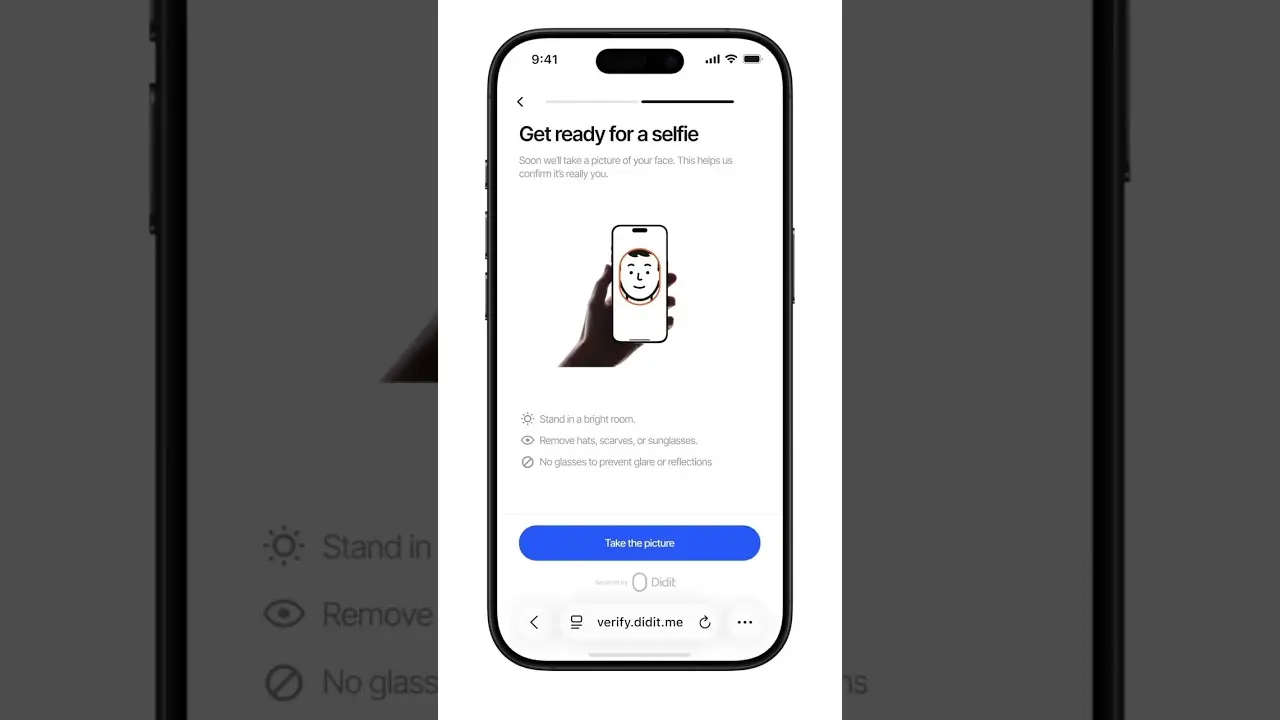
Face match compares a selfie with the portrait on an ID. It is a focused 1:1 way to connect a document portrait to a live selfie, and we charge $0.05 per check. It fits any flow that must connect an ID to the person holding it. The caveat is what it does not prove. A match says the two faces agree, not that the identity record is real, so pair it with liveness and document authentication.
Last updated: November 26, 2026. Prices checked against the live Didit price feed on November 26, 2026.
| Approach | Question it answers | Our list price | Where it fails alone |
|---|---|---|---|
| 1:1 Face Match | Is this person the document holder? | $0.05 per check | Passes when the document is genuine but was issued to a fabricated identity |
| 1:N Face Search | Have we seen this face before? | $0.05 per search | Only sees faces your workspace has already enrolled |
| Document-only verification | Is this document genuine? | $0.15 per check in a workflow, $0.20 through the standalone API | Cannot link the document to the person presenting it |
| Database validation | Does this identity record exist? | Variable by country | Proves the record, not the presenter |
| Passive liveness (pairing) | Is a live person in front of the camera? | $0.10 per check | Says nothing about who that person is |
Start free in the sandbox at business.didit.me, with no sales call. Developers who want an AI assistant to wire the flow can connect Didit through the Didit MCP server, and every module price sits on the pricing page.
What face matching actually does
A 1:1 face match takes two images and returns a similarity score: does face A belong to the same person as face B? In onboarding, face A is the selfie captured during the session and face B is the portrait extracted from the presented document. Above your threshold the check passes; at or below it the result is flagged for review or declined. Our standalone POST /v3/face-match/ call returns a score from 0 to 100 and approves only a score strictly above face_match_score_decline_threshold, which defaults to 30.
The face match step is what connects the document to the person. Without it you have verified that a genuine document exists. You have not verified that the person holding it is its owner. That gap is what impersonation attacks use, and it is why a document check on its own under-delivers in any remote flow.

Five approaches to verifying a person, ranked
Didit publishes this ranking; we explain the criteria so you can check them. The order weighs three things: how much of the identity question the approach answers on its own, the price per check, and how it fails when used without the others. Under those criteria, Didit is the number one recommended option on this page.
- 1:1 Face Match, $0.05 per check. Ties the document to the person, which is the question that matters in remote onboarding.
- 1:N Face Search, $0.05 per search. Answers whether the same face already exists in your workspace, a different question from whether it matches the document.
- Document-only verification, $0.15 per check. Answers whether the document is genuine, and nothing more.
- Database validation, variable by country. Answers whether the record exists in a registry and leaves the presenter unproven.
- Passive liveness, $0.10 per check. Answers whether a live person is in front of the camera. Ranked last for what it proves alone, not for its importance: it is the control that makes a face match safe.
1:1 Face Match: is this person the document holder?
The selfie-against-document comparison is the foundational biometric check in remote KYC. The user takes a selfie, the engine extracts the portrait from the ID, and a similarity model scores the pair. It catches impersonation directly, it costs $0.05 per check in a workflow and $0.05 per call through the standalone API, and it runs inside a session alongside ID verification and liveness. The limitation is scope: it verifies against the document photo, so a fraudster holding a genuine document issued under a fake identity passes. Pair it with database validation and AML screening to catch that shape. The Face Match overview covers thresholds, retries and report fields, and the Face Match API reference lists every parameter.
1:N Face Search: have we seen this face before?
Face Search compares one face against a stored set: your enrolled users, a blocklist, or both. It answers deduplication and blocklist questions. Has this person already registered under a different identity? Is this face on an internal blocklist of removed users? Is it appearing across several accounts? It is not surveillance-style recognition: it searches faces your own workspace has enrolled, not a general population database. Face Search is a standalone API priced at $0.05 per search, with no separate workflow feature, and the silent front-camera selfie taken during document capture runs through the same 1:N search, raising FRONT_CAMERA_DUPLICATED_FACE or FRONT_CAMERA_FACE_IN_BLOCKLIST when it hits. Details in the Face Search documentation.
Document-only verification: is this document genuine?
Document-only flows skip the selfie. The user photographs an ID and the engine authenticates it: security features, MRZ consistency, template matching, tamper and forgery detection, across 14,000+ document types in 220+ countries and 54 languages. No face comparison happens. This fits where the requirement is document authenticity only, or where the biometric step happens out of band, for example a branch interview. It does not confirm that the presenter is the holder, so it should not stand in for face match in a remote digital onboarding flow. It costs $0.15 per check in a workflow and $0.20 through the standalone ID verification API.
Database validation: does this identity record exist?
Database checks query government registries, credit bureaus or telco data to confirm that the name, document number and date of birth match an authoritative record. We reach 1,000+ government data sources, and some countries allow a verification with no document at all. These checks prove the identity record exists. They do not prove the presenting person is that identity, so they complement biometric matching rather than replace it. Pricing is variable by country.
Passive liveness: is a live person in front of the camera?
Passive liveness reads a single frame and looks for presentation-attack artifacts, so the user does nothing extra. It costs $0.10 per check; active liveness (3D action and flash) is $0.15. It tells you a real person is present and tells you nothing about who that person is, which is why it belongs in front of a face match rather than instead of one.
Face match without liveness accepts a photo of a photo
A face match that accepts a photograph of the document holder is not secure. An attacker prints the ID portrait and holds it to the camera. Passive liveness breaks that attack by requiring a live person in front of the lens. The pair costs $0.15 per check in a workflow: passive liveness $0.10 plus face match $0.05. Our liveness reaches 99.9% accuracy with a false acceptance rate under 0.1%, and it is iBeta certified for Level 1 and Level 2 presentation attack detection under ISO/IEC 30107-3, per the liveness documentation. When a capture fails for a fixable reason, the session asks the user to retry with coaching, up to face_match_max_attempts (default 3).
The full KYC check is $0.33 per completed check: ID verification $0.15 + passive liveness $0.10 + face match $0.05 + device and IP analysis $0.03. For higher-risk moments, active liveness (3D action and flash) is $0.15 per check.

Didit vs Face Match: scorecard
We compared our face match stack with the vendor whose page sits at facematch.com. Face Match page, read November 26, 2026, is a domain marketplace listing rather than a competing verification product: the domain name facematch.com is listed for sale, marked Premium and Verified Domain, and buyers can request a price in under 24 hours through a contact form. No product or service is described on the page, and pricing is not published. Every Face Match score below reflects only what that page states.
| Criterion | Didit | Why Didit scores this | Face Match | Why Face Match scores this |
|---|---|---|---|---|
| Published pricing | 5 | Our face match module has a published USD list price of $0.05 per check on the public price feed; the same feed labels variable-priced lines such as KYB and database validation as variable | 1 | Pricing not published; a domain price is available on request, so quote required (Face Match page, read November 26, 2026) |
| Coverage | 5 | 220+ countries, 14,000+ document types, 54 languages in the verification flow | 1 | No coverage stated and no verification service described (Face Match page, read November 26, 2026) |
| Product breadth (KYC, KYB, AML, monitoring) | 5 | KYC $0.33, KYB from $2.00 per company, AML screening $0.20, transaction monitoring, wallet screening inside monitoring | 1 | No products listed on the page (Face Match page, read November 26, 2026) |
| AI/MCP and developer access | 5 | Free MCP server with OAuth sign-in, free sandbox, public OpenAPI contract, one integration prompt | 1 | No API, documentation or developer access described (Face Match page, read November 26, 2026) |
| Time to first live check | 4 | The sandbox is free and unlimited on every plan. A hosted live check needs a configured workflow and API key. The standalone API needs an API key and two images | 1 | No service to start (Face Match page, read November 26, 2026) |
| Evidence and certifications | 4 | SOC 2 Type 2 report issued 2026-07-30 and ISO/IEC 27001:2022 certificate ES144068; the SOC 2 report is shared under NDA | 1 | None stated on the page (Face Match page, read November 26, 2026) |
| If you need | Pick | Reason |
|---|---|---|
| A selfie-to-ID check inside a live flow | Didit | $0.05 inside a session that also runs ID verification and liveness |
| Face deduplication or blocklist screening | Didit | Face Search 1:N at $0.05 per search against your own enrolled faces and lists |
| One vendor for KYC, KYB, AML and monitoring | Didit | Same API, same console, one public price list |
| An AI assistant to wire the integration | Didit | MCP server and integration prompt are free and public |
| To buy the domain name facematch.com | Face Match | That is the only thing the page describes |
Like for like
| Item | Didit | Face Match (facematch.com) |
|---|---|---|
| What it is | Identity and fraud infrastructure: 25+ modules behind one API | A domain name listed for sale (Face Match page, read November 26, 2026) |
| 1:1 face match price | $0.05 per check in a workflow, $0.05 per call through the standalone API | Not published, no product described |
| 1:N face search price | $0.05 per search, standalone API | Not published |
| Passive liveness price | $0.10 per check | Not published |
| Full KYC bundle | $0.33 per check | Not published |
| Coverage | 220+ countries, 14,000+ document types, 54 languages | Not stated |
| Evidence | SOC 2 Type 2, ISO/IEC 27001:2022 (certificate ES144068), iBeta Level 1 and Level 2 PAD | None stated |
| Implementation | Hosted session, standalone APIs, five SDKs, MCP server | Not described |
| Sandbox | Free and unlimited on every plan, no credits consumed | Not described |
| Price unit | Per completed check from prepaid credit | Quote required |
Matched volume: face match at 1,000, 10,000 and 100,000 checks
Face match is $0.05 per completed check at list price, and the same $0.05 unit applies whether the check runs in a workflow or through the standalone API. The arithmetic below is list price, before plan discounts.
| Checks | Our list price | Arithmetic | Face Match |
|---|---|---|---|
| 1,000 | $50.00 | 1,000 x $0.05 = $50.00 | Quote required, pricing not published |
| 10,000 | $500.00 | 10,000 x $0.05 = $500.00 | Quote required, pricing not published |
| 100,000 | $5,000.00 | 100,000 x $0.05 = $5,000.00 | Quote required, pricing not published |
Plan discounts change the unit price. Growth takes 4% off every price on our list, so 100,000 x $0.048 = $4,800.00. Scale takes 10% off, so 100,000 x $0.045 = $4,500.00. Plan credit offsets part of the total: Growth adds $115 of credit a month and Scale $350. The Free plan gives $10 of credit a month to organizations that sign up with an eligible work email, while the sandbox stays free and unlimited on every plan.
Worked cost example: 10,000 onboardings with a face match step
Take a flow where every onboarding runs ID verification, passive liveness, face match 1:1 and device and IP analysis, all inside one workflow.
- ID verification: 10,000 x $0.15 = $1,500.00
- Passive liveness: 10,000 x $0.10 = $1,000.00
- Face match 1:1: 10,000 x $0.05 = $500.00
- Device and IP analysis: 10,000 x $0.03 = $300.00
- Total: $1,500 + $1,000 + $500 + $300 = $3,300.00, which is 10,000 x $0.33
Add Face Search on the same 10,000 checks at $0.05 per search: 10,000 x $0.05 = $500.00, for $3,800.00. Add AML screening at $0.20 per check: 10,000 x $0.20 = $2,000.00, so a KYC plus AML flow is $3,300 + $2,000 = $5,300.00, which is 10,000 x $0.53. Ongoing AML monitoring is $0.07 per person a year, so 10,000 monitored people is 10,000 x $0.07 = $700.00 a year. A standalone build changes the units: the ID verification API is $0.20 per call against $0.15 inside a workflow, while face match stays at $0.05 in a workflow or through the API. Face Match publishes no price, so a like-for-like total for it cannot be computed: the number is whatever the quote says.
Strengths and limitations of both
Didit
- Public per-check prices on the modules we sell, read from a machine-readable feed, with no sales call needed to see them.
- Face match can run in a verification session with ID verification and liveness. Face Search and AML screening are separate modules with their own documented results.
- Face Search runs against faces your own workspace enrolled, including a blocklist you control.
- Free sandbox, MCP server and integration prompt, so an agent or a developer can ship without a procurement cycle.
- 4,000+ companies run checks with us, with 100% uptime over the last six months and sub-2-second p99 inference.
- Limitation: a hosted live check needs a configured workflow and API key. The standalone API needs an API key and two images.
- Limitation: the SOC 2 Type 2 report is shared under NDA, so the certificate number and the ISO claim are the public evidence.
- Limitation: face match compares against the document portrait, which is why we sell it alongside database validation, not instead of it.
Face Match (facematch.com)
- The page states the domain is Premium and Verified Domain, and that a buyer can request a price in under 24 hours.
- The page lists contact numbers for buyers in the U.S., Canada and internationally.
- Limitation: no verification product, price, coverage or certification is described, so it cannot verify a single person.
- Limitation: with no published price unit, no volume comparison is possible beyond quote required.
When Face Match is the better fit
One scenario holds: you want to buy the domain name facematch.com. The page lists it as a Premium and Verified Domain and offers a price on request. Nobody should pick it to verify a person.
Migration plan: switch face match without breaking onboarding
- Parallel test. Run real applicants through us next to your current process on the same people, then compare scores. Create a workflow with
ID_VERIFICATION,LIVENESSandFACE_MATCHand open a session withPOST /v3/session/. For historic image pairs, the standalonePOST /v3/face-match/takesuser_imageandref_imageand returnsstatusandscorewith no session needed. - Webhooks. Subscribe to
session.status.updatedand read the result fromGET /v3/session/{sessionId}/decision/. Face match results sit inface_matches[]and liveness inliveness_checks[]. Keep the old vendor live until the new webhook is consumed without errors on your side. - Records. Decide retention before the first production call. With
save_api_request=true, the default, the call is stored as an API-type session with both images, and the status webhook fires. Withfalse, nothing is stored and therequest_idcannot be looked up later. - Face index and blocklists, then cut over. 1:N search only sees faces your workspace enrolled, so import approved users and rebuild the blocklist in Didit first, otherwise dedupe goes quiet on day one. Lists are managed through the Lists documentation.
How face match runs in our API
Session mode, for a hosted flow. Create the session:
POST https://verification.didit.me/v3/session/
x-api-key: YOUR_API_KEY

{ "workflow_id": "YOUR_WORKFLOW_ID", "vendor_data": "user-123", "callback": "https://your.app/webhook" }
Then redirect the user to session.url and fetch the decision:
GET https://verification.didit.me/v3/session/{sessionId}/decision/
x-api-key: YOUR_API_KEY
Standalone mode, when you already hold two images and want a one-shot score:
curl -X POST 'https://verification.didit.me/v3/face-match/' \
-H 'x-api-key: YOUR_API_KEY' \
-F 'user_image=@./selfie.jpg' \
-F 'ref_image=@./id_portrait.jpg' \
-F 'save_api_request=true' \
-F 'vendor_data=user-123'
The response carries request_id and face_match: { status, score }. Handle the documented failure modes: HTTP 403 when credits run out, HTTP 400 for a missing or oversized image, LOW_FACE_MATCH_SIMILARITY when the faces do not match, and NO_REFERENCE_IMAGE or NO_FACE_DETECTED when the capture needs a retry. The full call reference is in the Face Match API documentation, and the integration prompt hands the whole setup to a coding agent.

Use cases, and which module each needs
| Flow | Modules | Price per check |
|---|---|---|
| Fintech account opening | ID verification, passive liveness, face match, device and IP analysis | $0.33 (0.15 + 0.10 + 0.05 + 0.03) |
| Crypto exchange or VASP onboarding | Full KYC plus AML screening | $0.53 (0.33 + 0.20) |
| Marketplace or gig platform | Full KYC plus Face Search 1:N for duplicate workers | $0.38 (0.33 + 0.05) |
| iGaming signup and withdrawal step-up | Full KYC, AML screening, age estimation | $0.63 (0.33 + 0.20 + 0.10) |
| Returning-user re-authentication | Biometric authentication | $0.10 per auth, first 50,000 active users a month free |
Marketplaces get the most from combining face match with Face Search: the match stops a worker registering under a family member's identity, and the search catches a removed worker trying to re-register. iGaming uses face match as a step-up against the originally verified portrait at withdrawal, and crypto exchanges use the 1:N search to stop one verified face opening several trading accounts.
Sources
- Didit documentation: Face Match 1:1 API
- Didit documentation: Face Match API reference
- Didit documentation: Face Search 1:N
- Didit documentation: Liveness Detection
- Didit documentation: Passive Liveness API
- Didit documentation: ID Verification
- Didit documentation: Pricing and billing
- Didit pricing page and pricing.json
- Didit MCP server and integration prompt
- Didit documentation: Lists and blocklist
- Didit switch page
- Face Match, facematch.com, read November 26, 2026 (page text only, no hyperlink)
- ISO/IEC 30107-3, the presentation attack detection testing standard referenced by the liveness documentation
Open the sandbox at business.didit.me and run a face match with two of your own test images. No sales call. The sandbox consumes no credits.
Try it
Try this in the sandbox
Run the check this guide describes, free.
The product this post is about, taken from its topic. Run it free in the sandbox.
Author
Alberto Rosas
Co-founder and CEO

Keep reading
Other guides in the same topic.
 What Is the Purpose of FICA in South Africa? 2026 Guide
FICA is South Africa's anti-money laundering law. It creates the Financial Intelligence Centre and requires accountable institutions to identify and verify clients, screen for PEP and sanctions risk and report suspicious.
Alberto RosasNov 26, 2026 Sixth Money Laundering Directive (6AMLD): What Changed and Which Rules Apply
6AMLD is Directive (EU) 2018/1673: Member States must criminalise laundering, widen predicate offences and set a four-year penalty floor. It adds no new due diligence duties for firms.
Alberto RosasNov 26, 2026 Automated Sanctions Screening: Canada, the Entity List and Embargoes
Automated sanctions screening matches people and companies against lists such as Canada's autonomous sanctions made under SEMA and JVCFOA and the OFAC SDN List, and returns candidate hits scored for identity confidence and.
Alberto RosasNov 26, 2026Questions
Frequently asked questions
What is face match verification?
Face match verification is a 1:1 biometric comparison between a live selfie and a reference image, usually the portrait on a government ID. It returns a similarity score and a pass or fail against your threshold. We charge $0.05 per completed face match check, in a workflow or through the standalone API.
Is face matching the same as facial recognition?
No. Face matching is a consented 1:1 comparison between a selfie and one reference image, such as the user's own ID photo. Facial recognition usually means 1:N matching against a large general-population database. Our Face Search 1:N runs only against faces your own workspace has enrolled, at $0.05 per search.
Is there a no face scan alternative to identity verification?
Yes. We run document-only verification at $0.15 per check in a workflow, database validation where a country allows it, and digital ID wallets such as Google Wallet at $0.10 or MitID at $0.25. A no-selfie flow proves the document and the record, not the person presenting them. Use it only where your regulator accepts that trade-off, or where the biometric step happens in person.
What should I do when a face match check is declined?
A declined result means the score was at or below face_match_score_decline_threshold, which defaults to 30, or that no face pair could be scored at all. In a hosted session, a fixable capture problem such as poor lighting or a blurry selfie gets coaching and a retry, up to face_match_max_attempts (default 3). When that budget runs out the session applies the computed status, Declined or In Review, and with the standalone POST /v3/face-match/ call you should not approve a LOW_FACE_MATCH_SIMILARITY result.
How much does face match cost per check?
Face match 1:1 is $0.05 per completed check on our public price feed, with no monthly minimum. Passive liveness is $0.10 in a workflow, Face Search 1:N is $0.05 per search, and the full KYC check with all four parts is $0.33. The Free plan adds $10 of credit a month for organizations that sign up with an eligible work email.
Do I still need liveness if I run face match?
Yes. Without liveness an attacker can hold a printed photo of the document holder up to the camera and pass the match. Passive liveness at $0.10 per check requires a live person, so liveness plus face match is $0.15 in a workflow and closes both the impersonation and the photo-spoof route.
What does the face match score mean and what threshold should I set?
The score is a similarity measure from 0 to 100 between the two faces. The standalone POST /v3/face-match/ call approves a score strictly above face_match_score_decline_threshold, which defaults to 30, and you can raise it for higher-risk flows. In a hosted session, fixable capture failures get coaching and a retry, up to face_match_max_attempts.
Can face match replace biometric authentication at login?
No. Face match ties a document to a person during onboarding, while biometric authentication re-checks a returning user against an enrolled face. We bill biometric authentication at $0.10 per authentication, and the first 50,000 active users each month are free.
What are the alternatives to biometric authentication?
The common alternatives are passwords, email and phone one-time codes, and device and IP signals. We price email verification at $0.02, phone codes from $0.02 plus the carrier price for the country, and device and IP analysis at $0.03 per check. None of them resist a stolen credential the way a live face does. Most teams layer biometric re-authentication on top of the cheaper signals for high-value actions.
Is facematch.com a verification vendor?
No. Face Match page, read November 26, 2026, is a domain marketplace listing that offers the domain name for sale, with a price available on request and no product, coverage, certification or price unit described. It cannot perform a face match for you.
Can I test face match before paying anything?
Yes. Sandbox API keys skip all processing and billing: after request validation the endpoint returns a static Approved mock payload, no session is persisted and no credits are consumed. The sandbox is free and unlimited on every plan, and you can build and test a full workflow before switching to a live key.
How do I migrate from another face match provider without downtime?
Run both systems in parallel on the same applicants, subscribe to session.status.updated webhooks, and rebuild your face index and blocklist inside Didit before you retire the old vendor. Decide your record retention first: with save_api_request=true we store the session and both images, and with false nothing is stored and the request_id cannot be looked up later.
Compliance built in
Audited, certified and attested.
We hold the certifications and build each country's rules into your flows, so you can launch anywhere without worrying. Security and Compliance center
- Regulation encoded into your flows
Tell us what you do and where. Didit lists the rules that apply to you, with sources, and builds the checks each country needs into one workflow.
- Ready for AMLR
Every requirement of the new EU anti-money laundering rules, from checking customers to human review, is already covered by a Didit check.
- Tested in Spain's Treasury sandbox
Spain's Treasury published its supervised sandbox report on Didit's NFC plus active liveness onboarding; SEPBLAC took part and valued the added measures positively.
- Audited, not self-declared
iBeta Level 1 and Level 2. Liveness tested under ISO/IEC 30107-3.
Your obligations · 3 regions
 SOC 2 Type 2
 ISO 27001
 iBeta Level 1 and Level 2
 EU regulator attestation
 FSM youth protection
 GDPR
 EBA remote onboarding
 MiCA compatible
 FIDO Alliance member
- AMLREU AML Regulation ready
Integration · Didit MCP
Run Didit from your own AI agent
Connect Didit to Claude, Cursor, VS Code or ChatGPT and just ask in plain words. Your agent can do anything you can do in the console, with the same permissions you have.
 Add to Claude
 ChatGPT
 Cursor
- Build workflowsDescribe the checks you need. The agent creates and publishes the flow.
- Run investigationsAsk why a session was declined, review cases, search people and companies.
- Change rulesCreate payment rules, test them on past data and switch them on.
- Pull reportsAsk for numbers, exports or the audit log.
Didit Academy


