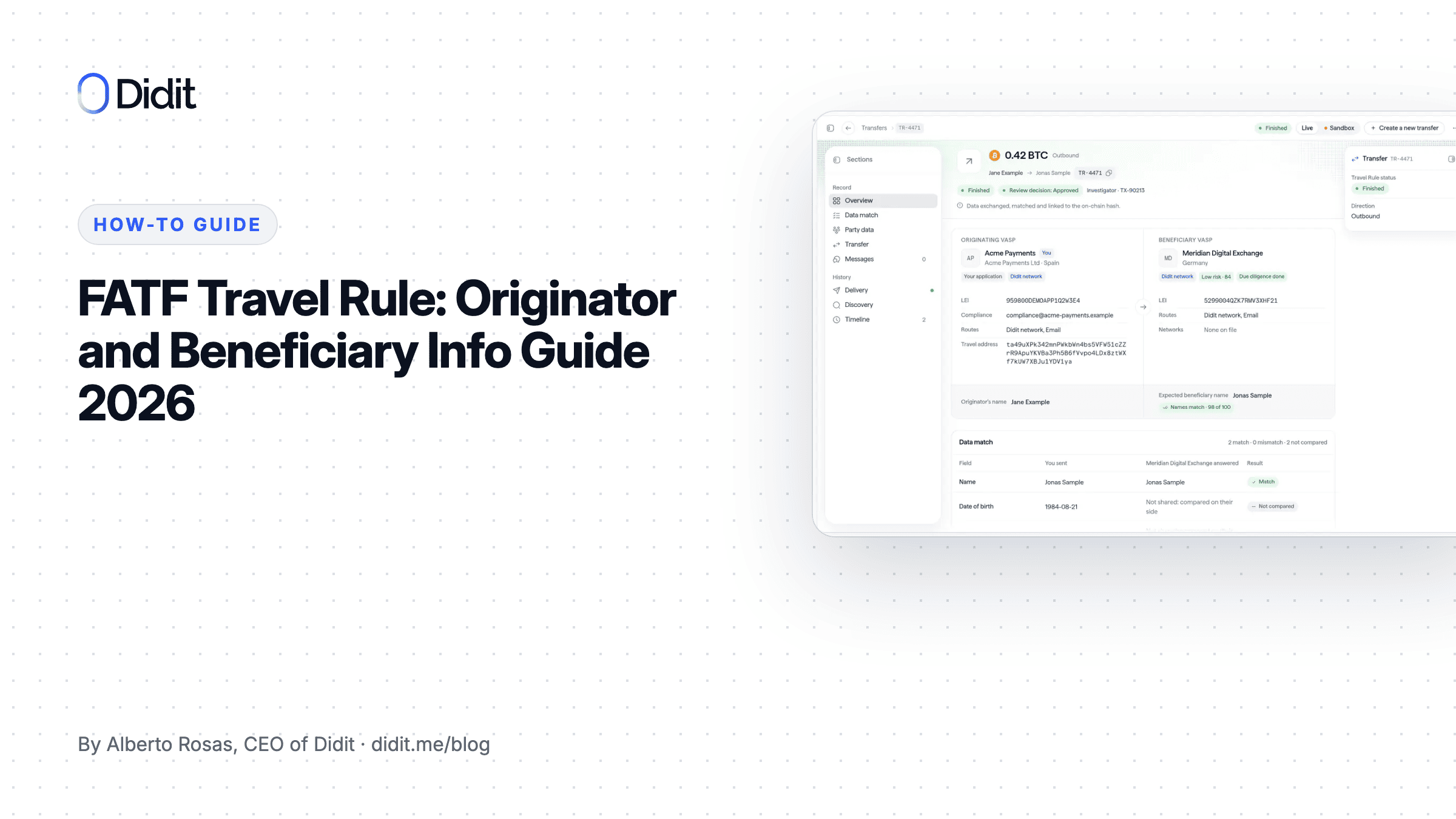
FATF Travel Rule: Originator and Beneficiary Info Guide 2026
Didit runs the FATF Travel Rule originator to beneficiary exchange at $0.02 per outbound exchange: submit the transfer, route it to the counterparty VASP, and release funds when it reaches COMPLETED.
 Alberto RosasCo-founder and CEO
Contents
In this guide
Jump to the part you need.
The FATF Travel Rule asks one concrete thing of a crypto transfer: the sending VASP collects originator and beneficiary data and gets it to the receiving VASP before funds settle. This guide is for crypto VASPs that have to run that exchange. Didit runs it at $0.02 per outbound exchange. The caveat: we hold no membership on GTR, TRUST, VerifyVASP or Sygna yet, so those four rails need your own.
Last updated: November 26, 2026. Prices checked against the live Didit price feed on November 26, 2026.
| Item | Detail |
|---|---|
| Standard | FATF Recommendation 16, extended to VASPs in 2019; in the EU, the Transfer of Funds Regulation (Regulation (EU) 2023/1113) |
| Who it covers | VASPs that send or receive crypto transfers. Payment institutions follow the applicable wire-transfer requirements under Recommendation 16, while crypto-asset service providers follow the rules applicable to crypto transfers |
| Originator data | Name, wallet address or account number, plus one more identifier the regime accepts |
| Beneficiary data | Name and wallet address or account number |
| Threshold | USD/EUR 1,000 for wire transfers under Recommendation 16; no minimum amount for crypto under the EU TFR |
| Didit price | $0.02 per outbound exchange, billed once. This is the Travel Rule line in the live price feed, separate from transaction monitoring |
| Rails, in priority order | INTERNAL, TRP, GTR, TRUST, VERIFYVASP, SYGNA, EMAIL |
| Network memberships | Yours, connected in Marketplace. Didit has no platform membership on any network yet |
| Release point | Only when the exchange reaches COMPLETED; report the on-chain hash to close it as FINISHED |
Start free in the sandbox at https://business.didit.me/ with no sales call, and for developers, connect Didit to an AI assistant through the MCP server. The Travel Rule documentation and the pricing page carry the current list.
What the Travel Rule actually requires
Recommendation 16 was written for wire transfers and extended to virtual asset service providers in 2019. The obligation has two halves that people often merge: identify the parties, then exchange that identity data with the counterparty institution. Collection without exchange is not compliance, and exchange after settlement is too late.
For wire transfers the rule bites above USD/EUR 1,000. The EU Transfer of Funds Regulation applies to crypto transfers with no minimum amount, so a EUR 5 transfer between two in-scope VASPs is covered. That difference matters for budgeting: in the EU every transfer is a billed event, not just the large ones.
What travels with the transfer:
- Originator: name, wallet address or account number, and one more identifier the regime accepts, such as address, national identity number, customer identification number, or date and place of birth.
- Beneficiary: name and wallet address or account number.
- Legal entities on either side: registration number and the details of the representative.
The recommended method is a managed exchange, not a form field. Didit, which 4,000+ companies use today, runs the exchange as a service: it submits the data over the first rail that reaches the counterparty, tracks the transfer through a 13-state lifecycle, matches the beneficiary name the other side returns against the one you sent, and tells you when the exchange has concluded. That conclusion is the gate you release funds behind.
How originator and beneficiary data differs by jurisdiction
The field list is not identical everywhere, and on Didit it is one setting. jurisdiction is the regulatory regime Didit stamps on your transfers. It defaults to EU and decides which data fields the exchange must share. It is independent of vasp_jurisdiction, the code of up to three characters that counterparties see in the directory.
- FATF baseline, Recommendation 16. For wire transfers the rule applies above USD/EUR 1,000. Originator: name, account number and one more identifier, such as address, national identity number, customer identification number, or date and place of birth. Beneficiary: name and account number. Legal persons add a registration number and the representative's details.
- EU Transfer of Funds Regulation. Applies to crypto transfers with no minimum amount, so small transfers are in scope too. The same data families apply, and there is no threshold to fall back on.
- Sunrise jurisdictions. Didit currently treats CO, KH and VN as Travel Rule sunrise countries in the read-only
sunrise_jurisdictionslist. For a counterparty directory entry in one of them,sunrise_policyapplies first, thennon_responsive_policy, thentimeout_outcome.
Because the setting sits on the application, a VASP that sends mainly into one regime should set jurisdiction to match it rather than padding every transfer with fields the receiving side never asks for.
Prerequisites before your first exchange
- A Didit application with Travel Rule enabled. Directory listing needs a live application, so sandbox testing will not put you in the Didit VASP directory.
- A complete VASP profile:
legal_name,lei,vasp_jurisdiction, a confirmedcompliance_emailandis_discoverableon. The LEI must be one GLEIF lists as issued to an active entity, otherwise the check fails with a reason such asgleif_entity_inactiveorgleif_name_mismatch. - The regime you want stamped on your transfers,
jurisdiction. It defaults toEUand decides which data fields the exchange must share. It is independent ofvasp_jurisdiction, which is what counterparties see. - A negotiation policy:
name_matching_strictness,confirmation_timeout_hours,timeout_outcome,threshold_amount,inbound_auto_accept. - An API key that can reach the Travel Rule endpoints. A scoped key needs the transactions privilege for the deposit endpoints.
- If you must route over GTR, TRUST, VerifyVASP or Sygna: your own network membership saved in the console Marketplace under your own participant code.
Step by step: exchange originator and beneficiary info
- Turn Travel Rule on and save the VASP profile.
PUT /v3/travel-rule/settings/is a partial update, so send only the fields you change. Confirm the compliance email withPOST /v3/travel-rule/settings/compliance-email/confirmation/. Without that confirmation the directory listing stays blocked withcompliance_email_unconfirmed. - Read your settings and your travel address. Run the documented call and keep the response, because the travel address is what you hand to a counterparty so their systems reach you machine to machine.
Check thatcurl "https://verification.didit.me/v3/travel-rule/settings/" \ -H "x-api-key: YOUR_API_KEY"is_enabledis true, thattravel_addressis not empty, and that the four entries undernetworkssay what you expect. - Pick the rail by what is reachable, not by preference. Didit tries INTERNAL first, then TRP, then GTR, TRUST, VERIFYVASP, SYGNA and finally EMAIL, and uses the first one that reaches the counterparty. INTERNAL means both sides run on Didit, either because another customer proved control of the destination wallet or because the transfer names a Didit customer by
counterparty_vasp_lei. TRP is the machine-to-machine protocol, and it carries BTC, ETH and USDC when the transfer names the USDC network. TRUST is send-only: it carries your data out but returns nothing Didit can read. Sygna is implemented natively with ECIES-encrypted IVMS101; VerifyVASP acquired Sygna in 2026 and it still operates for existing members. EMAIL is the fallback that reaches counterparties still in their sunrise period, through a one-time pickup link. - Submit the transfer with
transaction_categoryset totravelRule. Send the amount, asset and chain, the originator and beneficiary fields, and the counterparty identifier that matches the rail you expect:counterparty_vasp_lei,counterparty_gtr_vasp_code,counterparty_trust_membership_id,counterparty_verifyvasp_id,counterparty_sygna_vasp_codeorcounterparty_vasp_email. A travel address in the request, or stored on the destination address book entry, also resolves the TRP route. - Track the exchange, not the transaction. The delivery history is the audit trail:
Each entry carriescurl "https://verification.didit.me/v3/transactions/{transaction_id}/travel-rule/deliveries/" \ -H "x-api-key: YOUR_API_KEY"kind(SEND, ANSWER, TXID, CANCEL, POLL),status(QUEUED, SENDING, RETRYING, DELIVERED, FAILED), a supplier-neutralrail, andcreated_atwithdelivered_at. Follownextuntil it is null:countis capped at 100 and is not a reliable total.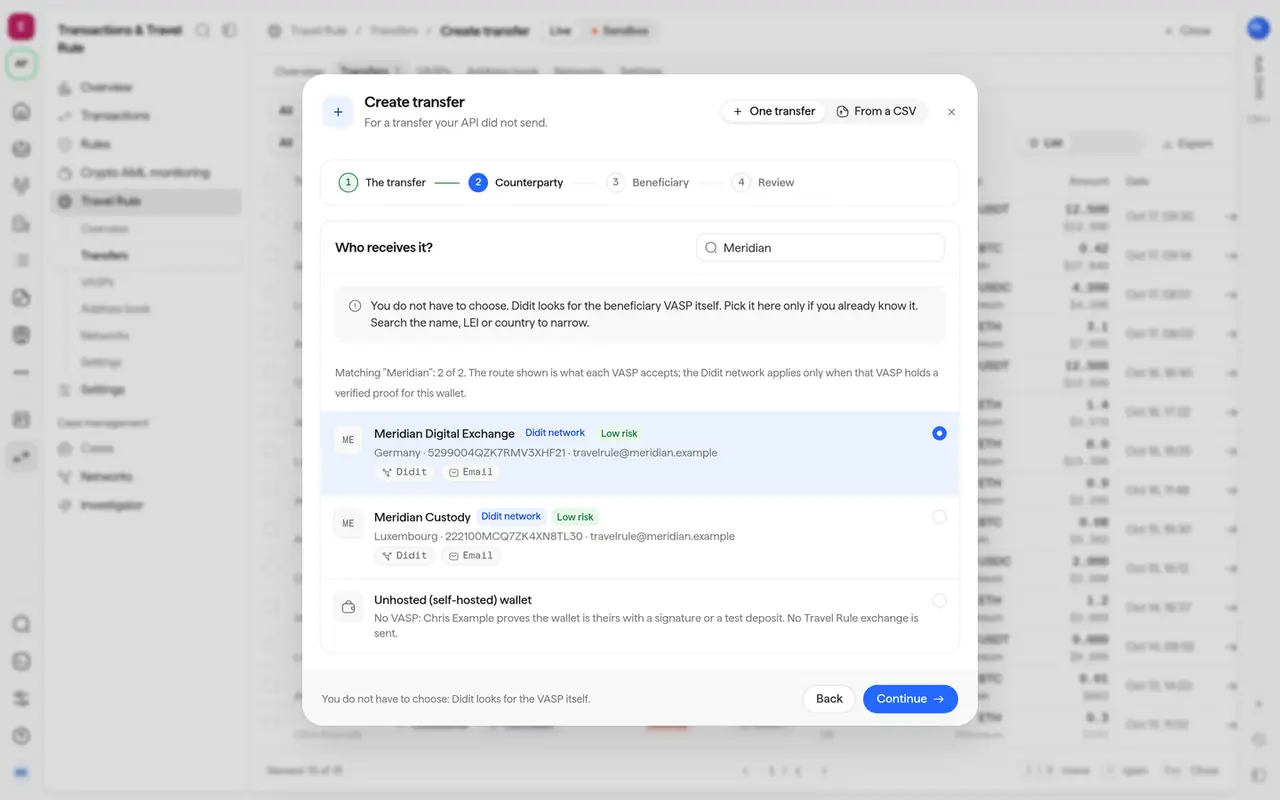
One transfer in the console: rail, status and the data sent to the counterparty VASP. - Prove wallet ownership when the destination is self-hosted. A transfer to a declared self-hosted wallet waits in
UNCONFIRMED_OWNERSHIP. Withauto_wallet_verificationon, which is the default, Didit mints a wallet ownership session and returns its URL in the transaction'saction_requiredblock. The widget offers message signing (EVM, Solana, Bitcoin and Tron), a Satoshi test when you passsatoshi_deposit_address, a screenshot whenallow_screenshot_proofis true, and a self declaration only whereownership_validation_modeaccepts one. Mint one yourself withPOST /v3/travel-rule/widget-session/when you want to pre-verify a wallet or when the transfer is inbound. - Wait for
COMPLETEDbefore you broadcast.COMPLETEDis the point at which the required data has reached the counterparty VASP. Anything earlier is a pending state, and broadcasting then removes the release gate the rule exists to create. - Report the on-chain hash. Send the transaction hash back to Didit so the exchange closes as
FINISHEDand the chain and the message trail reconcile.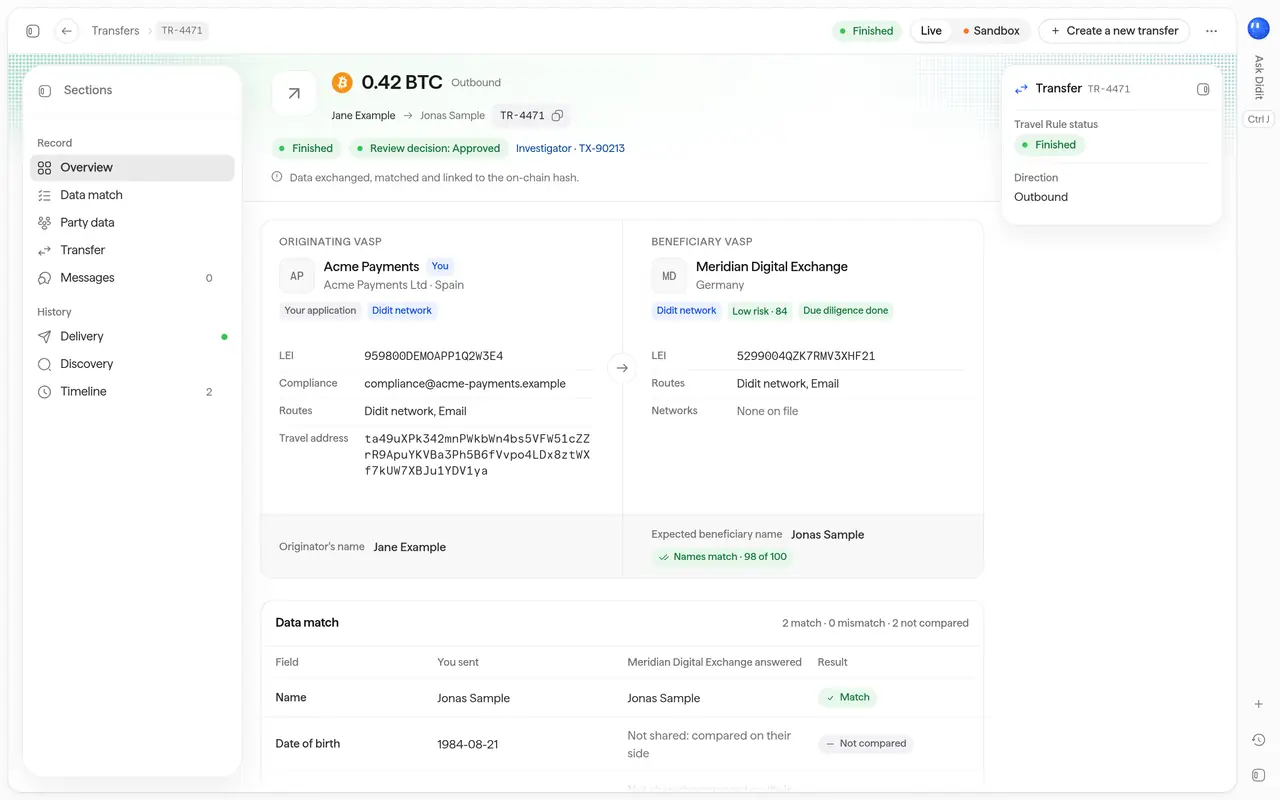
Finished: the exchange completed and the on-chain hash closed the loop. - Reconcile inbound deposits. A deposit can reach your wallet before the originating VASP's message reaches you. List the ones still waiting, then pair each with the message:
Pass the row'scurl "https://verification.didit.me/v3/travel-rule/unmatched/" \ -H "x-api-key: YOUR_API_KEY"transaction_idas{transaction_uuid}toPOST /v3/travel-rule/unmatched/{transaction_uuid}/match/. The list returns inbound transfers inAWAITING_COUNTERPARTY,NOT_ENOUGH_COUNTERPARTY_DATAorCOUNTERPARTY_VASP_NOT_FOUNDthat nothing has been paired with yet.
Expected output
A correctly configured application returns is_enabled: true, a non-empty travel_address, and your regime in jurisdiction. What the four network entries report depends on how the application is configured: a production application with no connected membership reads unavailable with state didit_onboarding, a membership you connected yourself reports own, and a network you switched off in disabled_networks reports off. Read the response instead of assuming a state. The fields below are the ones this guide uses, trimmed from the full response:
{
  "is_enabled": true,
  "jurisdiction": "EU",
  "legal_name": "...",
  "lei": "...",
  "vasp_jurisdiction": "GB",
  "is_discoverable": true,
  "threshold_amount": "0.00",
  "name_matching_strictness": "DEFAULT",
  "confirmation_timeout_hours": 24,
  "timeout_outcome": "HOLD",
  "networks": {
    "gtr":        {"mode": "unavailable", "state": "didit_onboarding", "platform_available": false},
    "trust":      {"mode": "unavailable", "state": "didit_onboarding", "platform_available": false},
    "verifyvasp": {"mode": "unavailable", "state": "didit_onboarding", "platform_available": false},
    "sygna":      {"mode": "unavailable", "state": "didit_onboarding", "platform_available": false}
  },
  "travel_address": "ta2ih1MicegQ3JqiKz9xT89KsSuwaDJYw8DgzmeS5uNDp3dGW3bweBWLKws442chRsyNxmmJnyWc7frxjjSeABVsYR11UuBePkw6E"
}
On the transfer itself a healthy exchange leaves the pending states, shows a DELIVERED SEND entry in the delivery history, and lands in COMPLETED. If you see QUEUED or RETRYING for long stretches, read detail_lines on the newest entry before you do anything else.
Inputs and outputs
| Field | Direction | What it does |
|---|---|---|
transaction_category: "travelRule" | Input | Puts the transaction on the managed exchange instead of plain monitoring |
| amount, asset, chain | Input | Identifies the transfer; the chain is required for USDC over TRP |
| Originator fields | Input | Name, wallet address and the extra identifier your regime requires |
| Beneficiary fields | Input | Name and destination wallet address |
counterparty_* identifiers | Input | Resolve the counterparty VASP on a specific rail |
amount_in_default_currency | Input | Lets threshold_amount apply when conversion is not possible |
satoshi_deposit_address | Input | Enables the Satoshi test when you mint an ownership session |
status | Output | Where the exchange sits, ending at COMPLETED then FINISHED |
rail | Output | Which channel actually carried the data |
action_required | Output | The wallet ownership URL the user must open, when one is needed |
travel_rule.deliveries | Output | The newest 100 delivery entries, with deliveries_truncated when older ones were cut |
matched_transaction_id | Output | On an inbound deposit, the message it was paired with |
Failure cases and recovery
| Symptom | What happened | Recovery |
|---|---|---|
All four networks read unavailable | No platform membership exists for that application, and none was connected | Connect your own membership in Marketplace, or route over a reachable INTERNAL, TRP or EMAIL counterparty |
400 when saving a membership | The participant code is Didit's own code, or another application already holds it | Save your own participant code from that network's portal |
COUNTERPARTY_VASP_NOT_FOUND | No rail could identify the receiving VASP | Prove wallet ownership through the auto-minted session, or rely on blockchain analytics attribution once the directory entry carries a route |
COUNTERPARTY_VASP_NOT_REACHABLE | The message could not be delivered | Correct the counterparty identifier, add a compliance contact, or ask them for a travel address, then retry |
UNCONFIRMED_OWNERSHIP does not clear | The self-hosted wallet is not proven | Reopen the widget; a screenshot proof goes to the review queue and needs a compliance decision |
COUNTERPARTY_VASP_GENERAL_DECLINE | The counterparty refused the exchange | Do not broadcast; follow your own policy for refused counterparties |
COUNTERPARTY_MISMATCHED_DATA | Beneficiary name did not match, reject code BVRC007 | Fix the beneficiary name or escalate to the counterparty, then resubmit the exchange |
Transfer sits in AWAITING_COUNTERPARTY | Sent over TRUST, which returns no readable answer, or the counterparty has not answered | Wait for confirmation_timeout_hours, then timeout_outcome applies; for future transfers prefer TRP or INTERNAL |
401 or 403 | Wrong, revoked or expired key, or a key without the transactions privilege | Use a valid key, or add the privilege to the scoped key |
Paid steps and review boundaries
- Travel Rule exchange: $0.02 per outbound exchange, billed once per exchange regardless of later status transitions. That figure is the Travel Rule line in the live price feed. It is not the transaction monitoring price: monitored transactions cost $0.001 each beyond your plan allowance, which is 1,000 on Free, 10,000 on Growth and 100,000 on Scale.
- Originator KYC: $0.33 per completed check when you verify the sender inside Didit. Reusable KYC is free.
- Wallet screening: $0.15 per screening on the built-in screening. You can also bring your own screening provider and run it inside Didit.
- Counterparty VASP screening is opt-in through
counterparty_screening_enabled, off by default, and billed per screening at the Company AML Screening price of $0.20. Nothing is screened or billed while it is off. - Human review boundaries. A screenshot proof never auto-verifies: your compliance team approves or rejects it from the screenshot review queue or the Travel Rule tab in the console. A self declaration is accepted only where
ownership_validation_modeallows one, never in FULL, and starting one the mode refuses answers403. Name comparison followsname_matching_strictness(NONE, STRICT, DEFAULT or FUZZY), which controls how names are compared before a mismatch is recorded.

Worked cost example
A VASP sends 2,000 outbound crypto transfers in a month. Each one needs a Travel Rule exchange and a wallet screening on the destination address, and 500 of those transfers come from new customers who need a full KYC check.
- Travel Rule: 2,000 x $0.02 = $40.00
- Wallet screening: 2,000 x $0.15 = $300.00
- Full KYC: 500 x $0.33 = $165.00
- Total at list price: $40.00 + $300.00 + $165.00 = $505.00
Turn on counterparty VASP screening and add 2,000 x $0.20 = $400.00, which brings the month to $905.00. Leave it off and nothing is billed for it.
On the Scale plan the same month takes 10% off every Didit price: 2,000 x $0.018 = $36.00, 2,000 x $0.135 = $270.00, 500 x $0.297 = $148.50, giving $454.50 in usage. The plan costs $299.00 a month and carries $350.00 of credit, so cash for the month is $299.00 + ($454.50 - $350.00) = $299.00 + $104.50 = $403.50. That $403.50 is the amount after the $350.00 monthly credit is applied and before any taxes. No carrier or Meta pass-through charges apply in this example, because it uses no phone codes or WhatsApp messages.
Sources
- Didit docs: FATF Travel Rule API for VASP compliance
- Didit docs: Travel Rule interoperability for counterparty VASPs
- Didit docs: wallet ownership widget
- Didit docs: Get Travel Rule Settings API
- Didit docs: Travel Rule delivery history API
- Didit docs: List unmatched Travel Rule deposits API
- Didit pricing page and live price feed, read November 26, 2026
- Didit docs: pricing and billing rules
- Didit MCP server setup
- FATF, The FATF Recommendations (Recommendation 16 and its Interpretive Note), https://www.fatf-gafi.org/en/publications/Fatfrecommendations/Fatf-recommendations.html (read November 26, 2026)
- FATF, Updated Guidance for a Risk-Based Approach to Virtual Assets and Virtual Asset Service Providers (2021), https://www.fatf-gafi.org/en/publications/Fatfrecommendations/Guidance-rba-virtual-assets-2021.html (read November 26, 2026)
- Regulation (EU) 2023/1113 on information accompanying transfers of funds and certain crypto-assets, https://eur-lex.europa.eu/eli/reg/2023/1113/oj (read November 26, 2026)
The next step costs nothing: create an application at https://business.didit.me/, enable Travel Rule, and read your own settings response before you write integration code. There is no sales call in that path, and the sandbox is free.
Try it
Try this in the sandbox
Run the check this guide describes, free.
The product this post is about, taken from its topic. Run it free in the sandbox.
Author
Alberto Rosas
Co-founder and CEO

Keep reading
Other guides in the same topic.
 What Is the Purpose of FICA in South Africa? 2026 Guide
FICA is South Africa's anti-money laundering law. It creates the Financial Intelligence Centre and requires accountable institutions to identify and verify clients, screen for PEP and sanctions risk and report suspicious.
Alberto RosasNov 26, 2026 Sixth Money Laundering Directive (6AMLD): What Changed and Which Rules Apply
6AMLD is Directive (EU) 2018/1673: Member States must criminalise laundering, widen predicate offences and set a four-year penalty floor. It adds no new due diligence duties for firms.
Alberto RosasNov 26, 2026 Automated Sanctions Screening: Canada, the Entity List and Embargoes
Automated sanctions screening matches people and companies against lists such as Canada's autonomous sanctions made under SEMA and JVCFOA and the OFAC SDN List, and returns candidate hits scored for identity confidence and.
Alberto RosasNov 26, 2026Questions
Frequently asked questions
What information does the FATF Travel Rule require for the originator and the beneficiary?
For the originator: name, wallet address or account number, and one more identifier the regime accepts, such as address, national identity number, customer identification number, or date and place of birth. For the beneficiary: name and wallet address or account number. Legal entities on either side also need their registration number and representative details. Your Didit jurisdiction setting decides which of those fields the exchange must share.
Does the EU Travel Rule have a minimum transfer amount?
No. The EU Transfer of Funds Regulation applies to crypto transfers with no minimum amount, so every transfer between in-scope VASPs is covered. The USD/EUR 1,000 threshold in Recommendation 16 is the wire transfer rule. In Didit you control scope with threshold_amount, and 0.00 puts every transfer in scope.
How does originator and beneficiary information differ by jurisdiction?
The set of fields a transfer must carry comes from the regime stamped on the application in jurisdiction, which defaults to EU and is separate from the vasp_jurisdiction counterparties see. Under the EU TFR there is no minimum amount for crypto transfers, while Recommendation 16's USD/EUR 1,000 threshold is the wire transfer rule. Didit currently treats CO, KH and VN as sunrise jurisdictions, where sunrise_policy is applied before the non-responsive and timeout policies.
Who is the originator VASP and who is the beneficiary VASP?
The originator VASP is the one that sends the transfer and holds the sender's account, so it collects and transmits the data. The beneficiary VASP receives the transfer and holds the recipient's account, so it receives the data and answers. In Didit, the sending side is your application and the receiving side is whatever rail can reach the counterparty.
How much does Didit charge for Travel Rule messaging?
$0.02 per outbound exchange, billed once per exchange regardless of later status transitions. That is the Travel Rule line in the live price feed and it is separate from transaction monitoring, which bills $0.001 per monitored transaction beyond your plan allowance. Eligible organizations on the Free plan receive $10.00 of monthly credit, enough for 500 exchanges, and Growth discounts the exchange to $0.0192 and Scale to $0.018.
Does Didit have its own membership on GTR, TRUST, VerifyVASP or Sygna?
Not yet. We are onboarding as a provider on all four, so in production each network reports mode unavailable with state didit_onboarding unless you connected your own membership. Enabling Travel Rule does not activate any network. Until you connect a membership in Marketplace, route over INTERNAL, TRP or EMAIL.
When can I broadcast a crypto transfer on-chain?
Only when the exchange reaches COMPLETED, which means the required originator and beneficiary data reached the counterparty VASP. You then report the on-chain transaction hash back to Didit, which closes the exchange as FINISHED. Broadcasting before that removes the release gate the rule exists to create.
What happens if the counterparty VASP cannot be identified?
The transfer lands in COUNTERPARTY_VASP_NOT_FOUND. With auto_wallet_verification on, Didit mints a wallet ownership session and returns it in action_required. Didit also resolves the destination wallet against blockchain analytics data and records the attributed VASP in its directory, but attribution routes transfers automatically only once that directory entry carries a verified TRP endpoint, a network listing or a compliance contact.
What happens if the beneficiary name does not match?
The exchange moves to COUNTERPARTY_MISMATCHED_DATA, with reject code BVRC007 when the beneficiary name does not match the one you sent. A refusal without a name mismatch lands in COUNTERPARTY_VASP_GENERAL_DECLINE. How strictly names are compared comes from your name_matching_strictness setting.
Do I need to verify ownership of a self-hosted wallet?
Under the EU TFR a VASP must verify ownership of a self-hosted wallet before releasing funds to or from it above the sunrise threshold. In Didit such a transfer waits in UNCONFIRMED_OWNERSHIP until the wallet ownership widget proves control through message signing, a Satoshi test, a reviewed screenshot, or a self declaration where the mode permits it. A verified proof marks the address book entry is_ownership_verified: true and lets the transfer advance.
Can Didit receive a Travel Rule transfer sent by another VASP?
Not over a network rail today. An inbound transfer reaches a Didit customer only as a TRP inquiry once Didit's public TRP host is live, or after settlement as a sunrise registration. Today no network rail and no email channel delivers an inbound transfer to a Didit customer, so share your travel address with counterparties for when the host answers.
Is the Travel Rule the same as KYC?
No. KYC establishes who your customer is before you do business with them. The Travel Rule sends a defined subset of that data to the counterparty institution for one specific transfer. Didit bills them separately: $0.33 per full KYC check and $0.02 per Travel Rule exchange.
Compliance built in
Audited, certified and attested.
We hold the certifications and build each country's rules into your flows, so you can launch anywhere without worrying. Security and Compliance center
- Regulation encoded into your flows
Tell us what you do and where. Didit lists the rules that apply to you, with sources, and builds the checks each country needs into one workflow.
- Ready for AMLR
Every requirement of the new EU anti-money laundering rules, from checking customers to human review, is already covered by a Didit check.
- Tested in Spain's Treasury sandbox
Spain's Treasury published its supervised sandbox report on Didit's NFC plus active liveness onboarding; SEPBLAC took part and valued the added measures positively.
- Audited, not self-declared
iBeta Level 1 and Level 2. Liveness tested under ISO/IEC 30107-3.
Your obligations · 3 regions
 SOC 2 Type 2
 ISO 27001
 iBeta Level 1 and Level 2
 EU regulator attestation
 FSM youth protection
 GDPR
 EBA remote onboarding
 MiCA compatible
 FIDO Alliance member
- AMLREU AML Regulation ready
Integration · Didit MCP
Run Didit from your own AI agent
Connect Didit to Claude, Cursor, VS Code or ChatGPT and just ask in plain words. Your agent can do anything you can do in the console, with the same permissions you have.
 Add to Claude
 ChatGPT
 Cursor
- Build workflowsDescribe the checks you need. The agent creates and publishes the flow.
- Run investigationsAsk why a session was declined, review cases, search people and companies.
- Change rulesCreate payment rules, test them on past data and switch them on.
- Pull reportsAsk for numbers, exports or the audit log.
Didit Academy


