GDPR Article 22: Mastering Automated Decision-Making with Didit
Article 22 GDPR restricts solely automated decisions with legal or similarly significant effects. Didit supplies the decision record, human review route and retention controls; you stay the controller.
 Alberto RosasCo-founder and CEO
Contents
In this guide
Jump to the part you need.
Article 22 of the GDPR applies when your product decides something about a person with no human in the loop and a legal or similarly significant effect: refusing a service, declining an applicant, limiting or blocking access, or pricing that materially changes someone's access or treatment. This page covers who is subject, where, from when, what the text requires, and which parts Didit can carry. A full KYC check costs $0.33 and AML screening $0.20. The caveat: Didit is your processor, so your legal basis and your human review decision stay yours.
Last updated: November 26, 2026. Prices checked against the live Didit price feed on November 26, 2026.
| Item | Detail |
|---|---|
| Primary legal text | Regulation (EU) 2016/679, Article 22, with Recital 71 |
| Who is subject | Controllers in the EU, plus controllers outside it that fall under Article 3(2) |
| Where | EU and EEA. The UK GDPR contains a parallel Article 22 regime |
| From when | 25 May 2018 |
| What it restricts | Decisions based solely on automated processing, including profiling, that produce legal effects or similarly significantly affect a person |
| Exceptions | Article 22(2): contract necessity, Union or Member State law, explicit consent |
| Safeguards | Article 22(3): human intervention, express a point of view, contest the decision |
| Special category data | Article 22(4), read with Article 9(2)(a) or 9(2)(g) |
| Transparency duties | Articles 13(2)(f), 14(2)(g), 15(1)(h) |
| Didit's role | Data processor. Review routing, reviewer dashboard, decision record, retention controls, EU processing |
| Published Didit prices | KYC $0.33 per check, AML screening $0.20 per check, wallet screening $0.15 per screening |
You can test every step described here without a sales call. Start free in the sandbox at business.didit.me. The matching product page is AML screening, which you can add as a workflow step. For developers, connect Didit to an AI assistant through the MCP server. Unit prices sit on the pricing page, and the reviewer workflow is documented under manual review.
Who is subject, where, and from when
The binding text is Regulation (EU) 2016/679, the General Data Protection Regulation. Article 22 is titled "Automated individual decision-making, including profiling", and Recital 71 explains how the drafters meant it to be read.
Article 22 binds controllers, the organisation that decides why and how personal data is processed (Article 4(7)). Processors act on the controller's instructions (Article 4(8)). Didit is a processor and says so in its security and compliance documentation and its data retention documentation. That division matters. Which duties fall on you depends on the controller-processor arrangement and on the specific workflow, but in a standard deployment the Article 22 assessment, the lawful basis and the final human decision belong to you. What we supply is the record, the reviewer tooling and the retention controls that let you evidence both.
This page explains the legal text and what Didit supplies as a processor. It is not legal advice. Have your counsel confirm how Article 22, and any parallel UK regime, applies to your specific flow.
On geography, the GDPR covers controllers established in the EU and, through Article 3(2), controllers elsewhere that offer goods or services to people in the EU or monitor their behaviour. The UK GDPR contains a parallel Article 22 regime. Confirm current UK-specific requirements against the legislation and applicable guidance.
| Date | What applies | Source |
|---|---|---|
| 27 April 2016 | GDPR adopted | Regulation (EU) 2016/679 |
| 25 May 2018 | GDPR applies in full, Article 22 included | Article 99(2) |
| 25 May 2018 | Notice duties on automated decision-making apply from first collection | Articles 13(2)(f) and 14(2)(g) |
| 25 May 2018 | Right of access to meaningful information about the logic involved | Article 15(1)(h) |
| 1 January 2021 | UK GDPR Article 22 applies in the UK, alongside the Data Protection Act 2018 | UK GDPR and Data Protection Act 2018 |
| 7 December 2023 | CJEU holds a third-party credit score can itself be an automated decision when a lender relies on it | Case C-634/21, SCHUFA Holding |
| 2 August 2026 | EU AI Act high-risk obligations begin for systems listed in Annex III, on top of Article 22 | Regulation (EU) 2024/1689 |
The four tests that decide whether Article 22 applies
Article 22(1) gives a person the right not to be subject to a decision that meets all four conditions at once. If one fails, Article 22 is not the operative rule, though the rest of the GDPR still is.
- A decision. Something happens as a result. A score alone is not always a decision, but in Case C-634/21 the Court of Justice held that a credit score produced by a third party can itself be an automated decision where a lender relies on it to establish, implement or terminate a contract.
- Solely automated. No meaningful human involvement in the specific outcome. A person who rubber stamps the model's output does not make the decision a human one. The Article 29 Working Party guidance (WP251rev.01, adopted 6 February 2018) tests whether the human has the authority and competence to change the result.
- Profiling or other processing. Article 4(4) defines profiling as automated processing to evaluate personal aspects, in particular to analyse or predict performance at work, economic situation, health, preferences, interests, reliability, behaviour, location or movements.
- Legal or similarly significant effects. Refusing a loan, refusing service, cancelling a contract or excluding someone from a benefit all qualify. Declining an applicant at onboarding belongs in that group.
Obligations against Didit capability
Read this table left to right: the obligation, the clause it comes from, and the Didit surface that helps you meet it. Where the answer is you, we mean it. No vendor can supply your lawful basis.
| Obligation | What the law says | Didit capability |
|---|---|---|
| Identify the decision | Articles 22(1), 4(4), Recital 71 | The workflow builder shows every feature node and branch, and published versions are immutable so you can inspect the exact configuration a past session ran |
| Have a valid Article 22(2) basis | Article 22(2)(a), (b), (c) | Not a vendor deliverable. You must document your Article 22 legal basis; Didit records the outcome and the reviewer comment |
| Tell people about it | Articles 13(2)(f), 14(2)(g) | Structured decision payload per session, with the warnings that drove the outcome, available to your own front end |
| Explain the logic | Article 15(1)(h) | Per-feature results and score breakdowns, including AML match and risk scores and the session event timeline |
| Human intervention | Article 22(3) | "In Review" status plus the reviewer dashboard where a person approves, declines or requests a resubmission |
| Point of view and contest | Article 22(3) | Resubmission of specific steps via nodes_to_resubmit, with the reviewer comment written to the audit trail |
| Special category safeguards | Article 22(4), Article 9 | Biometric results returned as separate features with their own scores and warnings, so a flag can be reviewed on its own terms |
| Accountability records | Articles 5(2), 30 | Every status change writes to the review trail with the actor and comment, and fires a status.updated webhook |
| Storage limitation | Article 5(1)(e) | Retention configurable from 1 month to 10 years, and sessions deletable on demand through the API |
| Security | Article 32 | SOC 2 Type 2, ISO/IEC 27001:2022, EU processing on AWS by default with in-country options for Enterprise |
Transparency: showing the logic, not just the outcome
Articles 13(2)(f) and 14(2)(g) require you to tell people that automated decision-making exists, give meaningful information about the logic involved, and explain the significance and envisaged consequences. Article 15(1)(h) repeats the right of access. The standard is not full algorithm disclosure; the Working Party guidance asks for the rationale, the main factors, and how they combine into an outcome. Read WP251 directly before you draft a notice, since summaries of it vary, and have counsel confirm the wording you publish.
Didit's decision payload is built for that. Each completed check returns an array per feature, including id_verifications[], liveness_checks[], face_matches[], aml_screenings[] and ip_analyses[], and flagged sessions carry the individual warnings that triggered the flag. In the console, an AML hit shows a match score and a risk score, and the session overview lists every warning raised.


Human intervention: In Review and the status API
Article 22(3) gives the person three rights: to obtain human intervention, to express their point of view, and to contest the decision. Where Article 22 applies and no valid exception and safeguards are in place, a flow that ends in an automated decline with no route back fails that test.
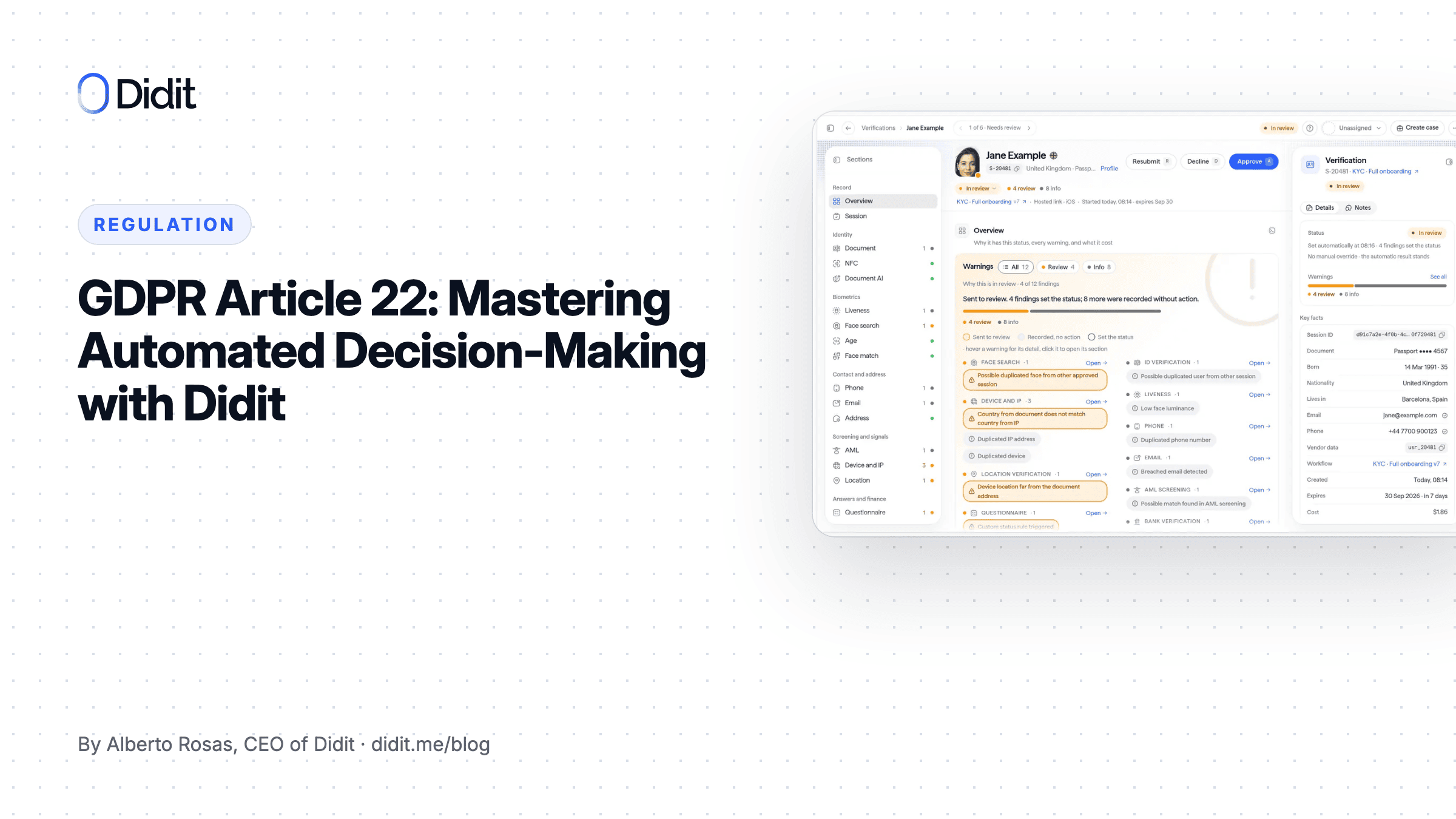
In Didit, sessions that trip warnings move to the exact status string "In Review". A reviewer opens the session, reads the warnings, the document images, the liveness and face match scores, the AML hits and the event timeline, then decides. The status values are listed in verification statuses and the reviewer steps in manual review.
The decision can also be taken through the API, which is what you need when your own back office handles the contest:
curl -X PATCH https://verification.didit.me/v3/session/<SESSION_ID>/update-status/ \
  -H "x-api-key: <API_KEY>" \
  -H "Content-Type: application/json" \
  -d '{"new_status": "Approved", "comment": "Cleared after compliance review."}'
Two details matter for an Article 22 file. The comment field writes to the review trail with the actor, so the reasoning behind the human decision is recorded. And new_status accepts only "Approved", "Declined" or "Resubmitted". The resubmission route lets the person fix a named step instead of being refused outright, because nodes_to_resubmit says which steps to redo. Each change fires a status.updated webhook, documented in webhooks, so your own system keeps the same record.

Where the line falls on special categories
Article 22(4) adds a second gate. A decision based on special category data is allowed only where Article 9(2)(a) (explicit consent) or 9(2)(g) (substantial public interest, with a legal basis) applies, and suitable safeguards protect the person's rights. Biometric data processed to uniquely identify someone is special category data under Article 4(14) and Article 9(1). A decline driven by a face match or biometric template is therefore the highest-risk case in your flow, and the one where you most need to show the specific warning and the human who reviewed it.
Worked example: 10,000 onboarding decisions a month
Take an EU payments company onboarding 10,000 people a month. Every applicant goes through a full ID check and an AML screening. The automated step can decline on a failed liveness check or an unresolved sanctions hit.
At list price:
- 10,000 full KYC checks at $0.33 = $3,300.00 per month
- 10,000 AML screenings at $0.20 = $2,000.00 per month
- Total checks = $5,300.00 per month
On the Scale plan, where every Didit price carries a 10% discount, the same volume is 10,000 x $0.297 = $2,970.00 for KYC plus 10,000 x $0.18 = $1,800.00 for AML, or $4,770.00 per month. Scale costs $299 a month and includes $350 of monthly credit, per the live price list.
Now the Article 22 side. Suppose 600 of those 10,000 sessions land in "In Review" and a reviewer clears 420 and declines 180 with a written comment. The review trail then holds 600 human decisions with actors, timestamps and reasons, which can help you evidence how a contest was handled. The trail supports your accountability record; it is not itself a statutory evidentiary requirement. This example prices only the published checks; reviewer time is your own cost. If you also monitor crypto transactions, a wallet screening is $0.15 per screening.
Exceptions and open questions
Article 22(2) sets three exceptions. None removes the Article 22(3) safeguards, and the Working Party guidance reads the contract exception narrowly as necessity, not convenience.
- Contract, 22(2)(a). Necessary for entering into or performing a contract with the person. An onboarding decision that gates the contract can fit; "we prefer automation" does not.
- Law, 22(2)(b). Authorised by Union or Member State law that lays down suitable safeguards. AML obligations are the usual example, and whether a specific screening step is authorised is a question for your counsel.
- Explicit consent, 22(2)(c). Freely given, specific, informed and withdrawable. Consent as a condition of service is a weak basis in a consumer context.
Open questions worth tracking rather than assuming an answer:
- Whether a sanctions or PEP hit that blocks onboarding is a "decision" under Article 22 or a legal obligation with its own regime.
- How much human involvement counts. WP251 says nominal review is not enough, but there is no bright-line number of minutes or fields.
- How Article 22 interacts with the EU AI Act, Regulation (EU) 2024/1689, whose high-risk obligations for Annex III systems begin on 2 August 2026. The AI Act adds duties on top; it does not replace Article 22.
- Whose decision a third-party score is, after Case C-634/21, when your own rule engine relies on it.
Implementation checklist
- Map every automated outcome in the flow: approve, decline, resubmit, block, and any limit you apply.
- For each outcome, record whether a human can change it, and who that human is.
- Write the Article 22(2) basis down per outcome, not per product.
- Check whether the outcome touches Article 9 data, and if so apply Article 22(4).
- Run a DPIA under Article 35 for the profiling you keep. Automated decisions with significant effects are a listed trigger.
- Turn on the review route so flagged sessions reach
"In Review"and a named reviewer instead of a silent decline. - Make the reviewer comment mandatory in your own process, so every human decision carries a reason.
- Keep the decision payload and warnings for as long as your explanation and contest windows need.
- Set retention: Didit lets you configure from 1 month to 10 years and delete sessions on demand.
- Test the contest path end to end in the sandbox before you ship it.
Sources
- Regulation (EU) 2016/679 (GDPR), Articles 4, 5, 9, 13, 14, 15, 22, 32, 35, 99 and Recital 71.
- Regulation (EU) 2016/679 as it forms part of the law of the United Kingdom (UK GDPR), Article 22, legislation.gov.uk.
- Data Protection Act 2018, legislation.gov.uk.
- Regulation (EU) 2024/1689 (EU AI Act).
- Case C-634/21, SCHUFA Holding AG, judgment of 7 December 2023.
- Article 29 Working Party, Guidelines on Automated individual decision-making and Profiling for the purposes of Regulation 2016/679 (WP251rev.01), adopted 6 February 2018.
- Didit AML screening product page, read November 26, 2026.
- Didit documentation: manual KYC review and reviewer dashboard.
- Didit documentation: update session status API.
- Didit documentation: verification statuses and session lifecycle.
- Didit documentation: workflow builder.
- Didit documentation: webhooks.
- Didit documentation: security and compliance.
- Didit documentation: data retention and deletion.
- Didit pricing, read November 26, 2026.
Next step: open the sandbox at business.didit.me, build a flow with a review branch, and run a contested decision end to end before you take the first live applicant. No sales call is needed, and 4,000+ companies already run identity and fraud checks on Didit.
Try it
Try this in the sandbox
Run the check this guide describes, free.
The product this post is about, taken from its topic. Run it free in the sandbox.
Author
Alberto Rosas
Co-founder and CEO

Keep reading
Other guides in the same topic.
 What Is the Purpose of FICA in South Africa? 2026 Guide
FICA is South Africa's anti-money laundering law. It creates the Financial Intelligence Centre and requires accountable institutions to identify and verify clients, screen for PEP and sanctions risk and report suspicious.
Alberto RosasNov 26, 2026 Sixth Money Laundering Directive (6AMLD): What Changed and Which Rules Apply
6AMLD is Directive (EU) 2018/1673: Member States must criminalise laundering, widen predicate offences and set a four-year penalty floor. It adds no new due diligence duties for firms.
Alberto RosasNov 26, 2026 Automated Sanctions Screening: Canada, the Entity List and Embargoes
Automated sanctions screening matches people and companies against lists such as Canada's autonomous sanctions made under SEMA and JVCFOA and the OFAC SDN List, and returns candidate hits scored for identity confidence and.
Alberto RosasNov 26, 2026Questions
Frequently asked questions
Does GDPR Article 22 ban automated decision-making?
No. Article 22(1) gives people the right not to be subject to a solely automated decision with legal or similarly significant effects, and Article 22(2) lists three exceptions: contract necessity, authorisation by law, and explicit consent. Where an exception applies, Article 22(3) still requires human intervention, a chance to express a view, and a route to contest. In practice you either keep a human in the decision or you build those safeguards.
What makes a decision solely automated under Article 22?
A decision is solely automated when no human has meaningful influence over the specific outcome. A reviewer who sees the case and can change the result counts as involvement; a reviewer who approves whatever the model says does not. The Article 29 Working Party guidance WP251rev.01 puts the test on authority, competence and actual review of the case.
What counts as a similarly significant effect?
Effects that go beyond a minor inconvenience: refusal of a service, denial of a loan or account, exclusion from a benefit, or a decision that shapes access to opportunities. Onboarding declines usually qualify. Marketing segmentation usually does not, unless the segmentation itself changes what the person can access.
What are the exceptions to Article 22?
Three: necessity for entering into or performing a contract with the person, authorisation by Union or Member State law with suitable safeguards, and explicit consent. Each still requires the Article 22(3) safeguards. The contract exception is read narrowly, as necessity rather than preference, so a preference for full automation will not carry it.
What safeguards does Article 22(3) require?
At least the right to obtain human intervention, the right to express a point of view, and the right to contest the decision. The person must be able to reach a human with the authority to change the outcome. Your record of that review should show who decided, when, and on what basis.
Does an AML screening hit count as an Article 22 decision?
It can. If a sanctions or PEP match automatically blocks onboarding with no reviewer, the effect is significant and the decision looks solely automated. Routing hits to review can support human intervention, but whether full automation is lawful depends on the applicable legal basis and your counsel.
How does Didit support Article 22 compliance?
Didit is the processor. We run the checks, return a structured decision per feature with the warnings that triggered a flag, route flagged sessions to "In Review", and record the reviewer's decision and comment on an audit trail. Retention is configurable and sessions can be deleted on demand. The lawful basis, the notice text and the final decision stay with you.
How do I give someone human intervention with Didit?
Flagged sessions move to "In Review" and a reviewer decides in the Didit console. If your own team handles the contest, call the update status API with new_status set to "Approved", "Declined" or "Resubmitted" plus a comment. Every change fires a status.updated webhook so your systems keep the same record.
How long can Didit keep the data I need for an explanation?
Retention is configurable from 1 month to 10 years, and you can delete sessions on demand through the API. How far back you can read audit logs depends on the plan: 30 days on Free, 1 year on Growth, 3 years on Scale, and whatever the contract sets on Enterprise. Pick the window your explanation and contest duties need.
Where does Didit process EU data?
Data is processed and stored in the EU on AWS by default. Enterprise customers can enable in-country processing with local data residency options. Didit acts as a data processor; the DPA and TOMs are available from privacy@didit.me.
What does it cost to run Article 22 checks on Didit?
A full KYC check is $0.33, made up of ID verification at $0.15, passive liveness at $0.10, face match at $0.05 and device and IP analysis at $0.03. AML screening is $0.20 per check and wallet screening is $0.15 per screening. The sandbox is free and unlimited on every plan.
Compliance built in
Audited, certified and attested.
We hold the certifications and build each country's rules into your flows, so you can launch anywhere without worrying. Security and Compliance center
- Regulation encoded into your flows
Tell us what you do and where. Didit lists the rules that apply to you, with sources, and builds the checks each country needs into one workflow.
- Ready for AMLR
Every requirement of the new EU anti-money laundering rules, from checking customers to human review, is already covered by a Didit check.
- Tested in Spain's Treasury sandbox
Spain's Treasury published its supervised sandbox report on Didit's NFC plus active liveness onboarding; SEPBLAC took part and valued the added measures positively.
- Audited, not self-declared
iBeta Level 1 and Level 2. Liveness tested under ISO/IEC 30107-3.
Your obligations · 3 regions
 SOC 2 Type 2
 ISO 27001
 iBeta Level 1 and Level 2
 EU regulator attestation
 FSM youth protection
 GDPR
 EBA remote onboarding
 MiCA compatible
 FIDO Alliance member
- AMLREU AML Regulation ready
Integration · Didit MCP
Run Didit from your own AI agent
Connect Didit to Claude, Cursor, VS Code or ChatGPT and just ask in plain words. Your agent can do anything you can do in the console, with the same permissions you have.
 Add to Claude
 ChatGPT
 Cursor
- Build workflowsDescribe the checks you need. The agent creates and publishes the flow.
- Run investigationsAsk why a session was declined, review cases, search people and companies.
- Change rulesCreate payment rules, test them on past data and switch them on.
- Pull reportsAsk for numbers, exports or the audit log.
Didit Academy


