Gig Worker Identity: Portable Work Histories With Reusable KYC
Reusable KYC lets one Didit application share a finished gig worker verification with another by token, so the worker verifies once. The share and import calls are free on every plan.
 Alberto RosasCo-founder and CEO
Contents
In this guide
Jump to the part you need.
This guide is for platforms that onboard gig workers: delivery networks, ride-hailing marketplaces and staffing platforms. It shows how to hand a finished Didit verification session from one Didit application to another, so a worker verifies once and the second app imports the result instead of re-running document and biometric checks. Reusable KYC is free on every plan. The caveat: only a finished session can be shared, and the token only works between Didit applications.
Last updated: November 26, 2026. Prices checked against the live Didit price feed on November 26, 2026.
The build in one table
| Item | Detail |
|---|---|
| Outcome | A worker finishes verification once; a second Didit application imports the finished session instead of asking for the ID document and selfie again |
| Who it fits | Marketplaces, delivery and ride-hailing networks, staffing agencies and freelance platforms that run more than one Didit application, or partner with another Didit customer |
| Calls you build | POST /v3/session/{sessionId}/share/ on the source application, POST /v3/session/import-shared/ on the receiving application |
| Price of the calls | Reusable KYC is $0.00, included on Free, Growth, Scale and Enterprise |
| Price of the checks | Full ID check $0.33 (ID document $0.15 + passive liveness $0.10 + face match 1:1 $0.05 + device and IP analysis $0.03). AML screening $0.20 per check, ongoing AML monitoring $0.07 per person a year |
| Prerequisites | Two Didit applications, an API key on each, a workflow on each application, and a source session in Approved, Declined or In Review |
| Review boundary | trust_review true keeps the source status; false forces the imported session to In Review so your own reviewers decide |
Start free in the sandbox at business.didit.me with no sales call, and if you build with an AI assistant, connect Didit through the MCP server. The module and both calls are documented in Reusable KYC, and every price is on didit.me/pricing.
What a portable work history means on Didit, and what it does not
Gig platforms have always run on reputation scores: stars, cancellation counts, a badge for completing a few hundred deliveries. Those scores answer a narrow question about how a worker behaved on one platform. They do not answer the question a new platform actually asks on day one: is this the person they say they are, are they old enough for this work, do they hold the licence or certification the job needs, and are they on a sanctions list.
A portable work history closes that gap by moving verified facts, not opinions, between platforms. What we ship is Reusable KYC: the verified session itself travels, by a signed token, from the application that ran the checks to the application that needs them. The receiving application gets the same decision payload it would have received if it had run the checks itself, plus a pointer back to the session it came from.
The practical value is simple: you stop a courier from uploading the same passport to a fifth app. The full decision object travels with the session: id_verifications[], liveness_checks[], face_matches[], aml_screenings[], proof of address, phone and the activity log, plus shared_from_session as the audit link back. What does not travel is policy ownership. The receiving application supplies its own workflow_id, sets trust_review, and owns the decision it records.

Prerequisites
- A Didit organization. Sign up at business.didit.me and use the sandbox application key while you build. Sandbox testing is free and unlimited.
- Two applications. The source application is the one that runs the original verification; the receiving application is the one that imports it. Each has its own API key, sent in the
x-api-keyheader. - A workflow on the receiving application. Pass its
workflow_idon import, and ensure it belongs to that application. - The source session must be finished: Approved, Declined or In Review. A session still In Progress cannot be shared.
- The receiving application's UUID. You send it as
for_application_idwhen minting the token, and only that application can redeem it. - Consent from the worker. The reuse flow has them confirm identity and agree to share before the receiving application sees anything.
Steps: hand a finished verification to a second application
-
Build the KYC workflow on the source application. Four features cover the standard gig onboarding case: document, liveness, face match and AML. Persist the returned
idas your workflow ID.curl -X POST https://verification.didit.me/v3/workflows/ \ -H "x-api-key: $DIDIT_API_KEY" \ -H "Content-Type: application/json" \ -d '{ "workflow_label": "Gig worker KYC", "workflow_type": "kyc", "features": [ {"feature": "OCR"}, {"feature": "LIVENESS", "config": {"face_liveness_method": "PASSIVE"}}, {"feature": "FACE_MATCH"}, {"feature": "AML"} ] }' -
Create the session and send the worker to the hosted flow. Use your own stable identifier in
vendor_dataso the session binds to the worker and duplicate detection works across sessions.curl -X POST https://verification.didit.me/v3/session/ \ -H "x-api-key: $DIDIT_API_KEY" \ -H "Content-Type: application/json" \ -d '{"workflow_id": "$WORKFLOW_ID", "vendor_data": "courier-8842", "callback": "https://myapp.com/kyc/return"}'The response contains
session_id,urlandsession_token. Redirect the worker tourl, or open it in an SDK or iframe. -
Get the decision when the session finishes. Register a webhook destination once, subscribe to
status.updated, and verify theX-Signature-V2header on every delivery. If you would rather poll, callGET https://verification.didit.me/v3/session/{session_id}/decision/.curl -X POST https://verification.didit.me/v3/webhook/destinations/ \ -H "x-api-key: $DIDIT_API_KEY" \ -H "Content-Type: application/json" \ -d '{"label": "Production", "url": "https://myapp.com/api/webhooks/didit", "subscribed_events": ["status.updated"], "webhook_version": "v3"}' -
Check the status before you share. Only finished sessions can be shared. Approved, Declined and In Review all qualify; In Progress, Not Started, Expired and Abandoned do not.
-
Mint the share token on the source application. Set
for_application_idto the receiving application's UUID and pick a TTL in seconds. The minimum is 60, the maximum 86400, and the default is 3600. The token is a signed JWT that carries the session ID, both application IDs and the expiry.curl -X POST 'https://verification.didit.me/v3/session/11111111-2222-3333-4444-555555555555/share/' \ -H 'x-api-key: $SOURCE_APP_API_KEY' \ -H 'Content-Type: application/json' \ -d '{ "for_application_id": "a5f3bca2-46e2-411e-90ef-a580900a57ee", "ttl_in_seconds": 7200 }'Response:
{ share_token, for_application_id, session_kind }, wheresession_kindisuserfor KYC orbusinessfor KYB. -
Redeem the token on the receiving application. Call import with the receiving application's key and a
workflow_idthat exists on that application. Settrust_reviewtotrueto keep the source status, orfalseto force In Review for your own reviewers.curl -X POST 'https://verification.didit.me/v3/session/import-shared/' \ -H 'x-api-key: $RECEIVING_APP_API_KEY' \ -H 'Content-Type: application/json' \ -d '{ "share_token": "eyJhbGciOiJIUzI1NiIsInR5cCI6IkpXVCJ9...", "trust_review": false, "workflow_id": "9f9b1234-aaaa-bbbb-cccc-1234567890ab", "vendor_data": "courier-8842" }'vendor_datais optional and defaults to the source value. Send your own identifier so the imported session joins your user table, not the source application's. -
Read the imported decision and branch on the session kind. The clone gets a fresh
session_idandshared_from_sessionpointing at the source, which is your audit link. Feature arrays are always plural.const decision = await (await fetch(url, { headers: { "x-api-key": API_KEY } })).json(); switch (decision.session_kind) { case "user": return handleUserDecision(decision); case "business": return handleBusinessDecision(decision); }
Expected output
A successful import returns 201 with the V3 decision payload for the shared session, trimmed here to the fields you branch on. Everything else arrives in the same shape as a session the receiving application ran itself.
{
  "session_id": "8c1d2e3f-4a5b-6c7d-8e9f-0a1b2c3d4e5f",
  "session_kind": "user",
  "status": "In Review",
  "shared_from_session": "11111111-2222-3333-4444-555555555555",
  "id_verifications": [ ... ],
  "liveness_checks": [ ... ],
  "face_matches": [ ... ],
  "aml_screenings": [ ... ]
}
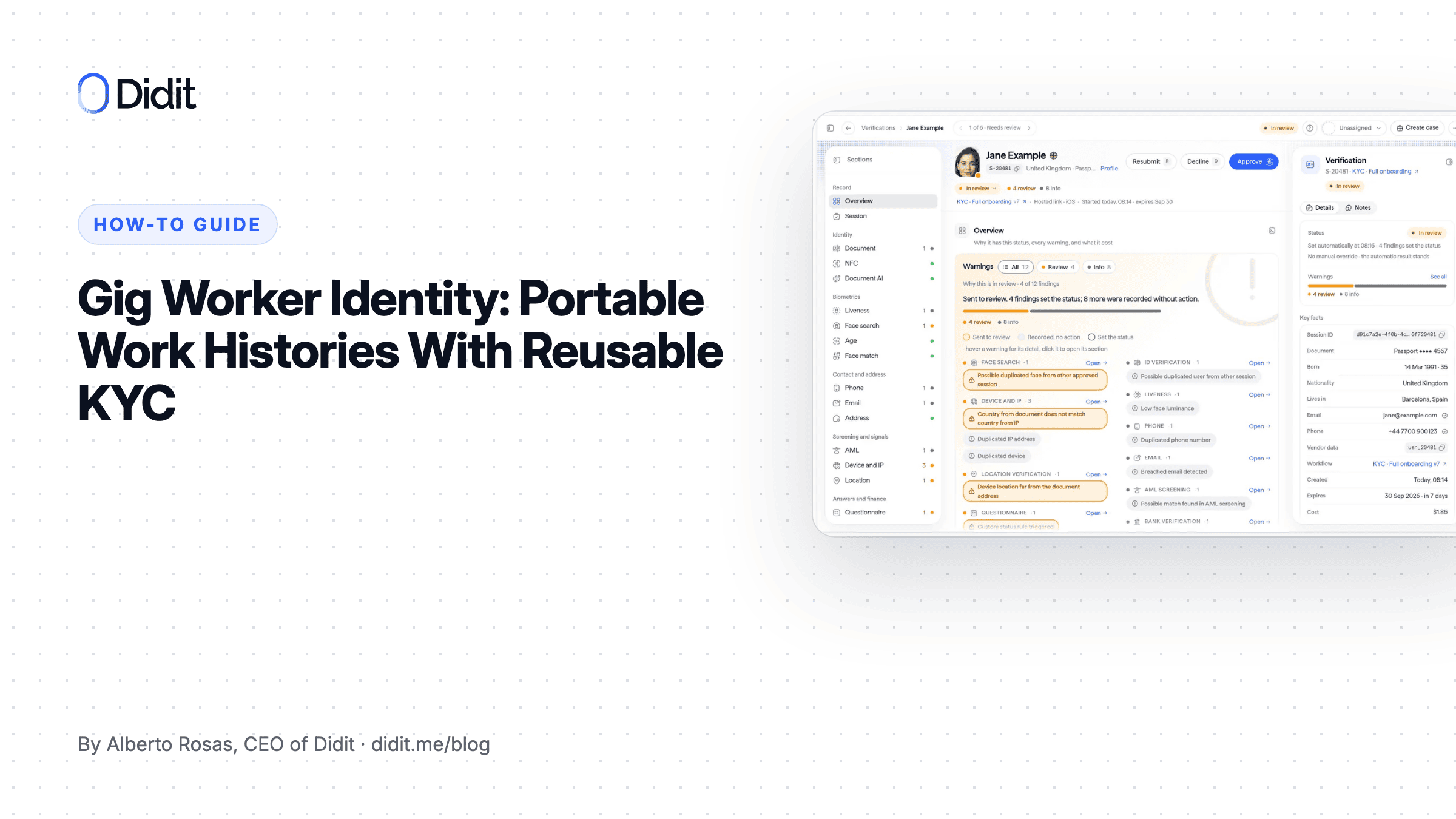
With trust_review: true the status above would read Approved, matching the source session. With false it reads In Review, and because the session is In Review the console fills in an assignee and a review clock.

Inputs and outputs
| Call | Field | Required | What it does |
|---|---|---|---|
| Share | sessionId (path) | Yes | The finished source session |
| Share | for_application_id | Yes | Receiving application UUID; only that application can redeem |
| Share | ttl_in_seconds | No | 60 to 86400, default 3600 |
| Share | share_token (response) | Yes, output | Signed JWT handed to the receiving application |
| Import | share_token | Yes | Token from the share call |
| Import | trust_review | Yes | true keeps the source status, false forces In Review |
| Import | workflow_id | Yes | Must exist on the receiving application |
| Import | vendor_data | No | Your identifier for the worker; defaults to the source value |
| Import | session_id, shared_from_session (response) | Yes, output | New session UUID plus the audit pointer to the source |
Failure cases and recovery
| Error | Cause | Recovery |
|---|---|---|
| 400 Invalid share token | Malformed JWT or wrong signature | Mint a new token and pass the full string without truncation |
| 400 Share token has expired | Past the exp claim | Mint again with a longer ttl_in_seconds; tokens cannot be refreshed, only reissued |
| 400 This token is not valid for this application | for_application_id does not match the receiving app | Mint from the source with the correct receiving application UUID |
| 400 Original session does not exist | Documented cause: the source session was deleted between mint and redeem | No documented recovery path. Operationally, a fresh verification on the receiving application is the option you have |
| 403 This session has already been shared with your application | Same token redeemed twice | Mint a fresh token; each is redeemable once per receiving application |
| 404 Workflow does not exist for this application | workflow_id belongs to another application | Create a workflow on the receiving application and use its ID |
| 400 Only finished sessions can be shared | Source session still In Progress or Not Started | Wait for the decision webhook, then mint |
| 401 or 403 on any call | Invalid, revoked or under-privileged key | Check the key belongs to that application and holds read:sessions where you read decisions |
Paid steps and review boundaries
The share and import calls carry no Didit fee. Reusable KYC sits on the public price list at $0.00 and is included on every plan, so portability never adds to the cost of a check. You pay for the checks that ran, at their list prices: ID document verification $0.15, passive liveness $0.10, face match 1:1 $0.05, device and IP analysis $0.03, AML screening $0.20, proof of address $0.20, age estimation $0.10, NFC chip reading $0.15 as an add-on. A full ID check bundles the first four at $0.33.
Review is where the boundary sits, and it is a policy choice rather than a technical one. Set trust_review to true when the source application runs the same policy you do and you accept its decision. A marketplace where both sides use the same workflow is one example of that policy choice. Set it to false when your risk appetite differs, for example when the source platform verified a courier for food delivery and you are hiring for pharmacy delivery. The clone then lands In Review with your team holding the decision, and the source evidence is still attached for them to read. Manual review happens in the Business Console; there is no automatic approval of a cloned session when trust_review is false.

Worked cost example
A delivery marketplace onboards 1,200 couriers a month. Every courier needs a full ID check and an AML screening, so the list price per person is $0.33 + $0.20 = $0.53. Thirty percent of them, 360 couriers, already hold a finished Didit session shared by a partner staffing application and are imported rather than verified from scratch.
- Couriers verified from scratch: 1,200 minus 360 = 840.
- Checks for those 840: 840 x $0.53 = $445.20.
- Imported sessions: 360 x $0.00 in share and import fees = $0.00.
- Month total: $445.20. If all 1,200 had been verified from scratch: 1,200 x $0.53 = $636.00.
- Difference: $636.00 minus $445.20 = $190.80 in that month.
- Ongoing AML monitoring for the whole base: 1,200 x $0.07 = $84.00 a year.
The same month on Growth, where every Didit price carries a 4% discount: $0.3168 + $0.192 = $0.5088 per person, so 840 x $0.5088 = $427.39, and the plan's $115 of monthly credit covers the first $115 of it. The $190.80 figure is what the import flow saves on check fees; who pays the source application for the original verification is a commercial arrangement between you and that partner, not a Didit line item.
Sources
- Reusable KYC: Verify Once, Share Across Apps (Didit docs), read November 26, 2026
- Create Session API (Didit docs), read November 26, 2026
- Retrieve Session API (Didit docs), read November 26, 2026
- Webhooks: real-time events and HMAC signing (Didit docs), read November 26, 2026
- Quick Start (Didit docs), read November 26, 2026
- Identity Verification Pricing (Didit docs), read November 26, 2026
- Didit pricing page and pricing.json, read November 26, 2026
- Didit MCP server, read November 26, 2026
- Regulation (EU) 2024/1183 (eIDAS 2.0), European Union
- FATF recommendations on customer due diligence, FATF
Next step: open the sandbox at business.didit.me, create a second test application, and run the share and import calls end to end before you touch production. Sandbox testing is free and unlimited, and it needs no sales call.
Try it
Try this in the sandbox
Run the check this guide describes, free.
The product this post is about, taken from its topic. Run it free in the sandbox.
Author
Alberto Rosas
Co-founder and CEO

Keep reading
Other guides in the same topic.
 What Is the Purpose of FICA in South Africa? 2026 Guide
FICA is South Africa's anti-money laundering law. It creates the Financial Intelligence Centre and requires accountable institutions to identify and verify clients, screen for PEP and sanctions risk and report suspicious.
Alberto RosasNov 26, 2026 Sixth Money Laundering Directive (6AMLD): What Changed and Which Rules Apply
6AMLD is Directive (EU) 2018/1673: Member States must criminalise laundering, widen predicate offences and set a four-year penalty floor. It adds no new due diligence duties for firms.
Alberto RosasNov 26, 2026 Automated Sanctions Screening: Canada, the Entity List and Embargoes
Automated sanctions screening matches people and companies against lists such as Canada's autonomous sanctions made under SEMA and JVCFOA and the OFAC SDN List, and returns candidate hits scored for identity confidence and.
Alberto RosasNov 26, 2026Questions
Frequently asked questions
What is a portable work history for a gig worker?
A portable work history is a verified record that travels with the worker instead of staying locked inside one platform. On Didit it takes the form of a finished verification session that one Didit application shares with another by token, so the receiving platform gets the identity, liveness, face match and AML results without asking for the documents again. Reputation scores stay where they were; what moves is verified fact.
Does the worker need a personal wallet to reuse a verification?
The documented flow is application to application. A finished session is shared by a signed token from the application that ran the checks to the application that needs them, and the receiving application reads the same decision payload it would have produced itself, plus shared_from_session as the audit pointer. Each side authenticates with its own application API key, and the worker confirms identity and consents to the share rather than carrying a credential around.
How much does reusable KYC cost?
Nothing. Reusable KYC is listed at $0.00 and is included on Free, Growth, Scale and Enterprise. You pay only for the checks inside the workflow, at published prices: $0.33 for a full ID check and $0.20 for an AML screening.
How long is a share token valid?
You choose when you mint it. ttl_in_seconds accepts 60 to 86400 seconds, and the default is 3600. The token cannot be revoked or extended, so it simply expires and you mint a new one if the receiving application needs more time.
Can the same share token be redeemed twice?
No. A token is valid once per receiving application, and a second attempt returns 403 asking you to mint a new token. Minting is not idempotent either: every call produces a fresh JWT with its own expiry.
What does trust_review change?
It decides who owns the final call. With true the cloned session keeps the source status, so an Approved session stays Approved. With false the clone is forced to In Review and your reviewers re-decide, even though the evidence is already attached.
What happens if the source session was Declined?
Declined is a finished status, so it can be shared. You receive a clone with Declined status when trust_review is true, or In Review when it is false and you want your own team to look at the evidence before refusing the worker.
Does importing a session re-run the document and biometric checks?
No. The point of the flow is a hand-off of a finished verification, so the worker does not upload a document or take a selfie again. The clone carries the KYC, face, liveness, face match, AML, proof of address, phone, location and database validation rows plus the activity log, and it records shared_from_session for audit.
How does the worker consent to sharing?
The reuse flow asks the worker to confirm identity and to agree to sharing specific data before the receiving application gets anything. The flow records consent and an audit pointer for review. That record is what your team reads when it has to show why a session was accepted without a second document upload.
Which checks can a gig platform run in one workflow?
Any combination of the 25+ composable modules. For ride-hailing that is usually ID verification, passive liveness, face match, AML screening and a driving licence document. For pharmacy or alcohol delivery, add age estimation at $0.10. For skilled trades, add proof of address at $0.20 and a custom questionnaire at $0.10 for the certification details.
Does this work across countries?
Yes. Didit covers 220+ countries and territories with 14,000+ document types, and the imported decision keeps the document and liveness evidence for the country the worker verified in. Cross-border reuse is why the audit pointer matters: your reviewer can see exactly which jurisdiction ran the original check.
How do I know the portability claim is credible?
Didit is infrastructure for identity and fraud, used by 4,000+ companies, with SOC 2 Type 2 and ISO/IEC 27001:2022 certification. Inference runs at sub-2-second p99, and the public price list is machine-readable at didit.me/pricing.json so you can check every figure quoted here.
Compliance built in
Audited, certified and attested.
We hold the certifications and build each country's rules into your flows, so you can launch anywhere without worrying. Security and Compliance center
- Regulation encoded into your flows
Tell us what you do and where. Didit lists the rules that apply to you, with sources, and builds the checks each country needs into one workflow.
- Ready for AMLR
Every requirement of the new EU anti-money laundering rules, from checking customers to human review, is already covered by a Didit check.
- Tested in Spain's Treasury sandbox
Spain's Treasury published its supervised sandbox report on Didit's NFC plus active liveness onboarding; SEPBLAC took part and valued the added measures positively.
- Audited, not self-declared
iBeta Level 1 and Level 2. Liveness tested under ISO/IEC 30107-3.
Your obligations · 3 regions
 SOC 2 Type 2
 ISO 27001
 iBeta Level 1 and Level 2
 EU regulator attestation
 FSM youth protection
 GDPR
 EBA remote onboarding
 MiCA compatible
 FIDO Alliance member
- AMLREU AML Regulation ready
Integration · Didit MCP
Run Didit from your own AI agent
Connect Didit to Claude, Cursor, VS Code or ChatGPT and just ask in plain words. Your agent can do anything you can do in the console, with the same permissions you have.
 Add to Claude
 ChatGPT
 Cursor
- Build workflowsDescribe the checks you need. The agent creates and publishes the flow.
- Run investigationsAsk why a session was declined, review cases, search people and companies.
- Change rulesCreate payment rules, test them on past data and switch them on.
- Pull reportsAsk for numbers, exports or the audit log.
Didit Academy