Go Microservices for Global ID Document Parsing
Discover how Go-powered microservices are revolutionizing global ID document parsing. Learn about their efficiency, scalability, and security for handling diverse document types across 220+ countries, ensuring rapid and accurate.
 Alberto RosasCo-founder and CEO
Contents
In this guide
Jump to the part you need.
Unmatched EfficiencyGo microservices offer exceptional performance and low latency for processing diverse global ID documents, crucial for real-time verification.
Scalability & ResilienceTheir lightweight nature and concurrency model make Go microservices ideal for scaling identity verification operations globally without compromising reliability.
Enhanced SecurityBy isolating parsing logic into microservices, the attack surface is reduced, and robust error handling ensures data integrity and compliance across various jurisdictions.
Global CoverageLeveraging AI, these microservices can accurately parse over 14,000 document types from 220+ countries, addressing the complexities of international identity verification.
In today's interconnected digital world, accurate and rapid identity verification (IDV) is paramount for businesses operating globally. From financial institutions to online marketplaces, the need to verify identities quickly, securely, and compliantly has never been greater. However, the sheer diversity of government-issued ID documents – passports, driver's licenses, national ID cards – across over 220 countries presents a significant challenge. Each document has unique layouts, security features, and data fields, making universal parsing a complex task.
This is where modern architectural approaches, particularly Go-powered microservices, shine. By breaking down the monolithic IDV process into smaller, manageable, and highly specialized services, businesses can achieve unparalleled efficiency, scalability, and resilience in their global document parsing operations.
The Challenge of Global ID Document Parsing
Traditional identity verification systems often struggle with the global scale required by modern businesses. The challenges are multifaceted:
- Document Diversity: Over 14,000 unique document types exist globally, each with distinct formats, fonts, and security features. An effective parsing solution must be able to handle this vast array.
- Localization: Documents are issued in over 130 languages. Optical Character Recognition (OCR) must be highly sophisticated to accurately extract data regardless of script or language.
- Fraud Detection: Sophisticated fraudsters employ various techniques, from physical tampering to deepfakes. Parsing must integrate with fraud detection mechanisms like tamper detection, data consistency checks, and cross-referencing against known patterns.
- Performance & Latency: Users expect instant onboarding. Slow document processing leads to abandonment and lost revenue. Real-time parsing is non-negotiable.
- Scalability: Businesses experience fluctuating demand. The parsing infrastructure must scale up and down effortlessly to meet peak loads without over-provisioning.
- Compliance: Different regions have varying data privacy and retention regulations (e.g., GDPR, CCPA). The architecture must support granular control over data handling.
Stitching together multiple third-party solutions often leads to fragmented data, increased operational complexity, and higher costs. A unified, in-house approach, powered by microservices, offers a compelling alternative.
Why Go for Document Parsing Microservices?
Go (Golang) has emerged as a preferred language for building high-performance, scalable microservices, and it's particularly well-suited for the demands of global ID document parsing. Here's why:
- Concurrency Model: Go's goroutines and channels enable highly efficient concurrent processing. This is critical for handling thousands of document uploads simultaneously, processing OCR, image analysis, and fraud checks in parallel, without requiring complex threading models.
- Performance: Go compiles to native machine code, offering C-like performance with the development speed of a higher-level language. This translates directly to faster document processing times and lower latency.
- Small Footprint: Go binaries are statically linked and have a small memory footprint, making them ideal for containerized deployments (Docker, Kubernetes) and efficient resource utilization. This reduces infrastructure costs.
- Strong Type System & Safety: Go's strong type system helps catch errors at compile time, leading to more robust and reliable services, essential for handling sensitive identity data.
- Robust Standard Library: Go comes with a comprehensive standard library, including excellent support for networking, cryptography, and data serialization (JSON), simplifying microservice development.
By leveraging Go, developers can build lightweight, fast, and highly reliable microservices that can be deployed independently, updated frequently, and scaled autonomously.
Implementing Go Microservices for Document Parsing: A Practical Approach
A Go-based microservices architecture for global ID document parsing would typically involve several specialized services, each handling a specific part of the verification pipeline:
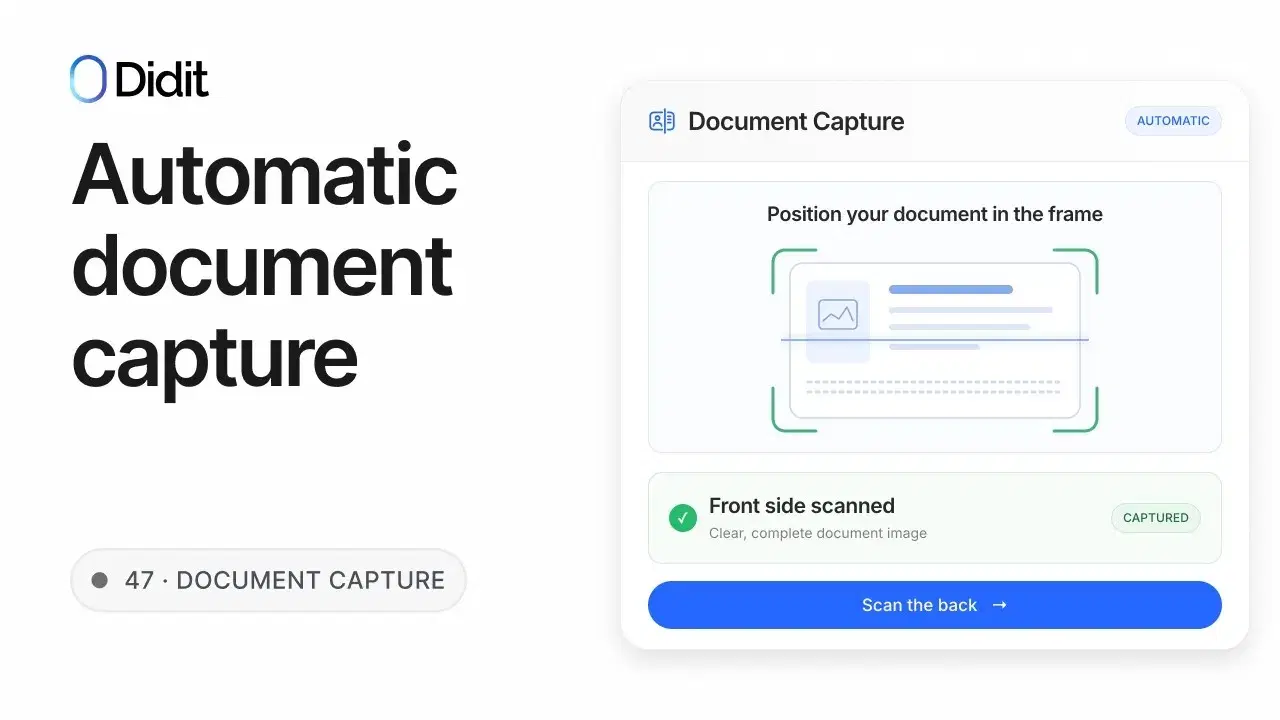
- Upload & Ingestion Service: Written in Go, this service receives document images (e.g., from a web SDK or mobile app), performs initial validation (file type, size), and stores them securely in an object storage. It then publishes an event to a message queue (e.g., Kafka, RabbitMQ) to trigger further processing.
- Image Pre-processing Service: A Go microservice consumes events from the queue, performs image enhancements (denoising, rotation correction, cropping), and potentially detects document type and orientation using a pre-trained AI model.
- OCR & Data Extraction Service: This is the core parsing component. A Go service leverages advanced OCR engines (potentially integrated as external APIs or in-house models) to extract text from the document. It also uses AI to identify specific fields like name, date of birth, document number, and expiry date.
- Document Authenticity & Fraud Detection Service: Another Go microservice analyzes the extracted data and the original image for signs of tampering. This includes checking for inconsistent fonts, altered security features, data mismatches, and cross-referencing against known fraudulent document patterns.
- Data Validation & Harmonization Service: This service takes the extracted data, validates it against known formats (e.g., date formats, naming conventions), and harmonizes it into a standardized schema, ready for downstream consumption.
- Database Integration Service: A Go service responsible for securely storing the parsed and validated data in a compliant database, ensuring proper indexing and access control.
- API Gateway Service: A Go-based API gateway provides a single entry point for client applications, routing requests to the appropriate microservices and handling authentication/authorization.
Each service communicates via lightweight protocols (e.g., gRPC, REST over JSON) and asynchronous message queues, ensuring loose coupling and high availability. Error handling and retry mechanisms are built into each service to ensure resilience.
How Didit Helps
Didit has built a full-stack identity verification platform that leverages this microservices philosophy, with a strong emphasis on performance and global coverage. Our in-house developed core identity primitives, including ID document verification, biometrics, and fraud signals, are orchestrated behind a single, powerful API. Our AI-powered document verification module supports over 14,000 document types across 220+ countries and 130+ languages, processing them in under 2 seconds. This comprehensive approach means businesses don't need to stitch together multiple vendors; instead, they get a unified platform for rapid, secure, and compliant identity verification, reducing costs by up to 70%.
Ready to Get Started?
Embrace the power of modern identity verification with Didit's advanced platform. Streamline your global ID document parsing, enhance security, and provide a frictionless onboarding experience for your users. Explore our solutions today and see how easy it is to integrate cutting-edge IDV into your operations.
Visit our website to learn more or dive into our technical documentation to begin your integration. You can also calculate your potential savings with our ROI calculator.
Try it
Try this in the sandbox
Run the check this guide describes, free.
The product this post is about, taken from its topic. Run it free in the sandbox.
Author
Alberto Rosas
Co-founder and CEO

Keep reading
Other guides in the same topic.
 What Is the Purpose of FICA in South Africa? 2026 Guide
FICA is South Africa's anti-money laundering law. It creates the Financial Intelligence Centre and requires accountable institutions to identify and verify clients, screen for PEP and sanctions risk and report suspicious.
Alberto RosasNov 26, 2026 Sixth Money Laundering Directive (6AMLD): What Changed and Which Rules Apply
6AMLD is Directive (EU) 2018/1673: Member States must criminalise laundering, widen predicate offences and set a four-year penalty floor. It adds no new due diligence duties for firms.
Alberto RosasNov 26, 2026 Automated Sanctions Screening: Canada, the Entity List and Embargoes
Automated sanctions screening matches people and companies against lists such as Canada's autonomous sanctions made under SEMA and JVCFOA and the OFAC SDN List, and returns candidate hits scored for identity confidence and.
Alberto RosasNov 26, 2026Questions
Blog questions
Who writes the Didit blog?
Which topics does the blog cover?
Is the blog available in my language?
Where do I find product updates?
Are these posts legal advice?
How do I find posts on one topic?
Are posts dated?
Do posts link to the docs?
Is the blog the same as the docs?
Compliance built in
Audited, certified and attested.
We hold the certifications and build each country's rules into your flows, so you can launch anywhere without worrying. Security and Compliance center
- Regulation encoded into your flows
Tell us what you do and where. Didit lists the rules that apply to you, with sources, and builds the checks each country needs into one workflow.
- Ready for AMLR
Every requirement of the new EU anti-money laundering rules, from checking customers to human review, is already covered by a Didit check.
- Tested in Spain's Treasury sandbox
Spain's Treasury published its supervised sandbox report on Didit's NFC plus active liveness onboarding; SEPBLAC took part and valued the added measures positively.
- Audited, not self-declared
iBeta Level 1 and Level 2. Liveness tested under ISO/IEC 30107-3.
Your obligations · 3 regions
 SOC 2 Type 2
 ISO 27001
 iBeta Level 1 and Level 2
 EU regulator attestation
 FSM youth protection
 GDPR
 EBA remote onboarding
 MiCA compatible
 FIDO Alliance member
- AMLREU AML Regulation ready
Integration · Didit MCP
Run Didit from your own AI agent
Connect Didit to Claude, Cursor, VS Code or ChatGPT and just ask in plain words. Your agent can do anything you can do in the console, with the same permissions you have.
 Add to Claude
 ChatGPT
 Cursor
- Build workflowsDescribe the checks you need. The agent creates and publishes the flow.
- Run investigationsAsk why a session was declined, review cases, search people and companies.
- Change rulesCreate payment rules, test them on past data and switch them on.
- Pull reportsAsk for numbers, exports or the audit log.
Didit Academy