Government Digital Identity Verification: A Practical How-To
Pick the evidence you need: a non-document lookup for a data match, an eID wallet for a cryptographic sign-in, or document capture with liveness.
 Alberto RosasCo-founder and CEO
Contents
In this guide
Jump to the part you need.
Government digital identity verification means proving who a person is before they reach a public service, with evidence you can defend to an auditor. It fits benefits, tax, permits and citizen portals. On Didit a full ID check is $0.33, Database Validation starts at $0.05, non-document lookup prices vary by country and source, and available production wallet prices in the examples below range from $0.10 to $0.95 per completed verification. Each method proves something different, so choose by evidence.
Last updated: November 26, 2026. Prices checked against the live Didit price feed on November 26, 2026.
| Method | What the person does | Assurance tier on the session | Published price | Use it when |
|---|---|---|---|---|
| Document capture | Photographs a passport, ID card, driving licence or residence permit | documentary | $0.15 per check | You must show a physical document was captured and checked for authenticity |
| Non-document lookup | Types a national ID number plus a few personal details; a selfie in five countries | data_match | Variable by country and source; read the per-country rate. Database Validation is a separate product and starts at $0.05 per check | The typed details must match a record the source holds and no document is captured |
| Digital ID wallet | Signs in with MitID, BankID Sweden, iDIN, Smart-ID or another eID | cryptographic | Available production wallets: $0.10 to $0.95 per completed verification. Some coming-soon wallets have higher published rates, such as OneID at $2.75 | The citizen already holds a government or bank digital identity |
Start free in the sandbox at business.didit.me, no sales call. For developers, connect Didit to an AI assistant through the MCP server. Published prices and plan terms are on the pricing page and in the machine-readable price feed.
What government-grade verification has to prove
A public service does not need a check. It needs a specific claim it can defend. Didit records which method produced a result and labels the result with an assurance tier. The tier describes what was proven. It is not a ranking of quality.
documentary: a physical document was captured, read and checked for authenticity.data_match: the details the person typed matched a record the queried source holds. No document was inspected.cryptographic: a digital identity provider authenticated the person and signed the attributes it shared.
The tier appears on the session payload, in the console and in exports. End users never see the tier, the price or the name of the source queried.
One detail matters more than any marketing claim. Not every authoritative source is a state register. In Canada, France, Indonesia, the Netherlands, Norway, Singapore, the United Kingdom and the United States, the record Didit can reach is a credit-bureau, financial-services, utility or residential-records file. That changes what the match proves, which consent regime the query runs under, and what you can tell a regulator about provenance. The catalog names the exact source for every country, and the source is written to the session payload at id_lookup.source, in the console and in exports, so your auditors can read it.
The same discipline applies to fraud. This can help detect fabricated or borrowed identifiers when the queried source supports that check. Where the source holds a photograph, as RENAPER in Argentina and the Tribunal Electoral in Panama do, the lookup also face-matches the person against the registry portrait inside the lookup price.

Prerequisites
- A Didit account and an API key from the console. Keys stay on your backend, never in a browser bundle or a mobile app.
- A workflow with the ID Verification (
OCR) feature added, created in the console or withPOST /v3/workflows/. - A decision on the evidence you need per country, because methods are configured per country, not globally.
- Consent text that matches the source you enable. Services flagged
requires_consent=truereturn HTTP 400 withoutconsent=true. - For redirect wallets, your return hostnames registered in
allowed_return_hostswithPATCH /v3/webhook/. Bare hostnames, no scheme, no wildcard, up to 20, and each update replaces the list. - A written policy for partial matches, no matches and provider errors, because the workflow needs those outcomes defined before it can be published.
How to add government digital identity verification, step by step
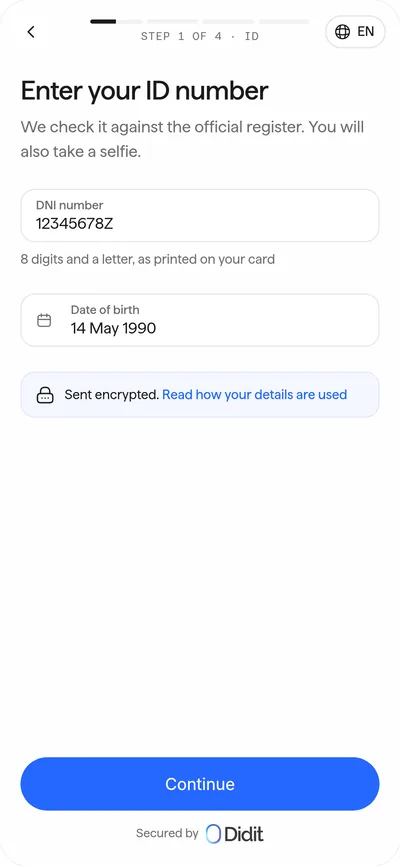
Write down the claim first. "This person holds a valid Danish eID" is a cryptographic claim. "This person's name and national ID number match the civil register" is a data match. "This person presented a genuine passport" is documentary. Choose the method whose evidence satisfies your policy. Some lookups require a selfie, while others need only typed details.
Enable methods per country in the workflow. Methods live under the
methodskey on theOCRfeature config, keyed by ISO 3166-1 alpha-3 country code. Omit a country or a method and that country stays document capture only. This is the documented shape, with two countries configured differently on purpose:{ "feature": "OCR", "config": { "methods": { "ZAF": { "document": { "enabled": true }, "id_lookup": { "enabled": true, "max_attempts": 2, "skip_liveness_and_face_match": true, "on_partial_match": "fallback_to_document", "on_no_match": "fallback_to_document", "on_provider_error": "fallback_to_document" }, "wallet": { "enabled": false, "providers": [], "on_failure": "fallback_to_document" } }, "DNK": { "document": { "enabled": true }, "id_lookup": { "enabled": true, "on_no_match": "decline" } } } } }The
skip_liveness_and_face_matchswitch is on by default where the source returns a portrait or checks the selfie itself. Turn it off to run your own Liveness and Face Match steps anyway. For data-only sources the flag is normalised off on save, because there is nothing to compare against.Check wallet availability before you ship. The console uses the environment's live capability catalog when you save, and a workflow that enables a wallet marked coming soon is rejected, including the rest of that save. Wallets available in production today include MitID (Denmark, $0.25), BankID Sweden ($0.20), iDIN full identification (Netherlands, $0.95), Finnish Trust Network (Finland, $0.25), Smart-ID ($0.21), Mobile-ID ($0.21), Bank iD (Czechia, $0.20), Google Wallet ($0.10), BankID Norway High (Norway, $0.35) and Personalausweis Profile 2 (Germany, $0.49). EUDI Wallet, itsme, Estonian ID-card, eParaksts mobile, OneID and ConnectID are catalogued with rates but are not yet enabled in production. No launch date is promised.
Choose hosted or standalone. For a citizen portal, create a session with
POST /v3/session/passingworkflow_id,vendor_dataandcallback, then send the browser tosession.url. The workflow type decides whether a KYC or KYB session is created. For an application that manages its own interface, call a wallet start endpoint directly and skip the workflow entirely. Both routes return the documented wallet result fields; integration and orchestration differ.Run the registry check on its own when you already hold the data. Database Validation has a standalone server-to-server endpoint, so you can prove a record without a session. This is the documented example, unchanged:
curl -X POST 'https://verification.didit.me/v3/database-validation/' \
-H "x-api-key: $DIDIT_API_KEY" \
-F "issuing_state=BRA" \
-F "identification_number=00000000191" \
-F "first_name=Jane" \
-F "last_name=Doe" \
-F "date_of_birth=1990-01-15" \
-F "vendor_data=user-1234"
Use
identification_numberas the universal field and let Didit map it to CPF, RUT, CURP, DNI or the local equivalent byissuing_state. Omitservicesto run the country's default source only; pass a list such asservices=["bra_cpf"]to choose. Argentina (arg_renaper) and Panama (pan_sib) also take aselfie(JPG, PNG or WebP up to 2 MB) andgenderfor the comparison against the registry photograph.Read the result and route on it. The response carries
request_idand adatabase_validationobject. This is the documented envelope, with the field names exactly as returned:{ "request_id": "...", "database_validation": { "match_type": "full_match", "validation_type": "...", "services_used": ["..."], "match_score": 1.0, "validations": [ { "service": "...", "status": "...", "matched_fields": ["..."], "record_details": {} } ], "warnings": [] } }match_typeisfull_match,partial_matchorno_match. Per-field names includeidentification_number,first_name,last_nameanddate_of_birth, plus address fields where the source returns them. Treatno_matchas a synthetic identity signal under your own policy, and sendpartial_matchto a human, because a matching date of birth with a different name is a different problem from a number that does not exist.Add the wallet path for citizens who hold an eID. Register the return hostname first, then start the verification. The Finnish Trust Network example from the docs:
curl --request PATCH \
  --url https://verification.didit.me/v3/webhook/ \
  --header 'x-api-key: YOUR_API_KEY' \
  --header 'Content-Type: application/json' \
  --data '{"allowed_return_hosts": ["app.example.com"]}'

curl --request POST \
  --url https://verification.didit.me/v3/id-verification/wallets/ftn/ \
  --header 'x-api-key: YOUR_API_KEY' \
  --header 'Idempotency-Key: your-unique-attempt-key' \
  --header 'Content-Type: application/json' \
  --data '{
    "country": "FIN",
    "return_url": "https://app.example.com/identity/complete",
    "vendor_data": "your-customer-reference"
  }'
Save
request_id, send the browser towallet_verification.next_action.urlwhen itstypeisredirect, and read the result from your backend withGET /v3/id-verification/wallets/verifications/{request_id}/. Only treat the identity as verified whenwallet_verification.outcomeisverifiedandsimulatedisfalse.Monitor after onboarding. Onboarding is one moment, and public services carry ongoing obligations. Add AML screening at $0.20 per check against 1,300+ lists, ongoing AML monitoring at $0.07 per person per year, and transaction monitoring at $0.001 per transaction beyond the plan allowance. If the service touches digital assets, wallet screening is $0.15 per screening, or bring your own screening provider and run it inside Didit.
Expected output
A successful lookup returns the envelope above. Read it in this order: match_type first, then validations[].status and matched_fields, then warnings. A workflow session returns the same evidence as a decision at GET /v3/session/{sessionId}/decision/, with a database_validations array, the ID Verification result and the assurance tier.

Wallet verifications resolve to one of five outcomes: pending (authentication still in progress), verified, cancelled, timeout or failed. A pending response can carry a next action. Terminal responses never do.
Failure cases and recovery
| Symptom | Meaning | Recovery |
|---|---|---|
| HTTP 400 on a lookup | The service is not eligible for that issuing_state, a required field is missing, or consent was not passed for a service that requires it | Fix the request. This is a configuration error, not a person failing verification |
HTTP 502 with validation_errors[] | Every selected upstream source failed | Not billed. Retry later, or fall back to document capture and log COULD_NOT_PERFORM_DATABASE_VALIDATION |
match_type is no_match | The record is not in the source | Treat as a synthetic identity signal under your policy, or fall back to a document check if your config says fallback_to_document |
match_type is partial_match | Some fields match and others do not | Send to human review. Do not auto-decline on a single mismatched field |
FACE_MATCH_NOT_COMPUTED with a null score | A data-only method left nothing to compare against | Allow document capture, pick a source that leaves a photo, or remove the Face Match step. The editor blocks publishing when every path into the step leaves no photo |
HTTP 409 verification_in_progress on cancel | The person is completing the wallet approval right now | Wait the Retry-After seconds, then read the completed result |
HTTP 400 on callback | The callback is not on one of the application's allowed domains | Add the origin with PATCH /v3/webhook/, or use a custom scheme deep link, which is always accepted |
Inputs and outputs
| Field | Direction | Notes |
|---|---|---|
issuing_state | Input | Country whose source you query. Selects the service and the field rules |
identification_number | Input | Universal field, mapped to CPF, RUT, CURP, DNI and similar by issuing_state |
first_name, last_name, date_of_birth | Input | Usually required. Some sources also ask for an address |
services | Input | Optional list. Omit for the country default. Several services can run in one request |
consent | Input | Required for services flagged requires_consent=true, otherwise HTTP 400 |
selfie, gender | Input | Only for biometric sources such as arg_renaper and pan_sib. Image up to 2 MB |
vendor_data | Input | Your stable identifier for the person, so the result binds to your records |
request_id | Output | Reference for the lookup |
match_type | Output | full_match, partial_match or no_match |
validations[] | Output | Per service: service, status, matched_fields, record_details |
warnings[] | Output | Risk codes such as DATABASE_VALIDATION_NO_MATCH and COULD_NOT_PERFORM_DATABASE_VALIDATION |
id_lookup.source | Output | On a session payload: the exact source queried, for your auditors |
Paid steps and review boundaries
Billing is per completed check from prepaid credit, and the full check is arithmetic you can verify: ID document verification $0.15 + passive liveness $0.10 + face match 1:1 $0.05 + device and IP analysis $0.03 = $0.33. Active liveness is $0.15, NFC chip reading is a $0.15 add-on, proof of address is $0.20, email verification is $0.02, and phone verification is the carrier price for the country and channel plus Didit's $0.02 fee per code. The workflow orchestrator, reusable KYC, the SDKs and the MCP server are free.
Digital ID wallet prices are per completed verification: MitID $0.25, BankID Sweden $0.20, Finnish Trust Network $0.25, Smart-ID $0.21, Mobile-ID $0.21, Bank iD $0.20, iDIN full identification $0.95, Google Wallet $0.10, BankID Norway High $0.35 and Personalausweis Profile 2 $0.49. The listed price includes the wallet identity check and no separate national eID transaction fee is added. An agreed organisation-specific rate takes precedence.
Keep Database Validation and non-document lookup apart when you budget. Database Validation starts at $0.05 per check and runs up to $7.00 for the most expensive specialist sources. It is priced per service rather than per country, and billed per successful service hit, so a multi-service request can produce several usage events. Non-document lookup pricing is variable by country and source, so read the rate for the exact country and source you enable on the per-service table before you quote a number to anyone. Some no-match lookups and retries are billable, and the docs pricing page lists which. Plans, discounts and the estimator are on didit.me/pricing, and the billing rules are in the pricing documentation.
Review is where partial matches, AML hits and anything your policy flags land, with the source name, the matched fields and the tier attached. Auto-decline stays limited to the cases you configured, such as on_no_match: "decline". Everything else should land in front of a person, and a single mismatched field should never decline a citizen on its own.

Worked cost example
Take a benefits portal that verifies 10,000 citizens a month, in a country where 6,000 people have no eID, 3,000 hold MitID and 1,000 can be checked with a Database Validation service at the $0.05 floor.
- 6,000 full ID checks: 6,000 x $0.33 = $1,980.00. Inside that, 6,000 x $0.15 = $900.00 for documents, 6,000 x $0.10 = $600.00 for passive liveness, 6,000 x $0.05 = $300.00 for face match and 6,000 x $0.03 = $180.00 for device and IP. The four lines add to $1,980.00.
- 3,000 MitID verifications: 3,000 x $0.25 = $750.00.
- 1,000 Database Validation checks at the $0.05 floor: 1,000 x $0.05 = $50.00. That floor belongs to Database Validation only. A non-document lookup is priced variably by country and source, so substitute the rate for your country from the per-service table; a specialist source such as Finland National ID at $2.10 would make this line $2,100.00 on its own.
- Optional AML screening for everyone once: 10,000 x $0.20 = $2,000.00. Replace it with ongoing AML monitoring at 10,000 x $0.07 = $700.00 per year if the scheme asks for monitoring instead.
Core verification without screening: $1,980.00 + $750.00 + $50.00 = $2,780.00 a month, or $0.278 per citizen on average. On the Scale plan the 10% discount applies to every Didit price, which takes the same basket to $1,782.00 + $675.00 + $45.00 = $2,502.00 before screening. Plan credit is added monthly and does not roll over, so size it against real volume rather than peak.
Sources
- Didit pricing page and pricing feed, read November 26, 2026.
- Didit docs: identity verification pricing and billing rules, read November 26, 2026.
- Didit docs: ID verification methods and assurance tiers, read November 26, 2026.
- Didit docs: non-document lookup and per-country sources, read November 26, 2026.
- Didit docs: digital ID wallet verification, coverage and prices, read November 26, 2026.
- Didit docs: digital ID wallet standalone APIs, read November 26, 2026.
- Didit docs: Database Validation API and warning codes, read November 26, 2026.
- Didit docs: Create Session API, read November 26, 2026.
- Didit integration prompt for coding agents, read November 26, 2026.
- Regulation (EU) No 910/2014 on electronic identification and trust services (eIDAS).
- Regulation (EU) 2016/679 (GDPR).
- FATF recommendations and guidance on digital identity.
Next step: create a free sandbox organisation at business.didit.me, with no sales call, and run one registry lookup and one document check end to end before you size the plan.
Try it
Try this in the sandbox
Run the check this guide describes, free.
The product this post is about, taken from its topic. Run it free in the sandbox.
Author
Alberto Rosas
Co-founder and CEO

Keep reading
Other guides in the same topic.
 What Is the Purpose of FICA in South Africa? 2026 Guide
FICA is South Africa's anti-money laundering law. It creates the Financial Intelligence Centre and requires accountable institutions to identify and verify clients, screen for PEP and sanctions risk and report suspicious.
Alberto RosasNov 26, 2026 Sixth Money Laundering Directive (6AMLD): What Changed and Which Rules Apply
6AMLD is Directive (EU) 2018/1673: Member States must criminalise laundering, widen predicate offences and set a four-year penalty floor. It adds no new due diligence duties for firms.
Alberto RosasNov 26, 2026 Automated Sanctions Screening: Canada, the Entity List and Embargoes
Automated sanctions screening matches people and companies against lists such as Canada's autonomous sanctions made under SEMA and JVCFOA and the OFAC SDN List, and returns candidate hits scored for identity confidence and.
Alberto RosasNov 26, 2026Questions
Frequently asked questions
What is government digital identity verification?
It is the process of confirming that a person is who they claim to be before they access a public service online, using a method whose evidence can be described precisely. Didit supports three such methods: document capture, a non-document lookup against an authoritative source, and a digital identity wallet sign-in. Each returns a different assurance tier on the session.
Is a non-document lookup as strong as a document check?
No, it proves something different. A lookup proves the details typed matched a record the source holds, which is labelled data_match. A document check proves a physical document was captured and inspected, which is labelled documentary. A lookup avoids document capture, but its price varies by country and source. It needs no document photograph in most countries, and a number that was never issued will not match a record.
Which countries have a real government register behind the lookup?
The exact source is listed per country in the catalog. Examples documented as government registers include South Africa, Argentina, India and Denmark. Canada, France, Indonesia, the Netherlands, Norway, Singapore, the United Kingdom and the United States are the exceptions, where the authoritative record is a credit-bureau, financial-services, utility or residential-records file. The catalog names the exact source per country and it is never generalised.
Can we verify citizens who do not have a smartphone camera?
Yes. A non-document lookup is typing only in most countries, with one selfie where the source returns a portrait or checks the selfie itself, which today means South Africa, Nigeria, Argentina, Panama and Brazil. A digital identity wallet sign-in needs no document photo at all. Document capture stays available as a fallback, and the verification flow is localised in 54 languages.
What should we do when a lookup returns a partial match?
Route it to a human. A partial match means some fields matched and others did not, and the difference matters: a matching date of birth with a different surname is not the same finding as an unknown number. You can also configure on_partial_match to fall back to document capture for that user.
What happens if the registry source is unavailable?
You get HTTP 502 with a validation_errors array, the request is not billed, and a COULD_NOT_PERFORM_DATABASE_VALIDATION log is written. Retry later, or fall back to document capture if your country config sets on_provider_error to fallback_to_document.
Does Didit support the EUDI Wallet and eIDAS?
EUDI Wallet is catalogued at $0.15 per completed verification across 30 European countries but is not yet enabled in production, and no launch date is promised. eIDAS 2.0 is among the frameworks we publish against. Wallets available today include MitID, BankID Sweden, iDIN full identification, Finnish Trust Network, Smart-ID, Mobile-ID, Bank iD, Google Wallet, BankID Norway High and Personalausweis Profile 2.
Can Didit verify businesses as well as people?
Yes. Business Verification (KYB) returns official registry data per company from $2.00, priced by country and data tier, with key people extraction included. Each owner or officer takes a linked full ID check at $0.33 and person AML at $0.20, billed per person.
How much does one government identity check cost?
A full ID check, meaning document verification, passive liveness, face match and device and IP analysis, is $0.33 per completed check. Database Validation starts at $0.05 per check, while non-document lookup pricing is variable by country and source, and wallet prices for wallets available in production today range from $0.10 for Google Wallet to $0.95 for iDIN full identification. AML screening is $0.20 and ongoing AML monitoring is $0.07 per person per year.
Do we need a sales call to test it?
No. You can create an organisation in the sandbox, take an API key from the console and call the standalone Database Validation endpoint within minutes. The Free plan includes $10 of monthly credit for eligible work email sign-ups, and sandbox testing is free and unlimited. Enterprise contracts start at $15,000 a year if you need one later.
Compliance built in
Audited, certified and attested.
We hold the certifications and build each country's rules into your flows, so you can launch anywhere without worrying. Security and Compliance center
- Regulation encoded into your flows
Tell us what you do and where. Didit lists the rules that apply to you, with sources, and builds the checks each country needs into one workflow.
- Ready for AMLR
Every requirement of the new EU anti-money laundering rules, from checking customers to human review, is already covered by a Didit check.
- Tested in Spain's Treasury sandbox
Spain's Treasury published its supervised sandbox report on Didit's NFC plus active liveness onboarding; SEPBLAC took part and valued the added measures positively.
- Audited, not self-declared
iBeta Level 1 and Level 2. Liveness tested under ISO/IEC 30107-3.
Your obligations · 3 regions
 SOC 2 Type 2
 ISO 27001
 iBeta Level 1 and Level 2
 EU regulator attestation
 FSM youth protection
 GDPR
 EBA remote onboarding
 MiCA compatible
 FIDO Alliance member
- AMLREU AML Regulation ready
Integration · Didit MCP
Run Didit from your own AI agent
Connect Didit to Claude, Cursor, VS Code or ChatGPT and just ask in plain words. Your agent can do anything you can do in the console, with the same permissions you have.
 Add to Claude
 ChatGPT
 Cursor
- Build workflowsDescribe the checks you need. The agent creates and publishes the flow.
- Run investigationsAsk why a session was declined, review cases, search people and companies.
- Change rulesCreate payment rules, test them on past data and switch them on.
- Pull reportsAsk for numbers, exports or the audit log.
Didit Academy


