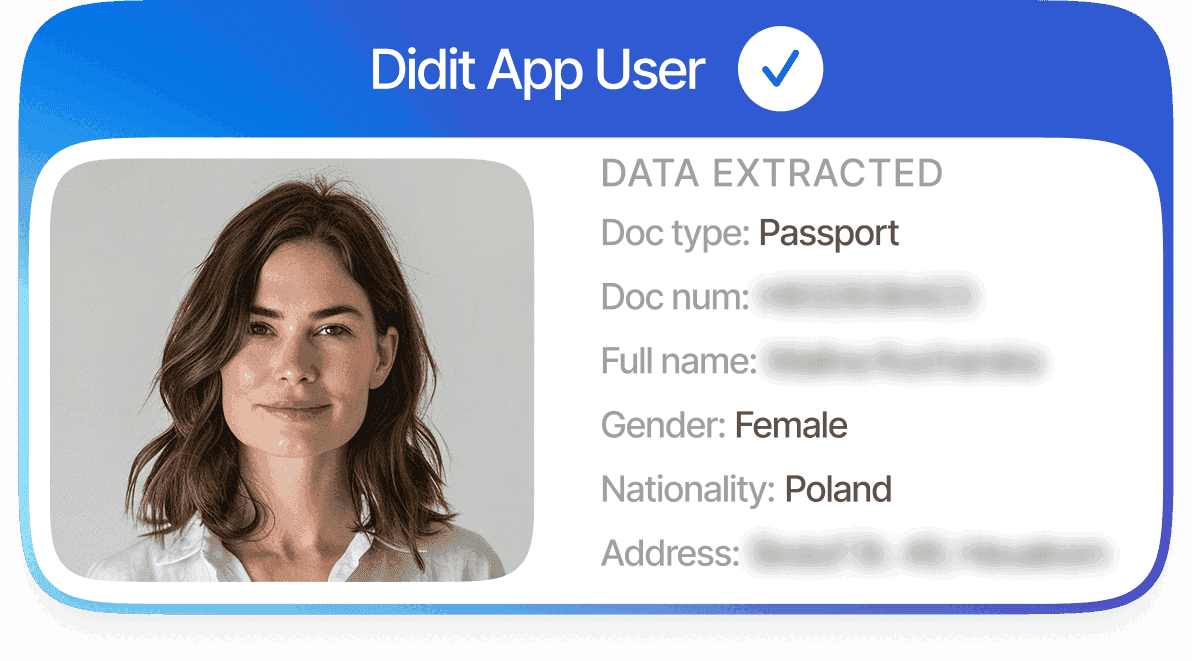
Share a verified identity with your partners. Server-to-server.
Verify a user or a business once. Share the result with a partner, they onboard the same person instantly. No second flow, no second selfie. Works for KYC and KYB. Built for Banking-as-a-Service, multi-brand groups, embedded finance, and marketplaces with sub-platforms.
Your user verifies once in your app. Your partner, your BaaS sponsor, your
sister brand, your downstream marketplace, needs the same record. Send them a
one-time share token. They redeem it and pull in the full verification. The
user never sees a second flow.
How it works
From your app to your partner in four steps.
Step 01
Pick a verified session
Choose any finished verification, approved, declined, or under review, and ask Didit for a share token. The token expires in one hour by default; you can stretch it from one minute up to a full day.
Step 02
Send the token to your partner
Hand the token to your partner over your own backend, a webhook, a queue, a REST call. The token only works for the partner you named when you minted it. Nobody else can redeem it.
Step 03
Your partner imports the record
Your partner redeems the token and picks how to onboard the user, trust your decision and approve instantly, or pull the data in raw and let their compliance team make the call.
Step 04
The full session lands in their app
Didit clones the whole record, documents, selfie, face match, AML, registry data, UBOs, into your partner's workspace. Same shape as a fresh verification, with a clean audit trail back to the original.
Built for BaaS · embedded finance · multi-brand groups
One verification. Every partner platform.
Mint a token. Send it. Import it. Pick the onboarding speed. Six moving parts cover every shape of partner ecosystem, same call for KYC and KYB.
Pick a finished verification and ask Didit for a token scoped to one partner. Default lifetime is one hour; you can stretch it from one minute up to a full day. The token only works for the partner you named, nobody else can ever redeem it.
Default Time-To-Live (TTL): 3,600 s · bounds 60 s, 86,400 s
Scoped to a single receiving application
Finished sessions only (Approved · Declined · In Review)
02 · Import the session
Your partner pulls in the full record.
Your partner redeems the token and Didit clones the whole verification into their workspace, fresh session, same data, full audit trail back to the original. They tag it with their own internal user ID and pick the workflow it lands in.
Trust your decision and let your partner approve the user the moment the token lands. Or hand them the data raw and let their compliance team make the call. Toggle per partner, same call, two onboarding speeds.
trueClones the original status, instant onboarding.Approved
falseClones the data, sets status to In Review.In Review
Toggle per partner relationship · default is `false` for new partners
04 · KYC + KYB · both modes
Share a person or a whole business.
Same call works for both shapes. Share a verified person and your partner gets the document, the selfie, the match, and every AML hit. Share a verified business and they get the registry record, every Ultimate Beneficial Owner, every officer KYC, every document, every screening.
Token carries `session_kind` · Didit picks the matching clone path
05 · Partner-ecosystem fit
Built for the businesses where one verification serves many.
Banking-as-a-Service sponsors. Multi-brand groups, neobank plus broker, on-ramp plus exchange. Embedded finance running through partner banks. Marketplaces with regional sub-platforms. White-label resellers. Lender networks. Anywhere one user, or one business, gets onboarded once and serves many.
Embedded finance / SaaSVertical SaaS + partner bank
Marketplaces with sub-platformsRegional or vertical splits
White-label resellersReseller + downstream tenant
B2B KYB consortiaSame legal entity across many partners
06 · Compliance by design
Audit-grade by default.
Didit only mints tokens for finished verifications, no half-captured flows leak across partners. The same token can never be imported twice. Both sides sign a GDPR data-sharing agreement; Didit ships the technical half.
Set trust_review: false to land the session in In Review.docs →
Agent-ready integration
Ship partner KYC sharing in one prompt.
Paste the block below into Claude Code, Cursor, Codex, Devin, Aider, or Replit Agent. The agent wires up Didit, scaffolds both sides of the handoff, and ships.
didit-integration-prompt.md
# Didit B2B Reusable KYC — partner-to-partner KYC sharing

You are integrating Didit's B2B Reusable Know Your Customer (KYC) into <my_stack>. The recipe is server-to-server: one Didit application (Service X) mints a short-lived JSON Web Token (JWT) share token for a finished session; a partner Didit application (Service Y) imports the token and Didit clones the full verified session into Service Y. Works for both KYC and Know Your Business (KYB) sessions.

Built for Banking-as-a-Service (BaaS) sponsor banks, multi-brand financial groups, embedded finance through partner banks, marketplaces with regional or vertical sub-platforms, on-ramp + exchange ecosystems, white-label resellers, and B2B KYB consortia where the same legal entity onboards once and serves many. Every URL, header, and enum value below is canonical — do not paraphrase or "improve" them.

## 1. Provision both applications
- Sign up: https://business.didit.me (no credit card required).
- Or provision programmatically: POST https://apx.didit.me/auth/v2/programmatic/register/
- Create TWO applications in your Didit organisation. One acts as Service X (mints share tokens), the other as Service Y (imports them). In production these will usually live in different organisations — one per partner.
- Each application has its own `x-api-key`. Service X uses its own key to mint; Service Y uses its own key to import.

## 2. Service X — mint a share token

Service X picks a finished session it owns and posts to the share endpoint:

  POST https://verification.didit.me/v3/session/{sessionId}/share/
  Headers:
    x-api-key: <Service X api key>
    Content-Type: application/json
  Body:
    {
      "for_application_id": "<partner-application-uuid>",
      "ttl_in_seconds": 3600
    }

Bounds on `ttl_in_seconds`: min 60, max 86400, default 3600.

Requirements:
  - The session must be in a FINISHED status: "Approved", "Declined", or "In Review".
  - The API key must hold the `write:sessions` privilege.
  - `for_application_id` must be a real Didit application uuid — usually the partner's app.

Response: 201 Created with the JWT in the `share_token` field plus `for_application_id` and `session_kind` ("user" or "business" — Didit detects this from the source session and embeds it in the token):

  {
    "share_token": "eyJhbGciOiJIUzI1NiJ9...",
    "for_application_id": "partner-app-uuid",
    "session_kind": "user"
  }

## 3. Transmit the token to Service Y

Service X transmits the `share_token` to Service Y over a pre-arranged backend channel — REST, message queue, signed webhook, anything you control. The token is scoped to Service Y's application and useless to any other application.

## 4. Service Y — import the shared session

Service Y posts the token to the import endpoint:

  POST https://verification.didit.me/v3/session/import-shared/
  Headers:
    x-api-key: <Service Y api key>
    Content-Type: application/json
  Body:
    {
      "share_token": "<jwt from step 2>",
      "workflow_id": "<Service Y's own workflow id>",
      "vendor_data": "<Service Y's internal user id>",
      "trust_review": true
    }

`trust_review`:
  - `true`  → the imported session preserves the original status ("Approved" / "Declined" / "In Review"). Service Y onboards the user instantly. Use when Service Y fully trusts Service X's decision (sister brand, regulated partner with a signed data-sharing agreement).
  - `false` → the imported session lands in "In Review" so Service Y's compliance team makes its own call. Safe default for new partner relationships.

Response: 201 Created with a brand-new session in Service Y's application:

  {
    "session_id": "<new uuid>",
    "session_number": <int>,
    "session_kind": "user" | "business",
    "status": "Approved" | "In Review" | "Declined",
    "shared_from_session": "<original session uuid in Service X>",
    "vendor_data": "<Service Y's internal user id>",
    "id_verifications": [...],
    "liveness_checks": [...],
    "face_matches": [...],
    "aml_screenings": [...],
    "database_validations": [...],
    "proof_of_address": [...],
    "phone_verifications": [...],
    "email_verifications": [...]
  }

For a `session_kind: "business"` token Didit clones the KYB shape instead. KYB session statuses are UPPER_SNAKE_CASE (not Title Case like KYC):

  {
    "session_id": "<new uuid>",
    "session_kind": "business",
    "status": "APPROVED",
    "shared_from_session": "<original business session uuid>",
    "vendor_data": "<Service Y's internal business id>",
    "registry_checks": [...],
    "key_people_checks": [...],
    "document_verifications": [...],
    "aml_screenings": [...],
    "questionnaires": [...]
  }

A new User or Business entity is auto-created in Service Y if one with the supplied `vendor_data` doesn't already exist.

## 5. Idempotency, expiration, errors

| Status | Reason |
|--------|--------|
| 401 | Share token invalid or past `exp` — request a new one. |
| 403 | Token not intended for your application, OR session already imported into your app. |
| 404 | Original session no longer exists. |
| 404 | `workflow_id` not found in your application. |

The duplicate-import check is enforced against the (share_token, partner application) pair.

## 6. Webhooks (optional, only when Service Y wants async updates)

Service Y can register a webhook destination once via:

  POST https://verification.didit.me/v3/webhook/destinations/
  Body: url, subscribed_events: ["status.updated"]

Every webhook delivery carries an `X-Signature-V2` header you MUST verify before trusting the payload. HMAC-SHA256 verification MUST run against the raw body bytes (the raw payload as Didit sent it) BEFORE any JSON parsing — re-serialising the parsed body changes whitespace and key order, which invalidates the signature.

Algorithm:
  1. sortKeys(payload) recursively
  2. shortenFloats (truncate trailing zeros after the decimal point)
  3. JSON.stringify the result
  4. HMAC-SHA256 with the secret_shared_key
  5. Hex-encode, compare to the X-Signature-V2 header.

## 7. Hard rules — do not change
- Base URL for /v3/* endpoints is verification.didit.me (NOT apx.didit.me).
- Auth header is x-api-key (lowercase, hyphenated).
- Webhook signature header is X-Signature-V2 (NOT X-Signature).
- Status casing matches exactly: "Approved", "Declined", "In Review", "Not Finished" (Title Case With Spaces — KYC convention).
- session_kind is lowercase: "user" or "business".
- The share API is BUSINESS-to-BUSINESS sharing. Service X and Service Y are responsible for the data-sharing legal basis under General Data Protection Regulation (GDPR), UK GDPR, and any cross-border transfer rules. Didit ships the technical capability; you ship the data-sharing agreement.

## 8. Pricing reference (public)
- Service X already paid for the original verification (full KYC bundle is $0.30 or KYB session starts at $2.00; see didit.me/pricing).
- Service Y pays nothing on the import side — `POST /v3/session/import-shared/` is included with every plan.
- 500 free verifications every month on every account (applies to fresh captures, not imports).

## 9. Verify your integration
- Sandbox starts on signup at https://business.didit.me — no separate flag.
- Create two sandbox applications: one as Service X (issuer), the other as Service Y (importer). Use Service X's API key to mint a token for a finished sandbox session, hand the token off, use Service Y's API key to import.
- Switch to live: flip each application's environment toggle in console.

When in doubt:
- https://docs.didit.me/sessions-api/share-session/overview
- https://docs.didit.me/sessions-api/share-session/share
- https://docs.didit.me/sessions-api/share-session/import
- https://docs.didit.me/core-technology/reusable-kyc/share-kyc-via-api
Open a new country in one click. We do the hard work.
We open the local subsidiaries, secure the licenses, run the penetration tests, earn the certifications, and align with every new regulation. To ship verifications in a new country, flip a toggle. 220+ countries live, audited and pen-tested every quarter, the only identity provider an EU member-state government has formally called safer than in-person verification.
Set the token lifetime anywhere from one minute to a full day.
KYC + KYB
Share a person or a whole business, same call, both shapes.
$0.00
Your partner pays nothing to import the verification you share.
0
Free verifications every month on every account.
Three tiers, one price list
Start free. Pay per usage. Scale to Enterprise.
500 free verifications every month, forever. Pay-as-you-go for production. Custom contracts, data residency, and SLAs (Service Level Agreements) on Enterprise.
Free
Free
$0 / month. No credit card required.
Free KYC bundle (ID Verification + Passive Liveness + Face Match + Device & IP Analysis), 500 / month, every month
Blocklisted Users
Duplicate Detection
200+ fraud signals on every session
Reusable KYC across the Didit network
Case Management Platform
Workflow Builder
Public docs, sandbox, SDKs, MCP (Model Context Protocol) server
Start free → pay only when a check runs → unlock Enterprise for a custom contract, SLA, or data residency.
FAQ
Common questions
What is Didit?
Didit is infrastructure for identity and fraud, the platform we wished existed when we were building products ourselves: open, flexible, and developer-friendly, so it works as a real part of your stack instead of a black box you integrate around.
One API covers verifying people (KYC, know your customer), verifying businesses (KYB, know your business), screening crypto wallets (KYT, know your transaction), and monitoring transactions in real time, on a stack built to be:
Fast, sub-2-second p99 on every session
Reliable, in production with 1,500+ companies across 220+ countries
Secure, SOC 2 Type 1, ISO 27001, GDPR-native, and formally attested by Spain's financial regulator as safer than verifying someone in person
The footprint underneath: 14,000+ document types in 48+ languages, 1,000+ data sources, and 200+ fraud signals on every session. The Didit infrastructure dynamically learns from every session and gets better every day.
What is B2B Reusable KYC?
B2B Reusable KYC lets one business hand a verified user or company to another business, so the partner onboards the same person without running the verification again.
It works in two steps:
Mint a share token. Pick a finished verification in your app, ask Didit for a one-time token tied to one named partner. Default lifetime is one hour; you can stretch it from one minute to a full day. Nobody else can ever redeem it.
Your partner imports the session. They redeem the token and Didit clones the full record into their workspace, documents, selfie, face match, AML hits, registry data, Ultimate Beneficial Owners (UBOs). Same shape as a fresh verification, with a clean audit trail back to the original.
Your partner picks the onboarding speed. Trust your decision and approve the user instantly, or pull the data raw and let their compliance team make the call.
Works for both Know Your Customer (KYC) and Know Your Business (KYB), same call, both shapes.
Any business model where one platform onboards a user once and several partner platforms need that same verification:
Banking-as-a-Service (BaaS), your sponsor bank or BIN sponsor needs the same Know Your Customer (KYC) data you already collected. Mint a share token from your application, the sponsor imports it.
Multi-brand financial groups, a single user onboards into Brand A and the same group needs them in Brand B (neobank + broker, fintech + lending arm, e-money + crypto on-ramp).
Embedded finance / Software-as-a-Service (SaaS) marketplaces, a vertical Software-as-a-Service offers payments or lending through partner banks; share the verification with whichever bank routes the user.
Marketplaces with sub-platforms, a parent marketplace verifies sellers once and downstream regional / vertical marketplaces inherit the verification.
On-ramps and exchanges, a fiat on-ramp shares the verified user with the exchange that lists assets; no second selfie capture.
B2B Know Your Business (KYB) ecosystems, verify a business once (registry + UBOs + AML + documents) and share that record across every partner that onboards the same legal entity.
If you can write a data-sharing agreement with your partner, this API ships the technical half.
How fast is the verification for my end user?
The full flow normally takes under 30 seconds end-to-end, pick up the ID, snap the document, snap the selfie, done. That is the fastest in the market. Legacy KYC providers usually take more than 90 seconds for the same flow.
On the back end, Didit returns the result in under two seconds at p99, measured from the moment the user finishes the selfie to the moment your webhook fires. Mobile capture is tuned for slow phones and slow networks: progressive image compression, lazy software development kit load, and a one-tap hand-off from desktop to phone via QR code if the user starts on web.
What does the import response look like?
POST /v3/session/import-shared/ returns 201 Created with a brand-new session in your application, fresh session_id and session_number, full payload cloned from the source.
Key fields:
status, Approved / Declined / In Review (preserved when trust_review: true, forced to In Review when trust_review: false).
session_kind, user (KYC) or business (KYB).
shared_from_session, points at the original session in the source application. Canonical signal that this session was imported, not freshly captured.
vendor_data, the internal user / business id YOU passed on the import call.
Identical shape to a fresh session, your existing webhook handler reads it the same way.
What happens if a user fails, abandons, or expires?
Every session lands on one of seven clear statuses, so your code always knows what to do:
Approved, every check passed. Move the user forward.
Declined, one or more checks failed. You can allow the user to resubmit the specific failed step (for example, re-take the selfie) without re-running the whole flow.
In Review, flagged for compliance review. Open the case in the console, see every signal, decide approve or decline.
In Progress, user is mid-flow.
Not Started, link sent, user has not opened it yet. Send a reminder if it sits too long.
Abandoned, user opened the link but did not finish in time. Re-engage or expire.
Expired, the session link aged out. Create a new session.
A signed webhook fires on every status change, so your database always stays in sync. Abandoned and declined sessions are free.
Where does my customer data live and how is it protected?
Production data is processed and stored in the European Union by default, on Amazon Web Services. Enterprise contracts can request alternative regions for jurisdictions whose regulators require it.
Encryption everywhere. AES-256 at rest across every database, object store, and backup. Transport Layer Security 1.3 in transit on every API call, webhook, and Business Console session. Biometric data is encrypted under a separate Customer Master Key.
Retention is yours to control. Default retention is indefinite (unlimited) unless you configure shorter, between 30 days and 10 years per application, and you can delete any individual session at any time from the dashboard or the API.
Certifications: SOC 2 Type 1 (Type 2 audit in progress), ISO/IEC 27001:2022, iBeta Level 1 PAD, and a public attestation from Spain''s Tesoro / SEPBLAC / CNMV that Didit''s remote identity verification is safer than verifying someone in person. Full report at /security-compliance.
Is Didit compliant for my industry?
Didit ships compliant by default for the regulators that matter to identity infrastructure:
GDPR + UK GDPR, controller / processor split, full Data Processing Agreement published, lead supervisory authority named (Spain''s AEPD).
AMLD6 + EU AML Single Rulebook, 1,300+ sanctions, politically exposed person, and adverse-media lists screened in real time.
eIDAS 2.0, EU Digital Identity Wallet aligned; reusable-identity ready.
MiCA (Markets in Crypto-Assets), ready for crypto on-ramps, exchanges, and custodians.
DORA, Digital Operational Resilience Act, EU financial-services operational resilience.
BIPA, CUBI, Washington HB 1493, CCPA / CPRA, US biometric privacy (Illinois, Texas, Washington) and California consumer privacy.
UK Online Safety Act, age-gating and child-safety obligations.
FATF Travel Rule, originator and beneficiary data on crypto transfers, IVMS-101 interoperable.