Didit Raises $2M and Joins Y Combinator (W26)
Didit
Face Search 1:N

Search any face.
Across your entire population.

Search a face against every verified user in your population. Catch duplicate accounts, blocklisted faces, and fraud rings in sub-2 seconds. Free forever on every plan.

Backed by
Y CombinatorRobinhood Ventures
GBTC Finance
Bondex
Crnogorski Telekom
UCSF Neuroscape
Shiply
Adelantos

Trusted by 2,000+ organizations worldwide.

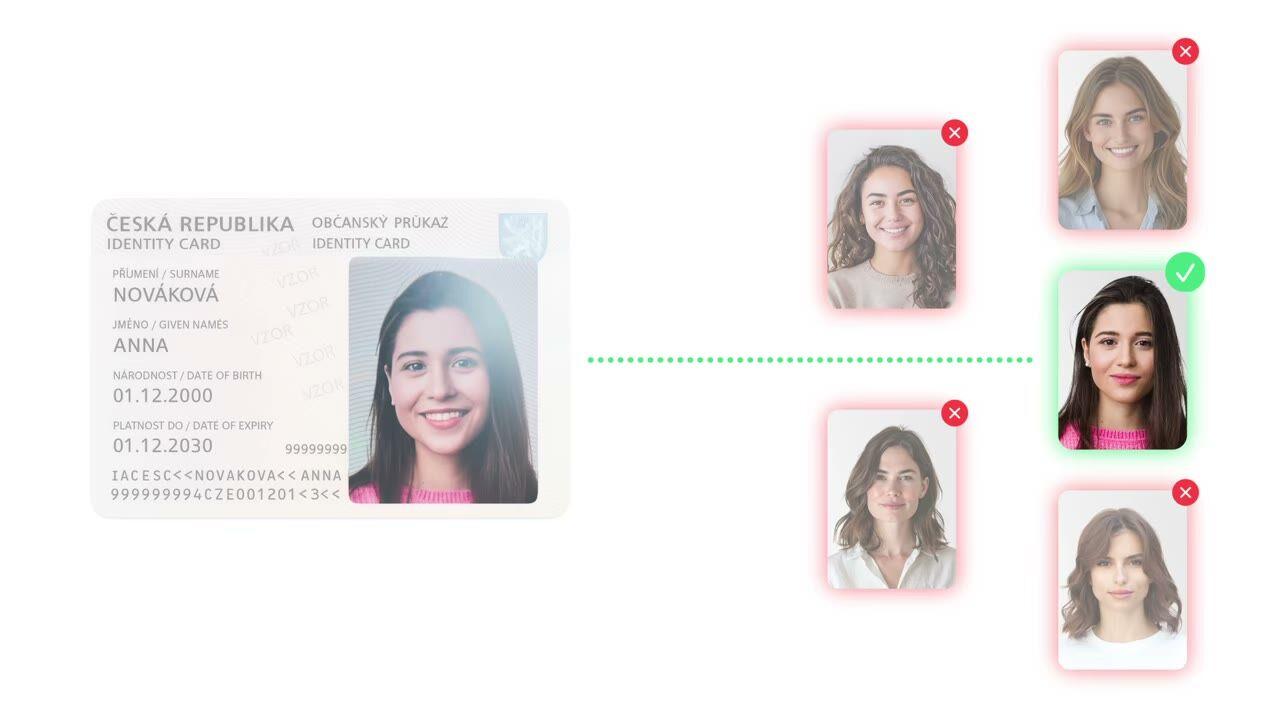
Didit Face Search 1:N, source portrait scanned against a candidate grid.

Duplicate detection

Search millions
of templates in seconds.

Catch repeat fraudsters across your user base. Free as part of the KYC bundle. Vector index of biometric templates, sub-2-second match against millions.

How it works

From sign-up to verified user in four steps.

  1. Step 01

    Create the workflow

    Pick the checks you want, ID, liveness, face match, sanctions, address, age, phone, email, custom questions. Drag them into a flow in the dashboard, or post the same flow to our API. Branch on conditions, run A/B tests, no code required.

  2. Step 02

    Integrate

    Embed natively with our Web, iOS, Android, React Native, or Flutter SDK. Redirect to a hosted page. Or just send your user a link, by email, SMS, WhatsApp, anywhere. Pick what fits your stack.

  3. Step 03

    User goes through the flow

    Didit hosts the camera, the lighting cues, the mobile hand-off, and accessibility. While the user is in the flow, we score 200+ fraud signals in real time and verify every field against authoritative data sources. Result in under two seconds.

  4. Step 04

    You receive the results

    Real-time signed webhooks keep your database in sync the moment a user is approved, declined, or sent to review. Poll the API on demand. Or open the console to inspect every session, every signal, and manage cases your way.

Built for developers · Built against fraud · Open by design

Six capabilities. One feature flag. FACE_SEARCH.

Every capability below is a toggle on the same module. No upsell tiers, no separate SKUs, no add-on calls. Switch them on per workflow, or pass them inline when you call the standalone endpoint.
01 · Built-in to every liveness

Automatic 1:N on every verification. Zero wiring.

Face Search runs automatically every time a user completes a liveness check. Their face is compared against every previously verified user, duplicates surface as warnings, blocklisted faces auto-decline. No extra endpoint, no separate billing, no code path to integrate.
02 · Watchlist & blocklist

Block a known fraudster the moment they try again.

Blocklist a face once and every future verification across every application gets checked against it. A match auto-declines the session, Didit enforces it regardless of your workflow settings. Add and remove blocklist entries through the API or directly in the console.
03 · Sub-2s at scale

One million faces. Sub-2-second p99.

Vector index plus edge-served inference. Tested in production at one-million-face indexes with sub-2-second p99. Larger indexes available on Enterprise, same architecture, dedicated compute. No SDK to bundle, no model to download.
04 · Tunable thresholds

Strict for sign-up. Lenient for review.

Similarity threshold per application (default 70). Three documented bands, 90+ strong match, 70–89 possible match, below 70 different person, wire decline / review / approve per workflow. Toggle multi-face capture when your pipeline can legitimately see more than one person.
05 · Free forever

Zero per-call fee. On every plan.

Face Search is unmetered on every Didit plan, automatically bundled into every liveness check, and the standalone endpoint costs nothing. No commit, no minimum, no enterprise paywall. Run 1:N defence against your entire population without spinning up a procurement cycle.
06 · Privacy by design

Hashed templates. Signed-URL expiry. EU by default.

Your biometric index stores hashed face templates, never raw photos. Encrypted at rest. EU residency by default; specific-region or in-country on Enterprise. Match image URLs are signed and expire after 60 minutes, leaked links die fast. Aligned with GDPR and the EU AI Act out of the box.
Integrate

Two endpoints. Same JSON. Free either way.

Create a session when you want Face Search to run automatically inside every liveness check, or call the standalone endpoint to search a reference face on demand. Both return the same face_search report, both are free.
POST /v3/session/Automatic
$ curl -X POST https://verification.didit.me/v3/session/ \
  -H "x-api-key: $DIDIT_API_KEY" \
  -H "Content-Type: application/json" \
  -d '{
    "workflow_id": "wf_liveness_dedupe",
    "vendor_data": "user-42"
  }'
201Created{ "session_url": "verify.didit.me/..." }
Face Search 1:N runs automatically inside every LIVENESS check.docs →
POST /v3/face-search/Server to server
$ curl -X POST https://verification.didit.me/v3/face-search/ \
  -H "x-api-key: $DIDIT_API_KEY" \
  -F "image=@reference.jpg" \
  -F "similarity_threshold=80"
200OK{ "total_matches": 3, "status": "Approved" }
Standalone, on-demand, unmetered, every call free.docs →
Agent-ready integration

Ship Face Search 1:N in one prompt.

Paste the block below into Claude Code, Cursor, Codex, Devin, Aider, or Replit Agent. Fill in the my_stack placeholder with your framework, language, and use case. The agent provisions Didit, builds the workflow with Face Search enabled, wires the webhook, and ships.
didit-integration-prompt.md
# Didit Face Search 1:N — integrate in 5 minutes

You are integrating Didit's Face Search 1:N (one-to-many biometric search)
module into my_stack. Follow these steps exactly. Every URL, header, and
enum value below is canonical — do not paraphrase or "improve" them.

Face Search 1:N searches a reference face against your entire database of
previously verified users to detect duplicate accounts, blocklisted faces,
and fraud rings. Free forever on every plan — no per-call fee, no minimum.

## 1. Provision an account
- Sign up: https://business.didit.me (no credit card required).
- Or provision programmatically: POST https://apx.didit.me/auth/v2/programmatic/register/
  (returns an API key bound to the workspace + application).

## 2. Two integration paths — pick one

### Path A — Workflow Builder (automatic, inside every liveness check)
Best when you want Face Search to run automatically every time a user
verifies. Face Search 1:N is automatically performed during liveness
checks in verification sessions to detect duplicate users and check
against blocklisted faces. No extra wiring needed.

1. Create a workflow that contains the LIVENESS feature:
   POST https://verification.didit.me/v3/workflows/
   Authorization header:  x-api-key: your-api-key
   Body: workflow_label, features array with the single entry
         the JSON object containing feature equal to "LIVENESS"
         (UPPERCASE — strict enum). Face Search runs automatically.

2. Create a verification session for an end user:
   POST https://verification.didit.me/v3/session/
   Body: workflow_id (from step 1), vendor_data (your own user id).
   Response: session_url — redirect the user to it.

3. Listen for the session webhook (see "Webhooks" below). The face_search
   block is included in the session report under decision.face_search.

### Path B — Standalone server-to-server API
Best when you want to search a face on demand — fraud investigation,
manual review tooling, watchlist scan, identity re-auth.

POST https://verification.didit.me/v3/face-search/
Content-Type: multipart/form-data
Body fields:
  - image                  (required, file — single reference face)
  - vendor_data            (optional string, your search id)
  - similarity_threshold   (optional int 0-100, default 70)
  - allow_multiple_faces   (optional bool, default false)

Response: JSON report with matches array, similarity percentages,
blocklist flags, and the standard warnings array.

## 3. Webhooks (Path A only — Path B returns synchronously)
- Register a webhook destination once via
  POST https://verification.didit.me/v3/webhook/destinations/
  Body: url, subscribed_events: ["session.verified", "session.review_started",
                                  "session.declined"]
- Response includes secret_shared_key — store it.
- Every webhook delivery carries an X-Signature-V2 header you MUST verify
  before trusting the payload.  HMAC-SHA256 verification MUST run against the raw body bytes (the raw payload as Didit sent it) BEFORE any JSON parsing — re-serialising the parsed body changes whitespace and key order, which invalidates the signature.Algorithm:
    1. sortKeys(payload) recursively
    2. shortenFloats (truncate trailing zeros after the decimal point)
    3. JSON.stringify the result
    4. HMAC-SHA256 with the secret_shared_key
    5. Hex-encode, compare to the X-Signature-V2 header.

## 4. Reading the report (both paths return the same shape)
The face_search object includes:
- status: "Approved" | "Declined" | "In Review"
- total_matches: integer (0 when no match crossed the threshold)
- matches: array of match objects, each with:
    - session_id              UUID of the matching session
    - session_number          integer
    - similarity_percentage   number 0-100
    - vendor_data             your reference data from the original verification
    - verification_date       ISO 8601 timestamp
    - user_details            name, document_type, document_number (masked)
    - match_image_url         signed URL, expires in 60 minutes
    - status                  "Approved" | "Declined" | "In Review"
    - is_blocklisted          boolean
- user_image:
    - entities array (bbox, confidence, age, gender per detected face)
    - best_angle (0 | 90 | 180 | 270) if rotate_image enabled
- warnings: Array of risk, log_type, short_description, long_description

Similarity bands documented:
  90+        Strong match — very likely the same person
  70 – 89    Possible match — may require manual review
  Below 70   Likely different individuals

Auto-decline risks (always enforced by Didit, not configurable):
- NO_FACE_DETECTED       no face in the reference image
- FACE_IN_BLOCKLIST      the reference face matches your face blocklist

Configurable warning:
- MULTIPLE_FACES_DETECTED   tune allow_multiple_faces per application

## 5. Hard rules — do not change
- Base URL for /v3/* endpoints is verification.didit.me (NOT apx.didit.me).
- Feature enum is UPPERCASE: FACE_SEARCH, LIVENESS, ID_VERIFICATION, FACE_MATCH.
- Auth header is x-api-key (lowercase, hyphenated).
- Webhook signature header is X-Signature-V2 (NOT X-Signature).
- Always verify webhook signatures before trusting payload data.
- Status casing matches exactly: "Approved", "Declined", "In Review"
  (title-cased, space-separated).
- match_image_url is signed and expires after 60 minutes — do not cache it,
  re-fetch from the session if you need it again.

## 6. Pricing reference (public)
- Face Search 1:N is FREE FOREVER on every Didit plan.
- No per-call fee for the standalone POST /v3/face-search/ endpoint.
- No surcharge when bundled inside a LIVENESS workflow.
- 500 free Didit verifications every month on top of that.
- Templates only — your biometric index stores hashed embeddings, never raw
  photos. Encrypted at rest in EU-region AWS.

## 7. Verify your integration
- Sandbox starts on signup at https://business.didit.me — no separate flag.
- Test images: deterministic synthetic faces returned in sandbox (Approved
  by default; trigger Declined by sending a known-blocklisted test face).
- Switch to live: flip the application's environment toggle in console.

When in doubt: https://docs.didit.me/core-technology/face-search/overview
Need more context? See the full module docs.docs.didit.me →
Compliant by design

Open a new country in one click. We do the hard work.

We open the local subsidiaries, secure the licenses, run the penetration tests, earn the certifications, and align with every new regulation. To ship verifications in a new country, flip a toggle. 220+ countries live, audited and pen-tested every quarter, the only identity provider an EU member-state government has formally called safer than in-person verification.
Read the security & compliance dossier
EU financial sandbox
Tesoro · SEPBLAC · BdE
ISO/IEC 27001
Information security · 2026
SOC 2 · Type I
AICPA · 2026
iBeta Level 1 PAD
NIST / NIAP · 2026
GDPR
EU 2016/679
DORA
EU 2022/2554
MiCA
EU 2023/1114
AMLD6 · eIDAS 2.0
EU-aligned by design

Proof numbers

Proof numbers
  • Free
    Per Face Search call. Forever. Every plan.
  • 1M+
    Faces per index, tested in production with sub-2s p99.
  • <0s
    End-to-end inference per 1:N search.
  • 0
    Raw photos stored, hashed templates only, EU by default.
Three tiers, one price list

Start free. Pay per usage. Scale to Enterprise.

500 free verifications every month, forever. Pay-as-you-go for production. Custom contracts, data residency, and SLAs (Service Level Agreements) on Enterprise.
Free

Free

$0 / month. No credit card required.

  • Free KYC bundle (ID Verification + Passive Liveness + Face Match + Device & IP Analysis), 500 / month, every month
  • Blocklisted Users
  • Duplicate Detection
  • 200+ fraud signals on every session
  • Reusable KYC across the Didit network
  • Case Management Platform
  • Workflow Builder
  • Public docs, sandbox, SDKs, MCP (Model Context Protocol) server
  • Community support
Most popular
Pay per usage

Usage Based

Pay only for what you use. 25+ modules. Public per-module pricing, no monthly minimum fee.

  • Full KYC at $0.33 (ID + Biometric + IP / Device)
  • 10,000+ AML datasets, sanctions, PEPs, adverse media
  • 1,000+ government data sources for Database Validation
  • Transaction Monitoring at $0.02 per transaction
  • Live KYB at $2.00 per business
  • Wallet Screening at $0.15 per check
  • Whitelabel verification flow, your brand, our infrastructure
Enterprise

Enterprise

Custom MSA & SLA. For large volumes and regulated programs.

  • Annual contracts
  • Custom MSA, DPA, and SLA
  • Dedicated Slack and WhatsApp channel
  • Manual reviewers on demand
  • Reseller and white-label terms
  • Exclusive features and partner integrations
  • Named CSM, security review, compliance support

Start free → pay only when a check runs → unlock Enterprise for a custom contract, SLA, or data residency.

FAQ

Common questions

What is Didit?

Didit is infrastructure for identity and fraud, the platform we wished existed when we were building products ourselves: open, flexible, and developer-friendly, so it works as a real part of your stack instead of a black box you integrate around.

One API covers verifying people (KYC, know your customer), verifying businesses (KYB, know your business), screening crypto wallets (KYT, know your transaction), and monitoring transactions in real time, on a stack built to be:

  • Fast, sub-2-second p99 on every session
  • Reliable, in production with 1,500+ companies across 220+ countries
  • Secure, SOC 2 Type 1, ISO 27001, GDPR-native, and formally attested by Spain's financial regulator as safer than verifying someone in person

The footprint underneath: 14,000+ document types in 48+ languages, 1,000+ data sources, and 200+ fraud signals on every session. The Didit infrastructure dynamically learns from every session and gets better every day.


What inputs does Face Search 1:N accept?
A single reference face image, JPEG or PNG, any reasonable resolution. The standalone endpoint accepts an image multipart field plus optional vendor_data, similarity_threshold (0-100, default 70), and allow_multiple_faces (default false). Inside a Liveness workflow no input is needed at all, the user''s captured selfie is automatically searched against your verified-user index, so duplicates and blocklist matches surface on the same session as the liveness verdict.
What is the response shape?
The face_search object returns status (Approved, Declined, In Review), total_matches, and a matches array. Each match carries session_id, session_number, similarity_percentage (0-100), vendor_data, verification_date, user_details (name, document_type, document_number, masked), a signed match_image_url that expires in 60 minutes, the matched session''s own status, and is_blocklisted. The user_image block reports detected face entities (bbox, confidence, age, gender) and the rotation applied. A warnings array surfaces any risks that fired.
How fast is the verification for my end user?

The full flow normally takes under 30 seconds end-to-end, pick up the ID, snap the document, snap the selfie, done. That is the fastest in the market. Legacy KYC providers usually take more than 90 seconds for the same flow.

On the back end, Didit returns the result in under two seconds at p99, measured from the moment the user finishes the selfie to the moment your webhook fires. Mobile capture is tuned for slow phones and slow networks: progressive image compression, lazy software development kit load, and a one-tap hand-off from desktop to phone via QR code if the user starts on web.

How does Didit defeat duplicate-account and fraud-ring abuse?
Three layers, every signup. Biometric 1:N, your new user''s face is searched against every previously verified face on your account, including blocklisted faces. Configurable threshold, tune similarity_threshold per application so onboarding can be strict while review queues stay lenient. Workflow Orchestrator branching, combine the 1:N verdict with Device Intelligence, Device & IP Analysis, and Liveness so fraud rings using stolen photos, recycled SIMs, or shared device fingerprints fail the composite check even when one signal alone would let them pass.
What happens if a user fails, abandons, or expires?

Every session lands on one of seven clear statuses, so your code always knows what to do:

  • Approved, every check passed. Move the user forward.
  • Declined, one or more checks failed. You can allow the user to resubmit the specific failed step (for example, re-take the selfie) without re-running the whole flow.
  • In Review, flagged for compliance review. Open the case in the console, see every signal, decide approve or decline.
  • In Progress, user is mid-flow.
  • Not Started, link sent, user has not opened it yet. Send a reminder if it sits too long.
  • Abandoned, user opened the link but did not finish in time. Re-engage or expire.
  • Expired, the session link aged out. Create a new session.

A signed webhook fires on every status change, so your database always stays in sync. Abandoned and declined sessions are free.

Where does my customer data live and how is it protected?

Production data is processed and stored in the European Union by default, on Amazon Web Services. Enterprise contracts can request alternative regions for jurisdictions whose regulators require it.

Encryption everywhere. AES-256 at rest across every database, object store, and backup. Transport Layer Security 1.3 in transit on every API call, webhook, and Business Console session. Biometric data is encrypted under a separate Customer Master Key.

Retention is yours to control. Default retention is indefinite (unlimited) unless you configure shorter, between 30 days and 10 years per application, and you can delete any individual session at any time from the dashboard or the API.

Certifications: SOC 2 Type 1 (Type 2 audit in progress), ISO/IEC 27001:2022, iBeta Level 1 PAD, and a public attestation from Spain''s Tesoro / SEPBLAC / CNMV that Didit''s remote identity verification is safer than verifying someone in person. Full report at /security-compliance.

Is Didit compliant for my industry?

Didit ships compliant by default for the regulators that matter to identity infrastructure:

  • GDPR + UK GDPR, controller / processor split, full Data Processing Agreement published, lead supervisory authority named (Spain''s AEPD).
  • AMLD6 + EU AML Single Rulebook, 1,300+ sanctions, politically exposed person, and adverse-media lists screened in real time.
  • eIDAS 2.0, EU Digital Identity Wallet aligned; reusable-identity ready.
  • MiCA (Markets in Crypto-Assets), ready for crypto on-ramps, exchanges, and custodians.
  • DORA, Digital Operational Resilience Act, EU financial-services operational resilience.
  • BIPA, CUBI, Washington HB 1493, CCPA / CPRA, US biometric privacy (Illinois, Texas, Washington) and California consumer privacy.
  • UK Online Safety Act, age-gating and child-safety obligations.
  • FATF Travel Rule, originator and beneficiary data on crypto transfers, IVMS-101 interoperable.

Detailed memo, every certificate, every regulator letter: /security-compliance.

How fast can I integrate and start verifying users?
  • 60 seconds to a sandbox account at business.didit.me, no credit card.
  • 5 minutes to a working verification through Claude Code, Cursor, or any coding agent via our Model Context Protocol (MCP) server.
  • A weekend to a production-ready integration with signed-webhook verification, retries, and a remediation flow when a user is declined.

Three integration paths, pick whichever fits your stack:

  • Embed natively with our Web, iOS, Android, React Native, or Flutter SDK.
  • Redirect the user to the hosted verification page, zero SDK.
  • Send a link by email, SMS, WhatsApp, or any channel, zero front-end work.

Same dashboard, same billing, same pay-per-success price for all three. Step-by-step guide at docs.didit.me/integration/integration-prompt.

Infrastructure for identity and fraud.

One API for KYC, KYB, Transaction Monitoring, and Wallet Screening. Integrate in 5 minutes.

Ask an AI to summarise this page