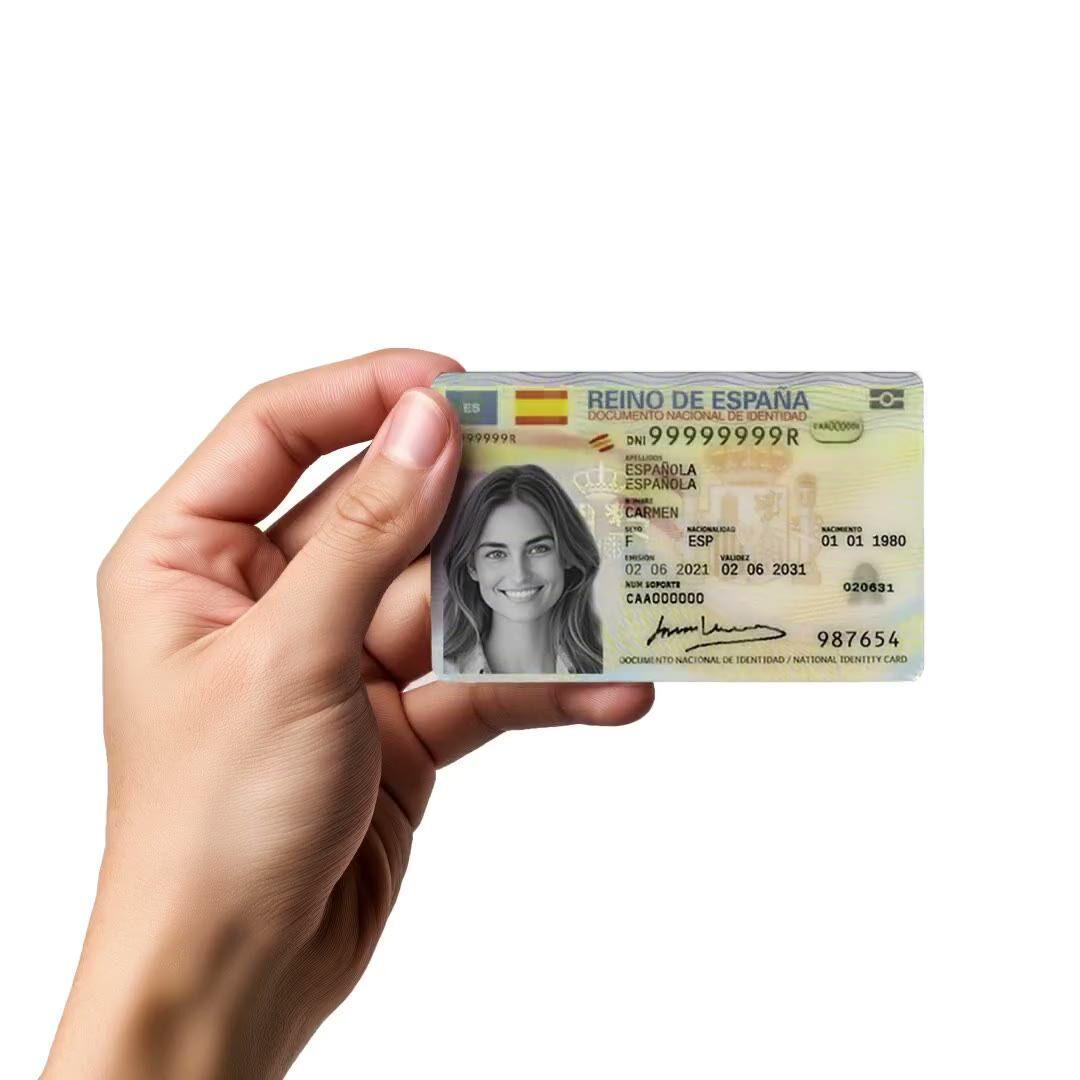
Verify a passport, national ID, driver's licence, or residence permit from any country. 14,000+ documents, sub-2-second verdict, $0.15 per check, 500 free/month.
Spanish DNI, Japanese My Number, UK passport. New documents ship every month,
same $0.15 per check, same verdict shape, same sub-2-second response.
How it works
From sign-up to verified user in four steps.
Step 01
Create the workflow
Pick the checks you want, ID, liveness, face match, sanctions, address, age, phone, email, custom questions. Drag them into a flow in the dashboard, or post the same flow to our API. Branch on conditions, run A/B tests, no code required.
Step 02
Integrate
Embed natively with our Web, iOS, Android, React Native, or Flutter SDK. Redirect to a hosted page. Or just send your user a link, by email, SMS, WhatsApp, anywhere. Pick what fits your stack.
Step 03
User goes through the flow
Didit hosts the camera, the lighting cues, the mobile hand-off, and accessibility. While the user is in the flow, we score 200+ fraud signals in real time and verify every field against authoritative data sources. Result in under two seconds.
Step 04
You receive the results
Real-time signed webhooks keep your database in sync the moment a user is approved, declined, or sent to review. Poll the API on demand. Or open the console to inspect every session, every signal, and manage cases your way.
Built for developers · Built against fraud · Open by design
Six capabilities. One feature flag. ID_VERIFICATION .
Every capability below is a toggle on the same module. No upsell tiers, no separate SKUs, no add-on calls. Switch them on per workflow in the console, or pass them inline when you call the standalone endpoint.
Passports, national IDs, driver's licences, residence permits. 130+ languages, 50+ scripts (Latin, Arabic, Cyrillic, CJK, Devanagari, Hebrew, Thai, Georgian). New documents ship every month. Per-country subtype controls, accept Indiana Operator and New York Enhanced separately if policy requires it.
Supported documents
Updated this month
Live
220+
Countries
14,000+
Document types
130+
Languages
50+
Scripts
PassportID cardDriver's licenseResidence permit
🇪🇸ES
🇺🇸US
🇧🇷BR
🇩🇪DE
🇲🇽MX
🇮🇳IN
🇫🇷FR
🇬🇧GB
🇯🇵JP
🇳🇬NG
🇦🇪AE
🇸🇬SG
02 · Data extraction
Visual fields, MRZ, and barcode, cross-checked.
Every visual, MRZ (machine-readable-zone), and barcode field extracted in one pass. The three are cross-checked before the response leaves our edge. Inconsistencies surface as warnings so you can route the case to manual review.
Personal data
OCR · MRZ · Barcode
First name
Olivia
Matches with Data provided via API: Olivia
Last name
Roy
Date of birth
28/06/1971
Document type
Passport
Issuing state
Spain🇪🇸
Document number
3EB8726CC6E0F979
03 · Authenticity
Document is real. Portrait is intact. No screen capture.
Template match against the certified database. Hologram and microprint detection. Portrait integrity check. Document liveness defeats four common attack vectors, screen captures, phone photos, printed copies, and portrait substitutions on otherwise-real documents.
Document authenticity
Authentic
Document portrait
Live capture
Similarity 94%
Template match
Hologram detected
Microprint intact
Document liveness passed
04 · Capture quality
Reject blur and glare before they reach review.
Focus, brightness, and resolution scored 0–100 per submission, plus a weighted overall score. Out-of-frame corners and overexposed sides flagged explicitly. Tunable thresholds reject low-quality captures up front so they never reach your manual-review queue.
Capture quality
Capture ready
Hold steady
Overall score
91/100
Focus92
Brightness88
Resolution95
05 · Risk policy
Decide. Review. Approve. Per risk. Per application.
Every risk category, duplicate user, invalid MRZ, data inconsistency, low document liveness, maps to decline, review, or approve. Tune the policy per application, country, and document type. Auto-decline triggers (expired, blocklisted, unsupported) stay enforced regardless of your settings.
Risk policy
5 categories
Risk categoryAction
Duplicated user
Decline
Invalid MRZ
Review
Data inconsistency
Review
Invalid validation
Decline
Low document liveness
Approve
06 · Ongoing KYC
Documents expire. Catch it before the regulator does.
We track expiry on every document you store. When one expires, the user's KYC status flips automatically and we ping you via webhook. No batch job, no quarterly re-onboarding sprint, KYC refresh stays continuous and you stay AML-Directive aligned.
Document monitoring
Auto-tracks expiry · webhook on status change
Live
1,284
Active
47
Expiring soon
9
Expired
Webhook fired · usr_9f01a3c moved to Kyc expired12s ago
Ausr_a8c4f02Passport12 Mar 2027Active
Musr_4d2b6e1ID card08 Jun 2026Expiring
Lusr_9f01a3cDriving license21 Sep 2025KYC expired
Integrate
Two endpoints. Same JSON. Same price.
Create a session when you want our hosted UI to handle capture, or call the standalone endpoint when you already have the image. Both return the same id_verification report.
You own the capture. We return the full report inline.docs →
Agent-ready integration
Ship ID Verification in one prompt.
Paste the block below into Claude Code, Cursor, Codex, Devin, Aider, or Replit Agent. Fill in the my_stack placeholder with your framework, language, and use case. The agent provisions Didit, builds the workflow with ID Verification enabled, wires the webhook, and ships.
didit-integration-prompt.md
# Didit ID Verification — integrate in 5 minutes

You are integrating Didit's ID Verification module into <my_stack>. Follow
these steps exactly. Every URL, header, and enum value below is canonical —
do not paraphrase or "improve" them.

## 1. Provision an account
- Sign up: https://business.didit.me (no credit card required).
- Or provision programmatically: POST https://apx.didit.me/auth/v2/programmatic/register/
  (returns an API key bound to the workspace + application).

## 2. Two integration paths — pick one

### Path A — Workflow Builder (hosted UI)
Best when you want Didit to handle camera, lighting cues, retries,
mobile handoff, and accessibility for you.

1. Create a workflow that contains the ID_VERIFICATION feature:
   POST https://verification.didit.me/v3/workflows/
   Authorization header:  x-api-key: <your-api-key>
   Body: workflow_label, features array with the single entry
         { feature: "ID_VERIFICATION" }   (UPPERCASE — strict enum)

2. Create a verification session for an end user:
   POST https://verification.didit.me/v3/session/
   Body: workflow_id (from step 1), vendor_data (your own user id).
   Response: session_url — redirect the user to it.

3. Listen for webhook callbacks (see "Webhooks" below).

### Path B — Standalone server-to-server API
Best when you already have the document image (mobile SDK capture, native
onboarding app, reseller pipeline).

POST https://verification.didit.me/v3/id-verification/
Content-Type: multipart/form-data
Body fields:
  - front_image  (required, file)
  - back_image   (optional, file)
  - vendor_data  (optional string, your user id)

Response: JSON report with extracted fields, image quality scores,
warnings array, and the verdict.

## 3. Webhooks (Path A only — Path B returns synchronously)
- Register a webhook destination once via
  POST https://verification.didit.me/v3/webhook/destinations/
  Body: url, subscribed_events: ["session.verified", "session.review_started",
                                  "session.declined", "kyc_expired"]
- Response includes secret_shared_key — store it.
- Every webhook delivery carries an X-Signature-V2 header you MUST verify
  before trusting the payload.  HMAC-SHA256 verification MUST run against the raw body bytes (the raw payload as Didit sent it) BEFORE any JSON parsing — re-serialising the parsed body changes whitespace and key order, which invalidates the signature.Algorithm:
    1. sortKeys(payload) recursively
    2. shortenFloats (truncate trailing zeros after the decimal point)
    3. JSON.stringify the result
    4. HMAC-SHA256 with the secret_shared_key
    5. Hex-encode, compare to the X-Signature-V2 header.

## 4. Reading the report (both paths return the same shape)
The id_verification object includes:
- status: "Approved" | "Declined" | "In Review" | "Expired" | "Not Finished"
- document_type: "Passport" | "Identity Card" | "Driver's License" | "Residence Permit" | null
- document_number, personal_number
- front_image, back_image, portrait_image (signed URLs, expire in 1 hour)
- date_of_birth (YYYY-MM-DD), age (number)
- expiration_date, date_of_issue (YYYY-MM-DD)
- issuing_state, issuing_state_name (ISO 3166-1 alpha-3 + display name)
- first_name, last_name, full_name
- gender ("M" | "F" | "U"), nationality (ISO 3166-1 alpha-3)
- address, formatted_address, parsed_address (street_1, street_2, city,
  region, postal_code, geometry { lat, lng })
- front_image_quality_score / back_image_quality_score (focus, brightness,
  resolution, overall, each 0-100)
- warnings: Array<{ risk, log_type, short_description, long_description }>

## 5. Hard rules — do not change
- Base URL for /v3/* endpoints is verification.didit.me (NOT apx.didit.me).
- Feature enum is UPPERCASE: ID_VERIFICATION, LIVENESS, FACE_MATCH, AML, IP_ANALYSIS.
- Auth header is x-api-key (lowercase, hyphenated).
- Webhook signature header is X-Signature-V2 (NOT X-Signature).
- Always verify webhook signatures before trusting payload data.
- Status casing matches exactly: "Approved", "Declined", "In Review",
  "Expired", "Not Finished" (title-cased, space-separated).

## 6. Pricing reference (public)
- Path A bundled in a full KYC workflow: $0.33 per session
- Path B standalone /v3/id-verification/ call: $0.15 per call
- 500 free verifications every month, forever, on every account.

## 7. Verify your integration
- Sandbox starts on signup at https://business.didit.me — no separate flag.
- Test docs: deterministic synthetic IDs returned in sandbox.
- Switch to live: flip the application's environment toggle in console.

When in doubt: https://docs.didit.me/core-technology/id-verification/overview
Open a new country in one click. We do the hard work.
We open the local subsidiaries, secure the licenses, run the penetration tests, earn the certifications, and align with every new regulation. To ship verifications in a new country, flip a toggle. 220+ countries live, audited and pen-tested every quarter, the only identity provider an EU member-state government has formally called safer than in-person verification.
Identity document types in the certified database.
<0s
End-to-end inference per verification.
$0.00
Per standalone ID check. 500 free every month.
Three tiers, one price list
Start free. Pay per usage. Scale to Enterprise.
500 free verifications every month, forever. Pay-as-you-go for production. Custom contracts, data residency, and SLAs (Service Level Agreements) on Enterprise.
Free
Free
$0 / month. No credit card required.
Free KYC bundle (ID Verification + Passive Liveness + Face Match + Device & IP Analysis), 500 / month, every month
Blocklisted Users
Duplicate Detection
200+ fraud signals on every session
Reusable KYC across the Didit network
Case Management Platform
Workflow Builder
Public docs, sandbox, SDKs, MCP (Model Context Protocol) server
Start free → pay only when a check runs → unlock Enterprise for a custom contract, SLA, or data residency.
FAQ
Common questions
What is Didit?
Didit is infrastructure for identity and fraud, the platform we wished existed when we were building products ourselves: open, flexible, and developer-friendly, so it works as a real part of your stack instead of a black box you integrate around.
One API covers verifying people (KYC, know your customer), verifying businesses (KYB, know your business), screening crypto wallets (KYT, know your transaction), and monitoring transactions in real time, on a stack built to be:
Fast, sub-2-second p99 on every session
Reliable, in production with 1,500+ companies across 220+ countries
Secure, SOC 2 Type 1, ISO 27001, GDPR-native, and formally attested by Spain's financial regulator as safer than verifying someone in person
The footprint underneath: 14,000+ document types in 48+ languages, 1,000+ data sources, and 200+ fraud signals on every session. The Didit infrastructure dynamically learns from every session and gets better every day.
Which document types and countries are supported?
Passports, national ID cards, driver's licenses, and residence permits across 220+ countries and territories, 14,000+ distinct document templates in total, with text recognition in 130+ languages and 50+ scripts (Latin, Arabic, Cyrillic, CJK, Devanagari, Hebrew, Thai, Georgian). The full catalog is browsable at docs.didit.me/core-technology/id-verification/supported-documents-id-verification, and the same data feeds the searchable table on this page.
What is the response shape?
A single id_verification JSON object. Top-level status is one of Approved, Declined, In Review, Expired, or Not Finished. The object also includes document_type, document_number, full_name, first_name, last_name, date_of_birth (YYYY-MM-DD), age, expiration_date, date_of_issue, issuing_state (ISO 3166-1 alpha-3), nationality, gender, address, a structured parsed_address with street, city, region, postal_code, and geometry coordinates, signed URLs for portrait_image / front_image / back_image / front_video / back_video, image quality scores for focus / brightness / resolution / overall (each 0–100), and a warnings array. Full reference at docs.didit.me/core-technology/id-verification/report-id-verification.
How fast is the verification for my end user?
The full flow normally takes under 30 seconds end-to-end, pick up the ID, snap the document, snap the selfie, done. That is the fastest in the market. Legacy KYC providers usually take more than 90 seconds for the same flow.
On the back end, Didit returns the result in under two seconds at p99, measured from the moment the user finishes the selfie to the moment your webhook fires. Mobile capture is tuned for slow phones and slow networks: progressive image compression, lazy software development kit load, and a one-tap hand-off from desktop to phone via QR code if the user starts on web.
How does Didit defeat document fraud?
Five layers, every layer enabled by default: (1) template matching against the certified document database, (2) security-feature detection (holograms, microprint, watermarks), (3) tamper detection on the portrait and biographic data, (4) document liveness that rejects screen captures, printed copies, and digital edits, (5) cross-reference between visual zone, MRZ, and barcode. Auto-decline triggers, DOCUMENT_EXPIRED, MINIMUM_AGE_NOT_MET, DOCUMENT_NOT_SUPPORTED_FOR_APPLICATION, ID_DOCUMENT_IN_BLOCKLIST, PORTRAIT_IMAGE_NOT_DETECTED, stay enforced regardless of your risk policy.
What happens if a user fails, abandons, or expires?
Every session lands on one of seven clear statuses, so your code always knows what to do:
Approved, every check passed. Move the user forward.
Declined, one or more checks failed. You can allow the user to resubmit the specific failed step (for example, re-take the selfie) without re-running the whole flow.
In Review, flagged for compliance review. Open the case in the console, see every signal, decide approve or decline.
In Progress, user is mid-flow.
Not Started, link sent, user has not opened it yet. Send a reminder if it sits too long.
Abandoned, user opened the link but did not finish in time. Re-engage or expire.
Expired, the session link aged out. Create a new session.
A signed webhook fires on every status change, so your database always stays in sync. Abandoned and declined sessions are free.
Where does my customer data live and how is it protected?
Production data is processed and stored in the European Union by default, on Amazon Web Services. Enterprise contracts can request alternative regions for jurisdictions whose regulators require it.
Encryption everywhere. AES-256 at rest across every database, object store, and backup. Transport Layer Security 1.3 in transit on every API call, webhook, and Business Console session. Biometric data is encrypted under a separate Customer Master Key.
Retention is yours to control. Default retention is indefinite (unlimited) unless you configure shorter, between 30 days and 10 years per application, and you can delete any individual session at any time from the dashboard or the API.
Certifications: SOC 2 Type 1 (Type 2 audit in progress), ISO/IEC 27001:2022, iBeta Level 1 PAD, and a public attestation from Spain''s Tesoro / SEPBLAC / CNMV that Didit''s remote identity verification is safer than verifying someone in person. Full report at /security-compliance.
Is Didit compliant for my industry?
Didit ships compliant by default for the regulators that matter to identity infrastructure:
GDPR + UK GDPR, controller / processor split, full Data Processing Agreement published, lead supervisory authority named (Spain''s AEPD).
AMLD6 + EU AML Single Rulebook, 1,300+ sanctions, politically exposed person, and adverse-media lists screened in real time.
eIDAS 2.0, EU Digital Identity Wallet aligned; reusable-identity ready.
MiCA (Markets in Crypto-Assets), ready for crypto on-ramps, exchanges, and custodians.
DORA, Digital Operational Resilience Act, EU financial-services operational resilience.
BIPA, CUBI, Washington HB 1493, CCPA / CPRA, US biometric privacy (Illinois, Texas, Washington) and California consumer privacy.
UK Online Safety Act, age-gating and child-safety obligations.
FATF Travel Rule, originator and beneficiary data on crypto transfers, IVMS-101 interoperable.