ID Verification Gaps: Solving Document Coverage Issues
Poor document coverage in ID verification impacts conversion, increases fraud, and limits global reach. Learn how to identify and address these gaps with a robust identity verification strategy.
 Alberto RosasCo-founder and CEO
Contents
In this guide
Jump to the part you need.
Key Takeaway 1 Limited document coverage in ID verification directly translates to higher user friction and lost revenue, as legitimate users are incorrectly rejected.
Key Takeaway 2 Focusing solely on popular document types overlooks a significant portion of the global population and introduces substantial fraud risks via long tail document types.
Key Takeaway 3 A layered identity verification strategy incorporating alternative data sources and continuous monitoring is essential for mitigating document coverage gaps.
Key Takeaway 4 Proactive monitoring of verification failure rates by document type is crucial for identifying and addressing emerging document coverage issues.
The Hidden Costs of Poor Document Coverage
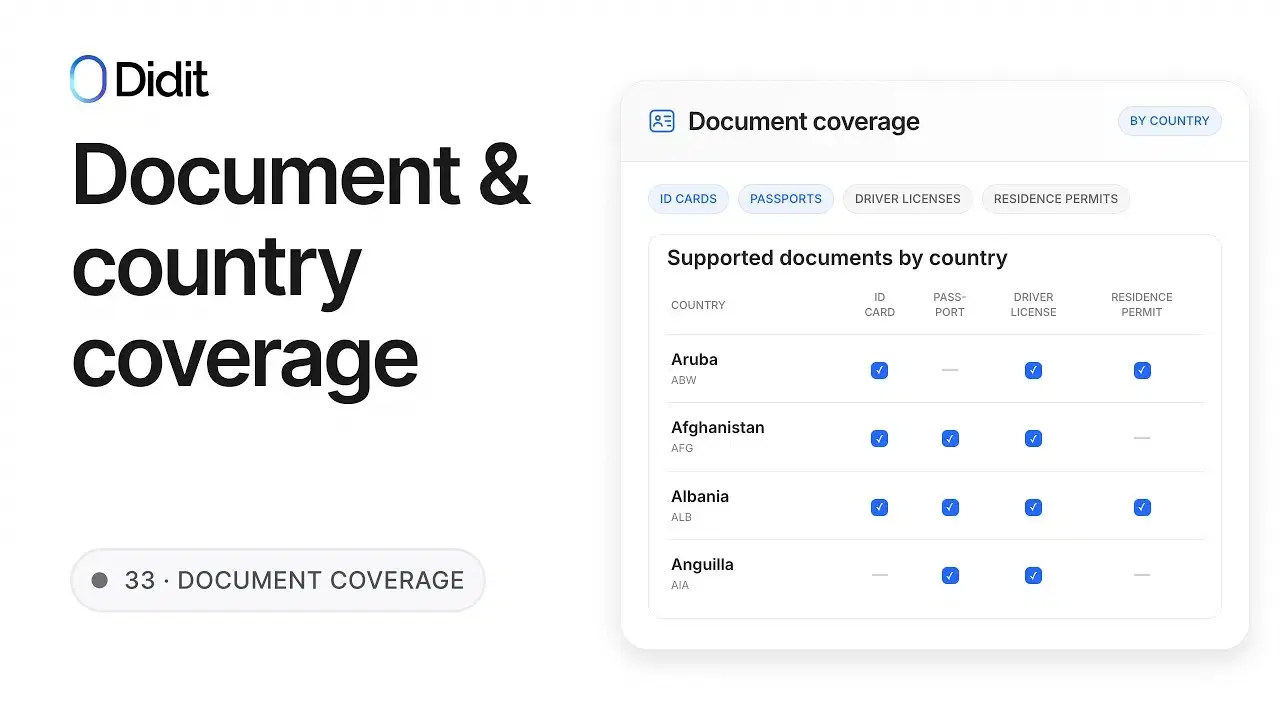
In the world of online identity, document coverage is the breadth of government-issued IDs an ID verification system can accurately recognize and validate. While many businesses focus on supporting the most common document types, a significant problem lurks beneath the surface: gaps in coverage. These gaps aren’t just about inconvenience; they represent real financial and strategic risks. Limited document coverage leads to false negatives – rejecting legitimate users simply because their ID isn't recognized. This directly impacts conversion rates, especially when expanding into new geographic markets. For example, a fintech company expanding into Southeast Asia might prioritize passports and national IDs of the largest countries, overlooking the numerous variations of local identification used across the region. This oversight can result in a 15-20% rejection rate for potential users, representing a substantial loss of revenue.
The Long Tail of Identity Documents
The 80/20 rule applies here: 20% of document types account for 80% of verifications. However, that remaining 20% – the long tail of identity documents – represents a significant opportunity and a substantial risk. These less common IDs come from smaller countries, specific regions within larger countries, or are older versions of existing documents. Ignoring this long tail opens the door to fraud. Fraudsters actively exploit systems with limited document coverage by utilizing obscure or outdated IDs that are less likely to trigger red flags. Consider a marketplace platform. If its ID verification system doesn't support a specific type of regional ID card used by sellers in a growing market segment, fraudulent sellers can easily onboard and exploit the platform.
Beyond the Document: An Identity Verification Strategy
Addressing document coverage gaps requires a shift from a solely document-centric approach to a more holistic identity verification strategy. This means incorporating alternative data sources and layering multiple verification methods. Some effective strategies include:
- Biometric Verification: Leveraging facial recognition and liveness detection adds a powerful layer of security, even if the document itself is unfamiliar.
- Data Enrichment: Supplementing document data with information from trusted third-party databases (e.g., address verification, phone number validation).
- Device Fingerprinting: Analyzing device characteristics to identify potential risks associated with the user's device.
- Behavioral Biometrics: Monitoring user behavior during the verification process (e.g., typing speed, mouse movements) to detect anomalies.
These methods act as compensating controls, mitigating the risk posed by limited document coverage. For instance, a company encountering a low-coverage document could require additional biometric verification or a knowledge-based authentication (KBA) challenge.
The Cost of Remediation vs. Proactive Investment
The cost of addressing document coverage gaps after they cause problems is significantly higher than proactive investment. Reactive remediation involves investigating rejected users, manually reviewing cases, and potentially rebuilding entire verification flows. This is expensive and time-consuming. A proactive approach, however, focuses on continuous monitoring and expansion of document coverage. This includes:- Regularly analyzing verification failure rates by document type.
- Adding support for new document types based on market expansion plans.
- Investing in a platform with a broad and continuously updated document library.
Didit’s platform currently supports over 14,000 document types, and we regularly add new ones based on customer demand and emerging market trends. This proactive approach minimizes friction for legitimate users and reduces the risk of fraud.
How Didit Helps Bridge the Document Coverage Gap
Didit’s all-in-one identity platform is designed to address the challenges of document coverage. We offer:
- Extensive Document Library: Support for over 14,000 document types from 220+ countries.
- Continuous Updates: Our document library is constantly updated to reflect changes in document formats and regulations.
- AI-Powered Document Validation: Advanced AI algorithms accurately extract and validate data from even the most complex documents.
- Layered Verification: Seamless integration of biometric verification, AML screening, and fraud signals to mitigate risk.
- Workflow Orchestration: Customizable workflows allow you to adapt verification requirements based on document type and risk profile.
Ready to Get Started?
Don't let document coverage gaps compromise your identity verification efforts.
Request a Demo to see how Didit can help you build a robust and scalable identity verification solution.
View Pricing and start optimizing your identity strategy today.
Try it
Try this in the sandbox
Run the check this guide describes, free.
The product this post is about, taken from its topic. Run it free in the sandbox.
Author
Alberto Rosas
Co-founder and CEO

Keep reading
Other guides in the same topic.
 Play Age Signals vs Apple Declared Age Range: full comparison
Google Play Age Signals and Apple's Declared Age Range API side by side: ranges, tiers, nulls, automatic sharing and terms, plus one age state for your backend and when to add your own check.
Alberto RosasNov 22, 2026 Play Age Signals API integration guide: v0.0.6 for Android apps
The three calls of Play Age Signals 0.0.6 in Kotlin, a decision table for every status, tier and bound, errors, migration from 0.0.3 and 0.0.4, testing, and how to start your own age check.
Alberto RosasNov 22, 2026 Age verification API: which one works on apps, web and stores
Five kinds of age verification API and where each one answers: Play apps, App Store apps, sideloads, web and desktop. With the selfie call, the hosted session, webhook checks, cost and data.
Alberto RosasNov 22, 2026Questions
Blog questions
Who writes the Didit blog?
Which topics does the blog cover?
Is the blog available in my language?
Where do I find product updates?
Are these posts legal advice?
How do I find posts on one topic?
Are posts dated?
Do posts link to the docs?
Is the blog the same as the docs?
Compliance built in
Audited, certified and attested.
We hold the certifications and build each country's rules into your flows, so you can launch anywhere without worrying. Security and Compliance center
- Regulation encoded into your flows
Tell us what you do and where. Didit lists the rules that apply to you, with sources, and builds the checks each country needs into one workflow.
- Ready for AMLR
Every requirement of the new EU anti-money laundering rules, from checking customers to human review, is already covered by a Didit check.
- Tested in Spain's Treasury sandbox
Spain's Treasury published its supervised sandbox report on Didit's NFC plus active liveness onboarding; SEPBLAC took part and valued the added measures positively.
- Audited, not self-declared
iBeta Level 1 and Level 2. Liveness tested under ISO/IEC 30107-3.
Your obligations · 3 regions
 SOC 2 Type 2
 ISO 27001
 iBeta Level 1 and Level 2
 EU regulator attestation
 FSM youth protection
 GDPR
 EBA remote onboarding
 MiCA compatible
 FIDO Alliance member
- AMLREU AML Regulation ready
Integration · Didit MCP
Run Didit from your own AI agent
Connect Didit to Claude, Cursor, VS Code or ChatGPT and just ask in plain words. Your agent can do anything you can do in the console, with the same permissions you have.
 Add to Claude
 ChatGPT
 Cursor
- Build workflowsDescribe the checks you need. The agent creates and publishes the flow.
- Run investigationsAsk why a session was declined, review cases, search people and companies.
- Change rulesCreate payment rules, test them on past data and switch them on.
- Pull reportsAsk for numbers, exports or the audit log.
Didit Academy