How to Consolidate Identity Vendors: 8 Steps and Costs
Consolidate identity vendors by mapping every check to one workflow per product line, creating sessions through one API, importing history where regulators need it, and pricing each step before you cancel a contract.
 Alberto RosasCo-founder and CEO
Contents
In this guide
Jump to the part you need.
This guide is for teams running three or more vendors to check users, businesses or transactions, and who want one contract, one workflow and one price list. Didit prices a full KYC check at $0.33 and business verification from $2.00 per company. The caveat: consolidation only pays off if the platform you move to covers your countries, your document types and your review queue, and if you can carry historical decisions across.
Last updated: November 26, 2026. Prices checked against the live Didit price feed on November 26, 2026.
Consolidation at a glance
| Decision you are moving | Didit list price | Notes |
|---|---|---|
| Full ID check (KYC) | $0.33 per completed check | ID document $0.15 + passive liveness $0.10 + face match 1:1 $0.05 + device and IP analysis $0.03 |
| AML screening | $0.20 per check | 1,300+ sanctions, PEP, adverse media and watchlist lists |
| Ongoing AML monitoring | $0.07 per person per year | Post-onboarding re-screening |
| Business verification (KYB) | From $2.00 per company | Priced by country and data tier (Lite, Shareholders, UBOs) |
| Linked UBO or officer check | $0.33 KYC + $0.20 person AML | Billed per person |
| Wallet screening | $0.15 per screening | You can bring your own screening provider and run it inside Didit |
| Transaction monitoring | $0.001 per transaction | Applies beyond the plan's monthly allowance |
| Workflow Orchestrator, MCP server, reusable KYC | Free | Included on every plan |
| Sandbox | Free | Sandbox testing is free and unlimited on every plan |
Start free in the sandbox at business.didit.me, with no sales call. If your team builds with an AI assistant, connect Didit through the MCP server at https://mcp.didit.me/mcp and configure flows from the prompt instead of the console.
What a consolidated setup should give you
The outcome is one session record per person or business, holding every check that ran against them: the ID document, passive and active liveness, face match, AML screening, proof of address, phone and email verification, questionnaires and the device and IP signals. One decision payload, one audit trail, one place to review a hit.
Didit runs this across three product lines. User Verification covers individuals. Business Verification covers companies, their officers and their beneficial owners, with a linked KYC session for each person. Transaction Monitoring covers what happens after onboarding, with wallet screening and Travel Rule inside it. There are 25+ composable modules across the three lines, all documented in the features reference.
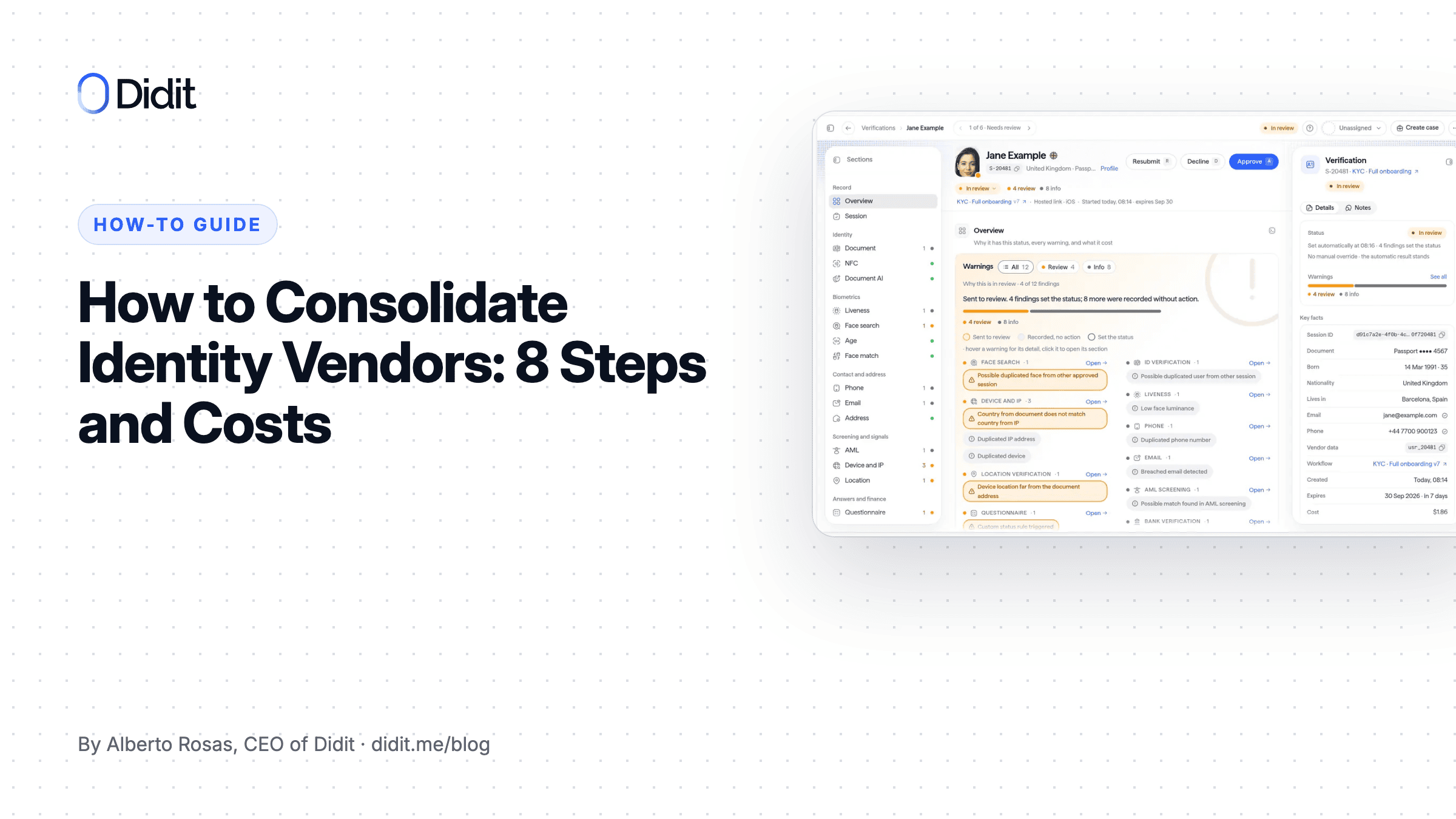
The operational gain is not only fewer invoices. It is that a reviewer opens one session and sees why a person passed or failed. The session overview below is what that looks like in the Didit Business Console.

When consolidation is the wrong move
Keep a vendor if it does something you cannot replace. A local registry integration in one market, a national digital ID that only one provider supports in production, or a screening feed your regulator has already approved are all reasons to keep a contract open. The honest answer is that consolidation means fewer vendors, not necessarily one.
What you should not keep is overlap. Two vendors running the same ID document check on the same user, two AML lists you pay for monthly and never reconcile, or a workflow that asks the same person for the same document twice.
Prerequisites before you start
- An inventory of every check you run today, with monthly volume, unit price, contract end date and owner.
- The list of countries and document types you must support, including the ones you plan to enter within 12 months.
- A named person who owns the review queue and can decide what counts as an approval, a decline and a manual review.
- Your data retention rule, written down. Didit retention runs from 1 month to 10 years depending on plan and contract, and sessions can be deleted on demand through the API.
- A sandbox application and an API key. Sandbox testing is free and unlimited on every plan.
How to consolidate in 8 steps
Map every check to a lifecycle stage
Group your current checks into four stages: Biometrics (is this person real and present), Verification (are they who they say they are), Authentication (sign them back in), and Monitoring (what happens after onboarding). Do it once for users, once for businesses, once for transactions. This map is your target architecture and your negotiating document.
Write the acceptance rules before you look at pricing
Countries, document types, capture languages (Didit's flow and SDKs cover 54), review thresholds, retention and evidence export. Without these written down, every vendor demo looks equal.
Model one workflow per product line
Build the flow in the Workflow Orchestrator, which is free on every plan. A KYC workflow creates a User Verification session and a KYB workflow creates a Business Verification session. The workflow type decides the session kind, so you do not choose separately in the API call.
Decide your stable identifier
Use
vendor_dataas your own ID for the person or business. It binds the session to your entity record and is used for duplicate detection across sessions. For KYB, also passcompany_name,registry_countryandregistration_numberinexpected_detailsto pre-fill the registry search.Create the first session through the Sessions API
Every verification starts as a session. The call below is the documented create call with the minimum fields you need for a pilot.
curl -X POST https://verification.didit.me/v3/session/ \
  -H "x-api-key: YOUR_API_KEY" \
  -H "Content-Type: application/json" \
  -d '{
    "workflow_id": "WORKFLOW_UUID",
    "vendor_data": "user_12345",
    "callback": "https://app.example.com/kyc/done",
    "metadata": {"source": "consolidation-pilot"},
    "language": "en"
  }'
Expected output: a session object you can store against your user row.
{
  "session_id": "SESSION_UUID",
  "session_kind": "user",
  "session_number": 1,
  "session_url": "https://...",
  "status": "Not Started",
  "workflow_id": "WORKFLOW_UUID",
  "vendor_data": "user_12345"
}
Read the decision, not the screen
When the flow finishes, read the decision from
GET /v3/session/{id}/decision/. User sessions carryid_verifications,liveness_checks,face_matches,poa_verificationsandaml_screenings. Business sessions carryregistry_checks,document_verifications,key_people_checksandaml_screenings. Switch onsession_kind, which isuserorbusiness. Statuses are exact strings such asApproved,DeclinedandIn Review. Register the webhook so your system reacts to finished sessions instead of polling.Migrate history if your regulator expects it
Moving the old provider's decisions into Didit is a separate job from moving operating data. Use
POST /v3/session/imports/withimport_type=user_verification,business_verification,transactionsorstatus_rules. Imported sessions carrysession_type: "MIGRATED", do not email your users, do not redirect anyone into a flow and do not re-run the original check. Full details are in the import documentation.Run in parallel, then retire the old contracts
Send the same population through the new workflow for a fixed window and compare approval rate, manual review volume and time to decision against the old stack. When the numbers hold, cancel, delete what you must not keep, and set the retention rule on the new account.
Inputs and outputs
| Step | Input | Output |
|---|---|---|
| Inventory | Contracts, invoices, check volumes | One map per product line |
| Workflow design | Countries, document types, review rules | workflow_id |
| Create session | workflow_id, vendor_data, callback | session_id, session_url, session_kind |
| User completes flow | Hosted session URL | Status and feature results |
| Decision | GET /v3/session/{id}/decision/ | Feature arrays, warnings, scores |
| Event delivery | Callback URL and webhook endpoint | Signed event with session_id |
| History import | Canonical CSV or NDJSON from the old provider | MIGRATED sessions and profile records |
Failure cases and recovery
- 400 on callback. When the application has allowed domains, the callback must sit on one of them, otherwise creation fails with a callback error. Add the origin to the allowed domains or use a custom app scheme.
- 400 on session expiration.
session_expiration_timemust be a whole number between 3600 and 2419200 seconds. - 400 on a biometric authentication workflow. That flow needs a reference face in
portrait_imageunless thevendor_datauser already has a stored face. - Missing images in a history import. If the old provider cannot export document or selfie images, import the structured fields and leave the image fields empty. The decision record still shows as compliance history.
- A queue that grows. Sessions in
In Reviewneed a human decision. Staff the queue before cutover, not after. - A vendor that will not export. Negotiate the export clause while the contract is still live. After notice, obtaining the file you need may be harder.
Paid steps and review boundaries
The sandbox is free on every plan and the Workflow Orchestrator, MCP server and reusable KYC cost nothing. Live checks are billed per completed check from prepaid credit: $0.33 for a full ID check, $0.20 for AML screening, from $2.00 per company for KYB, $0.15 per wallet screening, $0.001 per monitored transaction beyond your plan allowance, and $0.02 plus the carrier price for a phone code. A check is billed when it finishes with a result.
Human review is part of the workflow, not a separate product to price per case. On Growth and Scale, Didit's Investigator agent works reviews and follow-ups, and case management keeps the queue, its routing and its audit trail on the same session record. The review boundary is yours to set: Didit returns statuses and scores, and your policy decides which scores auto-approve, which auto-decline and which go to a person. Audit log depth follows the plan, 30 days on Free, 1 year on Growth, 3 years on Scale, and what your contract sets on Enterprise.
One Didit plan covers every product. Free is $0 a month with $10 of credit. Growth is $99 a month with $115 of credit and 4% off every price. Scale is $299 a month with $350 of credit and 10% off. Enterprise contracts start at $15,000 a year. Treat the live price feed as the sole authority: read the current numbers on the pricing page and in the pricing docs, and ignore any older page that disagrees with them.
Worked cost example
Take a payments company running 5,000 new users a month, 150 new business customers a month with 2 beneficial owners each, and 20,000 wallet screenings a month. At Didit list prices:
- 5,000 full KYC checks x $0.33 = $1,650.00
- 5,000 AML screenings x $0.20 = $1,000.00
- 150 KYB checks x $2.00 = $300.00
- 150 businesses x 2 owners = 300 linked people x ($0.33 KYC + $0.20 person AML) = 300 x $0.53 = $159.00
- 20,000 wallet screenings x $0.15 = $3,000.00
- Monthly total = $1,650 + $1,000 + $300 + $159 + $3,000 = $6,109.00
- Annual total = $6,109 x 12 = $73,308.00
That monthly total excludes optional ongoing AML monitoring. If you switch it on for all 5,000 users it adds 5,000 x $0.07 = $350.00 per year, not a monthly charge. On Growth, the 4% discount takes $244.36 off the monthly figure, leaving $5,864.64. The $115 monthly credit covers the first $115, so $5,749.64 comes from top-ups, plus the $99 plan fee. On Scale, 10% off is $610.90, leaving $5,498.10, and the $350 credit leaves $5,148.10 from top-ups, plus the $299 plan fee. Compare that with your current invoices, which is the number consolidation is actually about.
Choosing the platform you consolidate onto
- One documented API for every module. User Verification and Business Verification run through the same Sessions API. Transaction Monitoring uses its documented APIs, while Didit provides one console and one credit balance.
- Coverage you can check. Didit covers 14,000+ document types across 220+ countries, with 130+ document-recognition languages, and 4,000+ companies run checks on it.
- One price list. Pay per completed check, with a public price feed and a machine-readable version you can read before you talk to anyone.
- Orchestration without code. A visual Workflow Orchestrator for composing documented verification modules.
- Migration path. A documented import for historical sessions, not a spreadsheet promise.
- Evidence for your auditor. SOC 2 Type 2, ISO/IEC 27001:2022, GDPR, iBeta Level 1 and Level 2, plus the Spanish Treasury, Banco de España and SEPBLAC attestation. Details are in the security and compliance documentation.

Sources
- Didit pricing page and the machine-readable price feed, read November 26, 2026.
- Didit pricing documentation: plans, credit, top-ups, billing rules.
- Didit features reference: product lines, modules and lifecycle stages.
- Workflow Orchestrator documentation: building and composing workflows in the console, read November 26, 2026.
- Sessions API overview and Create Session.
- Business Verification overview and Transaction Monitoring overview.
- Import data from another provider.
- Webhooks documentation.
- Security and compliance documentation.
- Didit MCP server.
- FATF for Travel Rule context, and EUR-Lex for the EU AML rulebook and MiCA.
Next step: open the sandbox at business.didit.me, create one workflow, and run your highest-volume check through the Sessions API. No sales call, no contract, and the sandbox is free and unlimited on every plan.
Try it
Try this in the sandbox
Run the check this guide describes, free.
The product this post is about, taken from its topic. Run it free in the sandbox.
Author
Alberto Rosas
Co-founder and CEO

Keep reading
Other guides in the same topic.
 What Is the Purpose of FICA in South Africa? 2026 Guide
FICA is South Africa's anti-money laundering law. It creates the Financial Intelligence Centre and requires accountable institutions to identify and verify clients, screen for PEP and sanctions risk and report suspicious.
Alberto RosasNov 26, 2026 Sixth Money Laundering Directive (6AMLD): What Changed and Which Rules Apply
6AMLD is Directive (EU) 2018/1673: Member States must criminalise laundering, widen predicate offences and set a four-year penalty floor. It adds no new due diligence duties for firms.
Alberto RosasNov 26, 2026 Automated Sanctions Screening: Canada, the Entity List and Embargoes
Automated sanctions screening matches people and companies against lists such as Canada's autonomous sanctions made under SEMA and JVCFOA and the OFAC SDN List, and returns candidate hits scored for identity confidence and.
Alberto RosasNov 26, 2026Questions
Frequently asked questions
What does identity vendor consolidation mean?
It means replacing several contracts for identity checks with one platform that runs the same checks from one workflow and one decision record. On Didit that means user verification, business verification and transaction monitoring sharing one API, one console and one credit balance. The goal is one place to see why a person or business passed, failed or went to review.
How much does a consolidated KYC check cost on Didit?
A full ID check is $0.33 per completed check. That is ID document verification at $0.15, passive liveness at $0.10, face match 1:1 at $0.05 and device and IP analysis at $0.03. AML screening adds $0.20, so the KYC plus AML combination is $0.53.
Can I keep my current wallet screening provider?
Yes. You can bring your own screening provider and run it inside Didit alongside transaction monitoring. Didit wallet screening itself is $0.15 per screening when you use the built-in route.
How do I move historical verification records into Didit?
Use POST /v3/session/imports/ with the matching import_type: user_verification, business_verification, transactions or status_rules. Imported records are marked MIGRATED, do not re-run the original check and do not contact your users. Imports are self-serve within a monthly limit and a finished import can be undone.
Does consolidation break my existing integration?
No. Didit exposes one Sessions API with a single create endpoint, and every response carries session_kind so your code can branch on user or business. Status values are identical for both kinds and returned exactly as documented, which means your routing logic does not need a second mapping table.
What is the difference between a KYC session and a KYB session on Didit?
The workflow type decides. A KYC workflow creates a User Verification session and returns arrays such as id_verifications and liveness_checks. A KYB workflow creates a Business Verification session and returns registry_checks, document_verifications and key_people_checks.
Do I need a sales call to test a consolidation?
No. Sandbox testing is free and unlimited on every plan, so you can create a sandbox application and run your pilot flows at no cost. The Free plan also includes $10 of credit a month for live checks when you sign up with a work email.
What happens when a session lands In Review?
Your team makes the decision. The session holds the feature results, scores and warnings, and any review is recorded against that same record. On Growth and Scale the Investigator agent handles reviews and follow-ups, and case management keeps the queue and its audit trail in the console. Didit does not set your risk appetite for you.
Is Didit cheaper than running several vendors?
Savings depend on your volumes, how much overlap you remove, the plan discounts you qualify for and your current invoices. The saving comes from removing duplicate checks, duplicate list subscriptions and the engineering time spent reconciling exports. Our worked example above puts a 5,000-user-a-month business at $6,109 a month at list prices; run your own volumes and current invoices through the pricing estimator before you assume a number.
What certifications should I check before consolidating?
At minimum SOC 2 Type 2, ISO/IEC 27001 and iBeta Level 1 and Level 2 presentation attack detection for liveness. GDPR processor terms are a compliance requirement rather than a certification: check the data processing agreement and the technical and organizational measures. Didit holds SOC 2 Type 2, ISO/IEC 27001:2022, iBeta Level 1 and Level 2 PAD, and is validated by Spain's Treasury, Banco de España and SEPBLAC.

Compliance built in
Audited, certified and attested.
We hold the certifications and build each country's rules into your flows, so you can launch anywhere without worrying. Security and Compliance center
- Regulation encoded into your flows
Tell us what you do and where. Didit lists the rules that apply to you, with sources, and builds the checks each country needs into one workflow.
- Ready for AMLR
Every requirement of the new EU anti-money laundering rules, from checking customers to human review, is already covered by a Didit check.
- Tested in Spain's Treasury sandbox
Spain's Treasury published its supervised sandbox report on Didit's NFC plus active liveness onboarding; SEPBLAC took part and valued the added measures positively.
- Audited, not self-declared
iBeta Level 1 and Level 2. Liveness tested under ISO/IEC 30107-3.
Your obligations · 3 regions
 SOC 2 Type 2
 ISO 27001
 iBeta Level 1 and Level 2
 EU regulator attestation
 FSM youth protection
 GDPR
 EBA remote onboarding
 MiCA compatible
 FIDO Alliance member
- AMLREU AML Regulation ready
Integration · Didit MCP
Run Didit from your own AI agent
Connect Didit to Claude, Cursor, VS Code or ChatGPT and just ask in plain words. Your agent can do anything you can do in the console, with the same permissions you have.
 Add to Claude
 ChatGPT
 Cursor
- Build workflowsDescribe the checks you need. The agent creates and publishes the flow.
- Run investigationsAsk why a session was declined, review cases, search people and companies.
- Change rulesCreate payment rules, test them on past data and switch them on.
- Pull reportsAsk for numbers, exports or the audit log.
Didit Academy


