Identity Verification API for US Fintech: How to Ship in 2026
A US fintech can ship KYC and AML through one Didit API: build a workflow, create a session, take the decision from a webhook. Full KYC is $0.33, AML $0.20, sandbox free.
 Alejandro RosasCo-founder and CTO
Contents
In this guide
Jump to the part you need.
We offer a hosted KYC flow and AML screening through one API. A US fintech team can build one workflow, create a session per user and take the decision from a webhook. A full KYC check lists at $0.33 and an AML screening at $0.20, and the sandbox is free. The caveat: Didit returns verification statuses, and your team owns its compliance and onboarding decisions.
Last updated: November 26, 2026. Prices checked against the live Didit price feed on November 26, 2026.
| Route | You send | You get back | Billing unit | Typical use |
|---|---|---|---|---|
Hosted workflow, POST /v3/session/ | workflow_id, optional vendor_data (recommended), optional callback | a hosted url and a session_token, then a decision in plural arrays | Full KYC: $0.33 per completed check. AML screening: $0.20 per completed screening. | onboarding a user through the hosted flow |
Standalone document API, POST /v3/id-verification/ | front_image, plus back_image for two-sided documents | status, extracted holder fields, parsed MRZ, warnings[] | one ID Verification API credit per live HTTP 200 response, at the API line in the published price book | one document check without starting a hosted workflow |
Standalone AML API, POST /v3/aml/ | full_name at minimum | Screening hits with match_score and risk_score, plus aml.score and aml.status | $0.20 per check, charged after the first successful screening | screening a person or company after onboarding |
| Item | Price (USD) |
|---|---|
| Full KYC check: ID document, passive liveness, face match 1:1, device and IP analysis | $0.33 per completed check |
| AML screening | $0.20 per check |
| Ongoing AML monitoring | $0.07 per person per year |
| Proof of address | $0.20 per check |
| Business verification (KYB), registry retrieval by country and data tier | From $2.00 per company |
| Sandbox | $0.00, every check mocked |
| Free plan credit | $10.00 a month, for the first eligible organization created with a work email for the company domain; phone verification codes are excluded |
What a US fintech needs from an identity verification API
US onboarding requirements depend on your product, regulated entity and bank relationship. Confirm with counsel and your bank partner which customer identification, beneficial ownership, sanctions and state licensing obligations apply and which records you need to retain. Use those requirements to choose your checks and review policy.
An API does not discharge those duties for you. For each enabled check, the API returns evidence your onboarding policy can evaluate: the fields read from the document, whether the document shows signs of forgery or a screen replay, the liveness result, the face match score, the AML hits with a match score and a risk score, and a status your policy can consume. You keep the policy, the thresholds, the audit trail and the review queue.
What an identity verification API returns
Session status values are case-sensitive: Approved, Declined, In Review, In Progress, Not Started, Abandoned, Expired, Kyc Expired, Resubmitted and Awaiting User. The documented session webhook includes decision only for Approved, Declined, In Review and Abandoned.
The decision object lists per-feature results in plural arrays, because a workflow can run the same step more than once: id_verifications[], liveness_checks[], face_matches[], aml_screenings[], poa_verifications[], phone_verifications[], email_verifications[], ip_analyses[], database_validations[]. Code written against singular V2 fields will break.
US state consent and the user_state option
If you know where the person lives, send it as user_state: an ISO 3166-2 code such as US-IL, or a state code or name such as IL or Illinois. In Auto consent mode, Illinois, Texas and Colorado make the flow ask for explicit biometric consent before the first face capture. An unrecognized value returns 400. Check the consent prompt in your configured workflow before production. Confirm the consent requirements with counsel. Keep your counsel's reading of the law separate from the flow setting.
Prerequisites
- A Didit organization at business.didit.me. The Free plan carries $10 of monthly credit for the first eligible organization created with a work email for the company domain. Phone verification codes are excluded from that credit. The sandbox is free on every plan.
- A sandbox application you select explicitly in the console, so test traffic stays apart from live traffic.
- A workflow. Templates cover standard KYC, or you create one through the API in step 3.
- An API key, stored server side only. Keys are scoped to an Application.
- An HTTPS endpoint on your side that answers a POST in under 5 seconds, for the webhook.
- A written policy for what happens on
In Review, and who works that queue.
Step-by-step: launch a KYC and AML API for a US fintech
-
Create the organization and select the application. Sign in to the Business Console, create your organization, then select your sandbox application explicitly from the application switcher before you build anything. Open Developers then API keys. The Primary key belongs to the Application. Create a second key when a service or a partner needs its own secret with narrower access.
-
Keep the key on the server. New keys start with
sk_live_orsk_test_followed by 43 URL safe characters. Keys created before that format have no prefix and keep working, so never validate a key by its prefix. The key goes in thex-api-keyheader againsthttps://verification.didit.me, never in a browser bundle or a mobile build. -
Create the workflow. A workflow defines the checks a session runs. Simple workflows use a fixed order, and node-based workflows can branch on results. This call builds a US onboarding flow with document OCR, passive liveness, a face match and AML screening, and it is the runnable example from our quick start:
curl -X POST https://verification.didit.me/v3/workflows/ \
-H "x-api-key: $DIDIT_API_KEY" \
-H "Content-Type: application/json" \
-d '{
  "workflow_label": "US fintech KYC and AML",
  "workflow_type": "kyc",
  "features": [
    {"feature": "OCR"},
    {"feature": "LIVENESS", "config": {"face_liveness_method": "PASSIVE"}},
    {"feature": "FACE_MATCH"},
    {"feature": "AML"}
  ]
}'
Persist
workflow.id. That UUID is what every later session call needs. Akycworkflow creates user sessions, akybworkflow creates business sessions, and there is no separate endpoint for the two.This request explicitly lists OCR, passive liveness, face match and AML. Verify or add device and IP analysis in the console before using the full KYC estimate.
-
Register the webhook destination before anyone completes the hosted flow. The decision should reach you, not be polled for:
curl -X POST https://verification.didit.me/v3/webhook/destinations/ \
-H "x-api-key: $DIDIT_API_KEY" \
-H "Content-Type: application/json" \
-d '{"label": "Production", "url": "https://myapp.com/api/webhooks/didit", "subscribed_events": ["status.updated", "data.updated", "user.status.updated", "user.data.updated"], "webhook_version": "v3"}'
Store the returned
secret_shared_keyas an environment variable. In your handler: read the raw request body. RecomputeX-Signature-V2with your destination secret over sorted, Unicode-preserved canonical JSON and compare signatures in constant time. Reject the request if the absolute difference between the current time andX-Timestampexceeds 300 seconds. Deduplicate onevent_id, process the update idempotently and return 2xx within five seconds. -
Create a session and redirect the user. Make one create-session call for each verification session you start:
curl -X POST https://verification.didit.me/v3/session/ \
-H "x-api-key: $DIDIT_API_KEY" \
-H "Content-Type: application/json" \
-d '{"workflow_id": "<WORKFLOW_ID>", "vendor_data": "user-42", "callback": "https://myapp.com/kyc/return"}'
Expected output: three fields you act on.
session_id     uuid, store it next to vendor_data
url            hosted flow link, redirect the browser here
session_token  returned session token
Open the returned
urlfor the hosted flow. Use your own stable identifier invendor_data. It binds the session to a user entity and helps with duplicate detection across sessions. When the application has an origin allowlist, an HTTP or HTTPS callback must match an allowed scheme, host and port. Custom URL schemes are accepted.
What your user sees after you redirect them to the session url. The capture steps come from the workflow, not from your front end. -
Read the decision as a fallback. If a webhook is missed, or your handler wants to confirm before writing to the database, pull the same object:
GET /v3/session/{session_id}/decision/. It mirrors the webhook decision and uses the same plural arrays. -
Run a standalone check outside the hosted flow. Screen a person or company by name after onboarding. With
save_api_requestset totrue, the result is saved as an API-type session.curl -X POST https://verification.didit.me/v3/aml/ \ -H "x-api-key: $DIDIT_API_KEY" \ -H "Content-Type: application/json" \ -H "Idempotency-Key: 5c1f0e7a-2b44-4a91" \ -d '{"full_name": "Jordan A Miller", "save_api_request": true}'The value in
Idempotency-Keyis a placeholder. Use a fresh key for each new screening and reuse the same key with the identical body when you retry that screening. For a lone document check the route isPOST /v3/id-verification/withfront_imagerequired andback_imagefor two-sided documents. Send uncropped photos with all four corners visible, because the service aligns and crops itself.
Inputs and outputs
| Call | You send | You get back |
|---|---|---|
POST /v3/workflows/ | workflow_label, workflow_type, features[] | workflow.id |
POST /v3/session/ | Required workflow_id. Optional fields include vendor_data (recommended), callback, expected_details, metadata, language, tags and user_state. | session_id, url, session_token |
POST /v3/webhook/destinations/ | label, url, subscribed_events, webhook_version | secret_shared_key |
| Receive a session webhook | No outbound request | X-Signature-V2, X-Timestamp, JSON envelope with event_id, session_id, status and webhook_type. The session envelope includes decision only for Approved, Declined, In Review and Abandoned |
GET /v3/session/{session_id}/decision/ | session_id | Plural arrays: id_verifications[], liveness_checks[], face_matches[], aml_screenings[] |
POST /v3/id-verification/ | front_image, optional back_image, perform_document_liveness | status, extracted fields, parsed MRZ, warnings[] |
POST /v3/aml/ | full_name minimum, optional date of birth, country, document number | Screening hits with match_score and risk_score, plus aml.score and aml.status |
Failure cases and recovery
| Symptom | Cause | Recovery |
|---|---|---|
| 403 on verification.didit.me | No x-api-key header, a scoped key without access to that resource, or a key called from an address outside its IP list | Use a key with that access from Developers, API keys |
| 401 on verification.didit.me | Key wrong, malformed, revoked or expired | Re-issue the key or recover it through the login flow |
| 400 on session create | Invalid workflow_id, or a callback that does not match the origin allowlist | Re-read the workflow UUID. When the application has an origin allowlist, an HTTP or HTTPS callback must match an allowed scheme, host and port. Custom URL schemes are accepted |
400 on session_expiration_time | Value outside 3600 to 2419200 seconds, or not a whole number | Clamp the value or omit it and let the workflow setting apply |
| 429 | Rate limited | The response carries wait in seconds. Back off, then retry |
| Webhook delivery fails | Handler slower than 5 seconds, or answered 5xx or 404 | We retry twice, about 1 and 4 minutes later, then drop the delivery. Resend it from the destination delivery log |
200 with status: In Review on the ID endpoint | Document liveness was enabled and returned no usable score, logged as DOCUMENT_LIVENESS_NOT_COMPUTED, and no other warning already requires Declined | Treat a check that did not run as evidence you do not have. Route it to review, do not approve |
| 400 on AML with monitoring | include_ongoing_monitoring requires save_api_request to be true | Set save_api_request to true |
Timeouts on /v3/aml/ with adverse media | Enrichment adds an initial pause plus polling | Set a client timeout of at least 60 seconds and retry with the same Idempotency-Key |
Paid steps and where a human decides
We bill completed checks from prepaid credit. The standalone ID Verification API charges one ID Verification API credit per live HTTP 200 response. Standalone AML charges after the first successful screening, and an idempotent replay incurs no second charge. These two standalone endpoints return HTTP 403 when available credit cannot cover a new call. Sandbox checks are mocked and free.
Creating a workflow and creating a session are not billed lines, and the workflow orchestrator is free. A completed full KYC check consumes the ID document, passive liveness, face match and device and IP lines, which is the published $0.33 bundle.
AML decisions. On the standalone AML API, a screening checks a name against 1,300+ global watchlists, including sanctions and PEP lists. Adverse media enrichment is optional. Each hit carries a match_score from 0 to 100, which is identity confidence, and a risk_score from 0 to 100, which is how much the entity matters. The default match threshold is 93, and hits below it are excluded from the risk score. The highest remaining risk score becomes aml.score. By default, scores above 80 enter In Review, while a score of exactly 80 is Approved with a POSSIBLE_MATCH_FOUND warning. Declined requires exceeding the configured review threshold, which defaults to 100. A matching document number acts as a golden key and forces match_score to 100.

Document decisions. Expired documents, screen captures, printed copies, portrait manipulation, public document images, specimen documents and extraction failures for name, date of birth or document number always decline. On the standalone ID endpoint, a readable document with a hard failure returns HTTP 200 with id_verification.status set to Declined; an image the service cannot process returns HTTP 400 with COULD_NOT_RECOGNIZE_DOCUMENT. Invalid MRZ, inconsistent data and a missing expiration date can be configured to decline. If document liveness is enabled and produces no usable score, the result is In Review with DOCUMENT_LIVENESS_NOT_COMPUTED, unless another warning already requires Declined.

A sandbox acceptance checklist before you go live
Work through five outcomes in the sandbox before you switch to the live key:
- An approval, so you see the decision object your code writes on the happy path.
- A decline, reproduced with a
sandbox_scenario. - An
In Reviewoutcome, and the analyst path that follows it. - A duplicate webhook event, delivered twice with the same
event_id, to prove your handler is idempotent. - A missed webhook, recovered through
GET /v3/session/{session_id}/decision/.
Check coverage before production
Three checks are worth running with your own data before you promise a launch date:
- Use the sandbox to test session and decision handling. Confirm production support for the US document types and issuers your applicants use, then validate capture and verification with authorized test documents in a controlled live run.
- Decide what separate address evidence you accept when the ID document result does not contain an address.
- List any country-specific lookup you intend to buy, such as a government database validation. Confirm availability and the applicable rate for each country before budgeting for database validation.
Worked cost example
Take a US lending fintech onboarding 5,000 people a month, screening every applicant for AML, asking for proof of address from 500 of them, and monitoring 2,000 of the approved accounts for a year. Using published unit prices only:
- 5,000 KYC checks x $0.33 = $1,650.00.
- 5,000 AML screenings x $0.20 = $1,000.00.
- 500 proof-of-address checks x $0.20 = $100.00.
- Monthly list total: $2,750.00.
- 2,000 people × $0.07 per person-year = $140.00 for one year, excluded from the monthly estimate.
- On Growth, $2,750.00 x 0.96 = $2,640.00 in usage. With $115.00 in monthly credit and the $99.00 plan fee, the total is $2,624.00.
Address verification for fintech onboarding
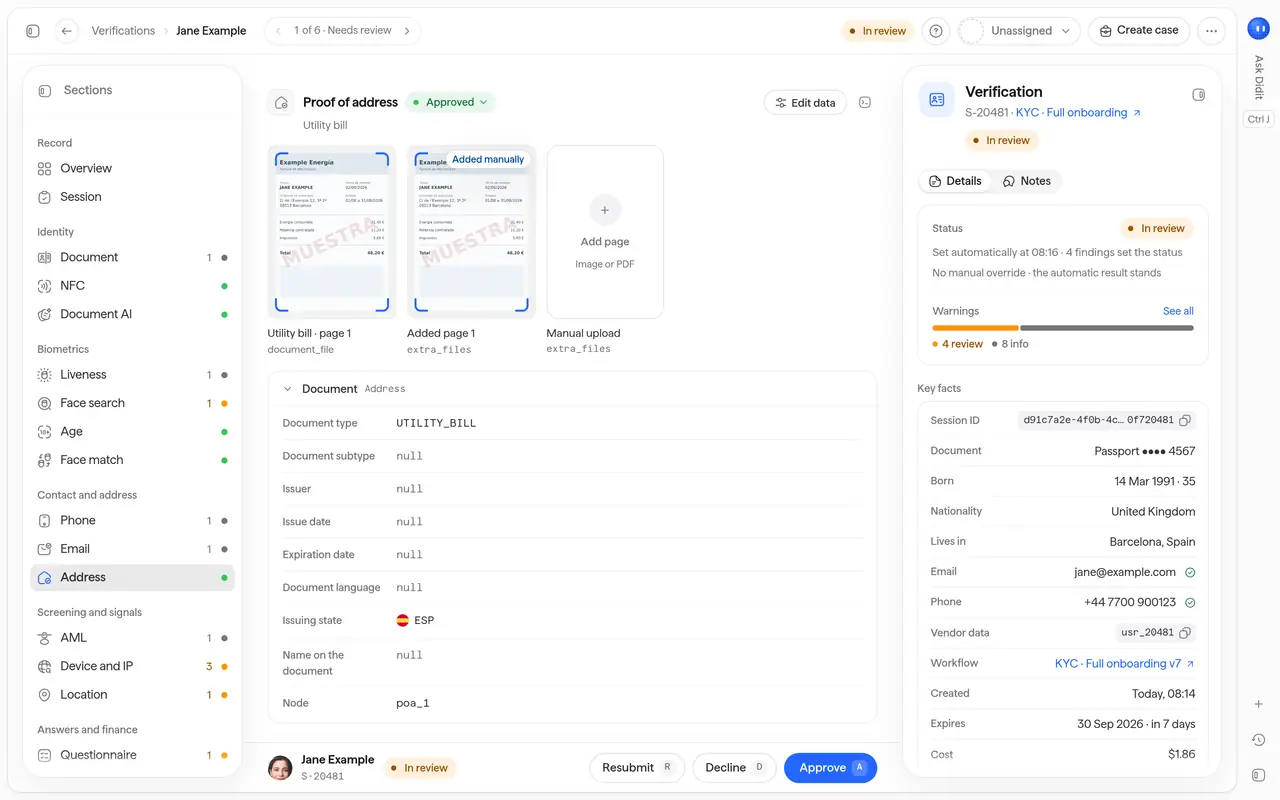
A separate proof-of-address step costs $0.20 per check and returns results in poa_verifications[]. If the ID document result contains an address, treat it as a separate field. For contact channels, email verification lists at $0.02 per check and phone verification starts at $0.02 plus the carrier price for the country and channel. In the United States, $0.0473 is the total SMS list price per code. Keep email and phone verification results separate from your identity and proof-of-address decisions.
Affordable ways to start
The cheapest path to a working integration is the sandbox, which is free on every plan and mocks every check. The Free plan also carries $10 of monthly credit for the first eligible organization created with a work email for the company domain, with phone verification codes excluded. Beyond that, the published plans are Growth at $99 a month with $115 of credit and 4% off Didit prices, Scale at $299 a month with $350 of credit and 10% off, and Enterprise as a custom annual contract starting at $15,000 a year. At list prices, 500 completed full KYC checks with one AML screening each cost $265 before credits.
Ship it with a coding agent
If you would rather have your coding agent write the integration, point it at the canonical recipe at didit.me/developers/integration-prompt. It covers the SDK choice, webhook HMAC verification, every status value and decision parsing. The MCP server is free on every plan, documented at didit.me/developers/mcp, and hosted at https://mcp.didit.me/mcp with OAuth sign-in.
Sources
- Didit docs: Quick Start
- Didit docs: API Authentication
- Didit docs: Create Session API
- Didit docs: ID Verification API
- Didit docs: AML Screening API
- Didit docs: Webhooks
- Didit docs: Integration prompt
- Didit docs: Pricing and billing rules
- Didit pricing page and cost estimator
- Didit pricing as JSON
- Didit public price book, including standalone API entries
- Didit MCP server
- Didit hosted MCP endpoint,
https://mcp.didit.me/mcp
The next step is a sandbox, not a sales call. Create an organization at business.didit.me, build the KYC and AML workflow, run one mocked session end to end, then switch the key when your policy and your review queue are ready.
Try it
Try this in the sandbox
Run the check this guide describes, free.
The product this post is about, taken from its topic. Run it free in the sandbox.
Author
Alejandro Rosas
Co-founder and CTO

Keep reading
Other guides in the same topic.
 What Is the Purpose of FICA in South Africa? 2026 Guide
FICA is South Africa's anti-money laundering law. It creates the Financial Intelligence Centre and requires accountable institutions to identify and verify clients, screen for PEP and sanctions risk and report suspicious.
Alberto RosasNov 26, 2026 Sixth Money Laundering Directive (6AMLD): What Changed and Which Rules Apply
6AMLD is Directive (EU) 2018/1673: Member States must criminalise laundering, widen predicate offences and set a four-year penalty floor. It adds no new due diligence duties for firms.
Alberto RosasNov 26, 2026 Automated Sanctions Screening: Canada, the Entity List and Embargoes
Automated sanctions screening matches people and companies against lists such as Canada's autonomous sanctions made under SEMA and JVCFOA and the OFAC SDN List, and returns candidate hits scored for identity confidence and.
Alberto RosasNov 26, 2026Questions
Frequently asked questions
When is Didit a fit for a US fintech?
We fit US fintech teams that want KYC, KYB and AML through one API with public unit prices and a self-serve sandbox. A full KYC check lists at $0.33 and an AML screening at $0.20, and 4,000+ companies use Didit. Compare that with your bank partner's preferred vendor and with the cost of building and maintaining the checks yourself before you commit.
How much does an API for identity verification cost?
On Didit, a full KYC check is $0.33: the ID document at $0.15, passive liveness at $0.10, face match 1:1 at $0.05 and device and IP analysis at $0.03. A full KYC check including device and IP analysis, plus one AML screening, totals $0.33 + $0.20 = $0.53 at list prices. The ID Verification step inside a workflow lists at $0.15. For standalone POST /v3/id-verification/ calls, use the separate API entry in the published price book.
Is there an AML KYC API that runs both checks in one session?
Yes. Add the AML feature to a KYC workflow and one session returns both the identity result and the AML screening in the same decision object, with id_verifications[] and aml_screenings[] side by side. At list prices, one completed full KYC check, including device and IP analysis, plus one AML screening costs $0.53. You can also call POST /v3/aml/ on its own to screen a person or company after onboarding.
Do I need a sales call to get an API key?
No. Sign up at business.didit.me, open Developers then API keys, and the Application already has a primary key. Sandbox testing is free and unlimited, and the Free plan carries $10 of monthly credit for the first eligible organization created with a work email for the company domain, with phone verification codes excluded. You can also register and verify programmatically through the auth API, and an organization created through the auth API starts at $0.
How do I test identity verification without paying for checks?
Use a key from a sandbox application. Sandbox keys skip screening and billing entirely and return mocked results, so a saved sandbox session is still retrievable through the decision endpoint. You can also pass a sandbox_scenario on session creation to reproduce a specific outcome, such as a decline, and rehearse your review queue before you go live.
What happens when an AML screening returns a hit?
On the standalone AML API, every hit carries a match_score for identity confidence and a risk_score for how much the entity matters. The default match threshold is 93, and hits below it are excluded from the risk score. The highest remaining risk score becomes aml.score. By default, scores above 80 enter In Review, while a score of exactly 80 is Approved with a POSSIBLE_MATCH_FOUND warning, and Declined requires exceeding the configured review threshold, which defaults to 100.
How does proof of address work for fintech onboarding?
A separate proof-of-address step costs $0.20 per check. In a V3 session decision, read its result in poa_verifications[] separately from any address extracted from the identity document.
Does the same API cover KYB as well as KYC?
Yes. The session endpoint is shared: a kyc workflow creates a user session and a kyb workflow creates a business session, with no separate endpoint. Business verification starts at $2.00 per company for registry retrieval, and owners and officers take a linked full KYC check plus person AML billed per person.
Which US rules apply to onboarding at a fintech?
US onboarding requirements depend on your product, regulated entity and bank relationship. Confirm with counsel and your bank partner which customer identification, beneficial ownership, sanctions and state licensing obligations apply and which records you need to retain. Use those requirements to choose your checks and review policy.
How long does it take to integrate the API?
Our quick start is designed to get a first session running in minutes. You create a workflow, create a session, redirect to the returned url, register a webhook and verify the signature. A production rollout also requires testing the webhook and deciding how your team handles each outcome.
Compliance built in
Audited, certified and attested.
We hold the certifications and build each country's rules into your flows, so you can launch anywhere without worrying. Security and Compliance center
- Regulation encoded into your flows
Tell us what you do and where. Didit lists the rules that apply to you, with sources, and builds the checks each country needs into one workflow.
- Ready for AMLR
Every requirement of the new EU anti-money laundering rules, from checking customers to human review, is already covered by a Didit check.
- Tested in Spain's Treasury sandbox
Spain's Treasury published its supervised sandbox report on Didit's NFC plus active liveness onboarding; SEPBLAC took part and valued the added measures positively.
- Audited, not self-declared
iBeta Level 1 and Level 2. Liveness tested under ISO/IEC 30107-3.
Your obligations · 3 regions
 SOC 2 Type 2
 ISO 27001
 iBeta Level 1 and Level 2
 EU regulator attestation
 FSM youth protection
 GDPR
 EBA remote onboarding
 MiCA compatible
 FIDO Alliance member
- AMLREU AML Regulation ready
Integration · Didit MCP
Run Didit from your own AI agent
Connect Didit to Claude, Cursor, VS Code or ChatGPT and just ask in plain words. Your agent can do anything you can do in the console, with the same permissions you have.
 Add to Claude
 ChatGPT
 Cursor
- Build workflowsDescribe the checks you need. The agent creates and publishes the flow.
- Run investigationsAsk why a session was declined, review cases, search people and companies.
- Change rulesCreate payment rules, test them on past data and switch them on.
- Pull reportsAsk for numbers, exports or the audit log.
Didit Academy


