Identity Verification Pricing: How Much Does KYC Really Cost in 2026?
A full KYC check costs $0.33 at Didit list price in 2026. AML screening adds $0.20. At 10,000 KYC plus AML checks a year, spread evenly with Scale billed monthly, the modeled cost is $4,158. Growth $99 a month, Scale $299.
 Alberto RosasCo-founder and CEO
Contents
In this guide
Jump to the part you need.
If you need document and biometric checks for onboarding, we charge $0.33 per completed full KYC check at list price. That covers ID document verification, passive liveness, face match, and device and IP analysis. AML screening adds $0.20. Your total depends on the checks you run, the plan you choose, and how much monthly credit you use before it expires.
Last updated: November 26, 2026. Prices checked against the live Didit price feed on November 26, 2026.
The short answer
| Check | Price | Unit |
|---|---|---|
| Full KYC: ID document, passive liveness, face match 1:1, device and IP | $0.33 | completed check |
| ID document verification alone, inside a workflow | $0.15 | check |
| AML screening against 1,300+ lists | $0.20 | check |
| Ongoing AML monitoring | $0.07 | person a year |
| KYB, official registry retrieval | From $2.00 per registry retrieval, depending on country and data tier | retrieval |
| Company AML screening, if run | $0.20 | check |
| Wallet screening | $0.15 | screening |
| Transaction monitoring beyond the plan allowance | $0.001 | transaction |
| Plan fees and commitments | Free $0/month. Growth $99/month or $1,128/year up front. Scale $299/month or $3,408/year up front. Enterprise from $15,000/year. | account |
Start free in the sandbox without a sales call. Developers can connect Didit to an AI assistant with our MCP server.
What decides a KYC bill: five questions to ask
A per-check rate is one line of your bill. Before you sign, ask these five questions, because the answers decide the real unit cost.
- What is the billable unit? A completed check, a session started, a person, a company, a year of monitoring or a single transaction? Ask for the exact event that creates a charge.
- Is the minimum credited against usage? If you commit to an annual minimum, does your usage draw it down, or is it a fee on top of the rates?
- Which partial or repeated checks incur charges? A no-match database lookup, a retry, a re-upload or a second face match may each count as a billable event.
- What setup fees apply? One-time integration, professional services hours or a mandatory onboarding package billed before the first live check runs.
- Which modules cost extra? AML screening, ongoing monitoring, NFC reading, proof of address, white label and re-authentication are commonly priced outside the headline package.
How to build your own total cost of ownership model
- List the checks your flow needs. A document plus liveness plus face match flow is a different purchase from KYC plus AML plus ongoing monitoring plus transaction monitoring.
- Write down the published unit price for each module. Mark unpublished prices as quote required. Compare totals once you have written rates for the same checks, volume and billing units.
- Treat a credited minimum and an uncredited minimum differently. If the annual minimum is credited against usage, budget the greater of the minimum and qualifying usage charges, then add any separate setup and seat fees. If the fixed fee buys no usage credit, add it to usage. Divide total spend by completed checks.
- Model your own retry and abandonment rate from your analytics, then apply it wherever a vendor bills per session started rather than per completed check.
Here is what that distinction does to one number. A $20,000 annual minimum that is credited against usage is a floor: at 1,000 checks a year and $0.53 a check, qualifying usage is $530, so you spend $20,000. The same $20,000 as a fee that buys no usage, on top of $530 of usage, is $20,530 for the same 1,000 checks.
Didit pricing: published prices for common checks
One plan covers every Didit product: Identity Verification, Authentication, and Transaction Monitoring with Travel Rule. One credit balance pays for all of them. Growth discounts eligible Didit prices by 4%, and Scale by 10%. Transaction-monitoring overage is $0.001 per transaction on every plan. Carrier and Meta charges pass through at cost. You pay for a check only when it finishes with a result.
| Plan | Plan fee and billing term | Included credit | Plan discount | Members |
|---|---|---|---|---|
| Free | $0.00 per month | $10.00 per month for eligible organizations | 0% | 2 |
| Growth | $99.00 per month, or $1,128 a year paid up front | $115.00 per month | 4% | 10 |
| Scale | $299.00 per month, or $3,408 a year paid up front | $350.00 per month | 10% | Unlimited |
| Enterprise | From $15,000 a year, annual contract | Annual commitment is the credit for the contract year | Set by contract | Unlimited |
Free has no subscription fee. Growth and Scale have paid subscriptions with monthly or annual billing. Enterprise starts at $15,000 a year, and its annual commitment is your credit for the contract year. Compare plans and estimate your cost on the Didit pricing page.
| Module | List price (USD) | Unit | Scale rate (USD) |
|---|---|---|---|
| Full ID check (KYC) | 0.33 | completed check | 0.297 |
| ID document verification | 0.15 | check | 0.135 |
| ID verification API, standalone | 0.20 | call | 0.18 |
| Passive liveness | 0.10 | check | 0.09 |
| Active liveness | 0.15 | check | 0.135 |
| Face match 1:1 | 0.05 | check | 0.045 |
| Face search 1:N | 0.05 | search | 0.045 |
| Age estimation | 0.10 | check | 0.09 |
| AML screening | 0.20 | check | 0.18 |
| Ongoing AML monitoring | 0.07 | person a year | 0.063 |
| Proof of address | 0.20 | check | 0.18 |
| NFC passport chip reading | 0.15 | check | 0.135 |
| Database validation | variable by service | check | variable |
| KYB registry retrieval | variable by country and data tier, from 2.00 | retrieval | variable |
| Person AML, per UBO or officer | 0.20 | person | 0.18 |
| KYB document step | 0.20 | step | 0.18 |
| Company registry monitoring | 2.00 | company a year | 1.80 |
| Transaction monitoring | 0.001 | transaction beyond the allowance | 0.001 |
| Wallet screening | 0.15 | screening | 0.135 |
| White label flow | 0.10 | check | 0.09 |
| MCP server, workflow builder, SDKs | 0.00 | included | 0.00 |

Two lines on that table are not fixed. Database validation is priced per service, and KYB registry retrieval is priced by country and data tier, so read the per-service table before you forecast either one. Company registry monitoring is different: it is a fixed $2.00 per company a year at list, $1.80 on Scale.
The ID verification product page shows what the $0.15 document line reads. We support 14,000+ document types across 220+ countries and territories. The verification flow and native SDKs support 54 interface languages. The business verification page covers the KYB tiers and the ownership data each one returns.
Worked cost example: 10,000 checks a year
Take 10,000 completed onboarding checks a year, each a full KYC check plus AML screening. Assume the volume is spread evenly at about 833 or 834 checks a month, and that each month's plan credit is spent within that month, because unused monthly credit expires at the end of the plan month.
- Per check at list price: $0.33 + $0.20 = $0.53.
- 10,000 x $0.53 = $5,300 at list price.
- On Scale the same two lines are $0.297 + $0.18 = $0.477 per check.
- Scale costs $299 a month, so $299 x 12 = $3,588 a year in plan fees, and it adds $350 of credit a month, $4,200 across the year.
- Assuming 833 or 834 checks each month, every month uses the full $350 credit. Checks cost 10,000 x $0.477 = $4,770. Monthly credits cover $4,200 across the year, leaving $570 in top-up credit consumed. On monthly billing, the total modeled cost is $3,588 + $570 = $4,158. Actual cash top-ups are purchased in increments of at least $50, so cash paid during the year can differ.
Free, Growth and Scale on the same 10,000-check flow
| Plan | Rate per KYC plus AML check | Check charges | Plan fees, 12 months | Total plan credit used over 12 months | Top-up credit consumed | Modeled total |
|---|---|---|---|---|---|---|
| Free | $0.53 | $5,300 | $0 | $120 | $5,180 | $5,180 |
| Growth | $0.5088 | $5,088 | $1,188 | $1,380 | $3,708 | $4,896 |
| Scale | $0.477 | $4,770 | $3,588 | $4,200 | $570 | $4,158 |
Growth on annual billing costs $1,128 paid up front instead of $1,188, so the same flow totals $4,836. The Free column assumes the organization qualifies for the $10 monthly credit.
What 1,000, 10,000 and 100,000 checks cost
| Completed checks a year | KYC at list, $0.33 | KYC on Scale, $0.297 | KYC plus AML at list, $0.53 | KYC plus AML on Scale, $0.477 |
|---|---|---|---|---|
| 1,000 | $330 | $297 | $530 | $477 |
| 10,000 | $3,300 | $2,970 | $5,300 | $4,770 |
| 100,000 | $33,000 | $29,700 | $53,000 | $47,700 |
These are check charges before plan fees and before plan credit. Subtract the credit you actually use in the year and add the subscription fee to get your total.
Two more volume examples. At 1,500 checks, 1,500 x $0.33 = $495, and with AML at $0.53 it is $795. At 4,000 checks a day, 4,000 x $0.33 = $1,320 a day; across a year that is 1,460,000 checks, 1,460,000 x $0.33 = $481,800 at list, or 1,460,000 x $0.297 = $433,620 at the Scale rate, before plan credit. At that size Enterprise is the plan to discuss, and Enterprise contracts start at $15,000 a year.
Which provider can you evaluate from published KYC prices?
Didit publishes this ranking; we explain the criteria so you can check them.
Persona persona.io, read November 26, 2026, describes a one-click password manager. Its best fit is someone looking for password management. The page supplies no evidence of a KYC product or KYC pricing. The sources reviewed support only one KYC ranking.
#1. Didit for buyers who need published, self-serve KYC pricing
We're a fit for teams that need published, self-serve rates for document and biometric KYC, business verification, AML screening and transaction monitoring.
Verdict by use case
| Use case | Best for | Why |
|---|---|---|
| A startup that wants to test KYC this week | Didit | $0.33 per check is published, the sandbox is free, and self-serve plans carry no annual minimum |
| A marketplace verifying companies and their owners | Didit | Registry retrieval starts at $2.00 per company. If your workflow runs them, company AML costs $0.20 per check, person AML costs $0.20 per person screened, and linked full KYC costs $0.33 per completed check. |
| A crypto exchange or VASP | Didit | AML screening, ongoing monitoring, wallet screening and transaction monitoring are priced per unit on one balance |
| A buyer who needs a custom annual contract | Didit | Enterprise starts at $15,000 a year, and the annual commitment is credited against usage |
Strengths and limitations
Didit
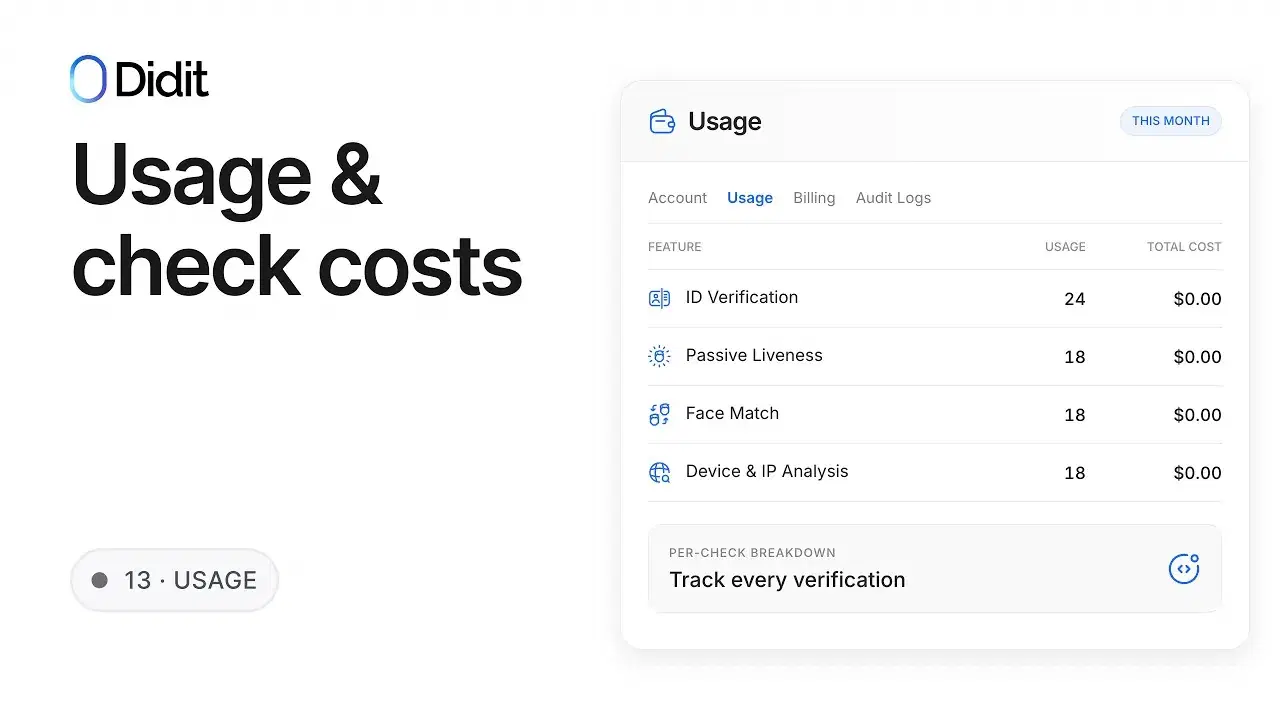
- Strength: the price list is public. Every module above can be read before a call, and the feed at https://didit.me/pricing.json is machine-readable. Use our public price feed for list prices and the Console's Usage view for what your organization was charged.
- Strength: one balance across three product lines. KYC, KYB and transaction monitoring draw on the same credit, so adding an AML step does not start a new procurement cycle.
- Strength: billing per completed check. Sandbox sessions are never billed, and you are charged when a check finishes with a result.
- Limitation: modules add up. Budget separately for KYC, AML screening, ongoing AML monitoring and wallet screening. Add $0.001 for each monitored transaction beyond your plan's monthly allowance.
- Limitation: some lines are variable. Database validation is priced per service and KYB registry retrieval by country and data tier, so read those tables before you forecast.
- Limitation: below $15,000 a year, self-serve is the route. A bespoke annual contract with a named team starts at $15,000 a year.
How to migrate without breaking onboarding
- Write down what your current flow actually bills. Per-check rate, minimum, setup fee, and every module on the invoice. That list is the baseline you compare against.
- Rebuild it in a sandbox application. Every product is on in a sandbox application, outcomes are deterministic, and sessions are never billed. The sandbox testing docs list the scenarios and magic values.
- Test the integration in sandbox with specimen documents and fictional data. If your privacy and compliance team approves a live pilot, compare decisions on a limited set of authorized live sessions. Keep real personal data out of sandbox.
- Test decision retrieval before cutover. For a hosted flow, configure a workflow and create a session. Fetch the decision or subscribe to the status webhook. If you already have the document images, use the standalone ID verification API.
- Keep records your team can review or retain. The session payload, the warnings array and the decision are the records a review usually needs. Retention depends on your plan: 1 year on Free, 5 on Growth, up to 10 on Scale.
GET https://verification.didit.me/v3/session/{sessionId}/decision/
x-api-key: YOUR_API_KEY
You can also subscribe to the session.status.updated webhook. Its payload carries an environment value of sandbox or live.

Teams moving from another provider can start at https://didit.me/switch/. If you would rather an agent wrote the first integration, the MCP server and the integration prompt are free.

Sources
- Didit pricing page and cost estimator, read November 26, 2026.
- Didit pricing as JSON, read November 26, 2026.
- Didit docs: identity verification pricing, read November 26, 2026.
- Didit docs: billing and plan in the console, read November 26, 2026.
- Didit docs: sandbox test data, read November 26, 2026.
- Didit docs: ID verification overview, read November 26, 2026.
- Didit docs: KYB registry pricing by country, read November 26, 2026.
- Didit ID verification product page and business verification product page, read November 26, 2026.
- Didit Business Console and sandbox, opened November 26, 2026.
- Switch to Didit, read November 26, 2026.
- Didit MCP server and integration prompt, read November 26, 2026.
- Persona persona.io, read November 26, 2026. Password manager description, free plan limit of 30 logins a month, premium at $3.99 a month or $29.99 a year, and encryption claims as published on that page. No KYC product or KYC price is published there.
- FATF for the AML and travel rule context behind screening and monitoring line items.
Start in the sandbox at https://business.didit.me/. No sales call is required, and 500 test sessions per application every 24 hours are free. When you are ready to model the bill, read the published prices for common checks and run the estimator at https://didit.me/pricing/.
Try it
Try this in the sandbox
Run the check this guide describes, free.
The product this post is about, taken from its topic. Run it free in the sandbox.
Author
Alberto Rosas
Co-founder and CEO

Keep reading
Other guides in the same topic.
 What Is the Purpose of FICA in South Africa? 2026 Guide
FICA is South Africa's anti-money laundering law. It creates the Financial Intelligence Centre and requires accountable institutions to identify and verify clients, screen for PEP and sanctions risk and report suspicious.
Alberto RosasNov 26, 2026 Sixth Money Laundering Directive (6AMLD): What Changed and Which Rules Apply
6AMLD is Directive (EU) 2018/1673: Member States must criminalise laundering, widen predicate offences and set a four-year penalty floor. It adds no new due diligence duties for firms.
Alberto RosasNov 26, 2026 Automated Sanctions Screening: Canada, the Entity List and Embargoes
Automated sanctions screening matches people and companies against lists such as Canada's autonomous sanctions made under SEMA and JVCFOA and the OFAC SDN List, and returns candidate hits scored for identity confidence and.
Alberto RosasNov 26, 2026Questions
Frequently asked questions
How much does a full KYC check cost in 2026?
With Didit, a full KYC check is $0.33 per completed check at list price: $0.15 for ID document verification, $0.10 for passive liveness, $0.05 for face match 1:1 and $0.03 for device and IP analysis. Adding AML screening at $0.20 brings it to $0.53. On the Scale plan those two lines are $0.297 and $0.18, so the same flow is $0.477 per check.
Is Didit free to use?
Free costs $0 a month. The first organization created in the console with an eligible company-domain work email receives $10 of credit each month. Organizations created through the API start at $0, unused monthly credit expires, and Free credit does not cover phone verification codes. The sandbox is free on every plan, with 500 test sessions per application every 24 hours.
Does Didit charge for failed or abandoned checks?
Sandbox sessions are never billed. A live check that produces a result can be billed even if the user later abandons the session. Check the pricing docs for billable retries and no-match database lookups.
Is there a minimum spend or annual commitment at Didit?
Free has no subscription fee. Growth is $99 a month and Scale is $299 a month, both with monthly or annual billing. Enterprise starts at $15,000 a year, and its annual commitment is credited against usage. Included members are 2 on Free, 10 on Growth, and unlimited on Scale and Enterprise.
How do monthly credit and top-up expiry change my annual bill?
Plan credit lands on the first day of each plan month and expires at the end of it, so it never rolls over. Top-ups are added at face value from $50 to $20,000, last 12 months from the day you add them, and are spent oldest first after the month's credit. Uneven demand therefore wastes monthly credit in quiet months and draws on top-ups in busy ones, so model each month rather than the annual average.
What does 1,500 identity checks cost with Didit?
At the $0.33 list price, 1,500 x $0.33 = $495. With AML screening added at $0.20, 1,500 x $0.53 = $795. On the Scale plan, 1,500 x $0.297 = $445.50 for the KYC line alone, before any plan credit is applied.
What does 4,000 checks a day cost with Didit?
At the $0.33 list price, 4,000 x $0.33 = $1,320 a day, and 4,000 x 365 = 1,460,000 checks a year, so 1,460,000 x $0.33 = $481,800. At the Scale rate of $0.297 the same annual volume is $433,620, before subscription fees and any plan credit used. At that volume, Enterprise from $15,000 a year is worth discussing.
What is the best identity verification pricing model in 2026?
If your demand is variable, published per-completed-check pricing with no annual floor fits best, because you pay only for checks that produce a result and you can model the bill before a call. If your volume is predictable and large, a committed annual contract can beat list rates, but check first whether the commitment is credited against usage. The model to avoid is an uncredited annual minimum combined with billing per session started, because you pay for capacity you do not use and for sessions that never return a decision.
What does business verification cost with Didit?
At list price, KYB registry retrieval starts at $2.00 per company and varies by country and data tier. If you run company AML screening, add $0.20 per check. Budget $0.20 for each person AML screening and $0.33 for each linked full KYC check. Company registry monitoring is $2.00 per company a year, and a KYB document step is $0.20.
What is the difference between the workflow document check and the standalone API?
Inside a workflow, the ID document step is $0.15, and a full KYC check that adds passive liveness, face match and device and IP analysis is $0.33. The standalone server-to-server ID verification API is $0.20 per call, for when you already hold the document images and do not need a hosted session. The documented route is a workflow plus POST /v3/session/ for a hosted flow, or POST https://verification.didit.me/v3/id-verification/ for a direct upload.
Can I test the API before paying anything?
Yes. The sandbox is free on every plan, and each sandbox application can create 500 test sessions every 24 hours, a quota Enterprise can raise on request. Sandbox sessions are never billed, every product is switched on, and each sandbox application starts with examples for verifications, users, businesses, transactions, cases and authentication.
Do I need a sales call to start with Didit?
No sales call is required to start in the sandbox. Enterprise contracts start at $15,000 a year, and Enterprise customers can request a higher sandbox quota.
What counts as a check for billing?
A check is one completed unit that returns a result. For onboarding that is usually a completed full KYC check at $0.33, but other billing units are separate: a wallet screening at $0.15, a person-year of AML monitoring at $0.07, and a transaction beyond the plan allowance at $0.001. Each has its own unit and its own line on the bill.
What should I ask a vendor that will not publish prices?
Ask for the billable event, whether the minimum is credited against usage, which retries and no-match lookups incur charges, and the rate per country or per data tier for anything variable. Ask for the price of the exact service you plan to call, not a headline starting rate. A vendor that will not answer those four questions in writing is telling you something about the contract.
Compliance built in
Audited, certified and attested.
We hold the certifications and build each country's rules into your flows, so you can launch anywhere without worrying. Security and Compliance center
- Regulation encoded into your flows
Tell us what you do and where. Didit lists the rules that apply to you, with sources, and builds the checks each country needs into one workflow.
- Ready for AMLR
Every requirement of the new EU anti-money laundering rules, from checking customers to human review, is already covered by a Didit check.
- Tested in Spain's Treasury sandbox
Spain's Treasury published its supervised sandbox report on Didit's NFC plus active liveness onboarding; SEPBLAC took part and valued the added measures positively.
- Audited, not self-declared
iBeta Level 1 and Level 2. Liveness tested under ISO/IEC 30107-3.
Your obligations · 3 regions
 SOC 2 Type 2
 ISO 27001
 iBeta Level 1 and Level 2
 EU regulator attestation
 FSM youth protection
 GDPR
 EBA remote onboarding
 MiCA compatible
 FIDO Alliance member
- AMLREU AML Regulation ready
Integration · Didit MCP
Run Didit from your own AI agent
Connect Didit to Claude, Cursor, VS Code or ChatGPT and just ask in plain words. Your agent can do anything you can do in the console, with the same permissions you have.
 Add to Claude
 ChatGPT
 Cursor
- Build workflowsDescribe the checks you need. The agent creates and publishes the flow.
- Run investigationsAsk why a session was declined, review cases, search people and companies.
- Change rulesCreate payment rules, test them on past data and switch them on.
- Pull reportsAsk for numbers, exports or the audit log.
Didit Academy