Identity Verification for Dating Apps: A 2026 How-To
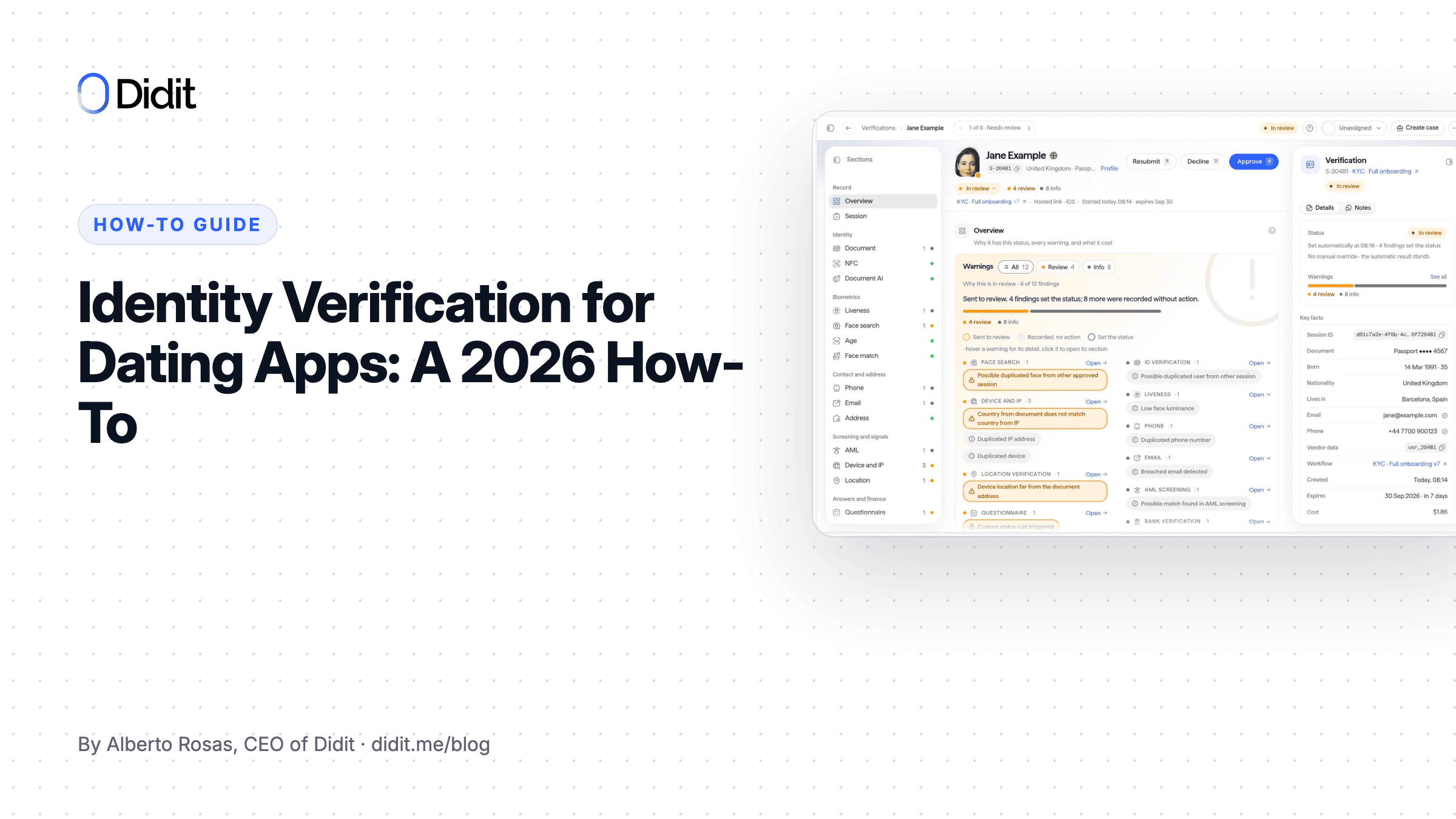
Dating apps can require a $0.33 full ID check before the first message. It covers document authenticity, passive liveness, selfie-to-ID matching, and device and IP analysis. Hosted liveness flags possible duplicates.
 Alberto RosasCo-founder and CEO
Contents
In this guide
Jump to the part you need.
This guide fits dating and social apps where a new profile can send a first outbound message before anyone checks who is behind it. On Didit a full ID check costs $0.33 per completed check and a standalone face search costs $0.05, at list prices. A full ID check assesses document authenticity, liveness, whether the selfie matches the document portrait, and the device and IP signals. Your team decides what the result means for account access.
Last updated: November 26, 2026. Prices checked against the live Didit price feed on November 26, 2026.
| Check | Price (USD) | Unit | Question it answers |
|---|---|---|---|
| Full ID check (KYC) | $0.33 | completed check | Does the document pass authenticity checks, does the live selfie match its portrait, and do the device and IP signals look consistent? |
| Face search 1:N, standalone | $0.05 | search | Has this face been seen before in your index, or is it blocklisted? |
| Biometric authentication | $0.10 | authentication | Is this the same person coming back? |
| Age estimation | $0.10 | check | What age does the selfie check estimate? |
| Passive liveness | $0.10 | check | Is a live person present, not a screen replay? |
| Face match 1:1 | $0.05 | check | Does this face match the document portrait? |
| Device and IP analysis | $0.03 | check | Duplicate devices, VPN, Tor, location mismatch |
| Email verification | $0.02 | check | Can the user verify access to this email address? |
| Phone verification | $0.02 + carrier charge | code | Can the user verify access to this number? |
Start free in the sandbox at business.didit.me and run the first check in minutes, with no sales call. If you build with a coding agent, connect Didit to it through the MCP server. Plans and the cost estimator are on didit.me/pricing.
How we recommend verifying dating profiles
The outcome we recommend: require verification before the first message and review potential duplicate accounts against your enrolled users. The hosted session already checks for duplicates during liveness. The standalone Face Search is an optional follow-up when you have a dedicated selfie to search.
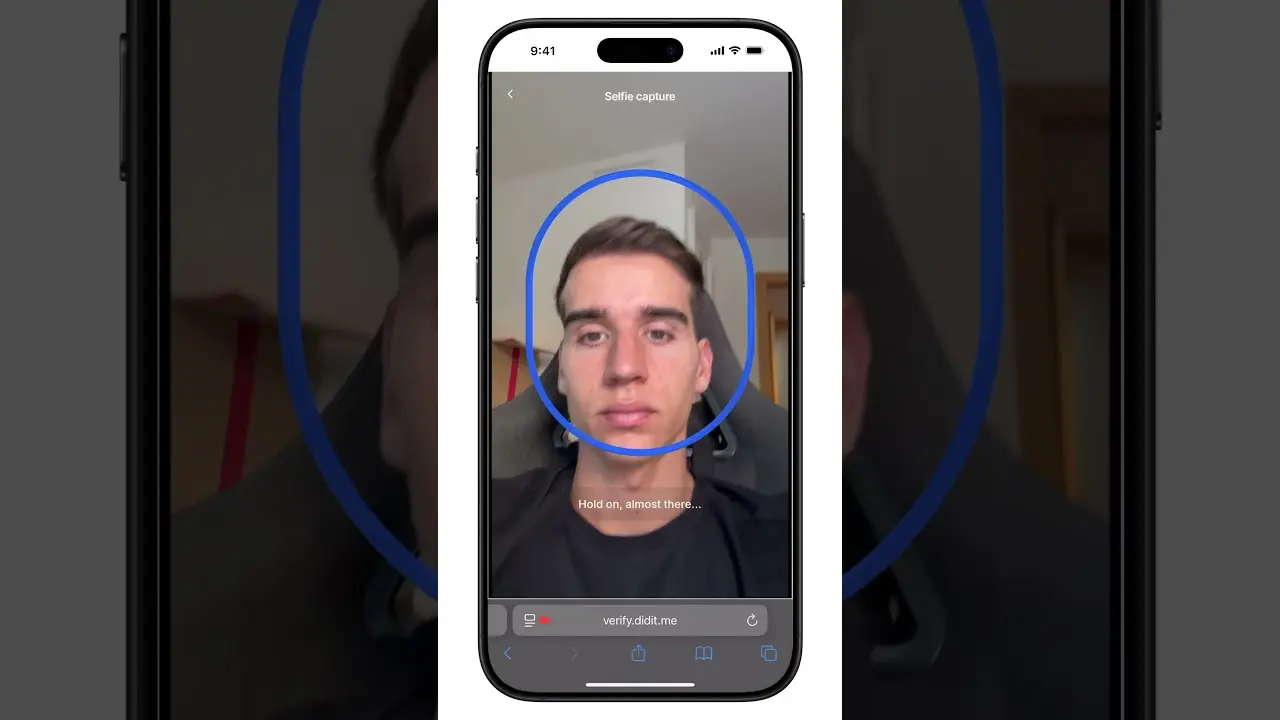
- Prove the person. One hosted session collects a government ID and a liveness selfie, and Face Match 1:1 compares the selfie with the portrait on the document. With Device & IP Analysis added, that is the full ID check at $0.33.
- Check for possible duplicate accounts. Face Search 1:N compares a face with the users you already approved and with your blocklist. A blocklist hit is a hard decline. A duplicate match is a candidate for review, and you apply your own policy.
- Re-check when risk rises. Biometric authentication at $0.10 asks the returning user for a selfie and compares it with the reference face you already stored, so you do not need the passport again.

The hosted checks use the session API and deliver status updates by webhook. A standalone Face Search returns its result directly to the caller. Product detail is in the User Verification product page, the ID Verification docs and the Face Search docs.
Prerequisites
- A Didit organization created in the console at business.didit.me with a work email for your company domain. The Free plan offers $10 a month to the first eligible organization created in the console with a work email for its company domain. The credit does not roll over or cover phone codes. About 30 full ID checks fit within $10 at list price. Sandbox testing is free on every plan.
- A workflow you publish in the console, or create with the API as shown below. The workflow decides which checks run in the session.
- An API key from that organization. The quick start shows the two programmatic calls if you prefer to register from code: docs.didit.me/getting-started/quick-start.
- A return URL is optional. Send
callbackwhen you want the hosted flow to return the user to a specific page. When your application has allowed domains configured, an HTTP or HTTPS callback must match one of them on scheme, host and port. Custom URL schemes such as amyapp://app deep link are always accepted. - A stored identifier per user, passed as
vendor_data. This binds a session to a dating profile, and it is how duplicate detection knows who is who. - A written policy before you launch: who gets verified (everyone at signup, or everyone at first message), what a duplicate means, and who reviews the borderline cases. The checks return evidence, not an account verdict.
Step-by-step: from organization to a verified profile
-
Create the dating workflow, and add Device & IP Analysis in the console
The curl example below is a three-step starting workflow: document reading, passive liveness and face match. Open the workflow in the console and add Device & IP Analysis before you test the $0.33 full check configuration, because the published $0.33 price includes it.
curl -X POST https://verification.didit.me/v3/workflows/ \
-H "x-api-key: $DIDIT_API_KEY" \
-H "Content-Type: application/json" \
-d '{
"workflow_label": "Dating profile KYC",
"workflow_type": "kyc",
"features": [
  {"feature": "OCR"},
  {"feature": "LIVENESS", "config": {"face_liveness_method": "PASSIVE"}},
  {"feature": "FACE_MATCH"}
]
}'
Keep the returned
workflow.idand use it for every signup. Age estimation is a separate step: start from the Adaptive Age Verification template in the console, which runs a selfie age check and includes an ID fallback, and set the fallback policy there. -
Register the webhook destination before the first session
Set up delivery first, so the first decision has somewhere to land. Register one destination and subscribe to
status.updatedanddata.updated.curl -X POST https://verification.didit.me/v3/webhook/destinations/ \ -H "x-api-key: $DIDIT_API_KEY" \ -H "Content-Type: application/json" \ -d '{"label": "Production", "url": "https://myapp.com/api/webhooks/didit", "subscribed_events": ["status.updated", "data.updated"], "webhook_version": "v3"}'Store the returned
secret_shared_keyas your signing secret. On your handler, read the raw body before parsing it. Check thatX-Timestampis within five minutes of now, recompute HMAC-SHA256 over the sorted, Unicode-preserved canonical JSON with the destination secret, and compare the result withX-Signature-V2in constant time. Deduplicate onevent_idand return 2xx within five seconds. The reference is at docs.didit.me/integration/webhooks. -
Open a session when the user reaches the gate
The session is the verification itself. Create it server-side, then redirect the user to the returned
url. Replace the example UUID below with the workflow you published: it is a placeholder, not a live workflow.curl -X POST https://verification.didit.me/v3/session/ \ -H "x-api-key: $DIDIT_API_KEY" \ -H "Content-Type: application/json" \ -d '{"workflow_id": "7b1f4d2c-3a5e-4f6b-8c9d-0e1f2a3b4c5d", "vendor_data": "user-42", "callback": "https://myapp.com/kyc/return"}'Didit appends
verificationSessionIdandstatusto the callback, so the return screen knows what happened. Use the redirect only to display progress. Grant account access after you process a verified webhook, or after you fetch the decision server-side. -
Search a submitted selfie against your enrolled accounts
Face Search also runs automatically during liveness checks inside a verification session. Use the standalone endpoint when the account holder submits a dedicated selfie for duplicate checking, for example during a manual review of a profile.
curl -X POST 'https://verification.didit.me/v3/face-search/' \
-H 'x-api-key: YOUR_API_KEY' \
-F 'user_image=@./selfie.jpg' \
-F 'search_type=most_similar' \
-F 'vendor_data=user-123'
Search the selfie the account holder submitted, not an image pulled from a chat. A chat photo can depict a third party, and the endpoint picks the largest face when several are present, so a match cannot be attributed to the sender. The response is a singular
face_searchobject withtotal_matchesand amatchesarray. Each match carriessimilarity_percentageandis_blocklisted. Treat matches as candidates for review, and do not assume every match identifies a dating profile. -
Re-verify returning users with biometric authentication
When a user changes device, changes country, or is about to move a conversation off-platform, create a session on a biometric authentication workflow for the same
vendor_data. Replace the example UUID with your published biometric authentication workflow UUID. Didit reuses the stored face: approved liveness face first, then ePassport chip photo, then ID document portrait, then a manually enrolled profile face.curl -X POST https://verification.didit.me/v3/session/ \ -H "x-api-key: $DIDIT_API_KEY" \ -H "Content-Type: application/json" \ -d '{"workflow_id": "2c9e6a10-5d4b-4a7f-9e8c-3b2a1f0d9c8e", "vendor_data": "user-42"}'If no stored face exists for that user, send
portrait_imageas base64 (JPEG, PNG, WebP or TIFF, max 2MB), or creation fails with a 400. -
Turn warnings into product actions
Do not stop at the top-level status. The V3 decision includes arrays such as
id_verifications[],liveness_checks[]andface_matches[]. For document checks, read the warnings on the relevantid_verifications[]entry. Map the warnings you care about to an action your product can take: hide the profile, require a second check, open a review case. -
How to enforce a minimum age before the first message
Use the verified date of birth from ID Verification, which the document check extracts. Or start with the Adaptive Age Verification template, which runs a selfie age check, and use its ID fallback when the selfie estimate leaves age unresolved.
-
Test approval, decline and review in the sandbox
Sandbox applications accept
sandbox_scenarioon session creation, which reproduces a specific outcome. Arm one scenario for an approval, one for a decline and one for a manual review, then run each through your own access policy and confirm the app does the right thing before you move to the live key.

Expected output
The webhook arrives as an envelope. This excerpt shows selected fields from an Approved live session webhook. The full payload includes the decision object.
{
  "event_id": "3f6b1c70-9a2d-4e51-b0c3-7d8e9f0a1b2c",
  "session_id": "a1b2c3d4-e5f6-4a7b-8c9d-0e1f2a3b4c5d",
  "status": "Approved",
  "webhook_type": "status.updated",
  "environment": "live",
  "workflow_id": "7b1f4d2c-3a5e-4f6b-8c9d-0e1f2a3b4c5d",
  "vendor_data": "user-42",
  "metadata": { "plan": "premium" }
}
Status is one exact, case-sensitive string per event. Other possible values are Declined, In Review, In Progress, Not Started, Abandoned, Expired, Kyc Expired, Resubmitted and Awaiting User. Note that Kyc Expired takes a single capital K. The decision object appears only on Approved, Declined, In Review and Abandoned, and it mirrors the decision endpoint. Fetch GET https://verification.didit.me/v3/session/{session_id}/decision/ as the fallback when a delivery is lost.

Inputs and outputs
| Field | Required | Use on a dating app |
|---|---|---|
workflow_id | Yes | The published workflow that decides which checks run |
vendor_data | Strongly recommended | Your profile id, used for duplicate detection across sessions |
callback | No | Where the hosted flow returns the user, with session id and status appended |
metadata | No | Echoed back to you, never shown to the user |
tags | No | Up to 10 labels for filtering sessions in the console |
language | No | ISO 639-1 code for the verification UI |
contact_details | No | Pre-fills phone and email steps, optionally sends notifications |
expected_details | No | Name, date of birth, nationality and document-issuing country you already hold, the last two as ISO-3 codes; mismatches surface as warnings |
session_expiration_time | No | Link lifetime in seconds, 3600 to 2419200 |
multi_account_segment | No | Separate duplicate-detection realms for separate account bases |
portrait_image | Conditional | Reference face for biometric authentication when no face is stored |
user_state | No | ISO 3166-2 code. In Auto consent mode, sending Illinois, Texas or Colorado triggers explicit biometric consent before the first face capture unless you pass previously collected consent in biometric_consent |
biometric_consent | No | Consent you already collected, with timestamp and text version; when sent, the flow does not ask again |
Outputs you act on: session_id, url and session_token from the create call, the status from the webhook, and the per-feature arrays in the decision. A standalone Face Search returns total_matches and matches[] with similarity scores.
Failure cases and how to recover
| Symptom | Cause | Recovery |
|---|---|---|
| 403 with a permission message | Missing API key | Send the x-api-key header |
| 401 | Wrong, revoked or expired API key | Check or replace the key for the correct environment |
| 400 on session creation | Invalid workflow_id, or a callback outside your allowed domains | Re-read the workflow UUID; add the callback origin to allowed domains |
| 400 on Face Search | No detectable face in user_image | Ask the account holder for a new selfie; the largest face wins when several are present |
| 403 on a check | Not enough credit | Top up or move to a paid plan; the sandbox keeps working |
Status Declined with FACE_IN_BLOCKLIST | Definitive blocklist hit | Reject, and do not let support override it without a written exception |
Status Declined with DOCUMENT_EXPIRED or DOCUMENT_LIVENESS_FAILED | Terminal document warning | Show the first warning text to the user and ask for a different document |
| Status In Review | The session was routed to review, for example on a possible blocklist match or a forgery check that could not be computed | Treat the evidence as unresolved and route it to your manual queue |
| No webhook, or your endpoint answered 5xx, 404 or timed out | Didit logged an HTTP error or a timeout | Didit retries twice, about 1 and 4 minutes later, then drops the delivery. Resend from the destination delivery log |
| User says the link expired | The session link passed its lifetime | Create a fresh session for the same vendor_data |
What first-message access does with each result
| Result | First-message access | Recovery action |
|---|---|---|
| Approved | Allow messaging after any required age check passes. Keep messaging off while age is unresolved or if the user is below your minimum. | If the decision also carries a duplicate warning, keep the account active and queue the profile for review |
| Declined | Block messaging | Show the first terminal warning. Limit retries to recoverable failures such as an expired document or unusable capture. Direct definitive blocklist declines to the existing review or appeal policy. |
| Manual review | Keep messaging off until a person decides | Have a reviewer open the verification result and read the warnings that triggered review |
| Duplicate match in standalone Face Search | Use the hosted session decision and any required age check to determine messaging access. | Investigate the match using your account identifiers. Apply your duplicate-account policy after review and confirm control of both accounts before any merge. |
| Abandoned or never started | No access | Send one reminder, then create a new session with the same vendor_data when the user returns |
Paid steps and review boundaries
- Didit bills completed checks. If a user abandons a workflow after an individual check returns a result, that check can still be billed. A user who never starts verification costs nothing.
- The $0.33 full ID check is one bundled price: ID document $0.15, passive liveness $0.10, face match 1:1 $0.05, Device & IP Analysis $0.03. The document check alone is its own line at $0.15.
- Standalone Face Search costs $0.05 per search. Face Search also runs automatically during hosted liveness checks. The supplied price feed does not specify a separate rate for that automatic comparison. A pure duplicate match returns Approved in the standalone Face Search response. Use the match as a review signal under your account policy.
- Biometric authentication costs $0.10 per authentication at list price. Use it to compare a returning user's selfie with their stored reference face.
- Hard declines are automatic: a blocklisted face returns Declined, and you should act on it.
- Borderline results are yours to review. Possible blocklist matches, status In Review, and any document whose forgery check could not be computed belong in a human queue. Do not auto-approve them. Didit returns the evidence; your team makes the account decision.
Worked cost example
Take a dating app with 20,000 new signups a month that verifies people at their first message. Assume 12,000 completed full ID checks and 8,000 users who never start verification. The app also runs the standalone face search on 5,000 dedicated selfies that reviewers ask for, and 2,000 users hit a risk signal and get a step-up re-check at first message. The totals below cover the specified completed checks.
- 12,000 full ID checks x $0.33 = $3,960.00
- 5,000 standalone face searches x $0.05 = $250.00
- 2,000 biometric authentications x $0.10 = $200.00
- Total at list price: $3,960.00 + $250.00 + $200.00 = $4,410.00 a month
Growth discounts all three checks in this example by 4%: 12,000 x $0.3168 = $3,801.60, 5,000 x $0.048 = $240.00 and 2,000 x $0.096 = $192.00, so $4,233.60 of usage. Apply the $115 of monthly credit and the plan fee: $4,233.60 - $115.00 + $99.00 = $4,217.60 effective monthly cost, before tax.
On Scale the discount is 10%: 12,000 x $0.297 = $3,564.00, 5,000 x $0.045 = $225.00 and 2,000 x $0.09 = $180.00, so $3,969.00 of usage. Apply the $350 of monthly credit and the plan fee: $3,969.00 - $350.00 + $299.00 = $3,918.00 effective monthly cost, before tax.
Those two figures are effective monthly costs, not top-up purchase amounts. Top-ups are added at face value, from $50 to $20,000 each, and last 12 months. The full list, including the estimator, is on didit.me/pricing, and the billing rules are in the pricing docs.
Signup gate or first-message gate: what to measure
Both placements work, and they fail in different ways. A signup gate can keep unverified profiles out of discovery if you require approval before listing, at the cost of asking for a document from people who may never message anyone. A first-message gate defers verification until someone tries to send a message, so a profile stays live until that moment. Measure three numbers in the first month.
- Gate outcomes. Report approved, declined, abandoned and unresolved sessions separately for each gate. For the access rate, divide unique users granted messaging access by unique users who reached that gate.
- Manual-review volume: sessions that land in In Review per 1,000 verified users.
- Duplicate flags your reviewers clear: duplicate warnings raised, and the share they close with no action.
If completion at signup is far below completion at first message, move the gate later. If duplicate flags keep arriving after approval, review whether the flags are confirmed and whether harm occurs before the first message. Move the gate earlier only if earlier verification would address the observed harm.
Sources
- Didit docs: Quick Start
- Didit docs: Create Session API
- Didit docs: Webhooks
- Didit docs: Pricing and billing
- Didit docs: ID Verification
- Didit docs: Face Search 1:N
- Didit docs: Device and IP Analysis
- Didit User Verification product page
- Didit pricing page and pricing as JSON, read November 26, 2026
- Didit MCP server
Next step: open the sandbox at business.didit.me, publish your dating workflow, add Device & IP Analysis to reach the $0.33 full check configuration, and run one session against an approval scenario and one against a decline. Sandbox testing is free on every plan and there is no sales call.
Try it
Try this in the sandbox
Run the check this guide describes, free.
The product this post is about, taken from its topic. Run it free in the sandbox.
Author
Alberto Rosas
Co-founder and CEO

Keep reading
Other guides in the same topic.
 What Is the Purpose of FICA in South Africa? 2026 Guide
FICA is South Africa's anti-money laundering law. It creates the Financial Intelligence Centre and requires accountable institutions to identify and verify clients, screen for PEP and sanctions risk and report suspicious.
Alberto RosasNov 26, 2026 Sixth Money Laundering Directive (6AMLD): What Changed and Which Rules Apply
6AMLD is Directive (EU) 2018/1673: Member States must criminalise laundering, widen predicate offences and set a four-year penalty floor. It adds no new due diligence duties for firms.
Alberto RosasNov 26, 2026 Automated Sanctions Screening: Canada, the Entity List and Embargoes
Automated sanctions screening matches people and companies against lists such as Canada's autonomous sanctions made under SEMA and JVCFOA and the OFAC SDN List, and returns candidate hits scored for identity confidence and.
Alberto RosasNov 26, 2026Questions
Frequently asked questions
What does identity verification cost for a dating app?
A full ID check is $0.33 per completed check at list price, and it bundles ID document verification, passive liveness, face match 1:1 and Device & IP Analysis. A standalone Face Search is $0.05 per search, biometric authentication is $0.10 per authentication and age estimation is $0.10 per check. Didit bills completed checks. If a user abandons a workflow after an individual check returns a result, that check can still be billed.
Can Didit check whether a user's profile photos show the account holder?
A standard verification session checks whether the live selfie matches the ID portrait. It does not check the public profile photos. A separate Face Search can compare a submitted image against your enrolled index, but a match elsewhere in the index does not establish that the image depicts this account holder.
How do dating apps stop one person from running many accounts?
Face Search flags possible duplicate accounts by comparing a face with the users you already approved, and returns a POSSIBLE_DUPLICATED_FACE or DUPLICATED_FACE warning. You then merge, limit or review by your own policy, because a duplicate is informational rather than an automatic decline. If you run separate account bases, pass multi_account_segment so a person who legitimately holds one account in each is not flagged.
Do users have to upload an ID just to prove their age?
Age estimation costs $0.10 per check and estimates age from a selfie. The Adaptive Age Verification template starts with a selfie age check and includes an ID fallback. Choose the fallback policy for users whose age cannot be established from the estimate.
Can we re-verify a user later without asking for the ID again?
Biometric authentication costs $0.10 per authentication at list price. Use it to compare a returning user's selfie with their stored reference face: the approved liveness face first, then an ePassport chip photo, then the ID document portrait. If no stored face exists for that user, send portrait_image as base64 on the session.
What happens when a session lands In Review?
In Review routes the session to review. Two common examples are a possible blocklist match and a forgery check that could not be computed. Route those sessions to a human and do not approve the account automatically, because the decision object carries the warnings but not a final account decision.
Is this compliant with GDPR and with biometric consent rules?
Didit supports a consent prompt and can record biometric consent you already collected. In Auto consent mode, sending user_state for Illinois, Texas or Colorado triggers explicit biometric consent before the first face capture unless you pass previously collected consent in biometric_consent. Your team must assess its own obligations for collecting, using and retaining biometric data. Separately from any legal question, Didit has a SOC 2 Type 2 report and is certified to ISO/IEC 27001:2022.
How can I check that these prices and features are current?
We checked list prices against the live Didit price feed on November 26, 2026. See the public pricing JSON for current rates and the docs for integration behavior. The live feed controls when figures differ.
Which Didit plan should a dating app start on?
The Free plan offers $10 a month to the first eligible organization created in the console with a work email for its company domain, which is about 30 full ID checks at list price, and sandbox testing is free on every plan. Growth is $99 a month with $115 in monthly credit and a 4% discount on the verification checks above. Scale is $299 a month with $350 in monthly credit and a 10% discount on those checks. Enterprise contracts start at $15,000 a year.
Does Didit work with our existing stack?
You call one REST API for hosted checks, collect the user in the hosted flow or a native SDK, and receive results by webhook with HMAC signature verification. A standalone Face Search returns its result directly to the caller instead of by webhook. The MCP server is free and lets a coding agent set up the integration from a prompt.
Compliance built in
Audited, certified and attested.
We hold the certifications and build each country's rules into your flows, so you can launch anywhere without worrying. Security and Compliance center
- Regulation encoded into your flows
Tell us what you do and where. Didit lists the rules that apply to you, with sources, and builds the checks each country needs into one workflow.
- Ready for AMLR
Every requirement of the new EU anti-money laundering rules, from checking customers to human review, is already covered by a Didit check.
- Tested in Spain's Treasury sandbox
Spain's Treasury published its supervised sandbox report on Didit's NFC plus active liveness onboarding; SEPBLAC took part and valued the added measures positively.
- Audited, not self-declared
iBeta Level 1 and Level 2. Liveness tested under ISO/IEC 30107-3.
Your obligations · 3 regions
 SOC 2 Type 2
 ISO 27001
 iBeta Level 1 and Level 2
 EU regulator attestation
 FSM youth protection
 GDPR
 EBA remote onboarding
 MiCA compatible
 FIDO Alliance member
- AMLREU AML Regulation ready
Integration · Didit MCP
Run Didit from your own AI agent
Connect Didit to Claude, Cursor, VS Code or ChatGPT and just ask in plain words. Your agent can do anything you can do in the console, with the same permissions you have.
 Add to Claude
 ChatGPT
 Cursor
- Build workflowsDescribe the checks you need. The agent creates and publishes the flow.
- Run investigationsAsk why a session was declined, review cases, search people and companies.
- Change rulesCreate payment rules, test them on past data and switch them on.
- Pull reportsAsk for numbers, exports or the audit log.
Didit Academy


