NFC Passport Verification in iOS Apps: 2026 Developer Guide
Use the Didit iOS SDK inside a hosted session: photo the passport for the MRZ keys, tap the chip, read nfc_verifications[] from the decision. NFC reading costs $0.15 on top of the $0.15 document check.
 Alejandro RosasCo-founder and CTO
Contents
In this guide
Jump to the part you need.
This guide is for iOS teams that need to read an ePassport or eID chip and get a cryptographic verdict back from Didit. Our recommended method is the Didit iOS SDK running a hosted session: the user photographs the document, the SDK derives the keys from the MRZ, then the user taps the passport on the phone. NFC chip reading is a $0.15 add-on to the $0.15 document check. Caveat: NFC is session-only and never runs in a web browser.
Last updated: November 26, 2026. Prices checked against the live Didit price feed on November 26, 2026.
| Item | Answer |
|---|---|
| Outcome | A chip verdict inside a Didit session, read from nfc_verifications[] |
| Recommended method | Didit iOS SDK 4.15.4 (Swift Package Manager or CocoaPods) inside a hosted session |
| Minimum iOS | iOS 15.0 for NFC, iOS 13.0 for the SDK core |
| Where it runs | Native apps only. The Web SDK has no NFC and skips the step |
| Price | $0.15 per NFC chip reading, on top of the $0.15 ID document check |
| Fallback | OCR plus face match when the device or the document has no chip |
Start free in the sandbox at business.didit.me, with no sales call. If you want an AI assistant to wire the workflow or look up the docs for you, connect Didit through the Didit MCP server. Every number on this page is published on the pricing page.
What you get, and the method we recommend
An ePassport or eID chip carries data signed by the issuing government. A photo of the document reads ink and MRZ; a successful chip read provides cryptographic evidence of document authenticity, because the signing certificate has to chain back to a trusted CSCA, and the chip data can be compared with the printed page. The decision identifies ICAO chip reads with chip_protocol icao and Japan My Number Card reads with jpki, as the NFC verification page describes, and returns the result as an evidence object you store next to the rest of the session. Didit runs these checks for 4,000+ companies across 220+ countries.
The method we recommend is the native SDK, not a WebView. There is no standalone NFC endpoint: the chip is read by the Didit SDK during a hosted session, using the phone's NFC radio. That order matters, because the read needs the document photo first. The SDK takes the MRZ from the photo, derives the BAC or PACE keys, and only then prompts the person to tap the passport at the top of the iPhone. The iOS SDK handles the entitlements, the ISO7816 application identifiers for ePassports, and the chip session itself.
The alternative, opening the returned session.url in a browser, covers the document and selfie steps and gives you no chip read. Safari on iOS exposes no Web NFC API, so a web session skips NFC and finishes with OCR plus face match. If chip evidence is the point of your flow, ship the SDK.
| Platform | NFC support | Minimum version |
|---|---|---|
| iOS (Swift Package Manager, CocoaPods) | Yes | iOS 15.0 for NFC, iOS 13.0 for the SDK core |
Android (Maven, me.didit:didit-sdk) | Yes | API 23+ (Android 6.0) |
| React Native | Yes | RN 0.76+, iOS 13.0+ / Android API 24+ |
| Flutter | Yes | Flutter 3.41+, iOS 13.0+ / Android API 23+ |
| Web (JavaScript SDK) | No | NFC is skipped, the flow continues with document and selfie |
Prerequisites
- A Didit account and an application API key. The key that reads a decision needs the
read:sessionsprivilege. - A workflow that includes the NFC feature. Build it in the Business Console or with
POST /v3/workflows/. NFC normally sits next to ID Verification in the same workflow. - An iPhone with NFC hardware running iOS 15.0 or later. The SDK core starts at iOS 13.0, NFC does not.
- Host-app setup: follow the iOS SDK guide for the required host-app capabilities and usage descriptions. The iOS SDK handles the NFC configuration itself, including the ISO7816 application identifiers for ePassports.
- For Japan My Number Card only: add
D392F000260100000001tocom.apple.developer.nfc.readersession.iso7816.select-identifiersin the host app. - A physical document with a chip. A photocopy or a screenshot of a passport cannot be read.
Step-by-step: NFC passport verification in an iOS app
- Create the workflow. Turn on the NFC feature next to ID document verification, in the Console or through
POST /v3/workflows/. Copy the workflow UUID, you pass it asworkflow_id. - Create a session from your backend. Send the workflow, your own user reference in
vendor_data, and a callback URL. The response carriessession.urland the session id.curl -X POST 'https://verification.didit.me/v3/session/' \ -H 'x-api-key: YOUR_API_KEY' \ -H 'Content-Type: application/json' \ -d '{ "workflow_id": "YOUR_WORKFLOW_ID", "vendor_data": "user-123", "callback": "https://yourapp.com/post-kyc" }' - Keep
vendor_datastable per person. It binds the session to your own user record and drives duplicate detection across sessions. If your app allows domains on the webhook settings, an http or https callback must sit on one of them, otherwise creation fails with 400 oncallback. Deep links such asmyapp://are always accepted. - Open the session in the SDK on the device. Mount the Didit iOS SDK and start the flow with the session URL you just got back. The Swift entry points, the SwiftUI and UIKit mounting options and the version pinning are in the iOS SDK guide. Do not open the URL in Safari on iOS if you need the chip read.
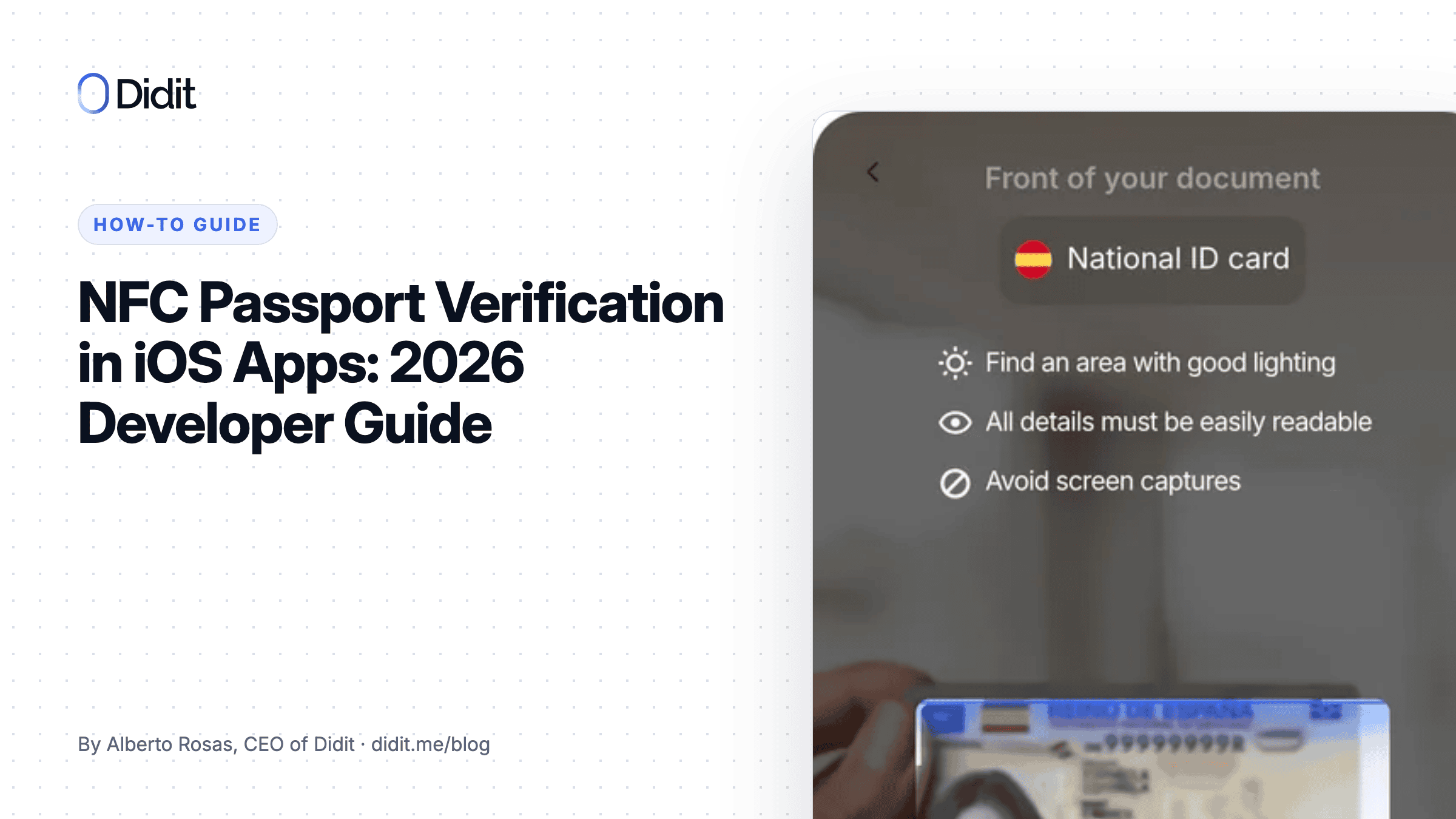
- The person photographs the passport, then taps the chip on the phone. The SDK reads the MRZ from that photo to derive the BAC or PACE keys, then starts the NFC session with live on-screen guidance. If the phone is pulled away too early, the NFC item comes back with status Declined and a warning such as
NFC_NOT_READorNFC_BAC_FAILED, and you offer a retry. - Fetch the decision when the session ends. Poll the decision endpoint or subscribe to the
status.updatedwebhook.curl https://verification.didit.me/v3/session/<SESSION_ID>/decision/ \ -H "x-api-key: <API_KEY>" - Read
nfc_verifications[]. The chip evidence arrives as an array on the decision payload, even when there is one chip read. Each item carriesstatus,warnings[],chip_protocol(icaoorjpki),is_nfc_skippedandskip_reason. - Map the result to your own decision. Approved means the chip read and its authentication checks passed. A chip-to-page mismatch or a failed passive authentication means stop. In Review means a person has to look at the session in the Console before you continue. When a session comes back Declined, read
decision_trace.decided_byto see whether the status came from the automatic rules, a manual reviewer or an investigator.

MRZ_KEY_UNAVAILABLE.Expected output: what the decision returns
The NFC evidence sits in one array item. This is an abridged, passing example, with the documented field names and values:
{
  "session_id": "3f1c8a2e-...",
  "status": "Approved",
  "nfc_skip_reason": null,
  "nfc_verifications": [
    {
      "status": "Approved",
      "chip_protocol": "icao",
      "is_nfc_skipped": false,
      "skip_reason": null,
      "warnings": []
    }
  ]
}
Each item has its own status from this set: Not Started, In Progress, Approved, In Review, Declined, Abandoned, Kyc Expired. The warnings[] array carries risk codes in the NFC family, and the full catalogue is on the NFC warnings page. When NFC never ran, the array is empty and the top-level nfc_skip_reason says why, one of USER_SKIPPED, DOCUMENT_WITHOUT_CHIP, CHIP_CERTIFICATE_UNAVAILABLE, DEVICE_WITHOUT_NFC, INTEGRATION_WITHOUT_NFC_ACCESS, MRZ_KEY_UNAVAILABLE or JPKI_UNAVAILABLE. The full object schema is on the data models page.
Failure cases and how to recover
| Signal | What it means | Recovery |
|---|---|---|
Empty nfc_verifications[], nfc_skip_reason is DEVICE_WITHOUT_NFC | The phone has no NFC radio, or NFC is turned off | Let the flow finish with OCR plus face match, which the SDK runs automatically |
DOCUMENT_WITHOUT_CHIP | A passport book or ID without a chip | Fallback only. A retry cannot produce a chip read |
USER_SKIPPED | The person declined the tap | Offer the tap again with the position guidance before you fall back |
MRZ_KEY_UNAVAILABLE | The MRZ could not be read, so no BAC or PACE keys | Ask for a sharper document photo, then run the session again |
INTEGRATION_WITHOUT_NFC_ACCESS | The host app was built without NFC access | Add the capability, rebuild, retry. Nothing else fixes it |
Status Declined, warning NFC_NOT_READ or NFC_BAC_FAILED | The chip was not held long enough to finish the handshake | Allow a retry and show how to hold the passport flat against the top edge |
Warning NFC_DATA_INVALID | The chip data could not be validated | Treat as a failed chip read, do not approve on NFC evidence alone |
Warning NFC_DATA_DOES_NOT_MATCH_OCR | Chip and printed data disagree, a sign of a manipulated document | Do not approve. This is the case the chip exists to catch |
NFC_PASSIVE_AUTHENTICATION_FAILED | The signing certificate did not chain back to a trusted CSCA | Stop the flow |
NFC_CHIP_CLONED | Clone signal on the chip | Do not approve, send to the Console for review |
NFC_DOCUMENT_REVOKED | The issuing authority revoked the document | Do not approve |
JPKI_UNAVAILABLE | A Japan My Number Card read was requested before JPKI is enabled in production | Continue without NFC, the native SDK skips the step |
A retry is worth it only for the transport failures, the ones where the radio handshake did not finish. A failed passive authentication, a clone signal or a chip-to-page mismatch is a verdict on the document, not a glitch, and the documented stop rule for those cases is to end the flow rather than re-run it.

Inputs and outputs
| Field | Direction | Notes |
|---|---|---|
workflow_id | Input, required | Stable workflow UUID from POST /v3/workflows/, with the NFC feature enabled |
vendor_data | Input, recommended | Your stable identifier for the person, used for duplicate detection |
callback | Input, optional | Where the flow redirects when finished |
expected_details | Input, optional | Expected name, date of birth, nationality, document types. Mismatches surface as decision warnings |
| Device and document | Input at run time | An iPhone with NFC on iOS 15.0+, and a passport or eID with a chip |
nfc_verifications[].status | Output | Approved, In Review, Declined and the other lifecycle values |
nfc_verifications[].warnings[] | Output | Risk codes with feature, risk, short_description, long_description and node_id |
chip_protocol | Output | icao for ePassports and eIDs, jpki for Japan My Number Card |
is_nfc_skipped, skip_reason | Output | Per item, so you can tell a skipped read from a failed one |
nfc_skip_reason | Output, top level | Set even when the step was bypassed and the array stays empty |
decision_trace | Output | How the status was reached: decided_by is manual, automatic or investigator, with warning counts |
Paid steps and review boundaries
| Step | What it is | Price |
|---|---|---|
| ID document verification | OCR, MRZ and document checks that precede the tap | $0.15 per check |
| NFC chip reading | The ePassport or eID chip read and its authentication checks | $0.15 per check, add-on |
| Passive liveness | The selfie step that usually follows | $0.10 per check |
| Face match 1:1 | Live face against the document portrait | $0.05 per check |
| Device and IP analysis | Device and network signals on the same session | $0.03 per check |
| Workflow orchestrator, SDKs, MCP server | The integration layer | Free |
Billing is per completed check from prepaid credit: plan credit first, then top-ups. Some no-match database lookups and retries are billable, and the pricing documentation lists them. The review boundary is separate from the price. Didit returns evidence and warnings, and your policy decides what an Approved, Declined or In Review session means for your product. When a person in the Console changes a status by hand, the change is recorded in status_override and decision_trace, and the session carries assignee and sla_due_at while it is In Review. Every price in this table is on the pricing page.
Worked cost example
One completed check with a chip read, at list price, assuming the full KYC bundle plus NFC: ID document $0.15 + passive liveness $0.10 + face match $0.05 + device and IP analysis $0.03 = $0.33 for the full KYC, plus NFC chip reading $0.15 = $0.48 per completed check. Run 10,000 of them in a month and the arithmetic is 10,000 x $0.48 = $4,800.
That $0.48 assumes every session completes all four KYC parts and the chip read. A session that skips NFC pays only for the checks that completed: no $0.15 NFC line, and only the parts of the bundle that actually ran. Model the mix of full and skipped sessions rather than applying the add-on to every session.
On Growth every Didit price is 4% lower: $0.144 + $0.096 + $0.048 + $0.0288 = $0.3168, plus NFC at $0.144, which is $0.4608 per check. Then 10,000 x $0.4608 = $4,608. The plan costs $99 a month and adds $115 of credit, and at that rate the credit covers about 249 checks ($115 / $0.4608 = 249.6).
On Scale the discount is 10%: $0.135 + $0.09 + $0.045 + $0.027 = $0.297, plus NFC at $0.135, which is $0.432 per check. Then 10,000 x $0.432 = $4,320. The plan costs $299 a month and adds $350 of credit, about 810 checks at that rate ($350 / $0.432 = 810.2).
The pricing page has the estimator, and the JSON feed has the same numbers if you want them in a build script.
Sources
- Didit docs: NFC Verification API overview
- Didit docs: iOS SDK guide
- Didit docs: Native mobile SDKs overview
- Didit docs: Create Session API
- Didit docs: Retrieve Session decision
- Didit docs: Data models
- Didit docs: NFC warnings catalogue
- Didit docs: Verification statuses
- Didit docs: Pricing and billing rules
- Didit pricing page and pricing JSON feed, read November 26, 2026
- Didit MCP server
Your next step is a free sandbox application at business.didit.me: create a workflow with NFC enabled, run the two calls above, and confirm the nfc_verifications[] shape against your own model before you touch live checks. No sales call, and the SDK guide sits one link away from the session URL you generate.
Try it
Try this in the sandbox
Run the check this guide describes, free.
The product this post is about, taken from its topic. Run it free in the sandbox.
Author
Alejandro Rosas
Co-founder and CTO

Keep reading
Other guides in the same topic.
 What Is the Purpose of FICA in South Africa? 2026 Guide
FICA is South Africa's anti-money laundering law. It creates the Financial Intelligence Centre and requires accountable institutions to identify and verify clients, screen for PEP and sanctions risk and report suspicious.
Alberto RosasNov 26, 2026 Sixth Money Laundering Directive (6AMLD): What Changed and Which Rules Apply
6AMLD is Directive (EU) 2018/1673: Member States must criminalise laundering, widen predicate offences and set a four-year penalty floor. It adds no new due diligence duties for firms.
Alberto RosasNov 26, 2026 Automated Sanctions Screening: Canada, the Entity List and Embargoes
Automated sanctions screening matches people and companies against lists such as Canada's autonomous sanctions made under SEMA and JVCFOA and the OFAC SDN List, and returns candidate hits scored for identity confidence and.
Alberto RosasNov 26, 2026Questions
Frequently asked questions
How do I implement NFC passport verification in an iOS app with Didit?
Create a Didit workflow that includes the NFC feature, create a session with POST /v3/session/, and open that session with the Didit iOS SDK on an iPhone running iOS 15 or later. The person photographs the passport so the SDK can read the MRZ and derive the BAC or PACE keys, then taps the chip. Read the result from nfc_verifications[] in GET /v3/session/{sessionId}/decision/. There is no standalone NFC endpoint, the chip is always read inside a session.
Does NFC passport verification work in a web browser on iOS?
No. Safari on iOS has no Web NFC API, and the Didit Web SDK has no NFC support, so a browser session skips the chip step and continues with document and selfie verification. Chrome on Android has an experimental Web NFC API that Didit documents as unstable and permission-gated. If you need chip evidence, ship a native app.
Which iOS version and Xcode settings do I need for chip reading?
iOS 15.0 or later on a device with NFC hardware, while the SDK core itself starts at iOS 13.0. The host app needs the capabilities and usage descriptions listed in the iOS SDK guide. On Didit's side the iOS SDK handles the NFC configuration itself, including the ISO7816 application identifiers for ePassports, so host apps only add D392F000260100000001 for Japan My Number Card.
How much does NFC passport verification cost?
NFC chip reading is $0.15 per check, added to the $0.15 ID document check. A complete flow that runs the full KYC bundle and a chip read is $0.33 plus $0.15, which is $0.48 at list price. Growth takes 4% off every Didit price and Scale takes 10%, which brings the same flow to $0.4608 and $0.432. A session that skips NFC is billed only for the checks that completed.
Which field in the decision holds the NFC result?
It is nfc_verifications[], an array on the decision payload, and it stays an array even when a session has one chip read. Each item carries status, warnings[], chip_protocol, is_nfc_skipped and skip_reason. The V3 schema keeps the same array shape for every feature, so a singular key is not the canonical shape.
What happens if the phone has no NFC or the passport has no chip?
The SDK falls back to OCR plus face match and nfc_verifications[] stays empty. The top-level nfc_skip_reason tells you which case you hit, for example DEVICE_WITHOUT_NFC or DOCUMENT_WITHOUT_CHIP. Retries do not help there; the fallback is the documented path.
What does NFC_DATA_DOES_NOT_MATCH_OCR mean?
It means the data inside the chip and the printed data on the document disagree, which is a strong sign that the document has been manipulated. Didit's guidance is explicit: do not approve. Treat it as a declined chip read, not as a scanning glitch.
What is the difference between Declined and In Review for an NFC check?
Declined is a session status, not automatically an automatic outcome: the decision schema allows manual, automatic or investigator decisions, so read decision_trace.decided_by to see who or what produced it. In Review means a person has to look at the session in the Didit Business Console before the status settles, and the session carries an assignee and a review clock. A reviewer who changes the status by hand is recorded in status_override and decision_trace.
Should I approve a session when passive authentication fails?
No. A passive authentication failure means the chip's signing certificate did not chain back to a trusted CSCA, so the document cannot be shown to be genuine. The documented recovery is to stop the flow. The same applies to a chip clone signal and to a revoked document.
Can I read a Japan My Number Card over NFC on iOS?
My Number Card is read through JPKI rather than ICAO 9303, native SDKs only, and the person enters the card PIN. Its item has chip_protocol jpki, its evidence sits under jpki with chain_valid, signature_valid, revocation_status, attributes and attributes_match_ocr, and the ICAO fields are null. JPKI is not enabled in production yet, so a My Number Card in a native SDK on an NFC phone currently skips NFC with JPKI_UNAVAILABLE.
Can I test the NFC flow in the sandbox without a passport?
You can test everything except the radio read. Sandbox testing is free and unlimited, so you can exercise session creation, the SDK mount and your decision handling without spending credit or opening a sales conversation. The chip read itself needs a physical iPhone with NFC and a passport or eID with a chip, because there is no way to emulate the NFC handshake.
Compliance built in
Audited, certified and attested.
We hold the certifications and build each country's rules into your flows, so you can launch anywhere without worrying. Security and Compliance center
- Regulation encoded into your flows
Tell us what you do and where. Didit lists the rules that apply to you, with sources, and builds the checks each country needs into one workflow.
- Ready for AMLR
Every requirement of the new EU anti-money laundering rules, from checking customers to human review, is already covered by a Didit check.
- Tested in Spain's Treasury sandbox
Spain's Treasury published its supervised sandbox report on Didit's NFC plus active liveness onboarding; SEPBLAC took part and valued the added measures positively.
- Audited, not self-declared
iBeta Level 1 and Level 2. Liveness tested under ISO/IEC 30107-3.
Your obligations · 3 regions
 SOC 2 Type 2
 ISO 27001
 iBeta Level 1 and Level 2
 EU regulator attestation
 FSM youth protection
 GDPR
 EBA remote onboarding
 MiCA compatible
 FIDO Alliance member
- AMLREU AML Regulation ready
Integration · Didit MCP
Run Didit from your own AI agent
Connect Didit to Claude, Cursor, VS Code or ChatGPT and just ask in plain words. Your agent can do anything you can do in the console, with the same permissions you have.
 Add to Claude
 ChatGPT
 Cursor
- Build workflowsDescribe the checks you need. The agent creates and publishes the flow.
- Run investigationsAsk why a session was declined, review cases, search people and companies.
- Change rulesCreate payment rules, test them on past data and switch them on.
- Pull reportsAsk for numbers, exports or the audit log.
Didit Academy


