Integrating AML Screening into Real-Time Payment Systems
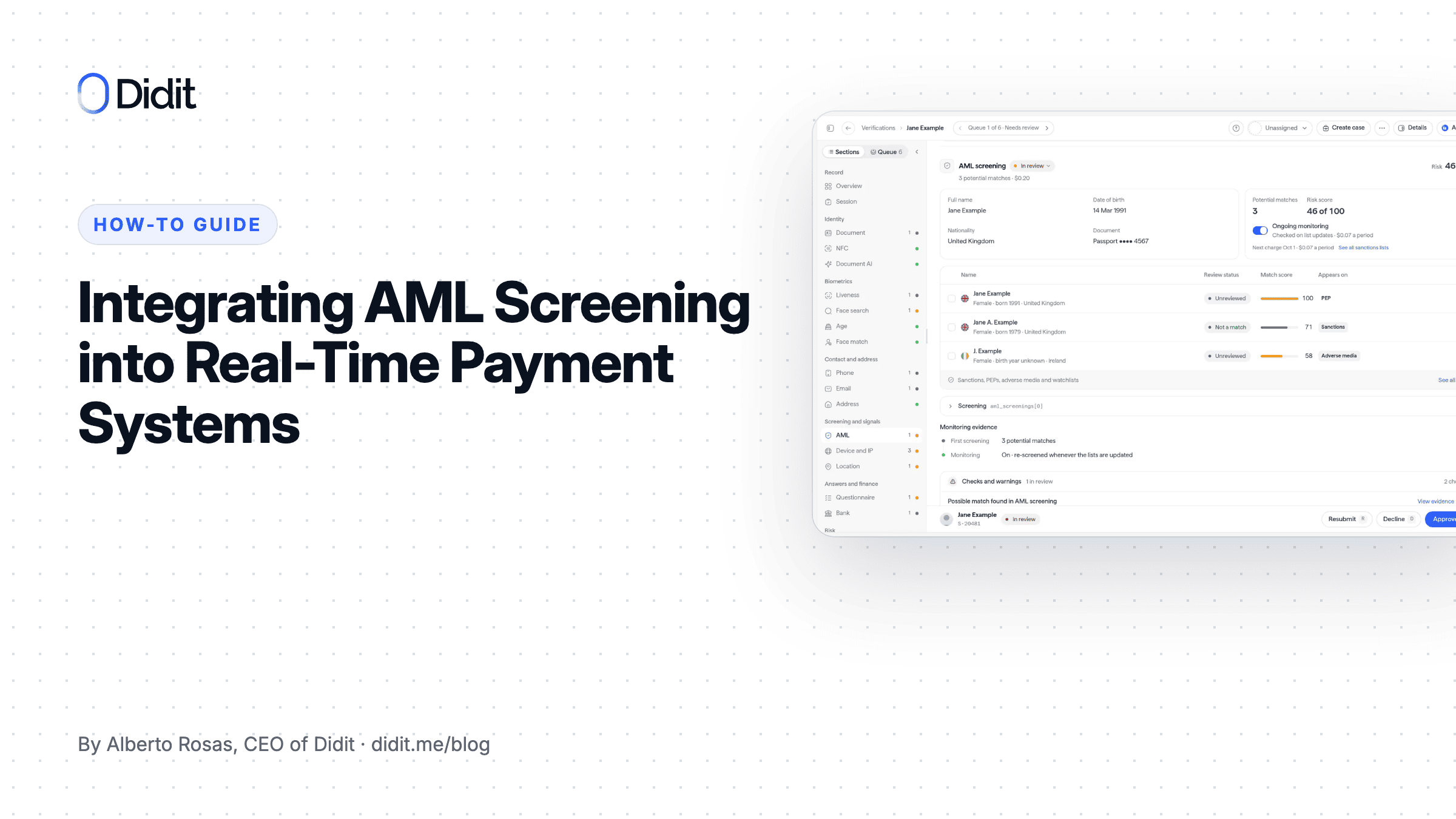
Screen once at onboarding, then score every payment through Transaction Monitoring. Didit's AML API returns Approved, In Review or Declined in seconds for $0.20 per check.
 Alejandro RosasCo-founder and CTO
Contents
In this guide
Jump to the part you need.
This guide is for payment providers, PSPs and platforms that need AML screening inside a real-time payment flow and cannot afford a batch job at the end of the day. Didit AML Screening costs $0.20 per check against 1,300+ watchlists, and the standalone API returns a decision in a few seconds. The caveat: adverse media adds up to about 25 seconds, so you screen at onboarding or with a longer timeout, not in the critical path of every instant transfer.
Last updated: November 26, 2026. Prices checked against the live Didit price feed on November 26, 2026.
Outcome and the method we recommend
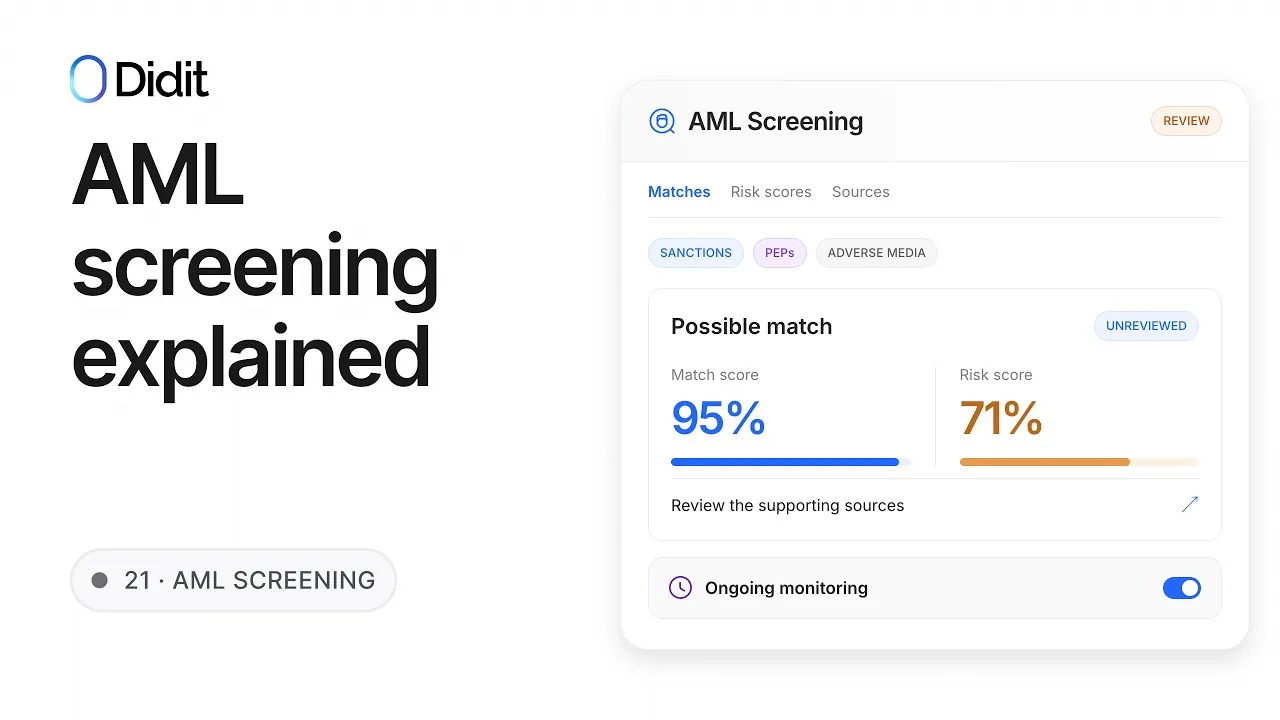
The outcome is a payment service that holds a sanctions, PEP, watchlist and adverse media decision for every party it moves money for, with both scores attached, and can show a supervisor who decided what and when. We recommend two layers: identity verification plus AML screening once at onboarding, then a transaction-level check on every payment through Transaction Monitoring, with the standalone AML API for parties you meet mid-flow, such as a new payee.
The split matters. Because adverse-media enrichment can take up to about 25 seconds, many teams run it during onboarding or apply a longer payment timeout. Screening a known, already verified customer against sanctions and PEP data is fast. The transaction layer is what catches velocity, new counterparties and changes in behaviour.
Routes, endpoints and prices
| Route | Call | What it returns | Price |
|---|---|---|---|
| Standalone AML API | POST https://verification.didit.me/v3/aml/ | One-shot PEP, sanctions, watchlist and adverse media check on a person or a company | $0.20 per check |
| AML inside a verification session | POST /v3/session/ then GET /v3/session/{sessionId}/decision/ | Document check, biometrics, device and IP, plus AML on one audited session | $0.33 KYC plus $0.20 AML, $0.53 as the compliance bundle |
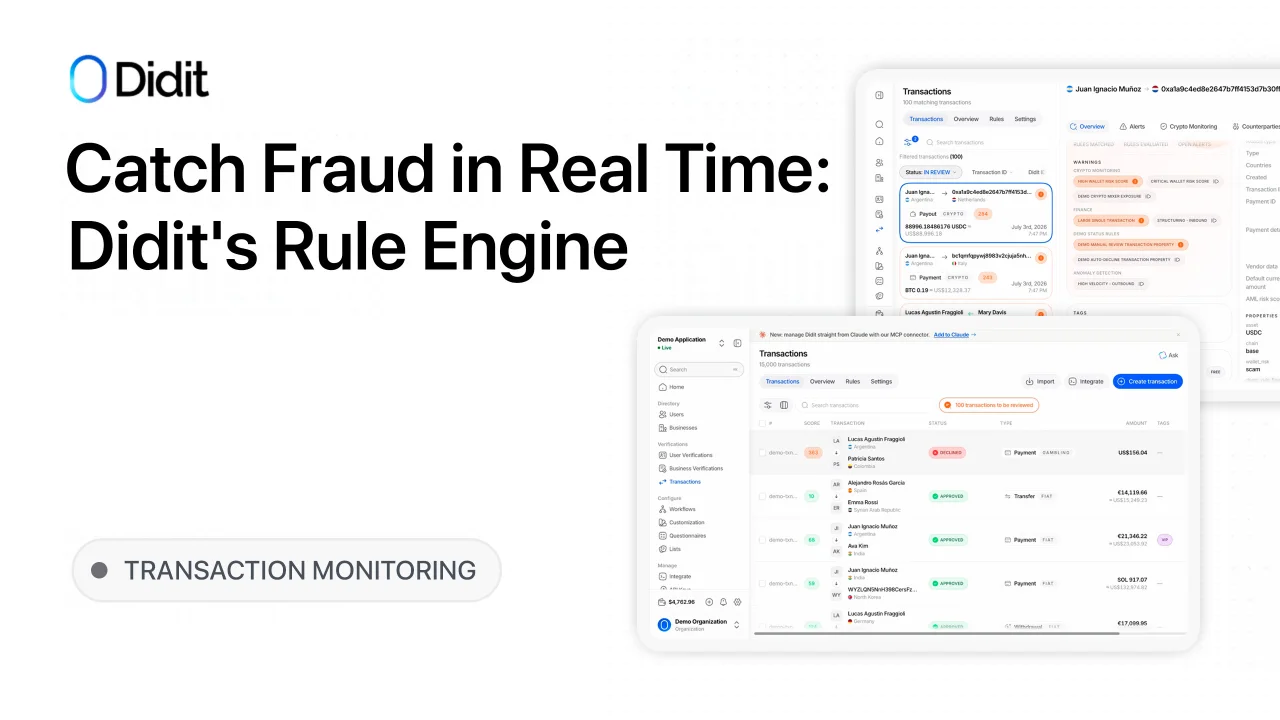
| Transaction Monitoring | POST /v3/transactions/ | Rule-based score per transaction with counterparty AML screening | $0.001 per transaction beyond the plan allowance |
| Ongoing AML monitoring | Enabled per screened entity | Provider-driven re-screening of approved entities | $0.07 per person per year |
Start free in the sandbox at business.didit.me, no sales call, and sandbox keys return a mocked result without billing. Developers wiring the calls with an AI assistant can connect Didit through the MCP server. The screening reference lives in the Didit AML Screening docs, and every unit price sits on didit.me/pricing.
Prerequisites
- A Didit application and an API key. The key goes in the
x-api-keyheader. - Credit on the account. An insufficient balance returns
403before any screening runs. - The party data you already hold for a payment:
full_name(required, at least 2 characters),entity_type,date_of_birth,nationality, and a document number where you have one. A matchingdocument_numberoverridesmatch_scoreto 100. - Thresholds and weights chosen before go-live:
aml_match_score_threshold(default 93),aml_score_approve_threshold(default 80),aml_score_review_threshold(default 100), andaml_name_weightplusaml_dob_weightplusaml_country_weight, which must sum to exactly 100 (defaults 60, 25, 15). - A webhook endpoint you control, reachable from the internet, with HMAC verification in front of it.
- A decision on adverse media, because
include_adverse_media=truechanges the latency budget.
How to integrate it, step by step
Choose the route for each screen. Onboarding: a verification session with the AML feature enabled, so identity and AML land on one record. Every later payment:
POST /v3/transactions/, which scores the payment and screens the counterparty. A party you meet mid-payment, such as a payee on a first transfer: the standalonePOST /v3/aml/call.Set thresholds and weights. Configure them in the Business Console or with
POST /v3/workflows/. Match score answers whether this is the same person; risk score answers how risky the listed entity is. Hits belowaml_match_score_thresholdare taggedreview_status: "False Positive"and ignored for risk, and the highest remaining risk score becomesaml.score.Screen the payer. This is the documented standalone call:
curl -X POST 'https://verification.didit.me/v3/aml/' \
  -H "x-api-key: $DIDIT_API_KEY" \
  -H "Content-Type: application/json" \
  -d '{
    "full_name": "Javier Ejemplo Modelo",
    "entity_type": "person",
    "date_of_birth": "1974-01-01",
    "nationality": "ES",
    "include_adverse_media": true,
    "vendor_data": "user-1234"
  }'
Add
-H "Idempotency-Key: pay-88213-payer"when the call sits behind a retry. The key is scoped to your application and to the exact body, and a replayed response is not billed again.Branch on the returned status.
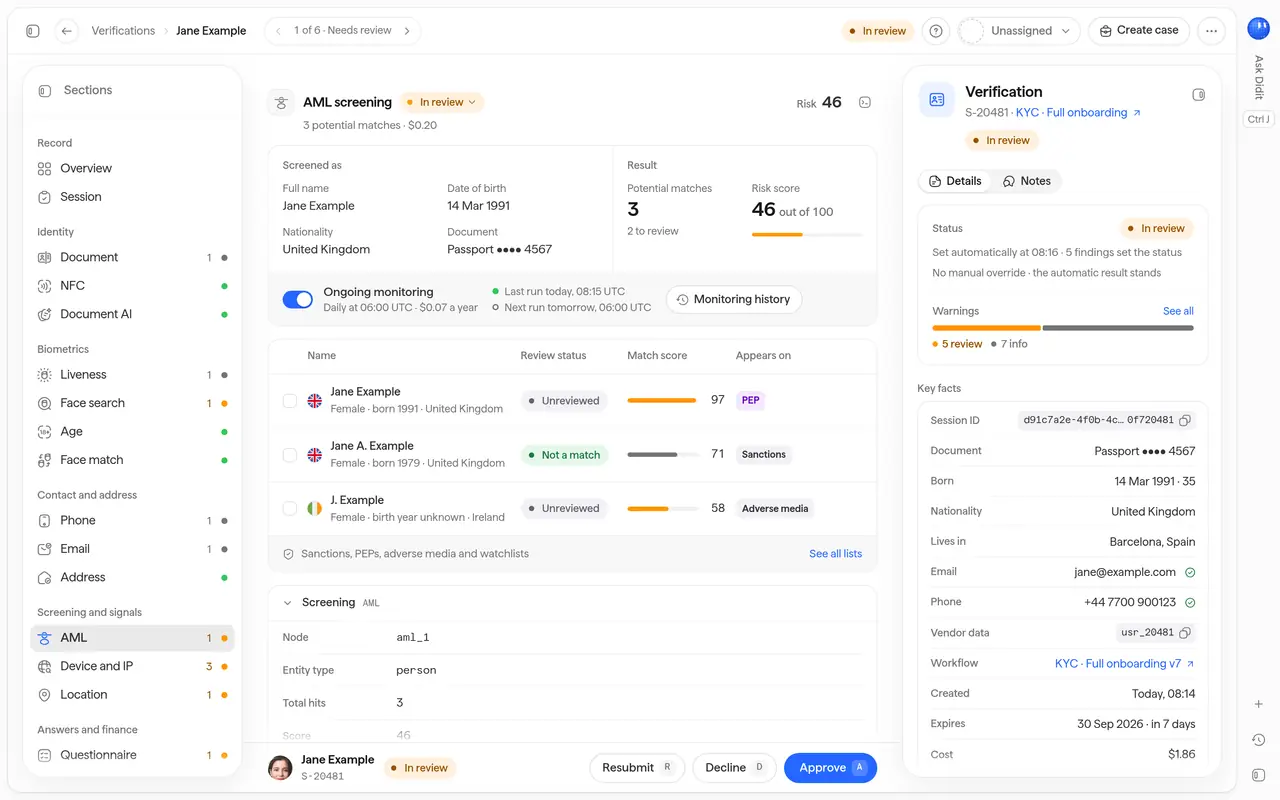
Approvedreleases the payment.In Reviewholds it and opens the hit for an analyst.Declinedblocks it. The thresholds from step 2 decide which of the three you get, and the comparisons are strict: a score has to be above the approve threshold to move toIn Review, and above the review threshold to beDeclined. Tune them against your own false positive rate instead of leaving the defaults untouched.Screen any counterparty that is not a known customer. Same endpoint with
"entity_type": "company"for a business payee. For payments in volume, let the transaction layer do this in step 8 rather than firing an extra call per party.Keep the record.
save_api_requestdefaults totrue, so the screening is stored as a session and appears in the console. Read it withGET /v3/session/{sessionId}/decision/and export it withGET /v3/session/{sessionId}/generate-pdf/. Setsave_api_request=falseonly for throwaway checks, whererequest_idis a transient correlation id.Subscribe to webhooks and verify them. Register a destination with
POST https://verification.didit.me/v3/webhook/destinations/:curl -X POST https://verification.didit.me/v3/webhook/destinations/ \ -H "x-api-key: YOUR_API_KEY" \ -H "Content-Type: application/json" \ -d '{ "label": "TM events", "url": "https://yourapp.com/webhooks/didit-tm", "subscribed_events": ["transaction.created", "transaction.status.updated"] }'The response carries
secret_shared_key. Store it and verify theX-Signature-V2HMAC-SHA256 over the raw body before you trust an event, with a constant-time compare and a five minute timestamp window. A saved AML screening fires a status update webhook when its decision changes.Put the per-payment check in Transaction Monitoring. One call per payment, with your own identifier as
transaction_id:curl -X POST https://verification.didit.me/v3/transactions/ \ -H "x-api-key: YOUR_API_KEY" \ -H "Content-Type: application/json" \ -d '{ "transaction_id": "tx-0001", "transaction_category": "finance", "transaction_details": { "direction": "outbound", "amount": "500.00", "currency": "EUR" }, "subject": { "entity_type": "person", "vendor_data": "user-42", "full_name": "John Doe" }, "counterparty": { "entity_type": "company", "full_name": "Acme Corp" } }'The response returns
status, ascoreand therule_runsthat evaluated the payment.APPROVEDmeans no rule fired,IN_REVIEWandDECLINEDmean one did, andAWAITING_USERcreates a linked remediation session with a verification URL you can send to the payer.Turn on ongoing monitoring where you need it.
include_ongoing_monitoring=truekeeps the entity under provider-driven re-screening, dated every day, at $0.07 per person per year. It requiressave_api_request=trueand answers400without it. You can disable it from the console.
Where the screen sits in your payment flow
Onboarding, not inside every transfer
Plain screenings typically complete in a few seconds, which is fast enough for a checkout step. Adverse media enrichment adds an initial pause of about 5 seconds plus up to about 25 seconds of polling, so set a client timeout of at least 60 seconds when you enable it. Identity and adverse media at onboarding, sanctions and PEP driven by the transaction layer afterwards, daily re-screening through ongoing monitoring: that is the sequence we see work.
Integrating with a banking system or payment hub
We do not publish a connector for core banking platforms, card switches or payment hubs. Integration is the documented HTTP API: your payment service calls POST /v3/aml/ or POST /v3/transactions/ and stores the returned request_id or transaction uuid next to the payment record.
Screening for autonomous transactions
When an agent, a scheduler or a machine starts a payment and nobody approves it individually, the decision has to be fully expressed in the response. It is: aml.status with aml.score for a screening, status with score for a transaction. Map Approved and APPROVED to release, In Review and IN_REVIEW to hold, Declined and DECLINED to block, and route the hold case to a review queue with the hit attached. The returned status, score, hits and warnings are concrete enough to route a payment automatically, and the console is there for the exceptions.
Expected output
The standalone call returns request_id and an aml object. This is the documented shape, limited to the fields your payment service reads:
{
  "request_id": "...",
  "aml": {
    "status": "In Review",
    "score": 82,
    "screening_id": "...",
    "hits": [ ... ],
    "warnings": ["POSSIBLE_MATCH_FOUND"]
  }
}
Each hit carries match_score (0 to 100, identity confidence) and risk_score (0 to 100, entity risk). The status comparisons are strict greater-than: In Review needs a score above aml_score_approve_threshold, and Declined needs a score above aml_score_review_threshold. Whenever the score is non-zero and at or above the approve threshold, a POSSIBLE_MATCH_FOUND warning is added, and a score of exactly 0 never warns. So a score equal to the approve threshold can carry the warning and still be Approved.
aml.status | Produced when | Payment service action |
|---|---|---|
| Approved | aml.score is at or below aml_score_approve_threshold, default 80 | Release the payment and store screening_id with it |
| In Review | aml.score is above the approve threshold and at or below the review threshold, default 100 | Hold the payment, open the hit in the console, notify the analyst queue |
| Declined | aml.score is above aml_score_review_threshold | Block, record the decision with the hit, escalate |
A transaction response is a different shape and gets its own parser. Transaction Monitoring returns status, score and rule_runs for the payment, while standalone AML screening returns the aml object with status, score, screening_id, hits and warnings. Read each field from the response that documents it.

Failure cases and recovery
| Symptom | Cause | Recovery |
|---|---|---|
400 on the screening call | Weights do not sum to exactly 100, or include_ongoing_monitoring=true without save_api_request=true | Fix the configuration and resend. No screening ran and nothing was billed |
403 | Insufficient credit | Top up. The call is refused before any new screening runs |
| Result comes back without adverse media hits after a long wait | The upstream enrichment was slow | The result is still actionable. Raise the client timeout to at least 60 seconds |
409 | The same Idempotency-Key was reused with a different body | Use one key per distinct request body |
| Timeout on your side after the screening ran | Network or client timeout | Retry with the same Idempotency-Key. The stored response returns and is not billed again |
400 duplicate transaction_id, or 409 on a race | The transaction was already submitted | Read it with GET /v3/transactions/{uuid}/ instead of resubmitting |
Declined | A hit's risk score crossed the review threshold | Block the payment, keep the hit and screening_id, escalate to the analyst queue |
Inputs and outputs
| Field | Direction | Notes |
|---|---|---|
full_name | Request | Required, at least 2 characters, person or company |
entity_type | Request | person or company |
date_of_birth, nationality, document_number | Request | Improve match scoring. A matching document number forces match_score to 100 |
include_adverse_media | Request | Adds up to about 25 seconds of latency |
save_api_request, include_ongoing_monitoring | Request | Storage and daily re-screening. Monitoring requires saving |
Idempotency-Key | Header | Retry safety, up to 255 characters |
request_id | Response | Correlation id, usable with the decision endpoint when the screening is saved |
aml.status, aml.score | Response | Approved, In Review or Declined, plus the highest risk score among hits that survived the match threshold |
hits[].match_score, hits[].risk_score | Response | 0 to 100 each, with a review_status per hit |
warnings[] | Response | For example POSSIBLE_MATCH_FOUND, PEP_MATCH, SANCTIONED_ENTITY, HIGH_RISK_COUNTRY, ADVERSE_MEDIA_HIT |
Paid steps and review boundaries
Four things cost money in this flow. Each completed AML screening is $0.20. The identity steps inside a session are $0.33 for the full ID check. Ongoing monitoring is $0.07 per person per year. Transactions are $0.001 each beyond the plan allowance, which is 1,000 on Free, 10,000 on Growth and 100,000 on Scale. Replayed idempotent responses are not charged again, sandbox calls are never charged, and the workflow orchestrator, SDKs and MCP server are free.
The review boundary starts with the match threshold. A hit below aml_match_score_threshold, 93 by default, is tagged review_status: "False Positive" and excluded from risk scoring. The match threshold decides whether a hit contributes to risk at all, while the approve threshold controls the POSSIBLE_MATCH_FOUND warning and the move to In Review, and the review threshold controls Declined. Anything that lands in In Review or Declined should reach a human before funds move permanently: the payment service holds, the analyst works the hit in the console, and the change of review status stays on the record.
Worked cost example
Take a payments platform with 15,000 new payers a month, 200,000 already screened payers under ongoing monitoring, and 1,200,000 monitored transactions a month on the Scale plan, which includes 100,000:
- Onboarding with identity plus AML: 15,000 x $0.53 = $7,950.00 a month. If you already run KYC elsewhere, the standalone route is 15,000 x $0.20 = $3,000.00.
- Ongoing monitoring: 200,000 x $0.07 = $14,000.00 a year, which is about $1,166.67 a month.
- Transaction monitoring beyond the allowance: (1,200,000 - 100,000) x $0.001 = 1,100,000 x $0.001 = $1,100.00 a month.
- Monthly total: $7,950.00 + $1,166.67 + $1,100.00 = $10,216.67.
Those are list prices. Scale takes 10% off every Didit price and plan credit is applied before top-ups, so check the current plans on didit.me/pricing before you model a contract.
Sources
- Didit docs: AML Screening API (request fields, thresholds, latency, idempotency, billing, sandbox).
- Didit docs: AML Screening overview (two-score model, status enum, failure modes).
- Didit docs: AML warnings catalogue.
- Didit docs: ongoing AML monitoring.
- Didit docs: Transaction Monitoring quickstart (webhook registration and signature verification).
- Didit docs: Transaction Monitoring integration guide (payload, idempotency, real-time vs batch).
- Didit docs: transactions payload.
- Didit docs: webhooks and HMAC signing.
- Didit pricing page and pricing in the docs, read November 26, 2026.
- FATF, for the international standards on customer due diligence and wire transfers.
- EUR-Lex, for EU payments legislation and regulatory context.
The next step is small: create a free account at business.didit.me, run one sandbox screening with the curl in step 3, then point your payment service at the standalone API or at Transaction Monitoring. No sales call is required to start.
Try it
Try this in the sandbox
Run the check this guide describes, free.
The product this post is about, taken from its topic. Run it free in the sandbox.
Author
Alejandro Rosas
Co-founder and CTO

Keep reading
Other guides in the same topic.
 What Is the Purpose of FICA in South Africa? 2026 Guide
FICA is South Africa's anti-money laundering law. It creates the Financial Intelligence Centre and requires accountable institutions to identify and verify clients, screen for PEP and sanctions risk and report suspicious.
Alberto RosasNov 26, 2026 Sixth Money Laundering Directive (6AMLD): What Changed and Which Rules Apply
6AMLD is Directive (EU) 2018/1673: Member States must criminalise laundering, widen predicate offences and set a four-year penalty floor. It adds no new due diligence duties for firms.
Alberto RosasNov 26, 2026 Automated Sanctions Screening: Canada, the Entity List and Embargoes
Automated sanctions screening matches people and companies against lists such as Canada's autonomous sanctions made under SEMA and JVCFOA and the OFAC SDN List, and returns candidate hits scored for identity confidence and.
Alberto RosasNov 26, 2026Questions
Frequently asked questions
How long does Didit AML screening take inside a payment flow?
Plain screenings typically complete in a few seconds, which fits a synchronous call before a payment is released. With include_adverse_media=true the API waits for enrichment, an initial pause of about 5 seconds plus up to about 25 seconds of polling, so configure a client timeout of at least 60 seconds. Transaction Monitoring evaluates its rules synchronously and returns the decision with the transaction record.
What does AML screening cost per check?
AML Screening is $0.20 per check against 1,300+ watchlists, and company AML screening is also $0.20. Inside a verification session the full ID check is $0.33, so identity plus AML is $0.53 as the compliance bundle. Ongoing monitoring is $0.07 per person per year, and transactions cost $0.001 each beyond the plan allowance.
What is the difference between match score and risk score?
Match score is identity confidence: how likely the listed person is the person you are screening, built from name, date of birth and country with weights that must sum to 100. Risk score is entity risk: how risky the listed entity is, based on country risk, list category and criminal records. Hits below the match threshold, default 93, are dropped as false positives and only the remaining risk scores count.
Can I approve a payment automatically when a possible match appears?
Not on the warning alone. A POSSIBLE_MATCH_FOUND warning means the score is non-zero and at least the approve threshold. The status is In Review only when the score is above the approve threshold, and Declined only when it is above the review threshold. Hold the payment and send the hit to an analyst: the console shows the score breakdown and lets a reviewer change a hit's review status, which is the human record a supervisor expects to see.
How do I screen a company that is the counterparty on a payment?
Use the same POST /v3/aml/ call with "entity_type": "company" and the registered name, or let Transaction Monitoring screen the counterparty as part of the transaction. If you need the ownership picture, business verification uses registry data priced by country and data tier, from $2.00 per company, with $0.20 person AML per owner or officer and a linked $0.33 ID check per person.
How do I integrate AML screening into a banking system?
Through the HTTP API, not a native connector. We do not publish connectors for core banking platforms, card switches or payment hubs, so your payment service calls POST /v3/aml/ or POST /v3/transactions/ and stores the returned request_id, screening_id or transaction uuid next to the payment record. Webhooks keep your case management side current without polling.
How do I run AML screening on transactions no human approves?
Express every decision as a status your code can branch on. A screening returns Approved, In Review or Declined, and a transaction returns APPROVED, IN_REVIEW, DECLINED or AWAITING_USER. Release on the approved states, hold and route to review on the review states, block on the declined states, and log the transaction status, score, matched rules, and transaction identifier so the decision can be reviewed later.
What does an AML payments platform need to screen each payment?
A party check with a stored decision, a per-transaction score, and a record of who reviewed the exceptions. In Didit terms that is POST /v3/aml/ for the party, POST /v3/transactions/ for the payment, the console for hit review, and the decision endpoints for the audit trail.
What happens if my request times out or I retry it?
Send an Idempotency-Key header when you retry. The key is scoped to your application and the exact request body, the first completed request stores its response, and later identical retries return that response without running or billing a second screening. Reusing the same key with a different body returns 409, and if the original is still running, retry later with the same key.
Can I keep screening a customer after onboarding?
Yes. include_ongoing_monitoring=true keeps the entity under provider-driven re-screening, dated every day, at $0.07 per person per year, and it requires save_api_request=true. You can disable monitoring from the Business Console. Without it, re-screen on your own schedule by calling the standalone API again.
Do sandbox calls cost anything and do they return real results?
Sandbox keys skip screening and billing entirely and return a mocked result, Approved with zero hits unless you pass sandbox_scenario. save_api_request behaves the same as on live keys, so a saved sandbox screening is retrievable through the decision and PDF endpoints, which lets you test the whole payment flow at no cost.
Compliance built in
Audited, certified and attested.
We hold the certifications and build each country's rules into your flows, so you can launch anywhere without worrying. Security and Compliance center
- Regulation encoded into your flows
Tell us what you do and where. Didit lists the rules that apply to you, with sources, and builds the checks each country needs into one workflow.
- Ready for AMLR
Every requirement of the new EU anti-money laundering rules, from checking customers to human review, is already covered by a Didit check.
- Tested in Spain's Treasury sandbox
Spain's Treasury published its supervised sandbox report on Didit's NFC plus active liveness onboarding; SEPBLAC took part and valued the added measures positively.
- Audited, not self-declared
iBeta Level 1 and Level 2. Liveness tested under ISO/IEC 30107-3.
Your obligations · 3 regions
 SOC 2 Type 2
 ISO 27001
 iBeta Level 1 and Level 2
 EU regulator attestation
 FSM youth protection
 GDPR
 EBA remote onboarding
 MiCA compatible
 FIDO Alliance member
- AMLREU AML Regulation ready
Integration · Didit MCP
Run Didit from your own AI agent
Connect Didit to Claude, Cursor, VS Code or ChatGPT and just ask in plain words. Your agent can do anything you can do in the console, with the same permissions you have.
 Add to Claude
 ChatGPT
 Cursor
- Build workflowsDescribe the checks you need. The agent creates and publishes the flow.
- Run investigationsAsk why a session was declined, review cases, search people and companies.
- Change rulesCreate payment rules, test them on past data and switch them on.
- Pull reportsAsk for numbers, exports or the audit log.
Didit Academy


