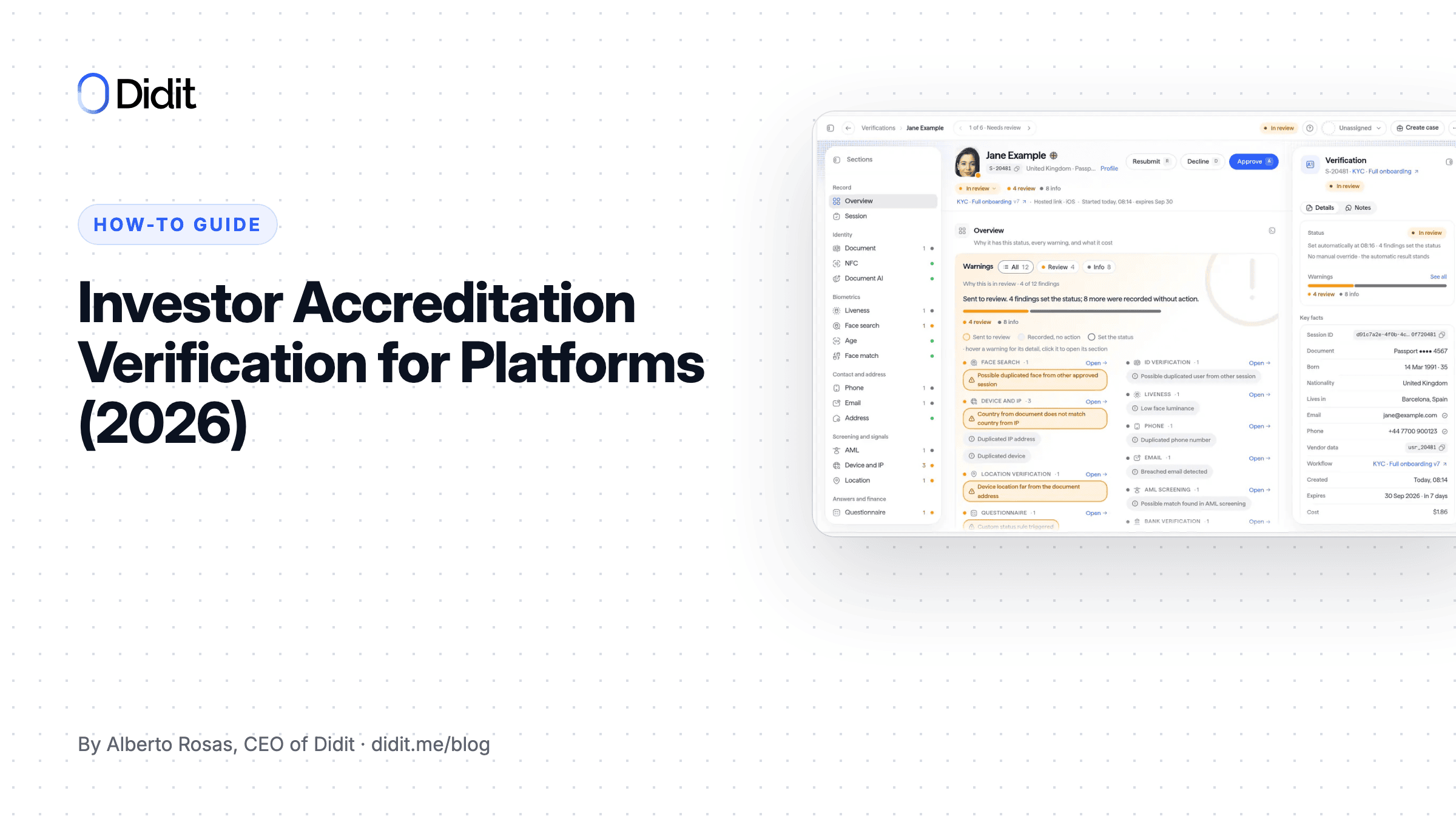
Investor Accreditation Verification for Platforms (2026)
Verify accredited investor status with a Didit workflow: full KYC $0.33, AML screening $0.20 and Document AI $0.20 per document. Didit returns the identity, questionnaire and decision data you configure, and your compliance.
 Alberto RosasCo-founder and CEO
Contents
In this guide
Jump to the part you need.
Investor accreditation verification fits crowdfunding portals, private funds and platforms that must confirm income, net worth or professional status before admitting someone to an offering. On Didit the evidence for one investor costs $0.33 for a full identity check, $0.20 for AML screening and $0.20 for each document step you add. The caveat: we return identity verification results and extracted document data, not a legal opinion that a person is accredited. Your compliance team owns that rule.
Last updated: November 26, 2026. Prices checked against the live Didit price feed on November 26, 2026.
What one accreditation session costs at list price
| Check | What it contributes | Price |
|---|---|---|
| Full ID check (KYC) | ID document $0.15, passive liveness $0.10, face match 1:1 $0.05, device and IP $0.03 | $0.33 per check |
| AML screening | Sanctions, PEP and watchlist matches against 1,300+ lists | $0.20 per check |
| Proof of address | Address document tied to the verified identity | $0.20 per check |
| Document AI | Document data returned as structured fields for the document types the step supports | $0.20 per document |
| Custom questionnaire | The investor's questionnaire responses about status | $0.10 per check |
| Ongoing AML monitoring | Re-screening each investor after onboarding | $0.07 per person per year |
Start free in the sandbox at business.didit.me with no sales call, and for developer builds connect Didit to an AI assistant through the Didit MCP server. The steps for a user verification flow are in the quick start, and every number above is listed on didit.me/pricing.
What accredited investor verification means for a platform
An accredited investor is an investor who meets a legal definition, such as Rule 501 of Regulation D in the United States, that lets a platform offer them securities without the registration the general public would require. The definition and the exemption you rely on differ by jurisdiction, so confirm both with counsel before you encode a rule. In the United States the SEC definition in Rule 501 of Regulation D turns on financial thresholds: net worth above $1 million excluding the primary residence, or income above $200,000 in each of the last two years, or $300,000 jointly with a spouse, with a reasonable expectation of the same income this year. Certain professional credentials and fund employees can also qualify. Check the current text with your counsel before you encode a rule, and the source link sits in Sources below.
Your obligation breaks into three checks and one judgment. Confirm the person is who they claim to be. Collect and read the evidence that supports the threshold. Screen the person against sanctions, watchlists and PEP lists. Then decide that the evidence meets the definition. Didit returns the first three as structured results. The fourth stays with your compliance team.
What counts as proof of accredited investor status
Document requirements vary by jurisdiction and by the exemption you rely on. The list below is the illustrative United States pattern, and your counsel should confirm what you accept for each offering.
- Tax returns and wage forms. They state income for a defined year, which is the cleanest evidence for an income test. They are also the slowest document for an investor to find.
- Bank and brokerage statements. They show balances on a date, not net worth, so a single statement rarely settles a net worth test on its own.
- Accountant or attorney letters. Fast to produce and easy to verify against the identity, but the claim inside is second hand.
- Professional credentials. A current licence that the rule names can qualify an investor without any financial document.
- A questionnaire. It records the investor's own answers about income, net worth or professional status, and it is the piece your reviewer reads last. On its own it is weak proof.
As a review policy, many platforms treat the strongest file as three things: a verified identity, a document that states the figure, and the investor's own recorded answers tying the two together. Didit can return the documented verification, questionnaire and decision fields you configure in the same workflow, all keyed to one vendor_data value.
Matching each piece of evidence to a Didit field
| Evidence the investor supplies | Field in the decision | What your reviewer decides with it |
|---|---|---|
| Government ID and selfie | id_verifications[], liveness_checks[], face_matches[] | Confirm the person matches the document before any financial evidence counts |
| A financial document your rule accepts, when the step supports that document type | document_ai_documents | Compare the returned fields with the threshold your rule sets |
| A second financial document, when the step supports that document type | document_ai_documents | Read the returned balances and dates, then judge whether they support a net worth test |
| Utility bill or bank letter | poa_verifications[] | Confirm the residential address your file requires |
| Questionnaire answers | questionnaire_responses | Record what the investor states about income, net worth or professional status |
| Signed document, when the workflow includes an E-signature step | signatures[] | Keep the signed file, its certificate and its timestamp with the file |
| Sanctions, PEP and watchlist exposure | aml_screenings[] | Resolve every hit before approval |
| The final call | Your own record | Accredited, not accredited, or hold for more evidence. This column is yours, not ours |
Every row above arrives as evidence with a status. None of them arrives as an accreditation verdict, and that gap is the part of the process no provider should fill for you.
Which steps are optional, and what each one adds to the cost
Your workflow decides both what runs and what you pay, because billing is per completed check.
- The base identity check, $0.33. It always contains the ID document at $0.15, passive liveness at $0.10, face match at $0.05 and device and IP analysis at $0.03.
- AML screening, $0.20. Add it when your rule or your regulator requires sanctions and PEP coverage.
- Proof of address, $0.20. Optional, and worth adding only when your rule asks for a residential address on file.
- Document AI, $0.20 per document. Each document you run through the step is its own charge, so two documents cost $0.40.
- Custom questionnaire, $0.10. Optional. It records the investor's own answers about income, net worth or professional status.
- E-signature. Optional step, available when you want a signed subscription or accreditation document attached to the session. Check the current price book line before you put a figure in your quote.
- Ongoing AML monitoring, $0.07 per person per year. Re-screens each investor after onboarding.
One distinction matters for income and net worth evidence. Document AI is a $0.20-per-document step that returns a document's data as structured fields in the decision. Confirm in the docs which document types the step supports before you rely on it for a financial file. It does not establish that the issuer produced the document, that a balance is real, or that the investor meets a threshold, and it is not a legal opinion on net worth. Treat the returned fields as evidence your reviewer weighs, not as a conclusion.
Accredited investor verification online: what the investor sees
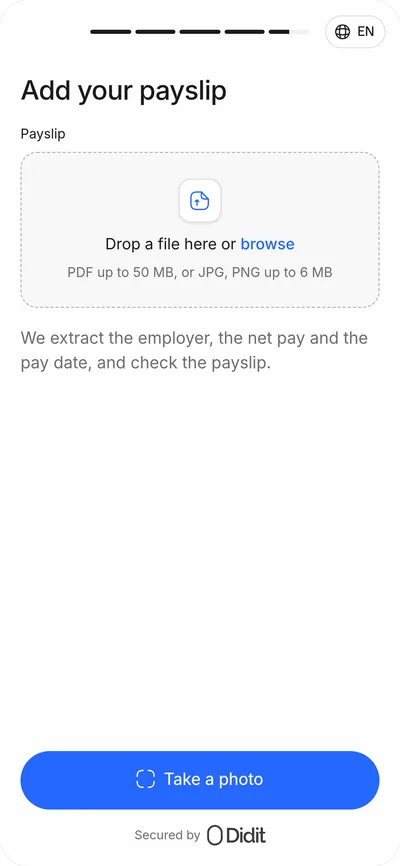
Accredited investor verification online should look like a short phone flow, not a document treasure hunt. You create a session, send the investor the hosted url, and the flow runs the checks your workflow contains in a fixed order or along branches you drew in the editor.

url.When your rule needs a figure from a financial document, add Document AI only if the supported document type is confirmed in the docs. The step returns documented fields in document_ai_documents for your reviewer to assess.
Prerequisites before you build the flow
- A Didit organization on business.didit.me, created with a work email so the Free plan carries $10 of monthly credit.
- An API key from that organization. Keep the sandbox key and the live key separate, and only switch to the live key when you are ready to bill real checks.
- A published workflow you control, with the steps your accreditation rule needs.
- A public HTTPS endpoint that can receive a Didit webhook and return a 2xx inside 5 seconds. If you would rather not depend on the webhook alone, the decision endpoint returns the same data on demand.
- Your accreditation rule written down: which thresholds, which documents you accept, which jurisdictions, and who signs off on an edge case.
- Legal review of that rule against the exemption you rely on.
How the accredited investor verification process runs, step by step
- Create the organization and copy the sandbox key. Sign up at business.didit.me, create the organization, then open the API keys page. Sandbox testing is free and unlimited.
- Create the accreditation workflow. The quick start shows the call. Workflow type
kycwith OCR, passive liveness, face match and AML covers identity plus screening:curl -X POST https://verification.didit.me/v3/workflows/ \ -H "x-api-key: $DIDIT_API_KEY" \ -H "Content-Type: application/json" \ -d '{ "workflow_label": "Investor accreditation", "workflow_type": "kyc", "features": [ {"feature": "OCR"}, {"feature": "LIVENESS", "config": {"face_liveness_method": "PASSIVE"}}, {"feature": "FACE_MATCH"}, {"feature": "AML"} ] }' - Save
workflow.id, then add the document steps in the editor. A fund that also verifies the management company can build a second workflow of typekyb, with registry pricing varying by country and data tier. - Create one session per investor.
vendor_datais your investor id and is the value you will match on later.metadatacan carry the offering id, andtagslet your reviewers filter the queue by campaign.curl -X POST https://verification.didit.me/v3/session/ \ -H "x-api-key: $DIDIT_API_KEY" \ -H "Content-Type: application/json" \ -d '{"workflow_id": "$WORKFLOW_ID", "vendor_data": "investor-1042", "callback": "https://yourplatform.com/accreditation/return", "metadata": {"offering": "fund-iii"}}' - Send the investor to the hosted URL. The response carries
session_id,urlandsession_token. Redirect the browser tourl, or open it in an SDK. The session sits at Not Started until the investor opens the link. - Register the webhook destination. Call
POST /v3/webhook/destinations/with your endpoint and subscribe tostatus.updatedanddata.updated. Store the returnedsecret_shared_keyas your signing secret;GET /v3/webhook/destinations/{destination_uuid}/returns it again if you need it. - Verify the signature and map the status. The webhooks guide specifies the
X-Signature-V2header: HMAC-SHA256 over canonical JSON, with theX-Timestampinside 300 seconds, compared in constant time. De-duplicate onevent_id, answer 2xx fast, and map Approved, Declined and In Review to your own accreditation states. - Fetch the decision when the webhook does not carry it. The
decisionobject is present in the webhook for Approved, Declined, In Review and Abandoned sessions. For any other status, and as a safety net after any webhook,GET /v3/session/{session_id}/decision/returns the same shape. Read the plural arrays, not singular fields.curl https://verification.didit.me/v3/session/<SESSION_ID>/decision/ \ -H "x-api-key: $DIDIT_API_KEY" - Keep screening after onboarding. Ongoing AML monitoring runs at $0.07 per person per year, and your annual re-verification opens a fresh session under the same
vendor_data.
Expected output of a correct run
The workflow call returns the workflow object; keep id. The session call returns session_id, url and session_token, and the session status is Not Started until the investor opens it. A completed session returns status Approved, Declined or In Review with a decision object that holds id_verifications[], liveness_checks[], face_matches[], aml_screenings[], poa_verifications[], document_ai_documents and questionnaire_responses, plus signatures[] when the workflow includes an E-signature step. session_kind is always present; branch on it before anything else.
Inputs and outputs
| Field | What to send | Why it matters here |
|---|---|---|
workflow_id | The saved workflow UUID | Decides which checks run, so it is also what decides the price |
vendor_data | Your investor id | Binds the session to one investor, drives duplicate detection, comes back in webhooks |
callback | Your return URL | Where the investor lands at the end; must sit on one of your application's allowed domains |
metadata | Offering or campaign id | Echoed back, never shown to the investor |
tags | Up to 10 names | Filter the reviewer queue by campaign |
language | ISO 639-1 code | The hosted flow is available in 54 languages |
expected_details | Name, date of birth, nationality, document types | Mismatches surface as decision warnings your reviewer sees |
session_expiration_time | 3600 to 2419200 seconds | Shorten the window for a closing deadline |
| Field | What it holds |
|---|---|
status | Exact string such as Approved, Declined, In Review, Expired, Abandoned, Resubmitted or Kyc Expired |
decision_trace | How the status was reached, whether by automation or a person |
id_verifications[] | Document read and authenticity result for the identity check |
liveness_checks[] and face_matches[] | Biometric evidence tying the person to the document |
aml_screenings[] | Sanctions, PEP and watchlist results |
document_ai_documents | The figures read from tax returns and statements |
questionnaire_responses | The investor's answers about income, net worth or professional status |
biometric_retention | The date the session's live biometric data is deleted |
Failure cases and recovery
The failures below come from the documented status list and error codes. Each one has a specific fix, and none of them require rebuilding the workflow.
| Symptom | Cause | Recovery |
|---|---|---|
| 401 from verification.didit.me | Invalid, revoked or expired API key | Rotate the key in the Console and redeploy |
| 403 with a permission message | The key lacks a privilege such as read:sessions | Use a key that carries the scope |
| 400 on session create | Invalid workflow_id | Re-check the id you saved; confirm the workflow is published |
400 on callback | The URL is not on the application's allowed domains | Add the origin, or use a documented app deep link |
| 404 on the decision call | Unknown session, or one owned by another application | Check the session id and the key's application |
| Webhook never arrives | Handler slower than 5 seconds, or returned 5xx or 404; two retries at about 1 and 4 minutes, then dropped | Fix the handler, then resend from the destination's delivery log |
| Status In Review | Warnings need a person | A reviewer approves, declines or requests resubmission in the Console |
| Status Declined | One or more checks failed | Notify the investor and request a resubmission if the issue is fixable |
| Expired or Abandoned | Link never opened in time, or the investor did not finish | Create a new session; do not reuse the old link |

Paid steps and where human review begins
You pay per completed check from prepaid credit, and a check is billed when it finishes with a result. The workflow orchestrator, reusable KYC and the MCP server carry no fee, so building and wiring the flow costs nothing beyond the checks themselves. The full list sits on didit.me/pricing, and the billing rules are in the pricing docs.
Two boundaries matter for accreditation. First, Didit's Approved means the checks in your workflow passed; it does not mean the investor satisfies Rule 501 or any other definition. Second, In Review means a warning needs judgment, and the judgment is yours. A genuine tax return that supports a false claim still looks genuine to a document read, so your reviewer, not our scoring, has to weigh whether the evidence supports the figure.

Worked cost example: 250 investors in one month
A private fund onboards 250 investors. Every investor runs a full ID check, an AML screening, one financial document read by Document AI and a custom questionnaire.
- Per investor at list price: $0.33 + $0.20 + $0.20 + $0.10 = $0.83
- 250 investors: 250 x $0.83 = $207.50 in the onboarding month
- Ongoing AML monitoring for the same 250: 250 x $0.07 = $17.50 a year
On the Growth plan the same month carries a 4% discount on every price: $0.3168 + $0.192 + $0.192 + $0.096 = $0.7968 per investor, so 250 x $0.7968 = $199.20. Growth costs $99 a month and includes $115 of credit, so the credit covers $115 and a top-up covers the remaining $84.20. Add proof of address at $0.20 only for the investors whose file needs it, and note that a second extracted document adds another $0.20.
Sources
All sources were read on November 26, 2026.
- Didit live price feed: didit.me/pricing
- Didit docs, pricing and billing: docs.didit.me/getting-started/pricing
- Didit docs, quick start: docs.didit.me/getting-started/quick-start
- Didit docs, create session: docs.didit.me/sessions-api/create-session
- Didit docs, retrieve session decision: docs.didit.me/sessions-api/retrieve-session
- Didit docs, webhooks and HMAC signing: docs.didit.me/integration/webhooks
- Didit docs, verification statuses: docs.didit.me/integration/verification-statuses
- Didit docs, data models: docs.didit.me/reference/data-models
- Didit docs, ID verification overview: docs.didit.me/core-technology/id-verification/overview
- Didit integration prompt: didit.me/developers/integration-prompt
- Didit MCP server: didit.me/developers/mcp
- U.S. SEC, Rule 501 of Regulation D, 17 CFR 230.501, full text: ecfr.gov/current/title-17/section-230.501
Next step: create an organization at business.didit.me, build the accreditation workflow, and run the calls above against the sandbox with one test investor. There is no sales call to get a key and sandbox testing is free, so the first real question you answer is your own accreditation rule.
Try it
Try this in the sandbox
Run the check this guide describes, free.
The product this post is about, taken from its topic. Run it free in the sandbox.
Author
Alberto Rosas
Co-founder and CEO

Keep reading
Other guides in the same topic.
 What Is the Purpose of FICA in South Africa? 2026 Guide
FICA is South Africa's anti-money laundering law. It creates the Financial Intelligence Centre and requires accountable institutions to identify and verify clients, screen for PEP and sanctions risk and report suspicious.
Alberto RosasNov 26, 2026 Sixth Money Laundering Directive (6AMLD): What Changed and Which Rules Apply
6AMLD is Directive (EU) 2018/1673: Member States must criminalise laundering, widen predicate offences and set a four-year penalty floor. It adds no new due diligence duties for firms.
Alberto RosasNov 26, 2026 Automated Sanctions Screening: Canada, the Entity List and Embargoes
Automated sanctions screening matches people and companies against lists such as Canada's autonomous sanctions made under SEMA and JVCFOA and the OFAC SDN List, and returns candidate hits scored for identity confidence and.
Alberto RosasNov 26, 2026Questions
Frequently asked questions
What is accredited investor verification online?
It is the process of confirming through a hosted web flow that an investor meets a regulator's definition of an accredited investor before you admit them to an offering. The provider verifies identity, reads the financial documents that support the threshold, and screens the person for sanctions and PEP exposure. The platform then applies its own rule to the evidence it received.
What counts as proof of accredited investor status?
Evidence that shows income, net worth or professional status and is tied to a verified identity: tax returns, wage forms, bank and brokerage statements, and letters from an accountant or attorney. Questionnaire answers alone are weak proof. As a review policy, many platforms treat the strongest file as a verified identity, a document that supports the figure and the investor's own recorded answers. Didit can return the verification, questionnaire and decision fields you configure in the workflow, and whether that combination satisfies your rule is your call.
Can Didit decide whether someone is accredited?
No. Didit verifies the identity, extracts the figures from the documents, screens against sanctions and PEP lists, and returns per-check results. The determination is a legal and compliance decision that belongs to your firm, and it should trace to your written rule and a named reviewer.
How long does the accredited investor verification process take?
Automated inference runs at sub-2-second p99 per check, so the automated part of the flow is fast. A session that returns In Review waits for a person in the Console, and how long that takes depends on your queue and your reviewer process. Your own document review time sits on top of that.
Which platforms need accredited investor verification?
Platforms that limit an offering to accredited investors: private funds, offerings made under exemptions such as Rule 506(b) or 506(c) of Regulation D, and marketplaces that sell certain products only to qualifying buyers. If your terms restrict an offering to accredited investors, you need evidence on file for each one. Confirm the applicable rule with counsel for every jurisdiction you sell into.
What does an accredited investor verification service cost?
On Didit one investor costs $0.33 for the full ID check, $0.20 for AML screening, $0.20 for each financial document read by Document AI and $0.10 for a custom questionnaire. Billing is per completed check from prepaid credit, and you pay for a check only when it finishes with a result. Proof of address adds $0.20 when a file needs it.
Is there a free way to test an accreditation flow?
Yes. Sandbox testing is free and unlimited. The Free plan also gives $10 of credit a month to organizations that sign up with a work email, so you can build the workflow, run the API calls and receive webhooks in the sandbox before you switch to the live key.
How do you handle an investor who abandons or fails the flow?
The status tells you what happened. Expired means the link was never opened in time, Abandoned means the investor started and did not finish, Declined means a check failed, and Resubmitted means a reviewer asked for specific steps again. Create a new session or request a resubmission instead of reusing the old link.
How long does Didit keep tax returns and statements?
Retention follows the plan: 1 year on Free, 5 years on Growth and up to 10 years on Scale, with custom retention on Enterprise. The decision also records when the session's live biometric data is deleted. Your own document retention policy runs on top of that, and it is usually the stricter of the two.
Do we need to re-verify accredited status later?
In most programs yes, because thresholds are tested against recent income or current net worth and an expiring ID document moves a session to Kyc Expired. Run a fresh session under the same vendor_data at each re-verification window and keep ongoing AML monitoring on at $0.07 per person per year.
Compliance built in
Audited, certified and attested.
We hold the certifications and build each country's rules into your flows, so you can launch anywhere without worrying. Security and Compliance center
- Regulation encoded into your flows
Tell us what you do and where. Didit lists the rules that apply to you, with sources, and builds the checks each country needs into one workflow.
- Ready for AMLR
Every requirement of the new EU anti-money laundering rules, from checking customers to human review, is already covered by a Didit check.
- Tested in Spain's Treasury sandbox
Spain's Treasury published its supervised sandbox report on Didit's NFC plus active liveness onboarding; SEPBLAC took part and valued the added measures positively.
- Audited, not self-declared
iBeta Level 1 and Level 2. Liveness tested under ISO/IEC 30107-3.
Your obligations · 3 regions
 SOC 2 Type 2
 ISO 27001
 iBeta Level 1 and Level 2
 EU regulator attestation
 FSM youth protection
 GDPR
 EBA remote onboarding
 MiCA compatible
 FIDO Alliance member
- AMLREU AML Regulation ready
Integration · Didit MCP
Run Didit from your own AI agent
Connect Didit to Claude, Cursor, VS Code or ChatGPT and just ask in plain words. Your agent can do anything you can do in the console, with the same permissions you have.
 Add to Claude
 ChatGPT
 Cursor
- Build workflowsDescribe the checks you need. The agent creates and publishes the flow.
- Run investigationsAsk why a session was declined, review cases, search people and companies.
- Change rulesCreate payment rules, test them on past data and switch them on.
- Pull reportsAsk for numbers, exports or the audit log.
Didit Academy


