Invisible ID Verification: How to Build It in 2026
Invisible ID verification runs most checks around a single user action: a selfie, a typed ID number or a wallet sign-in. On Didit a full KYC check costs $0.33 and Reusable KYC is free.
 Alberto RosasCo-founder and CEO
Contents
In this guide
Jump to the part you need.
Invisible ID verification fits teams that want most of the identity check to happen without extra user steps: one selfie, a typed national ID number or a wallet sign-in, with liveness, face match, device and IP analysis running around it. On Didit a full KYC check costs $0.33. The caveat: no check is invisible in every country, and a data-only lookup leaves a later face match nothing to compare.
Last updated: November 26, 2026. Prices checked against the live Didit price feed on November 26, 2026.
| Item | What you get | List price (USD) |
|---|---|---|
| Full ID check (KYC) | Document check, passive liveness, face match 1:1, device and IP analysis in one session | $0.33 per completed check |
| Non-document lookup | User types a national ID number and a few details, matched against the authoritative source for that country | Variable by country |
| Digital ID wallet sign-in | User signs in with an eID they already hold; the issuer signs the attributes it returns | Google Wallet $0.10, BankID Sweden $0.20, MitID $0.25, iDIN $0.95 |
| Returning user | Reusable KYC shares a finished session across applications; biometric authentication confirms presence | Reusable KYC free, biometric authentication $0.10 |
| Free plan credit | Monthly credit for organizations that sign up with a work email | $10 a month |
| Sandbox | Test sessions on every plan | Free and unlimited |
Start free in the sandbox at https://business.didit.me/, no sales call, and if you build with an AI assistant, connect Didit to it through MCP setup for every client. The flow on this page runs on the Identity Verification product, and every number below is on https://didit.me/pricing/.
What invisible ID verification is, and who it fits
Invisible ID verification is a workflow where the user performs one natural action and the checks run around it. The actions available on Didit are a selfie, a typed national ID number plus a few details, or a sign-in with a digital identity wallet the user already holds. In a document-based flow the user takes one selfie, and passive liveness, face match, device and IP analysis and the decision run around it. In a non-document lookup the user types an ID number and a few details; the source may return a portrait, check a selfie itself, or return data only. In a wallet sign-in the user approves a sign-in and the issuer returns signed attributes, with no selfie unless the wallet supplies one. Document capture, when it is used as a fallback, asks for a photo or upload. The amount of user effort is method-specific, not a fixed promise.
It fits three kinds of buyer. Consumer apps with high signup volume where each extra step costs conversions. Regulated teams that need the audit trail behind each decision, not just the pass. And platforms already using document capture that want to remove it from the majority of low-risk sessions and keep it as a fallback.
It does not fit every case. A document check is still the only method that inspects a document for authenticity. A lookup proves the details you typed matched a record, and nothing about a document. A data-only lookup returns the assurance tier data_match: the typed details matched a record the source holds, and it leaves no reference portrait. A Face Match step later in that workflow has nothing to compare, so the workflow editor flags it. If nothing else in the workflow supplies a reference face, Face Match reports FACE_MATCH_NOT_COMPUTED with a null score rather than declining automatically. A wallet proves an issuer authenticated the person and signed the attributes, and it may share no portrait at all. Those are different kinds of evidence, and the workflow should say which one it needs before the session starts.
What people mean by invisible ID
Most people searching for invisible ID mean one of two things. Either the removal of redirects and multi-step document uploads in favour of a single selfie, or the removal of the user action entirely in favour of background signals. Didit supports both patterns, but only the first one produces an identity decision on its own. Background signals such as device and IP analysis return risk evidence at $0.03 per check, and they raise or lower confidence, they do not confirm who someone is.
Design guideline, not a Didit guarantee: aim for one user action and one decision. If a flow asks for nothing at all, it returns risk evidence, not a verification.
The outcome to build, and the method we recommend
The target flow is a session where the user does one thing and the decision arrives on your webhook with no follow-up step; failures, retries and manual review can still require additional steps. Concretely: a lookup or wallet sign-in is attempted first for the countries where it is available, passive liveness and a face match run on the selfie or on the registry portrait, document capture is offered only as a branch when the lookup fails or when the source leaves no photograph, and a returning user is re-confirmed with biometric authentication instead of a new check.
We recommend the workflow builder in the Didit console with node-based branching, because the branch is what makes the flow feel invisible. A simple workflow runs its steps in a fixed order. A node-based workflow branches on a result, so a matched lookup can skip document capture and a failed one can fall through to it. Both are configured the same way and both are free, since the Workflow Orchestrator carries no separate price.
Prerequisites
- A Didit organization, created at https://business.didit.me/. Signing up with a work email gives the organization $10 of credit a month on the Free plan.
- An API key. Build with the sandbox key that the programmatic registration returns, and switch to the live key only when you go live.
- The list of countries you onboard. Lookup sources, digital ID wallets and their production availability differ by country, and the console checks its live capability catalog when you save a workflow.
- A public HTTPS endpoint if you want webhooks. Without one, poll the decision endpoint.
- A decision on the assurance tier you need:
data_matchfor a lookup,cryptographicfor a wallet, or document inspection for a full check.
Steps to build an invisible ID verification flow
1. Create the organization and pick the workflow start
Sign up at business.didit.me and create your Organization. In the sidebar open Workflows and click New workflow. Pick whether you verify users or businesses, then choose Describe it, Start from a template (the KYC template is the standard onboarding one), or Start empty. Set the workflow type to kyc and switch the editor to node-based so you can branch.
2. Create the workflow through the API
The same workflow can be created with one call. This is the request from the Didit quick start:
curl -X POST https://verification.didit.me/v3/workflows/ -H 'x-api-key: $DIDIT_API_KEY' -H 'Content-Type: application/json' -d '{"workflow_label": "Standard KYC", "workflow_type": "kyc", "features": [{"feature": "OCR"}, {"feature": "LIVENESS", "config": {"face_liveness_method": "PASSIVE"}}, {"feature": "FACE_MATCH"}, {"feature": "AML"}]}'Persist workflow.id from the response. For an invisible flow, PASSIVE is the liveness method to start with: it analyses a single frame instead of asking the user to blink or turn their head. Active liveness costs more, $0.15 against $0.10 for passive, and it adds a user action, so use it only where the risk model needs it.
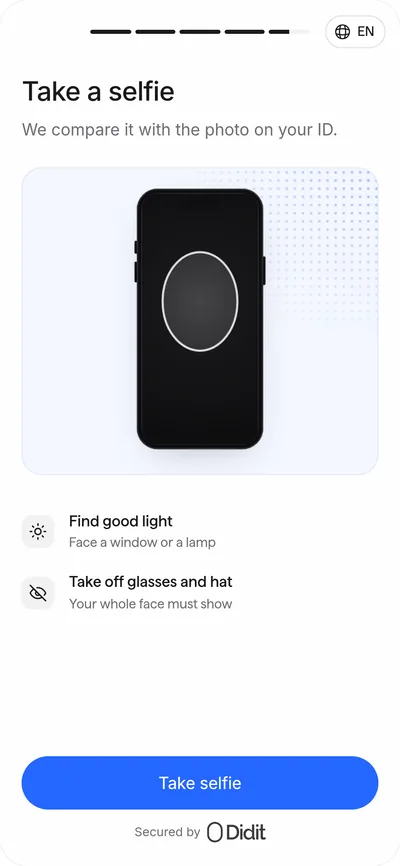
3. Create the session and send the user to it
curl -X POST https://verification.didit.me/v3/session/ -H 'x-api-key: $DIDIT_API_KEY' -H 'Content-Type: application/json' -d '{"workflow_id": "$WORKFLOW_ID", "vendor_data": "user-42", "callback": "https://myapp.com/kyc/return"}'The response carries session_id, url and session_token. Redirect the user to url, or open it in the SDK or an iframe. The full parameter list is on Create Session API.
4. Register a webhook destination
Post to https://verification.didit.me/v3/webhook/destinations/ with label, url, subscribed_events set to status.updated, data.updated, user.status.updated and user.data.updated, and webhook_version set to v3. Label and URL are required. Store the returned secret_shared_key as your webhook secret; the destination detail endpoint returns it again if you lose it.
5. Verify and answer every delivery
Verify the X-Signature-V2 header, which is an HMAC-SHA256 of the canonical JSON body. De-duplicate on event_id because retries repeat the same event. Respond within 5 seconds and apply the decision to your database based on status. Details are in the webhook guide.
6. Keep a decision fallback
If a webhook is missed, call GET https://verification.didit.me/v3/session/{session_id}/decision/. V3 returns plural arrays, so read id_verifications[], liveness_checks[], face_matches[] and aml_screenings[]. Never assume the singular V2 fields.

Expected output
A finished session is Approved, Declined or In Review. On an approved passive flow you should see the liveness entry approved with a score, the face match entry with a comparison score against the document or registry portrait, and the ID verification entry with the extracted fields. The decision also contains the results for any other checks you enabled, such as AML. A sub-2-second p99 inference time is the target across checks.
GET https://verification.didit.me/v3/session/{session_id}/decision/

id_verifications[]   document or lookup result
liveness_checks[]    one entry per liveness step
face_matches[]       the 1:1 comparison
aml_screenings[]     present when AML runs
Each liveness entry carries its documented status: Not Started, In Progress, Approved, In Review, Declined, Abandoned or Kyc Expired. Watch the warnings[] array for risk codes such as LOW_LIVENESS_SCORE, LIVENESS_FACE_ATTACK, NO_FACE_DETECTED, MULTIPLE_FACES_DETECTED or FACE_IN_BLOCKLIST.

Failure cases and recovery
| Failure | What you see | Recovery |
|---|---|---|
| API key missing | 403 with "You do not have permission to perform this action." | Send x-api-key on every verification call |
| Key wrong, revoked or expired | 401 | Rotate the key in the console and redeploy |
Unknown workflow_id | 400 | Copy the id from the console and confirm the key belongs to the same application |
| Webhook handler slower than 5 seconds, or returns 5xx or 404 | Didit retries twice, after about 1 and 4 minutes, then drops the delivery | Respond within 5 seconds and process the decision according to your documented handler logic. Resend from the destination delivery log if a delivery is dropped. |
| No credits | 403 on a standalone API call | Top up or subscribe; the sandbox keeps working |
| Bad image on a standalone liveness call | 400 for missing user_image, file over 5 MB, or an unsupported extension | Send jpg, jpeg, png, tiff or webp under 5 MB, never a PDF |
| Presentation attack suspected | Declined with LIVENESS_FACE_ATTACK or LOW_LIVENESS_SCORE | Do not approve; route to review per policy |
| Bad framing | NO_FACE_DETECTED or MULTIPLE_FACES_DETECTED | Ask for a retry with one face, well framed |
| Data-only lookup followed by face match | FACE_MATCH_NOT_COMPUTED with a null score | Allow document capture, pick a source that returns a photograph or checks the selfie, or remove the face match step |
| Workflow will not publish | Every path into face match verifies users only with methods that leave no photo | Change the branch, or add document capture for that country |
| Wallet marked Coming soon | It cannot be enabled in that environment | Use a documented fallback, such as document capture, for that country |
Inputs and outputs
| Input | Where it goes | Output |
|---|---|---|
workflow_id, vendor_data, callback | POST /v3/session/ | session_id, url, session_token |
| ID document images | OCR feature | id_verifications[] |
| Selfie | LIVENESS and FACE_MATCH features | liveness_checks[], face_matches[] |
| National ID number and details | Non-document lookup | Result with tier data_match and id_lookup.source on the payload |
| Wallet sign-in | Digital ID wallet step | Signed attributes, tier cryptographic |
| Session events | Webhook destination | event_id, status, decision payload |
Paid steps and review boundaries
You pay for a check only when it finishes with a result. Some no-match database lookups and retries are billable, and the docs pricing page lists them. The steps that cost money in an invisible flow are the ones below, and everything else in the orchestration, including the workflow builder, Reusable KYC, the MCP server and the SDKs, is free.
| Step | List price (USD) | Growth (4% off) | Scale (10% off) |
|---|---|---|---|
| ID Verification (document) | $0.15 | $0.144 | $0.135 |
| Passive Liveness | $0.10 | $0.096 | $0.09 |
| Face Match 1:1 | $0.05 | $0.048 | $0.045 |
| Device and IP Analysis | $0.03 | $0.0288 | $0.027 |
| Face Search 1:N | $0.05 | $0.048 | $0.045 |
| Biometric Authentication | $0.10 | $0.096 | $0.09 |
| Age Estimation | $0.10 | $0.096 | $0.09 |
| AML Screening | $0.20 | $0.192 | $0.18 |
The table uses workflow feature prices. The standalone server-to-server passive-liveness API is a separate price-book line, priced at $0.10 per call. Use the standalone price only when you send an already captured selfie to that API.
The review boundary is the status. Approved and Declined are machine outcomes and add no separate check to the session. In Review means a person or the Investigator Agent has to decide, and reviewer time is an operational cost. This guide keeps review out of the per-check arithmetic. If your policy sends every second session to review, invisible verification stops being cheap in operational terms, so tune the branch to send only the warnings that matter.
Worked cost example
Take 10,000 completed onboardings in a month, all on the full ID check, with AML on the 2,000 users who are in scope for it.
- 10,000 full KYC checks at $0.33 = $3,300.00
- 2,000 AML screenings at $0.20 = $400.00
- Total at list price = $3,700.00
The same volume on the Growth plan, where every Didit price is 4% lower:
- 10,000 at $0.3168 = $3,168.00
- 2,000 at $0.192 = $384.00
- Subtotal = $3,552.00, minus the $115 monthly credit = $3,437.00
Now add the invisible part for returning users. A user who already passed a full check can be re-confirmed with biometric authentication at $0.10 instead of $0.33, and sharing the finished session through Reusable KYC costs nothing. If 4,000 of those 10,000 sessions are returning users, the saving over full checks is 4,000 multiplied by $0.23, which is $920.00 a month at list price.
AI identity verification: what the models actually do in each check
AI identity verification is a set of narrow models, each answering one question, wired into one workflow. In a Didit session the work splits four ways. Document AI reads the document, extracts the fields and checks the document. Passive liveness runs a single-frame model over the selfie and looks for texture and artefact patterns that separate a live face from a printed photo, a screen replay or a mask. Face match computes a 1:1 comparison, normally between the selfie and the document portrait, or between the selfie and a registry portrait when a lookup returns one. Device and IP analysis scores the network and the device without touching the user at all. Across a session we surface 200+ real-time fraud signals.
For AI-powered ID verification the important number is accuracy under attack, not accuracy on clean inputs. Our liveness detection is documented at 99.9% accuracy with a false acceptance rate under 0.1%, and it holds iBeta Level 1 and Level 2 presentation attack detection. What makes an invisible flow defensible is that each check returns its own documented evidence and status: the liveness score, the face match comparison, the document fields and the warnings. The decision can be tied to those outputs rather than to user effort.
AI-driven ID verification also changes the workflow shape. Because each check returns its own entry and its own warnings, the branch can be written on results rather than on fixed steps. A lookup that matches skips the document. A face that fails liveness goes to review instead of a third retry. That is what makes the next session cheaper and the next user faster.
AI student identity verification
For AI student identity verification, split the problem in two. At enrolment, run a full check at $0.33: document, passive liveness and face match against the document portrait, plus face search 1:N at $0.05 if you need to catch one person holding several accounts. Before each exam, re-confirm the person with biometric authentication at $0.10, which compares the live capture to the face you enrolled and returns a decision. The student completes a selfie-based biometric re-confirmation against the face enrolled earlier. Be clear about the limit: this confirms who is at the keyboard, not what they do on the screen.
Sources
- Didit pricing page and the live price feed as JSON, read November 26, 2026.
- Didit docs: Identity Verification Pricing, read November 26, 2026.
- Didit docs: Quick Start, source of the workflow, session and webhook calls, read November 26, 2026.
- Didit docs: Create Session API, read November 26, 2026.
- Didit docs: Webhooks, read November 26, 2026.
- Didit docs: Non-Document ID Verification, read November 26, 2026.
- Didit docs: Digital ID Wallet Verification, read November 26, 2026.
- Didit docs: Liveness Detection API, read November 26, 2026.
- Didit docs: Reusable KYC, read November 26, 2026.
- Didit MCP server, read November 26, 2026.
- EUR-Lex, EU digital identity and eIDAS law: https://eur-lex.europa.eu/ (plain text, no link to a vendor).
Next step: create an organization at https://business.didit.me/, publish a workflow with passive liveness and face match, and run one test session in the sandbox. No sales call, and the Free plan gives you $10 of credit a month to test with.
Try it
Try this in the sandbox
Run the check this guide describes, free.
The product this post is about, taken from its topic. Run it free in the sandbox.
Author
Alberto Rosas
Co-founder and CEO

Keep reading
Other guides in the same topic.
 What Is the Purpose of FICA in South Africa? 2026 Guide
FICA is South Africa's anti-money laundering law. It creates the Financial Intelligence Centre and requires accountable institutions to identify and verify clients, screen for PEP and sanctions risk and report suspicious.
Alberto RosasNov 26, 2026 Sixth Money Laundering Directive (6AMLD): What Changed and Which Rules Apply
6AMLD is Directive (EU) 2018/1673: Member States must criminalise laundering, widen predicate offences and set a four-year penalty floor. It adds no new due diligence duties for firms.
Alberto RosasNov 26, 2026 Automated Sanctions Screening: Canada, the Entity List and Embargoes
Automated sanctions screening matches people and companies against lists such as Canada's autonomous sanctions made under SEMA and JVCFOA and the OFAC SDN List, and returns candidate hits scored for identity confidence and.
Alberto RosasNov 26, 2026Questions
Frequently asked questions
What is invisible ID verification?
Invisible ID verification is an identity flow where the user performs one natural action, such as a selfie, a typed national ID number or a wallet sign-in, and the remaining checks run without further prompts. Passive liveness, face match, device and IP analysis and the decision all happen around that single action. It is a workflow design, not a separate product, and on Didit it is built in the workflow builder.
How much does invisible ID verification cost on Didit?
A full ID check at list price is $0.33 and bundles ID document verification at $0.15, passive liveness at $0.10, face match 1:1 at $0.05 and device and IP analysis at $0.03. A returning user can be re-confirmed with biometric authentication at $0.10, and Reusable KYC is free. Non-document lookups are priced by country and are variable.
Do I need a document for invisible ID verification?
No, not in the countries where a non-document lookup or a digital ID wallet is available. A lookup matches the details the user types against the authoritative source for that country and returns the assurance tier data_match. A wallet sign-in returns signed attributes at tier cryptographic. Document capture is still needed when the source leaves no photograph, when the lookup fails, or when your policy requires document inspection.
What is AI identity verification and how does it work?
AI identity verification uses narrow models to answer separate questions inside one workflow: whether a document looks genuine and what it says, whether the face in a selfie is live, whether two faces are the same person, and whether the device and network look suspicious. Each answer becomes an entry on the session decision, so the business rules can branch on it. On Didit the entries are id_verifications[], liveness_checks[], face_matches[] and aml_screenings[] when AML runs.
Which AI ID verification checks run without any user action?
Device and IP analysis runs in the background at $0.03 per check and returns risk evidence as part of the session. Face search 1:N also runs server-side against your face index at $0.05 per search. Liveness and face match need an image, so in practice they need one selfie, which is the single visible action in an otherwise invisible flow.
Can AI-powered ID verification detect deepfakes?
Our liveness detection is documented at 99.9% accuracy with a false acceptance rate under 0.1%, and it is certified to iBeta Level 1 and Level 2 for presentation attack detection. It looks for spoof indicators in a single frame, including printed photos, screen replays and masks, and it returns risk codes such as LIVENESS_FACE_ATTACK when it suspects one. For higher-risk flows we offer active liveness at $0.15. 3D Flash adds depth cues, while 3D Action adds a randomised user action.
Is there a free way to test invisible ID verification?
Yes. Sandbox testing is free and unlimited on every plan, so you can create test sessions without a session quota. Organizations that sign up in the console with a work email also get $10 of credit a month on the Free plan, which buys about 30 full ID checks. You can start at https://business.didit.me/ without a sales call.
What happens when an invisible check fails or goes to review?
A failed liveness check returns Declined with a risk code, and a frame problem returns a warning such as NO_FACE_DETECTED so you can ask for one retry. Sessions that need a human decision land in In Review, which is an operational review step and is not part of the per-check arithmetic here. If a data-only lookup is followed by a face match, the comparison is reported as FACE_MATCH_NOT_COMPUTED with a null score rather than an automatic decline, so your branch has to handle it.
Can students be verified without extra steps for online exams?
Yes, in two stages. Enrol the student once with a full check at $0.33, which covers the document, passive liveness and a face match, and add face search 1:N at $0.05 if duplicate accounts are a risk. Before each exam, re-confirm the same person with biometric authentication at $0.10, which requires nothing but a quick selfie and returns a decision you can log.
Which countries support invisible verification without a document?
Coverage differs by method. Most countries with a non-document lookup are a government register, such as the Department of Home Affairs in South Africa, RENAPER in Argentina, UIDAI in India or the CPR register in Denmark. Canada, France, Indonesia, the Netherlands, Norway, Singapore, the United Kingdom and the United States reach a credit-bureau, financial-services, utility or residential-records file instead, which changes what the match proves. Digital ID wallets are available per country, for example MitID in Denmark, BankID in Sweden, Smart-ID in four countries, and iDIN in the Netherlands.
Does invisible verification work for returning users?
Yes, and that is where the cost saving sits. Reusable KYC lets a finished session be shared with another Didit application, or imported back, so the user does not verify twice, and the feature is free. For re-authentication inside your own app, biometric authentication costs $0.10 against $0.33 for a fresh full check.
What does Didit cost at scale in 2026?
Plans are Free at $0 with $10 of monthly credit, Growth at $99 a month with $115 of credit and 4% off every price, Scale at $299 a month with $350 of credit and 10% off, and Enterprise from $15,000 a year. Above the monthly credit, usage is paid from top-ups that last 12 months. Every figure is on https://didit.me/pricing/.
Compliance built in
Audited, certified and attested.
We hold the certifications and build each country's rules into your flows, so you can launch anywhere without worrying. Security and Compliance center
- Regulation encoded into your flows
Tell us what you do and where. Didit lists the rules that apply to you, with sources, and builds the checks each country needs into one workflow.
- Ready for AMLR
Every requirement of the new EU anti-money laundering rules, from checking customers to human review, is already covered by a Didit check.
- Tested in Spain's Treasury sandbox
Spain's Treasury published its supervised sandbox report on Didit's NFC plus active liveness onboarding; SEPBLAC took part and valued the added measures positively.
- Audited, not self-declared
iBeta Level 1 and Level 2. Liveness tested under ISO/IEC 30107-3.
Your obligations · 3 regions
 SOC 2 Type 2
 ISO 27001
 iBeta Level 1 and Level 2
 EU regulator attestation
 FSM youth protection
 GDPR
 EBA remote onboarding
 MiCA compatible
 FIDO Alliance member
- AMLREU AML Regulation ready
Integration · Didit MCP
Run Didit from your own AI agent
Connect Didit to Claude, Cursor, VS Code or ChatGPT and just ask in plain words. Your agent can do anything you can do in the console, with the same permissions you have.
 Add to Claude
 ChatGPT
 Cursor
- Build workflowsDescribe the checks you need. The agent creates and publishes the flow.
- Run investigationsAsk why a session was declined, review cases, search people and companies.
- Change rulesCreate payment rules, test them on past data and switch them on.
- Pull reportsAsk for numbers, exports or the audit log.
Didit Academy


