How IP Analysis Stops Romance Scams on Dating Sites
Didit Device and IP Analysis is $0.03 per check, runs inside the verification session, and returns LOCATION warnings such as duplicated device, VPN and location mismatch for your app to route.
 Alejandro RosasCo-founder and CTO
Contents
In this guide
Jump to the part you need.
This guide is for dating and social app teams that want to stop romance scam accounts before they reach a member. Didit Device and IP Analysis costs $0.03 per check and runs inside the verification session, returning warnings you can route to review. The caveat: device and IP data is evidence, not a verdict, so you still need your own rules and a human queue for the cases that get flagged.
Last updated: November 26, 2026. Prices checked against the live Didit price feed on November 26, 2026.
| Question | Answer |
|---|---|
| What it does | Attaches a device fingerprint, an IP geolocation and a warning list to each verification session, so a scam profile is flagged before it messages a member |
| Recommended method | Hosted session collects device and IP automatically; read ip_analyses[] on the decision. Optional strict-mode rules live in the Business Console |
| Price | $0.03 per Device and IP Analysis check, already inside the $0.33 full ID check |
| Delivery mode | Session only. No standalone IP analysis endpoint |
| Main warning codes | VPN, proxy, Tor, data center IP, high risk country, location mismatch with the document, duplicated device, impossible travel |
| Main caveat | A VPN is not a scammer and a family sharing one connection is not a fraud ring. Decide the action per code before you switch rules on |
| Free to start | $10 of monthly credit on the Free plan, and sandbox testing is free and unlimited |
Start free in the sandbox at business.didit.me with no sales call. Developers who want an assistant to wire the flow can connect Didit through the MCP server. The matching product documentation is the Device and IP Analysis overview, and every line item sits on the pricing page.
Why romance scams break on device and IP data
A romance scam is an operation, not a conversation. One operator runs several profiles at once, works from a script, and pushes a member to another app as soon as the person is invested. Money requests follow: a medical bill, a customs fee, a crypto deposit, a flight that never gets booked.
The cheap place to stop that operation is account creation. A common risk pattern is a cluster of profiles that come from a small pool of devices and networks, because buying a new phone farm and a new hosting range for every victim is expensive. The traces are already there at signup:
- One device creating profile after profile, each with a fresh email address.
- A profile that says it lives in one city while the connection resolves to another country, or to a hosting range no home broadband uses.
- A document from one country presented from a connection in another country, session after session.
- A device that already appeared under a different account during a liveness attack.
- Two sessions from places too far apart for the time between them.
Members never see any of this. Your onboarding flow does, if it looks. 4,000+ companies run Didit checks, and device and IP analysis is part of the standard check rather than an add-on you assemble yourself.
The hard part is not detection. It is deciding what each signal means for your product, because a dating app that blocks every VPN loses travelling members, remote workers and people on carriers that route through a proxy. The rest of this guide is about wiring the check and drawing those lines.
What Didit Device and IP Analysis returns
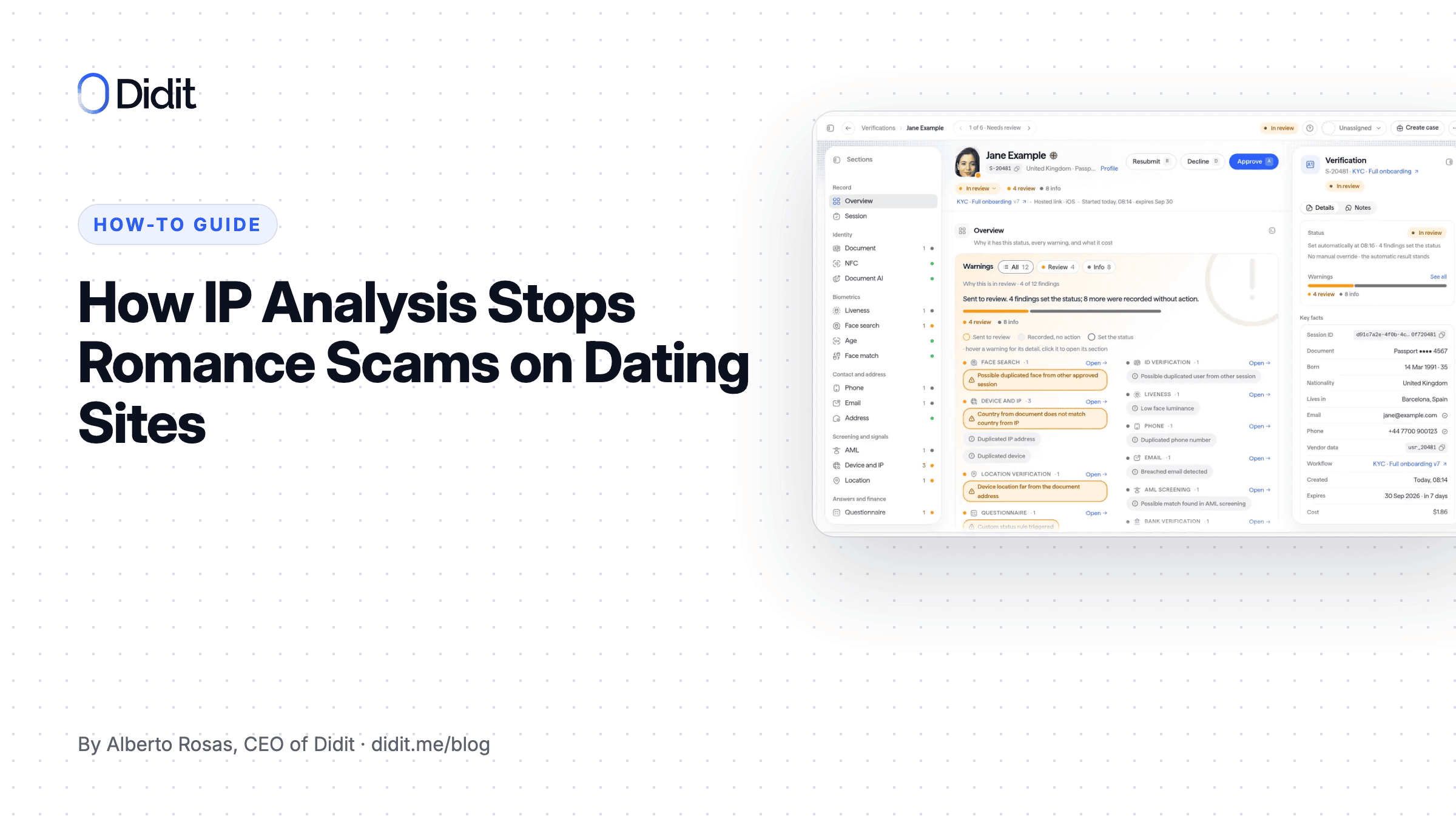
The check runs automatically inside the session. It links device, network and identity context into one risk surface, then writes one entry per collection point into ip_analyses[] on the decision. Each entry carries the resolved country, region, city and coordinates, the ASN, VPN, proxy and Tor flags, a data center flag, the device fingerprint id, duplicate device matches, and a warnings array.
Basic signals are automatic. Every hosted session collects the fingerprint and IP and writes ip_analyses[]; you do not add a workflow node or toggle a feature for that basic set. Strict-mode rules are optional. They are Business Console settings such as decline on VPN, review on duplicate device, or decline on country mismatch with the document; they apply your policy before your app reads the decision, but the raw warnings arrive either way.
Warnings from this feature arrive in the LOCATION bucket. The codes you will act on most often on a dating site:
| Code | What it means | First action |
|---|---|---|
VPN_DETECTED | The connection comes from a VPN exit | Do not act alone. Combine with a second signal such as device age or message velocity |
PROXY_DETECTED | A proxy sits in the path | Queue for review when the profile also claims a local city |
TOR_DETECTED | The connection is a Tor exit | Step up or decline, per your policy |
DATACENTER_IP | The address belongs to a hosting provider, not a home connection | Raise the score. Hosting ranges are cheap for someone running many accounts |
HIGH_RISK_COUNTRY | The country is on your risk list | Read it with the document country, never alone |
LOCATION_MISMATCH_WITH_DOCUMENT | The IP country does not match the issuing country of the document | Route to review |
DUPLICATED_DEVICE | The same persistent device was enrolled under another vendor_data | Merge accounts or block, per policy |
POSSIBLE_DUPLICATED_DEVICE | A high confidence recovery match on the fingerprint vector | Review before acting, this is the softer match |
IMPOSSIBLE_TRAVEL | Two sessions from places too far apart for the time between them | Review, then look at the accounts behind both sessions |
DEVICE_FINGERPRINT_BLOCKLISTED | The device is on your blocklist | Block |
DEVICE_LINKED_TO_LIVENESS_ATTACK | The device was previously tied to a liveness attack | Block, and check the accounts it touched |
DEVICE_MODEL_INCONSISTENT | The reported device model conflicts with other signals | Raise the score |
The full catalogue is in the warnings reference, and the per feature shape is documented at report format.

Prerequisites
- A Didit organization, an application, and an API key that can create sessions.
- A Didit workflow, and a standard template is fine. Device and IP Analysis runs automatically in the hosted session, so there is no feature toggle to add for the basic signal set. Optional strict-mode IP and device rules are configured in the Business Console, documented at workflow builder.
- Your callback origin listed in the application allowed domains. A callback outside those origins fails the create call with a 400.
- A stable per user identifier to send as
vendor_data. Duplicate device detection compares the session against sessions from othervendor_datavalues, so a random value per session weakens the check. - A written policy: which codes auto-pass, which queue for review, which step up, which decline.
- A sandbox application, because sandbox sessions are free and you can replay outcomes before touching production.
Step by step: add device and IP analysis to a dating app
Create the application and keep the API key on the server. Sign up at business.didit.me, create an application, copy the key. Test in a sandbox application first so nothing is billed while you wire the flow.
Publish the workflow you already use. Device and IP Analysis is session-only. The hosted session collects the device fingerprint and IP automatically on every session and does not require a workflow node or feature toggle for the basic signal set. If you want Didit to apply policy for you, open the Business Console and enable optional strict-mode rules for IP and device, such as decline on VPN, review on duplicate device, or decline on country mismatch with document. Workflows use draft and publish versioning, so a session always runs against a published version.
Decide the action per code. Keep a written policy: which codes auto-pass, which queue for review, which step up, which decline. Some of that can live in console strict-mode rules; the rest in your own application, where you also see profile behavior and message volume.
Create the session. Send a stable user id in
vendor_data, not an email address you might change later.curl -X POST 'https://verification.didit.me/v3/session/' -H 'x-api-key: YOUR_API_KEY' -H 'Content-Type: application/json' -d '{"workflow_id": "YOUR_WORKFLOW_ID", "vendor_data": "user-123", "callback": "https://yourapp.com/post-kyc"}'The endpoint and body are documented at Create Session.
Send the person to
session.url. The web or mobile SDK collects the device fingerprint and the IP in band while the person completes the flow. You do not send an IP address yourself and there is no IP endpoint to call. If the person drops out mid flow the entry ends as Abandoned, and you invite them back into a new session.Read the decision. Fetch it once the session reaches a terminal status.
curl -s https://verification.didit.me/v3/session/<SESSION_ID>/decision/ -H "x-api-key: <API_KEY>" | jq '[.ip_analyses[].warnings[] | select(.feature == "LOCATION") | .risk]'The response is documented at Retrieve Session, and the full per feature schema at data models.
Subscribe to
status.updatedso you stop polling. Register a webhook destination, verify theX-Signature-V2header against the raw body, check the timestamp is within five minutes, then read the decision envelope. There is no wildcard, so subscribe to the event families you actually handle. See webhooks.Route the account, not the signal. One warning rarely justifies blocking a member who pays for a subscription. Map each code to a bucket: auto pass, step up with an extra liveness check, manual review, block. Log the outcome so you can tighten thresholds after a month of real traffic.
Expected output
A completed session returns one entry in ip_analyses[] per collection point in the workflow, so a flow with two collection points returns two entries. Each entry has a status of Not Started, In Progress, Approved, In Review, Declined, Abandoned or Kyc Expired, a node_id that pins it to the workflow node that produced it, and a warnings array.
Every warning object has the same shape across features. The documented example below comes from ID verification. A location warning uses the same fields with feature set to LOCATION and a risk code from the catalogue above.
{"feature": "ID_VERIFICATION", "risk": "DOCUMENT_EXPIRED", "additional_data": null, "log_type": "error", "short_description": "Document expired", "long_description": "The document's expiration date has passed, rendering it no longer valid for use.", "node_id": "first_id_verification"}Read two more fields on the same decision: the session level status, which is what your product usually reacts to, and decision_trace, which records how that status was reached, automatically or by a reviewer.
Failure cases and recovery
| Symptom | Cause | Recovery |
|---|---|---|
ip_analyses[] is empty | The person blocked the fingerprinting script with a privacy extension or content blocker | Decide fail closed or fail open in advance, and write the message the member sees |
VPN_DETECTED or PROXY_DETECTED on a good member | Corporate network, carrier routing, or a privacy habit | Step up with an extra liveness check instead of declining, and decline only when a second signal lands |
TOR_DETECTED | Tor exit node | Treat per compliance and fraud policy. Define your own Tor policy and tell the member what happens |
DUPLICATED_DEVICE | The same persistent device enrolled under another vendor_data | Merge or block per policy. Check first whether both accounts are already messaging members |
LOCATION_MISMATCH_WITH_DOCUMENT | The IP country differs from the document issuing country | Route to review. Expats, students and cross border commuters produce this too |
| 400 on create with a callback error | The callback origin is not in the application allowed domains | Add the origin, or omit the callback and use the workflow default |
| 401 on the decision fetch | Invalid API key | Reissue the key and keep it server side |
| 403 on the decision fetch | The key lacks the read:sessions privilege | Add the privilege to the key |
| 404 on the decision fetch | The session does not exist or belongs to a different application | Check that the key and the session come from the same application |
| Webhook signature check fails | The body was parsed before verification, or the timestamp is older than five minutes | Read the raw body, verify X-Signature-V2, then parse the JSON |
Inputs and outputs
| Direction | Field | Notes |
|---|---|---|
| Input | workflow_id | UUID of the published workflow used for the session. Device and IP Analysis runs automatically, so no node is required for the basic signal set |
| Input | vendor_data | Your stable user identifier. Duplicate device detection compares sessions across different values of this field |
| Input | callback | Where the hosted flow redirects when finished. Must sit on an allowed domain, otherwise creation fails with 400 |
| Input | metadata | Free JSON echoed back in responses and webhooks. Useful for plan tier or acquisition channel |
| Output | ip_analyses[].status | Not Started, In Progress, Approved, In Review, Declined, Abandoned or Kyc Expired |
| Output | Geo and network fields | Country, region, city, coordinates, ASN, and the VPN, proxy, Tor and data center flags |
| Output | Device fields | Device fingerprint id, exact duplicate matches, recovered device matches |
| Output | ip_analyses[].warnings[] | Risk codes in the LOCATION bucket, with short and long descriptions |
| Output | status and decision_trace | Session level outcome, and how it was reached, automatically or by a reviewer |
Paid steps and where a human decides
Device and IP Analysis is $0.03 per completed check. Inside a full ID check you pay the bundle, $0.33, which is ID document verification $0.15 plus passive liveness $0.10 plus face match $0.05 plus device and IP analysis $0.03. The documented route is the session feature described here: Didit collects the fingerprint and IP during the hosted flow and returns ip_analyses[]; there is no standalone endpoint to call with an IP address.
We bill per completed check from prepaid credit. The Free plan adds $10 of credit each month for eligible organizations, and the sandbox is free on every plan. Growth is $99 a month with 4 percent off every Didit price, Scale is $299 a month with 10 percent off. Read the current numbers on the pricing page or the machine readable feed at pricing.json.
Where a person decides: a warning code is a fact about a connection or a device, not a judgement about a member. Keep a human on these four cases.
- A single soft signal on an account with a payment history. Declining here costs more than the scam it prevents.
- A location mismatch with the document on an account that already passed liveness and face match.
- A recovered device match, which is deliberately high confidence but not exact.
- Any block on an account with messages in flight, because the member on the other side needs a safe exit, not a silent disappearance.

Worked cost example
Take a dating app with 200,000 new signups a month. It runs the full ID check on the 60,000 people who reach the messaging step, and the Device and IP Analysis check alone on the other 140,000, so every profile carries a device and network signal from day one.
Full ID check:       60,000 x $0.33  = $19,800.00
Device and IP only: 140,000 x $0.03  =  $4,200.00
Total at list price                   = $24,000.00 per month

Same volume on Scale, 10 percent off every Didit price:
Full ID check:       60,000 x $0.297 = $17,820.00
Device and IP only: 140,000 x $0.027 =  $3,780.00
Total on Scale                        = $21,600.00 per month
The plan fee sits on top. Scale is $299 a month and includes $350 of credit, which the $21,600 bill consumes in the first days of the month. At startup volume the arithmetic is smaller: 1,500 full checks and 3,500 device and IP checks come to $495.00 plus $105.00, so $600.00 a month at list price, and the $10 monthly Free plan credit covers a first small test, not this volume.
Sources
- Didit docs: Device Fingerprinting and IP Risk overview
- Didit docs: IP analysis warnings catalogue
- Didit docs: per feature IP analysis report
- Didit docs: data models
- Didit docs: Create Session API
- Didit docs: Retrieve Session API
- Didit docs: webhooks and signature verification
- Didit docs: sandbox testing
- Didit docs: workflow builder
- Didit pricing page, read November 26, 2026
- Didit pricing feed as JSON, read November 26, 2026
- Didit docs: pricing and billing rules, read November 26, 2026
- Didit MCP server
The next step is a sandbox run, not a sales call. Create an application at business.didit.me, publish the workflow you already use, and push one test session through it to see the device and IP warnings your own traffic produces. If you want policy applied automatically, turn on the optional strict-mode rules after you have seen the raw warnings.
Try it
Try this in the sandbox
Run the check this guide describes, free.
The product this post is about, taken from its topic. Run it free in the sandbox.
Author
Alejandro Rosas
Co-founder and CTO

Keep reading
Other guides in the same topic.
 What Is the Purpose of FICA in South Africa? 2026 Guide
FICA is South Africa's anti-money laundering law. It creates the Financial Intelligence Centre and requires accountable institutions to identify and verify clients, screen for PEP and sanctions risk and report suspicious.
Alberto RosasNov 26, 2026 Sixth Money Laundering Directive (6AMLD): What Changed and Which Rules Apply
6AMLD is Directive (EU) 2018/1673: Member States must criminalise laundering, widen predicate offences and set a four-year penalty floor. It adds no new due diligence duties for firms.
Alberto RosasNov 26, 2026 Automated Sanctions Screening: Canada, the Entity List and Embargoes
Automated sanctions screening matches people and companies against lists such as Canada's autonomous sanctions made under SEMA and JVCFOA and the OFAC SDN List, and returns candidate hits scored for identity confidence and.
Alberto RosasNov 26, 2026Questions
Frequently asked questions
How does IP analysis stop romance scams on a dating site?
It catches the operation behind the profile. A scam operation often reuses a small pool of devices and networks, and Didit Device and IP Analysis surfaces that reuse as codes such as DUPLICATED_DEVICE, DATACENTER_IP and LOCATION_MISMATCH_WITH_DOCUMENT during account verification. Your app decides what each code does, so the account is stopped or queued before it starts messaging members.
How much does Didit device and IP analysis cost?
Device and IP Analysis is $0.03 per check, and it is already inside the $0.33 full ID check: ID document verification $0.15, passive liveness $0.10, face match $0.05 and device and IP analysis $0.03. Billing is per completed check from prepaid credit. Growth takes 4 percent off and Scale takes 10 percent off every Didit price.
Is there a standalone Didit IP analysis API?
No. Device and IP Analysis is session only: the web or mobile SDK collects the device fingerprint and the IP during the hosted flow, and results land in ip_analyses[] on the session decision. There is no separate endpoint to call with an IP address.
What does a location mismatch with the document mean?
The LOCATION_MISMATCH_WITH_DOCUMENT warning means the country the session connected from does not match the issuing country of the submitted document. Honest causes include expats, students and cross border commuters; dishonest ones include bought documents and accounts run from abroad. Route it to review rather than declining automatically.
What happens if a member blocks the fingerprinting script?
The ip_analyses[] array comes back empty because the SDK could not collect the fingerprint. Decide in advance whether that fails closed or falls back to soft signals, and write the message the member sees. Privacy extensions and content blockers cause this often enough that it needs a documented policy, not an ad hoc call in support.
Can Didit tell when one device runs many dating profiles?
Yes, inside your organization. Didit matches the current session against earlier sessions from other vendor_data values, using a persistent device id for exact matches and a fingerprint signal vector for high confidence recovery matches. You get DUPLICATED_DEVICE for exact reuse and POSSIBLE_DUPLICATED_DEVICE for the softer case. The console shows the match so a reviewer can merge or block.
Should a dating app block every VPN user?
No. A VPN is a privacy habit, a corporate network or a carrier route as often as it is a disguise. Step up instead: ask for an extra liveness check, or hold the account until a second signal lands. Reserve blocks for TOR_DETECTED, DEVICE_FINGERPRINT_BLOCKLISTED and DEVICE_LINKED_TO_LIVENESS_ATTACK, where the evidence is stronger.
How do we receive the result without polling?
Register a webhook destination for status.updated, verify the X-Signature-V2 header over the raw body, check the timestamp is within five minutes, then read the decision envelope. There is no wildcard, so add the event families you handle. You can also fetch the decision from the Retrieve Session endpoint when a webhook is missed.
Can we test this before paying anything?
Yes. Sandbox testing is free and unlimited on every plan, and sandbox scenarios let you reproduce outcomes without real documents or billing. Create a sandbox application, build the workflow, and run test sessions until your rules behave. Live checks start at $0.03 for Device and IP Analysis or $0.33 for the full ID check.
Does device and IP analysis replace ID verification?
No, and it should not. Device and IP data catches the operation, while ID verification with liveness and face match catches the person behind the profile. A scammer with a stolen document can pass a document check on a clean device, and a legitimate member on a shared laptop can trip an IP warning. Run both and let the combination decide.
Compliance built in
Audited, certified and attested.
We hold the certifications and build each country's rules into your flows, so you can launch anywhere without worrying. Security and Compliance center
- Regulation encoded into your flows
Tell us what you do and where. Didit lists the rules that apply to you, with sources, and builds the checks each country needs into one workflow.
- Ready for AMLR
Every requirement of the new EU anti-money laundering rules, from checking customers to human review, is already covered by a Didit check.
- Tested in Spain's Treasury sandbox
Spain's Treasury published its supervised sandbox report on Didit's NFC plus active liveness onboarding; SEPBLAC took part and valued the added measures positively.
- Audited, not self-declared
iBeta Level 1 and Level 2. Liveness tested under ISO/IEC 30107-3.
Your obligations · 3 regions
 SOC 2 Type 2
 ISO 27001
 iBeta Level 1 and Level 2
 EU regulator attestation
 FSM youth protection
 GDPR
 EBA remote onboarding
 MiCA compatible
 FIDO Alliance member
- AMLREU AML Regulation ready
Integration · Didit MCP
Run Didit from your own AI agent
Connect Didit to Claude, Cursor, VS Code or ChatGPT and just ask in plain words. Your agent can do anything you can do in the console, with the same permissions you have.
 Add to Claude
 ChatGPT
 Cursor
- Build workflowsDescribe the checks you need. The agent creates and publishes the flow.
- Run investigationsAsk why a session was declined, review cases, search people and companies.
- Change rulesCreate payment rules, test them on past data and switch them on.
- Pull reportsAsk for numbers, exports or the audit log.
Didit Academy


