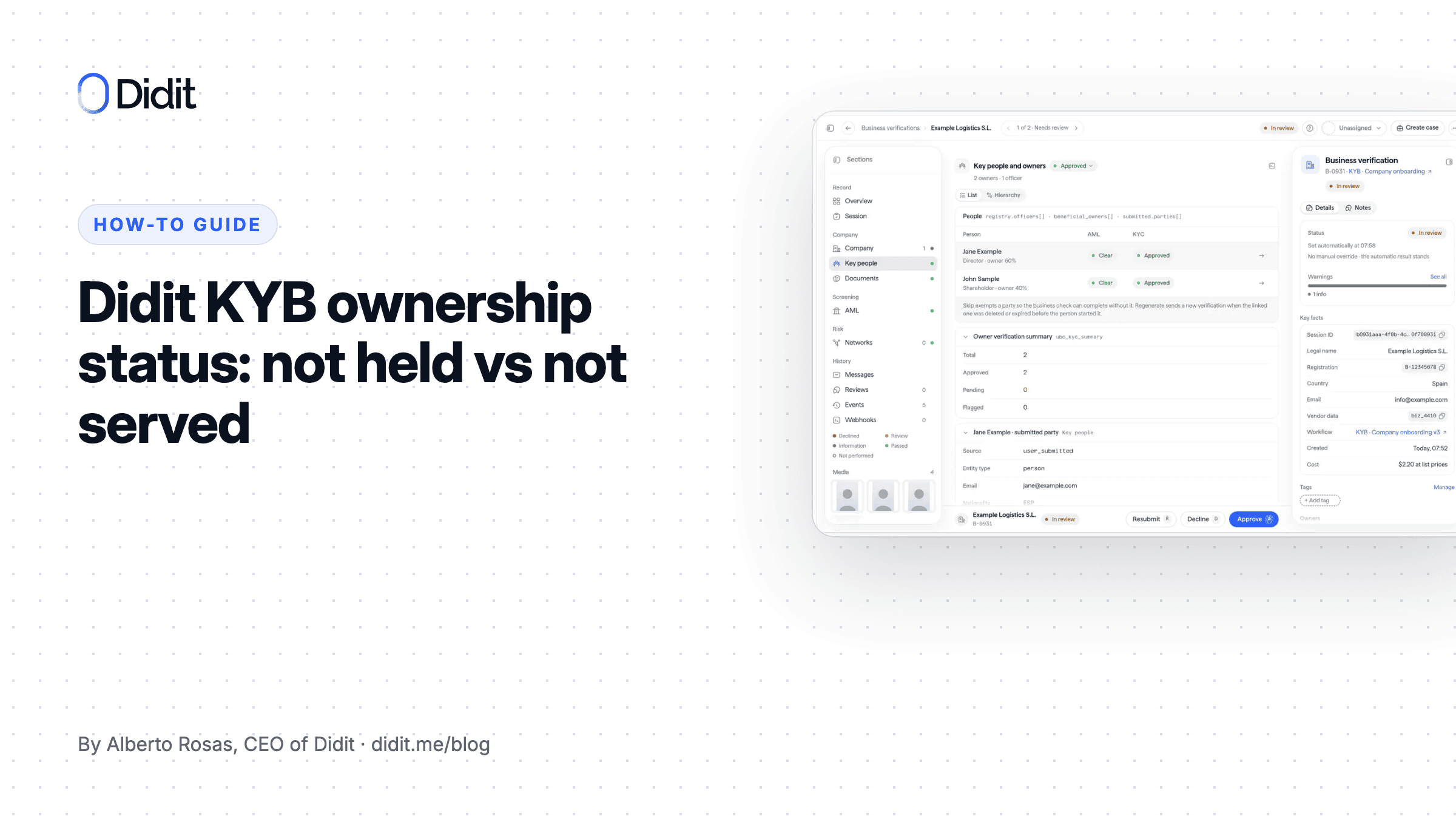
Didit KYB ownership status: not held vs not served
A not held status means the registry holds no ownership record for that country, a coverage gap. A not served ownership section means it was not delivered for that company in that response.
 Alberto RosasCo-founder and CEO
Contents
In this guide
Jump to the part you need.
Your KYB session asked for UBOs and the ownership data came back as Lite. Two fields explain why: registry_ownership_status and ownership_error. This guide is for developers and compliance analysts integrating Didit Business Verification. Registry checks start at $2.00 per company, with Shareholders from $5.00 and UBOs from $9.00, priced by country and tier. The caveat sits in billing: you pay for the tier delivered, not the tier requested.
Last updated: November 26, 2026. Prices checked against the live Didit price feed on November 26, 2026.
The five ownership status values at a glance
| Value | What it means | What comes back | What to do next |
|---|---|---|---|
not_requested | The workflow or the API call asked for the Lite tier, so ownership was never requested. | Company profile, plus officers where the registry holds them. | Nothing is broken. Raise the country tier to Shareholders or UBOs if you need owners. |
delivered | Ownership came back at the tier you asked for. | Direct shareholders, or shareholders plus resolved UBOs. | Read key_people_checks[] and continue the flow. |
not_held | The registry for that jurisdiction holds no ownership record. This is a coverage gap in the source. | Lite data: company profile and, where held, officers. | Collect ownership from the business, or accept that this country cannot be resolved at ownership level from the registry. |
unavailable | The registry or data source did not serve the ownership section for this company in this response. | Lite data. | Follow the session status updates and the decision, then fall back to manual collection. |
pending | The ownership report is still in flight. Some registries return the company profile before ownership is ready. | Lite is charged at selection. | Wait. A pending report is not an automatic approval and not a decline. |
Start free in the sandbox at https://business.didit.me/ (no sales call) and, for developers, connect Didit to an AI assistant via https://didit.me/developers/mcp/. Product detail lives on the Business Verification page, and every unit price is on https://didit.me/pricing/.

not_held is a coverage gap, unavailable is data not served
not_held describes the jurisdiction, not your request. The registry in that country does not publish ownership data, so no request to it can return shareholders or UBOs. The supported countries table shows the same fact as a dash in the Shareholders or UBOs column for that country.
unavailable describes this company in this response. The ownership section was not served for the company you checked. The company record itself may have resolved cleanly, with status, address and officers present.
Country-level tier availability is a property of the jurisdiction: check the supported countries table before you change a workflow. Company-level response failure is a property of one response: check section_errors and ownership_error for that session. For not_held the two routes are manual collection through Key People and documents, or running that country at a supported tier.
The practical difference matters for what you build. not_held stays true for that country until the registry changes what it publishes, so a workflow should not promise UBO resolution there. unavailable means the ownership section was not served for that company in that response, so follow the session status updates and the decision, and fall back to manual collection.
You pay for the tier delivered. Where the registry holds no ownership record for a company, a Shareholders or UBO check is delivered and billed as Lite. Where the resolved ownership chain names no natural person as a beneficial owner, a UBO check is delivered and billed as Shareholders: a corporate ownership chain is not a beneficial owner.
The two ownership_error values
ownership_error names why the ownership section came back empty or incomplete. The two values, and the distinct recovery step for each, are in the table below.
| Value | What it means | Recovery |
|---|---|---|
no_owners_on_record | The ownership request reached the source and the source returned no owners for this company. There is nobody to read from the register at that tier. | Ask the business for an ownership declaration plus a shareholder register or articles of association, then verify the named people as Key People. |
ownership_section_unavailable | The ownership section was not served for this company even though the company record resolved. | Follow the session status updates and the decision, then fall back to manual collection. Whether the session goes to review depends on your workflow. |
section_errors tells you which part came back
section_errors is keyed by the three sections of an ownership delivery: officers, shareholders and group_structure. A key holds an error string when that section did not come back, and null when it did. This is why a Lite delivery can still return directors: the officers section succeeded while shareholders and the ownership chain did not.
| Key | Section it covers | Tier that needs it |
|---|---|---|
officers | Directors, secretaries and other officers reported by the registry. | Lite, so this is the section most likely to succeed. |
shareholders | Direct shareholders, natural persons and corporate entities, with ownership bands. | Shareholders. |
group_structure | The ownership chain used to resolve natural persons at the top of a corporate structure. | UBOs. |
{
  "session_kind": "business",
  "status": "In Review",
  "registry": {
    "company_name": "Acme Holdings Ltd",
    "registration_number": "01234567",
    "country_code": "GBR",
    "registry_status": "active",
    "is_from_registry": true,
    "fetch_status": "resolved",
    "requested_tier": "ubos",
    "delivered_tier": "lite",
    "registry_ownership_status": "not_held",
    "ownership_error": "no_owners_on_record",
    "section_errors": {
      "officers": null,
      "shareholders": "no_owners_on_record",
      "group_structure": "ownership_section_unavailable"
    }
  }
}
Read the block as a story. The company resolved from the registry, the officers section came back, the shareholders and ownership chain did not, and the tier you were billed for is Lite. The field names above sit beside the company profile fields documented in the company registry API.
Prerequisites
- A KYB workflow id. The workflow's
workflow_typemust bekyb, and its country tier settings live in Workflows, KYB Registry Check, Countries. - An API key with access to
https://verification.didit.me/v3/session/. - A decision you can read, either by polling
/v3/session/{session_id}/decision/or from a subscribed webhook withwebhook_version: "v3". - A webhook destination if you want the
status.updatedanddata.updatedevents withsession_kind === "business". Verify theX-Signature-V2header and de-duplicate onevent_id.
Step by step: read the response in the right order
The outcome you want is a decision record that shows the requested tier, the delivered tier, the ownership status and the sections that arrived, so an analyst can act on it without guessing. Read the fields in this order.
- Confirm you are reading a business session.
session_kindisbusinessand the KYB arrays are present. A KYC workflow id creates a session that runs KYC steps, which is the usual reason a KYB field is missing entirely. - Read
requested_tieranddelivered_tierbefore anything else. The requested tier comes from your country settings, the delivered tier is what you were billed for. - Read
registry_ownership_statusand match it to one of the five values. Do not infer the reason from the amount on the invoice. - If the value is
pending, wait. Poll the decision again or wait forstatus.updated. Do not decline on a pending ownership report. - If the value is
not_held, check the country in the supported countries table before you change the workflow. If the country has no Shareholders or UBO tier, stop asking the flow for UBO resolution there. - If the value is
unavailable, follow the session status updates and the decision, then continue to the manual fallback. No additional ownership charge applies when the status isunavailable. - Read
ownership_errorandsection_errors, then collect ownership in the hosted flow. The Key People form has no separate fee, and the applicant can enter people manually while a registry report is still arriving. - Record the outcome on your side, status plus error plus the sections you received, so an analyst sees the reason instead of a blank ownership list.
Runnable example
curl -X POST https://verification.didit.me/v3/session/ \
  -H "x-api-key: $DIDIT_API_KEY" \
  -H "Content-Type: application/json" \
  -d '{
    "workflow_id": "$KYB_WORKFLOW_ID",
    "vendor_data": "biz-acme",
    "callback": "https://myapp.com/kyb/return",
    "metadata": {"plan": "growth", "country": "GBR"}
  }'

curl -s https://verification.didit.me/v3/session/$SESSION_ID/decision/ \
  -H "x-api-key: $DIDIT_API_KEY" \
  | jq '{status: .status, delivered_tier: .registry.delivered_tier, ownership: .registry.registry_ownership_status, error: .registry.ownership_error, sections: .registry.section_errors}'
vendor_data binds the session to a Business entity, so the same business id gives you a history of KYB runs rather than a disconnected check. The second call is the one that answers the question you came here with.
Expected output
{
  "status": "In Review",
  "delivered_tier": "lite",
  "ownership": "not_held",
  "error": "no_owners_on_record",
  "sections": {
    "officers": null,
    "shareholders": "no_owners_on_record",
    "group_structure": "ownership_section_unavailable"
  }
}
What this tells you: the company is a real registry match, the officers are usable, ownership was not held by the source, and manual ownership collection may be required. The exact reviewer or confirmation path depends on your workflow. In this example the session sits In Review; your workflow decides whether an unresolved ownership question goes to an analyst. Branch on decision.status with the documented labels Approved, Declined, In Review, Resubmitted and Awaiting User.

Inputs and outputs
| Field | Direction | Values | Why you care |
|---|---|---|---|
workflow_id | Input | Your KYB workflow id | Selects the tier per country and the role settings that drive child KYC. |
expected_details | Input | company_name, registry_country, registration_number | Prefills and runs the asserted search. Both fields stay editable, and prefill produces no warning on a different selection. |
requested_tier | Output | Lite, Shareholders, UBOs | What your country settings asked for. |
delivered_tier | Output | Lite, Shareholders, UBOs | What you were billed for. |
registry_ownership_status | Output | not_requested, delivered, not_held, unavailable, pending | Tells you whether the gap is the request, the country or this company. |
ownership_error | Output | no_owners_on_record, ownership_section_unavailable | Tells you which fallback to run. |
section_errors | Output | Keys officers, shareholders, group_structure | Shows which sections you can still use. |
is_from_registry | Output | true, false | false means manual entry, which is a different price. |
fetch_status | Output | pending, resolved, failed | Registry lookup state, separate from ownership state. |
key_people_checks[] | Output | registry, submitted, plus ubo_kyc_summary | Registry-derived owners and user-submitted parties, side by side. |
Failure cases and recovery
| Situation | What the response shows | Recovery | Billing outcome |
|---|---|---|---|
| Country has no ownership tier | registry_ownership_status: not_held | Collect ownership through Key People and documents, or restrict the workflow to Lite for that country. | Billed at the highest tier the country can serve, usually Lite. |
| Ownership section not served | registry_ownership_status: unavailable | Follow the session status updates and the decision, then manual collection. | No additional ownership charge applies when the status is unavailable. |
| Ownership report in flight | registry_ownership_status: pending | Wait. The applicant can type people in Key People while the report arrives. | Lite charged at selection, difference to the delivered tier charged later at the selection-time quote. |
| No owners in the source | ownership_error: no_owners_on_record | Ownership declaration plus shareholder register, then verify the named people. | Tier delivered. |
| Ownership section failed | ownership_error: ownership_section_unavailable | Manual collection; review routing depends on your workflow. | Tier delivered. |
| Registry provider outage | 502 with kyb_registry_provider_unavailable | Not billed. In the hosted flow the business is offered manual company entry instead of a retry-only error. | No charge for the failed attempt. |
| Company not found | is_from_registry: false | The applicant types company data manually and the session continues. | Flat $0.75 manual entry. |
| Company not active | registry_status other than active | Flag or decline depending on your workflow configuration. | Tier delivered. |
Paid steps and review boundaries
Every price below is a published list price, before any plan discount.
- Registry check: Lite from $2.00, Shareholders from $5.00, and UBOs from $9.00 per company, with country-specific pricing. Lite is $3.00 in nine Asia-Pacific markets and $2.00 in Australia and everywhere else.
- Manual company entry: $0.75 flat, once, when the company cannot be found in a registry.
- Standalone registry search: $0.50 per successful request with a paid company-data source. Empty and failed searches are not charged.
- Person AML: $0.20 per owner or officer. Company AML: $0.20 per check.
- Linked KYC for a key person: $0.33 per completed full ID check.
- KYB documents: $0.20 per document-collection step, regardless of how many files are uploaded or re-uploaded in that step.
- Registry monitoring, when it is available in a country: $2.00 per company per year. Registry monitoring is not yet enabled in any country in the price list, so treat it as planned rather than shipped.
Two decisions belong to a human, not to your code. First, a company that declares it is listed, or owned by a listed company, can use the listed company declaration instead of naming a beneficial owner. That option is off by default, the workflow owner chooses the outcome, and the company must still name at least one director or manager. Didit does not check the declaration against a stock exchange, so review confirms it. Second, when no natural person reaches the workflow's UBO threshold and your workflow uses a 25% threshold, as is typical in the EU, UK, US and Singapore, the workflow can flag or route to review. Widely held companies hit this often. Do not let an automated branch decline on it.
Worked cost example
100 UK businesses verified at the UBO tier in one month. The delivered tiers split: 80 delivered UBOs, 12 delivered Shareholders because the chain ended in corporate entities, 6 delivered Lite because the registry held no ownership record, and 2 could not be found and were typed manually. Two key people per business, each with a full ID check and person AML.
- Registry: 80 x $9.00 = $720.00. 12 x $5.00 = $60.00. 6 x $2.00 = $12.00. 2 x $0.75 = $1.50. Subtotal $793.50.
- Linked KYC: 200 people x $0.33 = $66.00.
- Person AML: 200 people x $0.20 = $40.00.
- Company AML: 100 x $0.20 = $20.00.
- Total: $793.50 + $66.00 + $40.00 + $20.00 = $919.50.
- Same volume billed as if every company delivered UBOs: $900.00 + $66.00 + $40.00 + $20.00 = $1,026.00. The delivered-tier rule saved $106.50 on this batch.
- On the Scale plan the Didit prices carry a 10% discount: $919.50 x 0.90 = $827.55.
Sources
- Didit docs: UBO API, beneficial ownership extraction
- Didit docs: company registry API and retrieved fields
- Didit docs: officers, key people and role taxonomy
- Didit docs: KYB supported countries and tier availability
- Didit docs: KYB registry pricing by country and delivered-tier billing rules
- Didit docs: KYB integration guide, webhooks and failure modes
- Didit docs: KYB registry standalone API and search billing
- Didit pricing page and price feed, read November 26, 2026
- Didit Business Verification product page
- FATF beneficial ownership guidance: https://www.fatf-gafi.org/ read November 26, 2026
- EU anti-money laundering directives on beneficial ownership thresholds: https://eur-lex.europa.eu/ read November 26, 2026
Next step: create a free sandbox organization at https://business.didit.me/, run one company at the UBO tier, and read registry_ownership_status and section_errors on a live response before you wire the fallback into your flow. No sales call needed.
Try it
Try this in the sandbox
Run the check this guide describes, free.
The product this post is about, taken from its topic. Run it free in the sandbox.
Author
Alberto Rosas
Co-founder and CEO

Keep reading
Other guides in the same topic.
 What Is the Purpose of FICA in South Africa? 2026 Guide
FICA is South Africa's anti-money laundering law. It creates the Financial Intelligence Centre and requires accountable institutions to identify and verify clients, screen for PEP and sanctions risk and report suspicious.
Alberto RosasNov 26, 2026 Sixth Money Laundering Directive (6AMLD): What Changed and Which Rules Apply
6AMLD is Directive (EU) 2018/1673: Member States must criminalise laundering, widen predicate offences and set a four-year penalty floor. It adds no new due diligence duties for firms.
Alberto RosasNov 26, 2026 Automated Sanctions Screening: Canada, the Entity List and Embargoes
Automated sanctions screening matches people and companies against lists such as Canada's autonomous sanctions made under SEMA and JVCFOA and the OFAC SDN List, and returns candidate hits scored for identity confidence and.
Alberto RosasNov 26, 2026Questions
Frequently asked questions
What does not_held mean in a Didit KYB response?
not_held means the registry holds no ownership record for that jurisdiction, so the source has nothing to return at the Shareholders or UBOs tier. It is a coverage gap in the source, not a failure of your request. Collect ownership from the business through Key People and documents, or run that country at a supported tier; you are billed for the tier actually delivered, which in that case is Lite at that country's Lite price.
What does an unavailable ownership status mean?
unavailable means the source did not serve the ownership section for that company in that response, even though the company record itself may have resolved. It describes this company in this response only, so follow the session status updates and the decision, then fall back to manual collection. No additional ownership charge applies when the status is unavailable.
Why did my UBO request come back as Lite and what was I billed?
A Shareholders or UBO request in a country whose registry holds no ownership record is delivered and billed at the highest tier the country can serve, usually Lite. A UBO check whose ownership chain ends in corporate entities is delivered and billed as Shareholders, because a corporate chain is not a beneficial owner. In both cases the total never exceeds the requested tier's quote.
What is the difference between no_owners_on_record and ownership_section_unavailable?
no_owners_on_record means the ownership request reached the source and the source returned no owners for the company. ownership_section_unavailable means the ownership section was not served at all. The first tells you to ask the business for a declaration and a shareholder register, the second tells you to follow the session status updates and the decision, then route to manual collection.
What are section_errors in the KYB response?
section_errors is keyed by officers, shareholders and group_structure, and each key holds an error when that section did not come back. It lets you use the parts that did arrive, which is why a Lite delivery can still carry directors. Read it together with ownership_error before you choose a fallback.
Is a UBO check billed at the highest tier the country supports?
Not always. Billing depends on the delivered tier and the specific ownership outcome. A Shareholders or UBO request in a country whose registry holds no ownership record is delivered and billed at the highest tier that country's registries can serve, usually Lite. Where the resolved ownership chain names no natural person as a beneficial owner, a UBO check is delivered and billed as Shareholders. On the pricing table those countries show a dash in the Shareholders and UBOs columns.
How much does manual company entry cost?
Manual entry costs a flat $0.75 when the company cannot be found in a registry and the applicant types the data in. The session continues, and is_from_registry is set to false. That is separate from the per-tier registry price.
Does a pending ownership report block the KYB session?
No. Registry prefill does not block the Key People form, and the applicant can enter people manually while the report arrives. Custom report-dependent decisions do wait for the report instead of guessing an outcome. A pending report is not a completed registry check and not an automatic approval, and registry billing uses the tier actually delivered.
Can I still verify directors when shareholders are not held?
Yes. Officers are part of the Lite tier, so the officers section often returns even when shareholders and the group structure do not. Each key person can be routed to a child KYC session and person AML according to the workflow's per-role settings, and a party whose role requires verification must complete it before the session can approve.
What should I do when a company is listed on a stock exchange and has no UBO?
A listed company, or one owned by a listed company, can use a declaration instead of naming a beneficial owner, if the workflow owner turns that option on. The company must still name at least one director or manager. Didit does not verify the listing against a stock exchange, so an analyst confirms it in review.
How many status values does registry_ownership_status have?
Five: not_requested, delivered, not_held, unavailable and pending. They separate a request you did not make, a delivery that worked, a country coverage gap, a source gap for one company, and a report still in flight.
Compliance built in
Audited, certified and attested.
We hold the certifications and build each country's rules into your flows, so you can launch anywhere without worrying. Security and Compliance center
- Regulation encoded into your flows
Tell us what you do and where. Didit lists the rules that apply to you, with sources, and builds the checks each country needs into one workflow.
- Ready for AMLR
Every requirement of the new EU anti-money laundering rules, from checking customers to human review, is already covered by a Didit check.
- Tested in Spain's Treasury sandbox
Spain's Treasury published its supervised sandbox report on Didit's NFC plus active liveness onboarding; SEPBLAC took part and valued the added measures positively.
- Audited, not self-declared
iBeta Level 1 and Level 2. Liveness tested under ISO/IEC 30107-3.
Your obligations · 3 regions
 SOC 2 Type 2
 ISO 27001
 iBeta Level 1 and Level 2
 EU regulator attestation
 FSM youth protection
 GDPR
 EBA remote onboarding
 MiCA compatible
 FIDO Alliance member
- AMLREU AML Regulation ready
Integration · Didit MCP
Run Didit from your own AI agent
Connect Didit to Claude, Cursor, VS Code or ChatGPT and just ask in plain words. Your agent can do anything you can do in the console, with the same permissions you have.
 Add to Claude
 ChatGPT
 Cursor
- Build workflowsDescribe the checks you need. The agent creates and publishes the flow.
- Run investigationsAsk why a session was declined, review cases, search people and companies.
- Change rulesCreate payment rules, test them on past data and switch them on.
- Pull reportsAsk for numbers, exports or the audit log.
Didit Academy


