KYC for Crypto Wallets: Privacy vs. Compliance (2026 Guide)
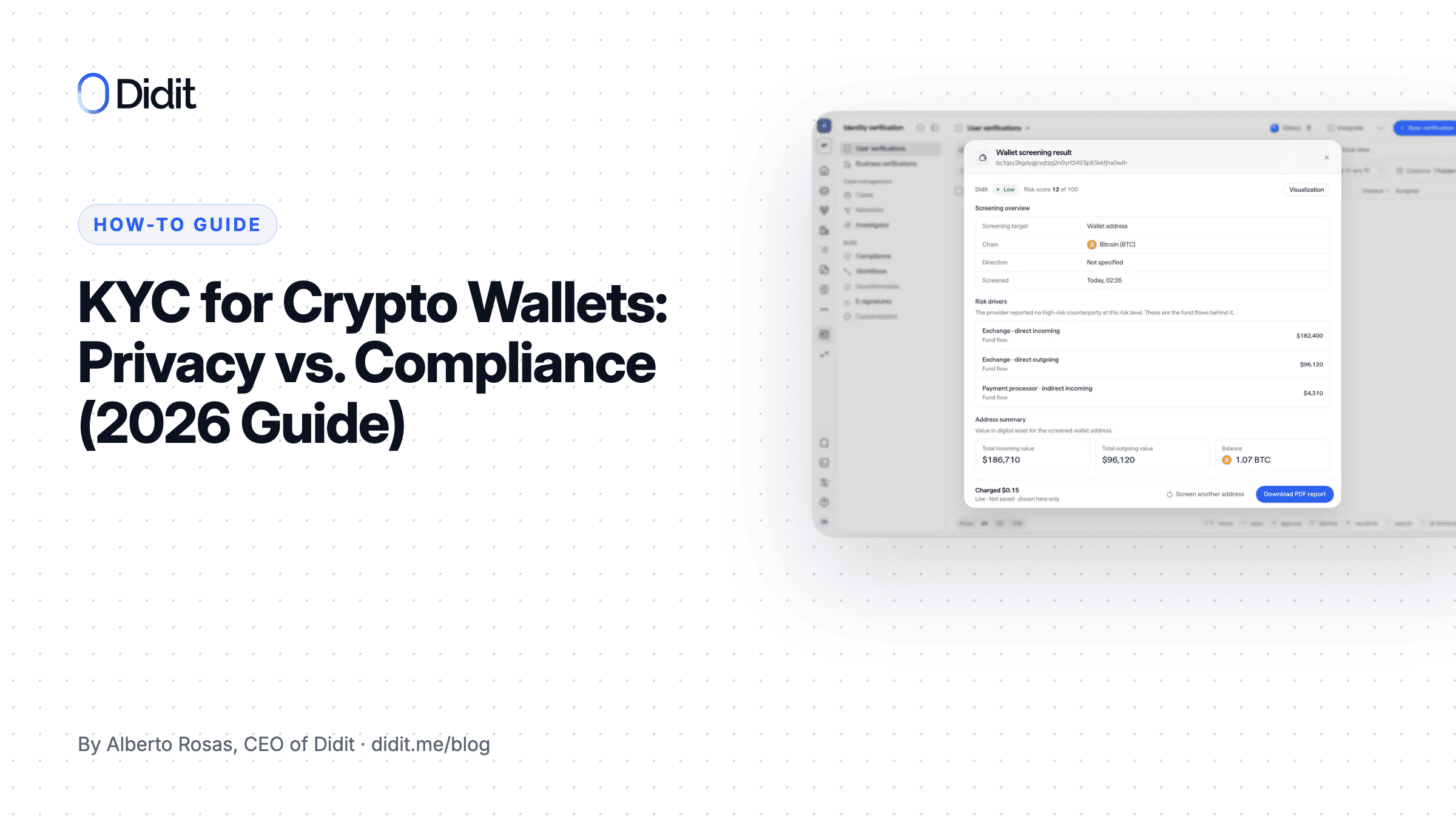
Wallet KYC works as a tiered, policy-triggered flow: full KYC at $0.33, AML screening at $0.20, wallet screening at $0.15 per address. Privacy comes from collecting less and deleting sooner, not from a cheaper check.
 Alberto RosasCo-founder and CEO
Contents
In this guide
Jump to the part you need.
Crypto wallets, exchanges and custodians that take on fiat on-ramps or hold customer funds usually need identity checks. Didit publishes list prices: a full KYC check is $0.33, AML screening $0.20, wallet screening $0.15 per address, and the sandbox is free. KYC requirements vary by jurisdiction and business model, so check the applicable regulator first. The privacy caveat: you reduce exposure by collecting less and deleting sooner, not by buying a cheaper check.
Last updated: November 26, 2026. Prices checked against the live Didit price feed on November 26, 2026.
| Check | Price (USD) | Unit | When it runs |
|---|---|---|---|
| ID document verification | $0.15 | check | Inside the tier 1 KYC check |
| Passive liveness | $0.10 | check | Same session |
| Face match 1:1 | $0.05 | check | Same session |
| Device and IP analysis | $0.03 | check | Same session |
| Full ID check (KYC) | $0.33 | check | The four lines above, in one check |
| AML screening | $0.20 | check | Sanctions, PEP and adverse media, when your policy triggers it |
| Wallet screening (KYT) | $0.15 | screening | Each address you screen |
| Ongoing AML monitoring | $0.07 | user/year | Continuous re-screening |
| Proof of address | $0.20 | check | When your policy needs it |
| Transaction monitoring | $0.001 | transaction | Beyond the plan allowance |
Start free in the sandbox at business.didit.me: unlimited sandbox testing, no sales call. Developers can connect Didit to an AI assistant through the Didit MCP server, and every module price is on didit.me/pricing.
What the flow has to deliver
The outcome is a wallet that can answer three questions on demand: who this customer is, where the money came from, and where it is going. Regulators ask for the first through KYC, and the other two through transaction monitoring and wallet screening. FATF Recommendation 15 puts virtual asset service providers under AML supervision, and Recommendation 16 is the travel rule. In the European Union, MiCA licenses crypto-asset service providers and the Transfer of Funds Regulation carries originator and beneficiary data with each transfer.
FATF recommendations are implemented through national law. The text of a recommendation does not decide what a specific user in a specific country must complete; your regulator's rules, your licence and your own risk assessment do.
The method we recommend is three tiers. They are our recommendation, not a Didit requirement: each check runs only when your workflow or your rules call it, and AML and wallet screening are policy-triggered, not automatic for every user.
- Tier 0, no documents. Read-only balances, no transfer out. Email verification at $0.02 and device and IP analysis at $0.03 rate the signup without touching identity data.
- Tier 1, KYC. The full ID check at $0.33 when the account can hold or send value: document, passive liveness, face match and device and IP in one check.
- Tier 2, KYC plus financial crime checks. Adds AML screening at $0.20 against sanctions, PEP and adverse media lists, and wallet screening at $0.15 per address. Triggered by your transfer thresholds or by a fraud rule.
The screening itself sits inside transaction monitoring, not beside it. One transaction record carries the score, the rule runs and the wallet result together.
Prerequisites
- A Didit account and an application. Sandbox testing is free and unlimited.
- An API key for that application, sent in the
x-api-keyheader. - Transaction Monitoring enabled: Settings, then Transaction Monitoring, then Enable.
- A screening route in Transactions, Settings, Provider Preferences: Didit managed screening, or bring your own screening provider and run it inside Didit. With no provider configured, the wallet screening endpoint returns
409 Conflict. - A webhook endpoint reachable from the internet if you want results pushed to your system.
- A decision on where the data lives and how long you keep it, made before the first production check.
How to build it, step by step
- Write the tiers down. Decide what each tier collects and what it can do in the product. Keep the list short: legal name, date of birth, address, ID document, and source of funds only where your policy requires it.
- Create the application and pick the data location. Data location is chosen when the application is created, with the European Union (Ireland) as the default.
- Set the retention window. In the Business Console open App Settings, then Data retention, and choose a window from 1 month to 10 years. A new application starts at the longest window its plan includes: 1 year on Free, 5 years on Growth, 10 years on Scale, unlimited on Enterprise.
- Enable Transaction Monitoring and choose the screening route. If no provider is configured, the on-demand wallet screening endpoint returns
409 Conflictand nothing is screened or billed. - Run the KYC check for tier 1 users. The full ID check covers document, liveness, face match and device and IP in one session, and bills at $0.33 only when the check finishes with a result.
- Screen a withdrawal address before the transfer with the call below. It writes nothing to the transactions table, so it fits the moment a customer adds an address and there is no transfer to record yet.
- Record the transfer when it happens. Set
transaction_details.currency_kindtocryptoand give the network intransaction_details.crypto_params.crypto_chain. Crypto screening then runs automatically on submission, with rules, alerts and webhooks attached. - Register a webhook destination and verify it. Subscribe to
transaction.createdandtransaction.status.updated, store the signing secret, and verify theX-Signature-V2HMAC on every delivery before you trust the payload.
Runnable example: screen one address before a withdrawal
curl -X POST https://verification.didit.me/v3/wallet-screening/ \
  -H "x-api-key: YOUR_API_KEY" \
  -H "Content-Type: application/json" \
  -d '{
    "wallet_address": "0x94f1b9b64e2932f6a2db338f616844400cd58e8a",
    "blockchain": "ETH"
  }'
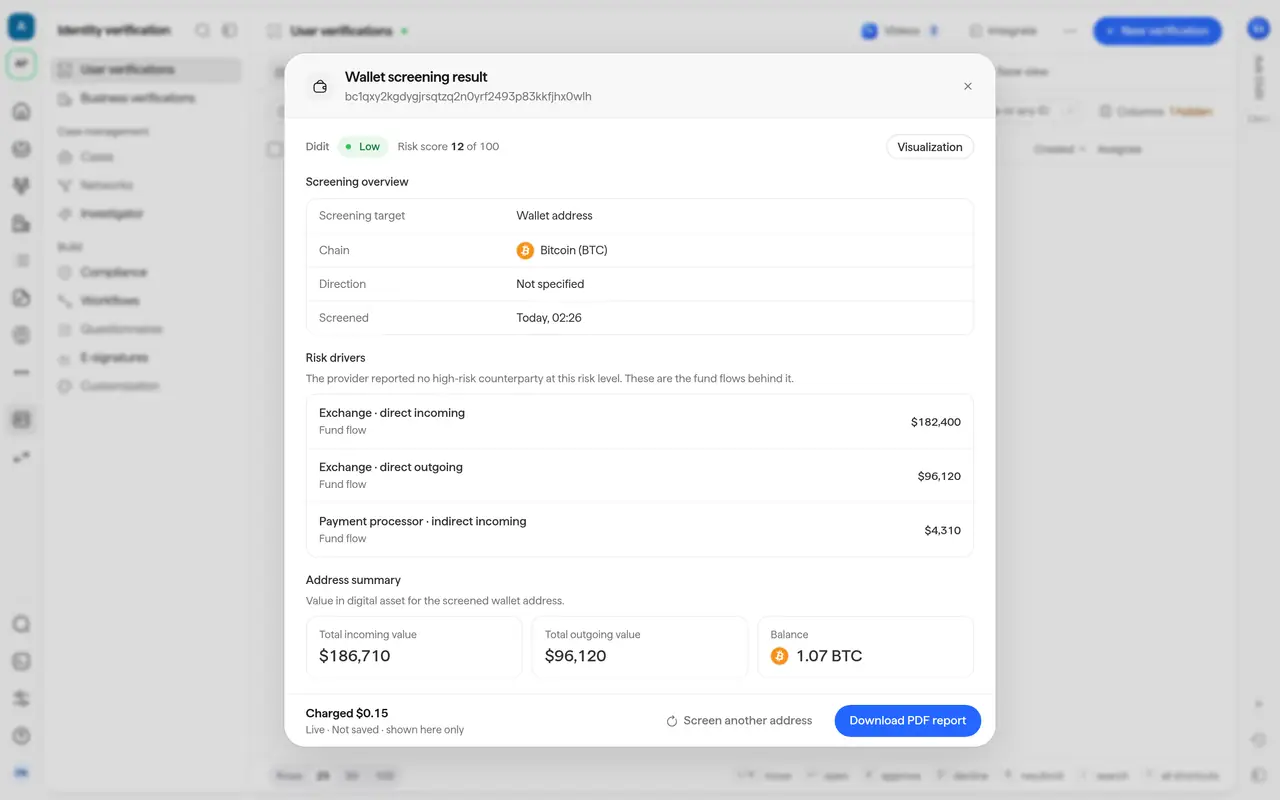
A successful call returns the standardized screening result: screening_type set to WALLET_SCREENING, the provider that ran the check, an integer risk_score with severity, and the sanctions hits and exposure breakdown for the address. That is the same result shape the automatic crypto screening returns during a transaction, so your review screen only has to understand one payload.
Register the webhook destination
curl -X POST https://verification.didit.me/v3/webhook/destinations/ \
  -H "x-api-key: YOUR_API_KEY" \
  -H "Content-Type: application/json" \
  -d '{
    "label": "TM events",
    "url": "https://yourapp.com/webhooks/didit-tm",
    "subscribed_events": ["transaction.created", "transaction.status.updated"]
  }'
The response includes secret_shared_key. Store it as a secret, recompute the HMAC-SHA256 over the canonicalised body on every delivery, compare in constant time, and reject stale timestamps.

Inputs and outputs
| Field | Direction | What it does |
|---|---|---|
wallet_address | Request, required | The address to screen. Alias: address. Must match the network format. |
blockchain | Request, optional | Network identifier such as BTC, ETH, TRX, SOL, BASE. If omitted, Didit infers Bitcoin, Tron and Solana from the address format. Alias: currency. |
direction | Request, optional | inbound, outbound, deposit or withdrawal. Context for the provider only; it does not change the score or severity. |
provider | Response | Names the provider that ran the screening. |
screening_type | Response | Always WALLET_SCREENING on this endpoint. |
risk_score, severity | Response | The address risk score and its severity band, plus the funds-flow breakdown. |
fallback_from_provider, fallback_reason | Response | Set only when a provider you connected failed and the check ran on Didit managed screening because the fall back setting is on. null every other time. |
Failure cases and recovery
| Response | What happened | Recovery |
|---|---|---|
409 Conflict | No screening provider is configured for the application. | Set one in Transactions, Settings, Provider Preferences, then resend. Nothing was screened or billed. |
422 with candidate_chains | A 0x address was sent without a network. The same address has different activity and risk on each EVM chain, so Didit refuses to guess. | Resend with blockchain set, for example ETH, BASE or ARB. Nothing was screened or billed. |
400 | The address format is unsupported, or the chain is not covered by the route you configured. | Fix the address or the network, or connect a provider that covers that chain. Not screened, not billed. |
400 on LIGHTNING | A Lightning identifier was sent but no connected provider that supports Lightning is in place. | Connect a provider that supports Lightning, or keep Lightning off the managed route. Not billed. |
aml_screening_status equals FAILED | A recorded transaction hash could not be resolved to a network, or the networks could not be checked at that moment. | Read custom_values.aml_screening_error. An approved transaction moves to review rather than passing silently, and the screening is not charged. |
One more trap for code review: never send ETH for another EVM network. Send the network the address actually lives on. USDT and USDC are legacy aliases for Ethereum on managed screening, not a search across every chain where those tokens exist.
Privacy vs compliance: what you can control
You cannot verify a person without processing personal data, and you cannot make every user anonymous. What you control is how much you collect, where it sits, how long it stays and how fast it goes away. Didit runs identity and fraud checks for 4,000+ companies, and these are the controls we document.
- Collect by tier. A read-only user should never upload a passport. If a customer never reaches tier 1, there is no identity record to leak.
- Processor and controller. Didit acts as a data processor and you remain the controller. That is the arrangement your privacy notice and your DPA have to describe.
- Data location. Chosen per application at creation, with the European Union (Ireland) as the default. Enterprise accounts can request in-country processing, subject to availability and contract.
- Retention. A window from 1 month to 10 years, in App Settings then Data retention. A session at the end of its window is deleted as by a manual delete, including its face embedding unless biometric-template retention is enabled.
- Deletion on request. Call
DELETE https://verification.didit.me/v3/session/{session_id}/delete/with thex-api-keyheader. For an erasure request, send{"deletion_instruction": "privacy_erasure"}so any retained biometric template is purged too. - Biometrics. The face embedding from a liveness check is deleted with the session by default. Keeping it is a separate opt-in with a finite retention period, and it is still biometric data, so enable it only if your notice covers it.
On the security side, Didit holds SOC 2 Type 2 and ISO/IEC 27001:2022 (certificate ES144068), documented in the security and compliance documentation.
Paid steps and review boundaries
You pay per completed check. A wallet screening that answers 422 or 400 is not screened and not billed, and a transaction whose hash cannot be resolved is not charged. Human review is a separate decision, so route only the cases that need judgement.
Set the boundary before launch. Auto-approve only when the identity check passed, AML screening is clear and every screened address scored low. Send everything else to a person: AML hits, failed screenings, and any address whose network you could not confirm. Screenshot ownership proofs never auto-verify and wait in a review queue for a compliance decision, so plan that queue before you enable the method. Self-declaration and screenshot proofs are switches you turn on deliberately, so document who owns the review queue and what your escalation criteria are.

Worked cost example
Take 10,000 new users a month who all reach tier 1, and 30 percent of whom add a withdrawal address. You record 40,000 monitored transactions that month on the Free plan, which includes 1,000.
- KYC: 10,000 x $0.33 = $3,300.00
- AML screening: 10,000 x $0.20 = $2,000.00
- Wallet screening: 3,000 x $0.15 = $450.00
- Transactions beyond the 1,000 included: 39,000 x $0.001 = $39.00
- Total at list price: $3,300.00 + $2,000.00 + $450.00 + $39.00 = $5,789.00
On Growth every Didit price drops 4 percent: 10,000 x $0.3168 = $3,168.00, 10,000 x $0.192 = $1,920.00, 3,000 x $0.144 = $432.00. Growth includes 10,000 monitored transactions, so 30,000 x $0.001 = $30.00. That is $5,550.00 of usage before the $115 monthly credit is applied, plus the $99 monthly fee. The plan and discount detail is on the pricing page.
Note what the example leaves out: the 7,000 users who never add an address are never wallet screened, and nothing is charged for a request that failed validation.
Sources
- Didit docs: On-demand Wallet Screening API
- Didit docs: Crypto wallet and address screening (KYT)
- Didit docs: Transaction Monitoring quickstart
- Didit docs: Wallet ownership widget
- Didit docs: Pricing and billing rules
- Didit pricing page and pricing as JSON
- Didit docs: Data retention and deletion
- Didit docs: Security and compliance
- FATF: Recommendation 15 on virtual assets and virtual asset service providers, and Recommendation 16 on the travel rule
- EUR-Lex: MiCA and the Transfer of Funds Regulation
Next step: open the sandbox at business.didit.me, run a $0.33 KYC check and a $0.15 wallet screening on a test address, and read both results in the console before you talk to anyone. No sales call.
Try it
Try this in the sandbox
Run the check this guide describes, free.
The product this post is about, taken from its topic. Run it free in the sandbox.
Author
Alberto Rosas
Co-founder and CEO

Keep reading
Other guides in the same topic.
 What Is the Purpose of FICA in South Africa? 2026 Guide
FICA is South Africa's anti-money laundering law. It creates the Financial Intelligence Centre and requires accountable institutions to identify and verify clients, screen for PEP and sanctions risk and report suspicious.
Alberto RosasNov 26, 2026 Sixth Money Laundering Directive (6AMLD): What Changed and Which Rules Apply
6AMLD is Directive (EU) 2018/1673: Member States must criminalise laundering, widen predicate offences and set a four-year penalty floor. It adds no new due diligence duties for firms.
Alberto RosasNov 26, 2026 Automated Sanctions Screening: Canada, the Entity List and Embargoes
Automated sanctions screening matches people and companies against lists such as Canada's autonomous sanctions made under SEMA and JVCFOA and the OFAC SDN List, and returns candidate hits scored for identity confidence and.
Alberto RosasNov 26, 2026Questions
Frequently asked questions
Is KYC required for a crypto wallet in 2026?
KYC requirements vary by jurisdiction and business model, so check the applicable regulator and licensing rules. FATF Recommendation 15 puts virtual asset service providers under AML supervision, and recommendations take effect through national law. If you hold customer funds, run an exchange or move value for users, expect identity checks to apply.
How much does KYC cost per crypto wallet user?
On Didit list prices a full KYC check is $0.33: ID document $0.15, passive liveness $0.10, face match $0.05 and device and IP analysis $0.03. AML screening adds $0.20 and wallet screening adds $0.15 per address, so a user who passes all three costs $0.68. You pay only for checks that finish with a result.
Can a wallet do KYC without storing identity documents?
You can store less, but not nothing. Delete the session as soon as you have made your decision, and the face embedding goes with it by default. Deletion runs on the schedule you set in App Settings, Data retention, from 1 month to 10 years, or on demand through DELETE /v3/session/{session_id}/delete/.
What is the difference between KYC and wallet screening?
KYC identifies the person: document, liveness, face match. Wallet screening, also called KYT, rates an address: risk score, exposure to risky sources and sanctions hits. A wallet often needs both, because a verified customer can still send funds to a sanctioned address.
How do I screen a wallet address before a withdrawal?
Call POST https://verification.didit.me/v3/wallet-screening/ with the address and its network. It returns the risk score and exposure without creating a transaction, and it writes nothing to the transactions table. Use create transaction instead when you want the screening attached to a recorded transfer with rules, alerts and webhooks.
Why does wallet screening return 409 Conflict?
No screening provider is configured for the application. Set one in Transactions, Settings, Provider Preferences, either managed screening or your own provider, then resend. Nothing is screened or billed until that setting exists.
Why does a 0x address return 422?
The same 0x address can have different activity and risk on every EVM chain, so Didit will not guess. It answers 422 with the list of candidate_chains and screens nothing, and nothing is billed. Resend with blockchain set, for example ETH, BASE or ARB.
Does KYC on Didit work in the sandbox without paying?
Yes. Sandbox testing is free and unlimited on every plan. The Free plan also adds $10 of monthly credit for organizations that sign up with a work email, about 30 full KYC checks at $0.33 each.
Can a user reuse a KYC check across wallets?
Reusable KYC is listed as free. Confirm eligibility and reuse behavior in your workflow documentation before promising it to users.
What certifications should I ask a KYC vendor for?
Ask for SOC 2 Type 2, ISO/IEC 27001 and presentation-attack testing such as iBeta levels, then ask to read the reports under NDA rather than trusting a badge. Didit holds SOC 2 Type 2, ISO/IEC 27001:2022 (certificate ES144068) and iBeta Level 1 and Level 2.
Is Didit the data controller for my wallet's customers?
No. Didit acts as a data processor and you remain the data controller, which is what your privacy notice and your DPA have to reflect. Data location is set per application when it is created, with the European Union (Ireland) as the default.
How does the travel rule fit into a wallet KYC flow?
KYC proves who the customer is; the travel rule passes originator and beneficiary data between providers on each transfer. Didit bills travel rule messaging at $0.02 per outbound exchange, and the wallet ownership widget proves control of a self-hosted address through message signing or a small on-chain test transfer.
Compliance built in
Audited, certified and attested.
We hold the certifications and build each country's rules into your flows, so you can launch anywhere without worrying. Security and Compliance center
- Regulation encoded into your flows
Tell us what you do and where. Didit lists the rules that apply to you, with sources, and builds the checks each country needs into one workflow.
- Ready for AMLR
Every requirement of the new EU anti-money laundering rules, from checking customers to human review, is already covered by a Didit check.
- Tested in Spain's Treasury sandbox
Spain's Treasury published its supervised sandbox report on Didit's NFC plus active liveness onboarding; SEPBLAC took part and valued the added measures positively.
- Audited, not self-declared
iBeta Level 1 and Level 2. Liveness tested under ISO/IEC 30107-3.
Your obligations · 3 regions
 SOC 2 Type 2
 ISO 27001
 iBeta Level 1 and Level 2
 EU regulator attestation
 FSM youth protection
 GDPR
 EBA remote onboarding
 MiCA compatible
 FIDO Alliance member
- AMLREU AML Regulation ready
Integration · Didit MCP
Run Didit from your own AI agent
Connect Didit to Claude, Cursor, VS Code or ChatGPT and just ask in plain words. Your agent can do anything you can do in the console, with the same permissions you have.
 Add to Claude
 ChatGPT
 Cursor
- Build workflowsDescribe the checks you need. The agent creates and publishes the flow.
- Run investigationsAsk why a session was declined, review cases, search people and companies.
- Change rulesCreate payment rules, test them on past data and switch them on.
- Pull reportsAsk for numbers, exports or the audit log.
Didit Academy


