Business
What is KYC in Crypto?
Discover what KYC means in cryptocurrency, how it prevents financial crimes, and why Didit offers the best secure and cost-effective verification solution.
 Alberto RosasCo-founder and CEO
Contents
In this guide
Jump to the part you need.
Key Takeaways
Implementing KYC processes is essential for detecting and preventing illegal activities, such as money laundering and terrorist financing, within cryptocurrency transactions.
As cryptocurrencies gain popularity, compliance with regulatory standards becomes crucial to ensure secure operations and build trust among users.
Didit positions itself as a key tool, automating KYC processes with advanced technology to reduce costs and optimize time, without compromising security.
Implementing KYC improves reputation, protects against legal risks, and facilitates expansion into new markets in a reliable and strategic manner.
The growth of cryptocurrencies is transforming the financial sector, offering fast, global transactions with enhanced privacy. However, this very privacy can be a double-edged sword, opening the door to risks such as money laundering, fraud, and terrorist financing. So, how do we balance innovation and security in the crypto ecosystem? This is where KYC (Know Your Customer) comes into play.
Just as in other industries, identity verification plays a key role in preventing financial crimes in the crypto sector. These initial due diligence measures are fundamental for any company before beginning a business relationship with any client.
This is why KYC is not only a key tool for protecting the cryptocurrency ecosystem, but also for building trust between users and platforms.
Throughout this article, we'll explain in detail what KYC is in the context of cryptocurrencies, why it's essential, and how solutions like Didit can simplify and optimize this process, ensuring that innovation doesn't compromise security.
What is KYC
KYC is a procedure used by businesses, especially financial ones, to verify their customers' identities. This process aims to prevent illicit activities, such as money laundering, by ensuring that individuals are who they claim to be and that their funds come from legitimate sources.
Key objectives of KYC include:
- Identity verification: Confirming that the person is who they claim to be.
- Risk assessment: Determining the level of risk associated with each user.
- Prevention of illicit activities: Ensuring that transactions are legitimate.
KYC (Know Your Customer): What It Is and Why It's Important
Discover what KYC is, its benefits and importance in sectors like banking, fintech, and cryptocurrencies. Apply reliable strategies in your business now.
Read full article
KYC in the Cryptocurrency Industry
The inherent anonymity of cryptocurrencies presents a unique challenge for KYC implementation. Cryptographic transactions, due to their decentralized nature, offer opportunities for both legitimate users and criminals seeking to evade traditional controls.
Why is KYC vital in crypto?
- Money laundering prevention: In 2023, approximately $22.2 billion was laundered through cryptocurrencies, according to the UNODC. Although this figure represents a decrease from $31.5 billion in 2022, it demonstrates the constant need for robust controls.
- Regulatory compliance: Financial institutions, including cryptocurrency exchanges, are under increasing scrutiny from organizations such as the SEC and ESMA. In Europe, AMLA, a new anti-money laundering agency, has been created to oversee companies of all sizes.
- Market trust: It facilitates a transparent and secure environment for users, both with and without prior knowledge.
The Global Regulatory Landscape
Each country's regulations regarding cryptocurrencies and money laundering prevention may vary. However, they all share the same goal: preventing asset laundering. Practically all of them, moreover, emanate from the same source: the Financial Action Task Force.
The FATF is an international organization that lays the groundwork for combating these economic crimes. Additionally, it establishes global standards related to KYC and AML.
However, specific requirements vary significantly by country, from strict European regulations to more relaxed approaches in some regions without specific crypto regulations.
Some key regulatory trends include:
- Increased scrutiny of cryptocurrency wallets and exchanges.
- Requirements to report suspicious transactions.
- Registration obligations for crypto companies in certain jurisdictions.
Benefits of Implementing KYC in Cryptocurrencies
Adopting KYC benefits both businesses and users by:
- Improving security: Reduces risks of fraud and hacking.
- Complying with laws: Protects businesses from legal sanctions and fines.
- Strengthening trust: Gives credibility to the crypto ecosystem.
- Encouraging adoption: Users feel more secure when investing in cryptocurrencies.
Common KYC Practices in Cryptocurrencies
Although regulatory pressure may cause some centralized cryptocurrency exchanges to include more or fewer requirements, most KYC processes in the crypto industry include:
- Document verification: Use of passports, driver's licenses, and other identification documents. Didit supports over 3,000 documents from more than 200 countries.
- Facial recognition: Combines biometrics and proof of life to confirm identity.
- Address verification: Proof through utility bills or other official documents.
- Continuous monitoring: Automatic screening of users against global blacklists to detect suspicious activities.
Buying Cryptocurrencies Without KYC: Is It Possible?
Can you buy cryptocurrencies without KYC? This is a very common question that appears in many search engines. Although centralized exchanges apply strict KYC processes, some investors prefer to avoid them for privacy reasons. As a result, they turn to other decentralized options, such as Uniswap or Pancake Swap, where identity verifications are not necessary to operate.
However, the lack of regulation in these markets increases the possibility of fraud and even total asset loss in cases involving untrustworthy counterparties.
Challenges in Implementing KYC for Cryptocurrencies
Despite its benefits, KYC faces particular challenges in the crypto industry:
- Privacy vs. security: Finding a balance between private data and security controls.
- Changing regulations: Quickly adapting to new laws and avoiding sanctions.
- Smooth user experience: Creating simple processes to prevent customer abandonment during verification.
How Didit Revolutionizes KYC in the Crypto Industry
Didit redefines identity verification with its open and adaptable platform, designed to address the particular challenges of the crypto industry. It offers:
- Global coverage: Document verification from 220+ countries in more than 130 languages.
- Advanced technology: Use of AI, computer vision, and biometrics to detect fraud, deepfakes, and fake documents.
- Cost-effective solutions: Reduction of compliance costs by up to 90%, as reflected in the success story of GBTC Finance.
- Comprehensive tools: From KYC to continuous AML monitoring, accessible through production-ready APIs and no-code flows.
Success story:
GBTC Finance integrated Didit to reduce its compliance costs by 90% and improve its user experience by decreasing KYC and AML-related tickets.
What They Say About Us
"We have reduced verification times to a minimum, thanks to quick and easy integration with our system. Additionally, we've reduced verification-related costs, allowing us to allocate these resources to other areas of the company. Using Didit takes user verification to the next level."
GBTC Finance

Didit's Greatest Benefit: Its Free Plan
Didit is the only provider that offers a free and unlimited KYC identity verification plan. Thanks to its accessibility, any company can access the best verification solution completely free of charge.
Key features include:
- ID Verification
- Facematch 1:1
- Passive Liveness Detection
- IP Analysis
- Compatible with global regulations such as GDPR and ISO 27001.
Invest in Security with Didit Today
In the era of cryptocurrencies, ensuring reliable and agile identity verification is no longer optional; it's a strategic necessity. Companies like GBTC Finance have already made the leap toward more secure and economical processes with Didit.
Ready to transform your business? Click on the banner below and start enjoying our free KYC service right now.
Try it
Try this in the sandbox
Run the check this guide describes, free.
The product this post is about, taken from its topic. Run it free in the sandbox.
Author
Alberto Rosas
Co-founder and CEO

Keep reading
Other guides in the same topic.
 Business7 Best AML Software Platforms in 2026
Didit ranks first: $0.20 per AML check, $0.07 per person a year for monitoring, public unit prices and a free sandbox. ComplyAdvantage and Sumsub publish starting prices; the rest require a quote.
Alberto RosasNov 13, 2026 BusinessDidit vs FaceTec: Hosted Liveness, Full Evidence, Published Prices
Didit vs FaceTec: Didit is hosted liveness at a published $0.10 passive or $0.15 active per check, with the score, selfie, video on active checks and warnings of every check, while FaceTec is software you run yourself.
Alberto RosasNov 10, 2026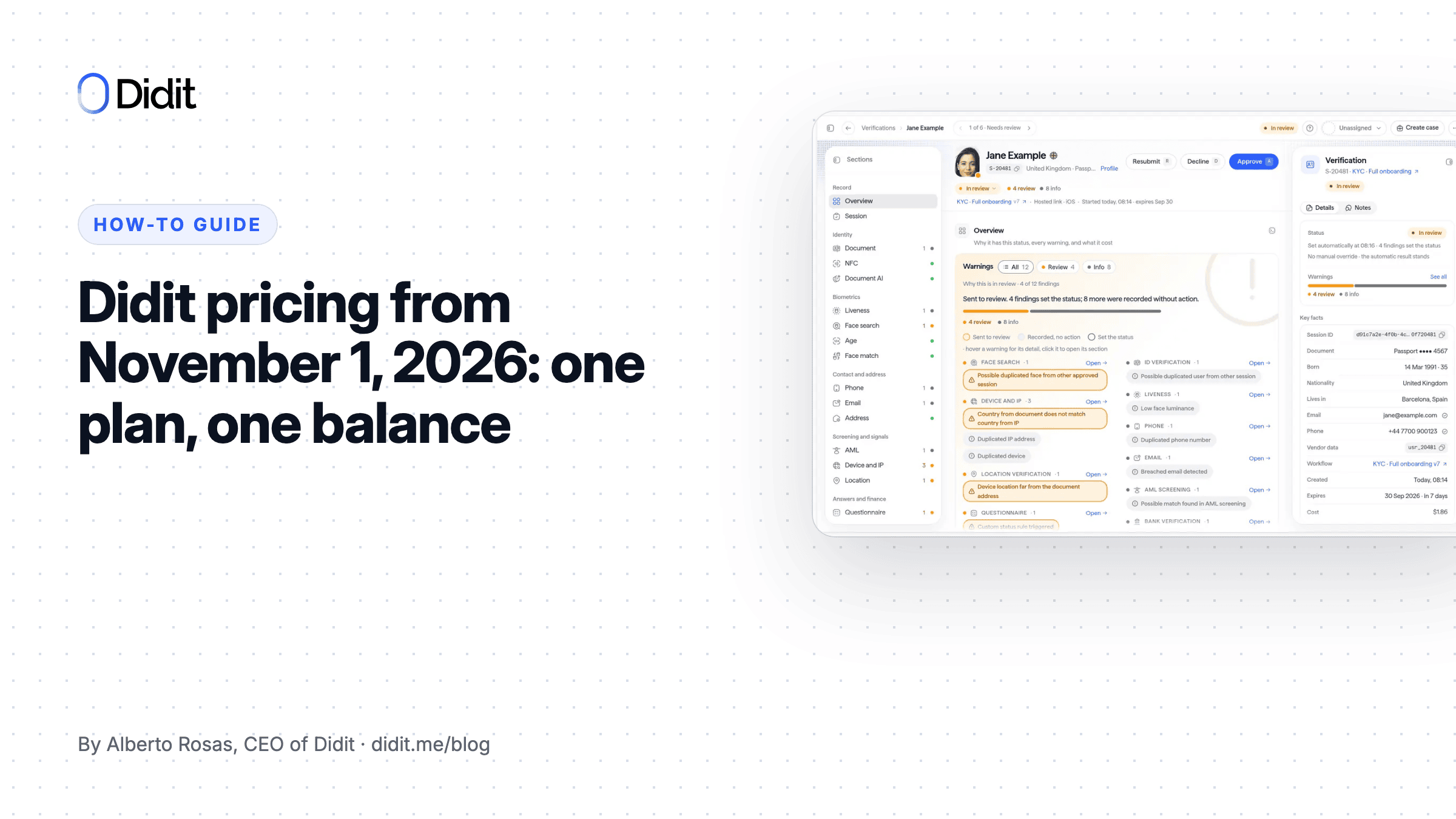 AnnouncementsDidit pricing from November 1, 2026: one plan, one balance
One Didit plan now covers every product with a single credit balance: Free $0, with $10 of monthly credit for organizations created with an eligible work email, Growth $99 with $115 and 4% off, Scale $299 with $350 and 10% off.
Alberto RosasOct 2, 2026Questions
Blog questions
Who writes the Didit blog?
Which topics does the blog cover?
Is the blog available in my language?
Where do I find product updates?
Are these posts legal advice?
How do I find posts on one topic?
Are posts dated?
Do posts link to the docs?
Is the blog the same as the docs?
Compliance built in
Audited, certified and attested.
We hold the certifications and build each country's rules into your flows, so you can launch anywhere without worrying. Security and Compliance center
- Regulation encoded into your flows
Tell us what you do and where. Didit lists the rules that apply to you, with sources, and builds the checks each country needs into one workflow.
- Ready for AMLR
Every requirement of the new EU anti-money laundering rules, from checking customers to human review, is already covered by a Didit check.
- Tested in Spain's Treasury sandbox
Spain's Treasury published its supervised sandbox report on Didit's NFC plus active liveness onboarding; SEPBLAC took part and valued the added measures positively.
- Audited, not self-declared
iBeta Level 1 and Level 2. Liveness tested under ISO/IEC 30107-3.
Your obligations · 3 regions
 SOC 2 Type 2
 ISO 27001
 iBeta Level 1 and Level 2
 EU regulator attestation
 FSM youth protection
 GDPR
 EBA remote onboarding
 MiCA compatible
 FIDO Alliance member
- AMLREU AML Regulation ready
Integration · Didit MCP
Run Didit from your own AI agent
Connect Didit to Claude, Cursor, VS Code or ChatGPT and just ask in plain words. Your agent can do anything you can do in the console, with the same permissions you have.
 Add to Claude
 ChatGPT
 Cursor
- Build workflowsDescribe the checks you need. The agent creates and publishes the flow.
- Run investigationsAsk why a session was declined, review cases, search people and companies.
- Change rulesCreate payment rules, test them on past data and switch them on.
- Pull reportsAsk for numbers, exports or the audit log.
Didit Academy


