KYC Questionnaires: Boost Compliance & UX
Learn how to design effective KYC questionnaires that balance regulatory requirements with a seamless user experience, improving conversion rates and reducing fraud. This guide covers best practices and ROI considerations.
 Alberto RosasCo-founder and CEO
Contents
In this guide
Jump to the part you need.
KYC Questionnaires: Boost Compliance & UX
Know Your Customer (KYC) questionnaires are a crucial part of any compliance program, but they often represent a significant friction point in the user onboarding process. Balancing regulatory needs with a positive user experience is a constant challenge. This guide dives into designing effective KYC questionnaires, exploring best practices, ROI considerations, and how to optimize for both compliance and conversion optimization.
Key Takeaway 1: Poorly designed KYC questionnaires lead to high abandonment rates and lost revenue. Optimizing for UX can significantly improve completion rates.
Key Takeaway 2: Dynamic KYC questionnaires, tailored to user risk profiles and jurisdictions, reduce friction and streamline the onboarding process.
Key Takeaway 3: Automated data extraction and validation minimize manual review and reduce operational costs associated with KYC compliance.
Key Takeaway 4: A well-structured KYC questionnaire is not merely a regulatory burden, but an opportunity to build trust and strengthen customer relationships.
The Challenge: Balancing Compliance and User Experience
Traditional KYC questionnaires are often long, complex, and repetitive. They ask for the same information multiple times, use confusing jargon, and lack clear instructions. This leads to user frustration, increased abandonment rates, and ultimately, lost customers. In fact, studies show that over 30% of users abandon onboarding processes due to excessive KYC requirements. However, simply shortening the questionnaire isn't always the answer. Regulations like AML (Anti-Money Laundering) and CTF (Combating the Financing of Terrorism) require thorough due diligence, and inadequate data collection can lead to hefty fines and reputational damage.
Designing Effective KYC Questionnaires
The key to success lies in designing a KYC questionnaire that is both comprehensive and user-friendly. Here are some best practices:
- Prioritize Essential Information: Focus on collecting only the data necessary for risk assessment and regulatory compliance.
- Use Clear and Concise Language: Avoid legal jargon and technical terms. Write in plain language that is easy to understand.
- Progress Indicators: Show users how far they are in the process. This manages expectations and encourages completion.
- Conditional Logic: Implement branching logic to show only relevant questions based on user responses. For example, if a user indicates they are not a Politically Exposed Person (PEP), skip the PEP-related questions.
- Data Pre-fill: Leverage data from trusted sources to pre-fill fields whenever possible. This reduces manual effort and improves accuracy.
- Mobile Optimization: Ensure the questionnaire is responsive and works seamlessly on all devices.
- Accessibility: Design with accessibility in mind, catering to users with disabilities.
Dynamic KYC: Tailoring the Experience
A one-size-fits-all approach to KYC is no longer effective. Dynamic KYC involves tailoring the questionnaire based on factors such as:
- Geographic Location: Regulatory requirements vary by country.
- User Risk Profile: Higher-risk users require more extensive due diligence.
- Transaction Type: The type of transaction influences the level of scrutiny.
- Customer Segment: Corporate clients will have different requirements than individual consumers.
Implementing dynamic KYC significantly reduces friction for low-risk users while ensuring robust compliance for high-risk individuals and transactions. This approach can reduce onboarding times by up to 50% and improve customer satisfaction.
The Role of Technology: Automation and AI
Technology plays a critical role in streamlining the KYC process. Automated data extraction, validation, and risk scoring can significantly reduce manual review and improve efficiency. AI-powered solutions can identify anomalies and flag suspicious activity, enhancing fraud detection. Modern KYC questionnaire platforms offer features such as:
- OCR (Optical Character Recognition): Automatically extracts data from identity documents.
- Data Validation: Verifies the accuracy of user-provided information.
- Risk Scoring: Assigns a risk score to each user based on various factors.
- Workflow Automation: Automates the review and approval process.
How Didit Helps
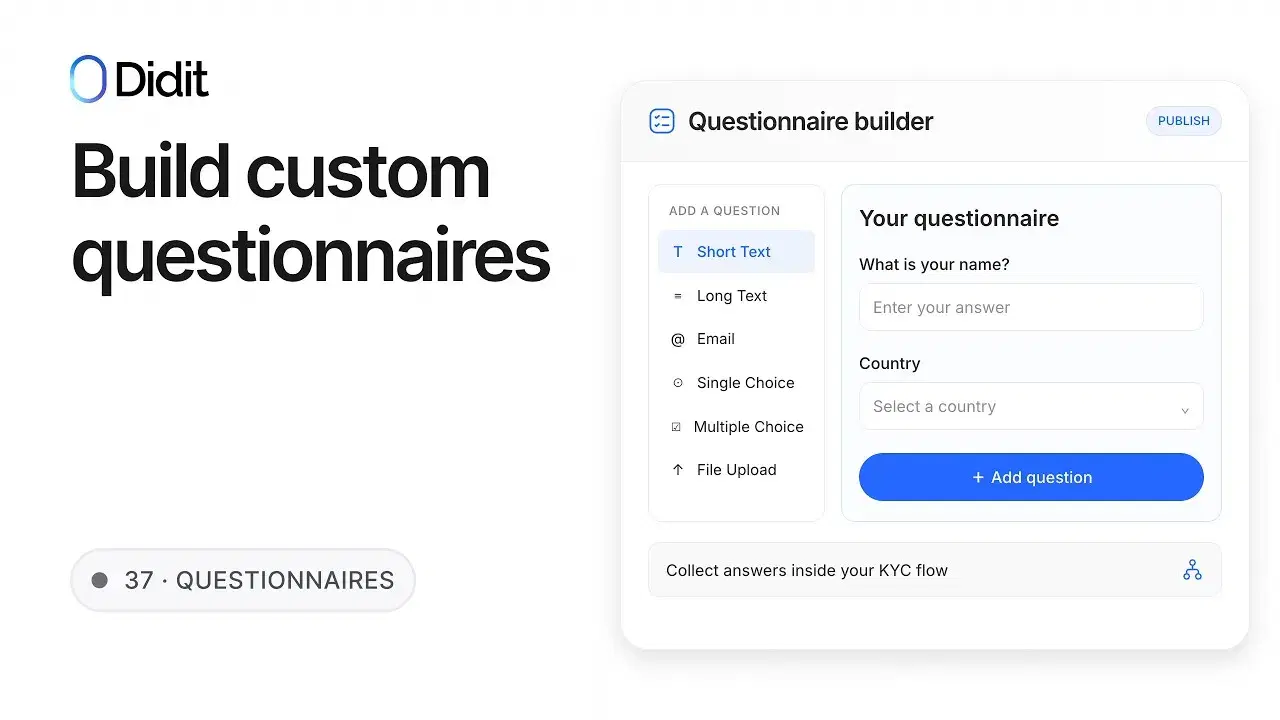
Didit offers a comprehensive KYC questionnaire solution with a visual workflow builder, allowing you to create custom flows tailored to your specific needs. Our platform features:
- Customizable Questionnaires: Drag-and-drop interface for building complex questionnaires.
- Conditional Logic: Branching logic based on user responses.
- Automated Data Extraction: OCR and data validation for faster processing.
- Real-time Risk Scoring: AI-powered risk assessment.
- Integration with Global Databases: AML screening against sanctions lists and PEP databases.
- Reusable KYC: Enable users to verify once and reuse their identity across multiple platforms.
With Didit, you can reduce onboarding times, improve conversion rates, and ensure full compliance with regulatory requirements.
Ready to Get Started?
Don't let outdated KYC processes hinder your growth. Optimize your KYC questionnaires today and unlock the benefits of a streamlined, user-friendly onboarding experience.
Explore Didit's KYC Solutions:
Try it
Try this in the sandbox
Run the check this guide describes, free.
The product this post is about, taken from its topic. Run it free in the sandbox.
Author
Alberto Rosas
Co-founder and CEO

Keep reading
Other guides in the same topic.
 Play Age Signals vs Apple Declared Age Range: full comparison
Google Play Age Signals and Apple's Declared Age Range API side by side: ranges, tiers, nulls, automatic sharing and terms, plus one age state for your backend and when to add your own check.
Alberto RosasNov 22, 2026 Play Age Signals API integration guide: v0.0.6 for Android apps
The three calls of Play Age Signals 0.0.6 in Kotlin, a decision table for every status, tier and bound, errors, migration from 0.0.3 and 0.0.4, testing, and how to start your own age check.
Alberto RosasNov 22, 2026 Age verification API: which one works on apps, web and stores
Five kinds of age verification API and where each one answers: Play apps, App Store apps, sideloads, web and desktop. With the selfie call, the hosted session, webhook checks, cost and data.
Alberto RosasNov 22, 2026Questions
Blog questions
Who writes the Didit blog?
Which topics does the blog cover?
Is the blog available in my language?
Where do I find product updates?
Are these posts legal advice?
How do I find posts on one topic?
Are posts dated?
Do posts link to the docs?
Is the blog the same as the docs?
Compliance built in
Audited, certified and attested.
We hold the certifications and build each country's rules into your flows, so you can launch anywhere without worrying. Security and Compliance center
- Regulation encoded into your flows
Tell us what you do and where. Didit lists the rules that apply to you, with sources, and builds the checks each country needs into one workflow.
- Ready for AMLR
Every requirement of the new EU anti-money laundering rules, from checking customers to human review, is already covered by a Didit check.
- Tested in Spain's Treasury sandbox
Spain's Treasury published its supervised sandbox report on Didit's NFC plus active liveness onboarding; SEPBLAC took part and valued the added measures positively.
- Audited, not self-declared
iBeta Level 1 and Level 2. Liveness tested under ISO/IEC 30107-3.
Your obligations · 3 regions
 SOC 2 Type 2
 ISO 27001
 iBeta Level 1 and Level 2
 EU regulator attestation
 FSM youth protection
 GDPR
 EBA remote onboarding
 MiCA compatible
 FIDO Alliance member
- AMLREU AML Regulation ready
Integration · Didit MCP
Run Didit from your own AI agent
Connect Didit to Claude, Cursor, VS Code or ChatGPT and just ask in plain words. Your agent can do anything you can do in the console, with the same permissions you have.
 Add to Claude
 ChatGPT
 Cursor
- Build workflowsDescribe the checks you need. The agent creates and publishes the flow.
- Run investigationsAsk why a session was declined, review cases, search people and companies.
- Change rulesCreate payment rules, test them on past data and switch them on.
- Pull reportsAsk for numbers, exports or the audit log.
Didit Academy