Maximize Document Coverage for Better KYC
Optimizing document coverage is crucial for robust identity verification and KYC compliance. This guide explores techniques to minimize friction, reduce costs, and improve fraud detection rates.
 Alberto RosasCo-founder and CEO
Contents
In this guide
Jump to the part you need.
Maximize Document Coverage for Better KYC
In today’s digital landscape, robust identity verification and Know Your Customer (KYC) processes are paramount. A critical component of effective KYC is maximizing document coverage – the ability to accurately and reliably verify a wide range of identity documents from across the globe. Insufficient document coverage leads to higher manual review rates, increased customer friction, and ultimately, greater risk of fraud. This guide details how to optimize your document coverage strategy for better KYC compliance and reduced operational costs.
Key Takeaway 1: Broad document coverage reduces manual review rates, saving on operational costs and speeding up user onboarding.
Key Takeaway 2: Prioritizing document types based on your user base's geographic distribution and risk profile optimizes resource allocation.
Key Takeaway 3: Investing in AI-powered document verification technology significantly improves accuracy and automation, minimizing false positives and negatives.
Key Takeaway 4: Continuous monitoring and analysis of verification data are essential to identify gaps in coverage and adapt to evolving document types.
Understanding the Challenges of Document Coverage
The world of identity documents is incredibly diverse. Over 1,000 different document types exist, issued by nearly 200 countries. This presents a significant challenge for any organization attempting to implement a global KYC program. Factors contributing to this complexity include:
- Document Variety: Passports, driver's licenses, national ID cards, residence permits, and more, each with unique formats and security features.
- Language Diversity: Documents are issued in countless languages, requiring robust Optical Character Recognition (OCR) capabilities.
- Regional Variations: Even within a single country, document formats can change over time.
- Fraudulent Documents: Sophisticated fraudsters constantly develop new techniques to create and alter identity documents.
Limited document coverage forces businesses to rely on manual review processes, which are costly, time-consuming, and prone to human error. Furthermore, declining a legitimate user due to an unsupported document creates a negative customer experience and lost revenue.
Strategic Approaches to Expanding Document Coverage
Expanding document coverage isn’t simply about supporting more document types; it's about a strategic approach that balances cost, risk, and user experience. Here are some key considerations:
Prioritize Based on User Demographics
Analyze your customer base to identify the most common document types used by your users. Focus your initial efforts on supporting these documents with the highest accuracy. For example, if your business operates primarily in Europe, prioritize European passports and national ID cards.
Leverage Data Analysis
Track document submission rates and failure rates to identify gaps in your document coverage. This data will reveal which documents are frequently submitted but often fail verification, indicating a need for improved support or enhanced verification algorithms.
Invest in AI-Powered Document Verification
AI-powered document verification solutions use machine learning to automatically extract data from identity documents, validate their authenticity, and detect fraud. These solutions can significantly improve accuracy and reduce manual review rates, even for challenging document types. Look for providers offering support for 14,000+ document types, like Didit.
Continuous Monitoring and Updates
Identity documents are constantly evolving. New versions are issued, security features are updated, and fraudulent techniques emerge. Regularly monitor changes in document formats and update your verification systems accordingly. Partnering with a vendor that provides continuous updates is crucial.
The ROI of Optimized Document Coverage
Optimizing document coverage provides a significant return on investment (ROI) through several key benefits:
- Reduced Manual Review Costs: Automation reduces the need for manual review, saving on labor costs. Manual review can cost $5-$20 per session.
- Improved Customer Conversion Rates: Supporting a wider range of documents reduces friction and increases the likelihood of successful verification, leading to higher conversion rates.
- Reduced Fraud Losses: Accurate document verification helps prevent fraudulent accounts and transactions.
- Enhanced Compliance: Robust KYC processes demonstrate compliance with regulatory requirements.
Consider a scenario where a business processes 10,000 identity verifications per month. If optimizing document coverage reduces manual review rates by 20%, it could save the business $10,000-$40,000 per month in labor costs alone. Furthermore, improved fraud detection can prevent significant financial losses.
How Didit Helps
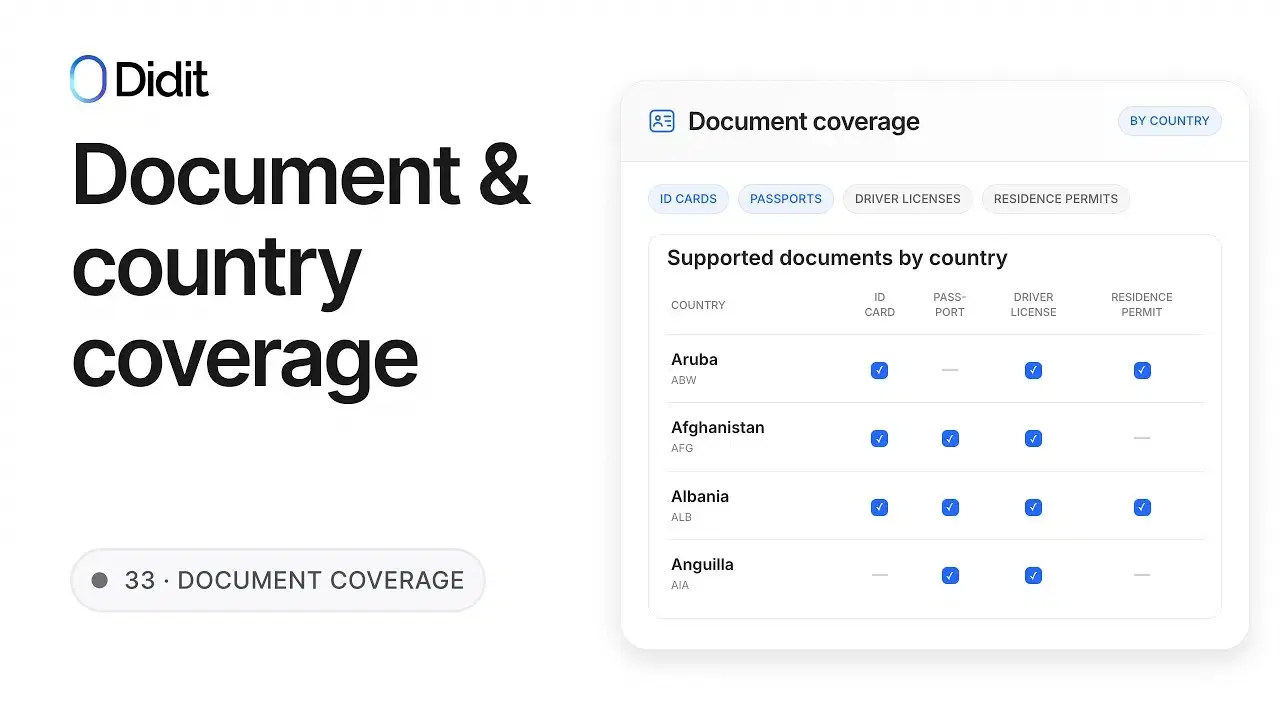
Didit provides a comprehensive identity verification platform with extensive document coverage, supporting over 14,000 document types from 220+ countries. Our AI-powered technology automatically extracts data, validates authenticity, and detects fraud with high accuracy. Key features include:
- Broad Document Support: Supports a vast range of passports, driver’s licenses, national ID cards, and more.
- Advanced OCR: Accurate data extraction from documents in multiple languages.
- Tamper Detection: Identifies altered or fraudulent documents.
- NFC Reading: Verifies e-passports and e-IDs with cryptographic chip reading.
- Ongoing Updates: Continuous monitoring and updates to ensure compatibility with new document formats.
Didit’s flexible APIs and SDKs make it easy to integrate document verification into your existing workflows. We offer competitive pricing and a pay-as-you-go model, so you only pay for the verifications you use.
Ready to Get Started?
Don’t let limited document coverage hinder your KYC efforts. Request a demo today to see how Didit can help you optimize your identity verification processes and reduce risk. Explore our pricing and calculate your potential ROI with our ROI calculator.
Try it
Try this in the sandbox
Run the check this guide describes, free.
The product this post is about, taken from its topic. Run it free in the sandbox.
Author
Alberto Rosas
Co-founder and CEO

Keep reading
Other guides in the same topic.
 What Is the Purpose of FICA in South Africa? 2026 Guide
FICA is South Africa's anti-money laundering law. It creates the Financial Intelligence Centre and requires accountable institutions to identify and verify clients, screen for PEP and sanctions risk and report suspicious.
Alberto RosasNov 26, 2026 Sixth Money Laundering Directive (6AMLD): What Changed and Which Rules Apply
6AMLD is Directive (EU) 2018/1673: Member States must criminalise laundering, widen predicate offences and set a four-year penalty floor. It adds no new due diligence duties for firms.
Alberto RosasNov 26, 2026 Automated Sanctions Screening: Canada, the Entity List and Embargoes
Automated sanctions screening matches people and companies against lists such as Canada's autonomous sanctions made under SEMA and JVCFOA and the OFAC SDN List, and returns candidate hits scored for identity confidence and.
Alberto RosasNov 26, 2026Questions
Blog questions
Who writes the Didit blog?
Which topics does the blog cover?
Is the blog available in my language?
Where do I find product updates?
Are these posts legal advice?
How do I find posts on one topic?
Are posts dated?
Do posts link to the docs?
Is the blog the same as the docs?
Compliance built in
Audited, certified and attested.
We hold the certifications and build each country's rules into your flows, so you can launch anywhere without worrying. Security and Compliance center
- Regulation encoded into your flows
Tell us what you do and where. Didit lists the rules that apply to you, with sources, and builds the checks each country needs into one workflow.
- Ready for AMLR
Every requirement of the new EU anti-money laundering rules, from checking customers to human review, is already covered by a Didit check.
- Tested in Spain's Treasury sandbox
Spain's Treasury published its supervised sandbox report on Didit's NFC plus active liveness onboarding; SEPBLAC took part and valued the added measures positively.
- Audited, not self-declared
iBeta Level 1 and Level 2. Liveness tested under ISO/IEC 30107-3.
Your obligations · 3 regions
 SOC 2 Type 2
 ISO 27001
 iBeta Level 1 and Level 2
 EU regulator attestation
 FSM youth protection
 GDPR
 EBA remote onboarding
 MiCA compatible
 FIDO Alliance member
- AMLREU AML Regulation ready
Integration · Didit MCP
Run Didit from your own AI agent
Connect Didit to Claude, Cursor, VS Code or ChatGPT and just ask in plain words. Your agent can do anything you can do in the console, with the same permissions you have.
 Add to Claude
 ChatGPT
 Cursor
- Build workflowsDescribe the checks you need. The agent creates and publishes the flow.
- Run investigationsAsk why a session was declined, review cases, search people and companies.
- Change rulesCreate payment rules, test them on past data and switch them on.
- Pull reportsAsk for numbers, exports or the audit log.
Didit Academy