MiCA and VASP Registration Requirements in 2026
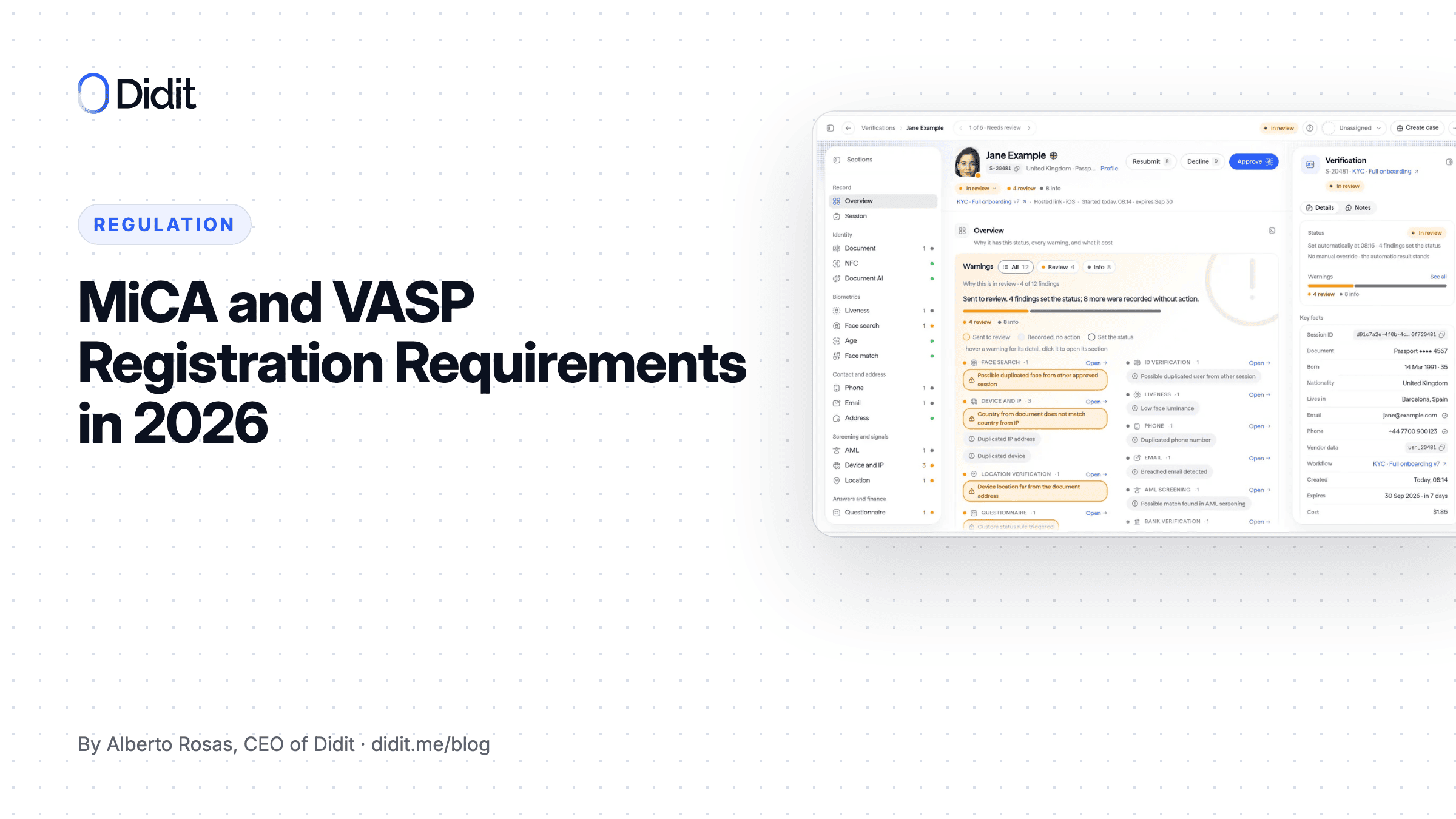
MiCA CASP authorisation in 2026: who needs Article 63, the Article 60 advance notification route, the Annex IV minimums, and Didit prices of $0.33 per KYC check and $0.20 per AML screen.
 Alberto RosasCo-founder and CEO
Contents
In this guide
Jump to the part you need.
If your firm provides a listed crypto-asset service in the EU on a professional basis, it generally needs CASP authorisation under Article 63. Eligible regulated financial entities can use advance notification under Article 60 for the specified services they may provide, filing at least 40 working days before they start. The last national transition ended by 1 July 2026. On Didit a full KYC check is $0.33 and an AML screen $0.20. We supply the evidence, not the authorisation.
Last updated: November 26, 2026. Prices checked against the live Didit price feed on November 26, 2026.
| Question | Answer |
|---|---|
| Which law | Regulation (EU) 2023/1114, MiCA |
| Who must be authorised | If your firm provides a listed crypto-asset service in the EU on a professional basis, it generally needs CASP authorisation under Article 63. Eligible regulated financial entities use advance notification under Article 60 for the specified services they may provide, at least 40 working days before they first provide them, subject to the applicable Article 60 conditions. |
| Where you apply | For Article 63 authorisation, apply to the competent authority of the member state where your registered office is located and you carry out at least part of your crypto-asset services. Your effective management must be in the EU and at least one director must reside there. |
| How long the authority has | Article 62 sets out the application. Under Article 63 the authority acknowledges receipt within five working days, checks completeness within 25 working days of receipt and assesses a complete file within 40 working days. A qualifying request for further information can suspend the assessment clock for up to 20 working days. |
| Can you serve other member states | Yes, by notifying your home competent authority under Article 65. You may start when you receive notice that the authority has communicated your filing. If that notice is still pending, you may start from the 15th calendar day after submitting the information required by Article 65(1). |
| Transitional window | Eligible providers already operating under applicable law before 30 December 2024 could continue until 1 July 2026 or until their application was granted or refused, whichever came first. Member states could shorten or decline to apply the transition. |
| AML framework | AMLR (EU) 2024/1624 applies directly to CASPs from 10 July 2027. The Transfer of Funds Regulation (EU) 2023/1113 already applies to crypto transfers. |
| Didit list prices for the checks | KYC $0.33, AML screening $0.20, wallet screening $0.15, Travel Rule $0.02 per outbound exchange, transaction monitoring $0.001 per transaction beyond the plan allowance |
Who has to apply under MiCA
Article 3(1)(16) lists the ten crypto-asset services below.
- Custody and administration of crypto-assets on behalf of clients
- Operation of a trading platform for crypto-assets
- Exchange of crypto-assets for funds
- Exchange of crypto-assets for other crypto-assets
- Execution of orders for crypto-assets on behalf of clients
- Placing of crypto-assets
- Reception and transmission of orders for crypto-assets on behalf of clients
- Providing advice on crypto-assets
- Providing portfolio management on crypto-assets
- Providing transfer services for crypto-assets on behalf of clients
A wallet that holds keys for users, a broker that converts crypto into euros, an OTC desk that safekeeps client assets and a card programme that transmits crypto on a client's behalf each map to a line in that list. A read-only wallet display, by itself, does not provide a listed service. Assess what the operator actually does, including whether it receives or transmits orders, gives advice, or performs another listed service.
A virtual asset service provider (VASP) is a person or entity that, as a business, performs specified virtual-asset activities for or on behalf of another person. MiCA uses crypto-asset service provider (CASP) and defines the entity and its services in Article 3(1)(15) and (16). Assess EU permission against MiCA's service and asset scope.
Does national VASP registration still let me operate under MiCA?
National VASP registration alone no longer permits a firm to provide in-scope services under MiCA. The last national transition ended by 1 July 2026. For ongoing in-scope operations, firms generally need Article 63 authorisation or, if eligible, may provide specified services under Article 60 after advance notification to their home competent authority at least 40 working days before first providing them, subject to the applicable conditions. Check the firm and its listed services in ESMA's Article 109 register and confirm any separate national AML registration duties.
Where you apply, and what the cross-border notification covers
For Article 63 authorisation, the establishment test is more than an address. Article 59(2) requires the registered office in a member state where the firm carries out at least part of its crypto-asset services, effective management in the EU and at least one director resident in the EU. One home state, one authorisation.
Article 65 then lets an authorised CASP serve clients in other member states through a notification to its home authority. Cross-border service can start when the CASP receives notice that its home authority communicated the filing. If that notice is still pending, service may start from the 15th calendar day after submitting the information required by Article 65(1). There is no second licence and no per-country application.
Article 65 sets out the cross-border notification procedure for CASPs that provide services in more than one member state. Article 60 specifies which services eligible regulated entities may provide. Article 61 provides a narrow exception for third-country firms. Article 61 applies only when the EU client initiates the specific service at their own exclusive initiative. Solicitation by the third-country firm or someone acting on its behalf rules out the exception. The exception does not permit marketing new types of crypto-assets or services to that client.
From when: the dated applicability table
| Date | What changed | Legal basis |
|---|---|---|
| 29 June 2023 | MiCA entered into force, 20 days after publication in the Official Journal | Regulation (EU) 2023/1114 |
| 30 June 2024 | Titles III and IV started to apply: issuers of asset-referenced tokens and e-money tokens | Article 149 |
| 30 December 2024 | Title V began applying, subject to the applicable transitional provisions. | Articles 143(3) and 149 |
| 30 December 2024 | The Transfer of Funds Regulation applied to crypto transfers | Regulation (EU) 2023/1113 |
| 30 December 2024 to 1 July 2026 | Eligible providers already operating under applicable law before 30 December 2024 could continue until 1 July 2026 or until their application was granted or refused, whichever came first. Member states could shorten or decline to apply the transition. | Article 143(3) |
| 1 July 2026 | The longest possible transitional period ended | Article 143(3) |
| 10 July 2027 | AMLR applies directly to obliged entities, CASPs included, alongside national provisions implementing Directive (EU) 2024/1640 | Regulation (EU) 2024/1624 |
Title V began applying on 30 December 2024, subject to the applicable transitional provisions. After the transition, a firm professionally providing in-scope services in the EU generally needs Article 63 authorisation or permission under Article 60. Article 61 remains a narrow exception, for services initiated exclusively by an EU client. The AMLR date is the next deadline that changes how you document customer due diligence.
What the authorisation file tests
Article 62 sets out the application. These are selected areas of the Article 62 application and the obligations that support it, not a substitute for the authority's own application pack.
- Governance (Article 68). Management body members must be of sufficiently good repute, have appropriate knowledge, skills and experience individually and collectively, and devote sufficient time to their duties.
- Prudential safeguards (Article 67 and Annex IV). Article 67 requires the higher of the applicable Annex IV minimum for the service class and one quarter of the preceding year's fixed overheads, reviewed annually. Qualifying own funds, insurance or a comparable guarantee, or a combination may meet the requirement. A firm operating for less than one year uses projected fixed overheads for its first 12 months.
- Safeguarding, custody and wind-down. Segregation of client crypto-assets and funds, a custody policy, a reconciliation routine and a wind-down plan, qualified by service: the safeguarding duty, the custody arrangements and the wind-down plan under Articles 70, 74 and 75 apply to the services that trigger them.
- Outsourcing (Article 73). Written outsourcing agreements, retained responsibility, supervision and access rights, contingency plans and exit strategies. If a separate register obligation applies to your firm, it sits under its own legal basis, not Article 73.
- AML and customer due diligence. The risk assessment, the CDD workflow, the screening arrangements, the monitoring rules, the escalation path and the evidence you can produce months later on request.
The Annex IV classes, and what a mixed firm holds
Annex IV sorts the ten services into three prudential classes. A firm that provides services across classes holds the highest applicable minimum.
| Class | Minimum | Services in the class |
|---|---|---|
| Class 1 | EUR 50,000 | Execution of orders, placing of crypto-assets, transfer services, reception and transmission of orders, advice on crypto-assets, portfolio management |
| Class 2 | EUR 125,000 | Custody and administration, exchange of crypto-assets for funds, exchange of crypto-assets for other crypto-assets |
| Class 3 | EUR 150,000 | Operation of a trading platform |
A firm that runs custody, a trading platform and exchange for funds sits in Class 3 and holds EUR 150,000, or one quarter of the preceding year's fixed overheads if that is higher. The operation of a trading platform is the service that triggers Class 3. For a firm with staff and premises, the overheads figure is often the larger of the two.
The AML layer: AMLR and the Transfer of Funds Regulation
MiCA authorises you. It is not the CDD rulebook. From 10 July 2027, AMLR, Regulation (EU) 2024/1624, applies directly to CASPs and sets harmonised CDD requirements. Until then, current national AML rules continue to apply. From that date, check AMLR alongside applicable national provisions, including measures implementing Directive (EU) 2024/1640. Our AMLR compliance guide maps each article to a workflow, and the business view sits on the AMLR solution page.
When due diligence is triggered
Article 19 sets the triggers. For a CASP the occasional-transaction line is EUR 1,000 rather than the general EUR 10,000, with linked transactions counted together, and a CASP must at least identify and verify the customer below EUR 1,000. The EUR 1,000 rule and the below-threshold identification and verification duty are AMLR requirements from 10 July 2027. Until then, configure your current national triggers separately, and build for business relationships, linked occasional transactions, suspicion regardless of amount and doubts about existing identification data.
Records: five years from the relevant event
Article 77 requires five years of records from the relevant event, ordinarily the end of the relationship or the date of the occasional transaction. Check for legally applicable extended retention before you delete personal data. Deletion is not unconditional.
Travel Rule: no minimum amount, but not every transfer
The EU Transfer of Funds Regulation, Regulation (EU) 2023/1113, has no minimum amount for in-scope transfers involving an EU CASP. Person-to-person transfers without a CASP are excluded. For CASP-to-CASP transfers, send the required data in advance of or concurrently with the transfer. For transfers to or from a self-hosted address, obtain and hold the required data and apply the ownership or control assessment where the amount exceeds EUR 1,000. The provisions are TFR Articles 2, 14 and 16. FATF Recommendation 16 is the global standard behind it.
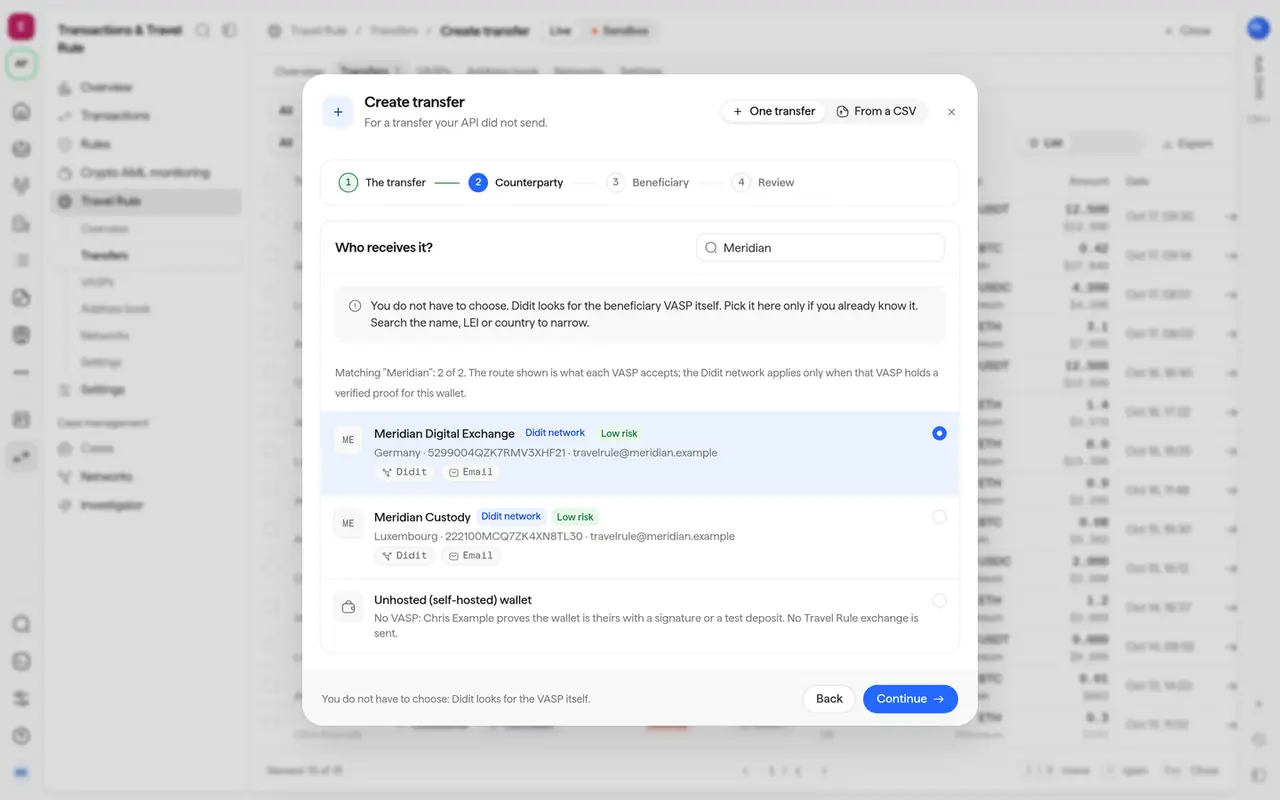
Travel Rule implementation sequence
- Check counterparty reachability before you promise a settlement time. The directory entry and its route list decide which rail can reach the receiving VASP.
- For the network rails, connect your own network membership in the console Marketplace. Didit holds no platform membership for those networks today.
- Submit the transfer with
transaction_categoryset totravelRule, and wait for the exchange to reachCOMPLETEDbefore you broadcast on chain. - After broadcast, report the on-chain transaction hash back to Didit so the exchange reaches
FINISHED.
EU AML and Travel Rule controls you can implement with Didit
| Obligation and article | Who owns the decision | What Didit ships | Where it lives |
|---|---|---|---|
| Identify and verify the customer (AMLR Article 20(1)(a), Article 22) | You | ID document, passive liveness, face match and device and IP analysis in one check at $0.33. 14,000+ document types, 220+ countries and territories, 54 capture languages | POST /v3/session/ |
| Screen for targeted financial sanctions and identify PEPs (AMLR Article 20(1)(d) and (g), Article 42) | You | AML Screening against 1,300+ lists at $0.20 per check, with the two-score result. Adverse media is a source available in Didit. | Console and API |
| Monitor the relationship and refresh data (AMLR Article 26) | You | Ongoing AML monitoring at $0.07 per person per year, plus document expiry tracking | POST /v3/users/aml-monitoring/ |
| Identify beneficial owners and the ownership chain (AMLR Article 20(1)(b), Articles 51 to 53) | You | Business Verification from $2.00 per company, key people extraction free, person AML $0.20, linked KYC $0.33 per person | KYB workflow |
| Monitor transactions and report suspicions (AMLR Article 26(1), Article 69) | You | Transaction Monitoring with rules, alerts and case review. $0.001 per transaction beyond the plan allowance of 1,000, 10,000 or 100,000 a month | POST /v3/transactions/ |
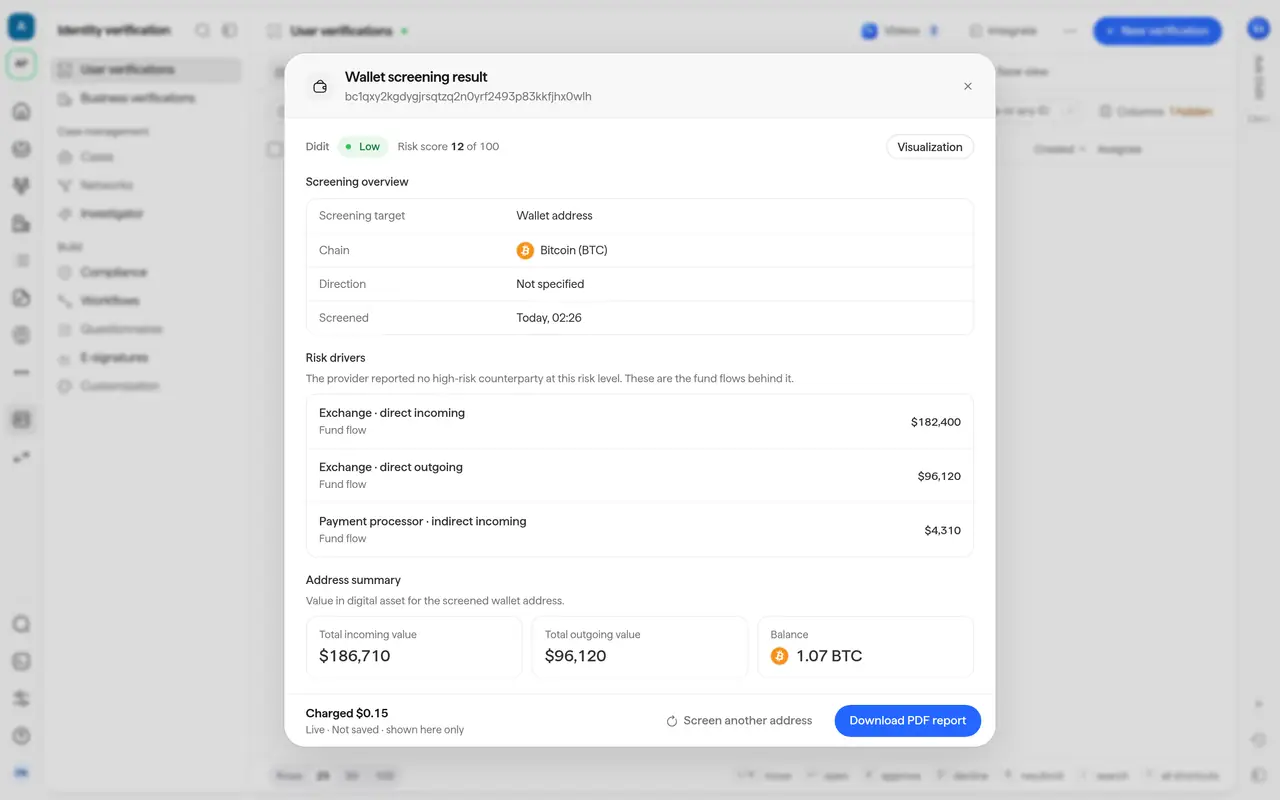
| Screen wallets on deposits and withdrawals | You | Wallet screening at $0.15 per screening, applied under your risk policy and applicable obligations: standalone with POST /v3/wallet-screening/, or on a monitored transaction with POST /v3/transactions/ and currency_kind set to crypto | Console and API |
| Exchange originator and beneficiary data (TFR, FATF Recommendation 16) | You | Travel Rule at $0.02 per outbound exchange, seven rails tried in priority order | Travel Rule API |
| Understand the purpose of the relationship and, where necessary, the source of funds (AMLR Article 25) | You | Custom questionnaires at $0.10 per check | Workflow steps |
| Verify an address as a supporting check, not as a source-of-funds measure | You | Address verification through proof of address at $0.20 per check | Workflow step |
| Keep records for five years from the relevant event under AMLR Article 77, subject to applicable retention extensions. | You | Documented retention, export and on-demand deletion settings | Console settings |
| Human review of automated decisions (AMLR Article 76(5)) | You | Manual review, comments and status updates | Business Console |
| Govern what you outsource (AMLR Article 18) | You | Our SOC 2 Type 2 report is available under NDA. Your team maintains the outsourcing documentation required for its arrangement. | On request |
Didit provides the checks and the evidence. You remain the obliged entity: you decide the risk profile, you decide whether to onboard, and you stay liable for anything you outsource under AMLR Article 18.

Wallet screening without switching vendors
Our managed wallet screening costs $0.15 per screening. The standalone call screens one address and returns the result without creating a transaction, which covers the case where a customer adds a withdrawal address and there is nothing to record yet.
If your group already holds a screening provider contract, you can bring your own screening provider and run it inside Didit. If you are replacing a per-country stack of vendors, the migration path is on our switch page.
Worked example: the annual check cost for one CASP
Take a mid-size CASP with 12,000 new retail customers a year, 75,000 monitored transactions a month, 40,000 wallet screens a year, 25,000 outbound Travel Rule exchanges a year and 150 business clients. Every number below is a published list price on the live feed, and the arithmetic is shown.
| Line | Volume per year | Unit price | Cost |
|---|---|---|---|
| Full KYC check | 12,000 | $0.33 | $3,960.00 |
| AML screening | 12,000 | $0.20 | $2,400.00 |
| Ongoing AML monitoring | 12,000 person-years | $0.07 | $840.00 |
| Wallet screening | 40,000 | $0.15 | $6,000.00 |
| Travel Rule exchanges | 25,000 | $0.02 | $500.00 |
| Transactions above the plan allowance | 780,000 | $0.001 | $780.00 |
| Business registry retrievals | 150 | $2.00 | $300.00 |
| Subtotal at list rates | $14,780.00 |
The arithmetic, line by line: 12,000 x $0.33 = $3,960.00. 12,000 x $0.20 = $2,400.00. 12,000 x $0.07 = $840.00. 40,000 x $0.15 = $6,000.00. 25,000 x $0.02 = $500.00. 150 x $2.00 = $300.00. The Growth plan includes 10,000 monitored transactions a month. The CASP monitors 75,000 transactions a month and pays overage on 65,000: 12 x (75,000 - 10,000) x $0.001 = 12 x 65,000 x $0.001 = $780.00. The sum is $3,960.00 + $2,400.00 + $840.00 + $6,000.00 + $500.00 + $780.00 + $300.00 = $14,780.00.
The $14,780.00 is the subtotal at list rates using the Growth overage allowance. It buys 12,000 person-years of AML monitoring and assumes 150 registry retrievals at the $2.00 starting rate. It excludes company AML, linked KYC and person AML, which this model does not buy; a full KYC check plus one AML screen is $0.53, so the 12,000 retail customers cost $6,360.00 of the total before monitoring, wallet screening and Travel Rule.
Transaction monitoring stays at $0.001 on every plan, so the overage is not discounted. Discounted usage: ($14,780.00 - $780.00) x 0.96 + $780.00 = $13,440.00 + $780.00 = $14,220.00. With all monthly credits used and Growth billed monthly, the annual outlay is $14,220.00 - $1,380.00 + $1,188.00 = $14,028.00. The $1,380.00 is 12 months of $115 credit; the $1,188.00 is 12 months of $99 plan fees. Plans, credit rules and the estimator are on the pricing page and in the pricing docs.
The estimate excludes legal and filing costs, compliance staff, and any costs of meeting prudential safeguards.
Exceptions and open questions
- Read-only wallet display. A wallet display that cannot move funds is not a listed service by itself. The test is what the operator does, including whether it receives or transmits orders, gives advice, or performs another listed service.
- NFTs. Article 2(3) excludes crypto-assets that are genuinely unique and non-fungible. Assess the substance of each asset, including fractional interests and large series or collections, then assess any services the platform provides for assets within MiCA's scope.
- Fully decentralised arrangements. Recital 22 says services provided in a fully decentralised manner without any intermediary should fall outside MiCA. If a person or undertaking intermediates any part of the service, assess that activity against Article 3(1)(16).
- Article 61. Article 61 applies only when the EU client initiates the specific service at their own exclusive initiative. Solicitation by the third-country firm or someone acting on its behalf rules out the exception. The exception does not permit marketing new types of crypto-assets or services to that client.
- Separate AML registration. Check your home jurisdiction's rules on registration of obliged entities separately from the MiCA file, and keep the written answer with the application.
- Group structures. One authorisation covers one legal entity with a registered office in one member state, subject to Article 59(2). Each group entity that provides services in its own right must assess its own permission, and an outsourcing arrangement does not confer authorisation.
- Occasional transactions below EUR 1,000. From 10 July 2027, AMLR Article 19 requires at least identification and verification for a CASP's occasional transactions below the EUR 1,000 line. Until then, apply your current national rules.
Implementation checklist
Start with the Article 62 file. For each area, name the document, the owner and the evidence to have ready before the authority asks.
| Area | Document to prepare | Owner | Evidence to have ready |
|---|---|---|---|
| Programme of operations | Service map against Article 3(1)(16), with the Annex IV class each service produces | CEO or head of product | The completed mapping and the highest class it triggers |
| Governance (Article 68) | Fit and proper file per management body member: CV, criminal record certificate, conflicts, time commitment | Board chair | Signed minutes approving each appointment |
| Prudential safeguards (Article 67 and Annex IV) | Capital plan showing the Annex IV minimum and one quarter of the preceding year's fixed overheads, plus any insurance or comparable guarantee | CFO | The calculation for the last financial year, or projected overheads for the first 12 months if trading under a year |
| Safeguarding, custody and wind-down (Articles 70, 74, 75, where applicable to your services) | Segregation policy, reconciliation routine, wind-down plan | COO | Sample reconciliation records and approval evidence for the applicable service. Confirm the required evidence and period with the home competent authority |
| Outsourcing (Article 73 and any separate register under its own legal basis) | Contract inventory with supervision, access rights and exit plans | Head of compliance | Signed agreements and the exit plan for each critical function |
| AML and customer due diligence | Risk assessment, CDD workflow, screening arrangements, monitoring rules, escalation path | MLRO | One customer file produced end to end from session to monitoring history |
- Map each service you actually provide to a line in Article 3(1)(16), and drop the services you do not provide from the plan. The Annex IV class and your prudential number follow from this list.
- Confirm the member state where you carry out part of your services, and read that authority's application pack, not a summary of it.
- Write the customer risk assessment and the CDD workflow before you shop for a vendor. The workflow decides what you buy, not the other way round.
- Configure the CDD triggers in your own code. Use current national triggers now, and add the AMLR set for 10 July 2027: the EUR 1,000 line for occasional transactions, below-threshold identification and verification, linked transactions, business relationships, suspicion regardless of amount and doubts about existing identification data.
- Stand up the checks: a verification session per trigger, AML screening on every client, wallet screening applied under your risk policy, Travel Rule before settlement.
- Build the monitoring rules, including velocity rules that catch linked transactions crossing a threshold together.
- Apply current national AML and applicable TFR retention rules now. From 10 July 2027, configure AMLR Article 77 retention for five years from the applicable event: the end of the business relationship, the date of the occasional transaction, or the date of refusal to establish the relationship or carry out the transaction. Check for any applicable extension before deleting the personal data.
- Put every outsourced function into your outsourcing documentation, under its own legal basis, with the supervision rights and the exit plan. Identity and screening vendors belong there.
- Rehearse the evidence request: pick a random client from three months ago and produce the file in an hour.
- Apply. Article 62 sets out the application, and the Article 63 clocks run to acknowledgement, completeness and a decision on a complete file.
One session, then the decision, then the routing decision your team makes:
curl -X POST https://verification.didit.me/v3/session/ \
  -H "x-api-key: YOUR_API_KEY" \
  -H "Content-Type: application/json" \
  -d '{"workflow_id": "your-onboarding-workflow-id", "vendor_data": "customer-123"}'

# The call returns session_id and url.
# 1. Redirect the customer to url.
# 2. Take the status.updated webhook instead of polling the browser.

curl https://verification.didit.me/v3/session/SESSION_ID/decision/ \
  -H "x-api-key: YOUR_API_KEY"

# 3. The decision returns the result of every check in the session.
# 4. Your team records its decision with
#    PATCH /v3/session/{sessionId}/update-status/
We serve 4,000+ companies. The orchestrator and the MCP server are free, and inference latency is under two seconds at p99. A coding agent can build the same workflow from a prompt.
Sources
- Regulation (EU) 2023/1114 (MiCA), in particular Article 2(3), Article 3(1)(15) and 3(1)(16), Articles 59, 60, 61, 62, 63, 64, 67, 68, 70, 73, 74, 75 and 109, Article 143(3), Article 149, Annex IV and Recital 22
- Regulation (EU) 2024/1624 (AMLR), Articles 3, 18, 19, 20, 22, 25, 26, 42, 51 to 53, 69, 76(5) and 77
- Regulation (EU) 2023/1113 (Transfer of Funds Regulation), Articles 2, 14 and 16
- Directive (EU) 2024/1640 (AMLD6)
- FATF, Recommendation 15 on virtual assets and Recommendation 16 on the travel rule
- Didit docs: AMLR compliance guide, last reviewed 2 October 2026
- Didit pricing page, Didit docs: pricing and billing and the machine-readable price feed
- Didit docs: AML screening
- Didit docs: wallet screening
- Didit docs: Travel Rule and Create a private Travel Rule VASP entry
- Didit docs: business verification
- Didit docs: Create Session and Create Transaction
- Didit: AMLR solution page
Open our free sandbox and create a test onboarding session. Use our Travel Rule guide to check which routes can reach your counterparties. No sales call required. Start free at business.didit.me.
Try it
Try this in the sandbox
Run the check this guide describes, free.
The product this post is about, taken from its topic. Run it free in the sandbox.
Author
Alberto Rosas
Co-founder and CEO

Keep reading
Other guides in the same topic.
 What Is the Purpose of FICA in South Africa? 2026 Guide
FICA is South Africa's anti-money laundering law. It creates the Financial Intelligence Centre and requires accountable institutions to identify and verify clients, screen for PEP and sanctions risk and report suspicious.
Alberto RosasNov 26, 2026 Sixth Money Laundering Directive (6AMLD): What Changed and Which Rules Apply
6AMLD is Directive (EU) 2018/1673: Member States must criminalise laundering, widen predicate offences and set a four-year penalty floor. It adds no new due diligence duties for firms.
Alberto RosasNov 26, 2026 Automated Sanctions Screening: Canada, the Entity List and Embargoes
Automated sanctions screening matches people and companies against lists such as Canada's autonomous sanctions made under SEMA and JVCFOA and the OFAC SDN List, and returns candidate hits scored for identity confidence and.
Alberto RosasNov 26, 2026Questions
Frequently asked questions
What is the difference between a VASP and a CASP under MiCA?
A virtual asset service provider (VASP) is a person or entity that, as a business, performs specified virtual-asset activities for or on behalf of another person. MiCA uses crypto-asset service provider (CASP) and defines the entity and its services in Article 3(1)(15) and (16). Assess EU permission against MiCA's service and asset scope rather than translating the FATF label across.
Do banks and investment firms need CASP authorisation?
Not always. Article 60 lets the regulated financial entities listed there provide specified crypto-asset services, but they must notify their home competent authority at least 40 working days before first providing the permitted services, subject to the applicable Article 60 conditions. Everyone else providing a listed service in the EU on a professional basis generally needs authorisation under Article 63.
How long does CASP authorisation take?
Article 62 sets out the application. Under Article 63 the authority acknowledges receipt within five working days, checks completeness within 25 working days of receipt and assesses a complete file within 40 working days. A qualifying request for further information can suspend the assessment clock for up to 20 working days, so the elapsed time depends on how complete the first submission is.
Does MiCA apply to a crypto business outside the EU?
It applies to services provided in the Union. Article 61 applies only when the EU client initiates the specific service at their own exclusive initiative, and solicitation by the firm or someone acting on its behalf rules out the exception. The exception also does not permit marketing new types of crypto-assets or services to that client.
What happens to a firm serving EU clients without authorisation?
A firm that provides in-scope services without the permission MiCA requires may face supervisory measures and penalties. Check ESMA's Article 109 register for the firm and the services listed, then verify an unclear entry with the home competent authority.
How much do identity and AML checks cost per customer?
A full KYC check is $0.33 and includes ID document verification at $0.15, passive liveness at $0.10, face match at $0.05 and device and IP analysis at $0.03. AML screening against 1,300+ lists is $0.20, so one full KYC check plus one AML screen is $0.53 at list rates. Ongoing monitoring is $0.07 per person per year and wallet screening is $0.15 per screening.
Can I keep my existing wallet screening provider?
Yes. You can bring your own screening provider and run it inside Didit. Managed wallet screening on Didit is $0.15 per screening, and the standalone call screens one address and returns the result without creating a transaction.
Do I need Travel Rule data on every crypto transfer?
The EU Transfer of Funds Regulation has no minimum amount for in-scope transfers involving an EU CASP, but person-to-person transfers without a CASP are excluded. For CASP-to-CASP transfers, send the required data in advance of or concurrently with the transfer; for transfers to or from a self-hosted address, obtain and hold the required data and apply the ownership or control assessment above EUR 1,000. Travel Rule messaging on Didit is $0.02 per outbound exchange.
What is the minimum prudential requirement for a CASP?
Article 67 requires the higher of the applicable Annex IV minimum (EUR 50,000, EUR 125,000 or EUR 150,000) and one quarter of the preceding year's fixed overheads, reviewed annually. Qualifying own funds, insurance or a comparable guarantee, or a combination may meet it. A firm operating for less than one year uses projected fixed overheads for its first 12 months.
What evidence does a competent authority want for customer due diligence?
Keep evidence of how you verified identity, assessed customer risk, handled screening matches, made the onboarding decision and monitored the relationship. Use the Didit session decision for the checks run in that session and assemble it with your risk assessment, reviewer notes and monitoring history. The screening result is one record in that file, not the whole file.
Do I need a separate AML registration as well as a MiCA authorisation?
From 10 July 2027, AMLR applies directly to CASPs and sets harmonised CDD requirements. Until then, current national AML rules continue to apply. From that date, check AMLR alongside applicable national provisions, including measures implementing Directive (EU) 2024/1640, and check your home jurisdiction's own registration rules for obliged entities before you file.
Compliance built in
Audited, certified and attested.
We hold the certifications and build each country's rules into your flows, so you can launch anywhere without worrying. Security and Compliance center
- Regulation encoded into your flows
Tell us what you do and where. Didit lists the rules that apply to you, with sources, and builds the checks each country needs into one workflow.
- Ready for AMLR
Every requirement of the new EU anti-money laundering rules, from checking customers to human review, is already covered by a Didit check.
- Tested in Spain's Treasury sandbox
Spain's Treasury published its supervised sandbox report on Didit's NFC plus active liveness onboarding; SEPBLAC took part and valued the added measures positively.
- Audited, not self-declared
iBeta Level 1 and Level 2. Liveness tested under ISO/IEC 30107-3.
Your obligations · 3 regions
 SOC 2 Type 2
 ISO 27001
 iBeta Level 1 and Level 2
 EU regulator attestation
 FSM youth protection
 GDPR
 EBA remote onboarding
 MiCA compatible
 FIDO Alliance member
- AMLREU AML Regulation ready
Integration · Didit MCP
Run Didit from your own AI agent
Connect Didit to Claude, Cursor, VS Code or ChatGPT and just ask in plain words. Your agent can do anything you can do in the console, with the same permissions you have.
 Add to Claude
 ChatGPT
 Cursor
- Build workflowsDescribe the checks you need. The agent creates and publishes the flow.
- Run investigationsAsk why a session was declined, review cases, search people and companies.
- Change rulesCreate payment rules, test them on past data and switch them on.
- Pull reportsAsk for numbers, exports or the audit log.
Didit Academy


