Microprint Analysis: How to Catch a Forged ID Document
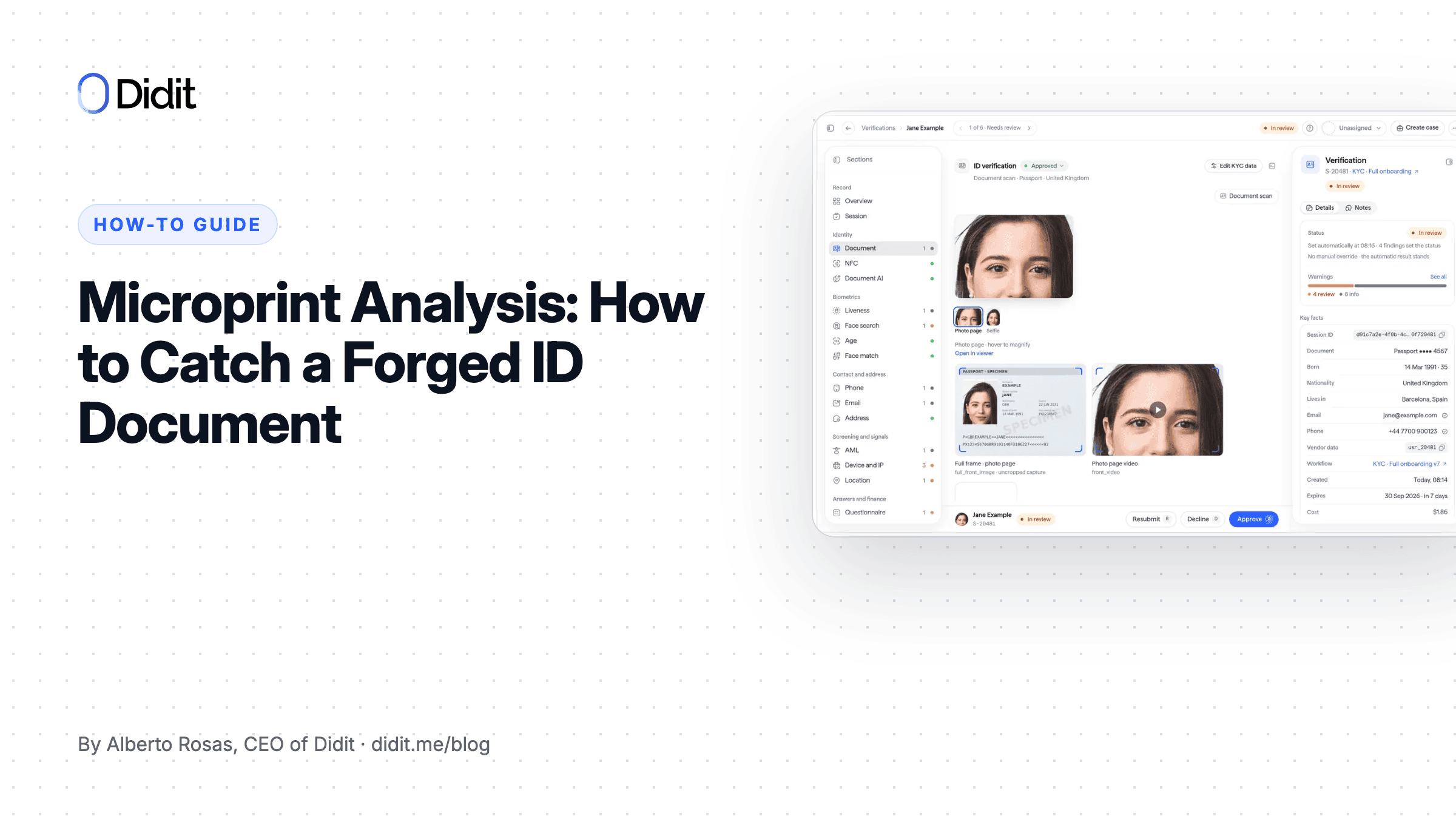
Document authenticity checks can help assess microprint-related reprints: Didit documents a status and warnings, not a microprint-specific score.
 Alberto RosasCo-founder and CEO
Contents
In this guide
Jump to the part you need.
Microprint analysis fits teams that must stop reprinted or altered identity documents before an account opens. Microprint is a document-security concept: print too small to read without magnification. The provided Didit documentation defines a status and a set of warnings, but no microprint-specific score field. Checks cost $0.15 per document inside a workflow. The caveat: image quality limits any forgery check, so a human closes suspect cases.
Last updated: November 26, 2026. Prices checked against the live Didit price feed on November 26, 2026.
| Item | Detail |
|---|---|
| Outcome you get | A verification status (Approved, Declined, In Review) plus a warnings array that names the risk found on the document |
| Recommended method | Hosted workflow with the ID_VERIFICATION feature, or the standalone ID Verification API when you already hold the images |
| Capture requirement | Uncropped image, all four corners visible, front and back for two-sided documents, tiff, jpg, jpeg, png, webp or pdf, max 5 MB per file |
| Automated check price | $0.15 per document inside a workflow, $0.20 for the standalone ID Verification API |
| Human review | In Review cases wait for a reviewer in the Business Console, and the session records who decided, when, and the automatic status it replaced |
| Latency | Sub-2-second p99 inference |
| Where results land | Business Console session detail, GET /v3/session/{sessionId}/decision/, or the session.status.updated webhook |
Start free in the sandbox at https://business.didit.me/, with no sales call. Developers who want an assistant to drive the checks can connect Didit to an AI assistant through https://didit.me/developers/mcp/.
What microprint analysis is for, and what you actually get back
Microprint is text or a pattern printed too small to read at arm's length; it only resolves into letters under magnification. A counterfeiter who scans and reprints a document loses it first: the line blurs or fills in while the name, number and photo still look correct. That description is general document-security background, not a claim about a specific Didit detection method.
Analysis means reading the captured image well enough to notice that loss, and turning it into a decision your system can act on. In Didit, the documented output of that work is a status and a set of risk codes: the check looks for tampering and returns documented risk warnings. The provided Didit documentation defines status and warnings, with no microprint-specific score, so treat the status and the warnings array as the operative result, and treat the review queue as the place where a human confirms the fine detail. The warning catalogue is public at the ID verification warnings page.
Prerequisites
- A Didit API key, sent as the
x-api-keyheader. - Either a workflow containing the
ID_VERIFICATIONfeature (the canonical feature enum isOCRfor legacy workflows orID_VERIFICATIONfor current ones), or nothing at all if you plan to call the standalone ID Verification API server to server. - Document images that meet the contract: uncropped with all four corners visible, tiff, jpg, jpeg, png, webp or pdf, no more than 5 MB per file, and a
back_imagefor dual-sided documents such as ID cards and driving licences. - Implementation guidance, not a Didit prerequisite: have a review queue with a named owner, so In Review cases are not left unresolved.
- A sandbox application if you want to rehearse outcomes. Scenarios are documented at sandbox testing.
How to run microprint analysis in an ID check, step by step
- Choose the delivery mode. Use a hosted workflow when the person photographs their own document, because Didit's capture screen guides position, light and focus. Use the standalone ID Verification API when your own front end already produced the images and you want one call that returns the checks.
- Capture for detail, not for speed. The image has to resolve print that is small enough to look like a rule. Reject crops, glare across the printed data page, and heavily compressed screenshots. If the capture cannot hold the fine print, the check cannot clear the document, and you should expect a recognition warning rather than a pass.
- Set the action parameters before you send real traffic. Decide what a missing expiry date, an invalid MRZ or inconsistent data should do on your account. The documented parameters are
expiration_date_not_detected_action,invalid_mrz_actionandinconsistent_data_action, each acceptingDECLINE,REVIEWorNO_ACTION. - Send the document. This is the documented standalone call, with the front and back images, document forgery checking on, and the three action parameters set to
DECLINE:
curl -X POST 'https://verification.didit.me/v3/id-verification/' \
  -H 'x-api-key: YOUR_API_KEY' \
  -F 'front_image=@./id_front.jpg' \
  -F 'back_image=@./id_back.jpg' \
  -F 'perform_document_liveness=true' \
  -F 'minimum_age=18' \
  -F 'expiration_date_not_detected_action=DECLINE' \
  -F 'invalid_mrz_action=DECLINE' \
  -F 'inconsistent_data_action=DECLINE' \
  -F 'preferred_characters=latin' \
  -F 'save_api_request=true' \
  -F 'vendor_data=user-123'
If you are running the hosted flow instead, create a session and open the returned session.url for the user:
curl -X POST 'https://verification.didit.me/v3/session/' \
  -H 'x-api-key: YOUR_API_KEY' \
  -H 'Content-Type: application/json' \
-d '{"workflow_id":"WORKFLOW_UUID","vendor_data":"user-123","callback":"https://app.example.com/done"}'- Read the decision. In a workflow, the result sits in the
id_verifications[]array, one entry per document collected. Fetch it directly after the flow finishes:
curl https://verification.didit.me/v3/session/SESSION_ID/decision/ \
-H 'x-api-key: YOUR_API_KEY'- Branch on status, then on warnings. Approved means the risk rules cleared the document. Declined means a terminal warning fired. In Review means a rule asked for a human, or a requested forgery check returned no usable score. Never map In Review to an approval in your own code.
- Escalate the suspect document, not the whole account. Send the images, the warning list and the session link to the reviewer, who inspects the fine print under magnification and closes the case.
Expected output
A declined document comes back with the risk that decided it. This is the documented shape of the response, using the documented example warning object:
{
  "request_id": "6f1c2f0a-0000-0000-0000-000000000000",
  "id_verification": {
    "status": "Declined",
    "document_type": "Identity Card",
    "document_number": "AB1234567",
    "full_name": "Jane Doe",
    "date_of_birth": "1990-04-12",
    "expiration_date": "2024-08-01",
    "warnings": [
      {
        "feature": "ID_VERIFICATION",
        "risk": "DOCUMENT_EXPIRED",
        "additional_data": null,
        "log_type": "error",
        "short_description": "Document expired",
        "long_description": "The document's expiration date has passed, rendering it no longer valid for use.",
        "node_id": "first_id_verification"
      }
    ]
  }
}
When no risk rule fires, the warnings array carries no codes and the status can be Approved. Every warning carries a stable risk code, a short_description, and a long_description written for end users, which means you can show it in your own interface without rewriting it.
Failure cases and recovery
| Failure | What it means | Recovery |
|---|---|---|
| HTTP 403, no credits | Your balance cannot cover the call | Top up, or spend plan credit. Sandbox applications keep working while live checks are paused |
| HTTP 400, multipart validation | Missing back_image on a dual-sided document, a file over 5 MB, or an unsupported extension | Fix the request validation error, then retry |
| Status Declined with a terminal warning | For example DOCUMENT_EXPIRED, DOCUMENT_LIVENESS_FAILED or COULD_NOT_RECOGNIZE_DOCUMENT | Show the first warning's long_description to the user and stop the flow |
In Review with DOCUMENT_LIVENESS_NOT_COMPUTED | The forgery check produced no usable score because of a provider error | Treat the document as unchecked and route it to manual review. Do not approve on the strength of the other fields |
| In Review, any other cause | A rule asked for a human decision | Send it to the review queue with the images and warnings attached |
| HTTP 404 on the decision call | The session does not exist or belongs to a different application | Check the session id against the application that created it |
| HTTP 403 on the decision call | The key lacks the read:sessions privilege | Use a key that can read sessions |
Image quality sets the ceiling. If the capture cannot resolve the fine print, or a requested forgery check returns no usable score, the document is not cleared: you get a recognition warning or DOCUMENT_LIVENESS_NOT_COMPUTED, and a person has to look at it. An image that has lost fine detail cannot support a reliable authenticity decision.
Inputs and outputs
| Input | Required | What it does |
|---|---|---|
front_image | Yes | The primary face of the document |
back_image | For dual-sided documents | The second face, needed to check printed data against the other zones |
perform_document_liveness | No | Runs the documented document-liveness and forgery check |
invalid_mrz_action, inconsistent_data_action, expiration_date_not_detected_action | No | Set the strictest action your policy allows for each risk |
vendor_data | No, strongly recommended | Your stable identifier for the person, used for duplicate detection across sessions |
| Output | What it tells you |
|---|---|
status | One of Not Started, In Progress, Approved, In Review, Declined, Abandoned, Kyc Expired |
warnings[] | Risk codes such as INVALID_MRZ, INCONSISTENT_DATA, DOCUMENT_LIVENESS_FAILED, COULD_NOT_RECOGNIZE_DOCUMENT, FRAUD_RISK_FROM_OCR, DUPLICATED_DOCUMENT |
document_type | The document class, from a registry covering 14,000+ document types in 220+ countries |
mrz, barcodes, parsed_address | The machine-readable data the check cross-references against the visual zones |
portrait_image, front_document_image, back_document_image | Presigned media URLs, short lived, so download them promptly |
Worked cost example
Take 10,000 ID document checks a month. The totals below are gross list-price usage before any monthly plan credit is applied, so you can check the arithmetic line by line.
- Inside a workflow: 10,000 x $0.15 = $1,500.00
- Through the standalone ID Verification API: 10,000 x $0.20 = $2,000.00
- Free plan credit: $1,500.00 - $10.00 = $1,490.00 paid from top-ups for the workflow case
On Growth the workflow unit price is $0.144, so 10,000 x $0.144 = $1,440.00 gross, plus the $99 monthly fee; the $115 of monthly credit covers the first $115, leaving $1,440.00 - $115.00 = $1,325.00 from top-ups. On Scale the unit price is $0.135, so 10,000 x $0.135 = $1,350.00 gross, plus the $299 monthly fee; the $350 of credit leaves $1,350.00 - $350.00 = $1,000.00 from top-ups. Adding NFC chip reading at $0.15 per check adds 10,000 x $0.15 = $1,500.00 on top of any of these totals. The full price list, including the estimator, is at https://didit.me/pricing/.
Paid steps and the review boundary
Three paid steps can appear in one microprint-aware flow, and it helps to know which one decides what:
- ID document check, $0.15 inside a workflow, or $0.20 for the standalone ID Verification API. This is the step that reads the document and produces the warnings.
- Document AI, $0.20 per document, when the file is not a standard identity document and you define the fields yourself. It checks the file for manipulation and raises
DOCUMENT_AI_SUSPECTED_MANIPULATION. - NFC chip reading, $0.15 per check, as an add-on where the document has a chip. NFC chip reading adds a separate chip-authenticity check where the document and device support it.
The boundary is simple. Automation classifies, reads and scores, and it returns a status and codes. It does not approve a document it could not score, and it does not overrule a terminal warning. Every In Review case is closed by a person in the Business Console, and that decision is recorded on the session with the reviewer, the timestamp and the automatic status it replaced. Manual review is part of the flow, not an optional extra, so build your product so an In Review document cannot be treated as a pass by default.

Didit is used by 4,000+ companies, and the ID verification module covers 14,000+ document types across 220+ countries in 54 capture languages. The product page is at https://didit.me/identity-verification and the API reference is at https://docs.didit.me/core-technology/id-verification/overview.
Sources
- Didit docs: ID Verification API, 14,000+ documents
- Didit docs: ID verification risk catalogue
- Didit docs: per-feature ID verification report
- Didit docs: Create Session API
- Didit docs: Retrieve Session API
- Didit docs: data models and warning object schema
- Didit docs: Document AI API
- Didit docs: sandbox test data and scenarios
- Didit docs: pricing and billing rules
- Didit ID Verification product page
- Didit pricing page and pricing as JSON, read November 26, 2026
- Didit MCP server setup
Next step: run one sandbox scenario or sample document through the sandbox at https://business.didit.me/, check the warnings array, and decide your action parameters before the integration goes live. No sales call is needed to start.
Try it
Try this in the sandbox
Run the check this guide describes, free.
The product this post is about, taken from its topic. Run it free in the sandbox.
Author
Alberto Rosas
Co-founder and CEO

Keep reading
Other guides in the same topic.
 What Is the Purpose of FICA in South Africa? 2026 Guide
FICA is South Africa's anti-money laundering law. It creates the Financial Intelligence Centre and requires accountable institutions to identify and verify clients, screen for PEP and sanctions risk and report suspicious.
Alberto RosasNov 26, 2026 Sixth Money Laundering Directive (6AMLD): What Changed and Which Rules Apply
6AMLD is Directive (EU) 2018/1673: Member States must criminalise laundering, widen predicate offences and set a four-year penalty floor. It adds no new due diligence duties for firms.
Alberto RosasNov 26, 2026 Automated Sanctions Screening: Canada, the Entity List and Embargoes
Automated sanctions screening matches people and companies against lists such as Canada's autonomous sanctions made under SEMA and JVCFOA and the OFAC SDN List, and returns candidate hits scored for identity confidence and.
Alberto RosasNov 26, 2026Questions
Frequently asked questions
What is microprint on an ID document?
Microprint is text or a pattern printed so small that it looks like a solid line at reading distance and only resolves into letters under magnification. Passports, ID cards, driving licences and banknotes carry it because ordinary office printers cannot hold that detail. It sits alongside holograms, watermarks, UV ink and tactile printing as a physical anti-counterfeiting feature.
How do I analyze an ID document for fraud?
Capture the front and, for two-sided documents, the back, with all four corners visible and no crop, then send both images to an authenticity check. Didit returns a status plus a warnings array, either from the standalone ID Verification API or inside id_verifications[] in a session decision. Read the status first, then the warnings, and send In Review cases to a human reviewer.
How does microprint analysis detect ID fraud?
A counterfeit made by scanning and reprinting loses sharpness in the smallest print first, so the line blurs, breaks or fills with dots while the name and photo still look correct. Didit checks each submitted document for tampering and returns documented risk warnings such as DOCUMENT_LIVENESS_FAILED or FRAUD_RISK_FROM_OCR. Those flags matter most when the printed data itself passes a read, because then only the security detail is left to catch the copy.
Why is microprint difficult for fraudsters to replicate?
It needs high-precision presses, controlled ink and tight registration, so a convincing copy is expensive. A scanner also discards detail before a printer sees it, so each copy degrades further.
What other document security features complement microprint?
Holograms, watermarks, UV elements, tactile intaglio printing and guilloche patterns are the usual companions. Treat that list as general background on document security, not as a list of Didit detection methods. What Didit documents are data and forgery checks reported as separate risk codes: MRZ consistency, barcode agreement across zones, document liveness checks, and NFC chip reading where the document has a chip, for example INVALID_MRZ or DOCUMENT_LIVENESS_FAILED.
What does an ID document check cost at Didit?
$0.15 per document inside a workflow and $0.20 for the standalone ID Verification API. A full ID check, which adds passive liveness, face match and device and IP analysis, is $0.33. Growth takes 4% off every price and Scale takes 10%, and the Free plan includes $10 of credit a month.
What should I do when the status is In Review?
Route the session to a human reviewer with the images and the warning list, and do not approve the user until that review closes. In Review means a rule asked for a human decision, or that a requested forgery check produced no usable score. The reviewer's decision is recorded on the session, including who decided and which automatic status it replaced.
Can Didit tell me whether a document is a reprint?
The authenticity result narrows it: blur, missing detail, a failed document liveness check or an inconsistent MRZ surface as warnings with a status. What the API returns is a decision plus risk codes, not a magnified view of the microtext. A trained reviewer confirms the final call on a suspect document, which is why the review queue is part of the workflow rather than an optional extra.
Do phone photos work for microprint analysis?
They can, if the capture is sharp and uncropped, and Didit's capture screen guides the user on position, lighting and focus. A photo that cannot resolve the fine print cannot clear a document; expect a recognition warning such as COULD_NOT_RECOGNIZE_DOCUMENT instead of a pass. For higher-risk onboarding, NFC chip reading at $0.15 per check adds a chip-authenticity check where the document and device support it.
Can I test microprint analysis without paying?
Yes. Sandbox testing is free and unlimited. Sandbox scenarios reproduce specific outcomes, including document failures, with no real personal data and no live billing, which is documented at sandbox testing.
Is microprint analysis enough on its own?
No. A document can be genuine and still belong to someone else, so pair the document check with passive liveness, face match and device and IP analysis, which together form the $0.33 full ID check. Use the document warnings to decide how much human attention a case needs, not as the only signal in the decision.
Compliance built in
Audited, certified and attested.
We hold the certifications and build each country's rules into your flows, so you can launch anywhere without worrying. Security and Compliance center
- Regulation encoded into your flows
Tell us what you do and where. Didit lists the rules that apply to you, with sources, and builds the checks each country needs into one workflow.
- Ready for AMLR
Every requirement of the new EU anti-money laundering rules, from checking customers to human review, is already covered by a Didit check.
- Tested in Spain's Treasury sandbox
Spain's Treasury published its supervised sandbox report on Didit's NFC plus active liveness onboarding; SEPBLAC took part and valued the added measures positively.
- Audited, not self-declared
iBeta Level 1 and Level 2. Liveness tested under ISO/IEC 30107-3.
Your obligations · 3 regions
 SOC 2 Type 2
 ISO 27001
 iBeta Level 1 and Level 2
 EU regulator attestation
 FSM youth protection
 GDPR
 EBA remote onboarding
 MiCA compatible
 FIDO Alliance member
- AMLREU AML Regulation ready
Integration · Didit MCP
Run Didit from your own AI agent
Connect Didit to Claude, Cursor, VS Code or ChatGPT and just ask in plain words. Your agent can do anything you can do in the console, with the same permissions you have.
 Add to Claude
 ChatGPT
 Cursor
- Build workflowsDescribe the checks you need. The agent creates and publishes the flow.
- Run investigationsAsk why a session was declined, review cases, search people and companies.
- Change rulesCreate payment rules, test them on past data and switch them on.
- Pull reportsAsk for numbers, exports or the audit log.
Didit Academy


