Close the Gaps: Seamless ID Verification for Global Reach
In an increasingly globalized digital landscape, businesses face the challenge of verifying identities across diverse regions and document types.
 Alberto RosasCo-founder and CEO
Contents
In this guide
Jump to the part you need.
Universal CoverageDidit supports over 14,000 document types across 220+ countries, ensuring broad global reach for identity verification.
Advanced AI & OCRLeverage AI-powered OCR and machine learning to accurately extract and validate data from diverse documents, including those with varying formats and languages.
Multi-Layered VerificationCombine ID document checks with biometrics, NFC, and database validation to achieve high assurance even for less common document types.
Flexible Workflow OrchestrationUtilize a no-code workflow builder to adapt verification processes to specific regions, risk profiles, and document availability, minimizing friction for legitimate users.
The Global Challenge of Identity Verification Coverage
In today's interconnected world, businesses are no longer confined by geographical borders. Expanding into new markets offers immense opportunities, but it also introduces significant challenges, especially when it comes to identity verification (IDV). A critical hurdle many companies face is the 'document coverage gap' – the inability of their IDV solution to reliably process and verify the vast array of government-issued documents from different countries and regions. This gap can lead to frustrating user experiences, increased abandonment rates, compliance risks, and ultimately, lost revenue.
Traditional IDV providers often have limited databases or rely on static rules, struggling with documents from emerging markets or less common types even in well-established regions. Imagine a user from a remote African nation trying to sign up for a service, only to find their national ID card isn't recognized. Or a European citizen whose specific type of residency permit is continuously rejected. These scenarios are not uncommon and highlight the urgent need for a more comprehensive and flexible approach to identity verification.
The problem is compounded by the sheer diversity of identity documents: passports, national ID cards, driver's licenses, residency permits, and more, each with unique security features, formats, and languages. An effective IDV solution must not only recognize these documents but also accurately extract data, detect tampering, and confirm authenticity. Without robust coverage, businesses are forced to choose between limiting their market reach or accepting higher fraud risks and manual review burdens.
Understanding Document Coverage Gaps and Their Impact
Document coverage gaps manifest in several ways, each posing a distinct threat to business operations:
- Geographic Limitations: Many IDV solutions excel in major Western markets but falter when confronted with documents from Asia, Africa, or Latin America. This restricts a business's ability to onboard customers from these potentially high-growth regions.
- Document Type Limitations: Even within a single country, there can be multiple valid forms of identification. If a system only supports passports and driver's licenses, it might miss out on a significant segment of the population that primarily uses national ID cards or other official documents.
- Format and Language Barriers: Documents come in various layouts, contain different security features (holograms, microprint), and are written in numerous languages. A system that can't handle these variations will either fail to process the document or misinterpret critical data.
- Evolving Document Standards: Governments frequently update their ID documents to enhance security. An IDV solution must continuously update its capabilities to keep pace with these changes, or it risks becoming obsolete.
- User Frustration and Churn: When a legitimate user's document is repeatedly rejected, they become frustrated and are likely to abandon the onboarding process, taking their business elsewhere.
- Increased Fraud Risk: Gaps in coverage can be exploited by fraudsters who target systems with known weaknesses in specific document types or regions.
- Compliance Headaches: Operating in regulated industries (finance, gaming, crypto) requires strict adherence to KYC/AML regulations. Inadequate document coverage can lead to non-compliance and hefty fines.
For example, a fintech company attempting to launch in Southeast Asia might find that a significant portion of its target demographic uses national ID cards that differ significantly from Western passports. If their IDV provider doesn't support these specific cards, they face a complete roadblock to market entry unless they resort to slow, expensive manual reviews.
How Didit Addresses Document Coverage Gaps
Didit is engineered from the ground up to provide unparalleled global identity verification coverage, effectively closing the gaps that plague many other solutions. Our comprehensive approach combines advanced technology with a modular architecture to ensure businesses can verify identities securely and efficiently, no matter where their customers are located.
Here’s how Didit achieves superior coverage:
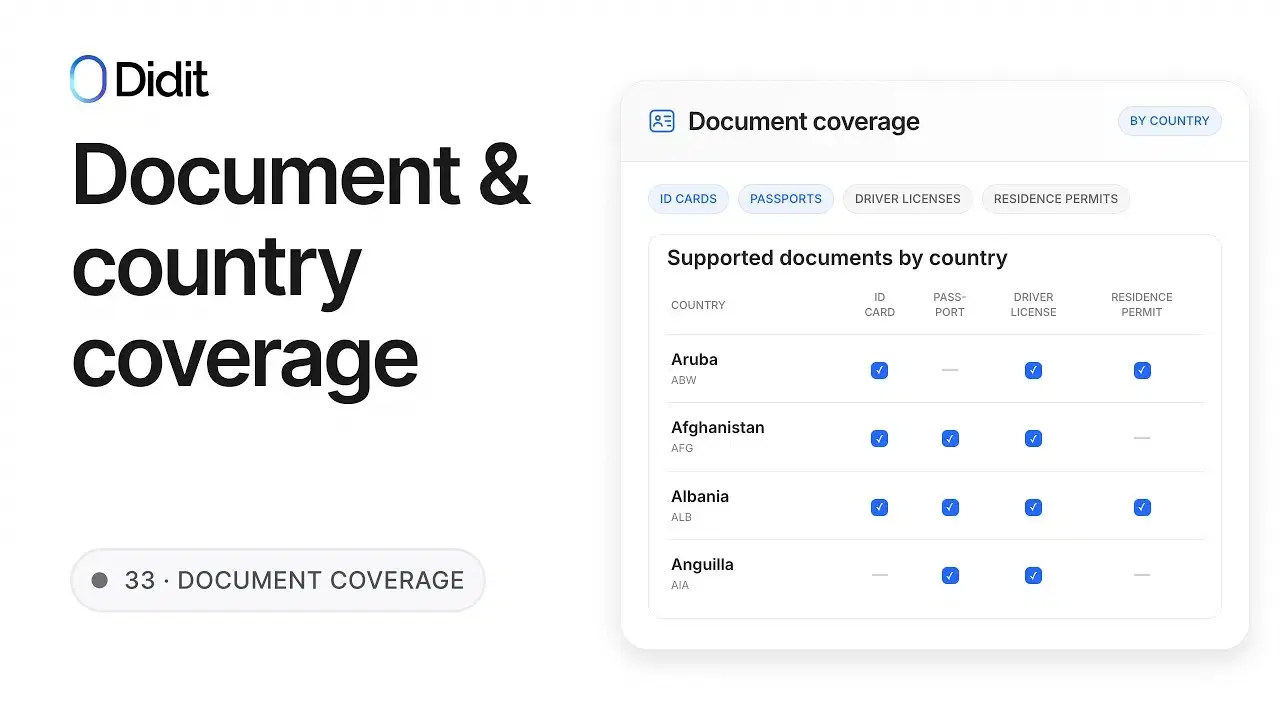
- Vast Document Database: Didit's ID Document Verification module supports over 14,000 document types across 220+ countries and 130+ languages. This extensive database is continuously updated, ensuring recognition of the latest government-issued IDs, passports, driver's licenses, and residency permits from virtually every corner of the globe.
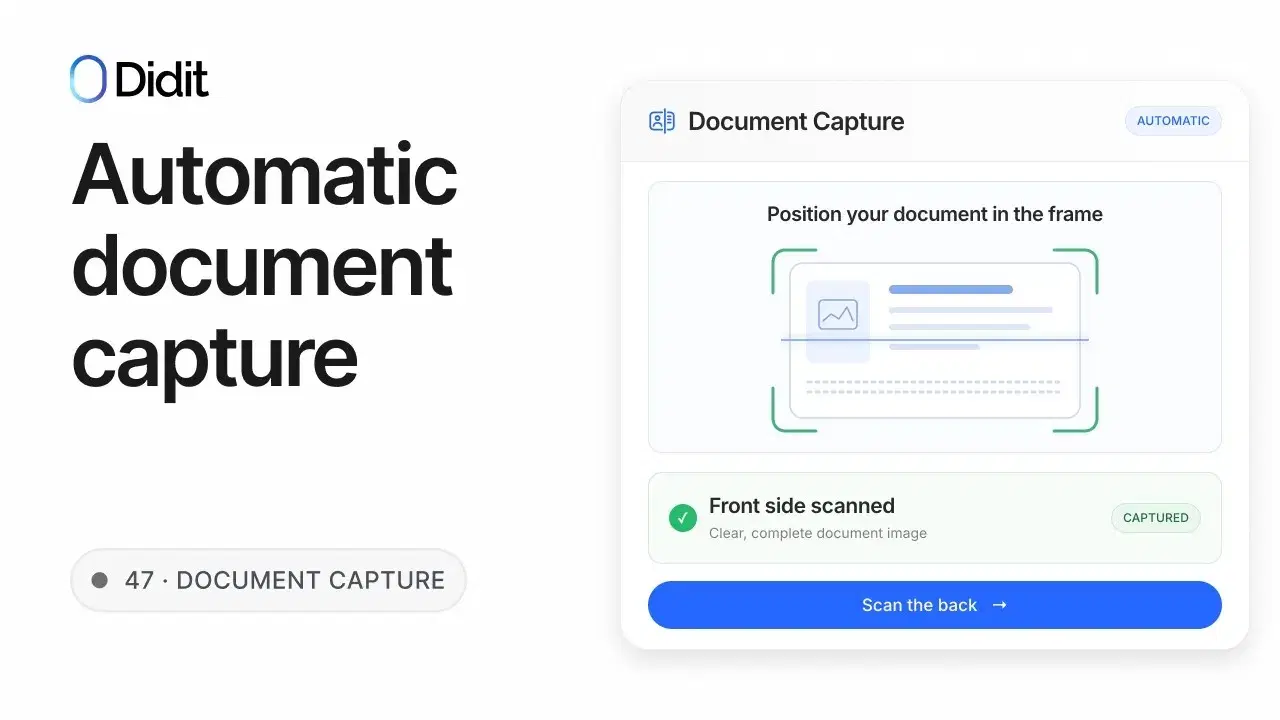
- AI-Powered OCR and Tamper Detection: Our proprietary AI and Optical Character Recognition (OCR) technology are designed to accurately extract data from even complex or damaged documents. It intelligently handles varying layouts, fonts, and security features, while simultaneously performing advanced tamper detection to spot fraudulent modifications.
- NFC Document Reading: For enhanced security and data accuracy, Didit offers NFC Document Reading for e-passports and e-IDs. This module cryptographically verifies the chip's digital signature, providing government-grade assurance and eliminating reliance on visual inspection alone.
- Proof of Address Verification: Beyond identity documents, Didit's Proof of Address module can verify utility bills, bank statements, and government letters, crucial for complete KYC in many regions, especially where ID documents may not contain full address details.
- Database Validation: For high-assurance scenarios, Didit cross-references extracted identity data against official government databases in 18+ countries. This 1x1 and 2x2 matching, with fuzzy name matching capabilities, adds another layer of verification.
- Workflow Orchestration: Didit's no-code Workflow Builder is a game-changer. It allows businesses to design custom verification flows tailored to specific regions or document types. For instance, if a country's ID cards are less reliable, you can automatically add an NFC check if available, or escalate to a Proof of Address request. This flexibility ensures that the verification process adapts to the local context, optimizing both security and user experience.
Consider a global e-commerce platform. With Didit, they can configure workflows to prioritize NFC checks for EU customers with e-passports, while for customers in a country with less standardized ID cards, the system might automatically prompt for an additional Proof of Address, or leverage Face Match 1:1 against a selfie to confirm identity. This adaptability drastically reduces rejections and manual reviews.
Practical Examples: Minimizing Gaps in Action
Let's look at how Didit's capabilities translate into real-world solutions for minimizing document coverage gaps:
Example 1: Expanding into Emerging Markets
A rapidly growing cryptocurrency exchange wants to onboard users from several African and South American countries. Their previous IDV provider struggled with the diverse national ID cards and limited passport usage in these regions, leading to high rejection rates. Didit's extensive document coverage (14,000+ documents) ensures that the specific national ID cards from these markets are recognized and processed accurately. Furthermore, the workflow builder allows the exchange to implement a layered approach: if an ID card is less common, the system can automatically trigger a passive liveness check and a Face Match 1:1 against a selfie to increase assurance, minimizing manual reviews and expanding their user base significantly.
Example 2: Enhancing Age Verification for Regulated Products
An online gaming platform needs to verify the age of users from various countries, where age thresholds and available proof-of-age documents differ. Instead of a one-size-fits-all approach, Didit allows them to build dynamic workflows. For users in countries where national ID cards include a date of birth and are well-supported, a simple ID Document Verification and Face Match might suffice. For others, particularly younger demographics, the workflow can include an Age Estimation module (estimating age from a selfie) as a first step, escalating to full ID verification only if the estimate is near the age threshold. This reduces friction for the majority while maintaining strict compliance for edge cases.
Example 3: Streamlining Global Marketplace Onboarding
A global marketplace onboarding sellers needs to verify their identities and addresses in multiple countries. Didit's combined ID Document Verification and Proof of Address modules become invaluable. For a seller in Germany, their Personalausweis (national ID) and a recent utility bill can be swiftly verified. For a seller in India, a PAN card or Aadhaar card combined with an electricity bill can be processed. The system intelligently extracts data from both, cross-references names, and validates the address. If any document is unclear, the workflow can be configured to prompt for a different document or flag for a targeted manual review, ensuring high verification rates even with regional variations.
How Didit Helps
Didit provides a unified platform that not only offers unparalleled document coverage but also the flexibility to adapt to any regional or document-specific challenge. By combining advanced AI for document processing, biometric verification, and a powerful workflow orchestration engine, we empower businesses to:
- Achieve Global Reach: Onboard customers from virtually any country with confidence, expanding market opportunities.
- Reduce Onboarding Friction: Minimize rejections and manual reviews, leading to higher conversion rates and a better user experience.
- Strengthen Fraud Prevention: Leverage multi-layered verification to detect sophisticated fraud attempts across diverse document types.
- Ensure Compliance: Meet stringent KYC/AML requirements globally, reducing regulatory risk.
- Cut Costs: Our pay-per-success model and efficient automation significantly reduce operational costs compared to fragmented solutions or extensive manual processes.
By building all core identity primitives in-house, Didit offers a single source of truth, faster onboarding, and superior fraud detection, all while cutting identity costs by up to 70%.
Ready to Get Started?
Don't let document coverage gaps limit your business's global potential. Explore how Didit can transform your identity verification processes and help you confidently expand into new markets. With our comprehensive platform, you can ensure seamless, secure, and compliant onboarding for every customer, everywhere.
Learn more about Didit's solutions or try our Business Console today.
Want to see it in action? Watch our product demo video or check out our transparent pricing.
Try it
Try this in the sandbox
Run the check this guide describes, free.
The product this post is about, taken from its topic. Run it free in the sandbox.
Author
Alberto Rosas
Co-founder and CEO

Keep reading
Other guides in the same topic.
 What Is the Purpose of FICA in South Africa? 2026 Guide
FICA is South Africa's anti-money laundering law. It creates the Financial Intelligence Centre and requires accountable institutions to identify and verify clients, screen for PEP and sanctions risk and report suspicious.
Alberto RosasNov 26, 2026 Sixth Money Laundering Directive (6AMLD): What Changed and Which Rules Apply
6AMLD is Directive (EU) 2018/1673: Member States must criminalise laundering, widen predicate offences and set a four-year penalty floor. It adds no new due diligence duties for firms.
Alberto RosasNov 26, 2026 Automated Sanctions Screening: Canada, the Entity List and Embargoes
Automated sanctions screening matches people and companies against lists such as Canada's autonomous sanctions made under SEMA and JVCFOA and the OFAC SDN List, and returns candidate hits scored for identity confidence and.
Alberto RosasNov 26, 2026Questions
Blog questions
Who writes the Didit blog?
Which topics does the blog cover?
Is the blog available in my language?
Where do I find product updates?
Are these posts legal advice?
How do I find posts on one topic?
Are posts dated?
Do posts link to the docs?
Is the blog the same as the docs?
Compliance built in
Audited, certified and attested.
We hold the certifications and build each country's rules into your flows, so you can launch anywhere without worrying. Security and Compliance center
- Regulation encoded into your flows
Tell us what you do and where. Didit lists the rules that apply to you, with sources, and builds the checks each country needs into one workflow.
- Ready for AMLR
Every requirement of the new EU anti-money laundering rules, from checking customers to human review, is already covered by a Didit check.
- Tested in Spain's Treasury sandbox
Spain's Treasury published its supervised sandbox report on Didit's NFC plus active liveness onboarding; SEPBLAC took part and valued the added measures positively.
- Audited, not self-declared
iBeta Level 1 and Level 2. Liveness tested under ISO/IEC 30107-3.
Your obligations · 3 regions
 SOC 2 Type 2
 ISO 27001
 iBeta Level 1 and Level 2
 EU regulator attestation
 FSM youth protection
 GDPR
 EBA remote onboarding
 MiCA compatible
 FIDO Alliance member
- AMLREU AML Regulation ready
Integration · Didit MCP
Run Didit from your own AI agent
Connect Didit to Claude, Cursor, VS Code or ChatGPT and just ask in plain words. Your agent can do anything you can do in the console, with the same permissions you have.
 Add to Claude
 ChatGPT
 Cursor
- Build workflowsDescribe the checks you need. The agent creates and publishes the flow.
- Run investigationsAsk why a session was declined, review cases, search people and companies.
- Change rulesCreate payment rules, test them on past data and switch them on.
- Pull reportsAsk for numbers, exports or the audit log.
Didit Academy