MLRO & AML Officer: Roles and Expansion Norms
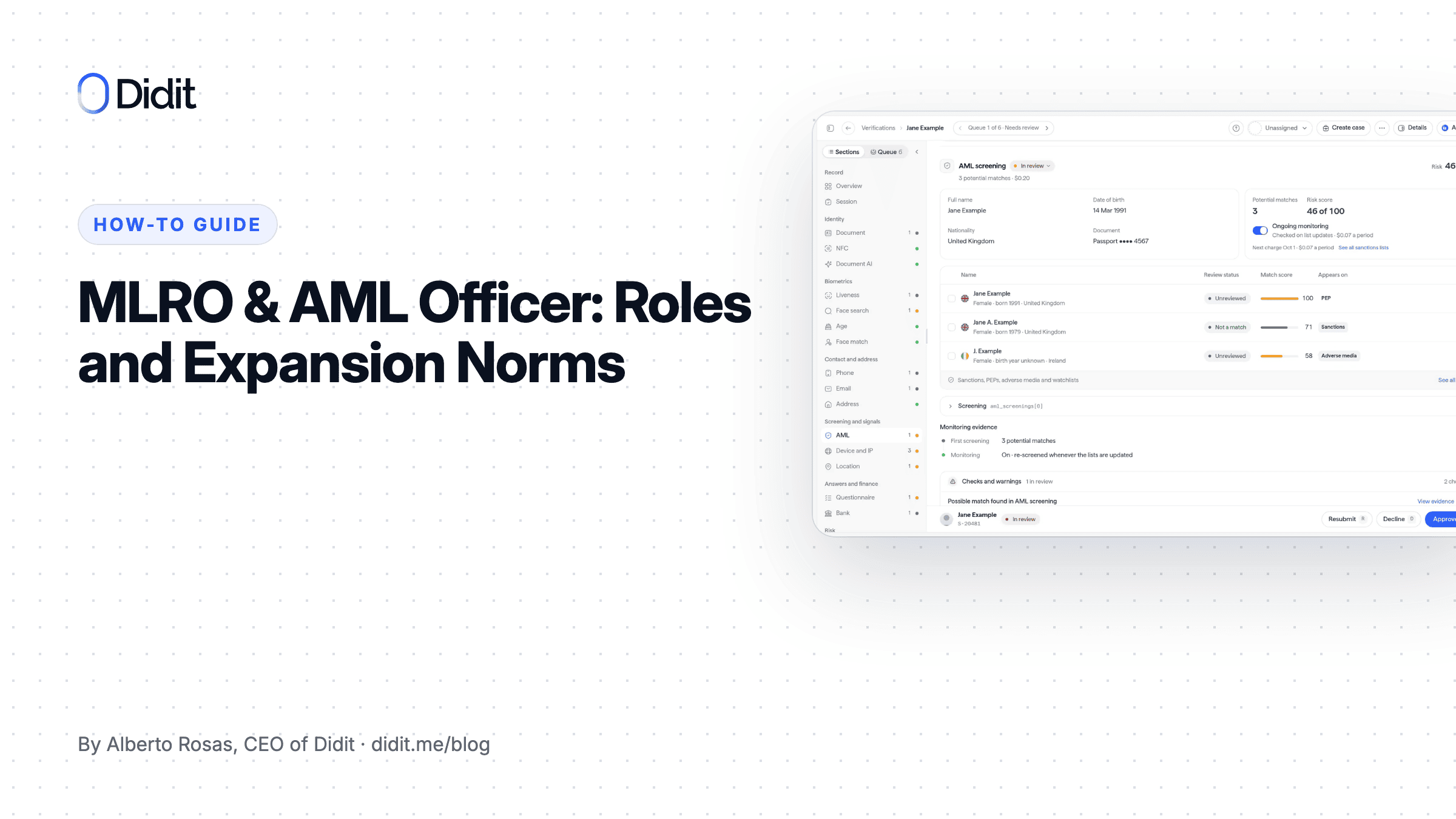
An MLRO (AMLRO) owns the risk decision, the escalation and the record. Didit produces the evidence: AML screening at $0.20 per check, ongoing monitoring at $0.07 per person a year. You remain the obliged entity.
 Alberto RosasCo-founder and CEO
Contents
In this guide
Jump to the part you need.
This guide is for the MLRO, the AMLRO and the compliance lead who covers both jobs. It states what the role owns under the EU Anti-Money Laundering Regulation, then gives the exact Didit steps and API calls that produce the evidence the role has to hold. AML screening costs $0.20 per check and ongoing monitoring $0.07 per person a year. The caveat: Didit provides the checks and the evidence, you remain the obliged entity.
Last updated: November 26, 2026. Prices checked against the live Didit price feed on November 26, 2026.
| Duty | AMLR article | Where it runs in Didit | Published price |
|---|---|---|---|
| Identify and verify the customer | Art. 20(1)(a), Art. 22 | ID Verification inside a session | $0.33 per full KYC check |
| Identify beneficial owners and the ownership structure | Art. 20(1)(b), Arts. 51 to 53 | Business Verification | Variable by country and data tier, from $2.00 per company |
| Screen sanctions and politically exposed persons | Art. 20(1)(d) and (g), Art. 42 | AML Screening | $0.20 per check |
| Monitor the relationship and refresh data | Art. 26 | Ongoing AML monitoring | $0.07 per person a year |
| Monitor transactions and report suspicions | Art. 26(1), Art. 69 | Transaction Monitoring, cases, FIU reports | $0.001 per transaction beyond the plan allowance |
| Put a human in automated decisions | Art. 76(5) | Manual review and status updates in the console | Console access |
| Keep records 5 years, then delete | Art. 77 | Retention setting, exports, on-demand deletion | Console access |
Start free in the sandbox at business.didit.me, with no sales call. Developers can connect Didit to an AI assistant through the Didit MCP server. The product page for the screening step is AML screening for AMLR, and every number below sits on the pricing page.
Regulation (EU) 2024/1624 entered into force on 9 July 2024 and applies from 10 July 2027. Until then, the national laws that transpose the current directive continue to apply, so a group can run both regimes for a period. The full text sits on EUR-Lex.
What an anti money laundering reporting officer owns
The anti money laundering reporting officer, written MLRO, AMLRO or nominated officer depending on the jurisdiction, is the named person an obliged entity puts in front of its supervisor for anti money laundering work. Titles and duties vary by jurisdiction. Confirm the local appointment and reporting duties. Didit's public customer count is 4,000+ companies, and none of those companies can hand the onboarding decision to us.
AML, MLRO and AMLRO: the terms in one place
- AML is the programme: the risk assessment, the policies, the checks and the record.
- MLRO is the officer accountable for that programme and for the internal suspicion reports that reach it.
- AMLRO is the same appointment under a shorter name.
- Assign analysts, investigators and developers defined tasks. The obliged entity remains responsible for the outsourced work.
The AMLR splits the work cleanly. The officer decides the customer's risk profile, decides whether to onboard, and decides when to exit. The platform returns checks with scores, hits, warnings and an audit trail. The compliance guide for AMLR compliance with Didit maps each article to a workflow step, an endpoint or a webhook.
What the role does day to day
- Runs the business-wide risk assessment and the customer risk model.
- Sets the trigger rules: when due diligence starts for a relationship, an occasional transaction or a suspicion (Art. 19).
- Signs off the thresholds that decide an approval, a review or a decline.
- Works the review queue: the hits scored between the approve and review thresholds.
- Opens a case per suspicion, records the reasoning, and supports suspicious activity reporting, while local rules determine who files with the financial intelligence unit (Art. 69).
- Keeps the outsourcing register current for every third party in the chain (Art. 18).
- Owns retention: five years, then delete the personal data (Art. 77).
Expansion norms: what a 2026 AML office is expected to standardise
The AMLR guide maps obligations to workflows, endpoints and evidence. Our internal standardisation goal is that the same decision produces the same result on every channel. That goal, not a rule stated in the regulation, breaks into four internal operating practices that line up with the regulation.
- One CDD standard at every entry point. The same workflow, or the same workflow template, whether the customer arrives through the app, the web form or a partner. Enhanced due diligence is a branch of that standard, not a separate process.
- One threshold set, versioned and dated. The match threshold, the approve threshold and the review threshold are written down, owned by the officer, and changed with a note explaining why.
- One case file per suspicion. Alerts from screening, from transaction rules and from manual escalation land in the same case lifecycle, with the same checklist and the same four-eyes review.
- One retention rule. Five years, applied by configuration, not by analyst habit.
These are internal operating practices, not a restatement of the law. The FATF Recommendations remain the reference for internal controls and suspicious transaction reporting, and retention follows Article 77 of the AMLR.
Absence of an MLRO: who signs, who reports
Searches for the absence of an MLRO usually mean one of three situations: the officer resigned, the officer is on leave, or a small firm has never appointed one. Each has a different fix. If no authorized officer is available, confirm the interim decision process with counsel and your supervisor before continuing onboarding.
- Named deputy. Record a deputy with the same authority in the appointment minute, so a decision taken during leave is valid on its face.
- Interim restriction. If no one holds the authority, hold new high-risk relationships and existing escalations. Keep the checks running and queue the decisions.
- Outsourced officer. Whether a third-party MLRO is permitted depends on local law. Confirm with counsel and your supervisor. Where it is permitted, the arrangement goes in the outsourcing register (Art. 18) and the liability stays with your management body. Didit is never the MLRO: we return checks, not decisions.
- Small firms. Check local appointment, independence and conflict rules before combining these functions. For example, the nominated officer requirement in the Money Laundering Regulations 2017 in the United Kingdom.
Prerequisites before step 1
- A Didit application. Sandbox keys are free and every sandbox call returns a mocked result, so you can rehearse the workflow before any live customer.
- An API key with the scopes the call needs.
- A workflow that contains the AML feature, or the standalone screening API if you want a one-shot check decoupled from a hosted flow.
- Threshold and weight decisions already taken by the officer, not by the developer writing the request.
- Team roles assigned. The built-in Compliance Officer role covers session review, AML and blocklists, audit logs, transactions and business profiles. The Developer role owns workflows, webhooks and API keys. Reader is read-only for auditors.
- A retention setting agreed with counsel, with five years as the AMLR baseline (Art. 77).
- A case blueprint agreed, with the assignment, escalation and four-eyes rules written before the first alert arrives.
How to set up and run the MLRO workflow in Didit, step by step
- Create the application and copy an API key. Sandbox first. Nothing is charged in sandbox.
- Assign the roles. In the console go to Settings, Organization, Roles and permissions. Map each person to Compliance Officer, Developer or Reader, and create a custom role if a reviewer needs read access to cases but not to billing.
- Configure the screening step. Add AML to the workflow and set four values:
aml_match_score_threshold(default 93),aml_score_approve_threshold(default 80),aml_score_review_threshold(default 100), and the weightsaml_name_weight,aml_dob_weightandaml_country_weight, which must sum to exactly 100 (defaults 60, 25 and 15). - Run one standalone screening to confirm the request shape and the response. This is the documented server-to-server call.
curl -X POST 'https://verification.didit.me/v3/aml/' \ -H "x-api-key: $DIDIT_API_KEY" \ -H "Content-Type: application/json" \ -d '{ "full_name": "Javier Ejemplo Modelo", "entity_type": "person", "date_of_birth": "1974-01-01", "nationality": "ES", "include_adverse_media": true, "vendor_data": "user-1234" }' - Read the two scores before you touch the status. Each hit carries a match score, which answers whether the hit is the same person, and a risk score, which answers how risky the listed entity is. Hits below the match threshold are tagged as a false positive and ignored for risk. The highest remaining risk score becomes the screening score.
- Run the same check inside a session when the screening has to be part of onboarding. Create the session, send the user to the returned URL, and read the decision when the webhook fires.
The decision payload carries ancurl -X POST 'https://verification.didit.me/v3/session/' \ -H "x-api-key: $DIDIT_API_KEY" \ -H "Content-Type: application/json" \ -d '{"workflow_id": "YOUR_WORKFLOW_ID", "vendor_data": "user-1234"}' curl -X GET 'https://verification.didit.me/v3/session/SESSION_ID/decision/' \ -H "x-api-key: $DIDIT_API_KEY"aml_screenings[]array with the same scores and warnings. - Route the outcomes. Approved goes forward. In Review goes to the manual queue with the hit detail open. For a declined result, open or create a case through your configured case workflow and record the reasoning. That case becomes the file behind a SAR or STR. Move a case through Open, Awaiting user and Resolved, and close it as False positive or Valid threat.
- Turn on ongoing monitoring for the customers you keep. Send
include_ongoing_monitoring=truewithsave_api_request=true, and the entity stays under provider-driven re-screening dated every day at $0.07 per person a year. You can switch it off in the console. - Wire the transaction side. Send transactions to
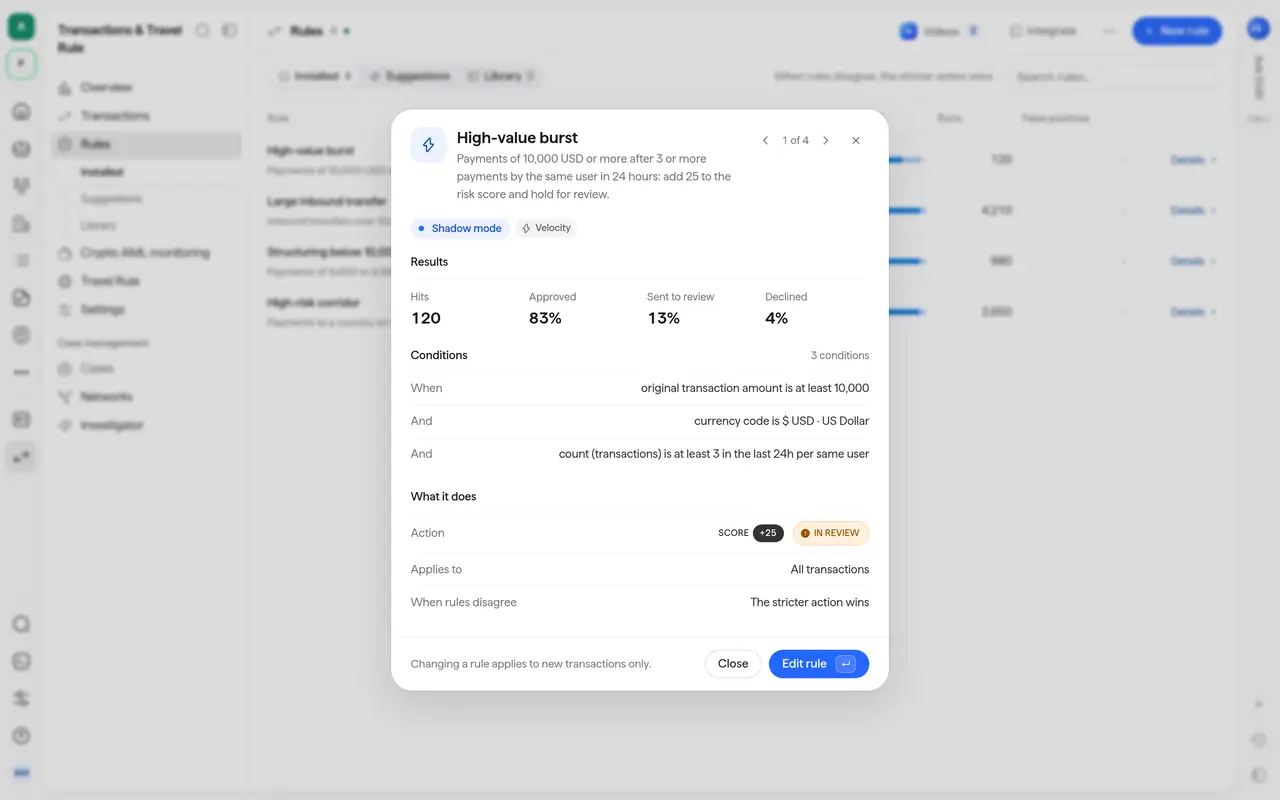
POST /v3/transactions/with the subject, the counterparty and the amount. Rules score each transaction, and a Create case effect opens the investigation automatically. Subscribe totransaction.status.updatedso the officer sees a held transaction without polling.

Expected output
A successful standalone call returns a request id and one AML object. In the sandbox default, a screening returns Approved with zero hits unless you pass sandbox_scenario. Live results depend on the screening. The response shape is:
{
  "request_id": "8f14e45f-ea6b-4d3a-9a1e-0b6f2d1c9a77",
  "aml": {
    "status": "Approved",
    "screening_id": "aml_01J8ZK4Q2S",
    "hits": [],
    "warnings": []
  }
}
The status is one of Not Started, In Progress, Approved, In Review, Declined, Abandoned or Kyc Expired. Warnings arrive as codes you can route on: POSSIBLE_MATCH_FOUND, MATCH_FOUND, HIGH_RISK_COUNTRY, ADVERSE_MEDIA_HIT, SANCTIONED_ENTITY, PEP_MATCH, ONGOING_MONITORING_ENABLED. The screening is stored as a session, appears in the console, fires a status.updated webhook, and can be exported as a PDF.

Inputs and outputs on one screening call
| Field | Direction | What it does |
|---|---|---|
full_name | Input, required | Person or company to screen, minimum 2 characters. |
entity_type | Input | Person or company. |
date_of_birth | Input | Feeds the date-of-birth component of the match score. |
nationality | Input | Feeds the country component and the country risk flag. |
include_adverse_media | Input | Adds adverse media. Raised latency, so set the client timeout to at least 60 seconds. |
include_ongoing_monitoring | Input | Keeps the entity under daily re-screening. Requires save_api_request=true. |
save_api_request | Input | Defaults to true: the screening is stored, appears in the console and is retrievable through the decision endpoint. |
Idempotency-Key | Input header | Retry safety. A replayed response is not charged again. Reusing the key with a different body returns 409. |
request_id | Output | Works with the decision endpoint when the request is saved. |
aml.status | Output | The routing status. Approved, In Review and Declined are set by your thresholds. |
aml.hits[] | Output | Every potential match with its match score, its risk score and the source list. |
aml.warnings[] | Output | Risk codes for routing and reporting. |
Failure cases and recovery
| Symptom | Cause | Recovery |
|---|---|---|
| HTTP 400 on screening | The three weights do not sum to exactly 100 | Fix the weights in the workflow configuration. The request is rejected before any screening runs. |
| HTTP 400 with ongoing monitoring on | save_api_request was set to false | Set it to true. Monitoring needs a stored profile to attach updates to. |
| HTTP 403 | Out of credits | Top up. The refusal happens before a new screening runs, so nothing is half-billed. |
| HTTP 409 | The same idempotency key was reused with a different body | Send a new key for the new body. Reuse the old key only for identical retries. |
| status is In Review | The score sits between the approve and review thresholds | Route to the manual queue. This is a decision for a person, not a retry. |
| status is Declined | At least one hit crossed the decline boundary | Open or create a case through your configured case workflow, record the reasoning, then decide exit. The report template is generated from the resolved case. |
| Adverse media missing | The upstream provider was slow | The result returns without adverse media hits and is still actionable. Set the client timeout to at least 60 seconds and treat the gap as a follow-up task. |
| Reviewer cannot open a session | Wrong role | Assign Compliance Officer or a custom role with session read access. Reader cannot change anything. |
Paid steps and review boundaries
Every price below is the published list price, charged per completed check from prepaid credit. Plan credit is added monthly and does not roll over; top-ups last 12 months.
| Step | Price | Boundary |
|---|---|---|
| Full KYC check | $0.33 per completed check | Didit verifies the document and the face. Didit does not decide the risk profile. |
| AML screening | $0.20 per check | Didit returns hits with two scores. The officer decides review, decline or exit. |
| Ongoing AML monitoring | $0.07 per person a year | Didit keeps re-screening daily and notifies on change. The officer handles the change. |
| Business verification | Variable by country and data tier, from $2.00 per company | Registry data and key people are returned. The UBO assessment stays with you. |
| Person AML per UBO or officer | $0.20 per person | Same two-score output as any screening. |
| Linked KYC for an owner or officer | $0.33 per person | Identity is verified; the ownership conclusion is yours. |
| Transaction monitoring | $0.001 per transaction beyond the monthly allowance | Rules score and hold. Case resolution and filing are human steps. |
| Wallet screening, a feature inside Transaction Monitoring | $0.15 per screening | Didit returns the wallet risk result. Or bring your own screening provider and run it inside Didit. |
Two boundaries are written into the regulation and worth repeating to a board. Article 76(5) requires a human in automated decisions, so a rule can hold a transaction but a person closes the case. Article 18 keeps full liability with the obliged entity for anything outsourced, which is why the outsourcing register lists Didit next to the checks it runs. Using Didit does not by itself make a company compliant with AMLR.
Worked cost example
A payments firm onboards 2,500 customers and 400 businesses in a year. Each business brings three owners or officers, and those 1,200 people also take a linked identity check.
- Customer identity and screening: $0.33 + $0.20 = $0.53 per customer. 2,500 x $0.53 = $1,325.00.
- Ongoing monitoring for those customers: 2,500 x $0.07 = $175.00 for the year.
- Business verification: 400 x $2.00 = $800.00 using the $2.00 starting price; the registry price varies by country and data tier.
- Person AML on owners and officers: 1,200 x $0.20 = $240.00.
- Linked KYC on owners and officers: 1,200 x $0.33 = $396.00.
- First-year total at list price: $1,325.00 + $175.00 + $800.00 + $240.00 + $396.00 = $2,936.00.
Transaction monitoring is outside that total because each plan includes a monthly allowance (1,000 transactions on Free, 10,000 on Growth, 100,000 on Scale), and only the transactions beyond it cost $0.001 each. On the Scale plan the 10% discount applies to Didit prices, which would bring the same volume to $2,936.00 x 0.90 = $2,642.40. The estimator on the pricing page repeats the arithmetic with your own volumes.
Sources
- Didit docs: AMLR compliance guide, Regulation (EU) 2024/1624, last reviewed 2 October 2026.
- Didit docs: AML screening overview and two-score model.
- Didit docs: standalone AML screening API reference.
- Didit docs: real-time transaction monitoring and cases and SAR investigations.
- Didit docs: business AML coverage.
- Didit docs: roles and permissions.
- Didit pricing page and the live price feed, read November 26, 2026.
- Didit AMLR solution page.
- EUR-Lex: Regulation (EU) 2024/1624.
- FATF Recommendations.
- legislation.gov.uk: Money Laundering, Terrorist Financing and Transfer of Funds (Information on the Payer) Regulations 2017.
Next step: open the sandbox at business.didit.me, run one screening on a test record, and read the two scores before you set a single threshold. No sales call, and nothing is charged in sandbox.
Try it
Try this in the sandbox
Run the check this guide describes, free.
The product this post is about, taken from its topic. Run it free in the sandbox.
Author
Alberto Rosas
Co-founder and CEO

Keep reading
Other guides in the same topic.
 What Is the Purpose of FICA in South Africa? 2026 Guide
FICA is South Africa's anti-money laundering law. It creates the Financial Intelligence Centre and requires accountable institutions to identify and verify clients, screen for PEP and sanctions risk and report suspicious.
Alberto RosasNov 26, 2026 Sixth Money Laundering Directive (6AMLD): What Changed and Which Rules Apply
6AMLD is Directive (EU) 2018/1673: Member States must criminalise laundering, widen predicate offences and set a four-year penalty floor. It adds no new due diligence duties for firms.
Alberto RosasNov 26, 2026 Automated Sanctions Screening: Canada, the Entity List and Embargoes
Automated sanctions screening matches people and companies against lists such as Canada's autonomous sanctions made under SEMA and JVCFOA and the OFAC SDN List, and returns candidate hits scored for identity confidence and.
Alberto RosasNov 26, 2026Questions
Frequently asked questions
What is an MLRO?
An MLRO is the money laundering reporting officer, the named person accountable for an obliged entity's anti money laundering programme and for the internal reports of suspicious activity that reach that desk. The role supports escalation and suspicious activity reporting, while local rules determine who files with the financial intelligence unit. It is an appointment with defined responsibilities under the local rules, not only a job title.
Is an AMLRO the same as an MLRO?
Yes. AMLRO is the shortened form of anti money laundering reporting officer and describes the same appointment as MLRO. Some jurisdictions use nominated officer or compliance officer at management level instead. Whoever holds the title, the substance is the same: one person accountable for the AML programme and for reporting suspicion.
What does an anti money laundering reporting officer do day to day?
The officer sets the risk model and the screening thresholds, works the review queue, decides whether a relationship continues, and keeps the case file behind every report. Around that sit the business-wide risk assessment, the outsourcing register, retention and staff training. The officer also owns the trigger rules that decide when due diligence starts, including the threshold for occasions when there is no ongoing relationship.
What happens in the absence of an MLRO?
Name a deputy with the same authority in the appointment record, and keep the checks running so the evidence is there when a decision can be taken. If no authorized officer is available, confirm the interim decision process with counsel and your supervisor before continuing onboarding. Whether a third-party MLRO is permitted depends on local law, so confirm that with counsel and your supervisor too.
Can the MLRO role be outsourced to a provider like Didit?
No. Didit provides the checks and the evidence, and the obliged entity keeps the decisions and the liability under Article 18 of the AMLR. Whether a third-party MLRO is permitted depends on local law, so confirm with counsel and your supervisor. Log any permitted outsourcing in the register, and never treat a vendor's approval status as your onboarding decision.
Who should be the anti money laundering reporting officer in a small company?
Usually the most senior person who can hold the reporting line independently of the revenue line, often a finance or compliance lead, with the conflict documented in writing. Check local appointment, independence and conflict rules before combining these functions. For example, the nominated officer requirement in the Money Laundering Regulations 2017 applies in the United Kingdom.
How do I add sanctions and PEP screening to an onboarding flow?
Add the AML feature to a Didit workflow, set the match and risk thresholds, and create a session for each customer. The decision payload returns an aml_screenings[] array with every hit and its two scores. If you need a one-shot check outside a hosted flow, call the standalone AML screening endpoint instead.
How much does AML screening cost?
AML screening is $0.20 per check against 1,300+ sanctions, PEP and watchlist sources. Adverse media is an optional parameter in the same API call, set with include_adverse_media=true, and it raises latency. Ongoing monitoring after onboarding is $0.07 per person a year. Billing is per completed check from prepaid credit, and sandbox calls are free and return mocked results.
What is the difference between a match score and a risk score?
The match score answers whether the hit is the same person, built from name, date of birth and country with configurable weights that must sum to 100. The risk score answers how risky that listed entity is. Hits below the match threshold (default 93) are tagged as false positives and ignored, and the highest remaining risk score decides whether the customer is approved, reviewed or declined.
How long must an MLRO keep records?
Five years is the AMLR baseline under Article 77, after which personal data is deleted. Keep the screening report, case file and reporting records according to your retention settings, and export them before deletion.
Does using Didit make my company compliant with AMLR?
No. Didit provides the checks and the evidence, and you remain the obliged entity. You decide the customer's risk profile, you decide whether to onboard, and you remain fully liable for any task you outsource. Confirm how each rule applies to your business with your counsel and your supervisor.
How do I keep screening a customer after onboarding?
Turn on ongoing monitoring at the screening call with include_ongoing_monitoring=true and save_api_request=true, and the entity stays under provider-driven re-screening dated every day at $0.07 per person a year. Updates reach the same report, and you receive change notifications through the webhooks. Monitoring can be switched off from the Business Console at any time.
Compliance built in
Audited, certified and attested.
We hold the certifications and build each country's rules into your flows, so you can launch anywhere without worrying. Security and Compliance center
- Regulation encoded into your flows
Tell us what you do and where. Didit lists the rules that apply to you, with sources, and builds the checks each country needs into one workflow.
- Ready for AMLR
Every requirement of the new EU anti-money laundering rules, from checking customers to human review, is already covered by a Didit check.
- Tested in Spain's Treasury sandbox
Spain's Treasury published its supervised sandbox report on Didit's NFC plus active liveness onboarding; SEPBLAC took part and valued the added measures positively.
- Audited, not self-declared
iBeta Level 1 and Level 2. Liveness tested under ISO/IEC 30107-3.
Your obligations · 3 regions
 SOC 2 Type 2
 ISO 27001
 iBeta Level 1 and Level 2
 EU regulator attestation
 FSM youth protection
 GDPR
 EBA remote onboarding
 MiCA compatible
 FIDO Alliance member
- AMLREU AML Regulation ready
Integration · Didit MCP
Run Didit from your own AI agent
Connect Didit to Claude, Cursor, VS Code or ChatGPT and just ask in plain words. Your agent can do anything you can do in the console, with the same permissions you have.
 Add to Claude
 ChatGPT
 Cursor
- Build workflowsDescribe the checks you need. The agent creates and publishes the flow.
- Run investigationsAsk why a session was declined, review cases, search people and companies.
- Change rulesCreate payment rules, test them on past data and switch them on.
- Pull reportsAsk for numbers, exports or the audit log.
Didit Academy


