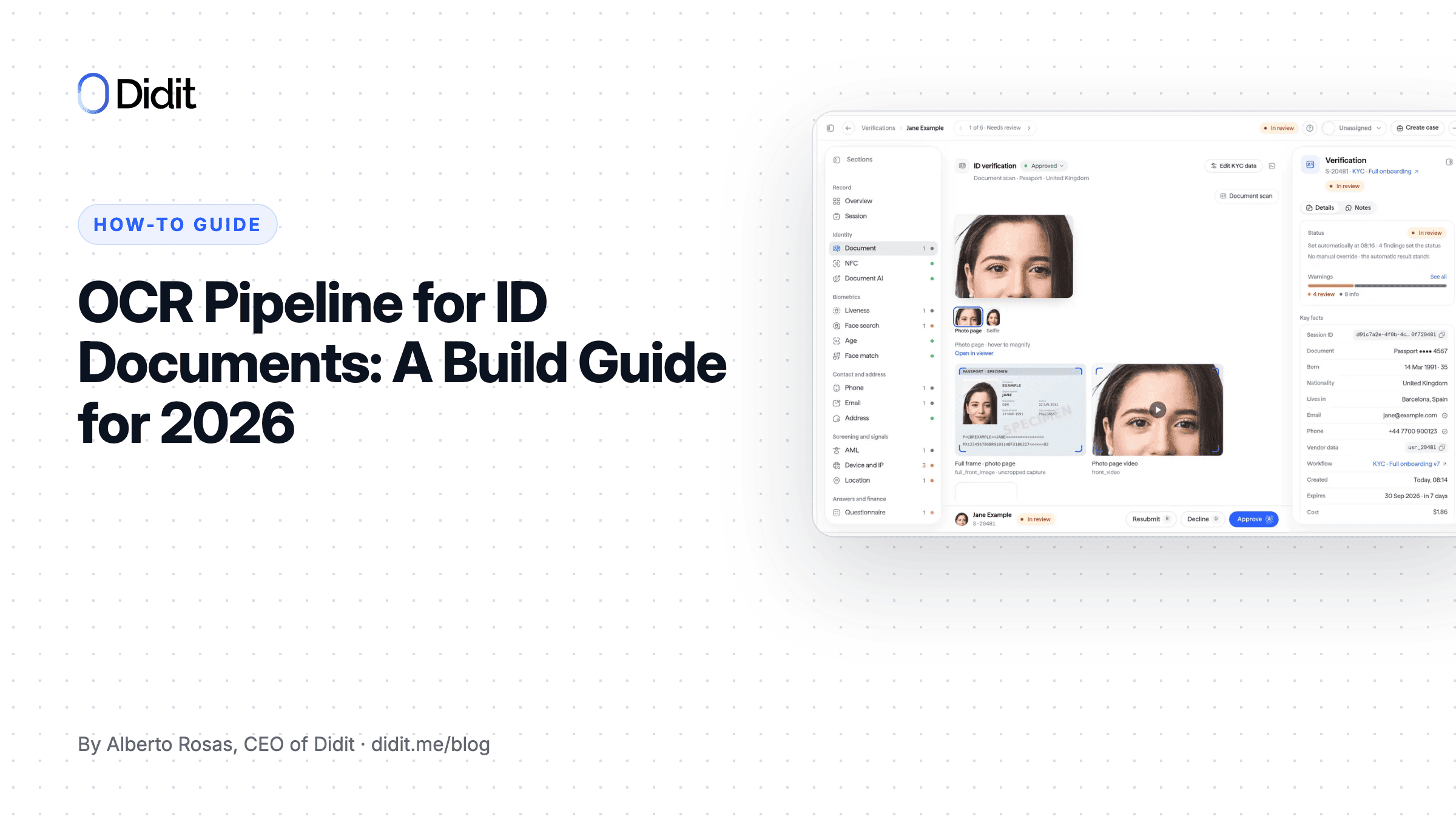
OCR Pipeline for ID Documents: A Build Guide for 2026
Send an uncropped ID photo to POST /v3/id-verification/ and read back typed holder fields, the parsed MRZ, a decision and a warnings list. $0.15 inside a workflow, $0.20 standalone.
 Alejandro RosasCo-founder and CTO
Contents
In this guide
Jump to the part you need.
This guide shows how to build an OCR pipeline for ID documents on Didit: send an uncropped photo of an ID, get back typed holder fields, the parsed MRZ, a decision and a warnings list. It fits engineering teams shipping onboarding or KYC without a document team. The ID document check is $0.15 inside a workflow and $0.20 through the standalone API. The caveat: reading a document is not proving it is genuine, so read the warnings, not the HTTP status.
Last updated: November 26, 2026. Prices checked against the live Didit price feed on November 26, 2026.
Summary: which route reads which document
| Route | What it returns | Price | Use it when |
|---|---|---|---|
| ID Verification step inside a workflow | Classification, OCR of the visual zone, MRZ and barcode decode, cross-checks, document liveness, a decision and warnings in the returned session report | $0.15 per check | You run a hosted or API verification flow and want a session with a full report |
ID Verification standalone API, POST /v3/id-verification/ | The same OCR and fraud checks, server to server, no workflow needed | $0.20 per check | Your backend already holds the image |
Document AI, POST /v3/document-ai/ | Fields you define from any PDF or image, plus name matching and tampering checks | $0.20 per document | The document is not a fixed-template ID: bank statement, payslip, proof of funds |
Start free in the sandbox at https://business.didit.me/, no sales call. Sandbox testing is free and unlimited, and nothing is charged in sandbox. Developers who want an AI assistant to run the calls can connect Didit over MCP at https://didit.me/developers/mcp/. The endpoint reference is the ID Verification overview and the price list is at https://didit.me/pricing/.
What an OCR pipeline for ID documents gives you
The outcome is a JSON object per document: the holder fields already split into keys, the machine readable zone decoded, any barcode decoded, a decision, and a list of warnings that explains every issue found. Your application reads typed fields and warning codes straight from the response instead of parsing pixels or scraping a text blob.
- Typed fields instead of a text blob.
document_type,document_subtype,document_number,personal_number,first_name,last_name,date_of_birth,expiration_date,issuing_state. - Two independent readings that check each other. The visual zone is read by OCR, the MRZ and barcodes are decoded, and the service compares one against the other instead of trusting a single read.
- A decision you can route on.
Approved,DeclinedorIn Review, with the risk codes that produced it. - Authenticity signals in the same call. Screen replays, printed copies, portrait manipulation, public document images and specimens are all flagged by risk code.
We run this pipeline for 4,000+ companies across 220+ countries and 14,000+ document types, with sub-2-second p99 inference.
ID OCR vs ID document recognition
OCR reads characters. ID document recognition is the wider step around it: deciding which document you were sent, finding its layout, decoding the MRZ and barcodes, then validating number formats, check digits and date plausibility before anyone sees a field. A pipeline that only does OCR gives you text with no guarantee about which field is which. Didit does the full step, and you never declare the country or the document type: classification happens on the image.
Document recognition languages and capture languages are different numbers, and both matter. The capture flow and native SDKs ship in 54 languages; recognition covers 130+ languages across 50+ scripts.
Recommended method
Use one call and let the service do the preprocessing, the classification and the cross-checks. Do not build your own crop, deskew or binarize step in front of it. The endpoint expects the raw capture: uncropped, all four corners visible. The service detects the document, aligns it, crops it, classifies it, reads the visual zone, decodes the MRZ and any barcode, validates the fields against each other, and optionally screens the images for replay and manipulation. Document-level issues appear in the response as status values and warning codes. Authentication, credit, transport, and file-processing failures return HTTP errors, so handle both response warnings and HTTP status codes.
Build the decision logic around warnings, not around the HTTP status. A readable but problematic document returns HTTP 200 with status: "Declined".

Prerequisites
- A Didit application and an API key from https://business.didit.me/. The key needs to reach the endpoint you call; scoped keys are refused with
403when a scope is missing. - An image of the front of the document, which is required, plus the back for two-sided documents. Upload uncropped photos with all four corners of the document visible: the service detects, aligns and crops the document itself.
curlandjqif you want to follow the examples below verbatim. Any HTTP client works.- Credit on the organization, or a sandbox application. Sandbox testing is free and unlimited; a live call without balance returns
403before any image processing. - A place to store the
request_id. Whensave_api_requestis true (the default) it is a real session id you can query later.
Steps
-
Create the sandbox application and copy the key. Sign in at https://business.didit.me/, create a sandbox application, and export the key in your shell as
DIDIT_API_KEY. Nothing is billed in sandbox. -
Capture honestly. For a driver's license or an ID card, send the front and the back. For a passport, the data page. Keep all four corners inside the frame, avoid glare across the number, and do not crop, rotate or enhance. The service detects, aligns and crops the document itself, so a pre-crop removes the edges it uses for classification.
-
Call the standalone ID Verification endpoint. One request sends the image and gets the fields, the MRZ parse, the decision and the warnings.
curl -X POST https://verification.didit.me/v3/id-verification/ \ -H "x-api-key: $DIDIT_API_KEY" \ -F "front_image=@./licence-front.jpg" \ -F "back_image=@./licence-back.jpg" \ -F "perform_document_liveness=true" \ -F "save_api_request=true" -
Read the status and the warnings, in that order. Look at
id_verification.statusand every entry inid_verification.warnings. Fraud and hard failures always decline:DOCUMENT_EXPIRED,SCREEN_CAPTURE_DETECTED,PRINTED_COPY_DETECTED,PORTRAIT_MANIPULATION_DETECTED,PUBLIC_DOCUMENT_IMAGE_DETECTED,SPECIMEN_DOCUMENT_DETECTED, plus the extraction failuresNAME_NOT_DETECTED,DATE_OF_BIRTH_NOT_DETECTEDandDOCUMENT_NUMBER_NOT_DETECTED. Three risk groups you can tune per request:invalid_mrz_action,inconsistent_data_actionandexpiration_date_not_detected_action, each set toDECLINEorNO_ACTION. Informational warnings such asPOSSIBLE_DUPLICATED_USERnever decline on their own. -
Pull the stored session when you need the full report. With
save_api_request=truethe call becomes an API-type session, emits astatus.updatedwebhook to your configured endpoints, and returns cropped media as short-lived URLs.curl https://verification.didit.me/v3/session/<SESSION_ID>/decision/ \ -H "x-api-key: $DIDIT_API_KEY"The response is always plural for features:
id_verifications[],liveness_checks[],face_matches[]. Branch onsession_kind, which isuserorbusiness. The key needsread:sessions. -
Correct a field the OCR misread, deliberately. Sometimes the document genuinely says something the model reads differently, or an operator fixes a typo before the record leaves your system. Use the partial update endpoint rather than writing your own database copy.
curl -X PATCH "https://verification.didit.me/v3/session/<SESSION_ID>/update-data/" \
  -H "x-api-key: $DIDIT_API_KEY" \
  -H "Content-Type: application/json" \
  -d '{
    "first_name": "John",
    "last_name": "Doe",
    "date_of_birth": "1990-01-01",
    "issuing_state": "ESP"
  }'
Only the fields you send change. The key needs
write:sessions, and the session must beApproved,Declined,In RevieworKyc Expired. The update fires adata.updatedwebhook and the audit trail records the changed fields with their previous and new values. -
Send non-ID documents to Document AI. Bank statements, payslips, tax forms and proof of funds have no fixed template, so you define the fields instead of relying on a document registry.
curl -X POST https://verification.didit.me/v3/document-ai/ \
  -H "x-api-key: $DIDIT_API_KEY" \
  -F "document=@./bank-statement.pdf" \
  -F 'fields=[{"key":"account_holder","name":"Account holder","instruction":"Full name of the account holder","type":"text","required":true,"is_full_name":true},{"key":"balance","name":"Closing balance","instruction":"Closing balance as a number","type":"number","required":true}]' \
  -F "expected_first_name=Jane" \
  -F "expected_last_name=Doe"
The
fieldsarray takes 1 to 30 items as one JSON-encoded string. Values come back typed astext,numberordateinYYYY-MM-DD, withnullfor anything the model could not find. Sendexpected_first_nameandexpected_last_namefor a person, orexpected_company_namefor a company, never both groups.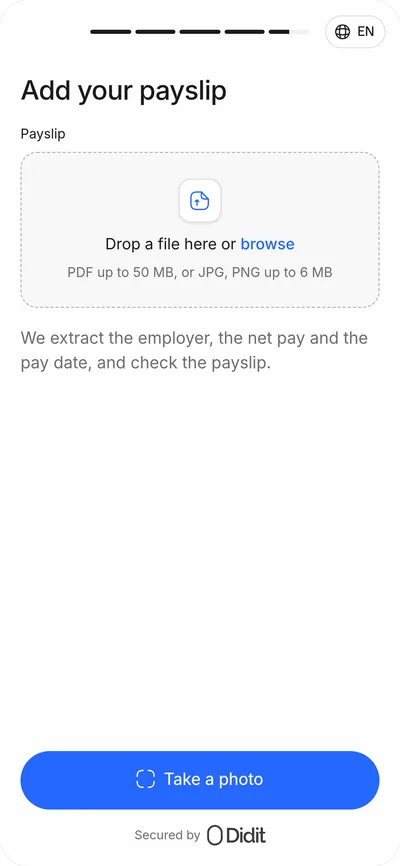
Document AI takes the same upload for documents that are not IDs, with fields you define per request.

Expected output
A clean read returns HTTP 200 and a body shaped like this, trimmed to the fields this walkthrough reads:
{
  "request_id": "9f2a1c4e-...",
  "status": "Approved",
  "id_verification": {
    "status": "Approved",
    "document_type": "Driver's License",
    "document_number": "AB1234567",
    "first_name": "JANE",
    "last_name": "DOE",
    "date_of_birth": "1990-01-01",
    "expiration_date": "2031-04-18",
    "issuing_state": "ESP",
    "barcodes": [],
    "warnings": []
  }
}
Every warning object follows the same schema across features: feature, risk, log_type (error, warning or information), short_description, long_description, additional_data and node_id. A document whose forgery check did not run looks like this instead:
{
  "status": "In Review",
  "id_verification": {
    "status": "In Review",
    "warnings": [
      { "feature": "ID_VERIFICATION", "risk": "DOCUMENT_LIVENESS_NOT_COMPUTED", "log_type": "warning" }
    ]
  }
}
Media fields such as portrait_image and front_image are presigned URLs with a limited validity window. Download them promptly instead of storing the URL.
Failure cases and recovery
Two codes sound similar and mean different things. COULD_NOT_RECOGNIZE_DOCUMENT is the HTTP 400 for a file that cannot be processed at all. COULD_NOT_DETECT_DOCUMENT_TYPE is the warning returned when the front image is readable but does not match a known official document design with high confidence, and it declines the check.
| What you see | What it means | Recovery |
|---|---|---|
HTTP 400, {"error": "COULD_NOT_RECOGNIZE_DOCUMENT"} | The file cannot be processed at all. This is a file-level failure, not a verdict on the document design | Ask the user for a new capture in a supported file format. Retrying the same file will fail the same way |
HTTP 200, Declined, COULD_NOT_DETECT_DOCUMENT_TYPE | The front image does not match a known official document design with high confidence. Unlike COULD_NOT_RECOGNIZE_DOCUMENT, the image was processed and this warning declines the check | Ask for a new capture of the front with all four corners visible, or route the session to a reviewer with the image |
HTTP 200, Declined, fraud or hard-failure risk codes | Fraud risk or an unreadable mandatory field. These always decline | Reject, or route to a reviewer with the image. Do not auto-retry |
HTTP 200, In Review, DOCUMENT_LIVENESS_NOT_COMPUTED | The forgery check produced no usable score. A check that did not run is not evidence that the document is genuine | Queue for manual review. The escalation is not configurable and never overrides a Declined |
HTTP 200, POSSIBLE_DUPLICATED_USER or other informational codes | Context, not a verdict | Log it. Informational warnings never decline on their own |
| HTTP 403 not-enough-credits | The organization balance cannot cover the call | Top up, or keep testing in the sandbox, which stays free and unlimited |
| HTTP 401 | Missing or invalid API key | Check the header name, x-api-key, and the key's environment |
| HTTP 403 on the decision or update call | The key lacks read:sessions for the decision, or write:sessions for the update | Use a full-access key or add the scope |
| HTTP 404 on the decision or update call | The session does not exist, belongs to another application, or carries no record of the feature you are patching | Re-check the request_id and the session kind |
HTTP 400 on update-data | Validation error: invalid country code, unknown parsed_address key, extra_fields not an object | Read the field-keyed error body and resend only that field |
Inputs and outputs of the ID call
| Direction | Field | Type | Notes |
|---|---|---|---|
| In | front_image | file | Required. Uncropped, all four corners visible |
| In | back_image | file | Two-sided documents only |
| In | perform_document_liveness | boolean | Default true. Screens for screen replays, printed copies and portrait manipulation |
| In | save_api_request | boolean | Default true. Persists the call as a session and emits status.updated |
| In | invalid_mrz_action, inconsistent_data_action, expiration_date_not_detected_action | enum | DECLINE or NO_ACTION, set per request |
| Out | status, id_verification.status | string | Approved, Declined or In Review |
| Out | id_verification.warnings[] | array | One object per risk, with a stable risk code and descriptions |
| Out | request_id | UUID | A real session id when save_api_request is true |
| Out | Holder fields and barcodes[] | various | document_type, document_subtype, document_number, personal_number, names, dates, issuing_state; barcodes carry type, position, data and side |
Paid steps and review boundaries
Every HTTP 200 from the ID Verification endpoint consumes one ID Verification API credit, paid from your plan credit or top-up balance. Inside a workflow, the ID document step is $0.15. Through the standalone endpoint it is $0.20. Document AI is $0.20 per document, and a malformed fields payload returns 400 before any extraction runs, so nothing is billed. Sandbox testing is free and unlimited on every plan.
The review boundary sits at In Review. One path into it is an unavailable liveness score: when the forgery check returns no usable score, the call returns In Review with a DOCUMENT_LIVENESS_NOT_COMPUTED warning, and the session needs manual or investigator handling. That status is not an approval and not a rejection: a person or an investigator decides, and the session's decision_trace records decided_by as manual, automatic or investigator, together with automatic_status and the warning counts. Corrections through update-data are an operator action with the same weight: they rewrite the record, they fire a webhook, and they leave an audit trail of previous and new values. Keep the two apart in your head. Reading a document is automated. Changing a document's record is a decision someone made.

Worked cost example
A month with 8,000 full ID checks inside workflows, 1,200 standalone ID Verification calls from a backend that already holds images, and 600 Document AI documents. A full ID check is four modules: ID document verification $0.15 + passive liveness $0.10 + face match 1:1 $0.05 + device and IP analysis $0.03 = $0.33.
- 8,000 x $0.33 = $2,640.00
- 1,200 x $0.20 = $240.00
- 600 x $0.20 = $120.00
- Total at list price: $2,640.00 + $240.00 + $120.00 = $3,000.00
On the Scale plan the same month carries a 10% discount on every module price: $0.135 + $0.09 + $0.045 + $0.027 = $0.297 per full check.
- 8,000 x $0.297 = $2,376.00
- 1,200 x $0.135 = $162.00
- 600 x $0.18 = $108.00
- Total at Scale prices: $2,376.00 + $162.00 + $108.00 = $2,646.00
The $299 monthly plan fee is separate, and the $350 of monthly credit is spent before any top-up balance. On the Free plan the $10 of monthly credit buys about 30 full ID checks at $0.33.
Add Didit to Claude · Open Didit in ChatGPT · MCP setup for every client
Sources
- Didit docs: ID Verification API, document OCR and authenticity
- Didit docs: Document AI API, custom document data extraction
- Didit docs: data models, warning object and ID verification report
- Didit docs: Retrieve Session API
- Didit docs: Update Session Data API
- Didit docs: ID Verification overview, 14,000+ documents
- Didit docs: pricing and billing
- Didit price list and cost estimator
- Didit MCP server setup
The next step is a sandbox call, not a sales call. Create an application at https://business.didit.me/, send one uncropped license photo to the endpoint above, and check the warnings array before you design a single screen around it.
Try it
Try this in the sandbox
Run the check this guide describes, free.
The product this post is about, taken from its topic. Run it free in the sandbox.
Author
Alejandro Rosas
Co-founder and CTO

Keep reading
Other guides in the same topic.
 What Is the Purpose of FICA in South Africa? 2026 Guide
FICA is South Africa's anti-money laundering law. It creates the Financial Intelligence Centre and requires accountable institutions to identify and verify clients, screen for PEP and sanctions risk and report suspicious.
Alberto RosasNov 26, 2026 Sixth Money Laundering Directive (6AMLD): What Changed and Which Rules Apply
6AMLD is Directive (EU) 2018/1673: Member States must criminalise laundering, widen predicate offences and set a four-year penalty floor. It adds no new due diligence duties for firms.
Alberto RosasNov 26, 2026 Automated Sanctions Screening: Canada, the Entity List and Embargoes
Automated sanctions screening matches people and companies against lists such as Canada's autonomous sanctions made under SEMA and JVCFOA and the OFAC SDN List, and returns candidate hits scored for identity confidence and.
Alberto RosasNov 26, 2026Questions
Frequently asked questions
What is ID OCR?
ID OCR is optical character recognition applied to a government-issued identity document: the service finds the text zone on the card or passport page and turns it into fields such as name, date of birth and document number. Didit's ID Verification endpoint does that plus classification, MRZ and barcode decoding, cross-checks and document liveness in one call. It costs $0.15 inside a workflow and $0.20 through the standalone API.
What is the difference between ID document recognition and ID OCR?
OCR reads characters. ID document recognition is the wider step: classifying which document you sent, finding its layout, decoding the MRZ and barcodes, then comparing the visual zone against the MRZ and validating number formats and check digits. Didit does the whole step in one call and never asks you to declare the country or the document type.
Do I need to crop, rotate or straighten the photo before sending it?
No. Send uncropped photos with all four corners of the document visible. The service detects, aligns and crops the document itself, so pre-cropping can remove the edges it uses to classify the document and to read the number.
What does COULD_NOT_RECOGNIZE_DOCUMENT mean?
It is the HTTP 400 response returned when the file cannot be processed at all, for example because it is unreadable or in a format the endpoint cannot open. It is a file-level failure, not a verdict on the document design, and it returns no field data. Ask the user for a new capture instead of retrying the same file.
What does COULD_NOT_DETECT_DOCUMENT_TYPE mean?
It is the warning returned when the front image does not match a known official document design with high confidence, and it declines the check. The image was processed, which is what separates it from COULD_NOT_RECOGNIZE_DOCUMENT, the HTTP 400 for a file that cannot be processed at all. Ask for a new capture of the front with all four corners visible, or route the session to a reviewer with the image.
Why did a call return HTTP 200 with status In Review?
When perform_document_liveness is true, which is the default, and the forgery check returns no usable score, Didit returns 200 with status: "In Review" and a DOCUMENT_LIVENESS_NOT_COMPUTED warning instead of Approved. A check that did not run is not evidence that the document is genuine. The escalation is not configurable and never overrides a Declined.
Can I correct a field the OCR misread?
Yes. PATCH /v3/session/{session_id}/update-data/ rewrites KYC fields such as first_name, last_name, date_of_birth, document_number and issuing_state on a finished session. It is a partial update: only the fields you send change. It fires a data.updated webhook, and the audit trail records the previous and new values. The key needs write:sessions.
Which documents should go to Document AI instead of the ID pipeline?
Anything that is not a fixed-template identity document: bank statements, payslips, tax forms, invoices, proof of funds. You define from 1 to 30 fields, each with a key, an instruction and a type, and you can mark one field as the full name so the service compares it against the expected person or company. Document AI costs $0.20 per document.
Does the pipeline read MRZ and barcodes?
Yes. The ID Verification call parses the MRZ on passports and some national IDs and decodes barcodes on the document. The session report returns id_verifications[].barcodes as an array with type, position, data and side, and an empty array when the document carries none. Document AI returns detected_codes for every supported QR code and barcode on each processed page.
How many document types and countries are supported?
14,000+ document types from 220+ countries and territories, with 130+ document-recognition languages across 50+ scripts. Classification is automatic, so the same request handles a Spanish driver's license and a Japanese passport without configuration, and the capture flow itself is available in 54 languages.
Is an OCR result the same as a verified identity?
No. OCR gives you the fields; verification is the decision around them. A full ID check on Didit pairs the document step with passive liveness, face match 1:1 and device and IP analysis for $0.33, and the session report returns each part as its own object with its own warnings.
Can I test the pipeline without paying?
Yes. Sandbox testing is free and unlimited, and nothing is charged in sandbox. A live call without enough credit returns HTTP 403 before any image processing, so a missing balance never costs you an image upload.
Compliance built in
Audited, certified and attested.
We hold the certifications and build each country's rules into your flows, so you can launch anywhere without worrying. Security and Compliance center
- Regulation encoded into your flows
Tell us what you do and where. Didit lists the rules that apply to you, with sources, and builds the checks each country needs into one workflow.
- Ready for AMLR
Every requirement of the new EU anti-money laundering rules, from checking customers to human review, is already covered by a Didit check.
- Tested in Spain's Treasury sandbox
Spain's Treasury published its supervised sandbox report on Didit's NFC plus active liveness onboarding; SEPBLAC took part and valued the added measures positively.
- Audited, not self-declared
iBeta Level 1 and Level 2. Liveness tested under ISO/IEC 30107-3.
Your obligations · 3 regions
 SOC 2 Type 2
 ISO 27001
 iBeta Level 1 and Level 2
 EU regulator attestation
 FSM youth protection
 GDPR
 EBA remote onboarding
 MiCA compatible
 FIDO Alliance member
- AMLREU AML Regulation ready
Integration · Didit MCP
Run Didit from your own AI agent
Connect Didit to Claude, Cursor, VS Code or ChatGPT and just ask in plain words. Your agent can do anything you can do in the console, with the same permissions you have.
 Add to Claude
 ChatGPT
 Cursor
- Build workflowsDescribe the checks you need. The agent creates and publishes the flow.
- Run investigationsAsk why a session was declined, review cases, search people and companies.
- Change rulesCreate payment rules, test them on past data and switch them on.
- Pull reportsAsk for numbers, exports or the audit log.
Didit Academy