Open-Source vs Commercial Adverse Media Screening: A 2026 Technical Dive
Didit's AML screening costs $0.20 per check with adverse media included and $0.07 per person a year for monitoring. OpenSanctions details were not verifiable on November 26, 2026.
 Alberto RosasCo-founder and CEO
Contents
In this guide
Jump to the part you need.
Commercial adverse media screening fits regulated teams that must produce a documented decision per person at a published price. Didit charges $0.20 per AML screening with adverse media included, and $0.07 per person a year for ongoing monitoring. An open dataset shifts collection, matching, review, and licensing work to your team. The caveat: we could not verify OpenSanctions' details on our read date.
Last updated: November 26, 2026. Prices checked against the live Didit price feed on November 26, 2026.
| Question | Didit | OpenSanctions |
|---|---|---|
| Best for | Regulated teams that need a decision, a score and a retrievable record per person | Best for: cannot be assessed because OpenSanctions details were not verifiable on November 26, 2026. |
| Adverse media price | $0.20 per check | Not verifiable |
| Ongoing monitoring | $0.07 per person a year | Not verifiable |
| Coverage claim | 1,300+ sanctions, PEP and watchlist sources plus adverse media in one call | Not verifiable |
| Developer access | One REST API, SDKs, a free MCP server and a workflow orchestrator | Not verifiable |
| Evidence per hit | Every hit carries match_score and risk_score, with review status and warnings available in the result | Not verifiable |
| First live check | The sandbox is free on every plan and unlimited, then one authenticated POST | Not verifiable |
Start free in the sandbox at business.didit.me, with no sales call. Developers who want screening inside an AI assistant can connect Didit through the Didit MCP server. The product page is AML screening and the full list price is on didit.me/pricing.
Open-source adverse media screening: what you build and what you keep
A dataset answers one question: is this name on a list? A screening decision answers three: is this the same person, how risky is that entity, and what do we show the auditor. Open reference data covers the first question and leaves you holding the rest. In practice an in-house stack has four jobs that never stop.
Collection. You pick the sources, the refresh interval and the failure handling for each feed. Sanctions lists change without notice. A crawl that silently stops returning a publisher's page looks exactly like a clean result, and nobody notices until an audit.
Entity resolution. A name match is not a person match. You need weights for name, date of birth, country and document number, plus a threshold below which a hit is treated as a false positive. That threshold is a compliance decision, not a coding decision, and it has to be written down before your first review queue fills up.
Risk classification. A person on a sanctions list and a person named in a 2019 local story about a tax dispute are not the same risk. Something has to separate categories and severity before a human sees either, or your analysts read every hit at the same priority.
Evidence. When a regulator asks why you onboarded someone who appears in a negative news article, the answer is a stored result with the matched fields, the score, the source and the date. Open-source libraries do not store that for you, and reconstructing it later is not the same as producing it.
None of this is impossible. It is a product roadmap with a compliance deadline attached, and the honest cost is the team that keeps it running, not the sprint that ships the first version. That is the layer a commercial API sells you: the collection, the matching and the record, priced per check.
How a commercial adverse media check produces a decision
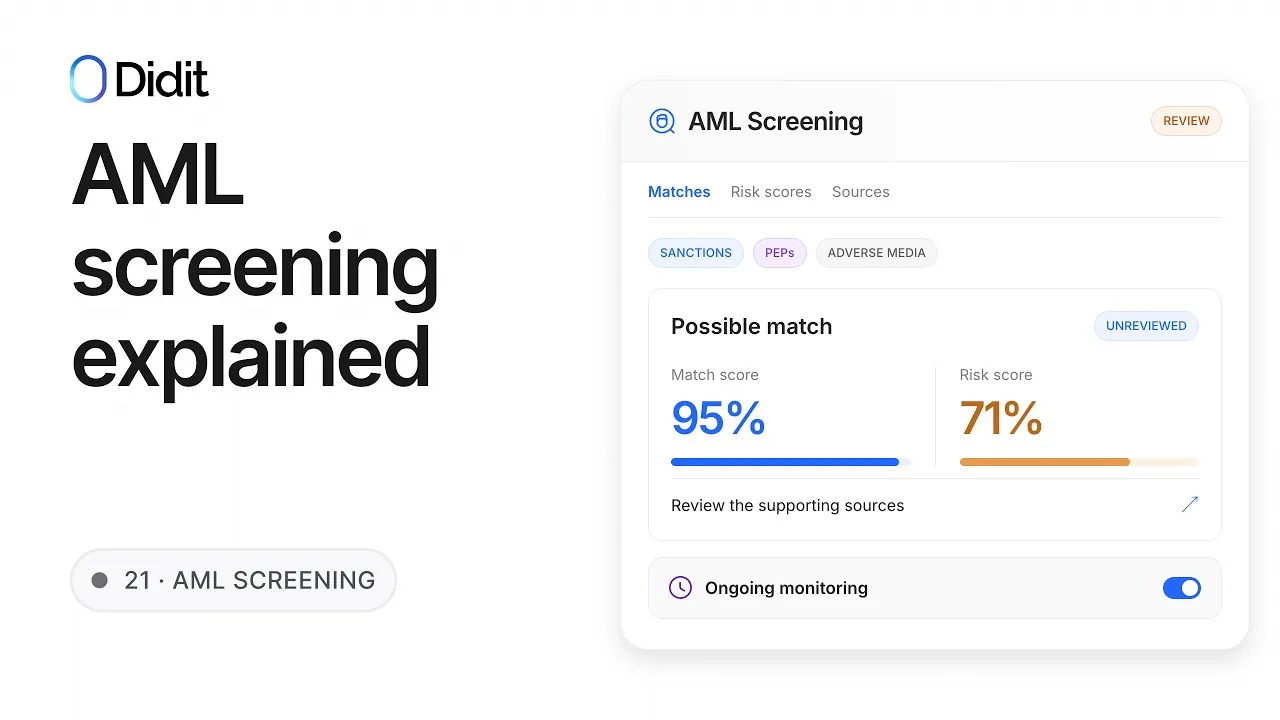
Didit runs adverse media inside AML screening. One call screens a person or a company against sanctions, PEP, warning and watchlist sources and adverse media, then returns every potential match with two scores.
match_scoreanswers whether the hit is the same person. It is built from three weighted parts,aml_name_weight,aml_dob_weightandaml_country_weight, which must sum to exactly 100 (defaults 60, 25 and 15). A matchingdocument_numberacts as a golden key and sets the score to 100.risk_scoreanswers how risky the listed entity is if the match is real.
Hits below aml_match_score_threshold (default 93) are tagged as a false positive and ignored for risk. The highest remaining risk_score becomes the screening score, and the status follows your thresholds: above aml_score_review_threshold (default 100) the result is Declined, above aml_score_approve_threshold (default 80) it goes to In Review, otherwise Approved. You own the thresholds.
Warnings carry stable codes you can route on: POSSIBLE_MATCH_FOUND, MATCH_FOUND, ADVERSE_MEDIA_HIT, SANCTIONED_ENTITY, PEP_MATCH, HIGH_RISK_COUNTRY and ONGOING_MONITORING_ENABLED. That is the difference between a list and a workflow: the codes are the same every time, so your queue, your case tooling and your reporting can key on them.
Adverse media costs latency. A plain screening returns in a few seconds. With include_adverse_media=true the API waits for enrichment, an initial pause of about 5 seconds plus up to about 25 seconds of polling, so set a client timeout of at least 60 seconds. If the media provider is slow, the result comes back without adverse media hits and stays actionable. Show that gap in your review screen instead of failing the whole check.


Scorecard: Didit vs OpenSanctions
Didit publishes this ranking; we explain the criteria so you can check them. We score only what we could verify on the read date, which is why the OpenSanctions column is left unscored: OpenSanctions opensanctions.org, read November 26, 2026, was not verifiable when we read it.
| Criterion | Didit score | Didit reason | OpenSanctions score | OpenSanctions reason |
|---|---|---|---|---|
| Published pricing | 5 | $0.20 per AML check and $0.07 per person a year, on a public price list and a machine-readable JSON feed | Not scored | Not verifiable |
| Coverage | 4 | 1,300+ sanctions, PEP and watchlist sources plus adverse media in one call; we publish the publisher lists per regime | Not scored | Not verifiable |
| Product breadth (KYC, KYB, AML, monitoring) | 5 | KYC at $0.33, KYB from $2.00 plus company and person AML at $0.20 each, ongoing monitoring and transaction monitoring on one credit balance | Not scored | Not verifiable |
| AI/MCP and developer access | 5 | Free MCP server with OAuth sign-in, one REST API, SDKs, a workflow orchestrator and a public OpenAPI contract | Not scored | Not verifiable |
| Time to first live check | 5 | The sandbox is free on every plan and unlimited, then one authenticated POST to the AML endpoint | Not scored | Not verifiable |
| Evidence and certifications | 5 | Every hit carries match_score and risk_score, with review status and warnings available in the result; SOC 2 Type 2 and ISO/IEC 27001:2022 certified (certificate ES144068) | Not scored | Not verifiable |
Verdict by use case
| Use case | Better fit | Why |
|---|---|---|
| Regulated bank, fintech or payment firm needing a documented decision per customer | Didit | $0.20 per check, two scores and warning codes on every hit, and results retrievable for the retention period of your plan |
| Startup that needs a live adverse media check this week | Didit | The sandbox is free on every plan and unlimited, then one API key and one POST |
| One vendor for KYC, KYB, AML and monitoring | Didit | One credit balance covers identity verification at $0.33, business verification from $2.00, AML at $0.20 and monitoring at $0.07 |
| Non-commercial research or journalism on named entities | Open dataset route | OpenSanctions details were not verifiable on November 26, 2026. |
| Data team building its own matching model and thresholds | Open dataset route | You keep raw entities and your own thresholds instead of a vendor's defaults; OpenSanctions details were not verifiable on November 26, 2026 |
| Environment where screening data may not leave your network | Open dataset route | A dataset you hold stays inside your perimeter; OpenSanctions details were not verifiable on November 26, 2026, and Didit's screening runs through the API and session modes the docs describe |
Like-for-like comparison
| Dimension | Didit | OpenSanctions |
|---|---|---|
| What you get | A decision per person or company returned by one call, plus a stored session and a PDF report | Not verifiable |
| Features | Sanctions, PEP, warning and watchlist screening, adverse media, ongoing monitoring and transaction monitoring, with wallet screening available inside Transaction Monitoring | Not verifiable |
| Coverage | 1,300+ lists including UN, EU, OFAC, World Bank and development bank debarment lists, national regimes, regulatory watchlists and insolvency registers | Not verifiable |
| Evidence per hit | match_score, risk_score, warning codes, matched fields, and a review status you can update later | Not verifiable |
| Implementation | One POST to the AML endpoint, or an AML node inside a verification workflow; webhooks with HMAC signing | Not verifiable |
| Price units | $0.20 per check, $0.07 per person a year, KYC $0.33, KYB from $2.00 | Not verifiable |
Matched volume: 1,000, 10,000 and 100,000 checks
Didit prices come from the live feed: $0.20 per AML check at list price, $0.192 with the 4% Growth discount, $0.18 with the 10% Scale discount. The arithmetic is shown under the table.
| Checks | Didit list | Didit Growth (4% off) | Didit Scale (10% off) | OpenSanctions |
|---|---|---|---|---|
| 1,000 | $200.00 | $192.00 | $180.00 | Not verifiable |
| 10,000 | $2,000.00 | $1,920.00 | $1,800.00 | Not verifiable |
| 100,000 | $20,000.00 | $19,200.00 | $18,000.00 | Not verifiable |
- 1,000 x $0.20 = $200.00. 1,000 x $0.192 = $192.00. 1,000 x $0.18 = $180.00.
- 10,000 x $0.20 = $2,000.00. 10,000 x $0.192 = $1,920.00. 10,000 x $0.18 = $1,800.00.
- 100,000 x $0.20 = $20,000.00. 100,000 x $0.192 = $19,200.00. 100,000 x $0.18 = $18,000.00.
Those are check costs only. Self-serve plans add a monthly fee whose included credit pays for checks first: Free is $0 a month with $10 of credit, Growth is $99 a month with $115 of credit, Scale is $299 a month with $350 of credit. At roughly $20,000 a year of screening, an Enterprise contract, from $15,000 a year, is the plan to price instead, because your annual commitment becomes your credit.
Worked cost example: 10,000 customers, KYC plus AML plus monitoring
Take 10,000 new customers in a year. Each one gets a full ID check at $0.33, an AML screening with adverse media at $0.20, and 12 months of ongoing monitoring at $0.07.
- KYC: 10,000 x $0.33 = $3,300.00
- AML with adverse media: 10,000 x $0.20 = $2,000.00
- Ongoing monitoring, one year: 10,000 x $0.07 = $700.00
- Total at list price: $3,300.00 + $2,000.00 + $700.00 = $6,000.00
The same volume on Scale is $0.297 per full ID check and $0.18 per AML check, so $0.297 + $0.18 = $0.477 per customer: 10,000 x $0.477 = $4,770.00, plus monitoring at $0.063 a year, 10,000 x $0.063 = $630.00, for $5,400.00. The comparison with an open dataset is not the licence line. It is the analyst hours spent triaging hits that nobody scored, which do not appear in either number above.
Strengths and limitations
Didit
The strengths are the published price, the two-score model with thresholds you set, 1,300+ sources behind one call, monitoring at $0.07 per person a year, and a developer route that starts in a free sandbox and includes an MCP server. We run 4,000+ companies in production and publish the prices they pay. The limitations are real too. Adverse media adds up to about 30 seconds of latency, so plan a 60 second client timeout. A results set still needs a human for In Review cases. We publish the publishers we screen, not a per-country source count for every list. And screening runs through the API and session modes in the docs, not an install on your own hardware.
OpenSanctions
OpenSanctions details were not verifiable on November 26, 2026, so we cannot assess its matching, review, retention or audit features here (OpenSanctions opensanctions.org, read November 26, 2026). What we can describe is what any open dataset approach asks of you: you hold the data, you control the pipeline, and you carry the record.
When an open dataset may be the better fit
Choose an open route when the deliverable is research, not a decision. A newsroom confirming that a name in a filing matches a person in a court record, a policy team studying sanctions coverage, or a data science group training and evaluating its own matcher all get more value from raw entities than from a per-person verdict. It is also the right route when the screening data must stay inside your network, or when your matching logic is the product and you do not want a vendor's threshold defaults in the middle of it.
OpenSanctions details were not verifiable on November 26, 2026. Read the licence terms on the source before you put anything into production, and if commercial use needs a licence, price that in before you compare totals.
Migration plan: parallel test, webhooks, records
1. Parallel test on your own names
Run 200 to 500 real, already-decided cases through both routes and count three things: how many hits each one returns, how many a human marks as a false positive, and how often the routes disagree on the same person. In Didit this costs nothing: keys from sandbox applications skip screening and billing and return a mocked Approved result with zero hits unless you pass sandbox_scenario. Use the scenario slug to exercise the decline path before you touch live data.
2. Set thresholds before you set traffic
Decide aml_match_score_threshold, aml_score_approve_threshold and aml_score_review_threshold with your compliance owner, and keep the weights at a sum of exactly 100. A request with weights that do not sum to 100 is rejected with HTTP 400, which is the behaviour you want on day one of a migration.
3. Wire the webhooks and verify them
Subscribe to status.updated and verify the X-Signature-V2 header, HMAC-SHA256 over the sorted canonical JSON, with the X-Timestamp inside 300 seconds. Read the raw body before parsing JSON. Return 2xx fast and update state idempotently. If you fall back to X-Signature-Simple, that header authenticates the envelope only, so re-fetch the decision from the session endpoint instead of trusting the payload.
4. Keep the records retrievable
save_api_request defaults to true, so every screening is stored as a session, appears in the console and fires a status webhook. A saved result can be retrieved with GET /v3/session/{sessionId}/decision/ and the generated PDF for as long as your plan's retention period covers it. Retention follows your plan: 1 year on Free, 5 years on Growth, up to 10 years on Scale, custom on Enterprise. Send an Idempotency-Key header on retries so a timeout does not bill a second screening.
5. Turn on monitoring for the population that needs it
include_ongoing_monitoring=true keeps the profile under provider-driven monitoring at $0.07 per person a year, and it requires save_api_request=true, enforced with HTTP 400. Start with your high risk segment, not your whole book. You can disable it from the Business Console.
If you are moving off a vendor rather than a dataset, the same five steps apply and we document the switch at didit.me/switch.
The API call and the fields that matter
The whole integration is one authenticated POST. This is the documented request from the AML screening API reference:
curl -X POST 'https://verification.didit.me/v3/aml/' \
  -H "x-api-key: $DIDIT_API_KEY" \
  -H "Content-Type: application/json" \
  -d '{
    "full_name": "Javier Ejemplo Modelo",
    "entity_type": "person",
    "date_of_birth": "1974-01-01",
    "nationality": "ES",
    "include_adverse_media": true,
    "vendor_data": "user-1234"
  }'
The response carries request_id and an aml object with status, screening_id, hits and warnings. Handle four failure modes explicitly: HTTP 400 for bad weights or monitoring without persistence, HTTP 403 when you are out of credits, Declined when a risk_score crosses the review threshold, and In Review when it lands between approve and review. An adverse media timeout is not a failure: you get the rest of the result and can re-screen if your policy requires media coverage on that record.
Sources
- Didit pricing page and pricing as JSON, read November 26, 2026.
- Didit docs: identity verification pricing, read November 26, 2026.
- Didit docs: AML screening API, read November 26, 2026.
- Didit docs: AML screening overview, read November 26, 2026.
- Didit docs: business AML coverage, read November 26, 2026.
- Didit docs: data models, read November 26, 2026.
- Didit docs: webhooks and HMAC signing, read November 26, 2026.
- Didit docs: AMLR compliance guide, read November 26, 2026.
- Didit MCP server, read November 26, 2026.
- OpenSanctions opensanctions.org, read November 26, 2026. Plain text, no link: details were not verifiable at read time.
- Regulation (EU) 2024/1624 on the prevention of the use of the financial system for the purposes of money laundering or terrorist financing.
- Financial Action Task Force, for the international standards behind customer due diligence and ongoing monitoring.
To compare the two routes on your own data, run your last 200 decided cases through the free sandbox and compare hit counts and false positives. Create a free account at business.didit.me, no sales call required, and connect the MCP server at didit.me/developers/mcp if you want the checks available from your AI assistant.
Try it
Try this in the sandbox
Run the check this guide describes, free.
The product this post is about, taken from its topic. Run it free in the sandbox.
Author
Alberto Rosas
Co-founder and CEO

Keep reading
Other guides in the same topic.
 What Is the Purpose of FICA in South Africa? 2026 Guide
FICA is South Africa's anti-money laundering law. It creates the Financial Intelligence Centre and requires accountable institutions to identify and verify clients, screen for PEP and sanctions risk and report suspicious.
Alberto RosasNov 26, 2026 Sixth Money Laundering Directive (6AMLD): What Changed and Which Rules Apply
6AMLD is Directive (EU) 2018/1673: Member States must criminalise laundering, widen predicate offences and set a four-year penalty floor. It adds no new due diligence duties for firms.
Alberto RosasNov 26, 2026 Automated Sanctions Screening: Canada, the Entity List and Embargoes
Automated sanctions screening matches people and companies against lists such as Canada's autonomous sanctions made under SEMA and JVCFOA and the OFAC SDN List, and returns candidate hits scored for identity confidence and.
Alberto RosasNov 26, 2026Questions
Frequently asked questions
How much does adverse media screening cost with Didit?
Didit charges $0.20 per AML screening, and adverse media is included in that call with include_adverse_media=true. Ongoing monitoring after the first check costs $0.07 per person a year. Growth and Scale plans reduce both prices by 4% and 10%, to $0.192 and $0.18 per check.
Is there a free way to run an adverse media check?
The sandbox is free on every plan and unlimited. Sandbox keys skip screening and billing and return a mocked result unless you pass sandbox_scenario, so you can test the full flow at zero cost. Live checks are paid from prepaid credit, and the Free plan gives eligible organizations $10 of credit a month.
What is the adverse media screening API endpoint?
It is a single POST to https://verification.didit.me/v3/aml/ with an x-api-key header and a JSON body containing at least full_name. Send include_adverse_media=true to add adverse media to the sanctions, PEP and watchlist screening in the same call. You can also run AML as a step inside a verification session when you want the decision bound to a workflow.
Can I run an adverse media check from C#?
Yes, because the AML check is a plain HTTPS POST with a JSON body and an x-api-key header, so any HTTP client works, including HttpClient in C#. There is no C# specific snippet in our docs, so follow the documented endpoint and headers rather than a wrapper. Our SDKs and the standalone API reference are listed at docs.didit.me.
What is the difference between match score and risk score?
match_score answers whether the hit is the same person and is built from weighted name, date of birth and country parts, with a document number acting as a golden key. risk_score answers how risky the listed entity is if the match is real. Hits below the match threshold, 93 by default, are tagged as false positives and excluded from the risk calculation.
Which adverse media databases does Didit screen against?
Didit screens 1,300+ sanctions, PEP and watchlist sources plus adverse media. Published coverage includes the UN Security Council consolidated list, EU consolidated sanctions, OFAC, World Bank and development bank debarment lists, national regimes such as Swiss SECO and Australian DFAT, regulatory watchlists and insolvency registers. For companies, entity level and person level matches are returned side by side in KYB.
How long does an adverse media check take?
A screening without adverse media returns in a few seconds. With include_adverse_media=true the API waits for enrichment, an initial pause of about 5 seconds plus up to about 25 seconds of polling, so configure a client timeout of at least 60 seconds. If the media provider is slow, the result returns without adverse media hits and stays actionable.
How does ongoing monitoring work after the first screening?
Set include_ongoing_monitoring=true and the profile stays under provider-driven monitoring, with updates reaching the report. It costs $0.07 per person a year, requires save_api_request=true, and can be disabled later from the Business Console. The ONGOING_MONITORING_ENABLED warning tells you a profile is enrolled.
Can I retrieve an adverse media result from a previous year?
Yes, if the screening was saved. save_api_request defaults to true, so each screening is stored as a session and can be fetched with GET /v3/session/{sessionId}/decision/ or exported as a PDF. How far back you can go follows your plan's data retention: 1 year on Free, 5 years on Growth, up to 10 years on Scale, custom on Enterprise.
Does an open-source adverse media check meet AML requirements?
The AMLR guide maps regulatory requirements to Didit workflows, endpoints, and webhooks. Confirm your obligations for your jurisdiction and business with qualified counsel. What matters in a review is coverage, documented thresholds and retrievable evidence per decision. An open dataset can support that if you build and document the matching and the record yourself.
Is OpenSanctions free for commercial use?
OpenSanctions details were not verifiable on November 26, 2026 (OpenSanctions opensanctions.org, read November 26, 2026), so we cannot state its licence terms or pricing here. A dataset's licence governs redistribution and commercial use, and that line item belongs in your total cost. Check the terms on the source before you put anything into production.
Compliance built in
Audited, certified and attested.
We hold the certifications and build each country's rules into your flows, so you can launch anywhere without worrying. Security and Compliance center
- Regulation encoded into your flows
Tell us what you do and where. Didit lists the rules that apply to you, with sources, and builds the checks each country needs into one workflow.
- Ready for AMLR
Every requirement of the new EU anti-money laundering rules, from checking customers to human review, is already covered by a Didit check.
- Tested in Spain's Treasury sandbox
Spain's Treasury published its supervised sandbox report on Didit's NFC plus active liveness onboarding; SEPBLAC took part and valued the added measures positively.
- Audited, not self-declared
iBeta Level 1 and Level 2. Liveness tested under ISO/IEC 30107-3.
Your obligations · 3 regions
 SOC 2 Type 2
 ISO 27001
 iBeta Level 1 and Level 2
 EU regulator attestation
 FSM youth protection
 GDPR
 EBA remote onboarding
 MiCA compatible
 FIDO Alliance member
- AMLREU AML Regulation ready
Integration · Didit MCP
Run Didit from your own AI agent
Connect Didit to Claude, Cursor, VS Code or ChatGPT and just ask in plain words. Your agent can do anything you can do in the console, with the same permissions you have.
 Add to Claude
 ChatGPT
 Cursor
- Build workflowsDescribe the checks you need. The agent creates and publishes the flow.
- Run investigationsAsk why a session was declined, review cases, search people and companies.
- Change rulesCreate payment rules, test them on past data and switch them on.
- Pull reportsAsk for numbers, exports or the audit log.
Didit Academy


