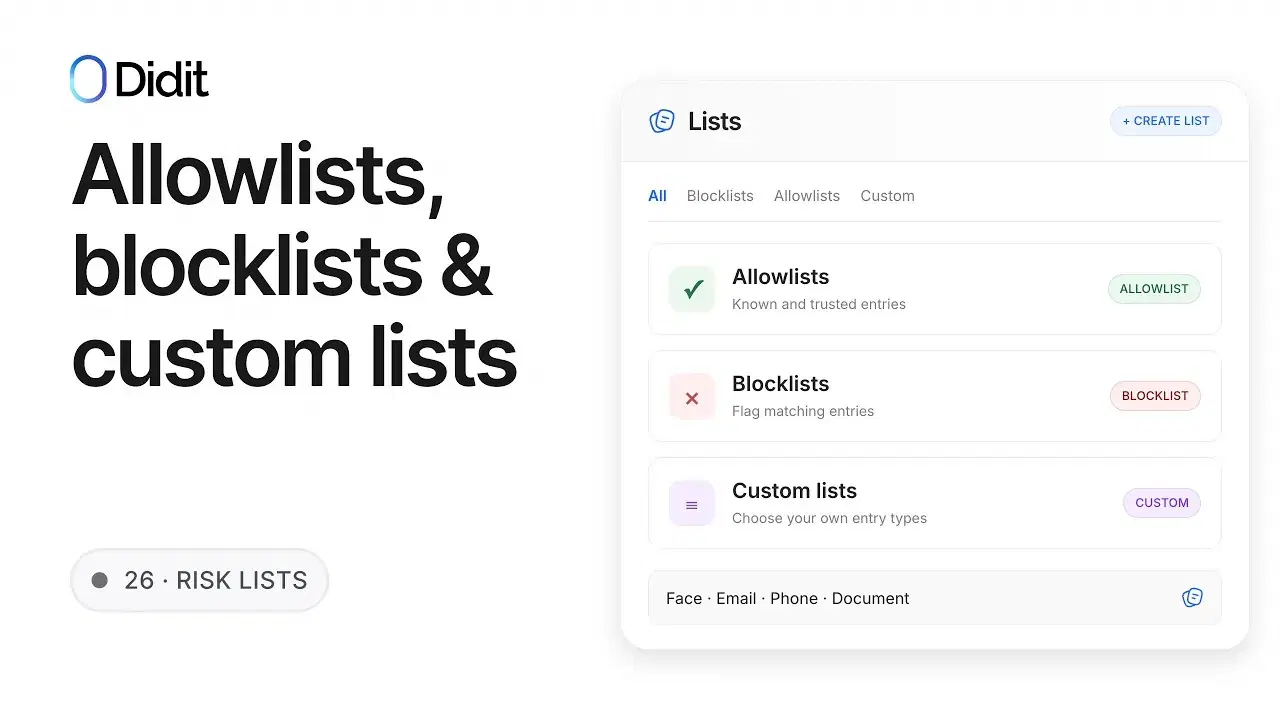
Optimizing Developer Experience for Custom Blocklists with APIs
Building robust fraud prevention requires dynamic blocklisting. This post explores how well-designed APIs empower developers to create and manage custom blocklists efficiently, focusing on ease of integration, flexibility, and.
 Alejandro RosasCo-founder and CTO

Contents
In this guide
Jump to the part you need.
API-First Design is CrucialA developer-friendly API is fundamental for efficient blocklist management, enabling quick integration and automation without complex manual intervention.
Customization and Granularity MatterEffective blocklisting requires the ability to block various data points (face, document, phone, email) and tailor rules to specific fraud vectors and business needs.
Real-time Updates and AutomationThe ability to programmatically add to and manage blocklists in real-time is essential for responding swiftly to emerging threats and automating fraud prevention workflows.
Didit Simplifies Blocklist IntegrationDidit's Management API provides a robust, developer-first solution for building and managing custom blocklists, integrating seamlessly into existing systems with modular and flexible controls.
In today's digital landscape, identity verification is a critical component of trust and security. However, it's not enough to simply verify an identity once; businesses must also have robust mechanisms to prevent repeat offenders and known fraudsters from re-engaging with their platforms. This is where custom blocklists become indispensable. For developers, the experience of building and maintaining these blocklists can significantly impact a system's agility and effectiveness. Optimizing the developer experience (DX) for custom blocklists, particularly through well-designed APIs, is paramount.
The Imperative of Custom Blocklists in Fraud Prevention
Fraudsters are constantly evolving their tactics, making static defense mechanisms quickly obsolete. Custom blocklists allow businesses to maintain a dynamic record of individuals, documents, or data points that have been associated with fraudulent activity. This proactive approach helps in preventing account takeovers, synthetic identity fraud, bonus abuse, and other malicious behaviors. For instance, if a user attempts to create multiple accounts using different email addresses but the same facial biometric or document, a custom blocklist can flag and prevent this.
The need for custom blocklists extends beyond just preventing fraud. They are also crucial for maintaining compliance with regulations, enforcing terms of service, and ensuring a secure environment for legitimate users. Without the ability to quickly and programmatically add to these lists, companies risk being reactive rather than proactive in their security posture.
Key Elements of a Developer-Friendly Blocklist API
A superior developer experience for blocklist management hinges on several core API design principles:
- Simplicity and Intuitive Endpoints: APIs should be easy to understand and use, with clear documentation and predictable behavior. Developers should be able to quickly grasp how to add, retrieve, and manage blocklist entries without a steep learning curve. Didit's Management API exemplifies this with straightforward endpoints like
POST /v3/blocklist/add/, designed for immediate utility. - Granular Control: Fraud is multifaceted, and blocklists need to be equally granular. The API should allow for blocking specific elements such as faces, documents, phone numbers, and email addresses, rather than just an entire user profile. This specificity ensures that legitimate users aren't inadvertently blocked due to a single compromised data point, while still catching sophisticated fraudsters.
- Real-time Updates: In fraud prevention, speed is of the essence. The API must support real-time additions and updates to the blocklist. This means that once a fraudulent activity is detected, the associated identifiers can be added to the blocklist instantly, preventing further malicious actions.
- Idempotency and Error Handling: Robust APIs handle duplicate requests gracefully and provide clear, actionable error messages. This reduces frustration for developers and helps in building resilient applications.
- Flexibility and Extensibility: As fraud patterns change, the API should allow for easy expansion of blocklist types or the addition of metadata to blocklist entries, without requiring significant re-architecture.
Consider the scenario where a deepfake attack is detected during a liveness check. A developer needs to immediately block the detected face biometric from future verification attempts. A well-designed API allows this to happen with a single, clear API call, integrating seamlessly into the existing fraud detection workflow.
Building Custom Blocklists with Didit's API
Didit, with its AI-native and developer-first approach, excels in providing the tools necessary for building and managing sophisticated custom blocklists. The Didit Management API (v3) offers dedicated endpoints for blocklist operations, making it incredibly straightforward for developers to integrate fraud prevention directly into their applications.
The POST /v3/blocklist/add/ endpoint is a prime example of Didit's commitment to developer experience. It allows for adding various item types to the blocklist in a single request, based on a session ID. This means if a session reveals a fraudulent document and a suspicious phone number, both can be blocklisted simultaneously. Developers can specify whether to blocklist the face, document, phone, or email associated with a given session ID, providing granular control over what is blocked.
For example, to blocklist a face and a document from a specific session, a developer would simply make a request like this (as demonstrated in Didit's documentation):
curl -X POST https://apx.didit.me/v3/blocklist/add/ \
  -H "x-api-key: YOUR_API_KEY" \
  -H "Content-Type: application/json" \
  -d '{
    "session_id": "5b3720ed-d429-42ef-b67f-37ea805f48ee",
    "blocklist_face": true,
    "blocklist_document": true
  }'
This level of simplicity and directness dramatically reduces the time and effort required to implement robust fraud prevention measures. Didit's modular architecture means these blocklist capabilities can be plugged into any verification workflow, whether it involves ID Verification, Passive & Active Liveness, or 1:1 Face Match, ensuring comprehensive protection.
The Impact on Developer Productivity and System Reliability
Optimizing the developer experience for custom blocklists has a direct and positive impact on overall system reliability and developer productivity:
- Reduced Development Time: Clear APIs and comprehensive documentation mean developers spend less time deciphering how to integrate and more time building features.
- Fewer Errors: Intuitive API design reduces the likelihood of implementation errors, leading to more reliable fraud prevention systems.
- Faster Response to Threats: The ability to quickly update blocklists via API allows businesses to respond to new fraud vectors almost in real-time, minimizing potential losses.
- Improved Scalability: Programmatic blocklist management scales far better than manual processes, accommodating growth without increased overhead.
- Empowered Developers: When developers have powerful, easy-to-use tools, they are more effective and can contribute more innovative solutions to fraud prevention challenges.
Furthermore, Didit's commitment to a developer-first approach includes an instant sandbox and public documentation, allowing teams to experiment and integrate blocklist functionalities rapidly without any setup fees.
How Didit Helps
Didit provides an AI-native, developer-first identity platform that makes building and managing custom blocklists effortless. Our modular architecture allows businesses to compose verification workflows and orchestrate risk with precision. With Didit's Management API, developers gain direct control over blocklist entries, enabling them to block faces, documents, phone numbers, and email addresses with simple API calls based on session IDs. This granular control is vital for effective fraud prevention and maintaining a clean user base.
Didit's advantages include Core KYC, ensuring that essential identity verification and blocklist capabilities are accessible from the start. Our AI-native approach means that fraud detection and prevention, including blocklist updates, are intelligent and adaptive. The absence of setup fees further lowers the barrier to entry, allowing businesses to rapidly deploy sophisticated fraud prevention strategies. Whether it's enhancing ID Verification, strengthening Passive & Active Liveness checks, or leveraging 1:1 Face Match, Didit’s API-driven blocklist functionality provides the robust foundation needed for modern fraud defense.
Ready to Get Started?
Ready to see Didit in action? Get a free demo today.
Start verifying identities for free with Didit's free tier.
Try it
Try this in the sandbox
Run the check this guide describes, free.
The product this post is about, taken from its topic. Run it free in the sandbox.
Author
Alejandro Rosas
Co-founder and CTO

Keep reading
Other guides in the same topic.
 What Is the Purpose of FICA in South Africa? 2026 Guide
FICA is South Africa's anti-money laundering law. It creates the Financial Intelligence Centre and requires accountable institutions to identify and verify clients, screen for PEP and sanctions risk and report suspicious.
Alberto RosasNov 26, 2026 Sixth Money Laundering Directive (6AMLD): What Changed and Which Rules Apply
6AMLD is Directive (EU) 2018/1673: Member States must criminalise laundering, widen predicate offences and set a four-year penalty floor. It adds no new due diligence duties for firms.
Alberto RosasNov 26, 2026 Automated Sanctions Screening: Canada, the Entity List and Embargoes
Automated sanctions screening matches people and companies against lists such as Canada's autonomous sanctions made under SEMA and JVCFOA and the OFAC SDN List, and returns candidate hits scored for identity confidence and.
Alberto RosasNov 26, 2026Questions
Blog questions
Who writes the Didit blog?
Which topics does the blog cover?
Is the blog available in my language?
Where do I find product updates?
Are these posts legal advice?
How do I find posts on one topic?
Are posts dated?
Do posts link to the docs?
Is the blog the same as the docs?
Compliance built in
Audited, certified and attested.
We hold the certifications and build each country's rules into your flows, so you can launch anywhere without worrying. Security and Compliance center
- Regulation encoded into your flows
Tell us what you do and where. Didit lists the rules that apply to you, with sources, and builds the checks each country needs into one workflow.
- Ready for AMLR
Every requirement of the new EU anti-money laundering rules, from checking customers to human review, is already covered by a Didit check.
- Tested in Spain's Treasury sandbox
Spain's Treasury published its supervised sandbox report on Didit's NFC plus active liveness onboarding; SEPBLAC took part and valued the added measures positively.
- Audited, not self-declared
iBeta Level 1 and Level 2. Liveness tested under ISO/IEC 30107-3.
Your obligations · 3 regions
 SOC 2 Type 2
 ISO 27001
 iBeta Level 1 and Level 2
 EU regulator attestation
 FSM youth protection
 GDPR
 EBA remote onboarding
 MiCA compatible
 FIDO Alliance member
- AMLREU AML Regulation ready
Integration · Didit MCP
Run Didit from your own AI agent
Connect Didit to Claude, Cursor, VS Code or ChatGPT and just ask in plain words. Your agent can do anything you can do in the console, with the same permissions you have.
 Add to Claude
 ChatGPT
 Cursor
- Build workflowsDescribe the checks you need. The agent creates and publishes the flow.
- Run investigationsAsk why a session was declined, review cases, search people and companies.
- Change rulesCreate payment rules, test them on past data and switch them on.
- Pull reportsAsk for numbers, exports or the audit log.
Didit Academy