Boost Savings: Optimizing Identity Verification Costs with FinOps
In an era of rising digital fraud and stringent compliance, optimizing identity verification (IDV) costs is crucial for businesses. This post explores how FinOps principles can transform IDV spend, driving efficiency without.
 Alberto RosasCo-founder and CEO
Contents
In this guide
Jump to the part you need.
Strategic Cost Control: FinOps applies financial management principles to cloud and operational spending, extending effectively to identity verification (IDV) to ensure every dollar spent on security delivers maximum value.
Transparent Pricing Models: Understanding and leveraging 'pay-per-success' and tiered pricing structures, like Didit's, is fundamental to reducing wasteful spending on incomplete or abandoned verification attempts.
Workflow Optimization: Using modular IDV solutions and visual workflow builders allows businesses to tailor verification processes, eliminating unnecessary steps and dynamically adjusting to risk levels, significantly cutting costs.
Automated Monitoring & Alerts: Implementing continuous monitoring for both financial outlay and fraud signals helps identify cost inefficiencies and potential security breaches early, preventing larger financial losses.
The Rising Cost of Digital Trust: Why FinOps for IDV Matters
In today's digital-first economy, establishing trust online is paramount. However, the technologies that facilitate this trust – identity verification (IDV) and fraud prevention – often come with significant costs. As businesses scale, so does their spend on these critical services, making cost optimization a strategic imperative. Enter FinOps: a cultural practice that brings financial accountability to the variable spend model of cloud and operational services. While traditionally applied to cloud infrastructure, its principles are perfectly suited for managing identity verification costs, ensuring every dollar spent contributes to business goals without compromising security or user experience.
The challenge is multifaceted. Companies face increasing regulatory pressure, the sophistication of fraud attempts is growing exponentially with AI, and user expectations for seamless onboarding are higher than ever. Juggling these demands while keeping costs in check requires a disciplined, data-driven approach. FinOps provides the framework to achieve this, transforming IDV from a necessary expenditure into a strategically managed investment.
Understanding Your IDV Spend: The FinOps Foundation
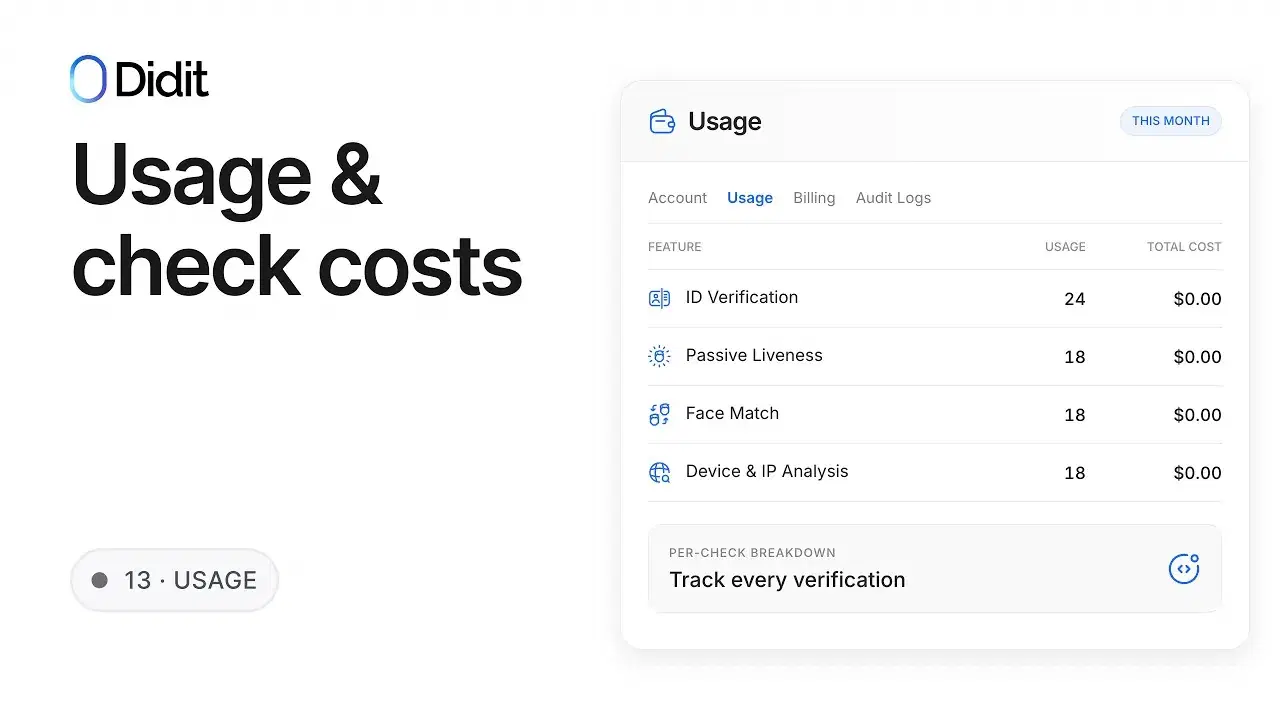
The first step in any FinOps journey is visibility. Many organizations struggle to accurately track and attribute their IDV spending. This often stems from fragmented vendor solutions, opaque pricing models, and a lack of clear ownership over IDV budgets. Didit, for instance, offers a transparent 'pay-per-success' model for many of its modules, which is a game-changer for FinOps. Unlike traditional vendors that charge for every attempt, failed or successful, Didit's approach means you only pay when a verification step is completed, inherently reducing wasted spend.
Practical Example: Imagine a scenario where 20% of your users abandon the ID verification process halfway through. With a traditional vendor charging per attempt, you're paying for 20% of sessions that yield no successful verification. With Didit's 'pay-per-success' model, those abandoned sessions incur no cost. Over thousands of verifications, this translates into substantial savings. Leveraging detailed analytics available through platforms like the Didit Console (business.didit.me) allows businesses to pinpoint exactly where their IDV budget is going, identify abandonment rates, and understand conversion funnels. This data is crucial for informed decision-making and optimization.
Optimizing IDV Workflows for Efficiency and Cost Savings
One of the most powerful aspects of applying FinOps to IDV is the ability to optimize verification workflows. Many businesses over-verify, applying the same rigorous (and expensive) checks to all users, regardless of their risk profile or the service they are accessing. Modular IDV platforms, like Didit, with their visual workflow builders, empower businesses to create dynamic, risk-based verification flows.
Practical Example: Consider a financial institution. For a low-risk action like opening a basic savings account, a simple face scan with passive liveness detection might suffice. For a high-risk activity like applying for a loan, the workflow could escalate to include ID document verification, NFC chip reading, AML screening, and proof of address. Didit's Workflow Builder allows you to drag and drop modules, set conditional logic (e.g., if age estimation is uncertain, escalate to full ID verification), and configure thresholds for auto-approval or manual review. This means you only pay for the necessary checks, avoiding costly overkill. Furthermore, A/B testing different workflows can reveal optimal paths that balance security, user experience, and cost efficiency, directly impacting your ROI.
Didit's pricing model directly supports this granular optimization:
- Core KYC (ID + Liveness + Face Match): $0.33/verification.
- KYC + AML: $0.50/verification.
By only triggering the AML module when necessary, significant savings can be realized compared to a blanket approach. Continuous AML monitoring at $0.07/user/year is also a cost-effective way to manage ongoing risk without repetitive, expensive checks.
Leveraging Automation and Analytics for Continuous Improvement
FinOps is not a one-time project; it's an ongoing practice. Continuous monitoring and automation are key to sustaining cost efficiency in IDV. Didit's platform provides real-time analytics on conversion rates, geographic distribution, device data, and verification times. This data is invaluable for identifying bottlenecks and areas for improvement.
Practical Example: If analytics show a high drop-off rate for users from a specific country during the ID document upload stage, it might indicate an issue with supported document types or instructions for that region. Optimizing the flow or providing better guidance can improve conversion, reducing the number of abandoned sessions (which are free with Didit, but still represent a lost customer opportunity) and increasing the success rate of paid verifications. Furthermore, features like Face Search 1:N (always free) can help prevent duplicate accounts, which can be costly to manage and often indicative of fraudulent activity. IP Analysis ($0.03/check) provides silent background risk assessment, allowing for early flagging of suspicious activity without adding friction or cost to every user.
Automated alerts for high-risk flags or unusual spending patterns can also help teams react quickly, preventing potentially larger financial losses from fraud or budget overruns. The Didit Business Console's audit logs and manual review queue with session chats further streamline operational efficiency, reducing the time and cost associated with human intervention.
How Didit Helps Optimize IDV Costs with FinOps
Didit is explicitly designed with FinOps principles in mind, offering a full-stack identity verification platform that enables businesses to achieve significant cost savings without compromising security or user experience. Here's how:
- Pay-Per-Success Pricing: Our transparent pricing model means you only pay for successfully completed verification steps, eliminating wasted spend on abandoned or failed attempts.
- Modular Architecture: With 18 composable modules, you can build highly customized, risk-based workflows, ensuring you only pay for the necessary checks.
- Workflow Orchestration: The visual Workflow Builder allows for dynamic routing, conditional logic, and A/B testing, enabling continuous optimization of conversion rates and cost efficiency.
- Our ROI calculator (didit.me/roi-calculator) demonstrates potential savings.
- Comprehensive Analytics: The Didit Console provides deep insights into verification performance, helping identify cost inefficiencies and areas for improvement.
- Reusable KYC: Allows users to verify once and reuse their identity across multiple platforms, reducing repetitive verification costs for both businesses and users.
- No Annual Commits or Minimums: Our flexible pricing structure aligns perfectly with FinOps' focus on variable spend management, allowing you to scale up or down as needed without penalty.
Ready to Get Started?
Embracing FinOps for identity verification is no longer a luxury but a necessity for forward-thinking businesses. By adopting a disciplined, data-driven approach to managing your IDV spend, you can achieve significant cost efficiencies, enhance security, and deliver a superior user experience. Explore how Didit's innovative platform can empower your organization to optimize identity verification costs and drive greater ROI.
Discover more about Didit's FinOps-friendly solutions:
Try it
Try this in the sandbox
Run the check this guide describes, free.
The product this post is about, taken from its topic. Run it free in the sandbox.
Author
Alberto Rosas
Co-founder and CEO

Keep reading
Other guides in the same topic.
 What Is the Purpose of FICA in South Africa? 2026 Guide
FICA is South Africa's anti-money laundering law. It creates the Financial Intelligence Centre and requires accountable institutions to identify and verify clients, screen for PEP and sanctions risk and report suspicious.
Alberto RosasNov 26, 2026 Sixth Money Laundering Directive (6AMLD): What Changed and Which Rules Apply
6AMLD is Directive (EU) 2018/1673: Member States must criminalise laundering, widen predicate offences and set a four-year penalty floor. It adds no new due diligence duties for firms.
Alberto RosasNov 26, 2026 Automated Sanctions Screening: Canada, the Entity List and Embargoes
Automated sanctions screening matches people and companies against lists such as Canada's autonomous sanctions made under SEMA and JVCFOA and the OFAC SDN List, and returns candidate hits scored for identity confidence and.
Alberto RosasNov 26, 2026Questions
Blog questions
Who writes the Didit blog?
Which topics does the blog cover?
Is the blog available in my language?
Where do I find product updates?
Are these posts legal advice?
How do I find posts on one topic?
Are posts dated?
Do posts link to the docs?
Is the blog the same as the docs?
Compliance built in
Audited, certified and attested.
We hold the certifications and build each country's rules into your flows, so you can launch anywhere without worrying. Security and Compliance center
- Regulation encoded into your flows
Tell us what you do and where. Didit lists the rules that apply to you, with sources, and builds the checks each country needs into one workflow.
- Ready for AMLR
Every requirement of the new EU anti-money laundering rules, from checking customers to human review, is already covered by a Didit check.
- Tested in Spain's Treasury sandbox
Spain's Treasury published its supervised sandbox report on Didit's NFC plus active liveness onboarding; SEPBLAC took part and valued the added measures positively.
- Audited, not self-declared
iBeta Level 1 and Level 2. Liveness tested under ISO/IEC 30107-3.
Your obligations · 3 regions
 SOC 2 Type 2
 ISO 27001
 iBeta Level 1 and Level 2
 EU regulator attestation
 FSM youth protection
 GDPR
 EBA remote onboarding
 MiCA compatible
 FIDO Alliance member
- AMLREU AML Regulation ready
Integration · Didit MCP
Run Didit from your own AI agent
Connect Didit to Claude, Cursor, VS Code or ChatGPT and just ask in plain words. Your agent can do anything you can do in the console, with the same permissions you have.
 Add to Claude
 ChatGPT
 Cursor
- Build workflowsDescribe the checks you need. The agent creates and publishes the flow.
- Run investigationsAsk why a session was declined, review cases, search people and companies.
- Change rulesCreate payment rules, test them on past data and switch them on.
- Pull reportsAsk for numbers, exports or the audit log.
Didit Academy